
The Interrupted Journey
Two Lost Hours Aboard a UFO
Core Thesis
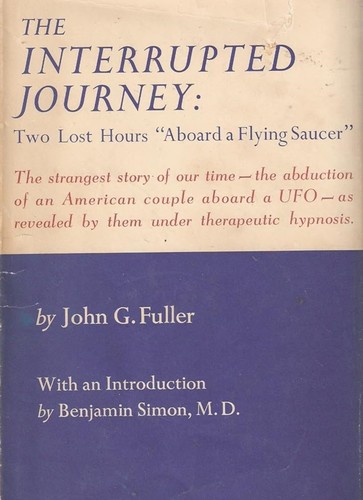
The Interrupted Journey: Two Lost Hours Aboard a UFO is the book that turned a single, obscure New Hampshire missing-time report into the founding document of an entire literary genre. Journalist John G. Fuller spent roughly a year and a half with the case files, correspondence, and — most consequentially — the verbatim hypnosis transcripts of Boston psychiatrist Dr. Benjamin Simon, who had spent 1964 treating Betty and Barney Hill for the anxiety and unexplained memory gap left by their September 19–20, 1961 encounter on a lonely stretch of Route 3 through New Hampshire's White Mountains. Fuller's core argument was not, strictly, that the Hills had been abducted by extraterrestrials; it was that their account, recovered independently under hypnosis by two people questioned separately and compared only afterward, was detailed, internally consistent, and psychologically genuine enough that it deserved to be taken seriously as documentary evidence rather than dismissed as a curiosity. That argument — and the reproducible hypnosis-driven method Fuller documented in doing it — did not just popularize one case. It handed the entire abduction-research field, for better and for considerably worse, the investigative template it would still be running on two decades later.
About the Author
John Grant Fuller Jr. was born November 30, 1913, in Philadelphia, Pennsylvania, and died November 7, 1990, in Norwalk, Connecticut, of lung cancer, at age 76. For many years he wrote "Trade Winds," a regular column for Saturday Review magazine, and built a career as a working investigative journalist and author with no formal scientific or clinical training — a credential gap this site's own key-figures entry on him states plainly rather than smoothing over. Before he ever wrote about UFOs, Fuller had already established himself across several unrelated fields of serious nonfiction: his 1962 book The Gentleman Conspirators examined a price-fixing scandal in the American electrical industry, and he wrote two Broadway plays, The Pink Elephant (1953) and Love Me Little (1958).
Fuller's entry into UFO research came almost by accident, and it came skeptical. In the fall of 1965 he traveled to Exeter, New Hampshire to investigate a wave of local sightings, arriving doubtful of the subject and growing steadily less so across roughly sixty witness interviews, including two police officers who had independently watched the same object. The resulting book, Incident at Exeter (1966), became a New York Times bestseller and ran through at least six printings within months. It was this book, published the same year as The Interrupted Journey, that gave Fuller the standing and the direct professional relationships — including his subsequent access to Dr. Benjamin Simon's confidential hypnosis-session tapes — that made the Hill book possible at all.
Fuller's later career shows a writer who kept returning to the same basic method — embedding with primary sources over months or years and building a case from original documents and taped interviews — across an unusually wide range of subjects that had nothing to do with UFOs. We Almost Lost Detroit (1975) documented a serious partial meltdown at the Fermi 1 nuclear plant near Detroit years before Three Mile Island made reactor safety a mainstream concern; The Poison That Fell from the Sky (1977) covered the 1976 Seveso, Italy dioxin disaster; and The Ghost of Flight 401 (1976), his best-selling book after the Hill case, investigated reported hauntings connected to a 1972 Eastern Air Lines crash and was adapted into a 1978 television movie. He also wrote Aliens in the Skies (1969), a follow-up analysis of Congress's 1966 and 1968 UFO hearings, and The Great Soul Trial (1969), about the contested will of an Arizona miner who left his fortune to anyone who could scientifically prove the existence of the human soul. This range is the specific fact this site's Historical Context section returns to: Fuller was never a UFO specialist who happened to write one abduction book. He was a generalist investigative reporter for whom the Hill case was one serious story among many, which is a large part of why his account carried the mainstream credibility it did in 1966.
Fuller's wife, Elizabeth, a former Northwest Airlines flight attendant, worked as a researcher on several of his later books, including The Ghost of Flight 401. The couple had four children. Fuller remained a working journalist and author until his death in 1990, having spent a quarter-century as one of the most consistently cited names in popular American UFO literature despite writing only two books directly on the subject.
Historical Context & Origins
When Betty and Barney Hill's sighting occurred on the night of September 19–20, 1961, American ufology's evidentiary center of gravity was still almost entirely visual: distant lights, disc-shaped objects on radar, photographs of varying quality. The Hills reported something categorically different — a close, low-altitude encounter followed by roughly two hours of unaccounted-for driving time — but for nearly four years their story remained a regional curiosity known mainly to Walter Webb and other NICAP investigators who had interviewed them within weeks of the event. Barney gave one low-key talk to a Unitarian congregation in 1963 that a reporter happened to attend, but it was not until the Boston Traveler ran a front-page series on the case in October 1965 — timed, as it happened, almost exactly alongside the wave of sightings Fuller was separately investigating in Exeter that same fall — that the Hill story reached a mass audience for the first time.
Fuller began working on the book shortly after that publicity broke, securing the Hills' cooperation and, critically, Dr. Benjamin Simon's agreement to share the transcripts of the hypnosis sessions he had conducted with the couple beginning in February 1964. Those sessions had originally been undertaken for a narrowly clinical reason: Barney was suffering from ulcers and severe anxiety, and both Hills wanted psychiatric help resolving what Barney himself dismissively called "the 'nonsense' about her dreams" — the vivid, recurring dreams Betty had experienced in the days after the sighting, of a roadblock, a walk through the woods, and a medical examination by small beings in blue uniforms. Hypnosis was never intended as a UFO-investigation tool when Simon began using it; Fuller's book is what turned a private course of psychiatric treatment into a publicly circulated method other UFO researchers would spend the following decades trying to replicate.
The Interrupted Journey also arrived at a specific moment in the credibility of hypnotic regression itself. In 1966, hypnosis carried real, if contested, scientific respectability as a memory-recovery technique, and Simon was a nationally recognized psychiatrist and neurologist rather than a UFO investigator moonlighting as a clinician — a distinction contemporary reviewers and, later, this site's own case file on the Hills both treat as central to why the book was taken seriously rather than dismissed outright. That credibility would not last: the same hypnotic-regression method Fuller documented here would face a sustained, much harsher scientific reckoning roughly two decades later, once Budd Hopkins and other researchers had built entire investigative careers on it, a reckoning this site's own Missing Time entry covers in detail. In 1966, none of that critique yet existed in organized form; Fuller's book landed into a climate where hypnotic recall was still widely presumed reliable, and it is largely responsible for how long that presumption survived within ufology specifically.
Core Arguments & Key Concepts
Fuller's central structural choice was to publish the hypnosis sessions almost as primary source material rather than as summarized narrative: long stretches of the book reproduce Dr. Simon's questions and the Hills' answers essentially verbatim, transcript-style, including Barney's fixation under hypnosis on the beings' eyes ("Oh, those eyes. They're there in my brain") and both Hills' halting, effortful recall of being led aboard a craft and separated for examination. This documentary presentation — showing the raw material rather than only Fuller's conclusions about it — was itself an argument: it invited readers to judge the sessions' consistency for themselves, and it became the format nearly every subsequent hypnosis-based abduction book, on this site and off it, would imitate.
The book's evidentiary core is the claim of independent corroboration under controlled separation. Betty and Barney were hypnotized separately, questioned without being told what the other had said, and their accounts — while not identical — converged on the same basic sequence and several specific, unusual details: a needle-like instrument inserted into Betty's navel during the examination (a procedure her own gynecologist later told her resembled amniocentesis, a technique not in clinical use in 1961) and a cup-like device Barney separately described being applied to his groin. Fuller presents this convergence, achieved without either spouse coaching the other, as the single strongest piece of evidence in the entire case, and it remains the detail most frequently cited by researchers arguing for the account's genuineness.
A second, quieter argument runs through the book's structure: that the Hills had every reason not to fabricate this story and real reasons to fear coming forward with it. Fuller devotes considerable space to Betty and Barney's standing as serious, unglamorous people — Barney a U.S. Post Office employee and NAACP board member, Betty a Maine State welfare department social worker — and to their interracial marriage, legally recognized nationally only since 1961 and still rare and socially risky in New Hampshire at the time. Fuller frames their reluctant, initially resisted decision to go public as evidence against the kind of publicity-seeking motive skeptics would otherwise expect to find.
Fuller does not, however, present the book as a closed case for extraterrestrial visitation. He includes Dr. Simon's own professional conclusion at length: Simon assessed the case as a "singular psychological aberration" rooted primarily in Betty's pre-hypnosis dreams, which he believed Barney had absorbed and incorporated into his own account under hypnosis — a conclusion Fuller reports candidly even though it complicates the book's more sympathetic overall framing. This willingness to include the treating psychiatrist's own skeptical verdict, rather than edit it out, is one of the features later reviewers and researchers on both sides of the debate have pointed to as distinguishing Fuller's book from more one-sided abduction literature that followed it.
The book's final chapters introduce the detail that would generate the case's longest-running independent controversy: the three-dimensional star map Betty drew under hypnosis, which she said the beings had shown her aboard the craft. Fuller reproduces the map itself but draws no firm conclusion about what, if anything, it depicted — the Zeta Reticuli interpretation that would make the map famous was still two years away when the book was published in 1966, and did not exist in any form Fuller could have addressed.
Key Cases & Evidence Discussed
The Interrupted Journey has exactly one subject, and this site's own Betty & Barney Hill Abduction case file (Case File #006, September 1961) is built directly on it: the file's own "Interrupted Journey and Cultural Legacy" section states outright that Fuller's book "is one of the most consequential publications in the history of UFO research" and that his access to Dr. Benjamin Simon's session transcripts and to extensive personal interviews with both Hills "created a narrative template that influenced virtually every subsequent abduction report." This exact 1966 Dial Press book, cited on that case file under the same ISBN 0425030024 edition used here, is quoted and summarized across multiple sections of the site's own case-file account of what actually happened that night on the drive through Indian Head, New Hampshire.
The book's account of Betty's star map, drawn under hypnosis and reproduced in Fuller's original text, is the direct source material for the case's second great controversy, one this site's own case file covers in its own dedicated section: beginning in 1968, after reading The Interrupted Journey, amateur astronomer Marjorie Fish spent years building 26 bead-and-string three-dimensional models of nearby star systems trying to match Betty's drawing, eventually proposing in a 1974 Astronomy magazine article that it depicted the Zeta Reticuli system. Fish's interpretation has itself since been substantially walked back — she told researchers she "now felt the correlation was unlikely" after later, far more precise stellar-distance data from the Hipparcos satellite mission undercut several of the matches her model depended on — but none of that debate exists without Fuller's book having first put the map into public circulation.
Because John G. Fuller wrote both of 1966's landmark New Hampshire UFO books, The Interrupted Journey sits in direct dialogue with this site's own Exeter UFO Incident case file (Case File #083, September 1965) as well: Fuller's Incident at Exeter, published months before the Hill book, established the journalistic access and public standing that made the more sensitive, personally invasive Hill project possible, and both cases fed directly into the climate that produced Congress's first public UFO hearing in April 1966.
This exact edition is also live infrastructure elsewhere on this site: it is cited directly on the Buff Ledge Encounter case file (Case File #087) as "the book most often cited when assessing whether later cases were culturally shaped" by the Hill narrative template, and on the Fort Benning Abduction Case file (Case File #132) among the sources researchers weighed when evaluating that case's own hypnosis-derived testimony against the template this book first established.
Critical Reception & Controversies
Contemporary reception in 1966 was, by every account, enormous and polarized. Reviewer Steve Donoghue, assessing a 2022 reprint for Open Letters Review, described the original release as "the publishing season's foremost guilty pleasure," met on arrival with what he called "instant, complete, and almost casually comprehensive dismissal" from skeptical readers even as the book sold briskly and established the Hills as national figures. Donoghue's own 2022 assessment is considerably harsher than that initial popular reception, calling several of the Hills' specific claims "clear, obvious fabrications" and arguing that the details they provided under hypnosis "swoop and swerve and change over time" in ways he finds never fully credible on their face — while still conceding that the Hills' initial radar-adjacent report "drew a suspiciously non-casual amount of attention" from Air Force personnel at nearby Pease Air Force Base, suggesting something worth investigating occurred even if Fuller's own extraterrestrial-leaning framing overreached.
The book's own most consequential skeptical voice is internal to it: Dr. Benjamin Simon, the psychiatrist whose transcripts form the book's evidentiary spine, concluded professionally that the case represented what Fuller quotes him calling a "singular psychological aberration" originating in Betty's pre-hypnosis dreams, which he believed Barney had subsequently absorbed into his own account — a conclusion this site's own key-figures entry on Simon summarizes as his view that "the abduction was a shared psychological construct originating from Betty's nightmares," even as he affirmed both Hills were being completely honest about what they believed had happened to them.
Later, more systematic skeptical treatments focused on specific mechanisms the original book had no opportunity to address. Astronomer Carl Sagan, addressing the star-map controversy directly in his 1980 television series Cosmos, argued that Betty's map, once its connecting lines were removed, bore no clear resemblance to any real stellar configuration and represented a statistically unremarkable pattern-match rather than genuine evidence of an alien home system. Ufologist and prominent skeptic Robert Sheaffer went considerably further on the Hills' broader credibility, documenting that Betty's later UFO-related claims grew markedly more extravagant over the following decades — he reports she was "literally jeered off the stage" at a 1980 National UFO Conference after presenting roughly 200 slides she described as UFO photographs, most of which Sheaffer characterized as ordinary lights and photographic artifacts.
The most technically specific critique targets the hypnosis sessions themselves rather than the Hills' honesty. Researcher Martin Kottmeyer proposed that Barney's hypnotically recovered description of the beings' large, wraparound eyes closely tracked an episode of the science-fiction anthology series The Outer Limits, "The Bellero Shield," which aired February 10, 1964 — twelve days before Barney's February 22, 1964 session in which he first described that exact eye shape under hypnosis. Writer Jason Colavito extended the analysis to additional February 1964 Outer Limits and Twilight Zone episodes airing in the same narrow window, arguing the timing was too precise to be coincidental; when later asked directly, Betty maintained she had never seen the program. Physician and science communicator Joe Schwarcz, writing for McGill University's Office for Science and Society, summarized the case's core methodological problem in similarly blunt terms: Betty's and Barney's hypnotic accounts were "similar, but not identical," tracking Betty's own earlier dreams closely enough to suggest contamination between spouses rather than two people independently recovering the same buried memory.
None of this later critical apparatus existed when Fuller wrote the book in 1966 — the Outer Limits parallel, the Sagan star-map analysis, and Sheaffer's credibility documentation all arrived over the following decade and a half — which is itself a significant part of the book's legacy: it was written and received in a period before ufology had developed any systematic framework for evaluating hypnotically recovered testimony, and its uncritical popular success is a direct cause of how long that framework took to develop.
Influence & Legacy
This site's own Betty & Barney Hill Abduction case file states the book's influence as plainly as any source could: "The Betty and Barney Hill case stands as the founding document of the modern alien abduction phenomenon," introducing "the now-familiar template: sudden encounter, missing time, medical examination by beings with large eyes, return to the vehicle with no memory of the intervening period, recovery of memories under hypnosis." That template is Fuller's book, not the 1961 sighting in isolation — the case remained a regional curiosity for four years until The Interrupted Journey gave it national, documentary form.
The most direct forward line runs to this site's own Missing Time entry, which states outright that psychiatrist Benjamin Simon's 1964 hypnosis sessions with the Hills, "popularized in John G. Fuller's 1966 book The Interrupted Journey, had established that hypnotic regression could surface a detailed abduction account from two credible, non-sensationalist witnesses" a full fifteen years before Budd Hopkins built an entire investigative methodology, and career, on that same premise. The chain continues from there: this site's own Abduction entry on John E. Mack and Abducted entry on Susan Clancy both describe a genre-wide argument over hypnotic regression's reliability that, on this site's own account, starts with the Hill case and Fuller's book specifically, not with any later researcher.
The book's cultural reach was massively amplified by NBC's October 20, 1975 television adaptation, The UFO Incident, starring James Earl Jones as Barney Hill and Estelle Parsons as Betty Hill. The film reached millions of viewers who had never read the book, and its timing produced one of ufology's more startling documented chain reactions: according to psychologist Susan Clancy's own later research, the broadcast directly influenced Arizona forestry worker Travis Walton to come forward with his own abduction account just two weeks later, on November 5, 1975 — the case this site's own Travis Walton Abduction file (Case File #009) documents in full.
More diffusely, the book is directly responsible for seeding the visual and narrative vocabulary of "grey" aliens — small, large-eyed, grey-skinned beings conducting purposive medical examinations — into American popular culture at large, a vocabulary later reflected in everything from Steven Spielberg's Close Encounters of the Third Kind (1977) to The X-Files. The specific imagery Betty and Barney described under hypnosis in 1964, published by Fuller in 1966, is measurably the same imagery that would recur, refined and elaborated, across every major abduction account this site profiles in its own Essential Reading library for the next four decades.
The Book
As an Amazon Associate, OverClassified may earn from qualifying purchases made through this link, at no extra cost to you.
Why This Is Essential Reading
The Interrupted Journey earns its place on this list for a reason none of the thirty-three books already covered here can claim: without it, most of them would not exist in their current form, and several might not exist at all. John G. Fuller was a generalist investigative journalist with no clinical training and no prior UFO expertise, working from one psychiatrist's confidential hypnosis tapes and a couple's reluctant cooperation — and what he produced, faithfully and with real editorial honesty about the case's own unresolved problems, became the founding template for the entire alien-abduction genre: missing time as an investigable symptom, hypnotic regression as the standard tool for recovering it, and independently corroborated testimony as the evidentiary gold standard. This site's own Missing Time, Abduction, and Abducted entries each describe a field still actively arguing, decades later, about exactly the questions this book first raised in 1966: whether hypnosis recovers memory or constructs it, and whether consistency between separately questioned witnesses proves an external event or only a shared psychological process. Reading The Interrupted Journey is reading the argument's origin point — the single case and single book every later entry in this debate, on every side of it, is still ultimately responding to.
Related Cases & Theories
Essential Viewing
The Abduction of Betty & Barney Hill - The Full Story | Documentary
Fire of Learning — A full documentary retelling of the 1961 New Hampshire encounter and the hypnosis sessions this book is built on, verified via YouTube oEmbed before inclusion.

Betty & Barney Hill: Can Their Chilling 1961 Experience Be Explained By Science?
Uncanny (BBC) — A skeptically-framed examination of scientific explanations for the Hill case, covering the same hypnosis-reliability and misperception debates this book's critical reception centers on, verified via YouTube oEmbed before inclusion.
Sources Cited
- Fuller, John G. The Interrupted Journey: Two Lost Hours Aboard a UFO. Dial Press, 1966; Berkley Publishing Corp. pbk., 1975 (ISBN 9780425030028 / 0425030024, cited here, matching the edition already cited on this site's own Betty & Barney Hill case file). archive.org
- "John G. Fuller." Wikipedia (biography: birth/death, Saturday Review career, bibliography of UFO and non-UFO books, death from lung cancer). en.wikipedia.org
- "Barney and Betty Hill incident." Wikipedia (case-specific page: sighting details, 1964 hypnosis sessions, the book's origin and reception, Marjorie Fish and Zeta Reticuli, the 1975 TV film, skeptical critiques including Sheaffer, Kottmeyer, and Colavito). en.wikipedia.org
- "The UFO Incident." Wikipedia (1975 NBC television film: broadcast date, cast, director, and its documented influence on Travis Walton's own account two weeks later). en.wikipedia.org
- Donoghue, Steve. "Reprint: The Interrupted Journey by John Fuller." Open Letters Review, May 30, 2022 (critical reassessment of a modern reprint, including contemporary 1966 reception and reader reaction). openlettersreview.com
- Schwarcz, Joe. "An Alien Abduction? Hardly a Convincing One." McGill University Office for Science and Society, (skeptical assessment of hypnotic-regression reliability in the Hill case, including Dr. Benjamin Simon's own "fantasy" conclusion). mcgill.ca
- "How Betty and Barney Hill's Alien Abduction Story Defined the Genre." HISTORY, (overview of the case's cultural impact and influence on later abduction narratives and popular culture). history.com
- "The Interrupted Journey." Internet Archive (full digitized scan of the 1966 first edition). archive.org
- "The Interrupted Journey by John Fuller." PenguinRandomHouse.com (2022 Dial Press/Vintage reissue listing, bibliographically distinct edition and ISBN from the one cited here). penguinrandomhouse.com
- "The Interrupted Journey." Amazon.com product listing for ISBN 0425030024 / 9780425030028 (edition cited here, matching this site's own resources library and Betty & Barney Hill case-file citation). amazon.com
- This site's own case file: Betty & Barney Hill Abduction (Case File #006), which cites this exact edition directly and profiles this book's role as "one of the most consequential publications in the history of UFO research."
- This site's own case file: The Exeter UFO Incident (Case File #083), John G. Fuller's other 1966 New Hampshire UFO book and the project that gave him the standing to write this one.
- This site's own key-figures entry: John G. Fuller, for his broader site-wide career and case connections beyond this book.
- This site's own key-figures entry: Dr. Benjamin Simon, the psychiatrist whose 1964 hypnosis sessions with the Hills form this book's evidentiary core.
- This site's own key-figures entry: Marjorie Fish, for the star-map / Zeta Reticuli analysis this book's published map directly enabled.
- This site's own essential-reading entry: Missing Time by Budd Hopkins, the 1981 study that credits this book's hypnosis method as its direct precedent.
- This site's own resources library: Full Reading List, where this exact 1966/1975 edition (ISBN 0425030024) is cited across the Betty & Barney Hill, Buff Ledge, and Fort Benning case files.
Have corrections, additional research, or peer-reviewed sources? Help improve this entry.
Suggest an Edit