
Abducted
How People Come to Believe They Were Kidnapped by Aliens
Core Thesis
Abducted is Susan A. Clancy's account of interviewing roughly fifty self-identified alien abductees — not as a ufologist testing their stories against physical evidence, but as a Harvard psychologist whose actual research specialty was how false memories form. Clancy's central argument is that abduction memories, especially those "recovered" or elaborated under hypnosis, are a specific, well-studied case of ordinary human memory construction rather than evidence of literal extraterrestrial contact: a sleep-paralysis episode supplies the raw sensory kernel — paralysis, a sensed presence, terror — a pre-existing cultural script supplies the interpretive frame, and suggestive hypnotic questioning supplies the narrative detail, all of it consolidating into a memory that feels, to the person holding it, exactly as vivid and real as anything that actually happened. Crucially, Clancy is explicit throughout that her subjects are not lying and not mentally ill; her clinical screening found only one participant with a diagnosable psychiatric condition. Her claim is narrower and, within cognitive psychology, considerably more mainstream than it sounds to outside readers: that ordinary memory processes, operating on ordinary people under a specific combination of conditions, can manufacture a conviction this strong and this sincere.
About the Author
Susan A. Clancy earned her Ph.D. in experimental psychology from Harvard University in 2001, after joining Harvard's psychology department as a graduate student in 1995. At the time Abducted was published in 2005, her book-jacket credit and the university's own reporting identified her as a research fellow in Harvard's Department of Psychology, working alongside her doctoral mentor and frequent co-author Richard J. McNally. She is not, and has never presented herself as, a ufologist: her actual specialty, developed years before she ever placed a newspaper ad seeking abductees, is the cognitive science of false memory — how vivid, emotionally convincing recollections of events can form in a person's mind without those events having happened.
That specialty did not begin with aliens. Clancy's earliest published research, conducted with McNally, Daniel L. Schacter, and Roger K. Pitman, examined false recognition in women who had recovered memories of childhood sexual abuse during therapy — a 2000 study in Psychological Science that found the recovered-memory group significantly more prone to false recognition on standard laboratory memory tasks than either women with continuous abuse memories or a control group. By her own account, reported in The New York Times, she turned to alien abductees specifically because they offered a version of the same research question with the ethical and factual stakes lowered: nobody disputes that the underlying events — actual extraterrestrial visitation — almost certainly never happened, which let her study the mechanics of false-memory formation in a population where she could study the process itself rather than adjudicate a live, painful factual dispute about a real crime.
Clancy's subsequent lab work with McNally extended directly into the abductee population that would become this book's subject: their 2004 Psychological Science study measuring psychophysiological responses during script-driven imagery in people reporting alien abduction, and their 2005 paper in Transcultural Psychiatry linking sleep paralysis, sexual-abuse memories, and space-alien abduction as related false-memory phenomena, both of which fed directly into this book's argument. Clancy went on to hold a joint position as associate professor of consumer behavior at INCAE Business School in Costa Rica and Nicaragua, and in 2010 published a second, more controversial book, The Trauma Myth, arguing that most child sexual abuse survivors do not experience the abuse itself as traumatic in the moment — a claim she has repeatedly paired with the explicit statement that "sexual abuse is never OK" and an atrocious crime regardless of a victim's contemporaneous emotional response. Read alongside Abducted, that later, separate controversy is worth noting for what it is not: not evidence Clancy is a debunker with an axe to grind against trauma survivors generally, but a consistent research program, applied twice, that has drawn genuine methodological criticism both times from people who felt her data did not support the sweep of her conclusions.
Historical Context & Origins
Clancy began her fieldwork for Abducted in the mid-to-late 1990s, recruiting subjects the same way she recruited for her recovered-memory research: newspaper advertisements asking, in effect, whether anyone believed they had been abducted by aliens. She interviewed and psychologically tested roughly fifty respondents over the following years, publishing pieces of the resulting research in peer-reviewed journals well before the book itself appeared in 2005. The book therefore arrived less as a single new claim than as a synthesis of a research program the psychological establishment had already begun absorbing piecemeal — the 2000 false-recognition study, the 2004 psychophysiology study, and the 2005 sleep-paralysis paper — folded into a single accessible narrative aimed at a general readership rather than a journal's peer-review committee.
It also arrived into a UFO-abduction literature that had, by the mid-2000s, been dominated for two decades by exactly the investigative method Clancy's research called into question. Budd Hopkins's casework beginning in the 1980s and psychiatrist John E. Mack's 1994 bestseller Abduction: Human Encounters with Aliens had both built their evidentiary base substantially on hypnotic regression, treating memories recovered under hypnosis as reliable windows onto literal, physical events. Clancy's book opens, tellingly, not with her own research but with the 1961 case of Betty and Barney Hill — the case that effectively founded the modern abduction narrative and that first modeled hypnotic regression as an abduction-investigation tool in psychiatrist Benjamin Simon's 1964 sessions with the couple. Positioning her own argument against that founding case, rather than against a later, more marginal one, was a deliberate way of aiming the book at the genre's evidentiary center of gravity rather than its edges.
The book also landed in the middle of a much larger, bitterly contested debate that had consumed academic psychology through the 1990s: the so-called "memory wars," fought between clinicians who treated recovered memories of childhood trauma as generally reliable and cognitive researchers, McNally prominent among them, who argued the recovery process itself was vulnerable to suggestion and confabulation. Clancy's abduction research was, in a real sense, a continuation of that fight fought on lower-stakes ground: the same false-memory mechanisms her recovered-memory research had implicated in contested child-abuse cases, she argued, were operating in a population where the underlying claim's implausibility was not seriously in dispute, making abductees a cleaner test case for the mechanism itself.
Core Arguments & Key Concepts
Clancy's explanatory model has four interlocking components, and the book's central methodological claim is that no single one of them is sufficient on its own — it is the specific combination that produces a sincere abduction memory. The first and most physiologically concrete is sleep paralysis: a normal, well-documented REM-sleep phenomenon in which a person wakes while the brain's sleep-paralysis mechanism is still active, leaving them conscious, immobile, and frequently gripped by hypnopompic hallucinations — a sensed presence in the room, pressure on the chest, flashing lights, sometimes a humanoid figure. Clancy treats this experience as real and common, not fabricated; what she disputes is only its interpretation.
The second component is cultural scripting. Clancy points out that abduction narratives cluster tightly around the decades following the 1961 Hill case and the wave of UFO-themed television and film that followed it — before that script was widely available, the same sleep-paralysis experience was interpreted through other culturally available frameworks entirely: incubus and succubus visitations, witches sitting on the chest, ghostly hauntings. A frightening, ambiguous physiological event, in her account, gets filled in with whatever explanatory narrative a person's culture makes available and plausible at the moment they go looking for one.
The third component is hypnotic suggestion, and it is here that Clancy's argument connects most directly back to her earlier recovered-memory research. She is sharply critical of hypnotic regression as a memory-recovery tool, arguing that the technique's inherently suggestive structure — a therapist asking leading questions of a subject in a highly suggestible state, both parties often already expecting an abduction narrative to emerge — does not recover a suppressed memory so much as construct a new one, built collaboratively and confabulated with just enough emotional conviction to feel indistinguishable from genuine recall once the session ends.
The fourth component is a set of measurable individual traits and a broader psychological need. In laboratory testing, Clancy's abductee subjects scored higher than controls on fantasy proneness and schizotypy — normal-range personality traits associated with vivid imagery and unusual perceptual experience, not clinical pathology — and were measurably more prone to generating false memories on standard word-list recall tasks. Layered on top of that susceptibility, Clancy argues, is a genuine psychological payoff: abduction belief supplies cosmic significance, a ready-made community of fellow experiencers, and an explanatory framework for otherwise free-floating anxiety or distress, functioning, in her comparison, less like a diagnosis and more like a form of transformative or even quasi-religious meaning-making — a comparison The New York Times's review specifically credited the book for reaching toward, even as it noted Clancy had not directly asked her subjects about their prior religious beliefs.
Key Cases & Evidence Discussed
Abducted is organized around Clancy's own recruited research population rather than a small set of famous incidents, so its case material runs through the kinds of claims she encountered — and through her explicit engagement with the field's two most influential prior investigators — more than through a catalogue of named sightings.
The book opens with the Betty & Barney Hill Abduction (Case File #006, 1961), using the case that effectively founded the genre, and the first documented use of hypnotic regression to recover an abduction narrative, as its point of departure. Stanton T. Friedman's published review of the book, discussed below, specifically challenges details of Clancy's treatment of the Hills, which places the case at the center of this book's most substantive documented dispute rather than at its margins.
Clancy directly engages the investigative legacy of Budd Hopkins and psychiatrist John E. Mack, the two researchers most responsible for popularizing hypnotic regression as an abduction-investigation method through the 1980s and 1990s; her critique of their subjects' hypnotically recovered testimony is the book's implicit argument against the entire evidentiary tradition built on that technique, rather than a case-by-case rebuttal of any single investigation.
The book's own evidentiary base — roughly fifty self-identified abductees Clancy recruited through newspaper advertisements and evaluated with standardized memory and personality testing — functions as its real "case file," and this site's own case files on the Berkshire UFO Wave / Thom Reed (Case File #072) and the Fort Benning Abduction Case (Case File #132) both already cite this book directly as relevant context for assessing their own subjects' hypnotically recovered testimony — two of this site's own working demonstrations of Clancy's framework applied to specific, documented claims.
Friedman's review also specifically disputes Clancy's account of the Allagash Waterway Abduction (Case File #045, 1976), a multi-witness case Clancy discusses in the book; Friedman contends she misstated the number of people involved and the year of the incident, a factual dispute this entry's Critical Reception section addresses directly rather than adjudicates.
Critical Reception & Controversies
Mainstream and scientific reception at publication was strongly favorable. The New York Times's Benedict Carey, reviewing the book on its August 2005 release, praised it for reaching past its stated subject toward "a larger ambition, to explain the psychology of transformative experiences" generally — religious conversion and divine visitation included — and offered only one substantive criticism: that Clancy had not asked her subjects directly about their religious beliefs, an omission he noted she herself regretted. Skeptical Inquirer's Chris Mooney, in a piece titled "Abductive Reasoning," credited the book's four-part explanatory model — sleep paralysis, cultural scripting, fantasy proneness, and hypnotic suggestion — with real explanatory power, while noting the book sold modestly compared to credulous bestsellers like Whitley Strieber's Communion, a gap he attributed partly to Harvard University Press's more limited marketing reach next to a trade publisher's. Scientific American columnist Michael Shermer separately drew on Clancy and McNally's underlying psychophysiology research to argue that "the vividness of a traumatic memory cannot be taken as evidence of its authenticity," illustrating the point with his own 1983 sleep-paralysis-driven experience that he had, at the time, briefly mistaken for something stranger.
The book drew genuine, substantive pushback from ufology researchers, not merely dismissal. Nuclear physicist and veteran UFO investigator Stanton T. Friedman published a detailed critical review arguing Clancy began her research already certain of her conclusion, quoting her own description of her working assumption that abductees held memories of "a traumatic event that I could be fairly certain had never occurred." Friedman also documented specific factual errors he says the book contains: he disputes Clancy's account of the Allagash case, contending it involved four witnesses rather than two and occurred in August 1976 rather than the 1960s, and he disputes her characterization of Betty Hill as a longtime UFO believer and science-fiction enthusiast, arguing Hill had neither interest before her 1961 experience and that Clancy's own account of the couple gets basic biographical facts wrong. Friedman further argued the book ignores the roughly one-in-six abduction reports involving physical trace evidence and cases with independently corroborated missing-time testimony, material he says complicates a purely psychological explanation.
A related, more targeted critique came from Kathleen Marden, Betty and Barney Hill's niece and, with Friedman, co-author of the 2007 book Captured! The Betty and Barney Hill UFO Experience. Marden has published her own critical analysis of Clancy's underlying Harvard research, arguing that the laboratory sample Clancy's conclusions rest on was drawn overwhelmingly — by Marden's estimate, roughly ninety percent — from self-identified abductees whose accounts had never been vetted by outside investigators against any prior evidentiary standard, meaning newly self-identifying "abductees" answering Clancy's newspaper ads could be functionally indistinguishable, within the sample, from a single well-documented case like the Hills'. Marden's critique, like Friedman's, singles out Clancy's treatment of her aunt specifically as a factual error rather than a difference of interpretation.
The sharpest and most pointed abductee-advocacy criticism came from the Intruders Foundation, the abduction-research nonprofit founded by Budd Hopkins. In a piece titled "The Faith-Based Science," author Tamara Thompson argued Clancy's methodology was compromised from the outset: an unvetted sample recruited through open newspaper advertisements, a stated expectation (per the piece's account of Clancy's own remarks) that "everyone" already knew abductions did not happen, and a research design that involved no witness interviews outside the lab, no site visits, and no examination of physical evidence — everything conducted, as the piece puts it, at a remove from the claims themselves. The piece's most provocative framing, comparing the study's a priori rejection of every abduction account to a hypothetical study that assumed all rape allegations were false before investigating them, is worth flagging as advocacy rhetoric from an organization with its own strong institutional stake in the abduction genre's legitimacy rather than as a neutral methodological assessment — but the underlying, calmer version of its complaint (self-selected sample, no independent fieldwork, conclusions set before data collection) tracks closely enough with Friedman's and Marden's separate critiques that this entry treats it as a genuine, three-times-independently-arrived-at limitation of the book's evidentiary base, not a fringe objection.
Influence & Legacy
Abducted became one of the most frequently cited single sources for the mainstream psychological explanation of abduction claims, both because it synthesized Clancy's own peer-reviewed research into an accessible narrative and because it arrived from a university press with the institutional credibility that carried into general-audience science writing for the following two decades. Its sleep-paralysis-plus-cultural-script-plus-hypnotic-suggestion framework has become close to the default account cited whenever mainstream science journalism explains the abduction phenomenon without invoking either fraud or mental illness on the part of the people reporting it.
On this site specifically, the book already functions as working infrastructure: it is cited directly in the case files for the Berkshire UFO Wave / Thom Reed and Fort Benning Abduction Case incidents, and in this site's own Psycho-Social Hypothesis theory file (Theory File PSH-001), where it sits alongside Christopher C. French's anomalistic-psychology research and Nicholas Spanos's 1993 Journal of Abnormal Psychology study as part of the theory's core evidentiary base.
Clancy's underlying research program also continued to generate academic and popular engagement well beyond the book's 2005 publication, from continued citation in sleep-paralysis and false-memory literature to general-audience science coverage — including SciShow Psych's own video treatment of what alien-abduction claims reveal about ordinary memory and perception, built on substantially the same research base this book popularized. Her subsequent, separately controversial 2010 book The Trauma Myth extended her broader research interest in how people process and later narrate ambiguous or traumatic experience, drawing its own genuine methodological criticism in turn — a pattern across both books this entry treats as consistent with a researcher whose conclusions reliably outrun what some critics believe her data supports, on two separate and otherwise unrelated subjects.
The Book
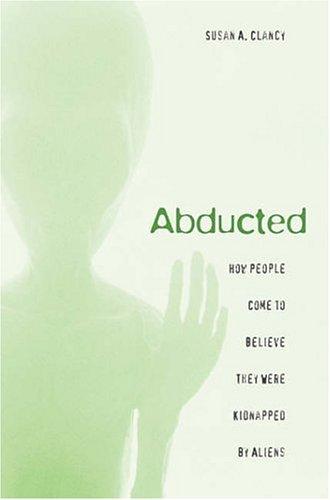
As an Amazon Associate, OverClassified may earn from qualifying purchases made through this link, at no extra cost to you.
Why This Is Essential Reading
Abducted earns its place on this list as the clearest single articulation of the false-memory explanation for alien abduction claims — not a debunker's dismissal, but a credentialed cognitive psychologist's genuine attempt to explain, mechanism by mechanism, how sincere, sane, non-delusional people can come to hold vivid memories of events that almost certainly never happened. Susan A. Clancy's sleep-paralysis-plus-cultural-script-plus-hypnotic-suggestion framework draws directly on her own peer-reviewed false-memory research, conducted first on a far higher-stakes population of recovered childhood-abuse memories, which gives the book's central mechanism a research pedigree most abduction literature, credulous or skeptical, simply does not have. That pedigree does not make the book above criticism, and this entry's own Critical Reception section documents real, substantive, independently arrived-at objections from Stanton Friedman, Kathleen Marden, and Budd Hopkins's Intruders Foundation — an unvetted, self-selected sample; disputed factual claims about the foundational Hill and Allagash cases; and a research design that never left the lab to examine a single piece of physical evidence. Read against those objections rather than instead of them, Abducted is essential not because it settles the abduction question but because it is the fullest, most rigorously sourced statement of the explanation that does not require assuming abductees are lying — and because the specific, documented weaknesses critics have found in it mark out, about as precisely as any single book on this list, exactly where the false-memory hypothesis still has work left to do.
Related Cases & Theories
Essential Viewing
![Abducted: How People Come to Believe They Were Kidnapped by Aliens [1/11]](/images/thumbs/Yx8zGRUjf8Y.jpg)
Abducted: How People Come to Believe They Were Kidnapped by Aliens [1/11]
Microsoft Research — A recorded lecture by Susan Clancy presenting the book's research directly, covering her recruitment methodology, the sleep-paralysis and cultural-scripting mechanism, and her lab findings on fantasy proneness and false recall, verified via YouTube oEmbed before inclusion.

What "Alien Abductions" Say About Our Brains
SciShow Psych — A general-audience explainer on the psychology behind alien-abduction memories, covering the same sleep-paralysis, cultural-scripting, and hypnotic-suggestion research this book popularized, verified via YouTube oEmbed before inclusion.
Sources Cited
- Clancy, Susan A. Abducted: How People Come to Believe They Were Kidnapped by Aliens. Harvard University Press, 2005. hup.harvard.edu
- "Susan Clancy." Wikipedia (biography: education, Harvard career, false-memory research, later work). en.wikipedia.org
- "Susan Clancy." INCAE Business School faculty directory (current academic position and credentials). incae.edu
- Carey, Benedict. "Explaining Those Vivid Memories of Martian Kidnappers." The New York Times, August 9, 2005 (contemporary review). nytimes.com
- "'Abducted': The Myth of Alien Kidnappings." NPR, November 9, 2005 (author interview on the book's release). npr.org
- Mooney, Chris. "Abductive Reasoning." Skeptical Inquirer (review of the book's sleep-paralysis, cultural-scripting, and hypnosis framework). skepticalinquirer.org
- Shermer, Michael. "Abducted!" Scientific American column, reproduced at michaelshermer.com (discussion of the underlying Clancy/McNally psychophysiology research). michaelshermer.com
- Friedman, Stanton T. "A Review of Susan Clancy's Book On Abduction." The UFO Chronicles (detailed critical review disputing the book's Hill and Allagash case material and its recruitment methodology). theufochronicles.com
- Thompson, Tamara. "The Faith-Based Science." Intruders Foundation (Budd Hopkins's organization; critique of the book's sample selection and lab-only methodology). intrudersfoundation.org
- Marden, Kathleen. "Another Look at the Harvard False Memory Study." kathleen-marden.com (critical analysis of Clancy's underlying sample and its treatment of the Betty & Barney Hill case). kathleen-marden.com
- McNally, Richard J. & Clancy, Susan A. "Sleep Paralysis, Sexual Abuse, and Space Alien Abduction." Transcultural Psychiatry, 2005. journals.sagepub.com
- Clancy, Susan A., Schacter, Daniel L., McNally, Richard J. & Pitman, Roger K. "False Recognition in Women Reporting Recovered Memories of Sexual Abuse." Psychological Science, 2000 (Clancy's earlier recovered-memory research, foundational to this book's methodology). journals.sagepub.com
- "Alien abduction claims examined." Harvard Gazette, 2003 (university reporting on Clancy's abductee research program prior to the book's publication). news.harvard.edu
- Grierson, Bruce. "A Bad Trip Down Memory Lane." The New York Times Magazine, July 27, 2003 (profile discussing Clancy's turn from recovered-memory research to abductee research). nytimes.com
- This site's own case file: Betty & Barney Hill Abduction, the foundational 1961 case this book opens with and that Friedman's and Marden's critiques center on.
- This site's own case file: Allagash Waterway Abduction, the 1976 case Friedman's review disputes Clancy's account of.
- This site's own case file: Berkshire UFO Wave / Thom Reed, which cites this book directly in assessing its own hypnotically recovered testimony.
- This site's own case file: Fort Benning Abduction Case, which likewise cites this book directly.
- This site's own theory file: Psycho-Social Hypothesis (PSH), Theory File PSH-001, which draws on this book's framework alongside related anomalistic-psychology research.
- This site's own resources library: Full Reading List, where this 2005 hardcover edition (ISBN 0674018796) is cited across 2 case-file pages.
Have corrections, additional research, or peer-reviewed sources? Help improve this entry.
Suggest an Edit