
The Exeter UFO Incident
In the pre-dawn darkness of September 3, 1965, 18-year-old Norman Muscarello was hitchhiking home along Route 150 near Exeter, New Hampshire, when a row of brilliant, silent, pulsating red lights appeared over a farmhouse and moved toward him across a field, sending him diving into a roadside ditch. Badly shaken, Muscarello flagged down a passing motorist and was driven to the Exeter Police Station, where Patrolman Eugene Bertrand Jr. — who about 12:30 AM had stopped beside a frightened woman motorist who said a red-lit object had chased her from Epping — drove him back to the site. There Bertrand and Muscarello watched five bright red lights rise from behind trees, rock and hover roughly a hundred feet away, and pulse in sequence; Patrolman David Hunt, called by radio, arrived within minutes and watched it too before it moved off to the east, toward Hampton and the sea. The U.S. Air Force's Project Blue Book first offered, then effectively withdrew, a conventional explanation; journalist John G. Fuller's 1966 bestseller Incident at Exeter made it one of the most famous UFO cases in American history; and NICAP investigator Raymond Fowler's Exeter file was printed in the record of the House Armed Services Committee's April 1966 UFO hearing, Congress's first open hearing on the subject, at the request of Representative William Bates.
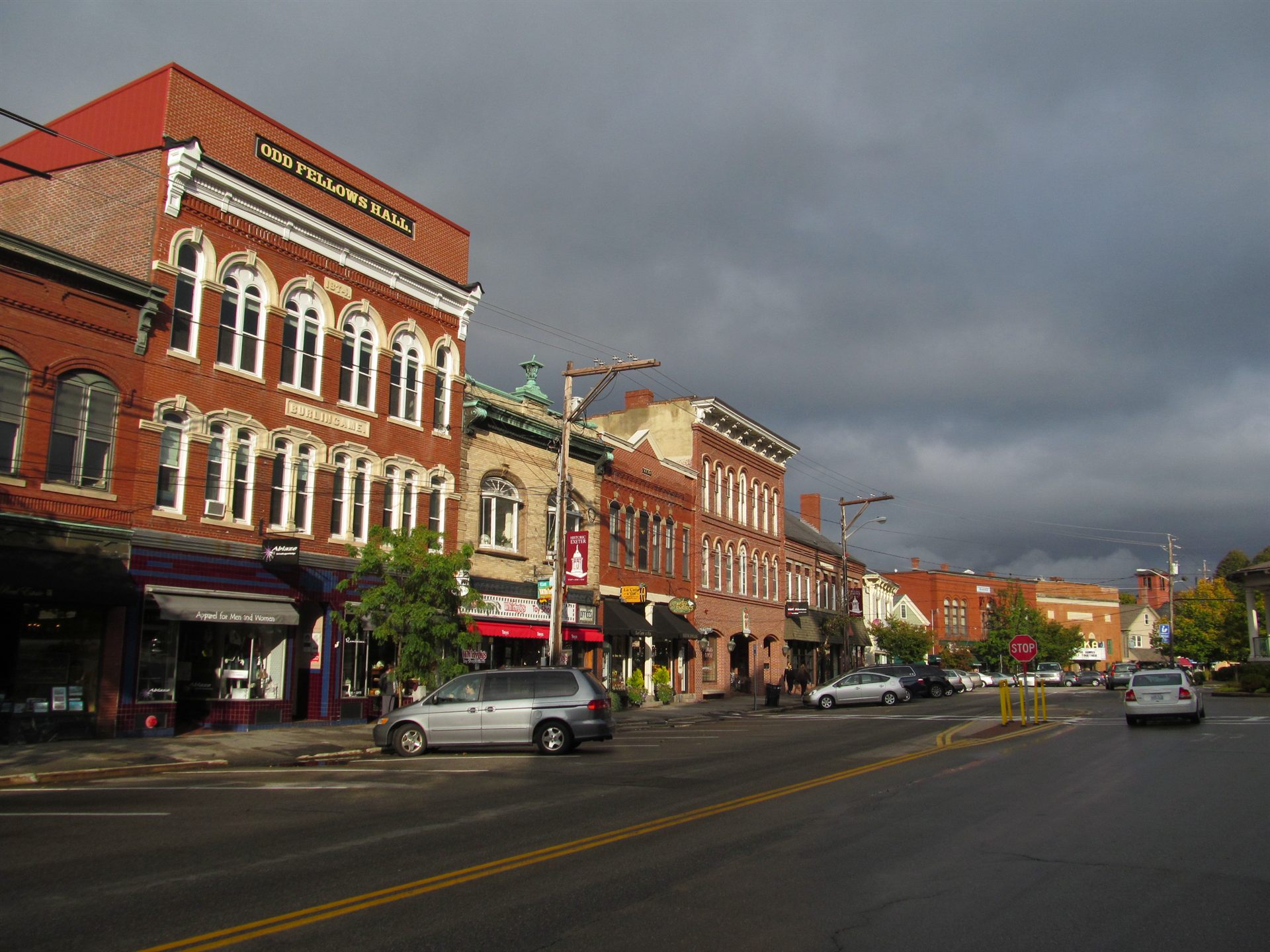
Pictured: Water Street in downtown Exeter, New Hampshire, part of the town's historic waterfront commercial district (photographed 2012) — not the actual sighting site, which sat on rural Kensington Road roughly three miles south of town. No public-domain or rights-clear photograph of the original 1965 field or the object itself is known to exist.
Theoretical Alignment
Exeter earns a moderate Extraterrestrial Hypothesis alignment on the strength of its witness pool rather than any physical or instrumented evidence: two on-duty, armed police officers, one of them an Air Force veteran of four years' refueling work, joined the teenager who first reported the object in describing the same silent, erratically moving lights at close range, and the Air Force's own field investigators — who had every institutional incentive to find a mundane cause — privately rated the three original witnesses "stable, reliable persons" and admitted they could not identify a probable cause. That is a genuinely unusual evidentiary profile: not a lone civilian's account, but a converging, same-night, same-object report from officers whose job was to assess exactly this kind of chaotic nighttime report skeptically. The alignment is capped well short of higher scores, however, because the case offers no physical trace, no photograph, no radar return, and no instrumented measurement of any kind — everything rests on visual testimony, however credible — and because a real, still-argued conventional explanation, a Pease Air Force Base KC-97 aerial-refueling tanker, remains on the table more than half a century later. The Interdimensional Hypothesis finds essentially nothing to work with here: this is a conventional, if unexplained, close-range aerial object sighting with no reported occupants, missing time, or trans-dimensional "high strangeness" of the kind IDH proponents typically point to. The Psycho-Social Hypothesis explains part of the story well — the sixty-plus copycat-adjacent reports that flooded the Exeter area in the weeks after national press coverage broke are a textbook example of a UFO "flap" amplified by media attention — but it struggles to account for the original triggering event itself, in which two professionally skeptical police officers, the second summoned by radio, gave consistent signed descriptions before any press coverage existed to prime their expectations.
Background
By the summer of 1965, the U.S. Air Force's Project Blue Book had been the government's public UFO-investigation office for more than a decade, inheriting the role from the earlier Project Sign and Project Grudge, and had developed a public reputation — fair or not — for explaining away nearly every report it examined. New Hampshire's own UFO history predated Exeter by four years: in September 1961, Portsmouth couple Betty and Barney Hill reported a close encounter and roughly two hours of missing time while driving near Indian Head in the White Mountains, an episode investigated under hypnosis by psychiatrist Benjamin Simon and later chronicled by journalist John G. Fuller in his 1966 book The Interrupted Journey. Both New Hampshire cases would eventually be documented by the same author within roughly a year of each other, an unusual coincidence that helped make the state, briefly, the epicenter of serious mainstream UFO journalism in America.
Exeter itself was, in September 1965, a quiet town of roughly eight thousand people built around Phillips Exeter Academy and its historic town center on the Squamscott River. Norman Muscarello, eighteen years old and a recent graduate of Exeter High School, was three weeks away from reporting for duty with the United States Navy. On the night of September 2 into the early hours of September 3, he had been visiting his girlfriend's family in Amesbury, Massachusetts, roughly ten miles southeast of Exeter, and was hitchhiking home along NH Route 150 in the small hours of the morning — an entirely ordinary, unremarkable errand that was about to become the opening scene of one of the most publicized UFO cases in American history.
Complete Timeline
| Date | Event |
|---|---|
| September 1961 | Betty and Barney Hill report a close encounter and missing time near Indian Head, New Hampshire, roughly 60 miles from Exeter — later documented by John G. Fuller in The Interrupted Journey (1966). |
| Sept. 3, 1965, ~12:30 AM | Patrolman Eugene Bertrand Jr. finds a distraught woman motorist parked on Route 101 just outside Exeter, who says an object with a brilliant red glow chased her for about twelve miles from Epping. (Press reports said two women; Fowler found one.) |
| ~2:00 AM | Norman Muscarello, hitchhiking home to Exeter from Amesbury, Massachusetts, sees five bright, pulsating red lights in a line over a house near the Dining and Russell properties on Route 150 in Kensington; they move toward him and he dives into a roadside ditch, pounds on the Russells' door without answer, then flags down a passing car. |
| ~2:00–2:24 AM | A passing motorist drives the shaken Muscarello to the Exeter Police Station, where night-desk officer Reginald Toland takes his report. |
| ~2:25–2:55 AM | Radioed by Toland, Bertrand drives Muscarello back to the field; walking into it, both see the red lights rise from behind trees and hover roughly 100 feet away at roughly 100 feet altitude. (Times differ between accounts; Fowler put the sighting at about 2:25–2:40, and the trio reported back to the station at 2:55.) |
| Same window | Bertrand radios for assistance; Patrolman David Hunt arrives within minutes and watches the lights before they move away to the east. Immediately afterwards the officers see what was "probably a B-47 at high altitude," which they said "bore no relation at all" to the object. |
| ~3:30 AM | From the Route 101 bypass, Hunt radios that he can again see what looks like the same object hovering in the distance; Bertrand suggests it is probably a star, and it soon disappears (Fowler). |
| September 3, 1965 (later that day) | The Exeter Police Department notifies nearby Pease Air Force Base; Major David Griffin and Lieutenant Alan Brandt travel to Exeter to interview Muscarello, Bertrand, and Hunt. |
| 15 September 1965 | Griffin's report reaches Blue Book: he is "unable to arrive at a probable cause" and calls the three witnesses "stable reliable persons, especially the two patrolman." A later Pentagon press statement attributes the reports to "multiple high altitude objects" from a SAC exercise and to stars and planets seen through a temperature inversion. |
| Fall 1965 | More than sixty additional UFO reports are logged in the greater Exeter area over the following weeks, including sightings by Exeter High School senior Ron Smith and by Mrs. Ralph Lindsay. |
| September 1965 | NICAP's Massachusetts subcommittee chairman Raymond Fowler interviews Bertrand and Hunt, who sign NICAP questionnaires; NICAP's Richard Hall acknowledges his report on 15 September. |
| October 2, 1965 | Saturday Review columnist John G. Fuller publishes a "Trade Winds" column on the case, built from telephone interviews with Fowler, the Exeter police and Bertrand; he then goes to Exeter to interview local witnesses for what becomes Incident at Exeter. |
| Undated, fall 1965 | Major Hector Quintanilla, chief of Project Blue Book, writes to Bertrand and Hunt that objects seen "between midnight and 2 a.m. might be associated" with "Big Blast," an 8th Air Force SAC/NORAD training operation, plus five B-47 aircraft flying in the area. |
| December 2, 1965 | Bertrand and Hunt write to Blue Book objecting to the explanation: the weather was clear, Bertrand had spent four years in the Air Force on refueling operations, and their sighting came "nearly an hour after 2:00 AM," after Big Blast had reportedly ended. |
| December 29, 1965 | Bertrand and Hunt's second, more detailed rebuttal letter is sent to Blue Book, restating that the object "lit up the entire field, and two nearby houses turned completely red." |
| February 9, 1966 | Lt. Col. John F. Spaulding of the Office of the Secretary of the Air Force replies: "we have been unable to identify the object you observed on September 3, 1965" — an effective retraction of the "Big Blast" explanation. |
| 1966 | John G. Fuller's Incident at Exeter is published by G.P. Putnam's Sons and becomes a New York Times bestseller. |
| April 5, 1966 | The House Armed Services Committee holds Congress's first open hearing devoted to UFOs. Rep. William Bates has Raymond Fowler's 1 April letter and NICAP Exeter file inserted into the printed hearing record. |
| 1977 | J. Allen Hynek, who introduced the "Close Encounter" classes in 1972, calls Exeter "a fine example of a Close Encounter of the First Kind" in The Hynek UFO Report. |
| February 23, 2003 | Norman Muscarello dies at age 55 after a sudden illness, having maintained the substance of his account for the rest of his life. |
| c. 2010 | The Exeter Area Kiwanis Club establishes the annual Exeter UFO Festival as a children's-charity fundraiser, commemorating the case. |
| November 2011 | Skeptics Joe Nickell and James McGaha publish "'Exeter Incident' Solved!" in Skeptical Inquirer, proposing a Pease-based KC-97 aerial-refueling tanker and its fluttering boom lights as the explanation. |
| 2022–2025 | The Exeter Police Department begins selling an annual commemorative UFO patch at the festival (from 2022); the 2025 festival marks the case's 60th anniversary. |
A Lone Figure on Route 150
Norman Muscarello was doing nothing more unusual than walking home. Eighteen years old, a recent Exeter High School graduate three weeks from reporting for U.S. Navy service, he had spent the evening at his girlfriend's family home in Amesbury, Massachusetts, roughly ten miles southeast of Exeter, and was hitchhiking back along New Hampshire Route 150 in the small hours of September 3, 1965, when no rides materialized. Walking near the Exeter–Kensington town line, in open farm country bordered by the properties of the Russell and Dining families, he saw five brilliant red lights appear over a house about a hundred feet from where he stood. In his signed statement he said the lights were "in a line at about a sixty-degree angle," that "only one light would be on at a time," pulsing "one, two, three, four, five, four, three, two, one," and that "they were so bright I could not distinguish a form to the object"; elsewhere he described "the Thing" as big as or bigger than a house, and estimated it at 80 to 90 feet across. The lights moved out over a large field, "acted at times like a floating leaf," dipped behind trees and a house and reappeared, bathing the ground and the nearby houses in red. Terrified, and with the lights seeming to close the distance, Muscarello dove into a roadside ditch, then ran to the Russell house and pounded on the door; the Russells later said they heard him but did not answer. He finally flagged down a passing car. The driver and passenger, a couple whose names were not widely publicized, agreed to take the shaken teenager directly to the Exeter Police Station rather than continuing on their own way — itself a small, telling detail, since Muscarello's evident state of fright was persuasive enough to redirect two strangers' night without argument.
The Desk Report and a Second, Independent Sighting
At the Exeter Police Station, night-desk officer Reginald Toland took Muscarello's report at around 2:00 AM (Fowler, reconciling conflicting times, settled on 1:45; Fuller gives 2:24); in Fuller's account the teenager arrived "white, and shaking," and Fowler was told he was "hardly able to talk." What made the desk report immediately credible to the department, rather than dismissible as a frightened teenager's imagination, was a detail Toland and Patrolman Eugene Bertrand Jr. both already possessed: less than two hours earlier, on routine patrol, Bertrand himself had come across a woman motorist pulled over and visibly distraught, who told him a huge, glowing red object had followed her car for roughly twelve miles before she managed to escape it. Bertrand, who by his own account had spent four years in the Air Force "engaged in refueling operations with all kinds of military aircraft," was skeptical; he stayed until the woman calmed down, made a routine radio report, and continued his patrol. When Muscarello's similar description reached the station, Toland radioed Bertrand and asked him to come in, pick up the teenager and check the field where he said he had seen the object.
Kensington Road: Two Officers, One Object
Bertrand and Muscarello arrived back at the field on Route 150 and at first saw nothing; Bertrand radioed headquarters that the boy must have been imagining things. Encouraged to check the field before returning, the two walked out into it, and as Bertrand played his flashlight across the field, Muscarello shouted that the object was rising from behind a stand of trees near the farmhouses he had described. Bertrand's descriptions vary in detail. He described "this huge, dark object as big as a barn over there, with red flashing lights on it," and told Fuller in September 1965: "I could see five bright red lights in a straight row. They dimmed from right to left, and then from left to right — just like an advertising sign does. It lit up everything around us. But it was silent." His signed Air Force statement, however, says the lights "flashed on one at a time" and were "so bright, I was unable to make out any form." Jerome Clark's summary puts the object about 100 feet away and 100 feet up, rocking back and forth, each light cycle taking no more than two seconds. "There was no tail, no wings," Bertrand told Fuller; the officers' later letter adds that "it sped, hovered, and turned on a dime." Bertrand dropped to one knee and drew his revolver, thought better of it, and pulled Muscarello back to the cruiser, where he radioed for assistance. One magazine account has Muscarello shouting "I see it! I see it!" and Bertrand radioing, "My God, I see the damn thing myself!"
Patrolman David Hunt, answering Bertrand's radio call, arrived within minutes and became the second police witness. His signed statement and later letter match Bertrand's on the essentials: the silence, the five pulsating red lights, the wobbling, "floating leaf" movement, and no wings or tail. Fuller recorded that horses in a nearby corral kicked and whinnied and that dogs barked and howled. Fowler, from the officers' questionnaires, put the observation at about ten minutes for Bertrand and Muscarello and about five for Hunt; the Pease report gives the object's departure heading as 160 degrees, and later accounts have it moving off east toward the sea. Immediately afterwards the officers saw what was "probably a B-47 at high altitude," which they said "bore no relation at all to the object we saw"; Hunt later told Fuller, "There was no comparison." At about 3:30 AM Hunt radioed from the Route 101 bypass that he could again see what looked like the object in the distance; Bertrand told him it was probably a star.
Virginia Hale: A Separate, Undated Report
Earlier versions of this page presented Virginia Hale as an independent press witness who watched the object's high-speed departure on the night of 3 September and compared it with a B-47. That account could not be traced. The only source found is a photo caption in TRUE magazine's 1967 Report on Flying Saucers, which identifies Mrs. Virginia Hale as a Haverhill Gazette reporter who "saw the saucer from her kitchen window" as it "hovered over neighbor's house 4 minutes." The caption gives no date, and nothing ties her sighting to the night of the police encounter; it belongs with the wave of area reports that followed. The B-47 comparison on the night itself belongs to the officers, who saw a bomber pass shortly after the object left and said it bore no relation to what they had watched.
Pease Air Force Base Responds: Griffin and Brandt's Investigation
After Exeter's police chief reported the sighting to Pease Air Force Base, the Air Force sent Major David H. Griffin, the base disaster control officer and a command pilot, and Lieutenant Alan Brandt to interview the three witnesses; they asked them not to talk to the press, but the Manchester Union Leader had already interviewed them. Griffin's report, received by Blue Book on 15 September 1965, was candid: "At this time I have been unable to arrive at a probable cause of this sighting. The three observers seem to be stable reliable persons, especially the two patrolman. I viewed the area of the sighting and found nothing in the area that could be the probable cause." It lists Bertrand as 30 and Hunt as 25, records clear weather with "a 5 degree inversion from surface to 5000 ft," and notes that Pease had five B-47s flying in the area, though Griffin did not believe they had any connection to the sighting — a detail that would become significant months later when his superiors at Blue Book headquarters reached a different conclusion using some of the same underlying facts.
"Big Blast": Blue Book's Explanation and the Officers' Rebuttal
Project Blue Book, then based at Wright-Patterson AFB under Major Hector Quintanilla, proposed a specific conventional explanation the field investigation itself had not endorsed: that the sighting was connected to "Big Blast," a SAC/NORAD training exercise flown by the 8th Air Force that night, together with the five B-47s Griffin had noted. Quintanilla's undated letter to the officers framed the connection cautiously: "Our investigation and evaluation of this sighting indicates a possible association with an 8th Air Force operation, 'Big Blast.' In addition to aircraft from this operation, there were five B-47 type aircraft flying in the area during this period… Since there were many aircraft in the area at that time, and there were no reports of unidentified objects from personnel engaged in this air operation, we might then assume that the objects observed between midnight and 2 a.m. might be associated with this military air operation." He added that if the officers had seen these aircraft, that "would tend to eliminate this air operation as a plausible explanation." Meanwhile a Pentagon press statement had attributed the Exeter reports both to "multiple high altitude objects" from the exercise and to "stars and planets" seen through a temperature inversion, in Clark's rendering "nothing more than stars and planets twinkling."
Bertrand and Hunt, who by this point had "been the subject of considerable ridicule since the Pentagon released its 'final evaluation,'" as their own subsequent letter to Blue Book put it, refused to let either explanation stand unchallenged. Writing directly to Blue Book, the two officers laid out specific, falsifiable objections rather than simply reasserting their belief. Their first letter, of 2 December 1965, said they had "confirmed and reconfirmed the fact that this was not any kind of conventional aircraft," that the weather was clear with "no chance of weather inversion," and that Bertrand's four years of Air Force refueling work made it "impossible to mistake what we saw for any type of military operation." Their second, sent on 29 December after Blue Book had not answered, went further: the object "was absolutely silent with no rush of air from jets or chopper blades whatever. And it did not have any wings or tail, it lit up the entire field, and two nearby houses turned completely red." Most damaging to "Big Blast," they pointed out that their sighting came "nearly an hour after 2:00 AM," after the operation had reportedly ended. Blue Book's own internal summary agreed: information from the 8th Air Force showed ten Pease B-47s from Big Blast "Coco" in the traffic pattern over Exeter from about 12:44 to 1:35 AM local time, which "conflicted with the time of the sighting and eliminated these aircraft." It attributed the earlier reports by "two unnamed women" to those aircraft, but not the officers' sighting, and the case is listed as unidentified. On 9 February 1966, Lieutenant Colonel John F. Spaulding of the Office of the Secretary of the Air Force replied: "Based on the additional information you submitted to our UFO investigation office at Wright-Patterson Air Force Base, Ohio, we have been unable to identify the object you observed on September 3, 1965."
John G. Fuller's Investigation and Incident at Exeter
John G. Fuller, a widely read Saturday Review columnist with no prior background in UFO research, first wrote about the case in his "Trade Winds" column of 2 October 1965, after telephone interviews with Fowler, Lieutenant Cottrell of the Exeter police, the Hampton police desk, the Manchester Union Leader, Bertrand and Pease AFB. He then went to Exeter and interviewed Toland, Bertrand, Hunt, Muscarello and many witnesses to the wider wave of local sightings, and described himself afterwards as "a former skeptic." Fuller went further than most journalists covering the case: during his own time in the area conducting research, he reported observing an unusual aerial object himself, one he described as being pursued by an Air Force jet fighter, an episode he included in his subsequent book as a first-person data point rather than secondhand reporting.
The resulting book, Incident at Exeter: The Story of Unidentified Flying Objects over America Today, published by G.P. Putnam's Sons in 1966, became a New York Times bestseller (Peebles). Its impact went well beyond book sales: Fuller's detailed, sympathetic-but-methodical treatment of the Exeter witnesses' credibility — particularly Bertrand and Hunt's professional standing as police officers — reframed the case for a national audience as a serious evidentiary puzzle rather than a tabloid curiosity, and its commercial success helped keep sustained public and press pressure on the Air Force's handling of UFO reports at exactly the moment Congress was beginning to take a public interest in the subject.
Raymond Fowler, NICAP, and the Congressional Record
Raymond E. Fowler, chairman of the Massachusetts subcommittee of the National Investigations Committee on Aerial Phenomena (NICAP), investigated within days, entirely separately from the Air Force. He had Hunt and Bertrand fill out and sign NICAP's eight-page questionnaire, walked the area with his brother looking for traces, checked and ruled out an advertising plane that local papers had blamed, and filed a report that NICAP's Richard Hall acknowledged on 15 September. Fowler also recorded an embarrassing public test in which an Air Force officer had Pease's lights switched on for a watching crowd, and nothing could be seen. On 1 April 1966 Fowler, then an administrative engineer on the Minuteman program at Sylvania, sent NICAP's complete Exeter file to Congress with a letter urging hearings; at the House Armed Services Committee's hearing of 5 April 1966, Congress's first open hearing on UFOs, Representative William Bates of Massachusetts had the letter and file inserted into the printed hearing record. The hearing did not occur in a vacuum shaped by Exeter alone: a highly publicized wave of Michigan sightings in March 1966, and the advocacy of Michigan Congressman and House Minority Leader Gerald Ford, who wrote that "the Air Force has been explaining away UFO's for years, and I don't believe the American people generally are satisfied with its statements" and urged, "Let's try to get to the bottom of this thing," supplied much of the immediate political momentum. Fowler's Exeter file, and the attention Fuller's Saturday Review and Look articles had drawn, put a multi-witness police case into the hearing record alongside the Michigan reports.
Hynek, "Close Encounters," and the Long Afterlife of a Small-Town Case
J. Allen Hynek, the Northwestern University astronomer who served for more than two decades as Project Blue Book's scientific consultant, introduced the tiered "Close Encounter" classification in his 1972 book The UFO Experience: A Scientific Inquiry, the scheme that later gave Steven Spielberg's 1977 film its title. In The Hynek UFO Report (1977), which reprints Muscarello's and Bertrand's statements and Quintanilla's letter, he called Exeter "a fine example of a Close Encounter of the First Kind," judged the astronomical explanation "completely untenable," and wrote that Big Blast had ended well before the sighting. Decades later, the case's cultural afterlife has settled into something between solemn case study and civic tradition: since about 2010 the Exeter Area Kiwanis Club has run an annual Exeter UFO Festival as a children's-charity fundraiser, drawing researchers, authors and visitors to the town around Labor Day. Since 2022 the Exeter Police Department has sold its own commemorative UFO patch at the festival, and the 2025 festival marked the case's sixtieth anniversary — a warm institutional embrace of a case that once subjected two of the department's officers to public ridicule.
Muscarello, Bertrand, and Hunt in Later Life
None of the three original witnesses ever meaningfully altered their account of what happened that night. Norman Muscarello started Navy basic training three weeks after the sighting; his brother told the Boston Globe that he served three tours of Vietnam and "wasn't the same person" afterwards. He later worked at the Alrose Shoe Company in Exeter, spoke to Exeter High School students in 1980, maintained that what he saw was real, and died on February 23, 2003, aged 55, after a sudden illness. Eugene Bertrand Jr. died in 1998. David Hunt, later a bailiff at the Rockingham County courthouse, declined interviews from the 1960s onward, telling the Globe in 2005 that "it doesn't really matter any more"; he died in 2011, the last of the three.
Circumstantial Evidence
- Patrolman Eugene Bertrand had met a frightened motorist reporting a red-lit object about two hours before his own sighting, without having heard Muscarello's account yet (Blue Book later attributed that earlier report to Big Blast aircraft).
- Two on-duty police officers, one with four years of Air Force refueling experience, watched the same lights in real time and gave signed statements.
- The officers saw a B-47 pass shortly after the object left and said it "bore no relation at all" to what they had watched.
- The Air Force's own field investigators, Major David Griffin and Lieutenant Alan Brandt, rated all three original witnesses "stable, reliable persons, especially the two patrolmen" and reported being "unable to arrive at a probable cause."
- Bertrand and Hunt's written rebuttal letters identified a specific, checkable factual flaw in Blue Book's "Big Blast" explanation — that the sighting occurred nearly an hour after the operation had reportedly ended — which Blue Book's own internal summary accepted.
- The Air Force's own final position, delivered in writing by Lt. Col. John Spaulding on 9 February 1966, was an explicit admission that it had been "unable to identify the object."
- Horses in a nearby corral and dogs in the area reportedly reacted with agitation during the sighting (Fuller; Clark).
- Raymond Fowler's independent NICAP field investigation, conducted within days of the sighting and separately from the Air Force's inquiry, collected signed questionnaires from both officers and reached broadly consistent conclusions about their credibility.
The 1965 New Hampshire UFO Wave
Exeter did not remain an isolated data point for long. In the weeks following the case's first newspaper coverage, more than sixty additional UFO reports were logged across the greater Exeter area, a volume investigators and skeptics alike have treated as a textbook example of a media-amplified regional "flap." Exeter High School senior Ron Smith told Fuller that two or three weeks after Muscarello's sighting, driving at 11:30 PM with his mother and aunt, all three saw an object with "a red light on top and the bottom was white and glowed. It appeared to be spinning"; it passed over the car, stopped in midair, then went back over the car again. Desk officer Toland told Fuller of a pre-dawn call from Mrs. Ralph Lindsay, who said the object was "like a big orange ball, almost as big as the harvest Moon" outside her window while her children watched it. None of these secondary reports carry the same evidentiary weight as the original police-corroborated sighting — they lack the trained-observer credibility, the same-night independent corroboration, and the sustained official investigation that made Muscarello, Bertrand, and Hunt's account exceptional — but their sheer volume illustrates how a single, well-publicized triggering case can measurably raise regional reporting rates regardless of what any individual report in the resulting wave actually represents, a pattern researchers have observed in UFO flaps from Levelland, Texas in 1957 to the Belgian Wave of 1989–1990.
The Skeptical Challenge: The KC-97 Tanker Theory
The most technically detailed and durable conventional explanation for Exeter did not arrive until nearly half a century after the sighting. In the November/December 2011 issue of Skeptical Inquirer, longtime paranormal investigator Joe Nickell and retired U.S. Air Force pilot and astronomer James McGaha published "'Exeter Incident' Solved! A Classic UFO Case, Forty-Five Years 'Cold,'" proposing that Bertrand, Hunt, and Muscarello had seen a Boeing KC-97 aerial-refueling tanker, a type that operated from SAC bomber bases like Pease Air Force Base. McGaha, a retired Air Force major and former special-operations pilot who had himself been refueled by KC-97s, recognised the witnesses' light sequence. Their theory rests on two technical claims: first, that the KC-97's underbelly carried a row of five red sequencing lights, switched on as a receiver aircraft approached, which flashed in exactly the pattern Muscarello gave in his signed statement — "one, two, three, four, five, four, three, two, one"; and second, that the lowered refueling boom hung at about 64 degrees (Muscarello reported the lights "in a line at about a sixty-degree angle") and fluttered in the air currents unless the boom operator was controlling it, which they argue explains the "floating leaf" motion. They note that the officers saw a B-47 just as the object disappeared, "Perhaps it had just refueled."
The theory is a serious one, offered by a credentialed pilot with direct professional familiarity with tanker operations rather than a casual armchair guess, and it remains the most specific conventional mechanism proposed for the case to date. It also faces real objections. Nickell and McGaha cite no record of a tanker over Exeter that night, and the Blue Book file points the other way: when Blue Book checked in September 1965, it was told that no refueling operations were conducted on the nights of 2–3 September, that the "Fur Trapper" refueling route over the area was closed for Big Blast from 1 to 2 AM local time, and that "there were no refueling operations in the New England area during the time in question." And Bertrand, by his own account, had spent four years in the Air Force "engaged in refueling operations with all kinds of military aircraft"; he and Hunt both insisted that what they saw was no kind of military aircraft. And the theory has never been tested by an actual controlled nighttime observation of a KC-97 in refueling posture from a comparable ground distance, leaving its central visual claim — that a fluttering boom and sequential fuselage lights could produce the specific "huge, dark, wingless object" silhouette all three witnesses described — a plausible hypothesis rather than a demonstrated match. Earlier skeptical proposals also exist: Philip J. Klass, in UFOs—Identified (1968), suggested that the Exeter lights were corona discharges or plasmas from high-tension power lines, a theory he later backed away from; and Martin Kottmeyer (1996) suggested a prankster's lighted box kite. The KC-97 theory has not displaced Exeter's classification as a serious, unresolved case among most researchers who have examined it closely, but it stands as the most specific surviving conventional explanation nearly six decades on.
Key Witnesses
Norman Muscarello
Hitchhiking home to Exeter from his girlfriend's family home in Amesbury, Massachusetts, Muscarello was the first to observe the object rising from behind a Kensington Road farmhouse, close enough that he dove into a roadside ditch for cover before flagging down a passing motorist and reporting to the Exeter Police Station. His brother said he later served three tours in Vietnam; he worked at the Alrose Shoe Company and maintained his account until his death in 2003.
Patrolman Eugene Bertrand Jr.
Bertrand had met a distraught motorist reporting a red-lit object about two hours before driving Muscarello back to the sighting site, where he became the second person — and the first professional witness — to observe the object directly. He drew his revolver, then retreated to the cruiser and radioed for assistance, later co-authored two detailed written rebuttals to the Air Force's proposed explanations, and died in 1998 having never altered his account.
Patrolman David Hunt
Answering Bertrand's radio call, Hunt arrived within minutes and watched the same silent, red-lit object Bertrand and Muscarello had already been watching. His account matched Bertrand's closely in behavior and lighting pattern, and he told Fuller that the B-47 that passed afterwards was no comparison. He co-signed the officers' letters objecting to Blue Book's "Big Blast" explanation, declined interviews for decades, and died in 2011, the last of the three original witnesses.
Virginia Hale
Known only from a 1967 TRUE magazine photo caption, which says she "saw the saucer from her kitchen window" as it hovered over a neighbor's house for four minutes. No date is given, and nothing ties her sighting to the night of the police encounter. An earlier version of this card, which had her watching the object's departure that night and comparing it with a B-47, could not be sourced and has been withdrawn.
The Five Observables Assessment
The Five Observables framework, developed by former AATIP director Luis Elizondo, is used to classify UAP encounters by performance characteristics exceeding known technology of their era. Exeter, like other purely visual, non-instrumented sightings in this catalogue, is a difficult structural fit: everything below reflects what three to five witnesses impressionistically described over several minutes of close-range observation, not anything independently measured by radar, camera, or onboard instrumentation.
Assessment: Anti-Gravity Lift is rated speculative because all three primary witnesses described the object hovering motionless at low altitude with no visible rotor, wing, or means of support, and no downwash or ground disturbance was reported — consistent with a genuinely novel means of lift, but based entirely on unaided visual observation rather than any instrumented reading. Instant Acceleration is rated speculative on similar grounds: the officers' letter says the object "sped, hovered, and turned on a dime," but no radar or other timed measurement exists to confirm any specific speed. Hypersonic Velocity is rated absent, since no witness ever claimed the object approached anything resembling supersonic or hypersonic performance — only that it was faster than they expected a conventional propeller aircraft to be at that altitude. Low Observability is rated absent, and distinctively so for this catalogue: the object was, by every account, extraordinarily conspicuous, its five red lights bright enough to bathe an entire field and two houses in red illumination, the opposite of a stealthy or hard-to-detect craft. Trans-Medium travel is rated absent, as the entire encounter took place in open air with no reported transition between air, water, or any other medium. Taken together, Exeter's observable profile is that of a highly visible, silently hovering and departing object witnessed at close range by multiple credible observers — a profile consistent with either a genuinely anomalous craft or a conventional aircraft whose lighting and flight characteristics were, for whatever reason, badly misjudged by frightened observers in the dark.
Evidence Assessment
Supporting Anomalous Origin
- Two on-duty police officers, one with four years of Air Force refueling experience, watched the same unusual object in real time and gave signed statements.
- A pre-sighting report from an unnamed motorist to Bertrand, describing a red-lit object, preceded and was not influenced by Muscarello's later account (though Blue Book attributed it to Big Blast aircraft).
- The Air Force's own field investigators formally rated the witnesses as credible and reported being unable to identify a probable cause.
- Blue Book's proposed "Big Blast" explanation contained a timing error that the witnesses identified in writing and Blue Book's own internal summary accepted.
- The Air Force's final, written institutional position was an explicit admission of non-identification rather than a maintained conventional explanation.
- Raymond Fowler's independent NICAP investigation and John G. Fuller's extensive independent journalistic investigation both concluded the case remained genuinely unresolved after examining the available conventional explanations.
Supporting Conventional Explanation
- No physical trace, photograph, radar return, or instrumented measurement of any kind exists; the entire case rests on unaided visual testimony given in darkness under high stress.
- Pease Air Force Base maintained active nighttime B-47 bomber and KC-97 tanker operations in the same regional airspace, providing a genuine, regularly occurring source of unusual nighttime aircraft lighting.
- Skeptics Joe Nickell and James McGaha's 2011 KC-97 tanker/refueling-boom theory matches the light sequence and the "sixty-degree angle" in Muscarello's signed statement, and has never been experimentally disproven.
- Both Muscarello's and Bertrand's signed statements say the lights were too bright to make out any form, so the "huge, dark object" was largely inferred; none of the witnesses had any instrument to measure distance, altitude, or speed.
- The subsequent wave of 60-plus regional reports in the following weeks demonstrates that media attention alone can generate a large volume of look-alike reports, complicating any simple reading of "many witnesses" as independent confirmation of an anomalous phenomenon.
Why "Credible"
The Exeter UFO Incident earns a CREDIBLE rating on this site's scale because it combines an unusually strong, professionally credentialed multi-witness core with the U.S. Air Force's own formal, written admission that it could not identify the object — while stopping short of the kind of physical, photographic, or instrumented corroboration that would justify a higher rating. On the strength side: two on-duty police officers, arriving at the scene under different circumstances and with no coordination beyond a radio call, independently described the same silent, wingless, red-lit object in closely matching detail; and the Air Force's own field investigators, whose institutional interest ran toward finding a mundane explanation rather than validating an anomalous one, formally rated all three original witnesses "stable, reliable persons." When Blue Book's Washington headquarters did propose a specific conventional explanation, "Big Blast," the officers rebutted it with a concrete, checkable factual objection — a nearly hour-long timing gap — that Blue Book's own internal summary accepted, and the case's official government position ultimately settled not on any conventional explanation but on an explicit written statement of non-identification. On the other hand, Exeter offers no radar track, photograph, film, or physical sample of any kind; its witnesses, however credible, were unaided observers working in full darkness under genuine fright, and two of them signed statements saying the lights were too bright to make out any form; and a real, technically specific conventional explanation — a Pease-based KC-97 tanker's sequential refueling lights and fluttering boom — was proposed by credentialed skeptics in 2011 and has never been definitively tested against the full combination of details the witnesses reported. That combination — strong, independently corroborating professional testimony and an official admission of non-identification, but no instrumented or physical confirmation and a serious surviving conventional alternative — places Exeter solidly in "credible" territory: one of the best-corroborated small-town police sightings on record, but not a closed case.
Sensor & Instrumentation Detection Profile
No radar, camera, or automated sensor system captured the Exeter object at any point during the encounter. The nearby Pease Air Force Base, home to Strategic Air Command B-47 bombers and KC-97 aerial tankers, maintained its own air-defense radar coverage of the regional airspace, but no radar log or correlated air-traffic record from that specific pre-dawn window has ever been published or cited by any investigator, official or independent — a genuine evidentiary gap rather than a documented "radar showed nothing" negative result. What the case does have, in place of instrumentation, is something closer to an inadvertent cross-check: two separately dispatched police officers, using their own eyes and each other as informal corroborating witnesses in real time, radioing the Exeter station while the object was still overhead. Bertrand radioed the station for assistance from his cruiser, and Hunt's arrival by patrol car minutes later gave the sighting a second, independently summoned observer before the object finally departed. Project Blue Book's own investigators, Major David Griffin and Lieutenant Alan Brandt, functioned as a delayed, human "instrument" of a kind: dispatched from Pease within days, they interviewed all three original witnesses and noted the five B-47s Pease had airborne without finding a match they were willing to endorse. Blue Book itself later telephoned the refueling-route controllers and was told there had been no refueling operations over New England during the period.
Environmental & Geospatial Context
Exeter, New Hampshire is a small colonial-era town in Rockingham County, in the state's rural southeastern seacoast region, roughly ten miles inland from the Atlantic and a similar distance from Pease Air Force Base in Portsmouth. The sighting itself unfolded not in the town center but on Kensington Road (New Hampshire Route 150), in open farm country a few miles south of Exeter proper, near the Kensington town line, in a large field bordered by the properties of the Russell and Dining families. The area in the mid-1960s was sparsely populated farmland typical of inland New England — dark, quiet, with minimal ambient light pollution, ideal viewing conditions for a genuinely unusual light source, and equally conducive to the misidentification of a distant conventional aircraft light against an otherwise empty black sky. The Pentagon's earliest public response to the case invoked an atmospheric temperature inversion, a real meteorological phenomenon that can distort and magnify the apparent size and movement of stars and planets near the horizon; the witnesses, all of whom reported the object at close range, hovering, and moving with clear directional control, rejected this explanation outright. Griffin's own report does record "a 5 degree inversion from surface to 5000 ft" with clear skies and light surface winds; Fowler's weather addendum gives clear skies, a 5 mph northwest wind and temperatures in the lower fifties. The region's importance to the case's later conventional-explanation debate is geographic as much as meteorological: Pease's active B-47 bomber and KC-97 tanker operations meant that unusual nighttime aircraft lighting, including in-flight refueling operations with their own distinctive light patterns, was a genuine, regularly occurring feature of the local night sky that any explanation for Exeter has to reckon with.
Observer Credibility & Occupational Profile
The Exeter case's central credibility asset is occupational: its two most important witnesses were on-duty, professionally trained police officers with no history of UFO interest and every institutional reason to avoid attaching their names to an implausible story. Eugene Bertrand Jr., who had spent four years in the Air Force "engaged in refueling operations with all kinds of military aircraft" before joining the Exeter Police Department, had already handled one related report earlier the same night — a distraught woman motorist who said a huge, glowing red object had followed her car for miles — before independently witnessing the object himself alongside Muscarello. David Hunt, summoned by radio after Bertrand's own sighting had already begun, arrived as a second trained observer and gave an account that matched Bertrand's closely on the essentials. Norman Muscarello, the case's original witness, was eighteen years old, a recent high school graduate three weeks from reporting for U.S. Navy service — a young man with no evident motive to fabricate an elaborate hoax on the eve of his own military commitment, and one who maintained for the rest of his life that what he saw was real. Project Blue Book's own field investigators, Major David Griffin and Lieutenant Alan Brandt, delivered a formal written assessment unusually favorable for an Air Force report of the era, describing all three original witnesses as "stable reliable persons, especially the two patrolman" — an evaluation offered by officers whose job was institutionally aligned with finding a mundane explanation, not endorsing an anomalous one. The case's credibility is real, but it is not unlimited: Bertrand's refueling background cut both ways (it is the basis of his rejection of an aircraft, and the very type of aircraft skeptics now propose), none possessed any instrument to measure distance, altitude, or speed, and the sighting occurred in full darkness at an hour when fatigue and adrenaline both run high.
Physical & Material Assays
Exeter produced no physical trace, debris, photograph, or recoverable material of any kind, and no witness or investigator has ever claimed otherwise — this sets it apart from ground-trace cases like Delphos, Kansas or Trans-en-Provence, and places its entire evidentiary weight on testimony and the Air Force's own contemporaneous paper trail. That paper trail is nonetheless unusually well preserved for a mid-1960s regional sighting: the Blue Book file includes Major Griffin's initial field report, Major Hector Quintanilla's subsequent written correspondence proposing the "Big Blast" explanation, two detailed rebuttal letters from Bertrand and Hunt themselves objecting to that explanation on specific factual grounds, and a final 9 February 1966 letter from Lieutenant Colonel John Spaulding effectively retracting the Air Force's own proposed identification. Circumstantial physical evidence exists only at one remove: Bertrand told Fuller that horses in a nearby corral began kicking and that dogs barked during the sighting, a detail that cannot be independently verified after the fact. No soil sample, metallic fragment, burn mark, or any other testable physical residue was ever collected, because none was ever found.
Historical Precedents & Archive Matches
Exeter belongs to a specific and historically important sub-category of UFO reports: the police-corroborated nighttime sighting, in which a civilian's initial report is independently confirmed by law-enforcement officers arriving separately and without prior coordination. It sits alongside cases like the 1957 Levelland, Texas wave, in which multiple Hockley County motorists and lawmen reported a glowing object and vehicle engine and light failures over one night, and prefigures the aircrew-corroboration structure later seen in cases like the 1973 Coyne helicopter incident, where professional occupational credibility, rather than any instrumented measurement, carried the evidentiary weight. Within New England specifically, Exeter followed closely on the heels of the September 1961 Betty and Barney Hill abduction case, which had occurred less than 60 miles away and in which Pease Air Force Base radar also figured; journalist John G. Fuller would go on to write the defining book on both cases within the same two-year span, cementing New Hampshire's disproportionate place in American UFO history. Exeter also sits at the head of its own regional cluster: in the weeks following the case's national press coverage, more than sixty additional UFO reports were logged in the immediate area, including a separate sighting by Exeter High School senior Ron Smith, his mother and aunt, who described an object with a red light on top and a glowing, spinning white bottom passing over their car, stopping, and passing back over it, and a call relayed by Toland from Mrs. Ralph Lindsay of an object "like a big orange ball, almost as big as the harvest Moon" watched by her children from a window — a wave pattern common to many of ufology's most publicized flaps, in which a single well-documented triggering case measurably increases regional reporting rates regardless of what any individual report actually represents.
Material Analysis
Exeter produced no physical debris, ground trace, or recoverable artifact of any kind, and no witness or investigator has ever suggested otherwise. Unlike landing-trace cases such as Delphos, Kansas or Trans-en-Provence, the object here was never reported at ground level and left nothing behind to sample or test. What exists instead is an unusually well-preserved documentary record: Major Griffin's report, which records that he "viewed the area of the sighting and found nothing in the area that could be the probable cause"; the full chain of Blue Book correspondence between Quintanilla, Bertrand, Hunt, and Spaulding; and the animal-agitation reports — horses and dogs reacting with distress during the sighting — which, while not physical evidence in a laboratory sense, are a non-visual behavioral detail recorded in the earliest accounts.
Supporting a Genuine Anomalous Trigger
- Major Griffin's own site inspection found nothing at the location that could explain the sighting by conventional means.
- Animal agitation appears in the earliest press and investigator accounts of the sighting.
- The Air Force's own documentary record shows its proposed explanation being raised, specifically challenged, and effectively withdrawn — not a case quietly closed and forgotten.
Supporting a Mundane Origin
- The absence of any physical trace is also consistent with a purely aerial phenomenon — a genuine or misidentified aircraft passing at altitude — that would never have been expected to leave ground-level evidence.
- No independent measurement of the animal-agitation reports was taken, leaving them anecdotal rather than documented.
- The Air Force's retraction reflects an admission that its own proposed identification was wrong, not confirmation that the object itself was anomalous.
The Conventional Explanation Candidates
Three distinct conventional explanations have been proposed for the Exeter sighting over the six decades since it occurred, each deserving serious individual evaluation rather than being treated as a single undifferentiated "skeptical" position.
Operation "Big Blast" and the Five B-47 Bombers
Project Blue Book, under Major Hector Quintanilla at Wright-Patterson AFB, proposed that the sighting was connected to "Big Blast," an 8th Air Force SAC/NORAD training exercise, combined with five B-47 bombers airborne from Pease Air Force Base that night. This candidate deserves serious consideration because it was the Air Force's own formally proposed explanation, based on real, verifiable operational activity in the area that night, and offered by the institution with the fullest access to relevant flight records. Its central weakness is a specific, documented timing discrepancy that Bertrand and Hunt themselves identified: their sighting occurred nearly an hour after Big Blast had reportedly concluded, a factual objection Blue Book's own internal summary accepted, noting that the ten Big Blast B-47s were in the Exeter pattern only until about 1:35 AM. The theory also does not account for the object's reported total silence, absence of wings or tail, or the officers' description of it hovering and turning "on a dime." Blue Book's own eventual retraction, via Lt. Col. Spaulding's 9 February 1966 letter, functions as the clearest evidence that the Air Force itself no longer considered this explanation viable.
Temperature Inversion / Astronomical Misidentification
The Pentagon's earliest public statement attributed the sighting to stars and planets distorted by an atmospheric temperature inversion, a real optical phenomenon capable of magnifying and animating the apparent movement of bright celestial objects near the horizon. This candidate is weak on its face for Exeter specifically: all three original witnesses described the object at close range — close enough to illuminate a field and two houses in red light, close enough for Muscarello to dive for cover — a proximity and apparent scale wholly inconsistent with a distant astronomical point source, however distorted. Griffin's report did record a modest inversion (5° from the surface to 5,000 ft), but nothing ties it to the close-range lights, and Blue Book itself pursued the "Big Blast" explanation instead.
The KC-97 Tanker and Refueling Boom
Joe Nickell and James McGaha's 2011 proposal that a Pease-based KC-97 Stratofreighter tanker's sequential refueling lights and fluttering, uncontrolled boom produced the sighting is the most technically specific and currently most-cited conventional explanation. It deserves serious weight because it was offered by a former military pilot who had himself been refueled by KC-97s, and because it accounts for several details — the five-light "one, two, three, four, five, four, three, two, one" sequence, the sixty-degree line of lights and the "floating leaf" motion — more precisely than either earlier Air Force theory. Its principal weakness is that no KC-97 has been placed over Exeter that night: the Blue Book file records that no refueling operations were conducted over New England during the period. It has also never been tested by a controlled nighttime observation, and Bertrand, who had worked on Air Force refueling operations for four years, rejected any military aircraft explanation.
Big Blast / B-47 Operation
ImplausibleContradicted by the officers' documented timing objection, which Blue Book's own internal summary accepted: Bertrand and Hunt's sighting occurred nearly an hour after Big Blast had reportedly concluded. It also fails to account for the object's total silence, absence of wings or tail, and hovering. Blue Book's 9 February 1966 retraction letter is the clearest evidence the Air Force itself abandoned this explanation.
Temperature Inversion / Astronomical
ImplausibleInconsistent with the close-range, high-detail nature of all three original accounts: the witnesses described the object close enough to illuminate a field and two houses in red light, close enough for Muscarello to dive for cover, wholly inconsistent with a distant astronomical point source. A modest inversion was on record (Griffin), but Blue Book itself pursued "Big Blast" instead.
KC-97 Tanker / Refueling Boom
Plausible But UnconfirmedThe most technically serious surviving candidate, proposed by Joe Nickell and James McGaha in 2011, matching the five-light sequence and the sixty-degree line of lights in Muscarello's signed statement. But it rests on an unidentified flight: the Blue Book file records no refueling operations over New England during the period, and the theory has never been experimentally tested against the full witness record.
Related Cases
Confirmed Documents & Official Records
Archived record of Congress's first open hearing devoted to UFOs. Rep. William Bates had Raymond Fowler's 1 April 1966 letter and NICAP's Exeter file, including Fuller's Saturday Review column, inserted into the printed record.
PUBLIC RECORDThe independent civilian investigation later printed in the 1966 House hearing record, preserved in NICAP's online case archive.
UNCLASSIFIED / PUBLIC ARCHIVESearch Government Archives Directly
Further Reading — Recommended Literature
Incident at Exeter
The classic account of the case: Fuller's bestselling investigation, built from interviews with Exeter-area witnesses including Bertrand, Hunt, Muscarello, and Toland.
The UFO Experience: A Scientific Inquiry
The book that introduced the "Close Encounter" classification system, written by Blue Book's own longtime scientific consultant. (Hynek's fullest treatment of Exeter is in his later The Hynek UFO Report, 1977.)
Project Blue Book Exposed
A detailed critical history of Project Blue Book's investigative methods and institutional pressures, directly relevant to understanding the Air Force's shifting explanations for Exeter.
DISCLOSURE: Some links above are affiliate links. If you purchase through them, OverClassified receives a small commission at no additional cost to you. This helps support independent research.
Essential Viewing
Incident at Exeter: Norman Muscarello and his frightening 1965 UFO encounter
A focused walkthrough of Muscarello's original sighting and its immediate aftermath at the Kensington Road site.
Norman Muscarello and other eyewitnesses recall the 1965 UFO incident in Exeter, New Hampshire
Archival and retrospective witness interviews, including footage related to NICAP investigator Raymond Fowler's involvement.

The 1965 Exeter UFO Incident
A dedicated case overview covering the timeline, the Blue Book investigation, and the case's lasting significance.

1965 UFOB Case Sightings: UFO at Exeter NH, Witnessed by Norman Muscarello
A structured case-file-style summary of the sighting and its documentation.

The Muscarello Miles
A locally produced Exeter TV piece retracing Muscarello's original walking route along Route 150 on the night of the sighting.
Sources
- "Exeter incident," Wikipedia. en.wikipedia.org
- Fowler, Raymond E. "The Exeter, N.H./Muscarello Case," original NICAP field investigation report, 1965. nicap.org
- NICAP. "Sept 2, 1965, Exeter, NH" case directory entry. nicap.org
- NICAP. Exeter case UFO report / summary directory page. nicap.org
- Schuessler, John F. "The Exeter, N.H. UFO Case, September 3, 1965," briefing document, October 2002 (PDF hosted by NICAP). nicap.org
- Nickell, Joe, and James McGaha. "'Exeter Incident' Solved! A Classic UFO Case, Forty-Five Years 'Cold,'" Skeptical Inquirer, Vol. 35, No. 6, November/December 2011. skepticalinquirer.org
- "John G. Fuller," Wikipedia. en.wikipedia.org
- "Raymond E. Fowler," Wikipedia. en.wikipedia.org
- "J. Allen Hynek," Wikipedia. en.wikipedia.org
- "Hector Quintanilla," Wikipedia. en.wikipedia.org
- "Investigation of UFO reports by the United States government," Wikipedia. en.wikipedia.org
- The Black Vault. "Gerald Ford Pushes for Congressional UFO Hearings in 1966" (Gerald R. Ford Presidential Library document archive). theblackvault.com
- Internet Archive. "Unidentified Flying Objects" — House Committee on Armed Services hearing transcript, April 5, 1966. archive.org
- Manchester Ink Link. "New Hampshire: First in the Nation in Major UFO Encounters, Part 2." manchester.inklink.news
- NH Magazine. "New Hampshire's UFO History and the Exeter UFO Festival." nhmagazine.com
- CBS News. "Exeter UFO Festival in New Hampshire Celebrates Notable 1965 Sighting." cbsnews.com
- Union Leader. "Festival Marks 50th Anniversary of 'Exeter Incident.'" unionleader.com
- Union Leader. "Exeter-terrestrial: UFO Festival Marks 60 Years Since Historic Sighting." unionleader.com
- Exeter UFO Festival, official site. "About Us." exeterufofestival.org
- Find a Grave. "Norman J. Muscarello (1947–2003)." findagrave.com
- UFO Casebook. "1965, The Exeter, New Hampshire Encounters." ufocasebook.com
- Coast to Coast AM. "Sept 3, 1965: The Exeter UFO Incident." coasttocoastam.com
- Openminds.tv. "The Exeter, New Hampshire UFO Incident 50 Years Later." openminds.tv
- Clark, Jerome. The UFO Encyclopedia, 4th Edition, Relevant Information LLC (entry on the Exeter incident).
- Project Blue Book case file, Exeter, New Hampshire, September 1965: Griffin/Brandt report (received 15 Sep 1965), Quintanilla letter, Bertrand and Hunt letters (2 and 29 Dec 1965), Big Blast "Coco" and refueling-route checks, Spaulding letter of 9 Feb 1966. archive.org
- U.S. House Committee on Armed Services. Unidentified Flying Objects, hearing of 5 April 1966 (89th Cong., 2nd sess.), pp. 6010–6020: Fowler letter of 1 April 1966, NICAP Exeter report and addenda, Fuller "Trade Winds" column (Saturday Review, 2 Oct 1965). archive.org
- "The Exeter Puzzle," in TRUE Report on Flying Saucers (1967), reproduced by Patrick Gross. ufologie.patrickgross.org
- Hynek, J. Allen. The Hynek UFO Report. Dell, 1977, pp. 154–166 (via Nickell and McGaha 2011).
- Klass, Philip J. UFOs—Identified. Random House, 1968, pp. 12–25 (via Nickell and McGaha 2011).
- "Exeter's UFO sighting still lingers," Boston Globe, 1 Sep 2005, reproduced by Patrick Gross. ufologie.patrickgross.org
- Concord Monitor (Granite Geek). "N.H. police department celebrates its UFO role," 18 Aug 2023. concordmonitor.com
- Peebles, Curtis. Watch the Skies!: A Chronicle of the Flying Saucer Myth, Smithsonian Institution Press, 1994.
Corrections (October 2026)
A fact-check against the Blue Book case file, the 1966 House hearing record, the 2011 Skeptical Inquirer article and contemporary press removed or corrected the following: the "independent press witness" account of Virginia Hale, including a quote comparing the object with a B-47 (the only source found is an undated 1967 caption describing a kitchen-window sighting); Bertrand radioing "I see it! I see it!" (attributed in the source to Muscarello) and his "right-angle turns" quote; the claim that Fowler's report was "entered into the Congressional Record" (it was inserted into the printed record of the 5 April 1966 hearing); the January 1966 date of the Spaulding letter (it is dated 9 February 1966); the claim that Hynek cited Exeter in The UFO Experience (1972) (the "fine example" quote is from The Hynek UFO Report, 1977); the claim that no inversion data were published (the Pease report records one); Muscarello's service aboard the USS Boston and work at Phillips Exeter Academy (unverified); Hunt as the case's "most durable living voice" (he declined interviews); the 2009 festival start and a special 2025 police patch; "six printings"; and "sixty interviews". The page now also records Bertrand's four years of Air Force refueling work and the Blue Book finding that no refueling operations took place over New England during the period.
Following this review, the rating was changed from Credible 78 to Credible 68 (October 26, 2026), because the higher rating had rested partly on claims corrected or removed above.
See something inaccurate? Have additional information or sources?
Suggest an Edit →Last Updated: October 2026