
The Delphos Ring Sighting
Around 7:00 PM on November 2, 1971, sixteen-year-old Ronald Johnson was tending his family's sheep on their farm outside Delphos, Kansas when, by his account, a brilliantly lit, multicolored object hovered with a rumbling sound beside a grove of trees about seventy-five feet away, then climbed away with a jet-like noise and a flash that left him temporarily blinded. His parents, Durel and Erma Johnson, saw a bright light receding to the south; when the family went to the spot they found a glowing, doughnut-shaped ring of altered soil approximately eight feet across — dry, crusted, and strangely repellent to water — where the object had been. That ring outlasted the season, was still outlined by unmelted snow thirty-two days later when physical-trace specialist Ted Phillips arrived to document it, and became the subject of chemical soil analyses performed two decades or more apart by two chemists, Erol A. Faruk (analysis in the 1970s, published 1989) and Phyllis A. Budinger (1998–99), both of whom identified a genuine, non-volatile organic coating on the ring soil that did not match the surrounding, untouched ground. More than fifty years later, Delphos remains one of ufology's most laboratory-scrutinized physical-trace cases — and one of its most genuinely contested, caught between real, repeatable chemistry and equally real, unresolved conventional explanations.
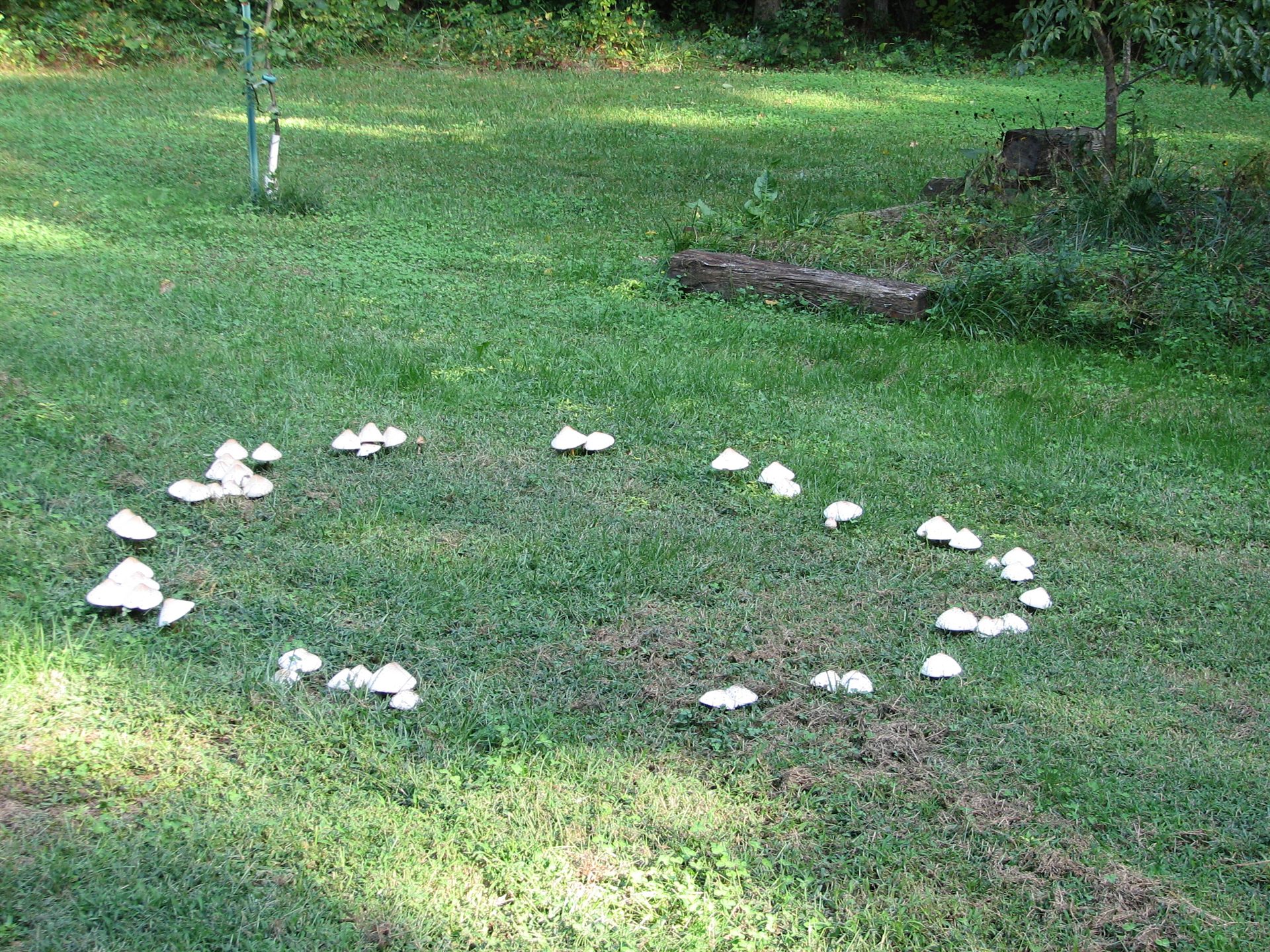
Pictured: a naturally occurring fungal "fairy ring," illustrating the conventional biological explanation some researchers have proposed for the Delphos ring — not a photograph of the Johnson farm itself. No public-domain or rights-clear image of the original 1971 ring is known to exist; the case's original news and investigative photographs remain under third-party copyright.
Theoretical Alignment
Delphos is, at its core, a chemistry dispute wearing a UFO sighting's clothes, and that shapes how it maps onto the standard hypotheses. The Extraterrestrial Hypothesis draws whatever support this case offers almost entirely from the ring's chemistry rather than from the sighting itself: a single teenage witness's account of a structured, glowing craft is the kind of report ufology logs by the thousands, but two chemical analyses, performed some two decades apart, both found a real, non-volatile organic surface coating on the ring soil that did not match untouched control soil nearby — a genuinely unusual, repeatable physical finding that keeps ETH alive here in a way pure testimony could not. It is capped at a modest 25%, however, because neither analysis found anything unambiguously non-terrestrial in the coating's actual chemical makeup; Budinger's later analysis identified compounds — fulvic acid, calcium oxalate — that occur naturally in ordinary soil biology. The Interdimensional Hypothesis finds little purchase in a case built entirely around a physical soil deposit and a conventional-looking craft description, earning only a residual score. The Psycho-Social Hypothesis explains the initial sighting about as well as it explains any single-witness account, but it cannot on its own explain a chemically distinct residue that two independent chemists, using period-appropriate laboratory methods decades apart, both measured directly from preserved physical samples — soil chemistry is not something eyewitness misperception can manufacture after the fact (though a deposit could have other origins), which is precisely why this case has survived on its physical evidence long after most single-witness 1970s sightings have faded from serious discussion.
Background
By November 1971, American ufology had spent nearly a quarter-century absorbing waves of eyewitness reports without ever settling on a body of physical evidence that both proponents and skeptics could examine together in a laboratory. Project Blue Book, the U.S. Air Force's public UFO investigation office, had closed nearly two years earlier in December 1969, leaving civilian organizations — the Aerial Phenomena Research Organization (APRO), the National Investigations Committee on Aerial Phenomena (NICAP), and, from 1973 onward, J. Allen Hynek's Center for UFO Studies (CUFOS) — to carry the burden of field investigation with no government funding or authority behind them. Within that landscape, a small but dedicated subset of investigators had begun arguing that eyewitness testimony alone, however sincere, could never resolve the UFO question, and that the field's future rested instead on cases that left something physical behind: scorched ground, broken vegetation, radiation traces, or chemically altered soil that could be sampled, preserved, and handed to a real laboratory.
The Johnson family — Durel and Erma Johnson and their teenage son Ronald — ran a modest sheep operation on a farm outside Delphos, a small farming community in Ottawa County, Kansas, about thirty miles north of Salina; the farm lay about a mile north and half a mile east of town, eleven miles north of the county seat of Minneapolis. Like the vast majority of families who would go on to report a UFO encounter, the Johnsons had no documented prior interest in the subject, no connection to any UFO organization, and nothing in their public history to suggest they were seeking attention. Ronald's evening chores that first Tuesday of November were as ordinary as farm life gets: working in the sheep pen after dark while his mother called him in to supper. Erma Johnson worked at a local rest home.
Complete Timeline
| Date | Event |
|---|---|
| December 1969 | Project Blue Book, the U.S. Air Force's public UFO investigation office, formally closes, leaving civilian organizations to carry out field investigation with no government backing. |
| November 2, 1971, ~7:00 PM | Ronald Johnson, 16, working in the sheep pen on the family farm near Delphos, Kansas, hears a rumbling sound and sees a brilliantly lit, multicolored object near a shelter belt of trees about 75 feet away. After several minutes it rises at a shallow angle with a jet-like sound, and he is briefly blinded. |
| Same evening | Ronald runs to the house; his father goes out and the family sees a bright light, "at least one half the apparent diameter of the full moon," receding due south. |
| Same evening | The family finds a glowing, doughnut-shaped ring of altered soil about 8 feet across, and parts of nearby trees glowing. Both parents touch it; Erma Johnson's fingertips (and her leg, where she wiped them) go numb for about two weeks, Durel's fingers for about four days. Erma photographs the glowing ring with a Polaroid camera. |
| November 3, 1971, noon | Thaddia Smith, reporter for the Delphos Republican, visits the farm and finds the ring "dried and crusted" while its center and the surrounding area are "still muddy from recent rains," a dead tree knocked down and a live limb broken. She calls the Concordia Weather Bureau (its radar was off) and KSAL radio in Salina, who refer her to the sheriff. |
| November 3, 1971, ~2:00 PM | Sheriff Ralph Enlow, Undersheriff Harlan Enlow and Kansas Highway Patrol Trooper Kenneth Yager visit the farm. Harlan Enlow takes a soil sample, "almost white in color and very dry," photographs the ring, and checks it with a Civil Defense radiological monitor (not radioactive). |
| November 3, 1971, evening | Smith and her husband return with the family after dark and see "very distinctly the glowing ring." |
| December 2–4, 1971 | J. Allen Hynek phones Ted Phillips about the case; Phillips visits on December 4, 32 days after the sighting. Unmelted snow still outlines the ring, the ring soil under it is dry and light brown while the surrounding soil is black and wet, and water poured on it will not soak in. He collects core samples. |
| 1972 | Phillips publishes "Landing report from Delphos" in Flying Saucer Review (Case Histories No. 9) and at the 1972 MUFON symposium, and a two-part "in depth investigation" in UFO Commentary. |
| 1973 | The National Enquirer's "Blue Ribbon Panel," whose members included J. Allen Hynek and plant physiologist Frank B. Salisbury, awards the Johnsons $5,000 for the most scientifically valuable UFO evidence of 1972. The family reportedly used the money to pay farm bills. |
| 1970s | Laboratory work on the ring soil reportedly finds a high concentration of Nocardia (order Actinomycetales), a filamentous bacterium; Phillips reports that plants grew in soil taken five feet from the ring but not in ring soil. |
| 1970s–1989 | British organic chemist Erol A. Faruk, then a postdoctoral researcher at the University of Nottingham, obtains ring soil through CUFOS and analyzes it with chemiluminescence specialist Frank Palmer; in 1989 he publishes "The Delphos Case: Soil Analysis and Appraisal of a CE-2 Report" in the Journal of UFO Studies (n.s. 1, pp. 41–65), identifying a water-soluble organic compound coating the ring soil. |
| September–October 1997 | Physicist Peter A. Sturrock convenes a scientific workshop at the Pocantico Conference Center in Tarrytown, New York, reviewing physical evidence associated with UFO reports, including ground traces. |
| December 7, 1998 | Ring and control soil samples, located on Thanksgiving Day 1998 in John Timmerman's attic, where he had kept them after CUFOS's Chicago office closed, reach analytical chemist Phyllis A. Budinger for renewed analysis at the request of Ted Phillips's Center for Physical Trace Research. |
| 1999 | Budinger's Technical Service Response UT001 (addendum dated January 27, 1999; report dated August 9, 1999) identifies the ring soil's non-volatile coating as about 85% humic substance (probably fulvic acid) and 5% calcium oxalate, and concludes that "the analysis neither proves nor rules out a UFO source of the release." |
| 2014 | Erol Faruk self-publishes The Compelling Scientific Evidence for UFOs: The Analysis of the Delphos, Kansas UFO Landing Report (CreateSpace, November 2014), with a foreword by Michael D. Swords. |
Tending Sheep at Dusk: Ronald Johnson's Sighting
Ronald Johnson's account, as Ted Phillips recorded it a month later, begins with nothing more dramatic than an ordinary farm chore. Around seven o'clock on the evening of November 2, 1971 — well after sunset; the Sun was 18° below the horizon and a nearly full Moon was about 20° up in the east (NASA JPL Horizons) — the sixteen-year-old was working in the sheep pen with his dog when his mother called him in to supper. He "heard a rumbling sound and saw a brilliantly illuminated object" near a shelter belt of trees behind a shed, about seventy-five feet away; neither he nor the dog had noticed it before the sound. The object "was illuminated from top to bottom by multi-colored light," blue, red and orange, "not from individual lights, but rather from a mass of varied colors over the entire surface." He could see no metallic surface, but made out a shape "slightly domed at the top and base, with a slight bulge at the center, and a bright glow between the base and ground," about nine feet across and ten feet high. "At no time did the witness see the object touch the ground." Its light lit up the trees and hurt his eyes, and he "likened the sound to that of an old vibrating washing machine."
After several minutes, the object brightened and enlarged at the base, then rose "at considerable speed at approximately a 25° angle," passing about four feet over a nearby shed; the sound became a high-pitched, jet-like whine, and Ronald went blind for what seemed several minutes. When his sight returned he saw the object in the sky and ran to the house. Phillips put the whole sighting at "two to five minutes." The earliest written accounts are simpler: the undersheriff's report of November 3 says Ronald "heard a loud noise and saw a bright light coming from a shelter belt behind a hog house" that "rose into the sky and left in a southerly direction," and the reporter who interviewed him that noon wrote of "a blinding, brilliant light" and "a loud rumbling sound that turned into a sound similar to a jet engine." Neither mentions the object's shape.
The Object Departs and the Ring Is Found
By Phillips's account, Durel and Erma Johnson did not believe their son at first. Durel went outside and saw a bright light in the southern sky, and all three watched it, "at least one half the apparent diameter of the full moon" and "the color of an arc welder," as it shrank into the distance. Neither parent saw the object near the ground. They then walked around the shed to the spot and saw, in the darkness, a glowing circle: "The soil surface glowed a bright gray-white. Portions of nearby trees also glowed." The ring was about eight feet across. The reporter Thaddia Smith, who saw it the next day, described the dried band as "about a foot across and very light in color," with the center of the ring and the area outside "still muddy from recent rains." The glow was not seen only by the family: Erma took a Polaroid photograph of it that night, and Smith and her husband, returning with the Johnsons after dark on November 3, "could see very distinctly the glowing ring."
Smith and the officers who came on November 3 also found a dead tree knocked to the ground and a live limb broken off a nearby tree, green under the break but snapping "as though it had been dead for some time," with bark that "looked as though it had been blistered." Phillips later mapped the trees and argued that an object of the size described could have come in and gone out between them, while noting that the dead tree could have been pulled over by a tractor; he found no chain marks, and he and the sheriff both doubted it.
Numbness, Nightmares, and a Family's Physical Aftermath
What elevated the Delphos case beyond a visual sighting with an odd ground mark was the family's own physical reaction to the ring material. Both parents touched the ring surface, which "felt strange, like a slick crust, as if the soil had been crystallized." Erma Johnson "noticed an immediate numbing at her fingertips"; when she rubbed her hand on her leg, that patch of skin went numb too. She likened it to a local anesthetic, and it kept her from taking pulse readings on patients at the rest home where she worked for about two weeks. Durel's fingers were numb for about four days. Ronald told Phillips that "for several days following the incident his eyes hurt and he suffered from headaches"; later press accounts add nightmares.
These physiological effects sit at an awkward evidentiary midpoint: they are exactly the kind of detail proponents cite as evidence the family encountered something physically real, since a purely visual misperception would not obviously explain contact numbness. At the same time, no medical record of them has been published, all were reported by the same family whose testimony is already central to the case, and Budinger's 1999 finding that the ring coating contained calcium oxalate — which, with oxalic acid, she noted is a known skin and eye irritant — offers a plausible, non-exotic chemical explanation for the numbness, whatever ultimately explains how that compound came to be on the ring.
Undersheriff Enlow, Trooper Yager, and the First Official Investigation
Unlike many rural UFO reports that never reach any official channel, the Johnsons' account was examined by Ottawa County law enforcement the next day. The reporter Thaddia Smith phoned the sheriff's office at about 1:30 PM on November 3, and at about 2:00 PM Sheriff Ralph Enlow, Undersheriff Harlan Enlow and Kansas Highway Patrol Trooper Kenneth Yager went to the farm. Harlan Enlow's report describes "a ring shaped somewhat like a donut with a hole in the middle. The ring was completely dry with the hole in the middle and outside of the ring mud." The officers saw the broken limbs and "a slight discoloration on the trees," were shown Erma's Polaroid "which showed that the ring glowed in the dark," and Harlan Enlow took a soil sample ("almost white in color and very dry") and photographs, 19 hours after the sighting. A Civil Defense radiological monitor showed the soil was not radioactive. The sample and photographs went into the sheriff's vault; a month later the sheriff gave Phillips the sample. Sheriff Ralph Enlow wrote that the Johnsons "are well known and respected by Officers from this Department. In the opinion of this Officer any information given by them would be accurate to the best of their knowledge." That on-the-record assessment speaks to the ring's physical existence and the family's apparent sincerity, not to what produced either one.
Ted Phillips and the Physical-Trace Case Tradition
Ted Phillips learned of the case from J. Allen Hynek in a phone call on December 2, 1971, and reached the Johnson farm on December 4 — thirty-two days after the sighting. He had been specializing in physical ground-trace cases at Hynek's suggestion. What Phillips found on his first visit was a ring still clearly defined more than a month after the encounter: "The unmelted snow perfectly outlined the ring." Under the snow the ring soil was "dry, light brown," in contrast to the black, moist soil in the ring's center and around it, and when he and Durel Johnson poured water onto it, "the soil would not permit the water to pass through the surface" — despite "several inches of rain and snow between November 2nd and December 4th." He took core and bulk samples, finding a white substance throughout the ring soil but not outside it, and observed the site over seventy-one days. His reports appeared in 1972 in Flying Saucer Review, the MUFON symposium proceedings and UFO Commentary. His broader career-defining project, the 1975 CUFOS-published catalog Physical Traces Associated with UFO Sightings: A Preliminary Catalog, situated Delphos within a growing database of ground-trace reports Phillips continued expanding across the following decades, ultimately amassing thousands of catalogued incidents and helping to establish trace-case investigation as a distinct methodology within a field otherwise dominated by testimony collection. Phillips concluded in 1972 that "there is considerable evidence which would seem to confirm the unusual event described by the witnesses," and his consistent public position was that Delphos represented one of the best-documented physical-trace cases on record — a case that, whatever ultimately explained it, had generated real, preserved, laboratory-testable material rather than only memory.
The Ring That Would Not Melt
Among the case's most-cited details is the ring's behavior under snow — often told the wrong way round. When Phillips arrived on December 4, the snow had begun to melt, but "the unmelted snow perfectly outlined the ring": snow lay on the ring while the surrounding soil was dark and wet. Faruk's later summary puts it the same way: the ring soil had become impervious to water, so that when snow fell "there was no absorption by the ring, leaving only a snow-covered shape while all around was dark muddy soil." Proponents read this as consistent with the hydrophobic coating later confirmed chemically: water from melting snow could not soak into the ring, while it drained into the ground around it. Skeptics note that compacted or otherwise disturbed ground can also shed or hold snow differently for ordinary reasons, and no thermal measurement was taken. What is not in dispute is that the ring's outline persisted for weeks, observed by Phillips and the sheriff as well as the family.
Erol Faruk and the First Detailed Chemical Analysis
Erol A. Faruk, a London-born British organic chemist, requested ring soil from CUFOS in the 1970s while doing postdoctoral research at the University of Nottingham. His supervisor, B. W. Bycroft, referred him to the department's chemiluminescence specialist, Frank Palmer, who recorded fluorescence spectra as the work went on. The analysis was published in 1989 as "The Delphos Case: Soil Analysis and Appraisal of a CE-2 Report" in the Journal of UFO Studies (n.s. 1, pp. 41–65), CUFOS's refereed journal. Faruk Faruk identified a highly water-soluble organic compound coating the ring soil — described in his analysis as an alkali-metal salt of an organic carboxylic acid, with properties he characterized as potentially chemiluminescent, meaning capable of producing light through a chemical reaction rather than combustion or electrical excitation. Faruk explicitly considered and weighed the two leading conventional alternatives in his own published analysis: a deliberate hoax, which he judged unlikely given the compound's unusual chemical characteristics and the deposit's elongation toward the wind direction that night (the sheriff's photograph, taken 19 hours later, shows the ring apparently spreading to the southeast), and a naturally occurring fairy-ring fungal growth, which he argued the compound's specific chemistry did not straightforwardly explain either. His conclusion, stated with more confidence than most subsequent researchers have been willing to commit to, favored an extraordinary origin for the coating. Faruk's later, self-published 2014 book, The Compelling Scientific Evidence for UFOs: The Analysis of the Delphos, Kansas UFO Landing Report — with a foreword by Michael D. Swords, not a co-authored text — revisited his original findings and the rejection of his paper by mainstream journals.
The National Enquirer's $5,000 Award and the Hoax Question
No account of Delphos is complete without confronting its most persistent shadow: money. In 1973 the National Enquirer's "Blue Ribbon Panel" of UFO consultants, whose members included J. Allen Hynek and Utah State University plant physiologist Frank B. Salisbury, awarded the Johnson family $5,000 for what it judged the most scientifically valuable UFO evidence of 1972. The family reportedly used the money to pay off farm bills. The prize inevitably invited the obvious skeptical reading: a farm family stages a story and a ring for a cash reward. Researchers sympathetic to the case point to the timing as a rebuttal: the Johnsons told a reporter and the sheriff's office the day after the sighting, and the award came some eighteen months later. That makes a hoax aimed at this particular award hard to argue, though it does not rule out a hoax for other reasons, or a family that told the truth and was rewarded for it later. Skeptic Philip J. Klass later used the Enquirer panel's cash awards, Delphos among them, as an example of the financial incentives surrounding "best cases."
Phyllis Budinger's 1999 Re-Analysis
The case's physical evidence might have ended with Faruk's 1989 paper had the original soil samples not survived. Ring and control samples, in their original film containers, were found on Thanksgiving Day 1998 in the attic of John Timmerman, who had kept them after CUFOS's Chicago office closed, and reached analytical chemist Phyllis A. Budinger on December 7, 1998. Working for Ted Phillips's Center for Physical Trace Research, Budinger used techniques unavailable in the 1970s, among them FT-IR, SEM/EDX, headspace GC/MS, NMR and ion chromatography. Her Technical Service Response UT001 (with an addendum dated January 27, 1999; report dated August 9, 1999) stresses that the soils had been sampled about two months after the event and stored for 27 years. She concluded that "there has been a definite release of material," agreeing with Faruk that it was "most probably deposited as an aqueous solution." The non-volatile material, about 2–3% of the ring soil by weight, coats the soil particles and still made the soil water-repellent. By her estimate it was about 85% (±10%) humic substance, "probably low molecular weight fulvic acid," resembling the mull-type humus of biologically active soils; about 5% (±2%) calcium oxalate; about 1% calcium carbonate; and traces of phosphate, sulfate and sulfide or mercaptan (a possible source of the foul odor some reported). Adding water and shaking dissolved the coating and the soil "readily loses its 'apparent' hydrophobic effect." She found no sign the soil had been exposed to high temperature, leaned toward the view that the fulvic acid was part of the original release rather than a later decomposition product, and noted that calcium oxalate and oxalic acid "are known skin and eye irritants and could account for the physical effects suffered by the witnesses." Her bottom line: "The analysis neither proves nor rules out a UFO source of the release." The report also prints a colleague's openly speculative suggestion that the oxalic acid could be exhaust from an engine burning elemental carbon.
The Sturrock Panel and the Wider Scientific Reception
In late September and early October 1997, physicist Peter A. Sturrock convened a four-day scientific workshop at the Pocantico Conference Center in Tarrytown, New York, under the auspices of the Society for Scientific Exploration, bringing together a panel of physical scientists to review the strongest available physical evidence associated with UFO reports — ground traces, radar returns, photographic material, and physiological effects among them — and assess whether continued investigation of such evidence was likely to be scientifically productive. The workshop's proceedings were published the following year, and Sturrock later distilled the project into his own 1999 book, The UFO Enigma: A New Review of the Physical Evidence. Ground-trace evidence of the Delphos type fell within the categories the panel examined, though this file has not confirmed whether Delphos itself was presented there. The panel's own broader published conclusion was measured rather than triumphant: physical evidence of the kind Delphos represents was judged worth further study, not proof of anything, an assessment that maps closely onto how the Delphos soil chemistry itself has been received — genuinely unusual, genuinely worth taking seriously, and genuinely short of a decisive answer.
Skeptical Counter-Explanations: Fungus, Fairy Rings, and the Sheep Trough
Two distinct conventional explanations have been proposed for the ring itself, independent of the hoax question, and both deserve to be taken seriously on their own terms rather than dismissed reflexively. The first traces back to the white material Phillips found throughout the ring soil, which laboratory work reportedly showed to contain an unusually high concentration of Nocardia, a filamentous, gram-positive bacterium of the order Actinomycetales with a fungus-like growth habit. Accounts of the case in the UFO literature note that such organisms are sometimes found growing with fungi that can be fluorescent — raising the possibility that some triggering event, not necessarily anything exotic, spurred an unusually rapid, ring-shaped colonization of these organisms at that specific spot and moment. This is, in effect, a scientifically informed version of the much older "fairy ring" folk explanation for circular marks in grass and soil, which are in fact a well-documented natural phenomenon caused by fungal mycelium spreading outward from a central point. The difficulty for this explanation, acknowledged even by researchers otherwise sympathetic to a biological origin, is that it does not straightforwardly account for the ring's reported glow on the night of the sighting, its specific coincidence with the timing of Ronald Johnson's encounter rather than appearing independently at some unconnected point in the growing season, its unusually rapid appearance rather than the gradual weeks-to-months development typical of a genuine fairy ring, or the family's numbness and eye irritation.
The second leading conventional theory, often attributed to skeptics including Philip J. Klass (this file has not confirmed the attribution in Klass's own writing), proposes a far more mundane origin: that the ring marks where a circular feeder or trough once stood, with animal waste accumulating around its base. A 2017 version of the idea cited a neighbor's claim that a galvanized iron chicken feeder had once stood at the spot. On this reading the ring soil's altered chemistry and circular shape resulted from years of accumulated waste around a feeder that had once stood at that spot on the property, with mineral and organic residue building up in a ring pattern around the trough's base long before the trough itself was removed, leaving a chemically distinct circle in the soil that happened to be where Ronald Johnson later reported seeing his object. This explanation has the appeal of requiring no fungal growth spurt, no glow, and no unusual chemistry beyond ordinary livestock waste accumulation — but researchers who examined the site, including Faruk, have argued it struggles to explain the specific chemical profile the 1999 Budinger analysis actually documented, since calcium oxalate and fulvic-acid-dominated coatings are not the signature analysts would most readily expect from long-term sheep urine deposition, and it offers no mechanism at all for the reported glow, the family's contact numbness, or the ring's sudden, dated appearance on a single specific night rather than a gradual accumulation with no clear starting point. Neither the fungal-ring theory nor the feeder theory has ever been definitively confirmed against the site's actual physical layout or ruled out by a direct, independent test; both remain live, unresolved candidates precisely because no one — proponent or skeptic — has ever produced the kind of dispositive follow-up study that would settle the matter either way.
Legacy: Delphos in the Physical-Trace Case Tradition
More than fifty years on, Delphos occupies a specific and durable niche in ufology's own internal hierarchy of evidence: not among the most spectacular sightings, and not among the cases with the largest number of witnesses, but consistently cited by researchers as one of the field's best examples of a genuinely reproducible, laboratory-testable physical trace. It appears in Jerome Clark's UFO Encyclopedia and in Jacques Vallée's published casework, was the subject of dedicated reports in Flying Saucer Review, MUFON proceedings and the Journal of UFO Studies, and remains a frequent reference point whenever researchers discuss what a genuinely well-documented physical-trace case ought to look like. Kansas regional press has continued to describe Delphos as the best UFO evidence to emerge from the state. Some retrospective accounts, drawing on 1973–74 Salina Journal reporting, say Ronald was teased at school and dropped out, and that he later reported premonitions — a claim considerably less rigorously documented than the case's physical evidence and one this catalogue treats as a loosely sourced personal account rather than an established fact. Accounts also say the site was fenced in 1973 after souvenir hunters took samples, and that the family later covered the ring to discourage visitors — a quiet, practical ending for a case whose central piece of evidence spent most of its existence being measured, sampled, and argued over rather than simply left alone.
Circumstantial Evidence
- Ottawa County Undersheriff Harlan Enlow and Sheriff Ralph Enlow, with a Highway Patrol trooper, examined and photographed the ring 19 hours after the sighting, describing it in terms matching the family's account; Erma's Polaroid from the night before showed the ring glowing.
- A Civil Defense radiological monitor showed the soil was not radioactive, ruling out one specific category of contamination while leaving the ring's actual chemistry unexplained.
- A reporter and her husband saw the ring glowing in the dark on the evening of November 3, so the glow does not rest on the family alone.
- The ring's dry, crusted, water-repellent character and general shape were independently confirmed by multiple parties — family, local press, law enforcement, and Ted Phillips — over a period of weeks, rather than resting on a single account.
- The ring was still outlined by unmelted snow, with dry soil beneath, thirty-two days after the sighting, a level of physical persistence unusual among reported UFO ground traces.
- Two chemists, working some two decades apart with different laboratory methods, both confirmed a genuine, non-volatile organic surface coating on preserved ring soil that did not match control soil from just outside the ring.
- The National Enquirer's $5,000 award came about eighteen months after the Johnsons had reported their sighting to the press and sheriff, complicating a hoax aimed at that award.
- Neither leading conventional counter-theory — the fairy-ring/Actinomycetales explanation or the feeder theory — has ever been definitively confirmed against the site's documented chemistry, leaving both live but unproven.
Key Witnesses
Ronald Johnson
Sixteen years old at the time, Ronald was working in the sheep pen when he heard a rumbling and saw a brilliantly lit, multicolored object, domed top and bottom, about seventy-five feet away near a shelter belt of trees. He was the only witness to the object near the ground; his parents saw only a bright light receding to the south. He was briefly blinded as it left, and told Phillips his eyes hurt and he had headaches for several days; later accounts add nightmares. Phillips noted that, "contrary to some published reports," Ronald did not claim the object was a spaceship.
Durel & Erma Johnson
Alerted by their son, Durel and Erma Johnson saw a very bright light to the south, "at least one half the apparent diameter of the full moon," receding into the distance. Together with Ronald, they then found the glowing soil ring, and Erma photographed it with a Polaroid. Both touched the ring: Erma's fingertips went numb for about two weeks (she could not take pulses at the rest home where she worked), Durel's for about four days. Neither parent saw the object near the ground.
Ted Phillips
Sent by J. Allen Hynek, Phillips arrived at the Johnson farm on December 4, 1971 — thirty-two days after the sighting — and documented the ring outlined by unmelted snow, its dry, light-brown, water-repellent soil, and the damaged trees, observing the site over seventy-one days. He published his findings in 1972 and situated the case within his broader career-defining catalog of physical ground-trace reports, Physical Traces Associated with UFO Sightings (1975), which helped establish trace-case documentation as a distinct methodology within UFO field investigation.
Erol A. Faruk
A British organic chemist, Faruk obtained Delphos ring soil through CUFOS while a postdoctoral researcher at the University of Nottingham, analyzed it in the 1970s with chemiluminescence specialist Frank Palmer, and published the case's first detailed chemical analysis in the Journal of UFO Studies in 1989, identifying a water-soluble organic compound coating the ring soil that he judged difficult to explain as either a simple hoax or an ordinary fungal fairy ring. His 2014 book (with a foreword by Michael D. Swords), The Compelling Scientific Evidence for UFOs, revisits his findings.
The Five Observables Assessment
The Five Observables framework, developed by former AATIP director Luis Elizondo, is designed to classify witnessed UAP flight performance against the limits of known technology. Delphos is a poor structural fit for that framework, and it is worth saying so plainly: this is a landed, physical-trace case built around a brief, close-range hover and departure witnessed primarily by one teenager, not an instrumented flight-dynamics event with tracked speed, altitude, or maneuvering data. Most of the standard performance observables below were simply never measured or reported by anyone, rather than genuinely absent from an observed craft, and the assessment reflects that honestly rather than inferring flight characteristics no instrument or trained observer ever recorded.
Assessment: Anti-Gravity Lift is rated speculative rather than present because the object was described as hovering, never touching the ground, with only "a bright glow between the base and ground" — consistent with a genuinely novel lift mechanism, but based entirely on one witness's visual impression rather than any instrumented measurement, and equally consistent with a much more mundane light source at close range. Instant Acceleration is similarly speculative: Ronald Johnson described the object's final climb and departure as rapid and accompanied by a dramatic increase in brightness, but no timed or instrumented measurement of its actual speed exists. Hypersonic Velocity is rated absent, since no witness made any claim of extreme speed comparable to cases involving trained aviation observers. Low Observability is rated absent, since the object was, by every account, extremely bright and conspicuous rather than stealthy. Trans-Medium travel does not meaningfully apply to a case in which the entire reported event took place near ground level over farmland with no medium transition of any kind — a marker of the case's fundamental category, a landed CE2 physical-trace report, rather than a flight-performance data point. The larger point stands: Delphos's evidentiary weight rests almost entirely on what was left on the ground after the object departed, not on any performance characteristic of the object itself while it was in the air.
Evidence Assessment
Supporting Anomalous Origin
- Ottawa County law enforcement examined, photographed, and sampled the ring the next afternoon, corroborating its physical existence and basic description without having witnessed the object; a reporter and her husband saw it glowing the next night.
- The ring persisted, visibly and physically distinct from surrounding ground, for weeks, still outlined by unmelted snow with dry soil beneath it thirty-two days after the sighting.
- Erol Faruk's analysis (published 1989) and Phyllis Budinger's 1998–99 re-analysis, using different laboratory methods some two decades apart, both confirmed a genuine, non-volatile organic coating on the ring soil not present in control soil nearby.
- The sheriff wrote that "any information given by them would be accurate to the best of their knowledge," and Phillips, after seventy-one days of site visits, found "considerable evidence which would seem to confirm the unusual event described by the witnesses."
- The National Enquirer's award came about eighteen months after the family reported the sighting to the press and sheriff, complicating a hoax aimed at that award.
Supporting Conventional Explanation
- The sighting of the object itself rests on a single sixteen-year-old witness, and the earliest written accounts (November 3) describe only a bright light and loud noise rising from the trees; his parents saw only a distant light.
- The family ultimately received a $5,000 National Enquirer prize for the case, a real and eventually substantial financial incentive, however imperfectly timed relative to the original report.
- Laboratory work reportedly found a high concentration of Nocardia (order Actinomycetales) in the ring soil, an organism associated with fungi that can be fluorescent.
- The feeder hypothesis offers a fully mundane mechanism — waste accumulating around a since-removed circular feeder — requiring no exotic explanation for the ring's basic chemistry or shape.
- Phyllis Budinger's 1999 analysis identified the ring coating's dominant component, fulvic acid, as a common humic substance and explicitly stated the findings "neither prove nor rule out" an extraordinary origin.
- No independent, controlled test has ever directly compared the ring's specific chemistry against either a documented natural Actinomycetales colonization or an actual sheep-trough residue sample from a comparable Kansas farm site.
Why "Disputed"
The Delphos Ring Sighting earns a DISPUTED classification because it is a case defined, more than almost any other in this catalogue, by real and repeatable laboratory evidence sitting in genuine, unresolved tension with equally credible conventional alternatives. On the strength side: this is not a case of memory alone. A ring of physically altered soil was examined and photographed by Ottawa County law enforcement the day after the sighting, and seen glowing that night by a reporter; it persisted for weeks, still outlined by unmelted snow a month later; and two separate chemists, working with preserved physical samples using different analytical methods some two decades apart, both confirmed — independently of the family's testimony — that the ring soil carried a genuine, non-volatile organic coating that did not match soil taken from immediately outside its boundary. That level of repeatable, laboratory-confirmed physical evidence is rare in ufology, and it is the single strongest reason this case has remained a reference point for physical-trace researchers for more than fifty years. On the other hand, the sighting itself rests on one sixteen-year-old witness for its most important details, and the earliest written accounts describe only a bright light and a loud noise; his parents saw only a distant light; a real financial incentive entered the picture within two years of the event, however imperfectly its timing maps onto a premeditated hoax; and neither leading conventional explanation for the ring — a rapid, coincidentally timed fungal/Actinomycetales growth event, or residue from a since-removed feeder — has ever been rigorously tested against the site and definitively eliminated, even by the researchers most sympathetic to an extraordinary explanation. Faruk's 1989 analysis favored an extraordinary origin; Budinger's more cautious 1999 re-analysis agreed a definite release of material had occurred but concluded it "neither proves nor rules out a UFO source." That is precisely the profile of a genuinely disputed case — not a case built on weak or absent evidence, but one built on strong, specific, still-unreconciled evidence that credentialed researchers on multiple sides have examined directly and still cannot fully agree on.
Sensor & Instrumentation Detection Profile
No radar, camera, or government sensor of any kind recorded the Delphos encounter as it happened; Project Blue Book had already closed in December 1969, and no military or civil aviation facility was in a position to track a low-altitude object over rural Ottawa County farmland; the Concordia Weather Bureau told the reporter its radar had not been on that night. The case's only "instrumentation" arrived after the fact, in the hands of investigators examining what the object left behind. Ottawa County Undersheriff Harlan Enlow and Sheriff Ralph Enlow checked the ring with a Civil Defense radiological monitor on November 3 and found it was not radioactive, a negative finding that at least ruled out one category of contamination. Every other piece of analytical instrumentation applied to this case came far later and was aimed not at the object but at the soil: Erol A. Faruk's 1970s organic-chemistry workup at the University of Nottingham (published 1989), and chemist Phyllis A. Budinger's 1998–1999 re-analysis of preserved samples using techniques including FT-IR, GC/MS and SEM/EDX. That both analyses were performed on soil rather than on any recording of the object itself is the single most important structural fact about this case: Delphos is not an instrumented sighting in the way a radar-visual case is; it is an instrumented aftermath, and everything the case can actually prove or disprove runs through the chemistry of what was left on the ground rather than through any direct measurement of what Ronald Johnson said he saw.
Environmental & Geospatial Context
The Johnson farm sat in the gently rolling wheat and sorghum country of Ottawa County, Kansas, a sparsely populated agricultural county in the Smoky Hills region north of Salina, with the small community of Delphos itself — population well under a thousand even at its historical peak — a short drive away. At 7:00 PM on November 2 it was fully dark — the Sun was 18° below the horizon — and a nearly full Moon (99.8% illuminated) stood about 20° above the eastern horizon (NASA JPL Horizons), well away from the light the family saw receding due south. The reporter who visited the next day found the farmyard "still muddy from recent rains," which made the dry, light-colored ring stand out sharply; Phillips later found the ring soil dry to at least a foot down, while soil outside was wet to at least eight inches. On December 4 the snow had begun to melt everywhere but on the ring, which it still outlined. The site lay about 250 feet north of the farmhouse, behind a low shed in a shelter belt of trees, where investigators found a dead tree knocked down and a broken live limb. No nearby military installation, airport, or industrial facility offers an obvious source of stray radar, aircraft lighting, or chemical runoff; Ottawa County in 1971 was, and remains, thinly populated ranch and farm country with little to explain an isolated bright light other than the ordinary rural traffic of the era.
Observer Credibility & Occupational Profile
The case's evidentiary weight rests heavily on a single family with no prior involvement in ufology and no obvious motive to fabricate a story at the moment it happened. Ronald Johnson, sixteen years old and engaged in the utterly mundane task of moving sheep at dusk, was the only witness to the object's full approach and hover; his parents, Durel and Erma Johnson, saw only a bright light, "the color of an arc welder," receding to the south after Ronald ran to fetch them. That distinction matters for how the case should be weighed: it is not a three-witness sighting of the full event, but a one-witness sighting of the encounter corroborated by a two-witness sighting of its departure, plus a family-wide sighting of the physical aftermath. None of the three had any documented history of UFO interest before that November evening, and they told a local reporter the next day, which brought the sheriff out that afternoon. Their openness to official scrutiny is generally read by proponents as a point in their favor. Working against that credibility profile is the same complication that shadows several of ufology's best-known trace cases: in 1973 the National Enquirer's "Blue Ribbon" panel of UFO consultants awarded the family $5,000 for what the panel judged the most scientifically valuable UFO evidence of 1972, a financial reward that came long after they first reported the sighting. Ted Phillips, who visited the family repeatedly over the following years as part of his broader physical-trace research, described them as "typical residents of the Midwest," "very pleasant and calm," and noted that Ronald did not claim the object was a spaceship.
Physical & Material Assays
Delphos is defined by its physical evidence in a way few UFO cases are: rather than a photograph or a radar track, the record consists of an actual, sampled, laboratory-analyzed patch of altered soil that multiple investigators examined in person over a period of years. The ring itself was roughly eight feet in diameter, a dry, light-colored band about a foot wide shaped like a doughnut, with muddy ground both in its center and outside it. Witnesses and early investigators described the ring soil as slick and crusted, almost as though crystallized, and it glowed after dark on the night of the sighting and again the following night, when a reporter saw it. Undersheriff Harlan Enlow collected a soil sample and photographed the ring 19 hours after the sighting; Ted Phillips's more detailed physical-trace examination, beginning with his first visit on December 4, 1971 — thirty-two days after the sighting — documented that the ring remained clearly defined, water-repellent, and outlined by unmelted snow while the ground around it was bare and wet. Decades later, two independent chemists working from preserved samples of that same soil — Erol A. Faruk in analysis published in 1989, and Phyllis A. Budinger in a 1999 technical report (addendum dated January 27, 1999; report dated August 9, 1999) — both confirmed that the ring soil carried a genuine non-volatile organic coating, distinct from surrounding control soil, that repelled water on contact. Budinger's more detailed 1999 breakdown identified that coating as roughly 2–3% of the ring soil's total weight, composed mostly of fulvic acid (a common humic substance associated with biologically active soil) alongside a smaller fraction of calcium oxalate, a compound recognized as a tissue irritant that could plausibly account for the family's reported numbness and eye irritation. Faruk favored an extraordinary origin; Budinger concluded her analysis "neither proves nor rules out a UFO source." Both established that something real and chemically identifiable had been deposited on the ring's surface, and that it did not match soil taken from just outside the ring's boundary.
Historical Precedents & Archive Matches
Delphos belongs to a specific, well-defined sub-genre of UFO reporting: the Close Encounter of the Second Kind, or CE2, in which a witnessed object leaves a measurable physical trace rather than only a visual impression. It is frequently discussed alongside the 1964 Socorro landing, in which police officer Lonnie Zamora reported scorched, indented landing-leg marks distinct enough that they were plaster-cast and measured by Air Force investigators, and the 1980 Rendlesham Forest case, whose disputed ground impressions and radiation-reading controversy raise many of the same physical-evidence-versus-conventional-explanation questions Delphos does. It is also regularly grouped with two other internationally significant trace cases in this catalogue — the January 1966 Tully, Australia "saucer nests" case, in which flattened, swirled reed beds became a template for physical-trace investigation in the Southern Hemisphere, and the January 1981 Trans-en-Provence sighting in France, whose GEPAN-commissioned soil analysis for the French space agency CNES is frequently cited as Delphos's closest international analogue in methodology. Within American ufology specifically, Ted Phillips's own 1975 CUFOS-published catalog, Physical Traces Associated with UFO Sightings, placed Delphos among a growing database of documented ground-trace reports that Phillips continued to expand for decades, establishing physical-trace analysis as a distinct, if still marginal, sub-discipline within UFO investigation separate from eyewitness case collection.
Material Analysis
Delphos's entire evidentiary case rests on the material analysis of its soil ring, making this section functionally the heart of the file. The ring's basic physical description — a roughly eight-foot doughnut-shaped patch of dry, crusted, water-repellent soil sharply distinct from muddy surrounding pasture — was documented by Ottawa County law enforcement the next day and by Ted Phillips within thirty-two days, then examined chemically twice: first by Erol A. Faruk (published 1989), and again by Phyllis A. Budinger's more granular 1998–1999 re-examination of preserved samples using updated laboratory methods. Both chemists, working decades apart, agreed on the central physical fact: a real, non-volatile organic coating existed on the ring soil's surface and was measurably different from soil taken just outside the ring's boundary. Where they diverged was in confidence about what that finding meant. Faruk's original 1989 paper leaned toward treating the compound's specific properties as difficult to reconcile with either a simple hoax or an ordinary fairy ring. Budinger's 1999 breakdown, working with more advanced instrumentation, identified the coating's actual chemical composition — predominantly fulvic acid, a substance common in biologically active soil, plus a smaller fraction of the known irritant calcium oxalate — and explicitly declined to call the finding proof of anything beyond its own chemistry, while leaning toward the view that the fulvic acid was part of the original deposit rather than later decomposition.
Supporting a Genuine Anomaly
- Two chemists, using different methods two decades or more apart, both confirmed the same basic finding: a real organic coating on ring soil not present in nearby control soil.
- Budinger found the coating had been deposited as an aqueous solution and leaned toward the fulvic acid being part of the original release; the ring soil showed no sign of heating.
- The ring's physical persistence for weeks, still outlined by unmelted snow a month later, exceeds what most reported UFO ground traces demonstrate.
Supporting a Natural or Mundane Origin
- The coating's dominant identified component, fulvic acid, is a common, naturally occurring humic substance rather than an exotic or unidentifiable compound.
- Calcium oxalate, the coating's second-largest identified component, is a compound many fungi and plants naturally produce, lending some support to a biological growth-based explanation.
- Phyllis Budinger's own 1999 report explicitly concluded the analysis "neither proves nor rules out" an extraordinary source for the material.
Conventional Explanation Candidates
Three distinct terrestrial explanations have been proposed for the Delphos case across more than fifty years of investigation, and each deserves individual evaluation on its own merits rather than being treated as a single undifferentiated "skeptical" position.
1. A Naturally Occurring Fairy Ring / Actinomycetales Growth Event
The first candidate holds that the ring resulted from a rapid, localized colonization of Actinomycetales — the filamentous, fungus-like bacterial order to which the Nocardia reportedly found in the ring soil belongs — potentially growing in the kind of ring pattern long documented in ordinary fairy-ring fungal growth, and possibly associated with a fluorescent fungus that could account for the reported glow. It deserves serious consideration because fairy rings are a real, common, well-studied natural phenomenon, and because a laboratory finding, not speculation, lies behind it (though the original lab report has not been located for this review).
Where the Fairy-Ring Theory Falls Short
Its central weakness is timing and speed. Genuine fairy rings typically develop gradually, over weeks to months or years, as fungal mycelium spreads outward from a central point; the Johnsons' ring, by every account, appeared coincident with a single specific evening's sighting, not as a slow, independently observable process the family would have noticed developing beforehand. The theory also does not naturally explain the reported glow witnessed that first night, nor the family's contact numbness, nor why Budinger found the deposit had been laid down as an aqueous solution.
2. Residue from a Former Feeder or Trough
The second candidate, often attributed to skeptics including Philip J. Klass, proposes that the ring's chemistry and shape resulted from animal waste accumulating around a since-removed circular feeder or trough that had stood at that location (a 2017 version cites a neighbor's claim of a galvanized chicken feeder), leaving behind a chemically altered, roughly circular deposit long before Ronald Johnson's sighting. This explanation requires no unusual biological or chemical process at all, only ordinary, well-documented livestock behavior compounding over time.
Where the Feeder Theory Falls Short
Proponents argue that a fulvic-acid- and calcium-oxalate-dominated coating is not the profile one would most readily expect from accumulated animal waste, and the theory offers no account at all for the ring's reported glow, its precise coincidence with the date of the sighting rather than a slow, undated accumulation, or the family's numbness on contact.
3. A Hoax Motivated by the National Enquirer Prize
The third candidate holds that the Johnson family fabricated the sighting and physically staged the ring, whether using a chemical agent or some other deliberate method, in pursuit of publicity or financial reward. This candidate deserves consideration precisely because the family did, in fact, ultimately receive a substantial $5,000 prize tied directly to this case, and financial motive is among the most common explanations for staged UFO evidence generally.
Where the Hoax Theory Falls Short
Its central weakness is chronology: the Johnsons told a reporter and the sheriff the day after the sighting, about eighteen months before the Enquirer's award, and the ring was photographed by officials with no connection to the family. The theory also does not account for the specific, non-obvious chemistry later confirmed by two independent chemists using laboratory methods unavailable to a 1971 Kansas farm family, nor for Sheriff Ralph Enlow's written statement vouching for the family.
Each conventional candidate offers a genuinely mundane mechanism for some part of the case, but none accounts for the full combination of the ring's precise timing, its confirmed chemistry, its physical persistence, and the family's reported physiological effects, and none has ever been tested directly against the documented physical evidence to the point of confirmation or elimination.
Related Cases
Confirmed Documents & Official Records
National Archives finding aid covering UAP-related textual holdings, including Project Blue Book (RG 341); relevant background context though the Delphos case itself was never formally investigated by any federal agency, having occurred nearly two years after Blue Book's closure.
UNCLASSIFIEDSearch Government Archives Directly
Further Reading — Recommended Literature
The Compelling Scientific Evidence for UFOs: The Analysis of the Delphos, Kansas UFO Landing Report
Written by the chemist who conducted the case's first detailed soil analysis, this book expands his original 1989 findings and situates them within the Sturrock Panel's broader review of UFO physical evidence.
Physical Traces Associated with UFO Sightings: A Preliminary Catalog
Written by the physical-trace investigator who first documented the Delphos ring in December 1971, this CUFOS-published catalog established ground-trace analysis as a distinct methodology and situates Delphos within a much larger evidentiary database.
Dimensions: A Casebook of Alien Contact
Discusses the Delphos ring's Actinomycetales identification and the broader biological/fairy-ring interpretation of the case's physical trace evidence, from one of ufology's most methodical researchers.
The Hynek UFO Report
Written by the astronomer who personally served on the 1975 National Enquirer scientific panel examining the Delphos evidence alongside Frank B. Salisbury, distilling decades of case-evaluation methodology relevant to physical-trace cases like this one.
DISCLOSURE: Some links above are affiliate links. If you purchase through them, OverClassified receives a small commission at no additional cost to you. This helps support independent research.
Essential Viewing
The 1971 Delphos, Kansas, UFO Landing With Physical Evidence, Witnessed by 15-Year-Old Ron Johnson
A focused case history from Eyes On Cinema covering the sighting, the ring, and the case's physical-trace evidence.

Science-Based Evidence May Indicate That UFO Landed In US Farm | Alien Contact
Quest TV documentary segment examining the soil chemistry evidence at the center of the Delphos case.

Family Has Permanent Physical Health Problems After UFO Encounter | Close Encounters
Quest TV documentary segment on the Johnson family's reported physiological effects following the encounter.
Sources
- The Black Vault Case Files. "Analysis of Soil Samples Related to the Delphos, Kansas November 2, 1971 [Case]." theblackvault.com
- Budinger, Phyllis A. "Analysis of Soil Samples Related to the Delphos, Kansas November 2, 1971 CE2 Event," Technical Service Response No. UT001, Frontier Analysis, requested by Ted Phillips (Center for Physical Trace Research), August 9, 1999, with addendum. documents.theblackvault.com
- Close Encounter Project. "Delphos Ring." closeencounterproject.wordpress.com
- UFO Evidence. "Delphos, Kansas Landing Ring — November 2, 1971." ufoevidence.org
- Openminds.tv. "Alleged UFO Landing in Delphos, Kansas." openminds.tv
- UNILAD. "'Eye-opening' scorch marks on Kansas Farm show where family watched 'UFO' land." unilad.com
- Podcast UFO. "UFO Trace Evidence in Delphos, Kansas." podcastufo.com
- Think About It Docs. "1971: Delphos, Kansas Landing Ring." thinkaboutitdocs.com
- Phantoms & Monsters. "The Delphos, Kansas UFO Landing Ring." phantomsandmonsters.com
- US UFO Center. "Ufologist: Delphos Kansas UFO Sighting of 1971." usufocenter.com
- UFO Chronicles. "'Just One Good Example' of UFO Evidence, asks SETI's Seth Shostak." theufochronicles.com
- Canada Journal. "UFO and Alien Landing on earth, claims scientist." canadajournal.net
- Salina Public Library. "Off the Shelf: UFOs and Kansas." salinapubliclibrary.org
- High Plains Public Radio (HPPR). "Rural Kansas Once UFO Hot Spot." hppr.org
- UFO Casebook. "1971, The Delphos Kansas UFO Landing Ring." ufocasebook.com
- Amazon.com. "The Compelling Scientific Evidence for UFOs: The Analysis of the Delphos, Kansas UFO Landing Report," Erol A. Faruk, foreword by Michael D. Swords. amazon.com
- UFO Evidence. "Sturrock Panel — Physical Evidence Related to UFO Reports (Abstract, Summary and Introduction)." ufoevidence.org
- UFO Evidence. "Sturrock Panel" topic overview. ufoevidence.org
- "Delphos, Kansas," Wikipedia. en.wikipedia.org
- "Philip J. Klass," Wikipedia. en.wikipedia.org
- Wikimedia Commons. "File: Fairy Ring 0004.JPG" (public domain, hero image source). commons.wikimedia.org
- Wikipedia. "Fairy ring." en.wikipedia.org
- Clark, Jerome. The UFO Encyclopedia, 4th Edition, Relevant Information LLC (entry on the Delphos, Kansas ring case).
- Phillips, Ted. "The Delphos Case: An in depth investigation," UFO Commentary 2(4), 1972, and "Conclusion," UFO Commentary 3(1), Fall 1972 (includes the statements of Sheriff Ralph Enlow, Undersheriff Harlan Enlow and reporter Thaddia Smith). archive.org; archive.org
- Phillips, Ted. "Landing report from Delphos," Flying Saucer Review Case Histories No. 9 (1972), pp. 4–10.
- Faruk, Erol A. "The Delphos Case: Soil Analysis and Appraisal of a CE-2 Report," Journal of UFO Studies, n.s. 1 (1989), pp. 41–65.
- Knuth, K. H., et al. "The New Science of Unidentified Aerospace-Undersea Phenomena (UAP)," arXiv:2502.06794 (2025), section on Delphos and appendix on Erol Faruk. arxiv.org
- The Dead History. "The Delphos UFO Ring" (draws on the Salina Journal, May 20, 1973 and October 13, 1974). thedeadhistory.com
- NASA JPL Horizons. Observer ephemerides for the Sun and Moon at 39.29°N, 97.77°W, November 3, 1971, 00:30–01:30 UT. ssd.jpl.nasa.gov
Corrections (October 2026)
A fact-check against Ted Phillips's 1972 reports in UFO Commentary (which reproduce the sheriff's, undersheriff's and reporter's November 3, 1971 statements), Phyllis Budinger's Technical Service Response UT001, the 2025 arXiv review that summarizes Erol Faruk's work, and NASA JPL Horizons found several errors. The snow detail was reversed: snow stayed on the ring while the ground around it was bare, not the other way round. The ring's dry band was about a foot wide with mud in its center, not dry inside. The glow was not seen only by the family: Erma Johnson photographed it that night and the reporter Thaddia Smith saw it the next evening. The parents saw a light "at least one half the apparent diameter of the full moon," not as big as the full Moon, and both parents (not only Erma) reported numbness. The officers came on November 3 at about 2 PM, not "within days," and used a Civil Defense radiological monitor. "Lester Ensbarger," a farmer said to have reported a light independently, does not appear in the record (the reporter's husband was Lester Smith) and was removed, as were a thirty-minute "missing time" claim (Phillips put the whole sighting at two to five minutes), quoted remarks attributed to the undersheriff in "later retrospective coverage," the Enquirer contest dates of March 12, 1972 and May 27, 1973, a 1985 MUFON UFO Journal article, an attribution to Vallée's Dimensions, a Salisbury quotation, the "Geneseo UFO Capital" passage and a "seventy-five miles north of Wichita" location (Delphos is about 110 miles north of Wichita). Budinger did not find the coating "concentrated at the surface rather than through the profile"; she found it coats the soil particles. Faruk obtained the soil through CUFOS, not "through the University of Nottingham," and carried out the work in the 1970s. The case's earliest written accounts describe a bright light and loud noise, not a shaped object; this is now noted. A computed "mainly clear" weather line was replaced with the recorded rain, and the computed Moon field with JPL Horizons figures (it was full dark, not dusk).
See something inaccurate? Have additional information or sources?
Suggest an Edit →Last Updated: August 2026