
The UFO Handbook
A Guide to Investigating, Evaluating, and Reporting UFO Sightings
Core Thesis
The UFO Handbook: A Guide to Investigating, Evaluating, and Reporting UFO Sightings is the closest thing the 1970s UFO field produced to a controlled experiment: rather than arguing from a curated set of famous cases, Allan Hendry ran a toll-free hotline for the Center for UFO Studies, the Evanston, Illinois-based organization J. Allen Hynek founded while chairing the astronomy department at Northwestern University, for roughly fifteen months, personally processed every one of the 1,307 reports that came in, and published the resulting statistical breakdown alongside a practical manual for how any investigator could reproduce his method. The finding that made the book famous — that the overwhelming majority of his cases, roughly 88.6 percent, resolved to identifiable causes like aircraft, meteors, planets, and satellites, against a genuinely unexplained residue of about 8.6 percent — was not a rhetorical claim but a number Hendry could show his work for, case by case, in the book's own pages. First published by Doubleday in August 1979 with a foreword by CUFOS founder J. Allen Hynek, the book found an unusual dual audience for a UFO title: skeptics cited its high explained-case rate as vindication, while researchers cited its investigative rigor and its author's stubborn refusal to explain away the residue that remained — a tension this entry treats as the book's defining, and most durable, achievement.
About the Author
Allan Hendry was born in 1950 and earned a B.A. in astronomy from the University of Michigan in 1972, credentials in observational science rather than psychology, engineering, or any social-science discipline, but ones that put him in a position to recognize misidentified aircraft, meteors, and astronomical objects on sight — a skill his later CUFOS work would depend on directly. He was hired by J. Allen Hynek, the astronomer and former Project Blue Book consultant who founded the Center for UFO Studies (CUFOS) in 1973, specifically because Hynek wanted a full-time investigator with genuine scientific training who was neither a committed debunker nor a UFO believer.
Hendry joined CUFOS's staff in 1976 and became, for most of the rest of the decade, its only full-time field investigator — personally examining more than a thousand UFO reports rather than delegating the work to a network of volunteers, as most contemporary organizations did. His defining project was CUFOS's toll-free "UFO Hot Line," a number distributed to police departments, airport control towers, and planetaria across the 48 contiguous states, which Hendry staffed and processed himself from August 15, 1976, through November 30, 1977 — roughly fifteen months that generated the 1,307-case dataset The UFO Handbook is built on.
UFO historian Jerome Clark, in The UFO Encyclopedia, called Hendry "one of the most skilled investigators in the history of UFO research," while also noting that Hendry's reluctance to speculate about the small residue of cases he judged genuinely unexplained — he argued they might simply reflect incomplete data rather than anything extraordinary — led some researchers to brand him a "closet skeptic." Hendry dismissed that label along with the opposite charge from committed skeptics that he was too willing to leave cases open, calling both lines of criticism little more than ad hominem attacks that rarely engaged his actual data. At a 1978 presentation at Walsh College, he put his own position plainly: "Maybe I'm the most skeptical of the people at the center. I'm in this thing to get an answer to the UFO question, whatever it is. If it's sociological, fine. If it's extra-terrestrial, fine. But I know there's no blanket explanation at this time."
By the early 1980s, CUFOS's finances could no longer support a full-time researcher, and Hendry had independently concluded that the field's prevailing investigative methodologies were, in his own assessment, "frustrating, inconclusive, and futile." He left the organization and largely withdrew from active UFO research afterward, though his April 1981 privately circulated report on the Cash-Landrum case — commissioned by the Fund for UFO Research to trace the helicopters witnesses reported alongside the anomalous object — shows him still applying the handbook's own evidentiary standards to a major case two years after the book's publication.
Historical Context & Origins
Hendry began his hotline project three years after J. Allen Hynek founded CUFOS in 1973 specifically to apply screening standards the Air Force's Project Blue Book, closed in December 1969 on the strength of the University of Colorado's negative Condon Report, had never consistently used. Where Blue Book's investigators worked case by case with no standing statistical project behind them, and NICAP's Richard Hall had built The UFO Evidence (1964) as a compiled, screened case catalog assembled from years of submissions, Hendry's hotline was something structurally different: a single investigator, working a fixed intake channel for a bounded time window, whose dataset was complete and internally consistent by design rather than assembled after the fact from whatever cases happened to reach the organization.
The book also arrived alongside a body of contemporaneous statistical UFO research it stands in direct company with: Jacques Vallée had already begun applying early computer-assisted methods to sighting databases earlier in the decade, and the same period produced this site's own Seasonal Sightings Analysis line of inquiry into whether reporting patterns reflect genuine phenomena or artifacts of how and when reports get collected — exactly the kind of methodological question Hendry's own hotline design was built to answer for a fifteen-month window in the late 1970s.
Structurally, The UFO Handbook filled a gap this site's own Observing UFOs entry documents Richard F. Haines's 1980 handbook addressing from a different angle the following year: where Haines, a NASA Ames human-factors psychologist, built his manual around the science of perception — how a witness's eyes and memory can mislead them — Hendry built his around the science of classification and base rates, using his own 1,307-case dataset to show what proportion of reports resolve to which category of mundane stimulus. The two books, published one year apart by investigators with almost no institutional overlap, arrived at compatible conclusions about UFO reports from opposite directions: Haines from the psychology of the individual witness, Hendry from the statistics of the aggregate case pool.
The book's foreword by J. Allen Hynek situates it explicitly within CUFOS's founding mission: Hynek had spent nearly two decades as the Air Force's own astronomical consultant on Blue Book, watching the government program apply inconsistent, often cursory screening to reports of genuine scientific interest, and Hendry's hotline data — gathered independently of any government program, published with its full statistical breakdown rather than a curated case selection — was the closest CUFOS came in its first decade to the systematic, reproducible dataset Hynek had argued for since his own Blue Book years.
Core Arguments & Key Concepts
The book's central, load-bearing finding is a statistical one: of the 1,307 reports Hendry personally processed through the CUFOS hotline between August 15, 1976, and November 30, 1977, he classified 1,158 (approximately 88.6 percent) as IFOs — identifiable flying objects with a conventional explanation, dominated by misperceived aircraft, bright meteors and fireballs, planets (especially Venus), stars, and, as the study period progressed, satellites — leaving 113 cases (approximately 8.6 percent) genuinely unidentified after investigation, with the remaining small fraction judged to lack sufficient information to classify at all. Hendry's point in publishing the full breakdown rather than a round summary number was methodological: he wanted other investigators able to see exactly how the classification was made, case type by case type, rather than take his verdict on faith.
A second major argument concerns why misidentification happens at all: Hendry devotes substantial space to cataloguing the specific mundane stimuli that most often generate high-quality, seemingly "structured craft" reports — bright fireball meteors above all, whose brief, brilliant, maneuvering-seeming trajectories he found were disproportionately responsible for detailed witness accounts of apparent solid objects, a misperception dynamic this site's own key-figures entry on Hendry notes was applied retroactively by later researchers to cases including the 1948 Chiles-Whitted sighting. Venus, aircraft with landing lights or beacon patterns, and, increasingly through the study period, the newly proliferating population of satellites round out his catalog of the most common conventional sources.
Hendry also built a formal sighting-classification taxonomy — nocturnal lights, daylight discs, radar-visual cases, and close encounters among its categories — designed to let an investigator sort a report by its evidentiary type before attempting to explain it, arguing that lumping every report into a single undifferentiated "UFO sighting" bucket, as much contemporary journalism and even some UFO organizations did, made systematic evaluation effectively impossible.
Underlying both the statistics and the taxonomy is an argument about method itself: Hendry contended that most of what discredited UFO reports scientifically was not any inherent unreliability in the witnesses but the amateurism of the investigation — leading questions, undocumented interviews, uncritical acceptance of a witness's own interpretation over their raw description — and that a hotline-style intake, processed promptly and consistently by a single trained investigator, produced categorically better data than the after-the-fact, word-of-mouth case collection most UFO organizations relied on.
Hendry was also candid about the limits of his own dataset, a caution this entry treats as part of the book's substance rather than a footnote: he noted that surveys tied to the Condon Report suggested only a small fraction of people who see something they cannot identify ever report it to any authority, meaning his 1,307 cases represented a fraction of actual sightings in the period, filtered further by which of his intake channels a given witness happened to know about — a sampling-bias caveat his book states plainly rather than glosses over.
Key Cases & Evidence Discussed
The Chiles-Whitted Sighting (Case File #066, 1948) connects to this book through the specific misperception pattern Hendry's own statistics identified as most common: bright fireball meteors generating detailed, seemingly structured "craft" descriptions. Though the case itself predates Hendry's hotline data by nearly three decades, the fireball-meteor explanation later researchers applied to Captain Clarence Chiles and First Officer John Whitted's July 1948 sighting over Montgomery, Alabama is exactly the category of misidentification Hendry's book catalogs as the single most common source of high-quality UFO reports.
The Val Johnson Incident (Case File #161, August 1979) is the book's most direct real-world sequel: Hendry was the primary CUFOS investigator on the case, arriving after his hotline study period had ended but applying the same evidentiary standards the book lays out, and in 1980 he personally debated the incident's merits against skeptic Philip J. Klass at a Smithsonian Institution symposium in Washington, D.C. — a rare instance of this book's own author publicly defending an unresolved case against the same skeptical community that had otherwise praised his statistical rigor.
Charlie Redstar (Case File #183, 1975–76) and the Vancouver Starlink Satellite Train Sighting (Case File #079, 2022) both sit within the recurring-light and satellite-misidentification categories Hendry's taxonomy was built to sort — the Manitoba "Charlie Redstar" nocturnal-light wave as the kind of extended, community-witnessed recurring phenomenon his classification system treats as its own evidentiary category, and the 2022 Starlink train as a satellite-based case from an era Hendry's own late-1970s data was already registering as an emerging source of misidentified "structured" sightings, decades before commercial satellite trains made the phenomenon commonplace.
This site's own Seasonal Sightings Analysis (Theory File SSA-001) shares this book's central methodological concern from a different angle and a much larger dataset: where Hendry asked what proportion of a fixed, fifteen-month case pool resolved to identifiable causes, that theory file asks whether reporting patterns across 147,585 NUFORC cases spanning more than a century reflect a genuine phenomenon or an artifact of how and when reports get collected — the same base-rate, sampling-bias questions Hendry's own book raises about its own more modest dataset.
Hendry's April 1981 privately circulated "Preliminary Report on the Cash/Landrum New Caney CE-II Case," commissioned by the Fund for UFO Research after his hotline study had ended, applied this book's own evidentiary standards to the Cash-Landrum case (Case File #011, December 1980) — tracing witness claims about military helicopters reported alongside the anomalous diamond-shaped object and producing what several later researchers, including case chronicler Barry Greenwood, have called one of the most objective, agenda-free documents written on the incident.
Critical Reception & Controversies
The book's most striking piece of critical reception came from the skeptical community's own leading figure: Philip J. Klass, reviewing it in the Skeptical Inquirer, called The UFO Handbook "one of the most significant and useful books on the subject ever published" — a rare instance of arch-skeptic Klass praising a UFO researcher's work without reservation. Klass repeated the assessment years later in an undated PBS "Ask the Scientists" interview, again recommending Hendry's book as among the field's best, an endorsement that held up across time rather than softening on reflection.
That skeptical praise sat uneasily alongside criticism from the same camp over Hendry's specific conclusions: UFO historian Jerome Clark documents that several noted skeptics and debunkers who had praised Hendry's scientific rigor turned sharply critical when he concluded that a handful of his well-documented cases — the 8.6 percent his own statistics left unexplained — seemed to defy conventional analysis and might represent genuine anomalies. Hendry, for his part, dismissed the criticism as largely ad hominem, arguing his critics engaged his conclusion but not the case-by-case data underlying it.
From the opposite direction, some UFO researchers labeled Hendry a "closet skeptic" for his reluctance to speculate about what his unexplained residue might represent, arguing that further data collection, rather than any bolder interpretive claim, was consistently his own preferred response to a genuinely puzzling case — a caution this site's own Observing UFos entry notes Richard F. Haines shared in his own 1980 handbook the following year, suggesting the criticism reflected a broader tension in scientifically-minded UFO investigation of the period rather than something unique to Hendry personally.
Jerome Clark's own summary judgment, in The UFO Encyclopedia, captures the book's dual reception concisely: he calls Hendry "one of the most skilled investigators in the history of UFO research" while also characterizing Hendry's overall appraisal of the ufology field in the book as "deeply pessimistic" — concluding that the subject was, in Hendry's own view, all but paralyzed by infighting, a lack of cooperation and standardization among investigators, and a persistent tolerance for dubious claims Hendry's own methodology was explicitly designed to screen out.
Influence & Legacy
The book's most concrete, independently verifiable influence is documented on this very site: this exact 1979 Doubleday edition, under ISBN 0385143486, is cited across resources.html in connection with 5 separate pages — the Charlie Redstar, Chiles-Whitted, and Val Johnson case files, the Vancouver Starlink Satellite Train Sighting, and this site's own Seasonal Sightings Analysis theory file — an unusually broad citation footprint for a single 1979 title, reflecting its ongoing use here as a working analytical reference rather than a novelty citation.
Within skeptical circles specifically, the book's IFO/UFO statistics became a standing reference point cited well beyond Hendry's own subsequent career: Skeptical Inquirer's own later coverage of UFO identification methodology has continued to draw on The UFO Handbook alongside other period sources including Klass's own 1976 and Robert Sheaffer's 1980 work, treating Hendry's 1,307-case breakdown as a durable baseline statistic rather than a one-time finding superseded by later research.
The book's 1980 sequel moment, Hendry's Smithsonian Institution debate with Klass over the unresolved Val Johnson Incident, extended the book's evidentiary standards into a live, public forum: Hendry, whose own statistics had just handed skeptics their most citable UFO number of the decade, spent that same period publicly defending one of his own unexplained cases against the very skeptical community that had embraced his data — a demonstration, played out in real time, that rigorous method does not automatically resolve every case it produces.
Hendry's April 1981 Cash/Landrum report shows the book's methodology outliving its author's active CUFOS tenure: applying the same case-by-case evidentiary discipline to a major 1980s case commissioned by an outside research fund, more than a year after Hendry had left full-time UFO investigation, in a document later researchers have singled out as an unusually objective account of a case otherwise thick with competing claims and disputed government-involvement theories.
The Book
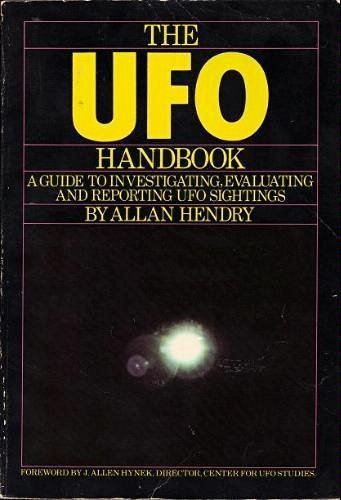
As an Amazon Associate, OverClassified may earn from qualifying purchases made through this link, at no extra cost to you.
Why This Is Essential Reading
The UFO Handbook earns its place on this list for a reason few other titles here can claim: it is the rare UFO book whose central finding is a number its author could show his work for. Allan Hendry did not argue from a curated set of famous sightings; he ran a fifteen-month hotline as CUFOS's only full-time investigator, personally processed all 1,307 reports that came through it, and published the full statistical breakdown — roughly 88.6 percent identifiable, roughly 8.6 percent genuinely unexplained — alongside a working manual for how any other investigator could reproduce the method. That the book earned direct praise from arch-skeptic Philip Klass while also drawing skeptical criticism for Hendry's refusal to explain away his own unresolved residue is not a contradiction this entry papers over; it is the book's defining achievement, and precisely why it remains, alongside Richard Hall's institutional The UFO Evidence and Richard F. Haines's perceptual Observing UFOs, one of the three books most worth reading together to understand what rigorous UFO investigation looked like before the field's scientific ambitions gave way to the cable-television era that followed it.
Related Cases & Theories
Essential Viewing
The Center For UFO Studies | Mark Rodeghier
Tim Ventura — An interview with current CUFOS president Mark Rodeghier on the organization's history and ongoing research — institutional context for the Center Allan Hendry served as sole full-time hotline investigator for during the study this book is built on. Verified via YouTube oEmbed before inclusion.
The Chiles-Whitted UFO Mystery - What Explains the 1948 Sighting?
My Dark Path — A survey of the 1948 Chiles-Whitted sighting and its proposed fireball-meteor explanation — the specific misperception pattern this book's own statistics identify as the single most common source of detailed "structured craft" UFO reports. Verified via YouTube oEmbed before inclusion.
Sources Cited
- Hendry, Allan. The UFO Handbook: A Guide to Investigating, Evaluating, and Reporting UFO Sightings. Doubleday & Company, August 1979 (ISBN-13 9780385143486, 297 pp., foreword by J. Allen Hynek). amazon.com
- "Allan Hendry." Wikipedia (biography: University of Michigan B.A. 1972, CUFOS hire by J. Allen Hynek, 1,000+ reports investigated, Val Johnson Incident, 1980 Smithsonian symposium debate with Philip Klass, departure from CUFOS in early 1980s). en.wikipedia.org
- Clark, Jerome. The UFO Encyclopedia, 2nd edition, Volume 1 (A-K). Omnigraphics, Inc., 1998 (ISBN 0-7808-0097-4), p. 481 ("one of the most skilled investigators in the history of UFO research"; "closet skeptic" characterization; "deeply pessimistic" appraisal of ufology).
- "The UFO Handbook." Open Library (bibliographic record OL4721146M: Doubleday, Garden City NY, 1979, 1st ed., xiii + 297 pp., LCCN 78008211, by statement "Allan Hendry ; foreword by J. Allen Hynek"). openlibrary.org
- "The UFO Handbook: a Guide to Investigating, Evaluating, and Reporting UFO Sightings." AbeBooks (first-edition listing: softcover/paperback binding confirmed, 1979, 297 pp.). abebooks.com
- Klass, Philip J. "The UFO Handbook." Skeptical Inquirer, Vol. 4, No. 2, Winter 1979/1980 (review calling the book "one of the most significant and useful books on the subject ever published"). skepticalinquirer.org
- "Philip Klass Q&A." PBS, Ask the Scientists archive (undated interview in which Klass again recommends Hendry's book as among the field's best). web.archive.org
- Facinelli, Paul. "UFO man has facts, but no 'explanation'." Akron Beacon Journal, October 13, 1978 (contemporary report on Hendry's Walsh College presentation, including his "most skeptical of the people at the center" quote). newspapers.com
- "The perils of statistics in ufology." ufologyiscorrupt.com (breakdown of Hendry's 1,307-case dataset: 1,158 IFOs / 88.6%, 113 unidentified / 8.6%, August 15 1976 – November 30 1977 collection period, toll-free hotline methodology). ufologyiscorrupt.com
- "Val Johnson incident." Wikipedia (Hendry's role as primary CUFOS investigator; 1980 Smithsonian Institution symposium debate with Philip Klass). en.wikipedia.org
- "Report on the Cash/Landrum New Caney CE-II Case by Allan Hendry." Blue Blurry Lines (primary-source repost of Hendry's April 1981 Fund for UFO Research-commissioned preliminary report). blueblurrylines.com
- "J. Allen Hynek Center for UFO Studies." Wikipedia (CUFOS founding 1973, Hendry joining staff 1976 as full-time investigator, International UFO Reporter newsletter). en.wikipedia.org
- This site's own resources library: Full Reading List, where this 1979 edition (ISBN 0385143486) is cited across 5 separate pages.
- This site's own case file: The Val Johnson Incident, for Hendry's primary investigation and 1980 Smithsonian debate with Philip Klass.
- This site's own case file: The Chiles-Whitted Sighting, for the fireball-meteor misperception pattern this book's statistics identify as the most common source of structured-craft reports.
- This site's own case file: Cash-Landrum, for Hendry's April 1981 preliminary investigative report applying this book's standards to a major post-CUFOS case.
- This site's own theory file: Seasonal Sightings Analysis, for a modern, much larger-scale statistical study of UFO reporting patterns sharing this book's core methodological concerns.
- This site's own key-figures entry: Allan Hendry, for his broader career and the site's existing Chiles-Whitted connection.
- This site's own essential reading entry: Observing UFOs, for Richard F. Haines's 1980 perceptual-psychology field manual, a close methodological sibling published one year after this book.
Have corrections, additional research, or peer-reviewed sources? Help improve this entry.
Suggest an Edit