
The UFO Evidence
NICAP's 1964 Case-by-Case Brief, Compiled to Put the Question Before Congress
Core Thesis
Where every other book on this list makes its case in a single author's voice, The UFO Evidence makes its case as an institution: NICAP assistant director Richard H. Hall spent the early 1960s screening more than 5,000 signed reports submitted to the National Investigations Committee on Aerial Phenomena down to 746 cases selected specifically for witness competence, multiple-witness corroboration, and instrumented data — radar returns, camera film, physiological and electromagnetic effects — then organized them not into a narrative but into a documentary brief, sorted by who reported them (Air Force pilots, other military personnel, civilian and airline pilots, scientists and engineers, police and ordinary citizens) and by what kind of evidence backed them up; NICAP mailed a copy to every member of Congress in 1964, and the book's argument, never dressed up as more than this, is that the phenomenon's best-attested reports had already cleared a scientific bar the Air Force's own public messaging refused to acknowledge.
About the Author
Richard H. Hall was born December 25, 1930, and earned a bachelor's degree in philosophy from Tulane University in New Orleans — an unusual credential for a man who would spend the next five decades building the evidentiary infrastructure of American ufology. He came to Washington, D.C. in 1958 to work for the newly formed National Investigations Committee on Aerial Phenomena, starting as executive secretary and rising to assistant director by the time he left in 1969, working directly under director Donald Keyhoe on the organization's core project: lobbying Congress to hold public hearings and press the Air Force toward a more open investigation.
NICAP itself had been incorporated on October 24, 1956, initially under inventor T. Townsend Brown, whose tenure lasted only a few months before the board removed him; retired Marine Corps Major Donald E. Keyhoe took over as director in 1957 and held the post until December 1969, with retired Rear Admiral Delmer S. Fahrney as board chair and, notably, former CIA director Vice Admiral Roscoe H. Hillenkoetter later joining the board — a roster of institutional credibility few civilian UFO organizations before or since have matched. By the early 1960s NICAP's membership had grown to roughly 14,000, making it the leading civilian UFO research organization of its era and the organizational home from which Hall would build his own reputation.
In 1964, Hall researched, edited, and wrote much of The UFO Evidence, the compendium this article covers, drawing on NICAP's own investigative files of reports from the 1940s through the early 1960s. Rather than arguing a position, Hall built a screening apparatus: NICAP considered a report's value a function of witness qualification and corroborating evidence, and Hall applied that standard to reduce a working file of more than 5,000 signed reports down to the 746 the book actually presents. A copy was sent to every sitting member of Congress the year it was published, and NICAP used radio appearances that same year to help publicize the report's release — a coordinated effort to move the UFO question out of tabloid territory and onto the desks of the people who could authorize a formal investigation.
Hall left NICAP after Keyhoe's ouster as director in December 1969, going on to work as a technical writer and, for a period, as an abstractor-indexer for the Congressional Information Service — a day job whose subject matter, cataloguing government documents, was not far removed from the case-file discipline he had brought to NICAP. He continued investigating individually into the 1960s and beyond, including the 1966 Portage County, Ohio police UFO chase, and later served as director of the Fund for UFO Research and as editor of the MUFON Journal, the publication of the Mutual UFO Network, before founding and editing his own Journal of UFO History. In 2001 he published a direct sequel, The UFO Evidence, Volume II: A Thirty-Year Report, updating his 1964 evidentiary framework with three additional decades of cases. Hall died on July 17, 2009, in California at age 78, of colorectal cancer; astronomer John B. Carlson of the University of Maryland called him "the dean of ufology," describing him as "scientific, careful... a researcher" representative of a generation that approached the subject through method rather than advocacy alone.
Historical Context & Origins
By the early 1960s, UFO literature already had a dominant register: Keyhoe's own bestselling books had spent a decade arguing, in the first person and with real narrative force, that the Air Force was actively concealing an extraterrestrial reality. What NICAP lacked, and what Hall's project was explicitly built to supply, was a document that read less like advocacy and more like testimony a scientific committee or a congressional subcommittee could actually work from — case identifiers, dates, witness qualifications, and evidence type, laid out in a reference format rather than a chapter-by-chapter argument. This was also several years after Edward J. Ruppelt's 1956 The Report on Unidentified Flying Objects had given the public its first insider account of Project Blue Book, and after the Air Force's own posture, shaped by the CIA-convened 1953 Robertson Panel, had settled into a public-education and debunking stance NICAP considered inadequate to the reports still coming in.
The book's actual content was assembled from NICAP's own case files, the product of investigator networks and affiliate chapters that had been collecting and vetting witness reports since the organization's 1956 founding. Hall's specific contribution was the screening and organizing framework: dividing the material into witness-category sections — Air Force pilots, navigators, and other officers and men; Army, Navy, and Marine Corps personnel; airline, military, and private pilots; scientists and engineers, including astronomers and aeronautical engineers; and police officers, civil defense observers, and ordinary citizens — alongside separate chapters devoted to radar cases, photographic evidence, and physical or physiological effects including electromagnetic interference. It was, by design, the opposite of a page-turner: NICAP's own later description of the report calls it "devoid of opinion or speculation," a documentary matrix organized by date, witness profession, shape, and movement rather than a sustained argument.
The report's release was also a deliberate act of political timing. NICAP had spent years building relationships with sympathetic members of Congress, and 1964 was the year the organization chose to formalize that lobbying with a physical document: every member of Congress received a copy, and NICAP supported the release with a radio publicity campaign. The book's evidentiary, low-rhetoric register was suited exactly to that audience — a Congress more likely to act on a screened, sourced case file than on another popular paperback arguing the extraterrestrial hypothesis in Keyhoe's more polemical voice, a contrast this site's own breakdown of UFOs and Government traces from a different institutional angle.
Core Arguments & Key Concepts
Because The UFO Evidence is a compilation rather than a single sustained argument, its real claims live in its organizing structure. The witness-category chapters — Air Force pilots and personnel, Army/Navy/Marine Corps witnesses, civilian and airline pilots, scientists and engineers, and police officers and ordinary citizens — embody NICAP's central evidentiary premise: that a report's credibility should scale with the training and professional judgment of the person making it, and that a trained radar operator's or airline captain's account deserves categorically more institutional weight than an anonymous "crackpot" file entry, the same two-tier logic Ruppelt had described operating inside Blue Book itself.
A second organizing layer runs across those witness categories: dedicated chapters on radar cases, photographic evidence, and physical or physiological effects, including electromagnetic interference. This is the book's clearest methodological statement without ever phrasing it as one — that instrumented, physical, or multiply-corroborated evidence constitutes a stronger evidentiary tier than testimony alone, and that a case combining a qualified witness with radar or camera corroboration represents the strongest category the file could produce.
Hall articulated the framework's underlying logic explicitly in later writing, in terms that describe the 1964 report's actual working method: he argued that researchers convinced nothing scientific exists in UFO reports "see only 'noise' and no 'signal'" in the data, an approach he said "totally ignores the content of the unexplained cases" by assuming, without testing it, that more complete information would explain away every remaining case. His alternative was not to assert the opposite conclusion but to propose actually testing both hypotheses — mundane explanation and genuine anomaly — "by spending time and money" on the residue of cases that had survived initial screening, rather than presupposing an answer either way.
That screening was itself the book's most concrete argument. Of the more than 5,000 signed reports in NICAP's files by the early 1960s, Hall's compilation selected 746 — a roughly one-in-seven ratio that the book presents as evidence of rigor rather than credulity: the vast majority of reports NICAP received did not meet its own standard for inclusion, and what remained was offered as the residue that had survived a real filter, not a comprehensive record of everything NICAP had been told.
The book stops well short of asserting an extraterrestrial conclusion. Its implicit argument, consistent with Hall's later writing on the subject, is narrower and more institutionally calibrated: that the screened residue of pilot, military, scientific, and radar-corroborated reports constituted a legitimate unsolved scientific and national-security question, one the government's own dismissive public posture was not actually earning through its own investigative record — a claim built to be persuasive to a congressional reader specifically because it withheld the more dramatic conclusions Keyhoe's own books reached for.
Key Cases & Evidence Discussed
The Killian Sighting (Case #089, February 1959) is directly and explicitly featured in the book, drawing on NICAP's New York City affiliate's original investigation; this site's own case file for the sighting credits Hall's 1964 report with treating the multi-witness commercial-aviation encounter as one of NICAP's most thoroughly documented cases of its type, and an original 1964 case summary in Hall's own words survives in the NICAP archive.
The RB-47 Bomber Chase (Case #150, July 1957), in which an Air Force reconnaissance jet was tracked and pursued by an unidentified target across multiple radar systems and visual sightings over several states, is likewise directly cited to this book on this site, and represents exactly the kind of radar-and-military-witness corroboration the book's own "special evidence" chapters were built to highlight.
The Gorman Dogfight (Case #039, October 1948), Lt. George Gorman's radar- and control-tower-corroborated pursuit of a maneuvering light over Fargo, North Dakota, is precisely the profile of case the book's Air Force pilot chapter was organized around: a trained military aviator's account backed by independent ground-radar and tower-log corroboration, the exact combination NICAP's screening framework treated as its strongest category.
The Lubbock Lights (September 1951), witnessed and reported by a group of Texas Technological College science professors whom Ruppelt himself called the most technically qualified witness group of his tenure, exemplifies the "Scientists & Engineers" witness category the book used as one of its core organizing sections — the specific class of professionally trained, credentialed observer NICAP's screening standard was built to privilege over an anonymous or unqualified report.
The Kinross Incident (Case #061, November 1953), in which an F-89C Scorpion sent to intercept a radar target over Lake Superior vanished along with its two-man crew after its blip merged with the target's on three separate ground radar scopes, represents the book's radar-case chapter at its most consequential: a case combining military witnesses, multiple independent instrumented tracks, and an outcome — a lost aircraft and crew — that no conventional explanation has ever fully resolved.
Critical Reception & Controversies
Reader reception, visible on Goodreads where the book holds a 4.06-star average from sixteen ratings, is strongly positive and frequently invokes the same characterization NICAP itself used to describe the report's standing in the field: one reviewer called it "considered by serious ufologists to be the bible of modern ufology," another described it as "not really theory or narrative... an encyclopaedic volume with an incredible array of reports," and a third simply wrote, "I'm now the proud owner of the UFOlogists bible!" — a nickname the book has carried since at least its own era and one NICAP's later promotional materials embraced directly.
The book's contemporary 1964 reception was measured less in book reviews than in the political attention it generated: press coverage of NICAP's congressional mailing and radio campaign, and the organization's own account of "substantial media and congressional attention" the report's release coincided with. That is a genuinely different kind of reception than the newspaper book reviews Ruppelt's 1956 memoir drew, or the academic-journal notice Watch the Skies! received three decades later — this site notes that gap directly rather than overstating a book-review footprint the report, as a self-published organizational document rather than a trade release, never really had.
The clearest methodological limitation, one later researchers and even NICAP's own subsequent work implicitly acknowledged, is sampling: the 746 cases were selected by NICAP's own investigators from NICAP's own case files, screened against NICAP's own competence criteria, which means the compilation documents the organization's strongest evidence rather than a neutral or independently audited sample of the UFO phenomenon as a whole. That is a structural feature of any advocacy organization's evidentiary brief, not a concealed flaw, and the book itself does not claim otherwise — but it means the residue the report treats as scientifically significant was never independently re-screened by a body without an institutional stake in the outcome.
That independent re-screening effectively happened a few years later, with the opposite result: NICAP transferred hundreds of case files, including material underlying this book, to the University of Colorado's Condon Committee in 1966 and 1967, only to break publicly with the project in 1968 over allegations of investigative bias, most notably the leaked "Low memo." The Condon Report's January 1969 conclusion that further UFO study was unlikely to yield scientific value stands as the most consequential critical response The UFO Evidence's underlying case files ever received — not a book review, but a rival government-commissioned evidentiary verdict reached from much of the same raw material.
Despite that institutional defeat, the book's standing within ufology itself has only solidified with time; historians of the field, including Jerome Clark, have continued to treat it as a foundational reference work precisely because of the screening discipline critics fault it for lacking neutrality on — a compilation built by people with a stake in the outcome, but built according to explicit, statable criteria a reader can evaluate case by case rather than take on faith.
Influence & Legacy
The book's most concrete, independently verifiable influence is documented on this very site: this edition, under ISBN 0760706271, is cited across resources.html in connection with up to 8 separate case-file and theory pages — including the Edwards AFB Canberra Photograph, the Lake Cote UFO Photograph, and the Wanaque Reservoir Incident — while a separate listing for the same 1964 report under a different retailer edition is cited on two further pages, including the Killian Sighting and the RB-47 Bomber Chase, reflecting its ongoing use here as a working evidentiary source rather than a novelty citation.
The book's most historically significant downstream effect runs through Congress itself. NICAP had circulated The UFO Evidence to every member of Congress and lobbied on Capitol Hill for hearings beginning in 1964; two years later, on April 5, 1966, the House Committee on Armed Services held a formal hearing titled "Unidentified Flying Objects," the most direct congressional UFO inquiry of the decade to that point — a hearing held in the same Capitol Hill hearing rooms that would host congressional UFO testimony for decades afterward. NICAP's own multi-year lobbying campaign, with Hall's screened case file as its physical centerpiece, was one part of the pressure that produced that hearing, alongside the public furor following the March 1966 Michigan sightings.
That congressional momentum continued into July 1968, when the House Committee on Science and Astronautics convened a full-day symposium at which physicist James E. McDonald delivered congressional testimony arguing the scientific community was "casually ignoring" the subject — even as NICAP itself, by then, had already broken publicly with the Colorado/Condon investigation over bias allegations, a reminder that the evidentiary case Hall's 1964 book built kept generating institutional consequences years after NICAP's own relationship with the government project it had helped bring about had soured.
Within Hall's own body of work, the 1964 report functioned as a first installment rather than a closed project: in 2001 he published The UFO Evidence, Volume II: A Thirty-Year Report through Scarecrow Press, extending the same screening framework across three additional decades of cases, and in the interim he continued personally investigating individual reports, including the 1966 Portage County, Ohio police UFO chase, whose most detailed contemporary account remains Hall's own.
Institutionally, NICAP itself did not survive the fallout from the Condon Report and Project Blue Book's December 1969 closure; membership collapsed from its roughly 14,000-member peak, and the organization dissolved in 1980, with its case files — the same investigative record Hall had drawn on for this book — transferred to the Center for UFO Studies, where they remain a core historical archive still cited by researchers today.
The Book
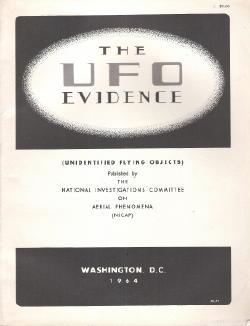
The UFO Evidence
NICAP's 1964 Case-by-Case Brief, Compiled to Put the Question Before Congress
Find on Amazon →As an Amazon Associate, OverClassified may earn from qualifying purchases made through this link, at no extra cost to you.
Why This Is Essential Reading
The UFO Evidence earns its place on this list for something none of this site's other Essential Reading titles quite are: not a single researcher's argument, but an organization's evidentiary brief, built by Richard H. Hall out of NICAP's own case files specifically to be usable by a Congress it was trying to persuade. That format produces real, durable strengths — a screening standard a reader can actually evaluate, case by case, rather than take on an author's word, and a documented, verifiable role in the political pressure that helped produce the April 1966 House Armed Services Committee hearing. It also carries the honest limitation any advocacy organization's own best-evidence file carries: the 746 cases were NICAP's strongest, screened by NICAP's own investigators, and the same underlying case material would be handed to the Condon Committee a few years later and read to a very different conclusion. Read alongside Ruppelt's insider memoir of Blue Book's earlier years, Hall's report supplies what that account cannot: the civilian evidentiary counter-file NICAP built specifically to argue, case by documented case, that the government's own dismissive posture had not actually earned itself through its own investigative record.
Related Cases & Theories
Essential Viewing
The Nicap Story - UFO Investigations
ParanormalX — A documentary account of NICAP's role investigating UFO reports during the era this book was compiled, tracing the organizational context The UFO Evidence emerged from.
Richard Hall
NICAP Official — A recorded lecture by Richard Hall at a Mutual UFO Network symposium, Hall speaking directly on the evidentiary approach that runs through his decades of NICAP and MUFON research.
Sources Cited
- "Richard H. Hall." Wikipedia (biography: birth/death, education, NICAP career 1958–1969, authorship of The UFO Evidence, later career and legacy). en.wikipedia.org
- "National Investigations Committee On Aerial Phenomena." Wikipedia (founding 1956, T. Townsend Brown, Donald Keyhoe's tenure, Condon Committee relations, dissolution 1980). en.wikipedia.org
- Rojas, Rick. "Richard H. Hall, 78: Leading Ufologist." The Washington Post, August 22, 2009 (obituary; John B. Carlson's "dean of ufology" characterization). washingtonpost.com
- "NICAP: The US Civilian UAP Investigative Group of the Cold War." UAPedia (organizational history, Hall's editorial role, 746 cases from over 5,000 reports, congressional circulation, Condon Committee relations). uapedia.ai
- Hall, Richard. "The UFO Evidence." NICAP (author's own description of the 1964 report's methodology and purpose, and of a planned companion volume covering post-1964 developments). nicap.org
- Hall, Richard. "Conceptualizing UFOs." NICAP (Hall's own statement of the "signal vs. noise" methodological framework underlying his evidentiary screening approach). nicap.org
- "The UFO Evidence." NICAP archive, full 1964 report (Washington, D.C.: National Investigations Committee on Aerial Phenomena, 1964), digitized. nicap.org
- "The UFO Evidence." AbeBooks (Barnes & Noble Books, 1997 reprint edition, ISBN 9780760706275, 184 pp., bibliographic record). abebooks.com
- "The UFO Evidence by Richard H. Hall." Goodreads (reader ratings and reviews, 4.06-star average, 16 ratings). goodreads.com
- "The UFO Evidence: A Thirty-Year Report, Volume 2." Google Books (Richard H. Hall, Scarecrow Press, 2001, bibliographic record for Hall's follow-up volume). books.google.com
- This site's own resources library: Full Reading List, where this 1964 report is cited across up to 8 separate case-file and theory pages under its canonical ISBN, plus 2 further pages under a separate retailer listing.
- This site's own case file: The Killian Sighting, for the 1959 case Hall's 1964 report directly featured as one of NICAP's most thoroughly documented commercial-aviation reports.
- This site's own case file: The RB-47 Bomber Chase, for the 1957 radar-corroborated case directly cited to this book.
- This site's own case file: The 1966 Portage County UFO Chase, for the case Hall personally investigated and documented after this book's publication.
- This site's own case file: The James E. McDonald Congressional UFO Testimony, for the 1968 hearing that extended the congressional pressure this book helped build.
- This site's own case file: The Condon Report, for the 1969 government study that reviewed much of the same NICAP case material and reached the opposite public conclusion.
- This site's own key-figures entry: Richard Hall, for his full biography and case connections.
Have corrections, additional research, or peer-reviewed sources? Help improve this entry.
Suggest an Edit