
The Portage County UFO Chase
Just before dawn on April 17, 1966, Portage County, Ohio sheriff's deputies Dale Spaur and Wilbur "Barney" Neff stopped on Route 224 to investigate what looked like an abandoned car and instead saw a large, brilliantly lit object rise over the trees behind them and stop overhead. What followed was one of the strangest police actions in American history: an 85-mile, high-speed pursuit across four counties and a state line, joined along the way by East Palestine patrolman H. Wayne Huston and, at the end, Conway, Pennsylvania patrolman Frank Panzanella, before the object shot upward into the brightening dawn sky and dwindled from view. Mantua police chief Gerald Buchert photographed something from in front of his home that morning, though NICAP's own investigator doubted it was the same object. The chase became national news within days. Project Blue Book chief Hector Quintanilla, working without his usual scientific consultant J. Allen Hynek, concluded the officers had first seen a satellite and then chased the planet Venus — an explanation the deputies furiously rejected and Hynek and his assistant William T. Powers, who had not been consulted before it was released, also disputed. The fallout devastated the men involved: Huston quit the force and left the state, Neff stopped talking about it, and Spaur — hounded by reporters, ridiculed in print, and pressed by Blue Book to sign a statement he did not believe — had within six months turned in his badge and lost his marriage. He died in 1983.
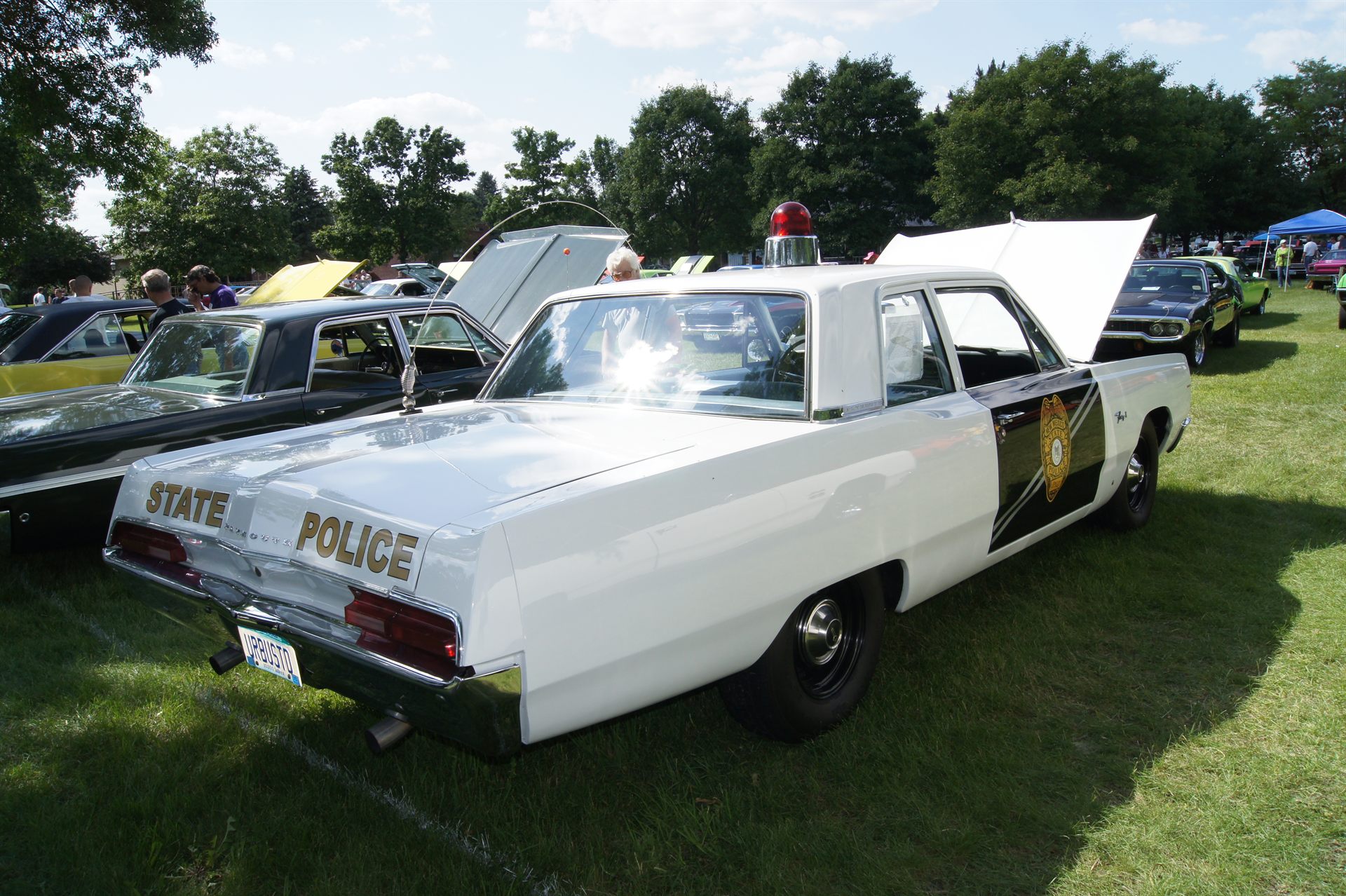
Pictured: a 1967 Plymouth Fury I police cruiser of the general type used by American sheriff's departments in the mid-1960s — not the actual patrol car involved. Chief Gerald Buchert's photograph was reviewed by the Air Force, which called the image a flaw in the negative; no version has entered the public record in verifiable form.
Theoretical Alignment
Portage County is a genuinely difficult case to score because it is very likely two different phenomena stitched into one 85-mile narrative. The initial encounter — a huge, low, silent object rising out of the trees at close range, hovering over an occupied patrol car, seen by two deputies at a range of about a hundred feet — cannot plausibly be the planet Venus, and it is this portion that keeps the Extraterrestrial Hypothesis alignment as high as it is: two deputies described a humming, light-emitting object at a range of a hundred feet or so, and a third officer saw it pass overhead later. But the alignment is capped well short of Exeter- or Coyne-tier scores because Blue Book concluded that the later stretch of the pursuit — watched from a moving car at increasing distance as dawn approached — was Venus, which really was bright and low in the east-southeast that morning. Hynek's assistant William T. Powers first suggested the same thing, then withdrew it once he learned the officers had seen the object alongside Venus and the Moon. That overlap is exactly why the Psycho-Social Hypothesis alignment is unusually high for this catalogue: an exhausted, adrenaline-charged, hour-long overnight pursuit is close to a textbook setup for perceptual contagion, in which an initial genuine anomaly primes several witnesses to keep reinterpreting an ordinary bright astronomical object as "the same thing" chasing them. The Interdimensional Hypothesis finds essentially nothing to work with: there is no reported occupant contact, missing time, or trans-dimensional "high strangeness," only a conventional (if unidentified) aerial object followed by a very bright planet.
Background
By April 1966, Project Blue Book, the U.S. Air Force's decade-old public UFO-investigation office, was under mounting pressure it had not previously faced. Weeks earlier, astronomer J. Allen Hynek, Blue Book's longtime scientific consultant, had been widely and derisively quoted attributing a wave of sightings near Ann Arbor, Michigan to swamp gas — a genuine phenomenon he had never claimed explained every report, but one the press flattened into a punchline that made "swamp gas" shorthand for official UFO cover-ups. Michigan Congressman and House Minority Leader Gerald Ford had publicly called for a congressional investigation, and the House Armed Services Committee obliged with its first public UFO hearing on April 5, 1966 — twelve days before a Sunday morning shift change in rural northeastern Ohio would hand Blue Book its next, and in some ways more damaging, controversy.
Portage County, Ohio, the county seat of Ravenna, was quiet farm and small-town country roughly thirty-five miles southeast of Cleveland. Deputy Sheriff Dale Spaur, 34, was working the overnight shift with "mounted deputy" or posse member Wilbur "Barney" Neff in patrol car P-13. Police radios had carried a report from a woman in neighboring Summit County of a flying object, and around 5:00 AM the pair stopped to check what looked like an abandoned automobile parked on the berm of State Route 224 between the villages of Atwater and Randolph — a routine, unremarkable call that was about to become the opening scene of one of the most publicized UFO cases in American history.
Complete Timeline
| Date | Event |
|---|---|
| March 1966 | J. Allen Hynek's "swamp gas" remark on a wave of Michigan sightings draws national ridicule and Congressional criticism of Project Blue Book. |
| April 5, 1966 | The House Armed Services Committee holds Congress's first public UFO hearing; Air Force Secretary Harold Brown defends Blue Book's methods. |
| April 17, 1966, before 5:00 AM | Police radios in Summit and Portage counties carry a woman's report of a flying object. |
| ~5:07 AM | Deputies Dale Spaur and Wilbur Neff, checking an apparently abandoned car on Route 224 between Atwater and Randolph, see a light over the trees grow into a large, self-illuminated object that stops overhead, lighting the ground "like high noon." It makes a hum "like an overloaded transformer." An anonymous deputy in Atwater reportedly sees it over the trees at the same time. |
| Shortly after | Spaur radios Ravenna; Sergeant Schoenfelt tells them to follow it. When the Ravenna radio operator suggests Neff take a shot at it, Neff declines. |
| ~5:07–5:35 AM | Spaur and Neff pursue the object east on Route 224 and then Route 14 at up to about 103 mph; it seems to "wait" for them at Deerfield, Canfield and near Columbiana. Mantua police chief Gerald Buchert, hearing the chase on his radio, photographs something moving near the wires in front of his home. |
| ~5:30 AM | East Palestine patrolman H. Wayne Huston, waiting in Unity on Route 14 after hearing the radio traffic, sees the object pass over at an estimated 800–1,000 feet and joins the chase. About the same time, Salem police officers Lonnie Johnson and Ray Esterly report a large bright object to the east being followed by three jets with contrails. |
| 5:35 AM | The Columbiana County radio log places Spaur and Neff at the state line; they continue on Pennsylvania Route 51. |
| 5:20–6:15 AM | Conway, Pennsylvania patrolman Frank Panzanella sees a bright object from 5:20 AM, watches it from a service station, and has been watching it about ten minutes when the Ohio cars arrive, low on fuel, after losing and re-finding it near Rochester. At 5:50 the log has them near Freedom. |
| ~6:00–6:15 AM | The four officers watch the object, which Spaur places left of and below the crescent Moon, with a separate bright point (Venus) to the Moon's right. It rises rapidly, an airliner passes below it, and it dwindles to "as small as a ballpoint pen." Spaur and Huston then phone an Air Force officer from Rochester. |
| April 18, 1966 | The story breaks in the Cleveland Plain Dealer, the Ravenna Record-Courier and the Beaver County Times. The FAA's Oberlin and Pittsburgh centers say they had no unknown radar targets. |
| Following days | Major Hector Quintanilla interviews Spaur in two short phone calls (about two and a half and one and a half minutes), opening with "tell me about this mirage you saw." On April 22 he tells Buchert his image is a flaw in the negative. |
| May 4, 1966 | NICAP investigator William B. Weitzel sends a detailed account to William T. Powers of Northwestern's Dearborn Observatory. |
| May 17–18, 1966 | The Greater Pittsburgh tower's watch supervisor states that he saw nothing on radar; Panzanella gives a signed statement. |
| Following weeks | Blue Book's official explanation: the officers first saw a satellite and then chased the planet Venus. Spaur refuses to sign a statement limiting the sighting's duration and disputes the explanation publicly. Powers writes to Spaur and Neff that a satellite "satisfies none of the characteristics" of their object and that Hynek agrees. |
| 1966 | Weitzel writes to Ohio Congressman William Stanton (April 23), and Stanton receives other complaints that no Air Force investigator has interviewed the officers in person. Under that pressure Quintanilla goes to Ravenna; at Spaur's request Weitzel tapes the interview. |
| 1966 | NICAP's report on the case is hand-delivered to Dr. Edward U. Condon, director of the newly formed University of Colorado UFO Project (the Condon Committee). |
| June 1966 | Spaur reports a brief further sighting of the object on Interstate 80-S; the radio operators' code name for it is "Floyd," Spaur's middle name. |
| October 9, 1966 | An Associated Press feature by John De Groot, carried by the Cleveland Plain Dealer, finds Spaur living in a Solon motel, no longer a deputy, his marriage over. |
| 1968 | The Condon Committee's final report is published; it does not mention or address the Portage County case despite Weitzel's report having been delivered to Condon directly. |
| 1972 | J. Allen Hynek publishes The UFO Experience: A Scientific Inquiry, reproducing part of the Quintanilla interview tape as an example of Blue Book's handling of witnesses and disputing the Venus explanation. |
| 1977 | Steven Spielberg's Close Encounters of the Third Kind is released; its police-car pursuit sequence is widely cited by researchers and journalists as likely inspired in part by the Portage County chase. |
| April 4, 1983 | Dale Spaur dies of pneumonia following influenza, according to his son as reported by James Renner in 2016. |
| 1986 | Gerald Buchert, still Mantua's police chief, suffers a brain aneurysm. |
An Abandoned Car on Route 224
The night had been ordinary. Dale Spaur and Wilbur "Barney" Neff were working the overnight shift out of the Portage County Sheriff's Office, patrolling in cruiser P-13, when, shortly before 5:00 AM, having heard radio traffic about a UFO reported in Summit County, they stopped to check on a car that appeared to have been abandoned on the berm of State Route 224, on the stretch between the small communities of Atwater and Randolph Township. (Weitzel later traced its owner and examined it: some tapes, a toy tape recorder and old tires, none of the "Seven Steps to Hell" insignia of later legend.) As they checked the car, Spaur noticed a light over the trees on the hill beyond the berm and called Neff's attention to it. Neither man thought much of it at first — a farmhouse light, perhaps, or a distant vehicle's headlamps against the hillside. Then the light began to move, and grow, and it became clear that its source was not fixed to the ground at all.
What came over the trees, by the deputies' signed statement, was "a large, self-illuminated object" that "came directly overhead and hovered above us," about a hundred feet up by Spaur's estimate. "Its light lit up the ground where we were standing, and our cruiser, P-13. It was too bright to look at without hurting the eyes." They put it at 30 to 45 feet across and 18 to 24 feet high, with "a sort of dome-shaped top," and at times "a projection on the top part, near the trailing edge"; part of the top looked "metallic; not shiny, but satiny." The only sound was "a hum... like a transformer being loaded or an overloaded transformer when it changes." Spaur recalled looking at his hands to see whether his clothes were burning; they were not, and NICAP's investigator recorded no heat or other physiological effects. The two men got back into the car and radioed in. When the Ravenna radio operator suggested Neff take a shot at it, Neff replied that it was like nothing he had ever seen and did not try.
Gerald Buchert's Independent Sighting in Mantua
Several miles away in the village of Mantua, Gerald Buchert — Mantua's chief of police — heard on his radio that the deputies were in pursuit and photographed something moving up and down near the power or telephone wires in front of his home, to the southeast. He told the Plain Dealer it was "round when I looked straight up at it, but when it moved to the left … it looked like a saucer, like two table saucers put together." He showed the paper a print, but said the Air Force had told him not to release it. Buchert's sighting is often presented as independent confirmation of the deputies' object, but NICAP's own investigator did not see it that way. William Weitzel, who examined the negative with Buchert, wrote that Buchert photographed "an object which was perhaps the same one Spaur and Neff chased, but most likely not," that the film showed "two dark arcs," and that he considered it "irrelevant" to the deputies' sighting "because of the lack of correlation" between the two. The Air Force offered several explanations (a flaw in the negative, poor development, old fogged film, an image of Venus); its file records a densitometer reading in which the image was less dense than the background, the opposite of what a bright object against a dark sky should produce. By October, Buchert said, "I saw something, but I don't know what it was."
Eighty-Five Miles: The Chase Begins
Ordered by Sergeant Schoenfelt to follow rather than let the object go, Spaur and Neff began what would become one of the longest documented UFO pursuits on record. The object moved east down Route 224 and then onto Route 14, and the deputies followed; Spaur said he clocked it at "about 103 miles per hour." It lit the ground beneath it as it went, tilting forward as it moved, and as the sky lightened they could see it in silhouette with a vertical projection at its rear. What struck both men most was the object's apparent behavior: rather than simply outrunning them or holding a constant course, it seemed to slow and wait when the cruiser fell behind, then dart forward again as they closed the gap — a pattern NICAP's Richard Hall later summarized as a "cat-and-mouse game"; Weitzel recorded it "waiting" at Deerfield, Canfield and near Columbiana. Radio carried their running position reports across the county and beyond. In Salem, two officers sent to a hill to look for the object, Lonnie Johnson and Ray Esterly, instead saw to the east a large, bright object being followed, as it seemed to them, by three jets with contrails; at about 5:30 the Salem radio operator heard an unidentified voice on the air say, "I'm right above it, and it's about forty-five feet across." The Air Force denied any jets were scrambled, and the source of that transmission was never found.
Crossing Into Pennsylvania: Wayne Huston and Frank Panzanella
H. Wayne Huston, a patrolman with the East Palestine, Ohio police department, had been listening to the radio traffic and waited in Unity, on Route 14, hoping to get a look at whatever the deputies were chasing. At 5:30 AM, he wrote, "the object went over me at what I thought was around 800'. The object appeared to look like a large Ice Cream cone with point down"; the point "looked more like light beams." He fell in behind Spaur and Neff, adding a third witness to a pursuit that had, within half an hour, already crossed multiple township and county lines. The chase crossed the state line at 5:35 AM, by the Columbiana County radio log, and continued on Pennsylvania Route 51 through Beaver County. Near Rochester they lost the object behind hills and underpasses, then found it again, lower, "waiting" over the road. At 5:50 the log has them near Freedom, still observing "bright light with a rope or string attached to it. 1500 to 2000 feet in height." In Conway they found a fourth witness: Patrolman Frank Panzanella, who wrote that he had first seen "a shining object" at 5:20 AM, thought it might be a reflection off a plane, and had been watching it for about ten minutes when the Ohio cars pulled up. He described it as "the shape of a half of football, was very bright and about 25 to 35 feet in diameter."
Dawn at Conway: The Object Departs
By the time the pursuit reached Conway, the eastern sky was lightening and Spaur's cruiser was nearly out of fuel. The officers watched the object from a service station. Spaur placed it left of and below the Moon, a thin crescent that had just risen, with "a bright stationary point to the right" of the Moon — which matches Venus, then about 15–20° up in the east-southeast (NASA JPL Horizons). The object rose rapidly, twice. Panzanella had his dispatcher call the Greater Pittsburgh airport, a passenger plane passed "about 1,000 feet below the object," and the object "continued to go upward until it got as small as a ballpoint pen." When a voice on the radio spoke of jets being sent up, Spaur said, "it went straight up." Panzanella logged the object in sight from 5:20 to 6:15 AM. Spaur and Huston then drove to Rochester to phone a number the airport had given, and spoke to a man Huston called "some colonel," who, Spaur said, "didn't give me a chance to say what I saw." That the officers saw the object, the Moon and the bright point together is the strongest argument against the Venus explanation for the end of the chase.
Major Hector Quintanilla and the Venus Explanation
Word of the chase reached the press almost immediately, and from the press it reached Project Blue Book's headquarters at Wright-Patterson Air Force Base in Dayton, Ohio. Blue Book chief Major Hector Quintanilla handled the case almost entirely by telephone rather than in person: a roughly two-and-a-half-minute call to Spaur in which he reportedly opened by asking Spaur to "tell me about this mirage you saw," followed by a second call of about a minute and a half. According to Spaur's own signed account, Quintanilla also pressed Spaur to sign a statement limiting the sighting's total duration to only a few minutes, an account Spaur refused to accept as accurate. Blue Book's official explanation, as its file puts it: "The probable cause of the sighting... was the passage of a satellite over northeastern Ohio. As the satellite approached the southeast portion of the sky, the satellite disappeared and Deputy Sheriff Dale F. Spaur focused his eyes on the planet Venus," which it gave as magnitude −3.9. Blue Book's staff had phoned agencies to ask whether Echo or Pegasus satellites would have been visible. Quintanilla denied that any Air Force jets had been scrambled, and radar did show nothing: the FAA's Oberlin and Pittsburgh centers reported no unknown targets, and the Greater Pittsburgh tower's watch supervisor stated that he "observed nothing on the radar presentation that coincided with the reported object." The officers rejected the Venus explanation, noting they had observed the object, the moon, and Venus simultaneously and could plainly distinguish among them.
What made the Air Force's handling of the case unusually controversial, even by Blue Book's already-contested standards, was procedural rather than purely substantive: normal Blue Book practice called for an astronomical identification of this kind to be reviewed by the program's civilian scientific consultant, J. Allen Hynek, before it was issued publicly. In the Portage County case, as Powers told the deputies in writing, Hynek "was not consulted before this news release was put forth." Quintanilla's explanation went out to the press essentially unreviewed by the one person on Blue Book's staff with the astronomical training to properly evaluate it — a break from procedure that fed directly into the case's broader reputation as an example of institutional carelessness rather than rigorous investigation.
J. Allen Hynek, William Powers, and a More Cautious Verdict
The fullest statement of the Dearborn Observatory's view is a letter to Spaur and Neff from William T. Powers, a systems engineer at Northwestern University's Dearborn Observatory and an assistant to Hynek, who had phoned Spaur the night after the sighting. Powers wrote that "a satellite satisfies none of the characteristics of your reported object. As a matter of fact, Dr. Hynek agrees with this." He admitted that he himself had first suggested to Quintanilla that during the latter part of the chase the officers "might have spotted Venus, and thought it was the same object at a higher altitude" — a suggestion recorded in the Blue Book file. But after reading Weitzel's material he withdrew it: "I now understand that you and other witnesses did notice Venus and the Moon, and saw the object in motion relative to them." "At no time," he added, "did I suppose that the earlier part of the sighting involved anything other than an airborne object," and the incident would "require considerable additional investigation, before any conclusion at all can be reached." He also offered a partial defense of Quintanilla, noting that Blue Book had just lost its only experienced field investigator. Hynek himself later reproduced part of the Quintanilla interview tape in The UFO Experience (1972) as an example of how Blue Book treated witnesses, and disputed the Venus identification.
William Weitzel, NICAP, and the Congressional Paper Trail
The most thorough contemporary investigation of the case was conducted not by the Air Force but by William B. Weitzel of Pittsburgh, working on behalf of the National Investigations Committee on Aerial Phenomena. Weitzel interviewed the witnesses directly, obtained signed statements and sketches from several of them, and — at Spaur's own request — arranged to record Quintanilla's eventual face-to-face interview with the deputy at the Portage County Courthouse, after congressional pressure finally brought Quintanilla to Ravenna. The resulting tape, later partially reproduced in Hynek's The UFO Experience and later issued on audio cassette by the Fund for UFO Research, documented an interrogation style several researchers considered heavy-handed for a witness whose only offense was reporting what he had seen while on duty. Weitzel assembled the full body of taped interviews, statements, sketches, and correspondence — including radio logs, signed statements from radio operators and the Salem officers, and his May 4 letter to William Powers — into a comprehensive case report that was made available to Congressional investigators and, when the University of Colorado's UFO Project began its work later that year, hand-delivered directly to project director Dr. Edward U. Condon. Despite that direct delivery, the Condon Committee's final 1968 report never mentioned the Portage County case at all, an omission researchers have cited ever since as evidence of the report's selective and incomplete engagement with the strongest cases available to it.
Congressman Stanton and the Pentagon's Concession
The case also drew direct political attention. Weitzel sent Ohio Congressman William Stanton a detailed letter on April 23, and the Blue Book file holds a letter to Stanton from a constituent, himself a former congressman, calling the Venus conclusion "so ridiculous that the United States Air Force has suffered a great loss of prestige in this community" and objecting that no Air Force representative had come to interview the officers in person. It was this pressure, by most accounts, that brought Quintanilla to Ravenna for the taped face-to-face interview.
The Officers' Ruined Lives
The human cost of the case fell unevenly and, for at least one man, catastrophically. Wayne Huston quit the East Palestine police force in the aftermath and relocated to Seattle, Washington, where he became a bus driver and began going by his middle name, Harold, rather than Wayne — a quiet, permanent retreat from a story he had only glancingly been part of. Neff stopped talking about the case; his wife told the AP in October 1966 that he had come home "real white, almost in a state of shock," and that he had said, "If that thing landed in my back yard, I wouldn't tell a soul." In 2004, journalist James Renner found him living in Florida, still standing by his account. Panzanella, inundated with phone calls from reporters and curiosity-seekers, ultimately disconnected his home telephone but never recanted his account. Buchert told the AP he would "rather not talk about it"; he was still Mantua's police chief when he suffered a brain aneurysm in 1986.
It was Dale Spaur who paid the highest price. Encouraged by NICAP to keep speaking publicly about the case even as the other officers went quiet, Spaur bore the brunt of the ridicule that followed Blue Book's Venus explanation. By that October, according to an Associated Press feature by John De Groot, he had lost forty pounds and was living in a $60-a-week motel room in Solon, walking three miles to an $80-a-week painting job, living on "one bowl of cereal and a sandwich each day," his wife and two children gone. At the end of July his wife had filed assault and battery charges after he shook her hard enough to leave bruises; he was jailed and turned in his badge. According to James Renner's 2016 reporting, drawing on Spaur's son, he later worked in the coal mines of West Virginia, where he fell about seventy feet down a shaft and broke his back. He rebuilt his life gradually in the years that followed, remarrying, settling near Cleveland, and eventually running a small bar; by his son's account, he did some consulting for Steven Spielberg's Close Encounters of the Third Kind and walked off when he learned the main character would not be a policeman. Spaur died of pneumonia following influenza on April 4, 1983 (Renner, 2016). In October 1966 he had told the AP: "If I could change all that I have done in my life, I would change just one thing. And that would be the night we chased that damn thing. That saucer."
Legacy: Close Encounters and Cultural Memory
The Portage County chase has become one of the most frequently cited "police UFO chase" cases in American popular culture, and researchers and journalists have long noted the resemblance between its three-cruiser, cross-jurisdiction pursuit and the police-car chase sequence that opens Steven Spielberg's 1977 film Close Encounters of the Third Kind, in which Roy Neary and law-enforcement officers unsuccessfully chase unidentified aerial lights by road. Spielberg has never issued a single definitive statement crediting Portage County alone as the sequence's inspiration — the film drew on multiple real cases and general 1960s UFO lore — but the parallel is close enough, and Spaur's reported brush with the production close enough, that the connection has become a fixture of how the case is remembered. More substantively, the case is remembered within ufology as one of the clearest illustrations of Project Blue Book's credibility problem in its final years: a case with more corroborating professional witnesses than almost any other in the program's files, handled with a speed and carelessness — a chief investigator who skipped his own program's normal scientific review, an in-person field investigation that NICAP conducted long before the Air Force did, and congressional complaints before Blue Book interviewed the officers face to face — that did lasting damage to public confidence in Blue Book at precisely the moment its future was being decided.
Circumstantial Evidence
- Four police officers in two states (Spaur, Neff, Huston and Panzanella) gave signed statements describing a bright, self-illuminated object, though Huston joined after hearing the radio chase.
- Patrolman Frank Panzanella saw a bright object in Conway, Pennsylvania from 5:20 AM, about ten minutes before the pursuing Ohio officers arrived.
- At the end of the chase the officers reported the object together with the crescent Moon and a separate bright point (Venus), which tells against the Venus explanation for that phase.
- The Columbiana County radio log (from 5:35 AM) records the deputies' positions and their description of the object as they went, corroborating the chase's timeline and route.
- Blue Book's own chief investigator, Hector Quintanilla, issued the case's official astronomical explanation without the normal prior review of Blue Book's scientific consultant, J. Allen Hynek — a documented procedural departure Hynek himself later criticized.
- Hynek's assistant William T. Powers, who had first suggested Venus, withdrew the idea in writing after reading the witnesses' statements.
- NICAP investigator William Weitzel's taped interviews and signed statements were made available to congressional investigators and hand-delivered to Condon Committee director Edward U. Condon.
Blue Book's Credibility Crisis and the Road to Condon
Portage County did not happen in isolation from Project Blue Book's broader institutional troubles. It followed within weeks of Hynek's "swamp gas" remark on the Michigan sightings and the House Armed Services Committee's first public UFO hearing on April 5, 1966, and it arrived at a moment when Congress, the press, and a meaningful slice of the public were already primed to view Blue Book's explanations with suspicion. The specific procedural failures in this case — a chief investigator who bypassed his own program's normal scientific review before issuing an astronomical explanation, a field investigation the Air Force never conducted in person while a civilian organization did, and congressional complaints that preceded any face-to-face Air Force interview — became, in the hands of researchers like James E. McDonald and organizations like NICAP, a recurring talking point in the argument that Blue Book's investigative rigor did not match its public claims. That argument fed directly into the pressure that produced the University of Colorado's Condon Committee later that year — even though, in a final irony the case's defenders have never let go of, the Condon Report itself never so much as mentioned Portage County despite William Weitzel's report having been hand-delivered to Edward Condon directly.
Key Witnesses
Deputy Sheriff Dale Spaur
The first officer to see the object over the trees along Route 224, Spaur stayed with the pursuit for its full 85 miles into Pennsylvania and became the case's most public and most damaged figure. He refused to sign a Blue Book statement limiting the sighting's duration, spoke publicly about the case, and within six months had turned in his badge after an assault charge, separated from his wife, and was living in a motel. He died in 1983.
Wilbur "Barney" Neff
Spaur's partner on patrol car P-13, Neff was present for the object's initial approach and co-signed the deputies' statement. When the Ravenna radio operator suggested he shoot at it, he declined. He stayed with the pursuit throughout but stopped talking about the case afterward; in 2004 he was living in Florida and still stood by his account.
Police Chief Gerald Buchert
Hearing the chase on his radio, Buchert photographed something moving near the wires in front of his home and described it as looking like "two table saucers put together." NICAP's Weitzel examined the negative and judged it "most likely not" the deputies' object; the Air Force called the image a flaw in the negative. No verifiable version has surfaced publicly. He was still Mantua's chief when he suffered a brain aneurysm in 1986.
Patrolman H. Wayne Huston
Alerted by the radio traffic, Huston waited in Unity on Route 14, saw the object pass over at about 800 feet at 5:30 AM ("like a large Ice Cream cone with point down"), and joined the pursuit. Several months later he resigned after seven years on the force, moved to Seattle, Washington, to drive a bus, and began going by Harold. "Sure I quit because of that thing," he told the AP. "People laughed at me."
Patrolman Frank Panzanella
Panzanella first saw a "shining object" at 5:20 AM and had been watching it for about ten minutes from a Conway service station when the Ohio officers arrived. He described it as "the shape of a half of football," 25 to 35 feet across, and watched it climb until it was "as small as a ballpoint pen," with an airliner passing below it. Overwhelmed by calls afterward, he had his telephone removed but never recanted.
The Five Observables Assessment
The Five Observables framework, developed by former AATIP director Luis Elizondo, is used to classify UAP encounters by performance characteristics exceeding known technology of their era. As with other purely visual, non-instrumented sightings in this catalogue, Portage County is an imperfect fit: everything below reflects what four officers described, mostly from moving vehicles, over about an hour, not anything independently measured by radar or onboard instrumentation.
Assessment: Anti-Gravity Lift is rated speculative because the object was repeatedly described hovering over the patrol car and at various points along the pursuit route with no visible wings, rotors, or other conventional means of support — consistent with a genuinely unconventional lift mechanism, but based entirely on unaided visual observation under high stress rather than any instrumented reading. Instant Acceleration is rated speculative on similar grounds: the object's "cat-and-mouse" behavior, slowing when the officers fell behind and bolting when they closed the distance, and its final vertical departure at Conway, were reported consistently across multiple witnesses, but no radar or other timed measurement exists to confirm any specific rate of acceleration. Hypersonic Velocity is rated absent, since even the pursuit's most extreme reported speeds — the deputies' own cruiser reaching 80 to 105 mph — describe a chase, not anything approaching supersonic performance. Low Observability is rated absent and distinctively so for this catalogue: the object was, by every account, extremely bright and conspicuous, its light powerful enough to illuminate the road and the interior of the patrol car, the opposite of a stealthy or hard-to-detect craft. Trans-Medium travel is rated absent, as the entire encounter took place in open air with no reported transition between air, water, or any other medium. Taken together, the observable profile is that of a highly visible object exhibiting apparently intelligent, evasive flight behavior at close range for its opening minutes, followed by a much longer stretch of distant, ambiguous observation consistent with either continued pursuit of the same craft or a gradual drift into misidentifying a bright planet.
Evidence Assessment
Supporting Anomalous Origin
- Four law-enforcement officers in two states gave signed statements describing the object's basic appearance and behavior; Panzanella saw it before the Ohio cars reached him.
- At the end of the chase the officers saw the object together with the Moon and Venus; Hynek's assistant Powers withdrew his own Venus suggestion on that basis.
- The object's initial approach — rising from treetop height and hovering directly over an occupied patrol car — describes a close-range encounter incompatible with a distant astronomical object.
- Blue Book's own scientific consultant, J. Allen Hynek, was not consulted before the explanation was released and disputed it; his assistant wrote that a satellite "satisfies none of the characteristics" of the object.
- Blue Book's chief investigator issued the case's astronomical explanation without the normal internal scientific review, a documented procedural failure rather than a settled finding.
- NICAP's independent field investigation, conducted with more rigor than the Air Force's own telephone-based inquiry, treated the case as substantively unresolved.
Supporting Conventional Explanation
- Venus (magnitude −4.4) was rising in the east-southeast during the pursuit, 11° up at 5 AM and about 21° at 6 AM, a real and independently verifiable astronomical fact (NASA JPL Horizons).
- Radar showed nothing: the FAA's Oberlin and Pittsburgh centers and the Greater Pittsburgh tower reported no target corresponding to the object.
- No photographic or other instrumented evidence corroborates the officers' estimates of the object's altitude, distance, or speed; Buchert's photo was judged unrelated even by NICAP's investigator.
- Witness descriptions of altitude and distance varied considerably over the course of the encounter and between witnesses, consistent with the kind of estimation drift common in prolonged, high-stress nighttime observation.
- None of the officers had specialized training in aircraft or astronomical identification, and all were operating under significant fatigue and adrenaline during an unplanned, hour-and-a-half overnight pursuit.
Why "Disputed"
The Portage County UFO Chase earns a DISPUTED rating on this site's scale because it combines an unusually large pool of independent, professionally credentialed witnesses with a real, astronomically verifiable partial conventional explanation that neither side has ever fully reconciled with the other. On the strength side: four law-enforcement officers in two states gave signed statements describing a bright, self-illuminated object, which the two deputies saw at close range; at the end of the chase the officers saw the object alongside both the Moon and Venus; and Blue Book's chief issued the official explanation without consulting Hynek, whose assistant then withdrew the Venus idea he had first suggested. On the other hand, Venus was rising, brilliant, in the same part of the sky the chase was heading toward; radar showed nothing; no physical trace or examinable photograph survives; Huston joined only after hearing the radio chase, so his sighting was not blind; and the witnesses' altitude and distance estimates shifted considerably over an exhausting high-speed chase. That combination — a real, multiply-corroborated close encounter very likely embedded within a much longer stretch of ambiguous, possibly astronomical misidentification — is exactly what "disputed" is meant to capture: a case substantial enough to have shaped Congressional and public skepticism of Project Blue Book, but not one that resolves cleanly in either direction.
Sensor & Instrumentation Detection Profile
No radar, camera, or automated sensor system independently tracked the object at any point. This alone separates Portage County from radar-visual cases like Lakenheath-Bentwaters: civil radar was checked and showed nothing. The FAA's Oberlin and Pittsburgh centers told the Plain Dealer they had no unknown targets, and the Greater Pittsburgh tower's watch supervisor stated on May 17 that he "observed nothing on the radar presentation that coincided with the reported object nor did I observe any other radar return." Blue Book's file likewise says radar showed no airborne objects in the area. The closest thing to instrumentation the case possesses is radio traffic: Spaur and Neff radioed their position throughout, and it was this traffic that pulled in Wayne Huston in East Palestine. Neither Ravenna nor Salem logged the chase; the Columbiana County log, from 5:35 AM, is the only written log. Panzanella in Conway saw the object before the Ohio officers reached him. Chief Gerald Buchert's photograph is the case's one piece of would-be documentary evidence, but it functioned as an anti-instrument rather than a corroborating one: the Air Force called the image a flaw in the negative (its file records a densitometer reading in which the image was less dense than the background), and NICAP's Weitzel, who examined the negative, thought it probably unrelated to the deputies' object.
Environmental & Geospatial Context
The chase unfolded across the rolling farm country of northeastern Ohio in the last hour of full darkness before an April sunrise, running east from rural Portage County on Routes 224 and 14 past Deerfield, Canfield and Columbiana to Unity and the state line, then on Pennsylvania Route 51 through Beaver County to Rochester, Freedom and Conway. This is precisely the kind of environment — dark, low-light-pollution farmland along a state highway corridor, with dawn twilight steadily brightening the eastern sky over the course of the pursuit — in which a genuinely bright astronomical object low on the horizon becomes progressively harder to rule out the longer an encounter runs. On April 17, 1966 Venus was a brilliant morning star (magnitude −4.4), rising about 4:00 AM EST and standing about 11° above the east-southeast horizon at 5:00 AM and 21° at 6:00 AM; a thin waning crescent Moon (11% lit) rose shortly before 5:00 AM just to its left; and the Sun was 8° below the horizon at 5:00 AM and rose about 5:55 AM (NASA JPL Horizons, for 41°N, 81°W). None of this environmental context explains the case's opening minutes, when the object was reported at treetop height and close range rather than near the horizon — but it is essential to understanding why Blue Book's later explanation, however unwelcome to the officers, was not simply invented from nothing.
Observer Credibility & Occupational Profile
Portage County's central credibility asset, like Exeter's, is occupational: nearly every primary witness was an on-duty law-enforcement officer with no history of UFO interest and a professional incentive to avoid attaching his name to an implausible story. Dale Spaur, a Portage County deputy, and Wilbur Neff, his partner from the sheriff's mounted posse, were the first to encounter the object and stayed with the pursuit for its full 85-mile length. Gerald Buchert, Mantua's police chief, photographed something from in front of his home while listening to the chase on his radio, though NICAP's investigator doubted it was the same object. Wayne Huston of the East Palestine Police Department was waiting for the chase, having heard it on the radio, and saw the object pass overhead; Pennsylvania patrolman Frank Panzanella had been watching a bright object in Conway for about ten minutes before the Ohio officers arrived. None of them sought publicity; several actively avoided it afterward. Their credibility is real but not unlimited: none had specialized training in aircraft or astronomical identification, all were working a physically and emotionally exhausting overnight pursuit at high speed, and their descriptions of altitude, distance, and speed varied considerably from witness to witness and from the beginning of the chase to its end.
Physical & Material Assays
The case produced no debris, no landing trace, and no laboratory-testable physical sample of any kind, and no participant or investigator has ever claimed otherwise. Its one candidate physical artifact, Gerald Buchert's photograph, was never independently examined by a third party in any verifiable way: the Cleveland Plain Dealer described a print as showing "an object with a very dark bottom and a very light top," each half like a saucer seen from the side; NICAP's Weitzel, who examined the negative, saw "two dark arcs" and judged it unrelated; and the Air Force called it a flaw in the negative after a densitometer reading found the image less dense than the background. The photograph's current whereabouts are unknown. Weitzel recorded no color changes, electromagnetic effects, physiological effects (such as heat or tingling) or radioactivity — a local civil defense unit checked Spaur and P-13 just after the sighting — distinguishing this case from electromagnetic-effects cases like Levelland. The documentary record that does survive is unusually extensive for a 1966 sighting precisely because of the controversy that followed: NICAP investigator William Weitzel's taped recording of Major Quintanilla's in-person interview with the witnesses at the Portage County Courthouse, the officers' signed statements, Weitzel's May 4, 1966 letter to William T. Powers, Powers's letter to Spaur and Neff, and the Blue Book file (Record 10073) all survive.
Historical Precedents & Archive Matches
Portage County belongs to the same police-corroborated sighting category as Exeter and the 1957 Levelland, Texas wave, in which trained officers independently converge on a consistent description of an unusual object — but it is distinguished within that category by its sheer geographic scale: rather than two officers confirming each other at a single field, it strings together four police witnesses across two states over about an hour, more closely resembling a rolling, multi-jurisdiction pursuit than a static observation. It also sits squarely inside the credibility crisis that would define Project Blue Book's final years: it followed within weeks of Hynek's much-mocked "swamp gas" explanation for a wave of Michigan sightings in March 1966, and it fed directly into the same wave of Congressional and public skepticism that produced the House Armed Services Committee's April 5, 1966 UFO hearing and, eighteen months later, the University of Colorado's Condon Committee study. Structurally, its aircrew-adjacent, multi-witness-across-distance profile prefigures later corroborated-instrument cases like the 1973 Coyne helicopter incident, in which professional occupational credibility, again absent any physical evidence, carried the case's entire evidentiary weight.
Material Analysis
Portage County produced no debris, no ground trace, and no recoverable physical sample of any kind, and no witness or investigator has ever claimed otherwise. The case's sole candidate physical artifact is Gerald Buchert's photograph, taken from in front of his home while the chase was under way. The Air Force variously called the image a flaw in the negative, poor development, old fogged film and Venus; its file records a densitometer reading in which the image (1.06) was less dense than the background (1.25), the opposite of what a bright object against a dark sky should produce. NICAP's Weitzel examined the negative with Buchert, saw "two dark arcs," and considered it irrelevant to the deputies' sighting. Because no independently examinable version of the photograph has surfaced since 1966, neither the Air Force's dismissal nor a more charitable reading of the newspaper's description can be verified today. Beyond the photograph, the only other quasi-physical record of the case is administrative rather than forensic: the Portage County Sheriff's dispatch radio log documenting the deputies' real-time position reports, which corroborates the pursuit's timeline and route without saying anything about the object's actual nature.
Supporting a Genuine Anomalous Encounter
- Buchert's print was described in the press as showing a two-part, saucer-like shape.
- The Air Force offered several mutually inconsistent explanations for the image.
- The Columbiana County radio log corroborates the pursuit's timeline and route from 5:35 AM, supporting the basic factual framework of the officers' account.
Supporting a Mundane Origin
- The photograph's current whereabouts and condition are unknown, meaning its evidentiary value cannot be independently tested by any modern analyst.
- A hand-held photograph of a bright light source taken by an amateur photographer at night is a well-documented source of lens flare, motion blur, and other fogging-like artifacts unrelated to any genuinely anomalous object.
- NICAP's own investigator thought Buchert's object "most likely not" the one the deputies chased, and the densitometer reading argues against a bright object on the film.
The Conventional Explanation Candidate: Venus and an Echo Satellite
Venus / Echo Satellite
Partially Plausible ImplausibleProject Blue Book's official explanation, advanced by Hector Quintanilla on an initial suggestion from William T. Powers that Powers later withdrew, holds that the deputies first saw a satellite pass and then, for the rest of the pursuit, chased the planet Venus — brilliant (magnitude −4.4) and low in the east-southeast, the direction the chase was heading, exactly the kind of light that can seem to "pace" a moving car. This candidate deserves serious evaluation because its central astronomical premise is verifiable: Venus really was in that part of the sky, at that brightness, that morning (NASA JPL Horizons).
Its central weakness is the case's opening minutes. A distant planet, however bright, cannot rise from behind a treeline and stop directly over an occupied patrol car, lighting up the ground around it. Nor does Venus fit the end of the chase, when the officers saw the object, the crescent Moon and Venus at the same time — the point that made Powers abandon the idea. Venus also cannot account for the object's reported "cat-and-mouse" behavior — slowing when the pursuing cruiser fell behind and accelerating when it closed the distance — a pattern of apparently responsive maneuvering that a fixed celestial body simply does not exhibit, whatever illusions relative motion against clouds or a moving vehicle's own turns might create. Blue Book's own investigation never adequately separated the encounter's close-range opening phase from its more distant, ambiguous later phase, treating the entire 85-mile, hour-and-a-half event as a single continuous misidentification rather than acknowledging — as Hynek himself ultimately did — that the case most plausibly represents two different phenomena run together into one narrative.
Student Hoax or Prank
ImplausibleA far less credible theory, circulated in the months after the case broke, held that the object was some kind of hoax or prank, such as a balloon (one April 18 news report claimed it had been a weather balloon). This candidate has never been substantiated by any investigator, official or independent, and it struggles badly against the case's basic facts: no hoax device has ever been produced or credibly described, and no student prank could plausibly account for an object followed by police for 85 miles across two states and seen by a Pennsylvania officer before the Ohio cars reached him.
Misidentified Aircraft or Weather Balloon
ImplausibleA third, more mundane candidate proposes a conventional aircraft or a lit weather balloon as the object's true identity, at least for the encounter's early, close-range phase. This candidate has never been endorsed by any investigator who examined the case closely, in part because it fails to explain the object's reported silence beyond an electrical hum (inconsistent with any propeller or jet aircraft of the era), its extremely low initial altitude and hovering behavior over an occupied vehicle, and the absence of any logged, scheduled aircraft or balloon operation in the area that could plausibly correspond to the sighting.
Related Cases
Confirmed Documents & Official Records
National Archives finding aid covering UAP-related textual holdings, including Project Blue Book's Project 10073 case files that contain the Portage County correspondence, FTD Form 164 witness reports, and Air Force internal memoranda on the case.
UNCLASSIFIEDThe National Investigations Committee on Aerial Phenomena's own case directory, indexing William Weitzel's field investigation materials, witness statements, and correspondence with Blue Book physicist William T. Powers.
PUBLIC RECORDSearch Government Archives Directly
Further Reading — Recommended Literature
The Hynek UFO Report
Written by Blue Book's own scientific consultant, who reproduces part of the Quintanilla interview tape from this case and disputes his own program's Venus explanation.
Project Blue Book Exposed
A detailed critical history of Blue Book's investigative practices, including the procedural shortcuts and skipped scientific review that made cases like Portage County so controversial.
Watch the Skies!: A Chronicle of the Flying Saucer Myth
A rigorously skeptical, well-documented history of American UFO cases spanning the 1966 Congressional-hearing era, useful context for the Blue Book credibility crisis Portage County exemplifies.
DISCLOSURE: Some links above are affiliate links. If you purchase through them, OverClassified receives a small commission at no additional cost to you. This helps support independent research.
Essential Viewing
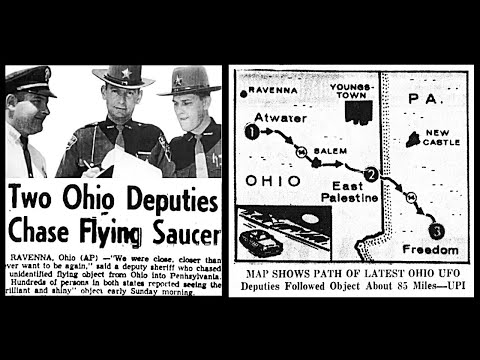
Deputy Sheriff Dale Spaur Talks About the Portage County UFO Chase
Archival footage of Dale Spaur himself describing the encounter, recorded within days of the April 17, 1966 chase.
UFO Case Review: Portage County UFO Chase, 1966
A focused case walkthrough covering the timeline, the witnesses, and the Blue Book controversy.
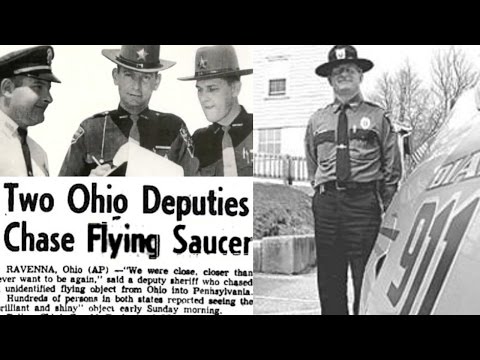
The Portage County Ohio UFO Chase & Police Encounter in 1966
A dedicated overview of the encounter and its aftermath from the FindingUFO channel.
The Portage County UFO Chase, April 17, 1966
A dedicated retrospective on the case from the EyesOnTheSkies channel.
AudioBlog: Portage County UFO Chase
An audio-blog style discussion from Podcast UFO Live Shows covering the case's investigative record.
Sources
- Gross, Patrick. "UFOs at Close Sight: The 1966 Portage County Police UFO Chase." ufologie.patrickgross.org
- Gross, Patrick. "The 1966 Portage County Police UFO Chase — Richard Hall's Account." ufologie.patrickgross.org
- National Investigations Committee on Aerial Phenomena (NICAP). "Portage County, Ohio UFO Chase, April 17, 1966" case directory. nicap.org
- NICAP. "Portage County Document Page." nicap.org
- Gross, Patrick. Portage County 1966 document pages: witnesses' written statements (Spaur and Neff; Huston; Panzanella, May 18, 1966; W. L. Ackers, Greater Pittsburgh tower, May 17, 1966), Weitzel's letter to William T. Powers (May 4, 1966), Powers's letter to Spaur and Neff, Cleveland Plain Dealer April 18, 1966 (Douglas Bloomfield) and October 9, 1966 (AP, John De Groot). ufologie.patrickgross.org
- Project Blue Book. Case file, April 17, 1966, Ravenna/Mantua, Ohio (Record 10073), via The Black Vault. theblackvault.com
- NASA JPL Horizons. Observer ephemerides for Venus, the Moon and the Sun at 41.0°N, 81.0°W, April 17, 1966, 08:30–11:30 UT. ssd.jpl.nasa.gov
- UFO Evidence. "Portage County, Ohio UFO Chase — April 17, 1966" case summary. ufoevidence.org
- UFO Casebook. "The Portage County, Ohio, UFO Chase." ufocasebook.com
- The Ohio Project. "Ohio and the Great UFO Chase of 1966." theohioproject.net
- The Pennsylvania Rambler. "The Great UFO Chase: Part One," February 20, 2022. thepennsylvaniarambler.wordpress.com
- Wolford, Ben. "Seeing a UFO Ruined Dale Spaur's Life," The Portager, via Medium. medium.com
- Renner, James. "Strangers in the Night," Cleveland Scene, March 31, 2004. clevescene.com
- Renner, James. "50 Years Ago, a Small Town Ohio Policeman Chased a Flying Saucer Into Pennsylvania…And It Ruined His Life," Cleveland Scene, April 14, 2016. clevescene.com
- Podcast UFO. "The Portage County UFO Chase" (episode page and case summary). podcastufo.com
- UFO Insight. "The Portage County UFO Chase." ufoinsight.com
- Anomalien. "Portage County Police Officers Pursue UFO in 1966." anomalien.com
- How and Whys. "Ohio Policeman Dale Spaur Chased Huge UFO For 138 Km In 1966, But It Ruined His Life." howandwhys.com
- Think About It Docs. "1966: Portage County, Ohio UFO Chase." thinkaboutitdocs.com
- Alien-UFO-Research. "Portage County, Ohio UFO Police Chase — 1966." alien-ufo-research.com
- OREohio. "Portage County UFO Chase." oreohio.org
- Wikipedia. "List of UFO Sightings" (Portage County, Ohio entry). en.wikipedia.org
- Wikipedia. "J. Allen Hynek" (Portage County dissent from Air Force explanation). en.wikipedia.org
- Hynek, J. Allen. The UFO Experience: A Scientific Inquiry, Henry Regnery Company, 1972 (partial transcript of the Quintanilla interview).
- Center for UFO Studies (CUFOS). "J. Allen Hynek Biography." cufos.org
- Clark, Jerome. The UFO Encyclopedia, 4th Edition, Relevant Information LLC (entry on the Portage County/Ravenna police chase case).
- Peebles, Curtis. Watch the Skies!: A Chronicle of the Flying Saucer Myth, Smithsonian Institution Press, 1994.
- Jacobs, David M. The UFO Controversy in America, Indiana University Press, 1975 (foreword by J. Allen Hynek; covers the 1966 Congressional hearings and Blue Book controversies).
Corrections (October 2026)
A fact-check against the officers' signed statements, NICAP investigator William Weitzel's May 4, 1966 letter, William T. Powers's letter to the deputies, the Project Blue Book file, contemporary Plain Dealer and AP reporting, James Renner's 2004 and 2016 articles, and NASA JPL Horizons found several significant errors. Powers was not a "Blue Book physicist" who found Venus consistent with the later chase: he was Hynek's assistant at the Dearborn Observatory, first suggested Venus to Quintanilla, and then withdrew it in writing because the officers saw the object alongside Venus and the Moon. Hynek's rating of the case as a "strong Unidentified" could not be found. Gerald Buchert's photograph was not independent corroboration: he took it while listening to the chase on the radio, and Weitzel judged it "most likely not" the same object. Radar was checked and showed nothing (FAA Oberlin and Pittsburgh centers; Greater Pittsburgh tower); the page had said no one knew whether radar had been checked. Panzanella had watched the object for about ten minutes, not thirty, before the Ohio officers arrived. The "ice cream cone" description was Huston's, not the deputies'. Neither deputy reported heat; Neff did not reach for his gun and was not "ordered to stand down" (he declined the radio operator's suggestion to shoot). The Moon was a thin crescent, not a quarter Moon. A Lt. Col. Spaulding's admission of "error" to Congressman Stanton, David Webb's presence at the Quintanilla interview, a Neff quotation ("I don't look up anymore"), Spaur's Korean War Air Force service, the April 18 and 21 dates of Quintanilla's calls, a May 11 Blue Book interview and a quoted Gerald Ford statement could not be sourced and were removed. Added: the Salem officers' report of jets following a bright object, the radio logs, and the Blue Book file's own wording. Computed Moon, weather and nearest-airport fields were replaced with JPL Horizons figures.
Following this review, the rating was changed from Disputed 52 to Disputed 55 (October 27, 2026).
See something inaccurate? Have additional information or sources?
Suggest an Edit →Last Updated: August 2026