
Observing UFOs: An Investigative Handbook
A Former NASA Ames Research Psychologist's 1980 Field Manual Brings Human-Factors Science to the UFO Witness Report — the Same Discipline Richard F. Haines Would Spend the Next Four Decades Building Into NARCAP
Core Thesis
Observing UFOs: An Investigative Handbook is not a narrative argument for or against any theory of what UFOs are — it is something rarer in the popular UFO literature of its era: a working field manual, written by a credentialed research psychologist for the specific purpose of teaching other investigators how to interview witnesses, evaluate the reliability of human perception under stressful or unfamiliar conditions, and document a sighting report to a standard that could withstand outside scientific scrutiny. Its author, Richard F. Haines, spent nearly two decades as a NASA Ames Research Center scientist, where his actual day job — studying how pilots, astronauts and other trained observers perceive, misjudge and remember visual information under demanding operational conditions — gave him a body of directly transferable expertise that few other UFO authors of his generation could claim. Rather than arguing that any particular sighting was inexplicable, Haines set out to supply the tools: chapters on the physiology and psychology of vision, the specific optical illusions and misperceptions that plague aerial sightings, interview techniques that minimize investigator-introduced bias, and the photogrammetric standards a genuine photographic analysis requires. Published in 1980 by the small Chicago professional press Nelson-Hall rather than a mass-market trade house, the book found a narrower but more durable readership than its more sensational contemporaries — one made up largely of working field investigators, NICAP and MUFON affiliates, and eventually the aviation-safety researchers whose own later work, including Haines's, would apply exactly the standards this book first laid out.
About the Author
Richard F. Haines was born May 19, 1937, in Seattle, Washington. He earned a bachelor's degree from Pacific Lutheran College in Tacoma in 1960, followed by a master's degree in 1962 and a Ph.D. in 1964, both in experimental psychology, from Michigan State University. Before beginning his NASA career he served as a predoctoral research fellow at the U.S. National Institutes of Health in the mid-1960s — additional formal training in the science of human perception and behavior that would directly shape both his day job and, more than a decade later, this book.
In 1967, Haines joined NASA's Ames Research Center in Mountain View, California as a research scientist, spending the next nineteen years investigating human visual perception and performance in the demanding, information-dense environments of spaceflight and aviation. He worked on human-factors problems tied to the Gemini, Apollo and Skylab programs and managed the joint FAA/NASA Head-Up Display Program, researching how pilots process visual information overlaid directly onto their forward field of view. From 1986 to 1988 he served as chief of Ames's Space Human Factors Office, directing research on the AX-5 prototype extravehicular-activity space suit, Space Station Freedom's habitability design, and spacecraft window design, before retiring from government service in 1988. He went on to teach psychology as an associate professor at San Jose State University and to consult part-time for NASA through the Research Institute for Advanced Computer Science — a research career whose entire arc, from graduate training through a NASA retirement, sat squarely in the specific discipline of human visual perception under real operational stress that this book applies directly to the UFO witness report.
Haines's interest in UFO reports developed alongside, not after, his NASA career: commercial and military pilots he interviewed in the course of his aviation human-factors research routinely mentioned unexplained sightings of their own, and by the mid-1970s he had begun collecting, cataloguing and analyzing these reports on his own time, independent of his NASA duties and without the agency's institutional involvement or endorsement. Observing UFOs, published in 1980 while he was still six years from his move into Ames's Space Human Factors Office, was the direct product of that side project: a distillation of the same perceptual-science standards Haines used professionally, reformatted as a practical manual for the civilian field investigators he had been corresponding with through organizations including NICAP and, later, MUFON.
After retiring from NASA in 1988, Haines devoted increasing attention to a specific, narrower slice of the UFO question: reports from pilots and other aviation professionals, the population whose training made their testimony hardest to dismiss and whose encounters carried the most direct aviation-safety stakes. In 1999–2000 he founded the National Aviation Reporting Center on Anomalous Phenomena (NARCAP), serving as its founding chief scientist and building, over the following years, the AIRCAT pilot-sighting database this site's own Long Island Sound Lufthansa/British Airways sighting case file draws on directly. He led NARCAP's investigations into cases including the 2006 Chicago O'Hare sighting and the 2010 El Bosque Air Base video, and was one of eight credentialed investigators invited to present physical evidence to the 1997 Sturrock Panel, a Stanford-convened scientific review of UFO physical evidence held at the Pocantico Conference Center in Tarrytown, New York. He retired as NARCAP's chief scientist effective January 1, 2017, capping more than four decades of aviation-focused UFO research whose defining thread, from his NASA human-factors work through NARCAP's aviation-safety mandate, remained the exact discipline this 1980 handbook first set out to teach other investigators.
Historical Context & Origins
Haines wrote and published this book into a UFO literature still reorganizing itself after a pair of consequential institutional defeats: the Air Force's Project Blue Book had closed in December 1969 on the strength of the University of Colorado's Condon Report, whose negative verdict on the scientific value of further UFO study the field's more research-minded wing had spent the 1970s trying to answer. That answer took an institutional form largely distinct from the popular paperback: J. Allen Hynek founded the Center for UFO Studies in 1973 specifically to apply more rigorous case-screening standards than Blue Book ever had, and researchers including Jacques Vallée had already begun applying early computer-assisted statistical methods to sighting data, the same discipline this site's own breakdown of Flying Saucers and the Straight-Line Mystery traces dismantling Aimé Michel's orthoteny theory a decade earlier. Haines's handbook belongs to that same scientific-legitimacy project, but approaches it from an angle none of those figures shared: not statistical analysis of an existing case pool, but a ground-up methodology for how the individual report should be gathered in the first place.
The book also arrived alongside a very different, far more commercially dominant strand of UFO publishing that Haines's own book pointedly does not resemble: the 1970s paperback market for contactee narratives, ancient-astronaut speculation, and increasingly the abduction genre that would crest with Whitley Strieber's Communion later in the decade. Where those books built a case through narrative momentum and dramatic testimony, Nelson-Hall — a Chicago house better known for professional and academic titles than mass-market trade releases — published Haines's book explicitly as reference material: a manual to be consulted case by case rather than read start to finish for its argument, a structural choice that shaped both its readership and its long publishing life as a working tool in field-investigator circles rather than a bestseller.
Structurally, the book also filled a genre gap the field's two most prominent prior English-language works had left open. Edward Ruppelt's 1956 The Report on Unidentified Flying Objects was an insider's narrative memoir of running Blue Book, and Richard Hall's 1964 The UFO Evidence was NICAP's screened case compilation, sorted by witness category and evidence type. Neither book taught a reader how to actually conduct the interview, evaluate the perception, or analyze the photograph that produced the case file in the first place. Haines's handbook, arriving sixteen years after Hall's compilation and still six years into his own NASA tenure when it appeared, was written specifically to close that gap — a field manual for the investigator doing the underlying work the other two books' finished case files depended on.
Core Arguments & Key Concepts
The book's organizing premise, stated early and returned to throughout, is that most of what makes a UFO report scientifically unsatisfying has less to do with the object reported than with how imperfectly the report was gathered: an untrained field investigator working from an emotionally affected witness's unaided memory, days or weeks after the fact, is simply not equipped to produce data a scientist could evaluate, however genuine the underlying sighting. Haines's corrective was to import, wholesale, the applied vision-science and human-factors methodology he used professionally at NASA — subject headings catalogued for the book include after-images, luminance and photometry, retinal images, and optical patterns, the technical vocabulary of a working perception researcher rather than a UFO writer's borrowed science.
A substantial portion of the book is given over to the specific perceptual illusions and misjudgments that disproportionately affect aerial sightings: the autokinetic effect, in which a genuinely stationary point of light against a dark, featureless sky can appear to move erratically to an observer with no fixed reference point; the size-distance ambiguity inherent to any unfamiliar light or object seen against open sky, where a small nearby object and a large distant one can produce visually identical images with no way to distinguish them absent an independent reference; and the specific ways afterimages, retinal fatigue, and expectation itself can shape what a witness reports having seen, independent of anything actually present. None of this is presented as a blanket explanation for UFO reports generally — Haines's own later career, investigating cases he ultimately judged unresolved, makes clear he did not intend it that way — but as the baseline perceptual literacy he argued any serious investigator needed before evaluating a report's residue of genuinely unexplained content.
A second major thread addresses the investigation itself rather than the witness's original perception: interview technique built to minimize the investigator's own contribution to the record, including separating multiple witnesses before questioning them, avoiding leading or compound questions, documenting testimony as close to verbatim as possible rather than paraphrased summary, and explicitly distinguishing what a witness directly perceived from what they inferred or concluded afterward — a distinction Haines treated as being routinely collapsed in casually gathered UFO testimony, to the detriment of any later scientific evaluation.
The book's treatment of photographic evidence lays out the specific photogrammetric standards Haines would apply to his own later case work almost a decade after writing it: checking a negative directly rather than a copy for evidence of double exposure or deliberate fabrication, examining focus, grain and optical density for consistency with the surrounding frame, and insisting that any real-world size or distance estimate requires an independent scale reference the photograph itself frequently cannot supply. This site's own Lake Cote UFO Photograph case file documents Haines applying exactly this standard in December 1987, when Jacques Vallée brought him the 1971 Costa Rican negative for the formal analysis that became their 1989 Journal of Scientific Exploration paper.
Underlying all of this is an evidentiary hierarchy the book argues for without ever quite naming it as such: instrumented or physical evidence — radar returns, camera film subjected to genuine technical analysis, physiological or material effects — deserves categorically more scientific weight than testimony alone, and testimony itself should be tiered by the training and perceptual reliability of the witness giving it. That is substantially the same evidentiary logic Richard Hall's NICAP had already built into The UFO Evidence sixteen years earlier, though Haines arrived at it from psychology and human-factors science rather than institutional case-screening, and would go on to formalize it a second time, decades later, in NARCAP's own technical-report methodology.
Key Cases & Evidence Discussed
Because Observing UFOs is a methodology manual written in 1980 rather than a case compilation, its most direct connection to this site's own catalogue runs forward in time rather than backward: the cases below are ones where Haines himself, in his later career, applied the exact standards this book lays out — not cases the 1980 text discusses directly.
The Chicago O'Hare UFO Sighting (Case #050, 2006) at O'Hare International Airport is the clearest institutional expression of this book's methodology in practice: NARCAP's roughly 150-page Technical Report #10, led by Richard Haines, compiled witness statements, examined the radar and weather record, and calculated the physical energy requirements of the reported cloud-hole formation — the same emphasis on instrumented corroboration and trained-witness credibility this book argues for, applied to a specific, disputed aviation case a quarter-century after the handbook first laid out the standard.
The Lake Cote UFO Photograph (Case #167, 1971) is this book's most direct methodological throughline of all: in December 1987, Jacques Vallée brought the case's original negative to Haines for formal photogrammetric analysis, and the resulting 1989 and 1990 Journal of Scientific Exploration papers — examining the negative for double-exposure artifacts, focus consistency, and a specific "pressure mark on film" hoax hypothesis — apply precisely the photographic-evidence standards this handbook lays out nearly a decade earlier.
The Petrozavodsk Phenomenon (Case #084, 1977) connects to Haines through a different channel: J. Allen Hynek personally passed his copy of Soviet astronomer Lev Gindilis's technical report on the September 1977 Karelia sighting to Haines, who translated it into English — placing a Soviet Academy of Sciences UFO investigation inside the same NASA-adjacent research orbit this book's author worked in throughout his career.
The El Bosque Air Base UFO Video (Case #163, 2010) shows this book's standards applied by two credentialed analysts working independently and reaching opposite conclusions: in November 2012, Haines and retired U.S. Navy optical physicist Bruce Maccabee published competing technical reports on whether Chile's CEFAA video showed the same object captured by two separated cameras simultaneously — a genuine, unresolved demonstration of how far careful methodology can carry an analysis before two rigorous investigators can still disagree.
The Long Island Sound Lufthansa/British Airways Sighting (Case #201, 1995) reached the historical record specifically through Haines's AIRCAT pilot-sighting database, the specialized aviation-safety-oriented archive he built over decades and that NICAP itself later drew on to catalogue the case — a direct institutional descendant of the same pilot-testimony discipline this 1980 book set out to formalize.
Critical Reception & Controversies
The book drew a notice from the skeptical community itself: psychologist Armando Simon reviewed it in the Summer 1980 issue of Skeptical Inquirer, the flagship journal of the organization now known as the Committee for Skeptical Inquiry. That a CSICOP-affiliated publication engaged with the book directly, rather than ignoring it alongside the era's more sensational contactee and ancient-astronaut paperbacks, is itself a meaningful data point about how differently Haines's NASA credentials and methodological framing registered compared to most UFO literature of the period, whatever the review's specific verdict.
The book's own standards were tested most visibly, and most inconclusively, by Haines's later career rather than by any formal review. The 2012 El Bosque dispute with Bruce Maccabee — two credentialed analysts, working from the same footage and applying broadly similar photo-analysis training, reaching flatly opposite conclusions about whether two cameras had captured the same object — is a genuine, site-documented demonstration of a limitation this book does not fully resolve: rigorous method narrows disagreement but does not always eliminate it, even between two investigators applying the same evidentiary discipline in good faith.
Haines's own field practice did not always meet the book's stated evidentiary bar. His 1988 analysis of dust samples from the Knowles family's Mundrabilla encounter, in which he reported the car's interior and exterior dust differed compositionally, was never published in a peer-reviewed journal and was never independently replicated — a finding this site's own case file on the incident treats as genuinely interesting but ultimately inconclusive, precisely the kind of unpublished, unreplicated result the book's own emphasis on documented, defensible evidence would caution against over-weighting.
Commercially, the book never approached the reach of the decade's bestselling UFO paperbacks; issued by a small Chicago professional press rather than a mass-market trade house, it holds only a single rating on Goodreads today, and surviving copies circulate mainly through used-book dealers and institutional archives — including Haines's own papers, held at Rice University's Woodson Research Center and at the University of Wyoming's American Heritage Center — rather than through the kind of ongoing popular reprint history books like Whitley Strieber's Communion received. That thin trade footprint sits alongside a very different, more substantial institutional reception: the Center for UFO Studies lists Haines among its board consultants, and Stanford physicist Peter Sturrock selected him as one of only eight credentialed investigators invited to present physical evidence to the 1997 Sturrock Panel — a standing among working researchers this handbook helped establish even without ever becoming a bestseller.
Influence & Legacy
The book's most concrete, independently verifiable influence is documented on this very site: this exact 1980 paperback edition, under ISBN 0882297252, is cited across resources.html in connection with 4 separate case-file pages — the Chicago O'Hare UFO Sighting, the El Bosque Air Base UFO Video, the Lake Cote UFO Photograph, and the Petrozavodsk Phenomenon — while a separate hardcover listing of the same 1980 title, under a bibliographically distinct ISBN, is cited on a further page, the Long Island Sound Lufthansa/British Airways Sighting, reflecting its ongoing use here as a working investigative reference rather than a novelty citation.
The book's single most consequential downstream effect is Haines's own founding of the National Aviation Reporting Center on Anomalous Phenomena (NARCAP) in 1999–2000, an organization built to apply this handbook's perceptual and human-factors standards specifically to pilot and aircrew reports on an ongoing, institutional basis. NARCAP's first technical report, 1999's "Aviation Safety in America: A Previously Neglected Factor," documented over 100 aviation-safety-relevant UAP incidents drawn in part from NASA's own Aviation Safety Reporting System, and the organization's technical-report series — including its formal investigations of the O'Hare and El Bosque cases — carried this book's evidentiary discipline forward for nearly two more decades under Haines's direct leadership.
That same throughline runs through Haines's peer-reviewed work as well: his 1989 and 1990 Journal of Scientific Exploration papers with Jacques Vallée on the Lake Cote photograph represent this handbook's photogrammetric standards published in a genuinely peer-reviewed venue, the Society for Scientific Exploration's own journal — a rare instance, within this site's own Essential Reading catalogue, of a book's stated methodology being independently re-demonstrated in the formal scientific literature by its own author.
More broadly, NARCAP's aviation-safety framing — treating pilot UAP encounters as a legitimate flight-safety data set worth systematic study independent of any conclusion about the objects' ultimate nature — has remained a durable strand within the wider UAP research field, distinct from both extraterrestrial advocacy and reflexive dismissal, that this site's own case files on pilot and aircrew sightings continue to draw on directly. The specific argument this 1980 book first made — that a trained observer's report deserves rigorous scientific evaluation on its own perceptual and evidentiary merits, independent of prior belief about what UFOs are — is the same argument NARCAP institutionalized under Haines's leadership and that aviation-safety-oriented UAP research continues to invoke today.
The Book
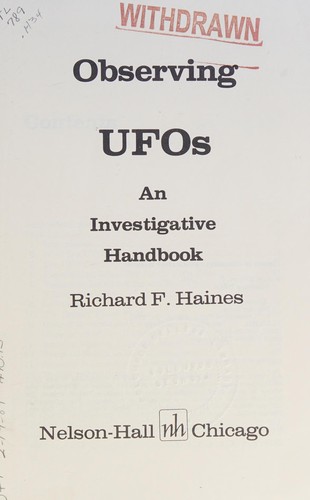
Observing UFOs: An Investigative Handbook
A Former NASA Ames Research Psychologist's 1980 Field Manual Brings Human-Factors Science to the UFO Witness Report — the Same Discipline Richard F. Haines Would Spend the Next Four Decades Building Into NARCAP
Find on Amazon →As an Amazon Associate, OverClassified may earn from qualifying purchases made through this link, at no extra cost to you.
Why This Is Essential Reading
Observing UFOs: An Investigative Handbook earns its place on this list for a reason distinct from almost every other title here: it is not an argument about what UFOs are, but a manual for how to find out — and its author's credentials for writing that manual are about as independently verifiable as any in this catalogue. Richard F. Haines spent nineteen years as a NASA Ames research scientist studying exactly the perceptual and human-factors questions this book applies to the UFO witness report, and he did not simply publish the standard and move on: he spent the following four decades applying it himself, from the 1989 Lake Cote photogrammetric analysis published in a peer-reviewed journal through NARCAP, the aviation-safety research organization this book's own methodology directly anticipates. That the standard did not resolve every case — the 2012 Maccabee-Haines split over El Bosque is proof enough that rigorous method narrows disagreement without eliminating it — does not undercut the book's value so much as demonstrate exactly what it promises and no more: better evidence, evaluated more carefully, by investigators equipped to know the difference between what a witness perceived and what they inferred. Read alongside Richard Hall's institutional The UFO Evidence, Haines's handbook supplies the missing piece that compilation never addressed: not which cases to believe, but how to gather one worth evaluating in the first place.
Related Cases & Theories
Essential Viewing
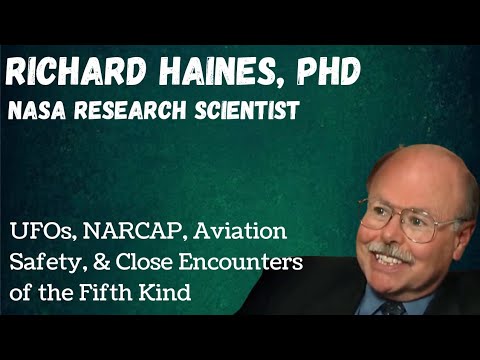
Richard Haines, PhD - UFOs, NARCAP, Aviation Safety, and Close Encounters of the Fifth Kind (CE-5)
Engaging The Phenomenon — A recorded interview with Richard Haines discussing NARCAP, aviation safety, and the decades of pilot-sighting research that grew directly out of the perceptual-science standards this 1980 handbook first laid out.
Interview with NARCAP founder Dr. Richard Haines
Todd Curtis (airsafe) — An interview with Haines hosted by an aviation-safety-focused outlet, discussing NARCAP's founding mission of applying rigorous, aviation-safety methodology to pilot and aircrew UAP reports.
Sources Cited
- "Richard F. Haines." Wikidata (Q107169737) (birth date May 19, 1937, birthplace Seattle, occupations psychologist and ufologist). wikidata.org
- "Richard F. Haines." The UFO Database (biography: NIH predoctoral fellowship, NASA Ames flight-simulator research, NARCAP founding 1999, chief scientist from 2000, O'Hare technical report). theufodatabase.com
- "Richard Haines." Center for UFO Studies (biography: education at Pacific Lutheran College and Michigan State University, NASA Ames career 1967–1988, Space Human Factors Office, NARCAP founding, over 40 years of UFO research). cufos.org
- "Observing UFOs: an investigative handbook / Richard F. Haines." National Library of Australia catalogue record (bibliographic detail: Nelson-Hall, Chicago, 1980, xix + 300 pp., illustrated). catalogue.nla.gov.au
- "Observing UFOs: An Investigative Handbook." Biblio.com listing for ISBN 9780882297255 (paperback, 1980, 320 pp., bibliographic record for the edition cited on this site). biblio.com
- "Observing Ufos: An Investigative Handbook." Amazon.com product listing for ISBN 0882297252 / 9780882297255 (edition cited across this site's own resources library). amazon.com
- "Observing Ufos: An Investigative Handbook by Richard F. Haines." Goodreads (reader rating and edition record, 320 pp., original publication April 1, 1980). goodreads.com
- Simon, Armando. "Observing UFOs." Skeptical Inquirer, Vol. 4, No. 4, Summer 1980 (contemporary review of the book in the Committee for Skeptical Inquiry's flagship journal). skepticalinquirer.org
- Haines, Richard F., et al. "Technical Report #10: Report of an Unidentified Aerial Phenomenon and its Safety Implications at O'Hare International Airport on November 7, 2006." NARCAP, March 2007. narcap.org
- Haines, Richard F. "Aviation Safety in America: A Previously Neglected Factor." NARCAP Technical Report #1, 1999 (NARCAP's founding report, documenting over 100 aviation-safety-relevant UAP incidents). narcap.org
- Haines, Richard F. & Vallée, Jacques. "Photo Analysis of an Aerial Disc Over Costa Rica." Journal of Scientific Exploration, Vol. 3, No. 2, pp. 113–131 (1989). scientificexploration.org
- "Physical Evidence Related to UFO Reports: The Proceedings of a Workshop Held at the Pocantico Conference Center, Tarrytown, New York, September 29 – October 4, 1997." Society for Scientific Exploration (Sturrock Panel proceedings, listing Haines among the eight invited investigators). ufoevidence.org
- This site's own resources library: Full Reading List, where this 1980 edition (ISBN 0882297252) is cited across 4 separate case-file pages, plus 1 further page under a bibliographically distinct edition.
- This site's own case file: The Chicago O'Hare UFO Sighting, for NARCAP's Technical Report #10 investigation Haines personally led.
- This site's own case file: Lake Cote UFO Photograph, for Haines's 1987 photogrammetric analysis with Jacques Vallée.
- This site's own case file: Petrozavodsk Phenomenon, for Haines's translation of the Gindilis report passed to him by J. Allen Hynek.
- This site's own case file: El Bosque Air Base UFO Video, for Haines's 2012 competing technical report with Bruce Maccabee.
- This site's own case file: Long Island Sound Lufthansa/British Airways Sighting, for the case's cataloguing within Haines's AIRCAT database.
- This site's own key-figures entry: Richard F. Haines, for his full biography and case connections.
Have corrections, additional research, or peer-reviewed sources? Help improve this entry.
Suggest an Edit