
The Betty Andreasson Luca Abduction
On the evening of January 25, 1967, the lights failed inside Betty Andreasson's house in South Ashburnham, Massachusetts, and a pulsating reddish-orange glow appeared at the kitchen window while her seven children and visiting parents looked on. A decade later, under fourteen separate hypnotic regression sessions directed by NICAP/MUFON field investigator Raymond E. Fowler for the Center for UFO Studies, Betty described small entities led by one identifying himself as "Quazgaa" walking through her closed door, placing her family in suspended animation, and taking her aboard a craft for a physical examination that included a needle-like probe inserted into her nostril. What began as a single family's report to a newspaper appeal became a twelve-month, multi-investigator project — two lie-detector examinations, a psychiatric interview, and a 528-page confidential report — and then, over the following two decades, the subject of four more books as the case's content grew steadily stranger, more overtly religious, and harder for either side of the UFO debate to resolve.
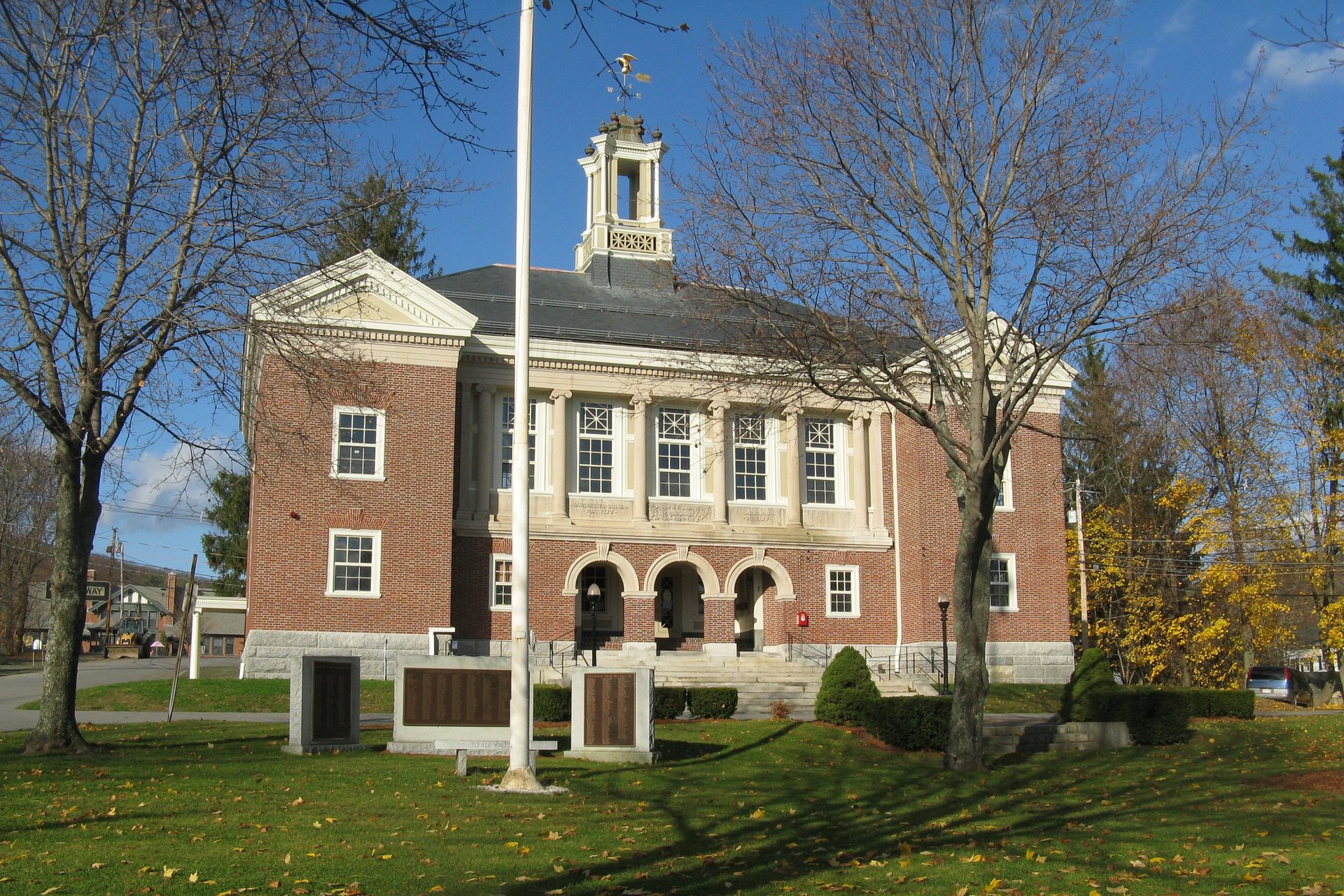
Pictured: the Town Hall of Ashburnham, Massachusetts, whose South Ashburnham village was the site of the January 1967 encounter — not a photograph of the Andreasson house, the reported entities, or the craft itself. No rights-clear photograph of the actual house on Washington Street, the 1967 event, or a verified public-domain image of Betty Andreasson herself is known to be available; the family's home remains a private residence and was never photographed or released as part of the CUFOS investigation.
Theoretical Alignment
The Andreasson case sits awkwardly across all three of ufology's major interpretive frameworks rather than cleanly fitting one. Its physical vocabulary — a landed craft, small grey-skinned entities in uniforms, a nasal probe, struts adjusted to the terrain — is straightforwardly extraterrestrial in form. But its climactic content, a walk through solid matter into an underground environment and a mystical vision of a phoenix-like bird explicitly received as a message from a Christian "Lord" figure, pushes as hard toward an interdimensional or consciousness-based framework as any case on this site. And because the entire detailed narrative was recovered only through fourteen hypnosis sessions with a single, devoutly religious witness whose account grew steadily more elaborate across four subsequent books, the Psycho-Social Hypothesis — that hypnosis surfaced and progressively built out material shaped by Betty's own emotional and spiritual life rather than recovering a literal buried memory — carries unusually strong weight for a case this well-documented.
Background
Betty Ann Aho was born January 7, 1937, in Fitchburg, Massachusetts, roughly six miles from the small mill-town village of South Ashburnham where she would spend most of her adult life. By January 1967 she was thirty years old, a devoutly Christian homemaker and mother of seven, married to pipe fitter James Andreasson. The couple's children — Becky (11), James Jr. (10), Mark (9), Scott (7), Todd (6), Bonnie (4), and Cindy (3) — ranged from toddlers to pre-teens. James had been hospitalized since a car accident on December 23, 1966, and remained hospitalized into early March 1967, and Betty's parents, Waino and Eva Aho, were staying at the house to help her manage the household and the nightly hospital visits while he recovered — a detail that put nine people, not just Betty, inside the house that January evening.
Betty told almost no one about what she said happened that night for years. It was not until 1975 — eight years later — that she wrote a letter to astronomer J. Allen Hynek after reading a newspaper article about his newly founded Center for UFO Studies, which had placed a general public appeal soliciting accounts of unusual personal experiences. Hynek's office filed the letter for months without acting on it, its unusually elaborate content apparently working against rather than for it, before forwarding it to MUFON's Humanoid Study Group. MUFON field investigator Jules Vaillancourt finally opened an investigation in January 1977 — almost exactly ten years after the reported event, and eleven years after Betty and Barney Hill's 1961 New Hampshire case had already established hypnotic regression as ufology's standard tool for recovering exactly this kind of long-delayed, fragmentary memory.
Complete Timeline
| Date | Event |
|---|---|
| Dec 23, 1966 | Betty's husband James Andreasson is hospitalized following a car accident; her parents Waino and Eva Aho move in to help. He would remain hospitalized into early March 1967. |
| Jan 25, 1967 (~6:35 PM) | The encounter. The house lights fail at Betty Andreasson's home on Washington Street, South Ashburnham, Massachusetts. A pulsating reddish-orange light appears outside the kitchen window. Betty's father Waino Aho glimpses small entities "jumping like grasshoppers" toward the house before he, too, loses awareness. |
| Jan 25, 1967 (later) | Betty later recounted (under hypnosis, a decade on) that four to five entities identifying their leader as "Quazgaa" entered through the closed kitchen door, placed her family in a state of "suspended animation," and led her to a landed craft in the backyard for an examination. |
| 1967–1975 | Betty tells almost no one of the experience. Fragmented conscious memories and unexplained anxiety persist, but the event is not reported to any UFO organization. |
| 1975 | Betty writes to J. Allen Hynek after reading about his new Center for UFO Studies. Her letter is set aside for months due to its unusually elaborate content before being forwarded to MUFON's Humanoid Study Group. |
| January 1977 | MUFON field investigator Jules Vaillancourt opens a formal investigation, roughly ten years after the reported event. |
| Feb–Apr 1977 | Raymond E. Fowler, MUFON's Massachusetts state director and a CUFOS associate investigator, assembles a team including MUFON state director Joseph Santangelo, investigator Fred Youngren, hypnotist Harold Edelstein (director, New England Institute of Hypnosis), and Psychological Stress Evaluator analyst Ernest C. Reid. |
| May–June 1977 | Fourteen hypnosis sessions. Sessions documented on at least May 5, 7, 14, 15, and 23, and June 4, 17, 18, and 19, 1977, recover the detailed abduction narrative: passage through the kitchen wall, the craft's interior, the nasal-probe examination, the underground environment, and the phoenix vision. |
| 1977 | Betty and her daughter Becky (present in the house as an 11-year-old in 1967) undergo two Psychological Stress Evaluator ("lie-detector") examinations administered by Ernest C. Reid; a psychiatric interview and a character-reference check with neighbors and clergy are also conducted. |
| 1977 | Fowler compiles the investigation into a 528-page confidential report for CUFOS. |
| 1978 | Betty meets Bob Luca, who would become her second husband; he reports his own separate abduction-type experiences, later investigated under hypnosis by Fowler's team as well. |
| 1979 | The Andreasson Affair is published by Prentice-Hall with a foreword by J. Allen Hynek, condensing Fowler's 528-page report for a general readership. |
| Winter 1979/1980 | Psychiatrist Ernest H. Taves publishes "Betty Through the Looking Glass" in Skeptical Inquirer, arguing the recovered material reflects "a dream or fantasy... that had meaning and utility in terms of her life history," not a literal event. |
| 1982 | The Andreasson Affair, Phase Two is published, documenting continuing paranormal experiences reported by Betty and Bob Luca (now married) and recovering additional childhood-era material under further hypnosis. Taves publishes a follow-up critical review in Skeptical Inquirer. |
| 1988 onward | Fowler, using the investigative template built for this case, begins the multi-year Allagash Waterway Abduction investigation. |
| 1990 | The Watchers is published, expanding the case's "genetic and consciousness" framing into an explicit organizing theory. |
| 1995 | The Watchers II is published, with a foreword by Whitley Strieber, extending the material into near-death-experience territory. |
| 1997 | The Andreasson Legacy, the fifth and final book in Fowler's series, is published, closing out nearly two decades of continuing investigation into the Luca and Fowler families' reported experiences. |
| 2002 | Fowler publishes UFO Testament: Anatomy of an Abductee, disclosing his own claimed lifelong abduction experiences. |
| 2018 | The Andreasson Affair is reissued with the retroactive subtitle The True Story of a Close Encounter of the Fourth Kind — a classification term that did not exist in ufology's working vocabulary at the time of the 1979 original. |
| Mar 18, 2022 | Betty Andreasson Luca dies at age 85 at the home of her daughter Bonnie in Martinsville, Virginia, survived by Bob Luca, her husband of 44 years. |
The Evening of January 25, 1967
By Betty's account, the evening began ordinarily. Her parents and seven children were gathered between the kitchen and living room of the family's house on Washington Street in South Ashburnham when the electric lights inside the house suddenly failed. Through the kitchen window, a pulsating reddish-orange light became visible outside, growing brighter. Betty's father, Waino Aho, went to investigate and, according to his later account to investigators, saw several small figures approaching the house that he described as resembling "Halloween freaks" wearing "a funny kind of headdress imitating a moon man," moving with an unusual bounding gait — "jumped one after the other — just like grasshoppers." He reported a brief sensation of feeling "kind of queer" before losing conscious awareness of what followed. Under later hypnosis, Betty herself described a state she called "suspended animation" settling over the rest of the household — her parents and children frozen in place, unaware of time passing, while she alone remained able to perceive and interact with what came next.
None of what followed — the entry of four or five entities, one identifying himself as "Quazgaa," passage through the closed kitchen door, or anything aboard a craft — was reported by Betty, her parents, or her children at the time, or for years afterward. What the family could and did consistently describe, independent of any hypnosis, was limited to the failed lights, the pulsating exterior glow, and a short but total gap in awareness. It is this initial, family-witnessed phenomenon — not the elaborate abduction narrative that followed — that constitutes the only part of the case with contemporaneous multiple-witness corroboration.
A Decade of Silence
Betty's reluctance to discuss the experience for eight years is itself a significant, well-documented feature of the case rather than an unexplained gap. She has said she feared not being believed, worried about the effect disclosure might have on her large family, and by her own account experienced recurring anxiety and fragmented recollections she did not know how to process without a framework for understanding them. This pattern — a period of silence followed by disclosure only after encountering a public institutional outlet, in this case Hynek's newly formed CUFOS — recurs across multiple cases in the abduction literature, including Betty and Barney Hill, who also delayed years before their account became public.
When Betty's 1975 letter finally reached Hynek's desk, its content was, by Fowler's own account, dramatically more elaborate than the typical CUFOS submission — a factor that led to it being set aside rather than acted upon immediately. It took MUFON's Humanoid Study Group, and then field investigator Jules Vaillancourt specifically, to finally open a formal case file in January 1977.
The CUFOS/MUFON Investigation
Raymond E. Fowler was, at the time, a Sylvania/GTE aerospace engineer working on the Minuteman ICBM program by day, and MUFON's Massachusetts state director and an associate investigator for Hynek's Center for UFO Studies by night — a defense-engineering background, not a clinical psychology or psychiatric one, a credential gap this site notes plainly for Fowler exactly as it does for other UFO investigators without formal behavioral-science training. Fowler assumed the role of principal investigator and, over twelve months in 1977, assembled a team that was unusually large and multidisciplinary for a single-case UFO investigation of its era: MUFON state director Joseph Santangelo, investigator Fred Youngren, professional hypnotist Harold L. Edelstein (director of the New England Institute of Hypnosis, a faculty instructor at three colleges, and a consultant to law enforcement agencies), and Ernest C. Reid, who administered Psychological Stress Evaluator (PSE) testing — a voice-stress-based deception-detection instrument, not a full multi-channel physiological polygraph, though it is frequently described as "polygraph" or "lie-detector" testing in secondary literature about the case. An unnamed psychiatrist also conducted an interview with Betty as part of the investigation.
Over fourteen separate sessions in May and June 1977, Edelstein regressed Betty under hypnosis while Fowler and other team members observed, recorded, and later cross-checked her account session to session for consistency. This was a materially larger investigative effort than Dr. Benjamin Simon's hypnosis sessions with the Hills a decade earlier, both in session count and in the range of supporting tests brought to bear — though, as this case file's Why "Disputed" section addresses directly, a larger investigative apparatus is not automatically stronger evidence when the underlying recovery method (hypnotic regression of a single witness) carries the same reliability concerns regardless of how many specialists observe it.
What the Hypnosis Recovered
Session by session, a narrative emerged that went well beyond anything in Betty's fragmented conscious memory. She described the entities passing directly through her home's closed kitchen door, escorting her outside to an oval craft with a raised central portion resting in the backyard on struts individually adjusted for the sloping terrain. The craft's underside became transparent as she approached, revealing "glass balls" and articulated arm-like structures beneath it. Aboard, she described a silver-gold interior, a "quarter bubble" entry chamber, multiple internal levels connected by stairways, and dome-shaped rooms with rippled, window-like surfaces.
The examination itself, as Betty described it under hypnosis, involved a long, flexible silver needle inserted into her left nostril, which she felt "break through" what she perceived as a membrane; when withdrawn, the needle carried "a little ball with little prickly things on it" that she said had not been there before insertion. A separate procedure involved a web-like, tan-brown material on a roll that the entities appeared to examine closely. Betty also recalled being told the examination was "for procreation," a detail she found deeply distressing to recount and one the book does not resolve into a specific clinical claim beyond her own description of the sensation and the entities' evident interest in her reproductive biology.
The entity identifying himself as Quazgaa — described as roughly four feet tall, gray-skinned, with a pear-shaped head, large cat-like eyes, and mongoloid facial features, wearing a dark blue form-fitting uniform — communicated with Betty telepathically throughout, delivering what she experienced as a message about watching over humanity, to be revealed "when the time is right." No other individual entities were named in the 1977 sessions.
The Underground Environment and the Phoenix Vision
Beyond the physical examination, later sessions surfaced material considerably stranger than anything in the Hill case or in most abduction accounts published up to that point: Betty described being led through a dark, tunnel-like passage into what she experienced as an artificial underground environment, culminating in a mystical vision of a massive, luminous phoenix-like bird that burned to ash and was reborn, worm-like, from within its own remains. Unlike the physical examination sequence, Betty did not interpret this vision in the vocabulary of alien technology or biology at all — she received it, in the moment and in every subsequent retelling, as a direct religious communication from a being she identified as "the Lord," describing herself afterward as "a chosen one." Hynek, whose own close-encounter classification system (nocturnal lights through CE3) was built around physical, externally observable phenomena, nonetheless wrote the book's foreword rather than steering its editorial direction away from this material — a decision Fowler's own account frames as institutional CUFOS credibility being extended to an investigation whose content sat well outside Hynek's own taxonomy.
Fowler is candid within the book itself about the limits of what his team's methodology could actually establish: the polygraph-style testing and consistency across sessions could document that Betty was recounting the material sincerely and without conscious deception, accompanied by genuine emotional distress, but none of it could establish what the phoenix vision or Quazgaa's message actually were — a distinction between documenting an experience occurring and endorsing its content that later reviewers, discussed below, found only partially persuasive.
Character References, Psychiatric Review, and the PSE Examinations
Alongside the hypnosis sessions, Fowler's team conducted an extensive character-reference check into Betty's reputation among neighbors and clergy, seeking any indication of a history of fabrication, attention-seeking, or psychiatric instability; none was reported. An unnamed psychiatrist separately interviewed Betty as part of the investigation. Ernest C. Reid administered Psychological Stress Evaluator (PSE) testing — a voice-stress-based instrument distinct from a full multi-channel physiological polygraph, though the case's own secondary literature and even some of Fowler's own team routinely describe it using the more familiar "lie-detector" or "polygraph" language — to both Betty and, separately, to her daughter Becky (11 years old at the time of the 1967 event, an adult by 1977), regarding their accounts of the 1967 evening specifically. Reid's analysis concluded both were being truthful about their memory of that night. It is important to be precise about what this actually demonstrates: PSE and polygraph-style testing can indicate a subject believes they are telling the truth about a genuinely experienced memory; neither instrument can distinguish a truthfully recounted external event from a truthfully recounted internally generated one, such as a vivid dream, a confabulated memory, or material actively constructed across repeated hypnosis sessions. Reid's finding is real and was honestly reported by Fowler's team, but it resolves Betty and Becky's sincerity, not the objective reality of what they described.
The Sequel Investigations
Publication of The Andreasson Affair in 1979 did not close the case. Fowler returned to the same family's continuing claims across four further books spanning nearly two decades: The Andreasson Affair, Phase Two (1982) recovered additional childhood-era material under further hypnosis and documented what Betty and her new husband Bob Luca (they married in 1978) described as ongoing paranormal experiences, including reports of unmarked helicopters shadowing the couple. The Watchers (1990) and The Watchers II (1995, with a foreword by author Whitley Strieber) expanded the implicit "genetic and consciousness" framing of the original book into an explicit organizing theory — a long-term alien monitoring or preparation program extending across Betty's family and, implicitly, humanity more broadly — and pushed the recovered material into far more elaborate territory, including an alleged underwater installation Betty called a "Museum of Time" and descriptions of humans preserved in glass containers. The Andreasson Legacy (1997) closed out the series.
By 1980s logistics, Fowler's team trained Bob Luca to conduct further hypnotic regression sessions with Betty directly, rather than relying solely on Edelstein — a methodological shift that meaningfully departs from the original investigation's use of an independent, professionally credentialed hypnotist with no personal stake in the outcome. Bob Luca's own separately hypnotically recovered abduction claims, investigated by Fowler's team as well, add a second experiencer to the case's later chapters, though his account emerged years after Betty's and after the couple's marriage, limiting its value as independent pre-existing corroboration. Skeptical researchers have consistently pointed to this expanding, ever-more-elaborate trajectory — four sequel volumes surfacing substantial new content session after session and book after book, rather than a single stable memory recovered once and left intact — as more consistent with hypnosis actively generating new narrative material over time than with a buried memory being progressively uncovered.
Critical and Skeptical Reception
The case's most substantial contemporary critique came from psychiatrist Ernest H. Taves, whose review "Betty Through the Looking Glass" ran in Skeptical Inquirer (Vol. 4, No. 2, Winter 1979/1980, pp. 88–95). Taves accused Fowler of "an attempt to inject mystery into a situation where there is none," arguing instead that "Betty recalled, or relived, in hypnosis, a dream or fantasy (or a number of them) that had meaning and utility in terms of her life history and her emotional needs" — a psychological-origin explanation that, notably, did not accuse Betty of deliberate fabrication. Taves returned to the case three years later, reviewing the 1982 sequel The Andreasson Affair, Phase Two for the same publication and extending his skepticism to the expanding case rather than treating the first book's problems as resolved by additional investigation.
Set against the general academic literature on hypnotic regression that developed substantially in the years after this investigation — work associated with researchers including psychologist Elizabeth Loftus, whose experiments repeatedly demonstrated that hypnosis and repeated leading questioning can implant confident, subjectively vivid, but factually false memories without any conscious deception by either the hypnotist or the subject — the Andreasson investigation's own design carries a specific structural vulnerability: fourteen sessions is a very high number for a single witness, each session building directly on material recovered in the one before it, conducted by a hypnotist who, however credentialed, was working from an investigative team already convinced something extraordinary had happened. Later sessions were compounded further when Fowler's team trained Betty's own husband Bob Luca to serve as hypnotist for continuing regression work, removing even the nominal independence Harold Edelstein had provided in 1977. None of this required bad faith on any investigator's part; it is precisely the profile of circumstances the post-1980s hypnosis-reliability literature identifies as highest-risk for confabulation.
Within ufology itself, reception has been more divided than uniformly skeptical. The case drew real respect for its investigative apparatus specifically — the PSE testing, the character-reference checks, and the sheer twelve-month duration of the team investigation represented a level of documentary effort few contemporary single-case investigations matched, and Hynek's willingness to write the foreword lent it institutional CUFOS credibility that purely independent investigators of similarly unusual cases often lacked. At the same time, the case's explicitly religious content — Betty consistently interpreted the beings and Quazgaa's message in the vocabulary of Christian prophecy and angelic visitation rather than secular extraterrestrial contact — has drawn a distinct line of skeptical response separate from the general hypnosis debate: critics both within and outside ufology have argued the case sits closer to a documented religious experience refracted through UFO-era cultural imagery than to a discrete physical event. Commentators comparing this case to Betty and Barney Hill's more secular, contained missing-time account have treated the divergence as the moment abduction literature split into more clinical and more mystical strands that developed largely separately across the following decades — a genre-shaping consequence of this specific case regardless of how its underlying facts are ultimately weighed.
Later Life and Death
Betty Andreasson Luca remained married to Bob Luca for 44 years and continued to speak and write about her experiences for the remainder of her life, becoming, alongside Betty Hill, one of the two most frequently cited female abduction experiencers in the field's history. She died on March 18, 2022, at age 85, at the home of her daughter Bonnie in Martinsville, Virginia. Raymond Fowler devoted more sustained investigative effort to this single case — twelve months of formal fieldwork in 1977 alone, followed by intermittent further investigation across nearly two more decades — than to any other case in his long UFO research career, including his later work on the Allagash Waterway Abduction, which he built directly on the investigative template this case established.
Key Witnesses
Betty Andreasson Luca
The sole witness to the detailed abduction narrative, recovered entirely through fourteen hypnosis sessions conducted a decade after the reported 1967 event. Passed two Psychological Stress Evaluator examinations regarding her sincerity about the 1967 evening specifically, underwent a psychiatric interview, and was the subject of an extensive character-reference check that found no history of fabrication or instability. Continued reporting further experiences across four additional books co-investigated by Fowler through 1997, and disclosed no financial motive beyond ordinary book royalties for an account she first tried to avoid publicizing for eight years. Died March 18, 2022, at age 85.
Waino Aho
The only family member who described, in his own words rather than solely under Betty's later hypnosis, directly glimpsing the entities themselves — small figures he compared to Halloween costumes, moving with an unusual bounding gait, before he lost conscious awareness of what followed. His account is consistent with Betty's own description of the same moment and represents the case's only independent, non-hypnotically-derived corroboration of an entity sighting, however brief and non-detailed.
Bob Luca
Met and married Betty roughly a decade after the 1967 event and years after her initial hypnosis sessions. Reported his own separate abduction-type experiences, investigated under hypnosis by Fowler's team and documented across the case's later sequel volumes. By the 1980s, was trained by Fowler's team to conduct further regression sessions with Betty directly in place of the original investigation's independent professional hypnotist — a methodological departure this case file's Why "Disputed" section treats as a genuine limitation on the later material's evidentiary independence, whatever the sincerity of either spouse's testimony.
Raymond E. Fowler
A Sylvania/GTE aerospace engineer on the Minuteman ICBM program with a defense-engineering rather than clinical-psychology background, and a former NICAP Massachusetts subcommittee chairman who had investigated the Exeter UFO Incident in 1965. Assembled and led the twelve-month, multi-investigator team behind this case, compiling a 528-page confidential report for CUFOS before condensing it into The Andreasson Affair (1979). Returned to the case across four further books through 1997, and later applied the same investigative template — multiple hypnosis sessions, polygraph-style corroboration, character-reference checks — to his 1988–1993 investigation of the Allagash Waterway Abduction. Disclosed his own claimed lifelong abduction experiences in 2002.
The Five Observables Assessment
Assessment: No instrumented data of any kind exists for this case — no radar, no photography, no physical trace evidence. Every performance characteristic attributed to the craft (landing on adjustable struts, a transparent underside, passage of entities through solid matter) comes exclusively from Betty's hypnotically recovered testimony, a decade after the fact. If taken at face value, the craft's described behavior would imply anti-gravity lift and low observability — it produced no sound, left no report of scorched grass or displaced snow despite reportedly landing in a winter backyard, and was seen by no one outside the immediate family. None of this rises above the level of uncorroborated witness description; the Five Observables framework, designed for instrumented modern encounters, has essentially nothing to evaluate here beyond narrative content.
Evidence Assessment
Supporting Genuine Anomalous Experience
- Nine family members were present in the house and the initial phenomenon (failed lights, pulsating exterior glow, a gap in awareness) is attested independent of Betty's later hypnosis, via her father Waino Aho's own separate account
- James Andreasson's hospitalization from a car accident is independently confirmed by hospital records, corroborating the household circumstances Betty described
- Two PSE examinations of both Betty and her daughter Becky, administered by an outside analyst, concluded both were being sincere about their memory of the 1967 evening
- An extensive character-reference check with neighbors and clergy found no history of fabrication, exaggeration, or psychiatric instability
- Betty told almost no one for eight years and showed no apparent motivation to fabricate a story for attention or profit at the time of first disclosure
- The investigation was unusually resourced for a single case in its era: twelve months, five named specialists, and a 528-page report
- J. Allen Hynek, whose own reputation depended on maintaining CUFOS's investigative standards, was willing to write the book's foreword
Supporting a Conventional or Psychological Explanation
- Every detail beyond the initial light and awareness gap comes exclusively from hypnotic regression of one witness, a technique with well-documented risk of confabulation and unintentional memory construction rather than accurate recall
- Betty's daughter Becky, the only other family member subjected to hypnosis or PSE testing regarding that night, was 11 years old in 1967 and her testimony was gathered a decade later as an adult, limiting its independent evidentiary weight
- The case's content grew substantially more elaborate across five books and nearly twenty years of continued hypnosis, a pattern more consistent with progressive narrative construction than a single memory being uncovered intact
- The Psychological Stress Evaluator used is a voice-stress instrument, not a full physiological polygraph, and can only establish sincerity, not the objective reality of an internally experienced memory
- Psychiatrist Ernest H. Taves's contemporary review concluded the recovered material more plausibly reflected "a dream or fantasy... that had meaning and utility in terms of her life history and her emotional needs" than a literal event
- By the 1980s, further hypnosis sessions were conducted by Betty's own husband Bob Luca rather than an independent professional hypnotist, removing a key methodological safeguard from the later material
- No physical trace evidence — landing marks, photographs, retained objects — was ever produced despite an alleged craft landing in an inhabited residential backyard
- Betty's strong pre-existing Christian religious framework provides a ready-made interpretive vocabulary (angels, a "Lord" figure, being "chosen") that critics argue shaped the hypnotically recovered content rather than being incidental to it
Why "Disputed"
This case earns a DISPUTED classification, not a higher "Credible" stamp comparable to Betty and Barney Hill (68/100) or Travis Walton (71/100), because its evidentiary structure is genuinely thinner at the points that matter most for corroboration, even though its documentary effort is, if anything, greater than either of those cases. The Hill case had two independent witnesses hypnotized separately by the same credentialed psychiatrist, each recovering broadly consistent (though not identical) material. The Andreasson case has exactly one primary witness for its entire detailed narrative; the only other family member examined under hypnosis or PSE testing, daughter Becky, was tested a decade after the fact as an adult recalling an experience from age eleven, and her testimony addressed only the initial 1967 evening, not the abduction narrative itself. Waino Aho's account, while real independent corroboration of a brief, ambiguous entity glimpse, was never itself elicited under hypnosis or tested for consistency the way Betty's was.
Set against that thinner corroboration is genuinely serious documentary effort: twelve months, five named investigators, two rounds of PSE testing, a psychiatric interview, and a character-reference check — a scale of investigation that exceeds most single-witness UFO cases on this site. But that effort measures the sincerity and internal consistency of Betty's account, which is not seriously in dispute; it does not, and cannot, independently verify that a craft actually landed in a South Ashburnham backyard in January 1967. The case's own trajectory across five books and nearly two decades of continued hypnosis — growing from a single physical examination in 1979 into an underwater "Museum of Time" containing humans preserved in glass containers by the 1990s — is the strongest single argument for caution: elaboration of this kind and scale is a known signature of hypnosis actively generating new content over repeated sessions, not of a stable buried memory being progressively recovered intact. What is not disputed: nine people were in that house on January 25, 1967; the lights failed and a pulsating light appeared outside; Betty's father independently described glimpsing small figures before losing awareness; and every person who examined Betty and her daughter directly — the psychiatrist, the PSE analyst, the character references — concluded they were sincere. Sincerity and accuracy are separable, and this case sits closer to the line between them than most.
Sensor & Instrumentation Detection Profile
No radar, photographic, audio, or other instrumented data exists for this case in any form. It occurred at a private residence in 1967, was not reported to any authority (military, civil aviation, or otherwise) at the time, and was not investigated until a decade after the fact by a private civilian organization with no access to contemporaneous instrumentation of any kind. Every detail comes from testimony alone.
Environmental & Geospatial Context
A winter evening in central Massachusetts in late January; no unusual meteorological, astronomical, or geophysical activity has been documented or claimed as relevant to the case. South Ashburnham sits in the hilly, forested terrain of northern Worcester County, roughly six miles from Fitchburg and close to the New Hampshire border — the same general region of New England that produced the 1965 Exeter UFO Incident that Fowler had personally investigated twelve years earlier.
Observer Credibility & Occupational Profile
Betty Andreasson was, by every account gathered in the character-reference check, a devout, unremarkable homemaker with no known history of fabrication, publicity-seeking, or prior interest in UFOs before 1967. Her father, Waino Aho, offered a brief, non-elaborate account consistent with an ordinary person describing a startling and confusing few seconds rather than a rehearsed narrative. The investigation team itself carried real, if narrow, credentials: Raymond Fowler was a working aerospace engineer with no clinical training; hypnotist Harold Edelstein held professional credentials as a law-enforcement hypnosis consultant and college instructor; PSE analyst Ernest C. Reid's specific professional certifications are not detailed in the published material. No credentialed research psychologist specializing in memory or hypnosis reliability was part of the original investigating team — a gap this case shares with most abduction investigations of its era, and one that later academic critics of hypnotic regression (a body of research this case's Conventional Explanation Candidate section addresses directly) would identify as a structural weakness across the entire genre, not a flaw unique to Fowler's team.
Physical & Material Assays
No physical trace evidence of any kind was recovered, tested, or retained from this case. No soil samples, landing-mark measurements, burned or displaced vegetation, photographs of any physical effect, or any retained object were ever produced, despite the craft's alleged landing in an inhabited residential backyard in winter, when a landing depression or disturbed snow would have been readily visible the following morning had anyone thought to look before the scene changed. The "small ball with prickly things" Betty described being extracted from her nostril under hypnosis was never physically recovered, examined, or produced for independent testing — it exists only as a hypnotically recalled sensory description, not a retained artifact, a meaningful distinction from later abduction cases (Budd Hopkins's and John Mack's investigations among them) that did produce claimed physical implant objects for laboratory analysis.
Historical Precedents & Archive Matches
The Andreasson case sits within a specific, identifiable lineage of Massachusetts and New England-area high-strangeness reports investigated by the same small circle of NICAP/MUFON/CUFOS field investigators through the 1960s and 1970s. Fowler himself had investigated the 1965 Exeter UFO Incident in neighboring New Hampshire, and would go on to investigate the 1976 Allagash Waterway Abduction in Maine using the identical multi-session hypnosis-plus-corroboration methodology he first built for this case. This site's own Berkshire UFO Wave / Thom Reed case file, from the opposite side of Massachusetts and two years later, cites this exact investigation directly as the regional standard its own more limited single-investigator documentation should be measured against. Nationally, the case is most frequently compared to Betty and Barney Hill (1961) as the two most extensively documented female-centered abduction narratives in American ufology, and to Travis Walton (1975) as a contemporary case combining multiple witnesses with formal polygraph testing, though Walton's case retained six co-witnesses to the initiating event where this case retained only Betty's fragmentary later hypnotic account of everything beyond the initial light and paralysis.
Material Analysis
Unlike case files built around a recovered physical object — debris, a metal fragment, a soil sample — this case has no physical evidence trail to analyze. The nearest thing to a physical claim is the small object Betty described being extracted from and reinserted into her nasal cavity during the examination sequence, a detail Wikipedia's own entry on alien implants credits The Andreasson Affair by name as the first significant publication to introduce to abduction literature. But the object itself was never recovered, photographed, or subjected to any laboratory analysis; its entire evidentiary existence is a verbal description recalled under hypnosis a decade after the alleged event. This distinguishes the case sharply from the later implant-claim investigations it helped inspire, several of which (through investigators including Budd Hopkins and physicians working with John Mack) did produce physical objects that underwent real, if contested, laboratory examination.
What Was Never Tested
No soil, vegetation, or ground-disturbance sample was ever collected from the Andreasson backyard. No photograph exists of any physical effect attributed to the reported landing. No independent medical examination of Betty's nasal cavity was conducted at or near the time of the alleged 1967 procedure; the earliest any physician-level scrutiny of her body entered the case file was the unnamed psychiatrist's 1977 interview, a decade after the fact and focused on her psychological state rather than any physical residue.
Supporting a Physically Real Encounter
- The nasal-probe sensation and resulting object were described with specific, consistent sensory detail (a bendable needle, a "membrane," a small textured ball) across multiple hypnosis sessions
- Betty's description predates by over a decade the point at which "alien implant" became a recognizable, widely discussed motif in abduction literature, arguing against simple cultural borrowing at the time of the original 1977 sessions
- The broader physical craft description (adjustable struts, transparent undercarriage) is internally detailed and consistent across sessions rather than vague or contradictory
Supporting No Physical Component Occurred
- No object was ever physically recovered, photographed, or tested — the entire "implant" claim exists solely as a hypnotically recalled sensation
- No landing-site evidence of any kind (soil disturbance, snow displacement, scorching) was ever documented, despite the alleged event occurring in an inhabited backyard in winter
- Detailed, internally consistent sensory description is a well-documented feature of vivid dreams, sleep-paralysis hallucinations, and hypnotically elaborated confabulation, and is not by itself distinguishing evidence of a physical event
- No contemporaneous 1967 medical record documents any physical symptom, injury, or abnormality consistent with a nasal procedure
The Conventional Explanation Candidate
No single conventional explanation accounts for every layer of this case equally well — a reflection of the fact that the case itself is really two distinct evidentiary tiers: a brief, multi-witness initiating phenomenon (failed lights, a pulsating exterior glow, a gap in awareness), and an extensive, single-witness abduction narrative recovered only through fourteen hypnosis sessions a decade later. Each tier invites a different leading candidate.
Hypnotic Confabulation & Memory Contamination
The dominant academic and clinical position on hypnotic regression, developed substantially in the decades after this investigation, is that hypnosis does not function as a reliable "replay" of stored memory. It increases a subject's confidence in recalled material without increasing its accuracy, and is documented to actively generate new, subjectively vivid, but factually unreliable content in response to a hypnotist's questions — a risk compounded here by fourteen separate sessions over several weeks, and further compounded across the sequel investigations by the later use of Betty's own husband as hypnotist in place of an independent professional. This does not require assuming deliberate hypnotist misconduct on Edelstein's or Fowler's part; leading questions and a genuinely believed narrative frame can produce confabulation without any bad faith. The case's own trajectory — expanding steadily from a single physical examination in 1979 to an underwater "Museum of Time" by the 1990s — is difficult to explain under a "single buried memory, progressively recovered" model, and much easier to explain under a model where each investigative session and subsequent book added genuinely new constructed material.
Sleep Paralysis / Hypnagogic Hallucination (Initiating Event)
The brief, family-witnessed onset of the event — lights failing, a pulsating exterior glow, and a sudden, total gap in awareness — is also consistent with a household electrical malfunction (a blown fuse or brief local outage, unremarkable in a 1960s New England winter) coinciding with a hypnagogic or sleep-paralysis-adjacent state affecting multiple family members in a darkened, disoriented room, particularly during an already stressful period with James Andreasson hospitalized and the household routine disrupted. Waino Aho's brief description of figures with an unusual bounding gait, followed immediately by his own loss of awareness, is a pattern that overlaps meaningfully with reported sleep-paralysis hallucination content in the broader clinical literature, though this remains a speculative fit rather than a confirmed diagnosis, since no contemporaneous medical assessment of any family member was ever conducted.
Sincere, Religiously-Framed Psychological Experience
Psychiatrist Ernest H. Taves's 1979/1980 Skeptical Inquirer review remains the case's most substantial contemporary critique, and it explicitly does not accuse Betty of lying: Taves concluded the hypnotically recovered material more plausibly reflected "a dream or fantasy... that had meaning and utility in terms of her life history and her emotional needs" than a literal external event. Under this reading, Betty's strong, lifelong Christian faith, combined with the acute stress of her husband's hospitalization and the demands of caring for seven children largely alone that winter, provided both motive and ready-made symbolic vocabulary (angels, a "Lord" figure, being "chosen") for a profound internally-generated experience that hypnosis later helped elaborate and externalize into an abduction narrative, without Betty herself ever being consciously dishonest about what she felt she had experienced.
Hypnotic Confabulation / Memory Contamination
PlausibleThe strongest single candidate for explaining the case's detailed content and its steady expansion across five books and two decades of continued hypnosis, including sessions later conducted by a non-independent hypnotist (Betty's own husband).
Sleep Paralysis / Hypnagogic Hallucination
InconclusiveA reasonable fit for the brief, family-witnessed onset specifically (lights failing, a glow, a sudden awareness gap), but unconfirmed by any contemporaneous medical evaluation and unable on its own to account for the far more elaborate hypnotically recovered narrative that followed a decade later.
Sincere, Religiously-Framed Psychological Experience
PlausibleConsistent with every credibility check the investigation itself performed (PSE testing, psychiatric interview, character references), all of which measured sincerity rather than external accuracy, and matches the specifically religious, non-technological content of the case's most distinctive material, the phoenix vision.
Related Cases
Investigation Status
This case was never reported to, or investigated by, the U.S. Air Force's Project Blue Book, which had already wound down active field investigation and would formally close entirely in December 1969, two years after the reported event and eight years before Betty's account first reached CUFOS. No FBI, CIA, or Department of Defense file referencing this case is known to exist; the entire investigative record was compiled by private civilian researchers (MUFON, CUFOS) using no government resources or personnel. Readers researching this case in government archives should expect to find nothing case-specific — the links below cover the general UAP-records infrastructure relevant to the era and to ufology broadly, not this case directly.
Search Government Archives Directly
Further Reading — Recommended Literature
The Andreasson Affair
The original investigation, with a foreword by J. Allen Hynek. Reproduces long stretches of the hypnosis transcripts directly, session by session, alongside the polygraph-style and character-reference evidence.
The Andreasson Affair, Phase Two
The direct sequel, documenting continuing experiences reported by Betty and her new husband Bob Luca and recovering additional childhood-era material under further hypnosis.
The Watchers
Expands the case's implicit "genetic and consciousness" framing into an explicit organizing theory of long-term alien monitoring of the family and humanity.
The Watchers II
Extends the case's material into near-death-experience territory, recovering further, considerably more elaborate content from continued sessions.
The Andreasson Legacy
The fifth and final volume, closing out nearly two decades of investigation and opening up the wider Luca and Fowler family history of reported UFO and psychic experiences.
DISCLOSURE: Some links above are affiliate links. If you purchase through them, OverClassified receives a small commission at no additional cost to you. This helps support independent research.
Essential Viewing
The Betty Andreasson Alien Abduction (1967)
A documentary-style overview of the January 25, 1967 encounter and its investigation, covering the same case timeline and hypnosis-session material addressed in this case file.
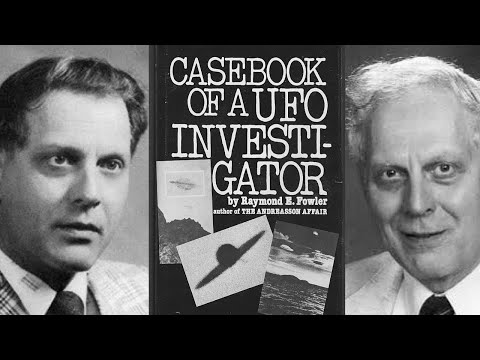
Raymond Fowler on the Andreasson Affair (Full Interview, 1987)
A full 1987 archival interview with principal investigator Raymond Fowler, discussing his investigation of the case directly a decade after the original 1977 hypnosis sessions.
Sources
- Fowler, Raymond E. The Andreasson Affair: The Documented Investigation of a Woman's Abduction Aboard a UFO. Prentice-Hall, 1979; Wild Flower Press pbk. reprint, 1994. Full digitized scan: archive.org
- Fowler, Raymond E. "THE ANDREASSON AFFAIRE." Full-text scan confirming investigation team members, hypnosis session dates, and hypnotically recovered narrative detail. archive.org
- Fowler, Raymond E. The Andreasson Affair, Phase Two: The Continuing Investigation of a Woman's Abduction by Alien Beings. Wild Flower Press, 1982. archive.org
- Fowler, Raymond E. The Watchers: The Secret Design Behind UFO Abduction. Bantam, 1990
- Fowler, Raymond E. The Watchers II: Exploring UFOs and the Near-Death Experience, foreword by Whitley Strieber. Wild Flower Press, 1995
- Fowler, Raymond E. The Andreasson Legacy. Marlowe & Company, 1997
- Fowler, Raymond E. UFO Testament: Anatomy of an Abductee. iUniverse, 2002
- Loftus, Elizabeth F. "Creating False Memories." Scientific American, Vol. 277, No. 3, September 1997, pp. 70–75 (general research on hypnosis, suggestion, and memory reliability cited in this case's skeptical-reception analysis). staff.washington.edu
- Taves, Ernest H. "Betty Through the Looking Glass." Skeptical Inquirer, Vol. 4, No. 2, Winter 1979/1980, pp. 88–95. skepticalinquirer.org
- Taves, Ernest H. Review of The Andreasson Affair, Phase Two. Skeptical Inquirer, Vol. 7, No. 2, Winter 1982/1983. skepticalinquirer.org
- "Raymond E. Fowler." Wikipedia (biography, NICAP/MUFON/CUFOS roles, Exeter investigation, publication list). en.wikipedia.org
- "Alien implants." Wikipedia (crediting The Andreasson Affair by name as the publication that first publicized the claim of a physically implanted object recovered from an abductee). en.wikipedia.org
- "Andreasson, Betty." Encyclopedia.com (case summary; entity identification; medical examination and phoenix-vision detail; investigation methodology). encyclopedia.com
- "Vale UFO Visionary Betty Andreasson Luca (1937–2022)." The Daily Grail, March 2022 (obituary and case retrospective). dailygrail.com
- "Betty Ann Aho Andreasson Luca (1937–2022)." Find a Grave memorial (birth/death dates). findagrave.com
- "Betty Andreasson Luca Has Died!" MUFON, March 30, 2022 (death announcement; case significance; Bob Luca marriage detail; sequel-book overview). mufon.com
- "These, Our Poor Afflicted Neighbours: A Woman's Powerful Place in Two Alien Abduction Narratives." We Are the Mutants, August 22, 2017 (comparative critical analysis of the Andreasson and Hill cases). wearethemutants.com
- "The Andreasson affair: the documented investigation of a woman's abduction aboard a UFO." Library of Congress catalog record, item 94019414 (Wild Flower Press edition bibliographic confirmation). loc.gov
- This site's own essential-reading entry: The Andreasson Affair, for the book's full critical reception, influence, and legacy within the broader abduction-literature genre.
- This site's own case file: Betty & Barney Hill Abduction, the case against which this one is most frequently measured.
- This site's own case file: Allagash Waterway Abduction, Raymond Fowler's later investigation built directly on this case's methodology.
- This site's own case file: Berkshire UFO Wave / Thom Reed, which cites this exact investigation as its own regional research standard.
- This site's own key-figures entry: Raymond E. Fowler, for his broader site-wide career and case connections.
- This site's own key-figures entry: J. Allen Hynek, who wrote this case's book foreword and founded the Center for UFO Studies that sponsored the investigation.
- "Project Blue Book." National Archives (confirming the program's formal December 1969 closure, establishing this case was never within its investigative scope). archives.gov
See something inaccurate? Have additional information or sources?
Suggest an Edit →Last Updated: August 2026