
The Andreasson Affair, Phase Two
The Continuing Investigation of a Woman's Abduction by Extraterrestrials — Where an Open Case Became an Open-Ended One
Core Thesis
The Andreasson Affair, Phase Two is the book in which a self-contained case stopped being self-contained. The Andreasson Affair (1979) had presented a bounded investigation: a single evening in January 1967 at a house on Washington Street in South Ashburnham, Massachusetts, reconstructed a decade later through fourteen hypnotic regression sessions, two Psychological Stress Evaluator examinations, a psychiatric interview and character references, compiled by Raymond E. Fowler into a 528-page confidential report for the Center for UFO Studies. This sequel abandons that boundary. Its argument is that the 1967 event was not an isolated encounter but one visible episode in a continuing relationship: that Betty Andreasson's experiences extended back into her childhood and forward into her present; that her second husband Bob Luca, whom she married in 1978, independently reported abduction-type experiences of his own; and that the couple were, after their marriage, subject to ongoing anomalous phenomena including repeated sightings of unmarked helicopters near their home and while travelling. It is a genuine escalation, and whether one reads it as the case deepening or as the case losing its edges is the central question this book poses.
About the Author
Raymond E. Fowler (b. 1933) came to UFO investigation from an aerospace career — he worked in minuteman missile and space-hardware engineering at Sylvania and GTE Government Systems — and from a background in NICAP and MUFON field investigation. His method, established across the first Andreasson book, was procedural rather than intuitive: multiple regression sessions with a professionally credentialed hypnotist, corroborating interviews with family members, character checks with neighbours and clergy, instrumented credibility testing, and a written report longer than the published book. That apparatus is what made the 1979 volume unusual, and it is also the standard by which this sequel has to be judged.
By 1982 Fowler was among the most respected field investigators in American ufology, and the first Andreasson book had carried a foreword by J. Allen Hynek — institutional endorsement of a kind almost no abduction investigation received. This sequel is the point at which his role begins to shift from investigator of a case to chronicler of a family, and the methodological consequences of that shift become the subject of the criticism the series attracted.
One change in this phase deserves flagging directly, because it materially weakens the investigative apparatus that made the first book credible. In the original investigation, hypnotic regression was conducted by Harold Edelstein, an independent, professionally credentialed hypnotist with no stake in the outcome. As the investigation continued, Fowler's team trained Bob Luca — Betty's husband, himself a claimed experiencer — to conduct further sessions with her directly. That is a real departure from the original design, and it introduces exactly the kind of interviewer-effect problem that the academic literature on hypnotic regression developed substantially in the years afterward would identify as decisive.
Fowler's own position became part of the story later still: in 2002 he published UFO Testament: Anatomy of an Abductee, disclosing what he described as his own lifelong abduction experiences. A reader assessing this 1982 book does not have that later disclosure available, but a reader today does, and it belongs in any honest account of how the investigator's relationship to his subject evolved across the five-book series.
Historical Context & Origins
1982 sits in the gap between two distinct eras of abduction research. Behind it lay the two founding cases — the Betty and Barney Hill abduction of 1961, documented in John Fuller's The Interrupted Journey, and Andreasson's own 1967 encounter — both investigated as individual anomalies. Ahead of it lay the mass-phenomenon framing that Budd Hopkins' Missing Time (1981) had just introduced and that Intruders (1987), Communion (1987) and David Jacobs' work would make dominant. This book is transitional, and it reads like it: a case study widening into a framework.
The unmarked-helicopter reports are a period marker in their own right. Sightings of unidentified, unmarked helicopters near the homes of experiencers and near cattle-mutilation sites were a recurring feature of American UFO reporting from the mid-1970s onward, and by 1982 they had become an established motif with its own literature. What is notable about their appearance here is that they arrive after the couple's marriage and after publication of the first book — that is, after Betty and Bob had become publicly identifiable as experiencers, a fact that has obvious innocent explanations as well as sinister ones and that the book does not adequately weigh.
The skeptical response to abduction research was also maturing. Psychiatrist Ernest H. Taves had published "Betty Through the Looking Glass" in Skeptical Inquirer in the winter of 1979/1980, arguing that the material Betty produced under hypnosis represented "a dream or fantasy… that had meaning and utility in terms of her life history" rather than a literal event — an explanation that notably did not accuse her of fabrication. Taves returned to the subject three years later specifically to review this sequel, which means Phase Two is one of the very few abduction books of the period to have drawn a second, dedicated rebuttal from the same qualified critic.
It is also worth registering what the wider scientific literature did not yet contain. The substantial body of research on the unreliability of hypnotically recovered memory, and on the confabulation risk of leading questions in regression settings, was largely developed after this investigation was designed. Fowler was not ignoring a settled science; he was working before it existed. That is a fair defence of his intent and not a defence of the results.
Core Arguments & Key Concepts
The 1967 encounter was not the beginning. The book's central new claim is that further regression recovered material placing Betty's contact experiences in childhood, well before the January 1967 event. This converts the case from an incident with a date into a lifelong pattern — the interpretive move that defines almost all subsequent abduction research, and one this book makes several years before it became standard.
Experiencers find each other, and that is evidence. Betty met Bob Luca in 1978 and married him the same year; Luca reported his own separate abduction-type experiences, subsequently investigated under hypnosis by Fowler's team. Fowler treats the convergence as corroborative — two independent experiencers whose accounts share features. The alternative reading, which the book does not seriously engage, is that shared experience is precisely what drew the two together and that their accounts had years of mutual exposure to converge in.
The phenomenon has a surveillance component. The unmarked-helicopter reports, and the couple's account of being followed at home and while travelling, introduce a monitoring dimension that the original 1979 book had no equivalent of. Fowler presents these as documented recurring events rather than as inference, and this is the material most obviously in tension with the tightly-evidenced style of the first volume.
The paranormal and the ufological are one subject. A structural argument that becomes explicit in The Watchers is already implicit here: Fowler treats poltergeist-type phenomena, precognition, and other reported anomalies around the Lucas as belonging to the same causal domain as the abductions rather than as separate claims requiring separate evidence. Readers who accept the abduction premise generally find this persuasive; readers who do not will note that it multiplies unverifiable claims rather than testing any of them.
What the book cannot establish, and does not claim to. Fowler is consistently honest that the credibility instruments applied in the first investigation — the PSE examinations, the psychiatric interview, the character references — establish sincerity rather than accuracy. Nothing in this sequel resolves the objective reality of what Betty and Bob described; it establishes, at most, that they continued to describe it consistently and that no one investigating them found evidence of deliberate deception.
Key Cases & Evidence Discussed
The January 25, 1967 South Ashburnham encounter. The founding event, recapitulated here rather than re-investigated: the house lights failing, a pulsating reddish-orange glow at the kitchen window witnessed by Betty's seven children and visiting parents, and — recovered a decade later under hypnosis — small entities led by one identifying himself as "Quazgaa" passing through a closed door, the family placed in suspended animation, and a physical examination that included a needle-like probe inserted into Betty's nostril. This site's Betty Andreasson Luca Abduction case file, stamped Disputed, carries the full evidentiary assessment.
The childhood-era regressions. The genuinely new investigative content of this volume: additional hypnosis sessions producing material Betty and Fowler placed in her childhood. Because this material was recovered later, under a modified session design, and after Betty had lived with the case's publication for three years, it carries less evidentiary weight than the original sessions rather than more — a point the book does not make and a modern reader should.
Bob Luca's own experiences. Luca reported abduction-type experiences independent of Betty's, investigated by Fowler's team under hypnosis after their 1978 marriage. His account is the closest thing the case has to independent corroboration, and it is also the piece most vulnerable to the objection that it was collected from someone already inside the case.
The unmarked helicopters. Reported repeatedly by the couple after their marriage, at home and while on holiday, and presented in the book as a documented pattern of surveillance. No registration numbers, photographs, flight records, or third-party confirmations are produced.
Where the series went next. The material recovered in this phase seeds everything that follows: the explicit monitoring framework of The Watchers (1990), the near-death-experience turn of The Watchers II (1995), and the family-wide account of The Andreasson Legacy (1997). Readers deciding how far into the series to go should treat this book as the pivot: everything before it is a case, everything after it is a cosmology.
Critical Reception & Controversies
Ernest H. Taves' second Skeptical Inquirer review is the most substantive published response, and its argument is specifically about what this sequel does rather than a rehash of his 1979/1980 critique. Taves extended his skepticism to the expanding case rather than treating the first book's problems as resolved by additional investigation — that is, he read the accumulation of new material as compounding the original methodological problem rather than answering it. That is a serious criticism and it is the correct one to engage with.
The methodological objection that has aged worst for Fowler is the training of Bob Luca to conduct regression sessions with his own wife. The first investigation's use of an independent credentialed hypnotist was precisely what distinguished it from most abduction work of the period; substituting an involved family member who is himself a claimed experiencer removes that distinction entirely. This site's own case file identifies the change as "a methodological shift that meaningfully departs from the original investigation's" design, and it is the single strongest reason to weight material recovered in this phase below material from the 1970s sessions.
Within ufology the book was generally well received, and Fowler's reputation as a rigorous field investigator survived it intact. The reception reflects a real feature of the work: Fowler documents thoroughly, states his sources, distinguishes what he observed from what was reported to him, and does not overclaim in his own voice. The problems here are structural rather than a failure of care.
The most useful modern framing is the one this site's case file applies to the whole Andreasson corpus: the credibility instruments establish sincerity, not accuracy, and no independent witness, document, or physical trace has ever corroborated the abduction content of any volume in the series. That was true of the 1979 book and it remains true here, with the additional complication that this book's new material was gathered under looser conditions.
A fair counterweight: the book's claims about the couple's ordinary life — the 1978 marriage, Luca's own reports, the continuing sessions, the sequence of events — are straightforwardly checkable and have never been shown to be false. What is unverifiable is the content recovered, not the existence of the investigation. Keeping those two categories separate is the whole discipline this case demands.
Influence & Legacy
This volume's most consequential legacy is conceptual rather than evidentiary: it is one of the earliest sustained arguments that abduction experiences are lifelong and multigenerational rather than episodic. That framing, arriving a year after Missing Time and five years before Intruders, became the organizing premise of essentially all subsequent abduction research, including David Jacobs' The Threat and, in a very different register, John Mack's clinical work.
It also transferred a working method. Fowler took the investigative template built for the Andreasson case — multi-session regression, family corroboration, instrumented credibility testing, documented chain of interviews — and applied it from 1988 onward to the Allagash Waterway Abduction, producing The Allagash Abductions (1993). Whatever one concludes about the results, the template is a real contribution to how such claims were documented.
Its cautionary legacy is equally durable and is the reason this article dwells on the hypnotist change. The Andreasson series is the clearest long-form demonstration available of what happens when an investigation's methodological safeguards are relaxed incrementally over two decades while the claims being investigated expand. Each individual relaxation is defensible; the cumulative effect is a case that ends up asserting far more than its evidentiary apparatus can support.
Within this site's library the four Fowler sequels function together as the documentary record of that trajectory, cited by the Andreasson case file for exactly that purpose — not as authority for what happened, but as the primary record of how the investigation itself changed.
The Book
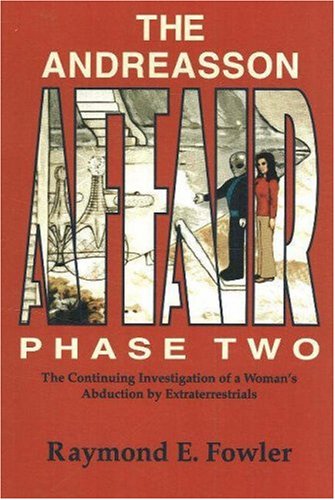
The Andreasson Affair, Phase Two
The Continuing Investigation of a Woman's Abduction by Extraterrestrials — Where an Open Case Became an Open-Ended One
Find on Amazon →As an Amazon Associate, OverClassified may earn from qualifying purchases made through this link, at no extra cost to you.
Why This Is Essential Reading
Read it if you are reading the case, and read it knowing what it is. Phase Two is where the Andreasson investigation stops being a bounded 1967 incident with an unusually strong documentary apparatus and becomes an open-ended, lifelong, two-person, family-wide phenomenon — and it is also where that apparatus starts to loosen, most consequentially in the decision to train Betty's own husband to conduct her regression sessions. Ernest Taves' second Skeptical Inquirer review saw the problem immediately and named it correctly: more material is not the same as better evidence. The book is honestly written, carefully documented in its own terms, and genuinely important as the hinge of a five-volume series. It is not a stronger case than the first book; it is a larger one.
Related Cases & Theories
Sources Cited
- Fowler, Raymond E. The Andreasson Affair, Phase Two: The Continuing Investigation of a Woman's Abduction by Extraterrestrials. Englewood Cliffs, NJ: Prentice-Hall, 1982; Wild Flower Press reissue, ISBN-10 0926524283 / ISBN-13 9780926524286. amazon.com
- Internet Archive, scanned copy of The Andreasson affair, phase two (Fowler, Raymond E., 1933–). archive.org
- Goodreads edition record, The Andreasson Affair: Phase Two by Raymond E. Fowler — printing history and reader reception. goodreads.com
- ThriftBooks edition record, The Andreasson Affair: Phase Two — publication and format data. thriftbooks.com
- Boston Public Library catalogue record for The Andreasson Affair, Phase Two — independent library bibliographic verification. bpl.bibliocommons.com
- Taves, Ernest H. "Betty Through the Looking Glass." Skeptical Inquirer, vol. 4 no. 2 (Winter 1979/1980), pp. 88–95 — the original psychiatric critique arguing the recovered material reflects "a dream or fantasy… that had meaning and utility in terms of her life history," without alleging deliberate fabrication. en.wikipedia.org (Taves biography)
- Encyclopedia.com, "Andreasson, Betty" — independent reference entry on the case and the Fowler book series. encyclopedia.com
- Taves, Ernest H. Follow-up review of The Andreasson Affair, Phase Two, Skeptical Inquirer, 1983 — extending the same critique to the expanding case rather than treating additional investigation as resolving the first book's problems.
- Fowler, Raymond E. The Andreasson Affair. Prentice-Hall, 1979, foreword by J. Allen Hynek. OverClassified breakdown
- Fowler, Raymond E. The Watchers: The Secret Design Behind UFO Abduction. Bantam, 1990. OverClassified breakdown
- Fowler, Raymond E. The Watchers II: Exploring UFOs and the Near-Death Experience. Wild Flower Press, 1995. OverClassified breakdown
- Fowler, Raymond E. The Andreasson Legacy. Marlowe & Company, 1997. OverClassified breakdown
- Fowler, Raymond E. The Allagash Abductions. Wild Flower Press, 1993 — the same investigative template applied to a separate case. OverClassified breakdown
- OverClassified case file, The Betty Andreasson Luca Abduction — the full evidentiary assessment, including the 14 regression sessions, the two Psychological Stress Evaluator examinations administered by Ernest C. Reid, the 528-page CUFOS report, the 1978 Luca marriage, and the shift from Harold Edelstein to Bob Luca as hypnotist.
- OverClassified case file, Betty & Barney Hill Abduction — the 1961 case that established the investigative pattern this series extends.
Have corrections, additional research, or peer-reviewed sources? Help improve this entry.
Suggest an Edit