
The Andreasson Legacy
UFOs and the Paranormal: The Startling Conclusion of the Andreasson Affair — Twenty Years, Five Books, and No Independent Witness
Core Thesis
The Andreasson Legacy: UFOs and the Paranormal — The Startling Conclusion of the Andreasson Affair closes the longest continuously-documented abduction investigation in American ufology, and it closes it by opening one more door. Where the 1979 volume had documented a single evening, Phase Two had extended it across a lifetime, The Watchers had built it into a monitoring programme and The Watchers II had relocated it in consciousness, this final book widens the frame to the families themselves. Raymond E. Fowler's thesis is that the phenomenon around Betty Andreasson Luca was never confined to her: that her relatives, her husband Bob Luca's family, and — the disclosure that gives the book its real weight — Fowler's own family carried parallel histories of reported UFO sightings and psychic experience. Presented as a conclusion, it functions as a widening; presented as evidence, it is the least testable claim in a series that had already given up testability two volumes earlier. It is nonetheless an essential document, because it is the point at which the investigator formally became part of his own case.
About the Author
Raymond E. Fowler (b. 1933) was an aerospace engineer — minuteman missile and space-hardware work at Sylvania and GTE Government Systems — and a NICAP and MUFON field investigator whose reputation rested on procedure. The 1979 Andreasson Affair was built on fourteen hypnotic regression sessions under an independent credentialed hypnotist, two Psychological Stress Evaluator examinations administered by Ernest C. Reid, a psychiatric interview, character references from neighbours and clergy, and a 528-page confidential report filed with the Center for UFO Studies before publication — and it carried a foreword by J. Allen Hynek.
By 1997 he had been on the same family's claims for twenty-two years. The independent hypnotist Harold Edelstein had long since been replaced for later sessions by Bob Luca, whom Fowler's team had trained to conduct regression with his own wife; the case had grown from an incident to a lifetime to a programme to a metaphysics; and Fowler had applied the same template to a second, multi-witness case in the Allagash Waterway investigation, published as The Allagash Abductions in 1993.
This volume's inclusion of the Fowler family's own reported experiences is the hinge of his whole public career, and it is best understood in light of what came next. In 2002 he published UFO Testament: Anatomy of an Abductee, in which he disclosed what he described as his own lifelong abduction experiences. Read against that, The Andreasson Legacy is not a researcher noticing an interesting coincidence in his own family history; it is a researcher approaching, and not yet making, a disclosure about himself. Whatever a reader concludes about the substance, this is a genuinely unusual thing to be able to watch happen in print across two books.
It should be said clearly, because it is easy to lose in a critical assessment: nothing in the record suggests Fowler was dishonest. His documentation of his own sources is consistent and scrupulous across all five volumes, he distinguishes throughout between what he observed and what was reported to him, and he never claims physical evidence he does not have. The problem with this book is not candour. It is that a researcher who has become a subject can no longer test his own conclusions, and Fowler does not appear to have recognised that.
Historical Context & Origins
1997 was the year the American abduction field's credibility peaked and began to fall. John Mack's Abduction (1994) had brought a Harvard psychiatry professorship to the subject and drawn a formal Harvard Medical School review in response; David Jacobs' The Threat would appear the following year; and the recovered-memory controversy had, by this point, largely destroyed the standing of hypnotically retrieved testimony in courts and in clinical practice alike.
It was also the fiftieth anniversary of Roswell, and the American UFO subject was at maximum public visibility — a saturated market that rewarded books promising a "startling conclusion." The subtitle is a publisher's promise, and readers should discount it accordingly: nothing in the book concludes anything in an evidentiary sense.
The specific move this volume makes — extending the phenomenon from an individual to a bloodline — was by 1997 an established convention rather than a discovery. Budd Hopkins' Intruders (1987) had made multigenerational involvement central, and Jacobs' work assumed it. The genuinely distinctive element here is not the family claim but whose family it turns out to include.
One further contextual note bears on how the book was read at the time and since: Betty Andreasson Luca herself never sought publicity, never lectured commercially at scale, and never repudiated any part of the account. She died on March 18, 2022, at the age of 85, at her daughter Bonnie's home in Martinsville, Virginia, survived by Bob Luca, her husband of forty-four years. Whatever the recovered material represents, the woman at the centre of it lived a private life around it for fifty-five years, and that is a fact any assessment has to sit with.
Core Arguments & Key Concepts
The phenomenon runs in families, not in individuals. The book's organising claim, completing the arc Phase Two began. Fowler documents reported UFO and psychic experiences across the wider Andreasson, Luca and Fowler families and treats their convergence as structurally significant.
UFO experience and psychic experience are one domain. Made explicit here in a way earlier volumes only implied. Precognition, poltergeist-type activity, apparitional experience and abduction are treated as expressions of a single underlying phenomenon rather than as separate claims each requiring separate evidence. This is intellectually consistent with The Watchers II's consciousness framing, and it multiplies unverifiable claims rather than testing any of them.
The investigator is inside the case. The book's most consequential and least examined argument. Fowler's inclusion of his own family's reported history is presented as one more data point in a pattern; a reader five years later, with UFO Testament in hand, will read it as something else entirely. Nothing in the book acknowledges the methodological problem this creates.
Twenty years of investigation is itself an argument. Fowler's implicit case throughout is cumulative: no other abduction claim has been documented this continuously by one investigator, and the consistency of Betty's accounts across two decades is offered as evidence of their authenticity. This is a real point about internal consistency and a weak one about external truth — a sincerely held false belief is also consistent across two decades.
What twenty years did not produce. Stated plainly, because the book does not: after five volumes and twenty-two years, there is no independent witness to any abduction event, no photograph, no document, no physical trace, and no medical finding. The 1967 event's only external corroboration remains what it was in 1979 — family members who confirm the house lights failed and a glow appeared at the kitchen window, which nobody disputes and which does not bear on the abduction claim.
Key Cases & Evidence Discussed
The January 25, 1967 encounter. The founding event, at the family house on Washington Street in South Ashburnham, Massachusetts: the interior lights failing, a pulsating reddish-orange glow at the kitchen window witnessed by seven children and Betty's visiting parents, and — recovered a decade later under hypnosis — entities led by one identifying himself as "Quazgaa," the family placed in suspended animation, and an examination including a needle-like nasal probe. See this site's case file for the full assessment.
The wider family histories. The new material: reported UFO sightings and psychic experiences among Betty's relatives, Bob Luca's family, and Fowler's own. None of it is independently investigated by anyone outside the case, and the book does not propose a way it could be.
Bob Luca's own experiences. Documented since Phase Two and carried forward here. Luca remains the case's closest thing to independent corroboration and simultaneously its most compromised element, having become the person conducting his wife's regression sessions.
Allagash as the control that was never run. Fowler's Allagash Waterway investigation — four men on a 1976 canoe trip near Eagle Lake, Maine, worked from 1988 and published in 1993 — had the multiple independent witnesses the Andreasson case never had. A researcher with both cases in hand had the materials for a genuine cross-check of the family-line hypothesis. This book does not attempt one.
The Hill case, thirty-six years on. Betty and Barney Hill, documented in The Interrupted Journey (1966), remains the template: witnesses, hypnotist, recovered narrative, no physical trace. The Andreasson series is the longest and most carefully documented example of that template ever produced, and it ends in exactly the same evidentiary position the template started in.
Critical Reception & Controversies
Reception within ufology was respectful and muted. Fowler's standing was intact, but by 1997 the Andreasson corpus had grown past the point where most readers were following it closely, and a fifth volume extending the phenomenon to the investigator's own relatives did not persuade anyone who had not already been persuaded by the fourth.
The skeptical objection had by this point become structural rather than case-specific. Ernest H. Taves' two Skeptical Inquirer critiques of the first two volumes — "Betty Through the Looking Glass" (Winter 1979/1980) and his 1983 review of Phase Two — had already made the argument that additional material does not answer a methodological objection. Five volumes in, with the independent hypnotist replaced by the subject's husband and the investigator's own family folded into the case, that argument is difficult to answer at all.
The most serious criticism specific to this book is one Fowler never addresses: an investigator who reports his own family's involvement in the phenomenon he is investigating has, at that moment, ceased to be able to function as an independent check on it. That is not an accusation of bad faith. It is a statement about what independence means, and it applies with the same force whether the reported experiences are real or not.
In fairness, the book is well within the norms of its genre in one respect that matters: it does not overclaim in the author's own voice. Fowler reports what was said to him, attributes it, and refrains from asserting physical facts he cannot support. Readers who find the content implausible will find no dishonesty to catch him in, which is more than can be said for a good deal of 1990s abduction publishing.
The settled verdict, as this site's case file records for the whole corpus, is that the instrumented credibility testing established Betty and her family's sincerity rather than the objective reality of what they described, and that no independent witness, document or physical trace has ever corroborated the abduction content. Five volumes and twenty-two years did not change that, and this book is where that becomes impossible to avoid noticing.
It is worth separating two things this book is often criticised for together. The paranormal framing — treating precognition, apparitional experience and abduction as one domain — is a substantive interpretive position with real intellectual company, including John Keel, Jacques Vallée, and much of the consciousness-centred literature that followed. Whether or not one accepts it, it is not an evasion. The methodological problem, by contrast, is not interpretive at all: material recovered by a subject's own husband, from a subject with two decades of exposure to the case's own literature, cannot be treated as independent testimony no matter which interpretive frame it is placed in. The first is a position; the second is a defect, and conflating them lets the defect slide.
Influence & Legacy
The Andreasson series as a whole is the longest single-case abduction record in the literature, and this volume's function is to close it. Its lasting use is as documentation of a trajectory rather than of a phenomenon: a rigorously-designed 1970s investigation, extended year by year through progressively looser methodology, arriving two decades later at a family-wide paranormal framework in which the investigator is a participant. There is no better worked example available of how that happens.
Its narrower influence is on the multigenerational-abduction convention, which it helped consolidate alongside Hopkins and Jacobs. That convention remains standard in experiencer-community discourse today, and its evidentiary foundations are, on inspection, largely these three authors' case files.
For this site specifically, the five Fowler volumes are cited by the Andreasson case file as the primary record of the investigation itself — who conducted which sessions, under what conditions, producing what content, in what order. That is a genuine and irreplaceable contribution, and it is entirely separate from whether any of the recovered content describes something that happened.
Fowler's own postscript belongs in the legacy. UFO Testament: Anatomy of an Abductee (2002) closed the loop this book opens, and taken together the two volumes form one of the more remarkable documents in the field: a career field investigator, over twenty-five years, moving from documenting someone else's claim to making his own. Whatever one concludes about the claims, that arc is worth understanding.
A final point about why this series is preserved in this library at all, given how sceptically this article has treated it. The Andreasson corpus is the closest thing abduction research has to a longitudinal study, and longitudinal records are rare and valuable independent of whether their subject matter is what its author believes. Across five books and twenty-two years it is possible to trace exactly when each safeguard was relaxed, exactly when each new class of claim entered, exactly who was in the room, and exactly how the interpretation changed — information that simply does not exist for the great majority of abduction cases, most of which are documented once, briefly, by someone with a book to sell. Fowler's rigour in recording his own process is what makes the series useful even to a reader who concludes the content is a construction, and that is a real and unusual scholarly virtue.
The Book
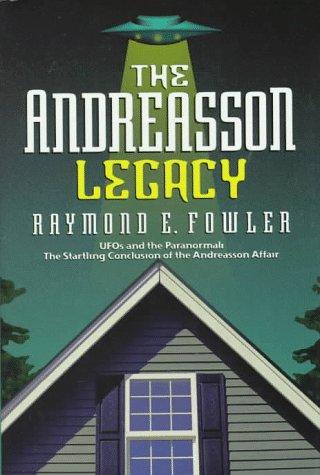
The Andreasson Legacy
UFOs and the Paranormal: The Startling Conclusion of the Andreasson Affair — Twenty Years, Five Books, and No Independent Witness
Find on Amazon →As an Amazon Associate, OverClassified may earn from qualifying purchases made through this link, at no extra cost to you.
Why This Is Essential Reading
The last volume, and the one that shows most clearly what the whole series became. The Andreasson Legacy is honestly written and carefully sourced in Fowler's usual manner, and it closes a twenty-two-year investigation that remains the most continuously documented abduction case in American ufology. But its "startling conclusion" is a widening rather than a resolution — the phenomenon extended across the Andreasson, Luca and Fowler families, with the paranormal folded in wholesale — and five years later Fowler disclosed his own claimed lifelong abduction experiences, which retrospectively changes what this book is doing. Read the 1979 volume for the case as investigated, read this one for how a twenty-two-year investigation ends when the investigator becomes a subject, and go to this site's case file for what any of it actually establishes: sincerity, documented thoroughly, and nothing external, ever.
Related Cases & Theories
Sources Cited
- Fowler, Raymond E. The Andreasson Legacy: UFOs and the Paranormal — The Startling Conclusion of the Andreasson Affair. New York: Marlowe & Company, 1997. ISBN-10 1569247544 / ISBN-13 9781569247549. amazon.com
- Wikipedia, "Raymond E. Fowler" — biography, aerospace career, NICAP and MUFON field-investigation record, and complete bibliography including UFO Testament: Anatomy of an Abductee (2002). en.wikipedia.org
- Encyclopedia.com, "Andreasson, Betty" — independent reference entry on the case and on Fowler's five-volume series. encyclopedia.com
- Wikipedia, "Ernest H. Taves" — the psychiatrist whose two Skeptical Inquirer critiques (Winter 1979/1980 and 1983) form the principal published skeptical response to this series. en.wikipedia.org
- Evergreen Indiana public library catalogue, Raymond E. Fowler holdings — independent library bibliographic verification for the series. evergreen.lib.in.us
- Fowler, Raymond E. The Andreasson Affair. Prentice-Hall, 1979, foreword by J. Allen Hynek. OverClassified breakdown
- Fowler, Raymond E. The Andreasson Affair, Phase Two. Prentice-Hall, 1982. OverClassified breakdown
- Fowler, Raymond E. The Watchers: The Secret Design Behind UFO Abduction. Bantam, 1990. OverClassified breakdown
- Fowler, Raymond E. The Watchers II: Exploring UFOs and the Near-Death Experience. Wild Flower Press, 1995. OverClassified breakdown
- Fowler, Raymond E. The Allagash Abductions. Wild Flower Press, 1993. OverClassified breakdown
- Hopkins, Budd. Intruders: The Incredible Visitations at Copley Woods. Random House, 1987. OverClassified breakdown
- Jacobs, David M. The Threat: Revealing the Secret Alien Agenda. Simon & Schuster, 1998. OverClassified breakdown
- Mack, John E. Abduction: Human Encounters with Aliens. Charles Scribner's Sons, 1994. OverClassified breakdown
- OverClassified case file, The Betty Andreasson Luca Abduction — the full investigative chronology, the 528-page CUFOS report, the hypnotist change, Betty Andreasson Luca's death on March 18, 2022 at the age of 85, and this site's Disputed assessment.
- OverClassified case file, Allagash Waterway Abduction — the multi-witness case Fowler investigated in parallel.
- Goodreads edition record, The Andreasson Legacy by Raymond E. Fowler — reader reception and printing history. goodreads.com
- ThriftBooks edition record, The Andreasson Affair: Phase Two and related Fowler titles — series printing history. thriftbooks.com
Have corrections, additional research, or peer-reviewed sources? Help improve this entry.
Suggest an Edit