
Fire in the Sky
The Walton Experience
Core Thesis
Fire in the Sky: The Walton Experience is Travis Walton's own account, in his own words, of the five days he says he lost after being struck by a beam of light from a hovering craft near Turkey Springs in Arizona's Apache-Sitgreaves National Forest on November 5, 1975 — a case this site's own Travis Walton Abduction file (Case File #009) already documents in exhaustive detail from the outside. This book is the view from the inside, first published in 1978 as the leaner, 181-page The Walton Experience and then substantially rewritten and nearly doubled in length for this 1996/97 edition, retitled to match a film adaptation Walton has spent three decades publicly disowning for its accuracy even as he benefited from the audience it brought him. The book's core argument is not really an argument at all in the evidentiary sense; it is testimony, presented at length and largely without third-party corroboration beyond the polygraph and medical material Walton includes as appendices — Walton's case for his own credibility, built from the physical evidence and crew testimony that made the case famous, updated with his own answer to a movie that turned his account into something he says he never described experiencing.
About the Author
Travis Walton was born in 1953 and grew up in the Snowflake and Taylor area of Navajo County, Arizona, the same rural, ranching-and-logging corner of the state where the incident that made him famous would occur two decades later. His pre-1975 biographical record includes one fact that has followed him through nearly every skeptical treatment of the case since: on May 5, 1971, Walton and an associate identified in court records as Carl Rogers pleaded guilty to breaking into the offices of the Western Molding Company, stealing company checks, and forging and cashing them. Both men received two years' probation, after which, per Arizona procedure for offenders of that age, they were permitted to withdraw the guilty plea and have the record expunged. Philip J. Klass would later surface this expunged record during his investigation of the 1975 case, treating it as evidence of a documented capacity for deception; this entry states the underlying facts plainly, in this Critical Reception section, rather than either burying or overstating them.
By the autumn of 1975, the 22-year-old Walton was one of seven men on a U.S. Forest Service thinning contract crew led by Mike Rogers, a Snowflake resident Walton described as his closest friend; Walton would later marry Rogers's sister Dora, making the two men brothers-in-law on top of their working relationship, a family tie this site's own key-figures archive does not flag but multiple independent biographical sources confirm. Walton held no scientific, medical, or investigative credentials of any kind before November 1975 — he was a logger, not a researcher — and this book, like the case file it supports, is a work of testimony rather than analysis, a fact this entry states as plainly as it does for every other first-person witness account in this site's Essential Reading library.
In the immediate aftermath of the 1975 incident, Walton and his family worked with APRO (the Aerial Phenomena Research Organization, co-founded by Coral Lorenzen) on the medical and polygraph investigations this book and the underlying case file both document, and Walton co-wrote his first account, The Walton Experience, with a ghostwriter's assistance for Berkley Medallion in 1978. The book sold modestly and the case receded from broad public attention for roughly fifteen years, until Paramount Pictures optioned it for the 1993 film Fire in the Sky. Walton has said the original 1978 book had gone out of print by the time the film revived interest in his story; he used that revival to produce this substantially reworked and expanded 1996 edition, retitled to match the movie's name, adding roughly 190 pages of new material, additional illustrations, and — centrally — his own detailed rebuttal of the film's invented onboard sequence.
In the decades since, Walton has remained a fixture of the UFO-conference and documentary-interview circuit rather than returning to logging or construction work, appearing at events including the International UFO Congress, sitting for a widely discussed 2021 interview on The Joe Rogan Experience, and cooperating with filmmaker Jennifer Stein's 2015 documentary Travis: The True Story of Travis Walton, made explicitly to counter what Stein and Walton regard as decades of unfair debunking. As of a 2025 fiftieth-anniversary retrospective, Walton was still actively defending the case's core facts while describing a genuine shift in his own interpretation of the beings' intent, now framing the encounter as a rescue from injuries the beam itself caused rather than a hostile abduction — a reading this entry notes as Walton's own evolving account rather than a claim independently verifiable by any source located in researching this article.
Historical Context & Origins
The incident this book documents unfolded over five days in November 1975 and immediately became a national story: a massive Navajo County search-and-rescue operation under Sheriff Marlin Gillespie, initially run as a potential homicide investigation, followed by Walton's disoriented reappearance at a Heber, Arizona gas station on the night of November 10, 1975. A blue-ribbon panel of ufologists convened by the National Enquirer would go on to name the case its most impressive UFO incident of the year, awarding Walton and his crew a combined $5,000 prize announced in the paper's June 13, 1976 edition — a detail this book covers as vindication and Walton's critics have since cited as evidence of financial motive, a tension this entry addresses directly in its Critical Reception section rather than resolving in either direction.
Walton's first book, The Walton Experience, appeared from Berkley Medallion in 1978, a relatively slim 181-page mass-market paperback published while the case was still fresh and while Philip J. Klass's most detailed skeptical rebuttals — later collected in his 1983 book UFOs: The Public Deceived — were still being developed. That original edition sold respectably within the UFO-book market of the period but did not approach the mainstream visibility the case would eventually reach; it went out of print, by Walton's own later account, well before the case resurfaced in the wider culture.
That resurfacing came from an unlikely direction. Paramount Pictures optioned Walton's story for a feature film, and Fire in the Sky reached theaters on March 12, 1993, directed by Robert Lieberman from a screenplay by Tracy Tormé, starring D.B. Sweeney as Walton, Robert Patrick as Mike Rogers, and James Garner as the investigating lieutenant. The film's most consequential decision — a lengthy, invented sequence depicting Walton's alleged experience aboard the craft as a nightmarish medical-horror ordeal — departed sharply from anything Walton had described in 1978, and this book's 1996 retitling and expansion, appearing three years after the film and explicitly capitalizing on its name recognition, exists in substantial part to set that specific record straight in Walton's own words.
This book's publication also sits inside a specific, and genuinely documented, chronological curiosity this site's own The Interrupted Journey entry already flags: NBC's October 20, 1975 television dramatization of the Betty & Barney Hill case, The UFO Incident, aired sixteen days before Walton's own encounter. Psychologist Susan Clancy's later research treats that broadcast as a plausible cultural influence on Walton coming forward with an abduction narrative at all, a reading Klass independently raised for skeptical rather than psychological reasons; this entry states the same underlying timeline both researchers rely on without adopting either one's interpretation of what it proves.
Core Arguments & Key Concepts
The book's central narrative is Walton's own detailed, chronological retelling of November 5, 1975: the crew's truck rounding a bend near Turkey Springs to find a glowing disc hovering in a clearing, Walton's decision to approach it against his crewmates' shouted warnings, and the blue-green beam that struck him and knocked him unconscious as the rest of the crew fled in panic. Walton devotes considerable space to what happened next from his own perspective — waking disoriented inside what he describes as a small, clean, warm, metallic room, encountering short beings with large eyes he compares to the classic "grey" description, and a later, hazier sequence involving human-appearing figures before he says he lost consciousness again and woke on a roadside near Heber. This first-person account is the book's entire evidentiary contribution beyond what the crew and investigators could independently document; it is Walton's word for what happened once he was out of anyone else's sight.
A second major argument rests on evidence Walton did not generate alone: the crew's near-unanimous polygraph results. On November 10, 1975, Arizona Department of Public Safety examiner Cy Gilson tested the six returned crew members, finding five — including Mike Rogers, Steve Pierce, Ken Peterson, John Goulette, and Dwayne Johnston — truthful about witnessing the object and Walton's disappearance, with Allen Dalis's result marked inconclusive. Walton presents this result, consistently reproduced across every subsequent secondary account of the case, as the strongest single piece of corroborating evidence that something genuinely anomalous occurred at the clearing, whatever ultimately happened to him afterward.
The book handles Walton's own polygraph history with considerably more editorial effort than any other part of the case, because that history is genuinely disputed. A November 15, 1975 examination by private examiner John J. McCarthy — sometimes rendered "Jack" McCarthy in period sources, the same person under a common nickname — concluded Walton was engaged in "gross deception," a result APRO and the National Enquirer kept confidential until Klass revealed its existence in June 1976. Walton and APRO countered that McCarthy's examination was hostile and procedurally irregular; a subsequent, APRO-arranged February 7, 1976 test by examiner George Pfeiffer found Walton truthful, a result Walton's book presents as vindication and that Klass, in turn, criticized on the grounds that Pfeiffer had allowed Walton to help shape some of the questions asked. This book gives its own extended defense of the McCarthy test's fairness; this entry's Critical Reception section states the dispute's actual, still-unresolved status rather than adopting the book's own conclusion.
The book's final major evidentiary strand is medical: the APRO-arranged November 12, 1975 examination by Dr. Howard Kandell and Dr. Joseph Saults, which documented significant dehydration, a loss of roughly ten to twelve pounds, elevated ketone levels consistent with starvation, and a puncture-like mark near Walton's elbow — combined, notably, with the near-total absence of frostbite, exposure injuries, or accumulated dirt one might expect from five days lost in a freezing high-altitude forest in November. Walton presents this combination as difficult to reconcile with either a simple survival scenario or a staged hoax requiring him to hide outdoors for five days; skeptical treatments of the case, discussed below, have proposed indoor-shelter alternatives this book does not itself address in comparable detail.
Key Cases & Evidence Discussed
This book has exactly one subject, and it is the same subject as this site's own Travis Walton Abduction case file (Case File #009, November 1975): the file's own account of the Turkey Springs beam strike, the five-day search, the crew polygraphs, and Walton's medical examination is built from the same primary record this book represents Walton's own first-person telling of, cited under this exact edition on that case file directly.
This book's relationship to this site's own The Interrupted Journey entry (Essential Reading ER-034) runs in an unusual, well-documented direction: that entry's own Influence & Legacy section states that NBC's October 20, 1975 broadcast of The UFO Incident, dramatizing the Betty & Barney Hill case, aired "just two weeks" before Walton's own encounter and, per psychologist Susan Clancy's research, plausibly influenced Walton to come forward with an abduction account at all. This book does not itself address that broadcast; this entry notes the connection because it is a fact this site's own library already carries on the record from the other side of the case.
This book's relationship to UFOs: The Public Deceived (Essential Reading ER-056), Philip J. Klass's 1983 skeptical sequel, is the case's single most sustained point-counterpoint: that book's own "key cases discussed" material devotes a full chapter to disputing the polygraph and medical claims this book makes, and this site's own Travis Walton case file cites both books directly when documenting "Klass's puncture-mark and polygraph arguments in full," per that entry's own sourcing.
The book's framework — a close-range beam strike followed by missing time and an onboard medical-style examination — is the same pattern this site's own Extraterrestrial Hypothesis (Theory File ETH-001) and Psycho-Social Hypothesis (Theory File PSH-001) theory files both survey as competing explanatory frameworks; this site's own case file rates the Walton encounter an 85% ETH alignment against a 20% PSH alignment, a split this book's own first-person argument is built to support and this entry's Critical Reception section examines from the opposing direction.
Critical Reception & Controversies
No single skeptic did more to shape the public argument against this book's account than Philip J. Klass, whose investigation culminated in a full chapter of his 1983 book UFOs: The Public Deceived. Klass's central theory held that Mike Rogers faced real financial jeopardy on his Forest Service contract — a missed deadline would have cost roughly $2,500 he needed for the winter — and staged the disappearance, with Walton's cooperation, as an alternative to forfeiting the contract. Klass supported the theory with Walton's 1971 check-fraud record, the suppressed McCarthy polygraph result, and documented evidence that National Enquirer staff discussed paying the family increasingly large sums as the story developed; writer Robert Sheaffer's own "Travis Walton vs. Philip J. Klass" (Bad UFOs, February 2012) and "The Selling of the Travis Walton 'Abduction' Story" (debunker.com) both document this case in comparable detail from the same broadly skeptical position, with Sheaffer separately promoting a 2021 hypothesis, developed by researcher Charlie Wiser building on producer Ryan Gordon's work, that the crew used a nearby Forest Service fire lookout tower to fake the light and shelter Walton during his absence.
This book's most consequential internal defender is not a skeptic at all: UFO historian Jerome Clark, whose own assessment — that whatever happened in the forest, the seven men "maintained the same account through polygraph tests, media scrutiny, skeptical attacks, and decades of potential financial and social incentives to change their story" — is frequently cited as the strongest brief for the case's consistency, independent of whether that consistency reflects a true event or a well-rehearsed one. A genuinely more complicated middle position comes from researcher Karl Pflock, a writer skeptical of many major UFO cases who nonetheless argued in 2000 that Klass's all-crew-collusion theory demanded more coordinated deception than the case required: Pflock proposed that only Walton and Rogers needed to have staged anything, with the other five men's convergent testimony explainable as genuine reactions to a smaller, two-man deception rather than proof the whole crew was in on it.
The case's witness consistency, the single strongest pillar of this book's own argument, fractured publicly and dramatically in 2021, well after this edition's publication. Rogers stated in a recorded call that circulated that year that the crew had discussed "creating a UFO hoax" and that "it was all deliberate," a statement he subsequently retracted after reconciling with Walton; Walton has said Rogers was misled by an investigator who falsely told him Walton intended to recant the story for a payment. Separately, crew member Steve Pierce, who had voiced private doubts about the case as early as 1978 according to Klass's own research, has more recently made public statements online alleging the incident was staged — a claim Walton and Rogers have disputed and that this entry reports as a documented, ongoing dispute among the original witnesses rather than a settled fact in either direction.
Michael Shermer, writing for Skeptic magazine's eSkeptic, revisited the polygraph evidence specifically, concluding that the disputed results illustrate the technique's fundamental unreliability rather than settling Walton's honesty one way or the other — a methodological critique distinct from Klass's motive-based hoax theory and one this book's own extended polygraph defense does not fully anticipate. None of this later material existed when this edition went to press in 1996/97; the 2021 witness rupture, the Gentry-tower hypothesis, and Pierce's more recent public statements all arrived after this book's own account was already fixed in print, a genuine limit on how current any printed defense of the case can remain.
Influence & Legacy
This book's most direct, documented legacy is defensive: it exists specifically because of the 1993 Paramount film Fire in the Sky, and its 1996 retitling to match the movie is itself evidence of how thoroughly the film reshaped public awareness of a case that had otherwise faded from wide attention since 1978. Screenwriter Tracy Tormé and the studio judged Walton's actual described experience "too fuzzy and too similar" to other televised abduction accounts and ordered a "flashier, more provocative" alternative; the result was an extended, invented sequence depicting Walton trapped in a slimy cocoon-like membrane aboard a nightmarish vessel and pinned to a table for brutal experimentation, imagery with no basis in anything Walton had published in 1978. Walton has said repeatedly and consistently, including in this book's own added material, that his actual account involved a calm, clean, metallic room and beings that did not resemble the film's monstrous creatures — a documented, specific gap between source and adaptation this book was written substantially to close.
The film itself earned a mixed critical reception on release — Roger Ebert praised its spacecraft interior sequences as "really very good" and "truly alien" while faulting the film's inconclusive ending, and it grossed roughly $19.9 million against a $15 million budget, a modest commercial result for a wide theatrical release. Even so, it remains, per multiple retrospective sources, one of the last major theatrical films built around an individual alleged abduction account, and it is directly responsible for making Walton's case one of the handful of UFO abduction stories most of the American public can name, independent of whether they know the film's specifics diverge from Walton's own book.
Within ufology specifically, this book's legacy is best measured by how long the underlying dispute has stayed active rather than by any resolution it produced. Filmmaker Jennifer Stein's 2015 documentary Travis: The True Story of Travis Walton, made explicitly to counter what she and Walton regard as unfair debunking, swept the "EBE" awards for best long documentary at that year's International UFO Congress Film Festival; a 2025 fiftieth-anniversary retrospective found Walton still actively defending the case's core facts to journalists, now framing the beings' actions as a rescue rather than a hostile abduction. Mike Rogers, the crew boss whose own 2021 recorded statements briefly threatened to unravel the case's central pillar of witness consistency, died on February 6, 2026, having spent five decades as Walton's most consistent corroborating witness outside a single disputed 2021 episode — a fact this entry notes as a genuinely recent development in a case whose central witnesses are now, five decades on, beginning to pass from the scene.
On this site specifically, this book was already cited once, by exact edition, on the resources library in connection with the Travis Walton Abduction case file, and its author already held a key-figures card describing the case as "one of the most famous abduction stories in history" before this dedicated Essential Reading entry existed; this article formalizes that existing citation trail with its own full biographical and critical-reception treatment.
The Book
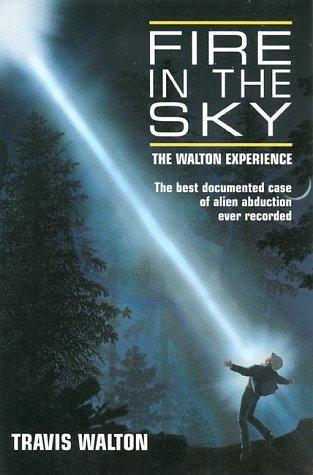
As an Amazon Associate, OverClassified may earn from qualifying purchases made through this link, at no extra cost to you.
Why This Is Essential Reading
Fire in the Sky: The Walton Experience earns its place on this list as the rarest kind of Essential Reading entry: a first-person primary source for one of ufology's most thoroughly investigated and most durably contested individual witness cases, written by the one person who cannot be cross-examined about what he alone claims to have experienced once he was out of his crewmates' sight. This entry has tried to be honest throughout about what that means for the book's evidentiary weight: the crew polygraphs and medical findings this book presents are genuinely documented and independently corroborated by this site's own case file, but Walton's own contested 1975 polygraph result, his skeptics' still-unresolved contract-deadline theory, and the 2021 rupture in the crew's decades-long consistency — arriving well after this edition's publication — are not resolved by anything in these pages, and this entry does not pretend otherwise. What the book does deliver, better than any secondary account including this site's own case file, is Walton's own explicit, detailed correction of the record against a Hollywood film that invented a horror-movie abduction sequence he says he never experienced and has spent three decades publicly disowning. Read Travis Walton's book not as a closed case for extraterrestrial contact, but as the single most direct way to hear, in the witness's own words, the account that a $15 million studio film decided was too boring to film as written.
Related Cases & Theories
Essential Viewing

Fire in the Sky (1993) Trailer #1
Rotten Tomatoes Classic Trailers — The original theatrical trailer for Paramount's 1993 film adaptation, the movie this book's 1996 retitling directly responds to and whose invented onboard sequence Walton has publicly disowned. Verified via YouTube oEmbed before inclusion.
Travis Walton Tells His Story of Alien Abduction
PowerfulJRE — Travis Walton recounting his own account of the November 1975 encounter in his own words, the same first-person testimony this book is built around, decades after its original publication. Verified via YouTube oEmbed before inclusion.
Sources Cited
- "Travis Walton incident." Wikipedia (case-specific page: sighting details, polygraph tests, National Enquirer award, the 1978 and 1996 books, the 1993 film, and named skeptics including Philip J. Klass, Robert Sheaffer, and Michael Shermer). en.wikipedia.org
- "Fire in the Sky." Wikipedia (1993 film: director, cast, screenwriter Tracy Tormé's account of the studio-ordered changes to the abduction sequence, box office, and critical reception). en.wikipedia.org
- Sheaffer, Robert. "Travis Walton vs. Philip J. Klass." Bad UFOs, February 2012 (documents Klass's investigation chapters, the disputed bribery allegation against Steve Pierce, and the case's skeptical chronology). badufos.blogspot.com
- Sheaffer, Robert. "The Selling of the Travis Walton 'Abduction' Story." debunker.com (documents the McCarthy polygraph suppression, the National Enquirer's financial role, and Karl Pflock's own more limited hoax theory). debunker.com
- Shermer, Michael. "Travis Walton's Alien Abduction Lie Detection Test." eSkeptic / Skeptic magazine (skeptical assessment of the competing 1975-76 polygraph examinations and their reliability). michaelshermer.com
- "Fire in the sky : the Walton experience." Open Library / Internet Archive (bibliographic record and digitized scan of the Marlowe & Co., 1996 first edition, 370pp.; ISBN 9781569248409). archive.org
- "Fire in the Sky: The Walton Experience." Open Library (bibliographic record for ISBN 9781569247105 / 1569247102, Marlowe & Company pbk., 1997 — the exact edition cited on this site). openlibrary.org
- "The Walton Experience." Open Library (bibliographic record for ISBN 9780425036754, Berkley Medallion, 1978 first edition, 181pp. — the original, bibliographically distinct edition under the original title). openlibrary.org
- "Fire in the Sky — The Book." travis-walton.com (Walton's own author site: publication history of the revised, expanded edition tied to the film). travis-walton.com
- "His Arizona UFO abduction story became legend. After 50 years, he's sick of attempts to debunk it." KJZZ, 2025 (fiftieth-anniversary retrospective: Walton's current stance, the 2021 Mike Rogers dispute and reconciliation, and Jennifer Stein's 2015 documentary). kjzz.org
- Randle, Kevin. "Mike Rogers Has Died." A Different Perspective, March 2026 (documents Mike Rogers's February 6, 2026 death and his decades-long role as Walton's principal corroborating witness). kevinrandle.blogspot.com
- This site's own case file: The Travis Walton Abduction (Case File #009), which documents the full incident, crew polygraphs, and medical evidence this book presents in first-person form.
- This site's own key-figures entry: Travis Walton, for his broader site-wide career and case connections beyond this book.
- This site's own key-figures entry: Philip J. Klass, the case's most sustained skeptical investigator.
- This site's own essential-reading entry: UFOs: The Public Deceived by Philip J. Klass, the direct skeptical counterpoint to this book's own account.
- This site's own essential-reading entry: The Interrupted Journey by John G. Fuller, for the documented NBC broadcast connection to Walton's case.
- This site's own resources library: Full Reading List, where this exact edition (ISBN 1569247102) is cited in connection with the Travis Walton case file.
Have corrections, additional research, or peer-reviewed sources? Help improve this entry.
Suggest an Edit