
Alien Abductions
Creating a Modern Phenomenon
Core Thesis
Alien Abductions: Creating a Modern Phenomenon is Terry Matheson's close reading of the abduction genre's own founding texts — not a field investigation, not a laboratory study, but a literature professor's rhetorical analysis of how John Fuller, Raymond Fowler, Budd Hopkins, Whitley Strieber, David Jacobs, and John E. Mack actually built their bestselling nonfiction narratives on the page. Matheson's argument is that the specific literary techniques these authors use — third-party framing devices, verbatim hypnosis transcripts presented as unmediated fact, editorial arrangement that smooths fragmented and often contradictory testimony into linear plot — do more work in producing a convincing abduction account than any of the authors, in Matheson's reading, fully recognize themselves doing. Tracing the genre from Fuller's 1966 account of the Hills through three subsequent decades of retellings, Matheson finds the alien figures themselves evolving in print — from relatively benign in the earliest accounts to, in his own phrase, entities with "intellects vast, cool and unsympathetic" — and reads that evolution as evidence of literary and cultural influence accumulating across books rather than a stable phenomenon being independently rediscovered by each new witness. Published seven years before Susan A. Clancy's Abducted would make a related argument from cognitive psychology, this book gets there first from an entirely different discipline: not the science of how false memories form, but the craft of how a genre of nonfiction storytelling gets written, revised, and believed.
About the Author
Terry Matheson — Terence Matheson in the University of Saskatchewan's own faculty records — holds a B.A. Honours from the University of Winnipeg, an M.A. from the University of Manitoba, and a Ph.D. from the University of Alberta. He spent his career as a professor in the University of Saskatchewan's Department of English, where he is now listed as Professor Emeritus, with research and teaching interests in American literature and utopian studies; university course listings and student accounts describe him teaching utopian and dystopian fiction alongside his broader work as a scholar of science fiction and film. Unlike this site's own entry on Susan Clancy, whose academic training is in experimental psychology, or investigators like Raymond Fowler and Budd Hopkins, who came to abduction research from engineering and fine art respectively, Matheson's entire academic training is literary: close reading, genre theory, and narrative analysis, the same toolkit he had already been applying to science-fiction texts before turning it on the ostensibly nonfiction abduction genre.
This book is, as far as the available record shows, Matheson's only full-length work on the UFO subject; it does not appear to have launched a second career in ufology or skeptical UFO writing the way it might have for an investigator embedded in the field, and Matheson's broader scholarly identity remains anchored in American literature and science-fiction studies rather than paranormal research. That outsider status is, on the book's own terms, close to the point: Matheson approaches Fuller, Fowler, Hopkins, Jacobs, and Mack not as a fellow investigator weighing their evidence, but as a literary critic reading their books as books — asking what narrative techniques a text uses to seem credible, rather than what physical evidence a case does or doesn't have.
Historical Context & Origins
By 1998, the abduction genre Matheson set out to analyze already had a two-decade publishing history behind it. Raymond Fowler had established the hypnotic-regression investigation format with The Andreasson Affair (1979) and extended it to multiple witnesses with The Allagash Abductions (1993), an Eagle Lake, Maine case Matheson discusses directly in this book. Budd Hopkins had turned the technique into a standing methodology with Missing Time (1981) and Intruders (1987); Whitley Strieber's Communion (1987) had carried the large-eyed grey alien into mass popular culture; and Harvard psychiatrist John E. Mack's clinical study Abduction (1994) had just weathered a fourteen-month Harvard peer-review inquiry, concluding in August 1995 with Mack's standing formally intact but, as this site's own entry on that book documents, never fully restored among his colleagues.
Matheson published with Prometheus Books, the Amherst, New York press that had by 1998 become the closest thing organized American skepticism had to a house publisher — the outlet for CSICOP-adjacent writers including Philip J. Klass, whose own hypnosis-methodology critiques this site's Stanford, Kentucky case file cites alongside Matheson's book. That placement matters for what this book is not: unlike Susan Clancy's 2005 book, which arrived from Harvard University Press carrying an experimental psychologist's peer-reviewed research program, Matheson's book arrived from a press explicitly identified with the skeptical movement, several years before Clancy or her doctoral mentor Richard McNally had published a word on alien abductees specifically. Matheson was, in effect, working the literary side of a case cognitive science had not yet built: his evidence is entirely textual — the published books themselves, read closely and compared against one another — because the sleep-paralysis and false-memory research that would later given skeptics a physiological mechanism to point to simply did not exist yet in application to this population.
The book's title makes its central historical claim explicit: that the culture was, in Matheson's own framing as later quoted in a 2017 Quartz retrospective on the Hill case, in "the exciting position of being able to observe and study a myth in the process of being created." Writing in 1998, with more than three decades of published abduction narratives already accumulated behind him, Matheson had a longer documentary record to work with than any single-case investigator — and used it not to adjudicate whether any one account was true, but to trace how the genre's conventions had visibly hardened and elaborated from book to book.
Core Arguments & Key Concepts
Matheson's central methodological move is to read the major abduction narratives as literary texts with identifiable rhetorical strategies rather than as transparent reports of fact. He catalogues the specific credibility-building devices these "nonfiction" books share: introductions by a supposedly impartial third party vouching for the author or subject, extended verbatim transcripts of hypnosis sessions presented with minimal editorial framing so they read as raw, unmediated testimony, and a narrative arc that resolves fragmented, often contradictory recollections into a single coherent story. His argument is that these are craft choices, not neutral transcription, and that a reader trained to notice them will see the author's hand shaping the account well before any question of the underlying event's reality comes up.
His second argument concerns evolution across the genre's own history: comparing earlier accounts against later ones, Matheson traces how the beings themselves changed in print, from the relatively benign entities of the 1960s narratives to the colder, more clinically threatening figures — his own phrase, "intellects vast, cool and unsympathetic" — that dominate the Hopkins- and Jacobs-era literature of the 1980s and 1990s. Matheson's explanation is literary rather than paranormal: each successive author had the entire prior published record available to read, absorb, and (consciously or not) build on, so that later books' more elaborate reproductive and hybridization content reads to him as accumulated narrative escalation rather than a stable external phenomenon being independently corroborated.
The book's third and most ambitious claim is that the aggregate genre, read across its bestselling entries, amounts to "the genesis of a powerful contemporary myth" — Matheson's explicit framing of the abduction narrative as a modern mythology in the anthropological sense, comparable in function to older cultural myth cycles even though its surface content is drawn from science fiction and technological anxiety rather than religion or folklore. This puts Matheson's project in a different lane from, but genuinely adjacent to, folklorist Thomas E. Bullard's contemporaneous structural studies of abduction narrative patterns: where Bullard's method was comparative folklore fieldwork across hundreds of cases, Matheson's is close literary reading of the handful of books that made the genre a publishing phenomenon in the first place.
Matheson's fourth argument is interpretive rather than evidentiary: he reads the abductors themselves as a kind of projection, concluding that the beings function in the texts as "advanced slaves of a joyless technology" — a symbolic register onto which late-twentieth-century anxieties about depersonalizing, dehumanizing technological life get displaced. This is the argument that most clearly marks the book as literary criticism rather than either investigative ufology or clinical psychology: Matheson is not asking whether abductees are lying, mentally ill, or misremembering, but what cultural work the specific shape of their stories is doing for the culture that keeps producing and consuming them.
Key Cases & Evidence Discussed
Matheson's book begins, as most accounts of the genre do, with the Betty & Barney Hill Abduction (Case File #006, 1961) as related in John Fuller's The Interrupted Journey (1966), the text this site's own entry on that book identifies as the founding template every later abduction narrative on this site traces back to; Matheson treats Fuller's own framing choices — the third-party journalist's voice, the reproduced hypnosis-tape transcripts — as the genre's first working model of the credibility devices his book goes on to track through three subsequent decades.
This site's own Allagash Abductions entry (Essential Reading ER-052) already documents the direct connection: its Critical Reception section states that Matheson's book, "already cited on this site's own Allagash case file, takes up this book specifically as an example of how abduction narratives evolve and accumulate detail across retellings, a literary rather than strictly investigative critique that complements Donderi's and Sheaffer's more methodological objections" — placing Matheson's reading of Raymond Fowler's Eagle Lake case alongside Don Donderi's scholarly review and Robert Sheaffer's MIT conference paper as one of three independent, differently-angled critiques of that case's evidentiary limits.
This site's own Stanford, Kentucky Abduction case file (Case File #216, 1976) cites this exact book in its own further-reading library, describing it as "an academic literary and narrative analysis of the abduction genre that situates cases like this one within the broader cultural template abduction accounts were already following by the late 1970s" — the second of the two site pages, alongside the Allagash file, where this precise ISBN is already in use ahead of this article's publication.
Beyond these two direct site citations, Matheson's book discusses Budd Hopkins's and David Jacobs's reproductive-hybridization casework and John E. Mack's clinical case histories from Abduction as later-genre examples of the narrative escalation his second core argument traces; Travis Walton's account, covered on this site in Fire in the Sky, belongs to the same 1970s-to-1990s publishing window Matheson's comparative method surveys.
Critical Reception & Controversies
The most substantial contemporary review appeared in Publishers Weekly (September 28, 1998), which credited Matheson, identified in the review as "an English professor at the University of Saskatchewan," with tracing the abduction genre's evolution "from benign contact stories to harrowing tales of experimentation" and with identifying the specific credibility-building techniques — third-party introductions, transcribed hypnosis sessions — that this entry's own Core Arguments section discusses in detail. The review's most pointed line of praise doubled as a caveat: it suggested that believers would likely find Matheson's critique hard to accept, while skeptical readers already familiar with the genre "might prefer" Carl Sagan's The Demon-Haunted World as an alternative treatment — a comparison that implicitly places Matheson's more narrowly literary approach as a specialized companion to, rather than a replacement for, broader popular skepticism.
The book's most durable form of critical engagement has come from within this site's own library rather than from a sustained external academic debate: no dedicated scholarly review in a folklore, literature, or skeptical-inquiry journal turned up in this entry's research, a genuine gap worth noting rather than papering over. What the record does show is two separate, independently documented instances of this site's own case files treating Matheson's book as a live, citable secondary source — the Allagash Abductions entry's direct quotation of his narrative-evolution argument, and the Stanford, Kentucky file's citation of his broader cultural-template thesis — which is a narrower but concretely verifiable form of ongoing relevance than a citation count in an academic database would show.
A structural limitation the book does not fully resolve is methodological reflexivity: because Matheson's evidence is entirely the published texts themselves, his reading of what abductees actually said under hypnosis depends on trusting that Fuller, Fowler, Hopkins, Jacobs, and Mack transcribed and edited their subjects' testimony faithfully — the very editorial mediation his own argument identifies as suspect. Matheson does not claim independent access to raw hypnosis-session material outside what these authors chose to publish, which means his critique of their narrative construction is necessarily built from the same constructed narratives he is analyzing, an irony the book itself does not directly address.
Set against Susan Clancy's later Abducted, the difference in critical reception is instructive: Clancy's 2005 Harvard University Press book drew sustained, named pushback from Stanton Friedman, Kathleen Marden, and Budd Hopkins's own Intruders Foundation specifically because her claims rested on a falsifiable empirical research design — a self-selected lab sample, memory testing, specific factual assertions about the Hill and Allagash cases — that partisans within ufology could examine and dispute point by point. Matheson's literary argument offers a much smaller factual surface for that kind of rebuttal: there is comparatively little in a rhetorical reading of narrative technique for a Friedman-style critic to contest as a factual error, which may help explain why this book generated praise and quiet citation rather than the kind of pointed, documented controversy Clancy's book would draw seven years later.
Influence & Legacy
This book's clearest, most concretely documented legacy is already on the record inside this site's own library: both the Allagash Abductions essential-reading entry and the Stanford, Kentucky Abduction case file cite this exact edition (ISBN 1573922447) directly, and this site's own resources library lists it as cited across two pages — a working demonstration, independent of this new article, of the book's continued usefulness as a secondary source for narrative-construction analysis of specific, named cases.
Within the broader skeptical literature on alien abductions, this book represents an early and comparatively rare example of literary-critical method applied to the genre, distinct from the folkloric structural analysis Thomas E. Bullard was conducting around the same period and from the psycho-social and cognitive-science approaches that would come to dominate later skeptical writing. It predates by seven years the book this site's own library already treats as the fullest statement of the cognitive-psychology explanation, Susan A. Clancy's Abducted (2005) — and the two books make genuinely complementary rather than redundant cases: Matheson asks how the stories were written and by what literary means they achieve their persuasive force, while Clancy asks how a sincere, non-delusional person's memory can come to hold one of those stories as true. Read together rather than as substitutes for one another, they cover the abduction genre's construction from the writer's side and the believer's side respectively.
Matheson's own subsequent scholarly output, so far as the public record shows, did not return to ufology; his professional identity remained anchored in American literature and utopian-studies scholarship at the University of Saskatchewan through to his retirement as Professor Emeritus. The book's afterlife has accordingly been quieter and more specialized than higher-profile skeptical works from the same period — sustained less by broad popular-science coverage than by exactly the kind of targeted, case-specific citation this site's own Allagash and Stanford, Kentucky files already demonstrate.
The book's central myth-making framing has also surfaced in general-interest retrospectives on the genre's origins: a 2017 Quartz feature on the Hill case's likely mundane explanations quoted Matheson's own description of the culture being positioned to "observe and study a myth in the process of being created," using his framing as a lens for explaining why the abduction narrative took the specific shape it did rather than some other shape — a small but real instance of this specifically literary argument reaching an audience well outside ufology or academic literary criticism.
The Book
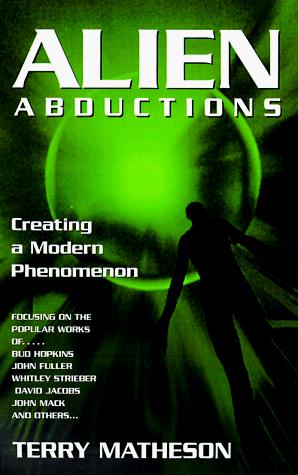
As an Amazon Associate, OverClassified may earn from qualifying purchases made through this link, at no extra cost to you.
Why This Is Essential Reading
Alien Abductions: Creating a Modern Phenomenon earns its place on this list as this site's earliest example of a purely literary-critical treatment of the abduction genre, arriving seven years before Susan Clancy's Abducted would make a related but methodologically distinct case from cognitive psychology. Where Clancy asks how a sincere person's memory can construct a false but vivid abduction experience, Terry Matheson asks a prior question: how the genre's own bestselling texts — Fuller's, Fowler's, Hopkins's, Strieber's, Jacobs's, Mack's — were actually written, and what specific narrative techniques let fragmented, often contradictory testimony read on the page as coherent, credible nonfiction. That question turns out to be independently verifiable in a way few claims on this list are: this site's own Allagash Abductions and Stanford, Kentucky case files already cite this exact book for exactly this purpose, a concrete demonstration of its continued usefulness that predates this article by years. The book's literary method is also its limitation, examined honestly in this entry's own Critical Reception section: Matheson's evidence is entirely textual, dependent on trusting that the authors he critiques transcribed their subjects faithfully, which means it can identify how a narrative was constructed without independently establishing what, if anything, actually happened to the people whose stories became that narrative. Read as a companion to Abducted rather than a substitute for it, this book supplies the half of the skeptical case Clancy's cognitive-psychology framework does not: not why a witness might believe, but why the story itself was built to be believed.
Related Cases & Theories
Essential Viewing
The Alien Abduction Phenomenon of the Mid-20th Century
Stuff You Should Know — A general-audience examination of how the alien abduction narrative took shape and spread through American popular culture across the mid-to-late 20th century, covering the same accumulation-across-retellings territory this book's literary analysis addresses. Verified via YouTube oEmbed before inclusion.

Whitley Strieber's Communion (Aliens, UFOs, Visitors, Abduction)
Jimmy Akin's Mysterious World — A close examination of Whitley Strieber's Communion, one of the specific bestselling narratives this book's rhetorical analysis discusses, tracing how the book's account was constructed, presented, and received. Verified via YouTube oEmbed before inclusion.
Sources Cited
- Matheson, Terry. Alien Abductions: Creating a Modern Phenomenon. Prometheus Books, 1998 (ISBN 1573922447 / 9781573922449, cited here, matching the edition already cited on this site's resources library and case files). archive.org
- "Alien Abductions: Creating a Modern Phenomenon." Publishers Weekly, September 28, 1998 (contemporary trade review, source of the "intellects vast, cool and unsympathetic" and "advanced slaves of a joyless technology" characterizations and the Demon-Haunted World comparison). publishersweekly.com
- "Terence Matheson." University of Saskatchewan, Department of English, Retired Faculty (degrees: B.A. Hons. Winnipeg, M.A. Manitoba, Ph.D. Alberta; research areas: American Literature, Utopian Studies; title: Professor Emeritus). artsandscience.usask.ca
- "Alien Abductions: Creating a Modern Phenomenon." Internet Archive bibliographic record (publisher, 1998, 317pp., ISBN 1573922447/9781573922449, includes bibliographical references and index). archive.org
- "Alien Abductions: Creating a Modern Phenomenon." Google Books listing (bibliographic record and description). books.google.com
- "Alien Abductions: Creating a Modern Phenomenon: Matheson, Terry: 9781573922449." Amazon.com product listing (edition and ISBN confirmation). amazon.com
- "A stressed, sleep-deprived couple accidentally invented the modern alien abduction phenomenon." Quartz, 2017 (quotes Matheson's "myth in the process of being created" framing in a retrospective on the Betty & Barney Hill case). qz.com
- This site's own essential-reading entry: The Allagash Abductions (ER-052), whose Critical Reception section directly quotes and cites this book by name.
- This site's own case file: Stanford, Kentucky Abduction (Case File #216), whose further-reading library cites this exact edition.
- This site's own case file: Allagash Waterway Abduction (Case File #045), the 1976 case this book discusses as an example of narrative evolution across retellings.
- This site's own case file: Betty & Barney Hill Abduction (Case File #006), the foundational 1961 case this book's analysis begins with.
- This site's own essential-reading entry: The Interrupted Journey by John G. Fuller (ER-034), the 1966 text establishing the genre's founding narrative template Matheson traces forward.
- This site's own essential-reading entry: Abducted by Susan A. Clancy (ER-026), the 2005 cognitive-psychology book covering related territory from a different disciplinary angle.
- This site's own key-figures entry: Terry Matheson, for his broader site-wide citations beyond this book.
- This site's own resources library: Full Reading List, where this exact edition (ISBN 1573922447) is cited across 2 case-file pages.
Have corrections, additional research, or peer-reviewed sources? Help improve this entry.
Suggest an Edit