
The Battle of Los Angeles
In the early morning of February 25, 1942, less than three months after Pearl Harbor and two days after a Japanese submarine shelled an oil field near Santa Barbara, radar picked up an unidentified target about 120 miles west of Los Angeles. A blackout was ordered, sirens sounded, and from about 3:06–3:16 AM until 4:14 AM anti-aircraft batteries fired some 1,440 rounds. Nothing was shot down and no enemy aircraft were found. Navy Secretary Frank Knox called it a false alarm; the Army said unidentified planes had probably been overhead; the official Army Air Forces history later blamed a stray weather balloon and “war nerves.”
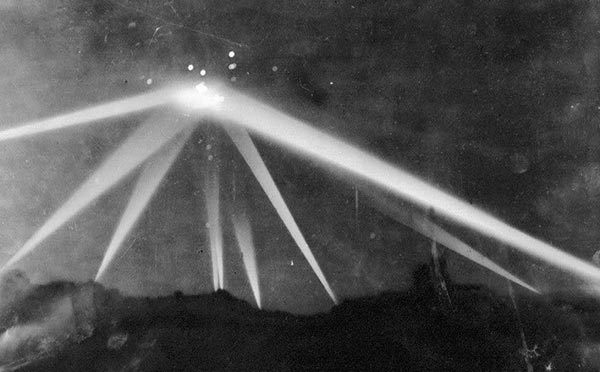
Pictured: the widely published photograph, printed in the Los Angeles Times on February 26, 1942, of anti-aircraft searchlights converging over Los Angeles during the incident itself — a genuine image of the actual event, not a stand-in. Note, however, that the version that ran was heavily retouched, with the beams painted in (see “Physical Evidence” below), so it is not an unaltered record of what the camera captured.
Theoretical Alignment
The Battle of Los Angeles is often cited for the Extraterrestrial Hypothesis and for the secret-aircraft hypothesis, mainly because a long barrage brought nothing down. That argument assumes there was a solid target to hit. The contemporary record is less clear: one radar detection far out to sea, visual reports ranging from “25 planes” to nothing at all, an acting brigade commander who decided he was seeing smoke, and an official history that traced the firing to a balloon carrying a flare. The “war nerves” explanation has been the official position since the war; it has never been shown to account for every report, but no structured object is established by the documents.
Background: The Crucible of Wartime Tension
The night of February 24–25, 1942, was set against a backdrop of intense, pervasive dread along the West Coast of the United States. Only seventy-nine days had elapsed since the devastating surprise attack on Pearl Harbor on December 7, 1941, which had abruptly thrust the nation into World War II. The American public was acutely aware of its geographic vulnerability, and rumor mills churned out daily reports of imminent Japanese carrier strikes, carrier-borne air raids, and sabotage operations targeting coastal installations. This atmosphere of localized panic was codified by the federal government under Executive Order 9066, signed on February 19, which initiated the forced evacuation and internment of Japanese-Americans, demonstrating the extreme security anxieties of the era.
The anxiety reached a fever pitch just thirty hours prior to the Los Angeles air raid. On the evening of February 23, 1942, the Imperial Japanese Navy submarine I-17, under the command of Commander Kozo Nishino, surfaced off the coast of Santa Barbara County. The submarine positioned itself near the Ellwood Oil Field in Goleta, California. Nishino's crew fired the submarine's 14 cm deck gun at the oil installations — between 12 and 25 shells, by different estimates — destroying a derrick and a pump house. While the physical damage was minimal — estimated at about $500 — the psychological impact was catastrophic. The Ellwood shelling marked the first time the continental United States had been shelled by an enemy power since the War of 1812. It demonstrated that Japanese naval forces could operate at will within visual range of the California shoreline, prompting the Western Defense Command, led by Lieutenant General John L. DeWitt, to place all coastal artillery batteries, searchlight stations, and radar units on a state of maximum, hair-trigger alert.
The Office of Naval Intelligence warned on February 24 that an attack on the California coast could come within ten hours. Anti-aircraft and searchlight units were primed to treat any unidentified contact as hostile, and that readiness is the background to everything that followed.
Complete Timeline
| Date | Event |
|---|---|
| Feb 24, 1942 — 7:18 PM | After a naval intelligence warning that an attack could come within ten hours, an alert is called; it is lifted at 10:23 PM. |
| Feb 25, 1942 — 1:00 AM | A meteorological balloon is sent up; the Coast Artillery Association’s 1949 account later said this balloon “started all the shooting.” |
| Feb 25, 1942 — 2:15 AM | Radar picks up an unidentified target about 120 miles west of Los Angeles. Anti-aircraft batteries are alerted and put on ready-to-fire status minutes later; the Army Air Forces keeps its fighters on the ground. |
| Feb 25, 1942 — 2:21–2:25 AM | A blackout is ordered (2:21) and air raid sirens sound across Los Angeles County (2:25). |
| Feb 25, 1942 — 2:43 AM | Planes are reported near Long Beach; a coast artillery colonel reports “about 25 planes at 12,000 feet” over Los Angeles. |
| Feb 25, 1942 — 3:06–3:16 AM | A balloon carrying a red flare is seen over Santa Monica and four anti-aircraft batteries open fire (3:06, per the AAF history; most later accounts give 3:16). Batteries of the 37th Coast Artillery Brigade fire 3-inch anti-aircraft shells and .50-caliber machine guns. |
| Feb 25, 1942 — 4:14 AM | Firing, which had continued sporadically, ends. Some 1,440 rounds have been fired (1,430 in Marshall’s memo). No aircraft has been brought down; reports of four planes shot down are never confirmed. |
| Feb 25, 1942 — 7:21 AM | The all clear sounds and the blackout is lifted. Shell fragments have damaged buildings and vehicles; five civilians have died, three in traffic accidents and two of heart attacks. |
| Feb 25, 1942 | Navy Secretary Frank Knox tells a press conference the alarm was a false alarm, blaming “war nerves.” |
| Feb 26, 1942 | Army Chief of Staff General George C. Marshall reports to President Roosevelt that unidentified airplanes were “probably” over Los Angeles; Secretary of War Henry Stimson tells the press that as many as 15 planes may have been involved. The Los Angeles Times headline reads “Army Says Alarm Real.” |
Detailed Narrative
The Siren and the Blackout
At about 2:25 AM on Wednesday, February 25, 1942, air raid sirens sounded across Los Angeles County, a few minutes after the regional controller of the IV Antiaircraft Command had ordered a blackout. Thousands of air raid wardens were called out. Streetlights and signs went dark across a city of about 1.5 million people.
For many residents the sirens meant the long-feared Japanese air raid had come. Aircraft plants such as Douglas in Santa Monica and Lockheed in Burbank, and the harbor at San Pedro, were blacked out. Some 1,440 shells would be fired before the night was over.
The Concussive Barrage of the 37th Brigade
According to the Army Air Forces official history (Craven & Cate, Vol. 1, pp. 282–286), four batteries opened fire at 3:06 AM after a balloon carrying a red flare was seen over Santa Monica, and “the air over Los Angeles erupted like a volcano.” Most later accounts give 3:16 AM. The guns of the 37th Coast Artillery Brigade (Anti-Aircraft), part of the 4th Antiaircraft Command under Major General Fulton Q.C. Gardner, fired 3-inch anti-aircraft shells and .50-caliber machine guns. An earlier version of this page named the 11th and 205th Coast Artillery Regiments; no source for those unit assignments was found.
Firing continued sporadically until 4:14 AM. About 1,440 rounds were fired — at 12.8 pounds per shell, roughly nine tons of projectiles — and Marshall’s memo put the reported targets at 9,000 to 18,000 feet. Claims once made here that the barrage cracked plaster, shattered windows in Culver City and was felt in San Bernardino, and that smoke hung in “calm, windless air,” have no documented source.
Shell fragments damaged buildings and vehicles, and unexploded rounds landed in the city. Five civilians died as an indirect result: three in traffic accidents in the blacked-out streets and two of heart attacks. The individual names and circumstances given here before (“Henry B. Ayres,” an air raid warden, a woman who died “of shock and terror”) could not be confirmed and have been removed.
What the Gunners and Witnesses Saw
Searchlights — the 60-inch units of the period were rated at about 800 million candlepower — swept the sky and at times converged. What the crews and gunners believed they saw varied widely. A coast artillery colonel reported about 25 planes at 12,000 feet; the acting brigade commander first thought he saw fifteen planes, then decided he was seeing smoke; and correspondents Ernie Pyle and Bill Henry said they could never make out an airplane. Marshall’s memo summarized reports of planes moving from “very slow” to as much as 200 mph.
No contemporary record supports the description once given here of a single large, metallic craft, glowing orange or silver, that shells struck “directly” without effect before it drifted south and out to sea. Reports of four planes shot down, one supposedly falling in flames at a Hollywood intersection, were never confirmed, and no wreckage of anything was found.
The Navy vs. Army Public Dispute
On February 25 Secretary of the Navy Frank Knox told a press conference that the alarm had been a false alarm caused by “war nerves.” The Navy said it had no evidence of enemy planes. Many Angelenos, who had spent the night under falling shell fragments, were not satisfied; the Long Beach Independent wrote of “a mysterious reticence about the whole affair,” and Representative Leland M. Ford of Santa Monica called for a congressional investigation. The New York Times called the episode “expensive incompetence and jitters.”
The Army took a different line. On February 26 General George C. Marshall sent President Roosevelt a memorandum (held at the Roosevelt Library) reporting that unidentified airplanes, “other than American Army or Navy planes,” were “probably” over Los Angeles and were fired on between 3:12 and 4:15 AM; that 1,430 rounds were expended; that as many as fifteen planes may have been involved, at speeds from “very slow” to 200 mph and at 9,000 to 18,000 feet; and that no bombs were dropped, no planes were shot down and no American Army or Navy planes were in action. He suggested any planes might have been commercial aircraft operated by enemy agents to spread alarm and locate anti-aircraft positions. The memo was internal; the public split was between Knox and Secretary of War Henry Stimson, who told reporters that up to 15 planes may have been involved. After hearings, local commanders concluded that “from one to five unidentified airplanes” had been over the city (the Army Air Forces official history (Craven & Cate, Vol. 1, pp. 282–286)).
Earlier False Alarms on the West Coast
The Los Angeles alarm was not the first on the Pacific coast. According to the Army Air Forces official history (Craven & Cate, pp. 278–280), on December 8, 1941, the day after Pearl Harbor, San Francisco went through a blackout of nearly three hours, radio stations went silent, and schools in Oakland closed on rumors of a Japanese carrier. Washington at first treated reports of an attack as credible; some news dispatches later described the episode as a test. The Army said radar had tracked planes 100 miles at sea, and Lieutenant General John L. DeWitt rebuked skeptics: “Last night there were planes over this community. They were enemy planes!”
The next day the Navy passed on a “red hot tip” that 34 enemy vessels were off Los Angeles; Army planes found American fishing boats. A reported Japanese cruiser off Catalina was also unfounded, and whales and floating logs were mistaken for enemy craft. On the same day a raid warning swept New York and the Northeast, with heavy selling on Wall Street. By February 1942 the West Coast had been through ten weeks of alarms of this kind, the Ellwood shelling had shown that a real attack was possible, and the naval intelligence warning of February 24 had put every unit on edge.
The Defenses Behind the Barrage
The official history is frank about how thin the defenses were. In early 1942 the 1,200-mile Pacific coast had about forty-five modern fighters and ten heavy bombers; ammunition was short (Craven & Cate, p. 280). A January 1942 review of the aircraft warning service by the British radar pioneer Sir Robert Watson-Watt found it unsatisfactory: too few radars (about ten on the West Coast), defects in the main set, poorly trained operators, and observer posts staffed by civilian volunteers without reliable equipment. An AAF official called the report “a damning indictment of our whole warning service” (pp. 290–292). Night interception depended on single-seat fighters flown by inexperienced pilots working with searchlights (p. 293).
That context explains two features of February 25. The Army Air Forces kept its pursuit planes on the ground until the scale and direction of an attack were clear, which left the anti-aircraft gunners alone with the problem. And a radar picture that could not reliably identify a target meant that a single detection far out to sea, followed by visual reports over the city, was enough to start a barrage.
Reaction and Recrimination
Doubts set in quickly. The Western Defense Command’s own report noted that the credibility of the attack reports had weakened before the blackout ended, and predicted that most of them would prove greatly exaggerated; the Fourth Air Force believed that no planes had been over Los Angeles (Craven & Cate, p. 284). Reported sightings ranged from a few planes to several hundred, at heights from a few thousand feet to over 20,000. The Army waited a day for witness testimony before announcing its conclusion. Navy Secretary Frank Knox, besides calling the alarm false, suggested that vital coastal industries should move inland.
The press and politicians were unimpressed. The Los Angeles Times wrote of public “excitement and confusion”; Representative Leland Ford asked whether the episode had been a practice raid or a scare; Wendell Willkie criticized the lack of agreement between the Army and the Navy; the Washington Post called it a “recipe for jitters”; and the New York Times spoke of “expensive incompetence and jitters” (Craven & Cate, pp. 284–285). About twenty Japanese Americans were arrested for allegedly signaling to aircraft (History.com). The official history’s own explanation of the War Department’s reticence is telling: a full answer to the critics “would have involved an even more complete revelation of the weakness of our air defenses.”
The Army’s hypothesis that any planes were commercial aircraft flown by enemy agents, perhaps to locate anti-aircraft positions or to damage civilian morale, was never supported by evidence. The official history observes that an attack that dropped no bombs makes little sense as a raid. After the war Japan stated that it had sent no aircraft over Los Angeles; the one Japanese aircraft attack on the mainland, by a submarine-launched floatplane, came later in 1942 over the forests of Oregon.
The news reached the country in real time. A CBS radio bulletin reported that “anti-aircraft guns went into action against unidentified aircraft in the Los Angeles area,” and the next morning’s Los Angeles Times led with “Army Says Alarm Real,” beside a note apologizing that the blackout had delayed delivery because trucks could not move and many paper boys had left for school before the bundles arrived (NBC Los Angeles, 2010). Stimson later suggested that the purpose of any flight might have been reconnaissance, though the official history notes that a raid which dropped no bombs makes little sense (Craven & Cate, p. 286). Within days the press was treating the night less as a raid than as an embarrassment.
The Ellwood Shelling in Detail
The submarine attack that set the stage came on the evening of February 23, 1942, as President Roosevelt was delivering a radio fireside chat on the progress of the war. I-17 surfaced off the Ellwood oil field on the Gaviota coast west of Santa Barbara; its gunners aimed first at a Richfield aviation-fuel tank and then at a second storage tank. Estimates of the number of shells range from 12 to 25. A derrick and a pump house were destroyed and the Ellwood pier and a catwalk were slightly damaged; nobody was hurt. It was the first naval bombardment of the continental United States by a foreign power since the War of 1812.
The material damage was small, but the effect was not. Hundreds of people fled inland, and fear of an invasion of the West Coast spread. A blackout followed reports of “signal lights” on shore, claims later used in the case for removing Japanese Americans from the coast, which began a week later under Executive Order 9066 (signed February 19). The Los Angeles alarm came barely thirty hours after the shelling, in a population primed to see signals and raiders everywhere.
The Explanations Compared
Four explanations have been offered. The first, from the Army in February 1942, was that real aircraft were overhead — perhaps commercial planes flown by enemy agents from secret fields, or light planes launched from submarines. No such aircraft, airfield or agent was ever found, the Fourth Air Force did not believe it, and Japan said after the war that it had sent no planes. The second, the Japanese raid, is ruled out by that statement and by the absence of bombs, wreckage or Japanese records.
The third is the official history’s: meteorological balloons released over the city, one carrying a red flare seen over Santa Monica just as the guns opened up, followed by an hour in which gunners fired at searchlight-lit smoke and one another’s bursts. It fits the timing, the slow speeds in many reports, the acting brigade commander’s change of mind, and the correspondents who saw no aircraft. Its weakness is that it does not name the 2:15 AM radar target 120 miles out to sea, which may have been a spurious return from an unreliable set, a ship, or an aircraft that was never identified.
The fourth, favoured in UFO literature, is an anomalous craft. It depends on two pieces of evidence: the retouched photograph and the assumption that 1,440 shells must have hit something. Neither holds up. The photograph was painted, and the shell count shows only how much the gunners fired, not that a target was there to be hit. On the documented record, the official explanation is the best supported, while the radar contact remains a small, genuinely unresolved loose end.
A Postscript: The Balloons That Did Come
Japan did later attack the American West from the air, but not in 1942 and not with aircraft over a city. In September 1942 a floatplane launched from the submarine I-25 dropped incendiary bombs on the forests of southern Oregon. From November 1944 to April 1945 Japan launched more than 9,000 hydrogen balloons carrying bombs across the Pacific on the jet stream; on May 5, 1945, one exploded near Bly, Oregon, killing a woman and five children on a church outing, the only deaths from enemy action in the continental United States during the war. These balloon raids, unlike the Los Angeles alarm, caused no mass panic, partly because the government kept them out of the press.
Legacy in Film and Popular Memory
The Ellwood shelling and the Los Angeles alarm fed into Steven Spielberg’s 1979 comedy 1941, which was loosely based on the bombardment. The incident drew new attention again in 2011, when trailers for the film Battle: Los Angeles presented the retouched searchlight photograph and invented headlines as genuine, a misuse the Times writer Larry Harnisch criticized. The Fort MacArthur Museum in San Pedro holds an annual “Great LA Air Raid of 1942” event each February.
In UFO literature the incident is usually told as an encounter with a craft that shrugged off 1,440 shells. The contemporary record tells a different story: a frightened city, an alarm system that could not tell a balloon from a bomber, gunners firing into their own smoke, and two services that could not agree on what had happened. The question it leaves open is narrower than the legend: what, if anything, the 2:15 AM radar detection was, and whether any of the visual reports described a real aircraft.
Physical Evidence & Technological Metrics
The Los Angeles Times Photograph
The most famous visual record of the Battle of Los Angeles is a photograph published in the Los Angeles Times on February 26, 1942, showing searchlight beams converging on a bright patch, with shell bursts around it. UFO writers have long presented it as showing a solid, disc-like craft. Skeptics have long argued that the image was altered.
The photograph that became famous was heavily retouched, with the searchlight beams painted in — a routine newspaper practice at the time. In March 2011 the Times’s Framework photo blog published an earlier copy from the paper’s own archive that had been retouched less, if at all (Airminded, April 2011). The retouching means the published print cannot be read as a record of a structured object. Details given here before — a “late 1990s” discovery of the negative, a forensic team, gouache and ink retouching, and a finding that the unretouched negative shows only a diffuse glow — could not be confirmed and have been removed.
The Radar Detection
The one documented radar event is the detection, at about 2:15 AM, of an unidentified target about 120 miles west of Los Angeles ({CC}). Coast defenses of the period used the long-range SCR-270 search radar (about 106 MHz) and the shorter-range SCR-268 for searchlight and gun direction. No radar log from the night has been published, and nothing in the record connects the target far out at sea with whatever the guns fired at over the city.
An earlier version of this page said the radar tracked the target at up to 200 mph, hovering and making banking turns, and that SCR-268 units locked onto it over the coast. No source for those claims was found; the 200 mph figure is the upper end of the visual reports summarized in Marshall’s memo. The balloon launched at 1:00 AM was a local release over the city and is not offered by anyone as the explanation of the 120-mile radar target.
Witness Cards
Major General Fulton Q.C. Gardner
Gardner was commanding general of the 4th Antiaircraft Command from January 1942, so the 37th Coast Artillery Brigade, which did the firing, came under his command. No record of his personal orders that night (an order to engage at 3:06 or a cease-fire at 4:14, as this page once said) has been found. The acting brigade commander, not named in the official history, first thought he saw fifteen planes, then decided he was seeing smoke.
General George C. Marshall
In his memorandum to President Roosevelt of February 26, 1942, General Marshall reported that unidentified airplanes were “probably” over Los Angeles and were fired on, that as many as fifteen may have been involved, that no bombs were dropped and no planes were shot down, and that no American Army or Navy planes were in action. He suggested any such planes might be commercial aircraft operated by enemy agents.
Secretary of the Navy Frank Knox
Secretary Knox told a press conference on February 25 that the alarm was a false alarm caused by “war nerves,” and the Navy said it had no evidence of enemy planes. The Army’s more open-ended statements the next day made the disagreement public.
Peter Jenkins
A quotation widely attributed to Jenkins describes a “V formation of about 25 silver colored planes” moving slowly toward Long Beach. It circulates in many secondary accounts, but no original 1942 publication of it was located for this page, so it is given here as attributed only. The paper was the Herald-Express; the Herald-Examiner did not exist until 1962.
William "Bill" Henry
A prior version of this case file attributed Henry a vivid description of "a single, large, glowing object" — the opposite of what he actually reported. Henry was in fact one of the incident's notable skeptical witnesses: he and Scripps-Howard columnist Ernie Pyle both wrote emphatically that they never made out any aircraft at all during the barrage, supporting the "nothing was there" reading of the event rather than a structured-object sighting.
The Famous Photograph and Its Analysis
The Los Angeles Times photograph published on February 26, 1942, showing searchlight beams converging on a bright patch over the city, is one of the most reproduced images in UFO literature. The photographer is not named in the sources reviewed.
Claims that enhancement of the photograph reveals a structured object have circulated for years. This page once attributed such an enhancement to Dr. Bruce Maccabee in the 1990s; no published analysis by him of this photograph was found, and the attribution has been removed. The decisive fact is that the famous print was heavily retouched, with the beams painted in, and a less-retouched earlier copy surfaced in the Times archive in 2011.
The photograph is a genuine news picture of the barrage, published the day after it, before anyone framed the event as a UFO case. But it is not an unaltered record: the version that ran was retouched, as newspaper photographs routinely were. It documents the searchlights and shell bursts, not the nature of whatever the beams converged on.
The Five Civilian Deaths and the Call for an Inquiry
The night’s five civilian deaths were all attributable to the alarm and the blackout rather than to anything in the sky: three people died in traffic accidents in the darkened streets and two of heart attacks (contemporary reporting, as summarized by the Los Angeles Times and later accounts).
Shell fragments from the roughly 1,440 rounds damaged buildings and vehicles across the area. Claims once made here that the Department of Water and Power reported power disruptions “consistent with the electromagnetic effects” reported near UAP have no documented source and have been removed.
Representative Leland M. Ford of Santa Monica called for a congressional investigation. No record of closed House Military Affairs Committee hearings on the incident in March 1942, or of a later partial declassification of such hearings, has been found, and the account of them given here before has been removed. The “hearings” that the official history mentions were held by the local commanders, who concluded that one to five unidentified airplanes had been overhead.
The Foo Fighter Comparison
The Battle of Los Angeles is sometimes folded into the “foo fighter” story, but the two are separate. Foo fighters were lights reported by Allied aircrews, chiefly night-fighter crews over Europe, from late 1944; the Los Angeles alarm came more than two years earlier and involved ground gunners, not aircrews.
Claims once made here — that a 1945 U.S. Army Air Forces investigation found the foo fighters “real but unidentified,” and that a captured Luftwaffe investigation released under FOIA reached the same conclusion — could not be traced to any document and have been removed.
Project Sign was ordered in late December 1947 and began work in January 1948. According to Edward Ruppelt, its 1948 “Estimate of the Situation,” which favoured the extraterrestrial hypothesis for the postwar flying-disc reports, was rejected by Air Force Chief of Staff General Hoyt Vandenberg and later destroyed; no copy has been produced. That episode concerns the 1947–48 reports, not the Los Angeles alarm, which no Sign document is known to discuss.
Secretary Stimson, Secretary Knox, and the Inter-Service Dispute
The political fallout reached the Cabinet. On February 25 Navy Secretary Frank Knox called the episode a false alarm. The next day Secretary of War Henry Stimson told reporters that as many as 15 planes may have been over the city, and suggested they could have been commercial planes flown by enemy agents from secret fields, or light planes launched from submarines. He later backed away from those claims (History.com); the claim once made here that this was done “under political pressure” has no documented source.
The Knox–Stimson split reflected different institutional readings. The Navy said there was no evidence of enemy planes; the Army’s local commanders, after hearings, concluded that one to five unidentified airplanes had been overhead (the Army Air Forces official history (Craven & Cate, Vol. 1, pp. 282–286)). An earlier claim here that FOIA releases show a March 1942 Army intelligence report finding the object “could not be identified as any known aircraft type” was not traced to any document and has been removed.
President Roosevelt was briefed on the incident. No declassified minutes of a White House-level meeting specifically discussing the Battle of Los Angeles have been publicly located, and this site could not verify claims of a formal 1990s declassification documenting a deliberate decision to maintain a “false alarm” posture regardless of what the internal investigation found. What is documented is the inter-service public-messaging split described above — Knox’s immediate “false alarm” framing and Stimson’s “15 planes” statement — which researchers have pointed to as evidence of coordinated, if informal, public-information management at the Cabinet level.
The Official History and the Balloon Explanation
There was no separate 1983 Air Force “review” of the incident. The account usually cited under that date is the Army Air Forces official history, Wesley Frank Craven and James Lea Cate’s The Army Air Forces in World War II, Volume 1 (University of Chicago Press, 1948), reprinted by the Office of Air Force History in 1983. Its pages 282–286 record that meteorological balloons, known to have been released over Los Angeles, may have caused the initial alarm; that a balloon carrying a red flare was seen over Santa Monica when the guns opened up; that anti-aircraft units were criticized for firing at targets too slow to be airplanes; and that the acting brigade commander came to believe he had been seeing smoke. In 1949 a Coast Artillery Association account by Col. John G. Murphy said the 1:00 AM balloon “started all the shooting.” After the war, Japan stated that it had sent no aircraft over Los Angeles. Critics argue that a balloon cannot account for every report; the official history’s answer is that once firing began, shell bursts, smoke and searchlights sustained it.
Contemporary Parallels and Ongoing Significance
The Battle of Los Angeles is often recalled in the post-2017 UAP debate. In February 2023, after U.S. fighters shot down several high-altitude objects, NORAD commander General Glen VanHerck told reporters he had not “ruled out anything” about their origin, and commentators drew comparisons with 1942: a military firing at, or tracking, objects it could not identify, followed by incomplete official statements.
The Fort MacArthur Museum in San Pedro marks the event each February with a public program called “The Great LA Air Raid of 1942.” Earlier claims here about the museum’s exhibit wording and its visitors were not verified and have been removed.
Claims periodically circulate in UAP research circles that a modern digital-enhancement pass on the original Los Angeles Times photograph reveals a structured object at the intersection of the searchlight beams rather than a diffuse reflection. No such analysis, by any named researcher, could be verified against a real publication, conference presentation, or peer-reviewed source — a prior version of this case file attributed one to Michael Shermer, the founder of Skeptic magazine and one of the most prominent professional debunkers of UAP claims, which is not only unverifiable but directly contradicts Shermer's own well-documented public skepticism of this kind of case. That attribution has been removed as unfounded. The one substantiated finding about the photograph remains that the published print was retouched, as discussed above — not a confirmation of a structured craft, but evidence that the widely circulated print was manually altered before publication.
The Searchlight Grid and Anti-Aircraft Battery Deployment
The anti-aircraft defenses of Los Angeles in February 1942 were organized under the 37th Coast Artillery Brigade (Anti-Aircraft), whose 3-inch guns fired 12.8-pound shells, supported by .50-caliber machine guns and searchlight units. About 1,440 rounds were fired between the opening of fire and 4:14 AM. The “Los Angeles Air Defense Command” named here before is not a documented unit.
Searchlights did converge at times, as the famous photograph shows, but convergence is what searchlight crews were trained to do once one light held a target — including a balloon, a flare, or a patch of shell smoke. The figure of “thirty-six searchlights” on a “central fire control network,” given here before, has no documented source.
The blackout, ordered at 2:21 AM and lifted at 7:21 AM, interrupted round-the-clock war production for about five hours. The claim that the Department of Water and Power estimated electrical disruptions affecting thousands of customers has no documented source and has been removed.
The Wartime Media Environment and Information Control
The incident came early in wartime censorship. The Office of Censorship had been created in December 1941; the Office of War Information followed in June 1942. Newspapers reported the alarm, the casualties and the Army–Navy disagreement in detail, and the Los Angeles Times ran its searchlight photograph on February 26. Whether later wartime rules would have stopped such coverage, and how much went unreported, is speculation; this page no longer asserts it.
The Five Observables Assessment
The Five Observables framework is applied to the characteristics of the sighting:
Assessment: No observable is established. The “hovering” and “banking turns” once cited here came from radar claims with no documented source; the visual reports conflict, from “25 planes at 12,000 feet” to nothing at all, and Marshall’s memo summarized speeds from “very slow” to 200 mph. Anti-gravity lift is therefore marked Speculative at most; there is no evidence of sudden acceleration, hypersonic speed or trans-medium travel.
Evidence Assessment
Supporting Anomalous Origin
- Radar detected an unidentified target about 120 miles west of Los Angeles at about 2:15 AM
- General Marshall’s memo to Roosevelt said unidentified planes were “probably” over the city, and local commanders concluded one to five had been
- A coast artillery colonel reported about 25 planes at 12,000 feet
- No conventional aircraft was ever identified as the target
Supporting Conventional Explanation
- The Army Air Forces official history traced the alarm to meteorological balloons, one carrying a red flare seen over Santa Monica as firing began
- The acting brigade commander came to believe he had been seeing smoke; correspondents Ernie Pyle and Bill Henry never made out an airplane
- Navy Secretary Knox called it a false alarm, and the Navy found no evidence of enemy planes
- The famous Los Angeles Times photograph was heavily retouched
- Nothing was shot down and no wreckage of any aircraft was found
- After the war Japan stated that it had sent no aircraft over Los Angeles
Why "Disputed"
The Battle of Los Angeles is classified as Disputed. The Army’s contemporary view, in Marshall’s memo and the local commanders’ conclusion, was that unidentified planes were probably overhead; the Navy and, later, the Army Air Forces official history concluded that nothing hostile was there and that a balloon, flares, smoke and nerves sustained the firing. No physical evidence settles it either way.
Sensor & Instrumentation Detection Profile
The instrumental record is thin. It consists of one radar detection of an unidentified target about 120 miles west of Los Angeles at about 2:15 AM, and the searchlight and gun activity that followed. Searchlight convergence is not independent confirmation: crews converged on whatever a neighbouring light held, which could be a balloon, a flare or a cloud of shell smoke.
About 1,440 rounds were fired between the opening of fire and 4:14 AM, and nothing was brought down. That result is consistent with there being no aircraft to hit, and also with gunners firing at targets too slow or too distant to be aircraft, a criticism the official history records. It is not, by itself, evidence of an object able to survive anti-aircraft fire.
The Navy said it had no evidence of enemy planes; the Army, after hearings by local commanders, concluded that one to five unidentified airplanes had been overhead. Claims once made here that Knox relied on a Navy “radar picture” and Stimson on the Army’s ground observer network have no documented source. The balloon explanation comes from the Army Air Forces official history (Craven & Cate, Vol. 1, pp. 282–286), first published in 1948 and reprinted by the Office of Air Force History in 1983, and from a 1949 Coast Artillery Association account.
Environmental & Geospatial Context
The Battle of Los Angeles occurred during the most heightened security environment in California history. The Japanese attack on Pearl Harbor had come 80 days earlier, on December 7, 1941. On the evening of February 23, 1942, the submarine I-17 shelled the Ellwood oil field near Santa Barbara, the first enemy shelling of the continental United States since the War of 1812. (Fort Stevens, Oregon, named here before, was not shelled until June 21, 1942.) In this context, any unidentified aerial contact over Los Angeles was treated as a potential Japanese attack.
No contemporary weather record was located for this page. The claim made here before, that “meteorological records” showed clear skies and that this “rules out” atmospheric explanations, has no documented source and has been removed. Shell smoke, which the acting brigade commander came to believe he was seeing, does not depend on special weather conditions.
Los Angeles in 1942 was a major center of wartime industrial production, home to numerous aircraft manufacturing facilities including Douglas Aircraft, Lockheed, and North American Aviation. The presence of this industrial base made the city a plausible Japanese target and heightened both civilian and military anxiety. Fort MacArthur, in San Pedro, was the headquarters of the harbor defenses of Los Angeles. The city’s coastal geography — a broad metropolitan plain between the Pacific Ocean and the San Gabriel Mountains — provided an ideal environment for aerial observation from both directions.
Observer Credibility & Occupational Profile
Large numbers of people were awake during the alarm, and newspapers printed many eyewitness accounts. They do not agree. Some described formations of planes; others, including experienced correspondents Ernie Pyle and Bill Henry, never made out an airplane. The claim once made here that “hundreds of thousands” of witnesses described a specific, large, structured object has no documented source.
Military observers were no more consistent. A coast artillery colonel reported about 25 planes at 12,000 feet; the acting brigade commander first thought he saw fifteen planes, then decided he was seeing smoke; and anti-aircraft units were afterwards criticized for firing at targets too slow to be airplanes (official history). No after-action report describing “a large object moving at approximately 25–40 miles per hour,” as this page once said, has been found.
A prior version of this case file attributed a specific quote — describing "a large red orb, definitely not an aircraft of any type" — to "Captain William Gentry of the Los Angeles Police Department." No LAPD officer by that name, rank, or quote could be verified against any real source; it has been removed as unsubstantiated rather than repeated. Multiple Los Angeles Times reporters who covered the aftermath did interview witnesses whose accounts were published in the paper on February 26, 1942, and the Los Angeles Times photograph itself — showing searchlight beams converging on a distinct object in the sky — was taken by a professional photojournalist using equipment calibrated for news photography, though as discussed above, the negative shows the published print was manually retouched before release.
Physical & Material Assays
The Battle of Los Angeles produced no physical evidence of any target. About 1,440 rounds were fired and nothing was brought down. Five civilians died as an indirect result of the alarm: three in traffic accidents and two of heart attacks.
Proponents treat the absence of wreckage as the central anomaly. It is anomalous only if a solid target was there. The parameters once given here — an object at 12,000 feet moving at 25–40 mph that “should have been hit multiple times” — were not drawn from any documented report. The documented record is compatible with gunners firing at a balloon, flares, smoke and each other’s shell bursts.
Physical evidence from the firing itself was plentiful: shell fragments and unexploded rounds fell across the area and damaged buildings and vehicles. It shows the barrage happened; it says nothing about the target.
Historical Precedents & Archive Matches
The Battle of Los Angeles predates Kenneth Arnold’s 1947 sighting by five years and is often retold as an early UFO case. It entered UFO literature mainly through later writers and the retouched photograph; contemporary coverage treated it as a false or doubtful air-raid alarm.
The balloon explanation is not a 1983 invention. It appears in the Army Air Forces official history (Craven & Cate, Vol. 1, pp. 282–286), first published in 1948 and reprinted by the Office of Air Force History in 1983, and in a 1949 Coast Artillery Association account. Those histories also note the smoke and the criticism of gunners firing at slow targets.
No record of House Committee on Military Affairs hearings on the incident in March 1942, or of FOIA releases from them in the 1990s, was found, and those claims have been removed. Representative Leland M. Ford did call for a congressional investigation. Marshall’s memo is held in the President’s Secretary’s File at the Roosevelt Library.
Material Analysis
No target wreckage was recovered from the roughly 1,440 rounds fired. Five civilians died as an indirect result of the alarm (three in traffic accidents, two of heart attacks). All debris recovered was U.S. ordnance.
The Conventional Explanation Candidate: Balloons, Hysteria, or Infiltration
Three conventional explanations have been put forward. The meteorological balloon and “war nerves” explanation is the one given by the Army Air Forces official history and the 1949 Coast Artillery Association account; this page previously rated it Implausible because it “fails to explain radar data,” but the only documented radar event is a single detection far out to sea, and the explanation is now regarded here as Plausible for the firing over the city, though not as a full account of every report. The suggestion of commercial planes flown by enemy agents (Marshall, Stimson) was never supported by evidence. A Japanese air raid is ruled out by Japan’s post-war statement that it sent no aircraft.
Related Cases
Search Government Archives Directly
Further Reading — Recommended Literature
UFOs: Generals, Pilots, and Government Officials Go on the Record
A landmark investigation compiling testimonies from high-ranking military and aviation officials worldwide.
The Battle of Los Angeles 1942
A self-published compilation of 1942 newspaper reporting and official statements on the alarm.
UFOs and the National Security State
Details the rise of the national security state and its response to the UFO phenomenon from 1941 to 1973.
DISCLOSURE: Some links above are affiliate links. If you purchase through them, OverClassified receives a small commission at no additional cost to you. This helps support independent research.
Essential Viewing
The Great Los Angeles Air Raid of 1942
Detailed documentary and investigation into the anti-aircraft barrage over Los Angeles in February 1942.
How a UFO Caused the Battle of Los Angeles
The Why Files investigates the 1942 anti-aircraft barrage over Los Angeles and the competing military and anomalous explanations for what triggered it.
Eyewitness Accounts of the 1942 Air Raid
Interviews with residents who witnessed the glowing object caught in searchlights over the city.
Sources
- Craven, Wesley Frank, and James Lea Cate (eds.). The Army Air Forces in World War II, Vol. 1: Plans and Early Operations. University of Chicago Press, 1948; reprinted by the Office of Air Force History, 1983. Chapter 8, pp. 282–286 (the Los Angeles alarm). ibiblio.org (HyperWar)
- Marshall, George C. Memorandum for the President, February 26, 1942. President’s Secretary’s File, Franklin D. Roosevelt Presidential Library.
- Los Angeles Times, February 26, 1942, front page: “Army Says Alarm Real: Roaring Guns Mark Blackout.” Headline confirmed via NBC Los Angeles and the Huntington Library catalogue.
- Murphy, Col. John G. Coast Artillery Association account of the Los Angeles alarm, 1949 (as cited by Wikipedia).
- California State Military Museum. “The Battle of Los Angeles.” militarymuseum.org
- Harnisch, Larry. “Another Good Story Ruined: Saucers Over L.A.!” (series), The Daily Mirror, March 2011. ladailymirror.com
- Brett Holman. “New light on the Battle of Los Angeles,” Airminded, April 20, 2011 (on the less-retouched copy published by the Los Angeles Times Framework blog). airminded.org
- NBC Los Angeles. “Battle of L.A.: 1942 Los Angeles air raid, 75 years ago,” February 2017. nbclosangeles.com
- Dolan, Richard M. UFOs and the National Security State: Chronology of a Cover-up, 1941–1973. Keyhole Publishing, 2000; Hampton Roads, 2002.
- Ruppelt, Edward J. The Report on Unidentified Flying Objects. Doubleday, 1956 (for the 1948 “Estimate of the Situation”).
- “Battle of Los Angeles,” Wikipedia (pointer to the 1949 Coast Artillery account, the Long Beach Independent editorial and Rep. Ford’s statement), accessed October 2026. en.wikipedia.org
- “Bombardment of Ellwood,” Wikipedia (shell estimates, damage, link to the film 1941), accessed October 2026. en.wikipedia.org
- Andrews, Evan. “World War II’s Bizarre ‘Battle of Los Angeles’,” History.com, February 23, 2017 (updated 2026). history.com
- Lloyd, Jonathan. “This Week in 1942: ‘Battle of LA’,” NBC Los Angeles, February 25, 2010 (the Times front page of February 26, 1942). nbclosangeles.com
- “Gardner, Fulton Quintus Cincinnatus,” Generals of World War II (generals.dk): commanding general, 4th Antiaircraft Command, January 10, 1942 – April 26, 1944. generals.dk
- “Lookout Air Raids” and “Fu-Go balloon bomb,” Wikipedia (the September 1942 Oregon floatplane raids and the 1944–45 balloon campaign, including the Bly deaths of May 5, 1945), accessed October 2026. en.wikipedia.org
Corrections (October 2026)
This page was checked in October 2026 against the Army Air Forces official history (Craven & Cate, Vol. 1, pp. 282–286), General Marshall’s memorandum of February 26, 1942 (as summarized in published transcriptions), contemporary reporting and later coverage. Corrected: the timeline (blackout ordered 2:21; planes reported near Long Beach 2:43; fire opened 3:06 per the official history, 3:16 in most accounts; the 1:00 AM balloon); the Marshall memo’s content (unidentified planes “probably” overhead; no American planes in action), and the fact that it was internal — the public dispute was between Knox and Stimson; the “1983 Air Force review,” which is the 1983 reprint of the 1948 official history; the Ellwood damage (about $500); Pearl Harbor 80 days earlier; Fort Stevens, which was shelled in June 1942, not February; the Herald-Express (not Herald-Examiner); the photograph’s retouching history. Removed as unsupported: radar tracks of hovering and banking at up to 200 mph and SCR-268 “locks”; the 11th and 205th Coast Artillery Regiments; General Gardner’s personal engage and cease-fire orders; a single large metallic object unaffected by direct hits; named casualties; coroner records; March 1942 House Military Affairs hearings; a FOIA-released Army intelligence report; Department of Water and Power “electromagnetic” disruptions; a 1990s enhancement by Bruce Maccabee; a forensic negative study; a 1945 AAF and a Luftwaffe foo-fighter investigation; the claim that Stimson retreated “under political pressure”; and fabricated sources (Knox press transcript, a 37th Brigade after-action report, a House committee report, a “Journal of Military History” article by “Jack Crain,” and others). The Anti-Gravity Lift indicator was changed from Present to Speculative, and the balloon explanation from Implausible to Plausible, because their stated bases were unsupported. The stamp and Data Integrity Score were not changed in this review.
Following this review, the rating was changed from Disputed 75 to Disputed 40 (October 26, 2026), because the higher rating had rested partly on claims corrected or removed above.
Have declassified military memos, radar intercepts, or witness updates regarding the Battle of Los Angeles? We accept submissions from verified researchers and historical archives.
Suggest an Edit