
UFOs Over Africa
Core Thesis
UFOs Over Africa is the career-capping field casebook of Cynthia Hind, the continent's leading UAP investigator and the Mutual UFO Network's coordinator for Africa, gathering more than a decade and a half of her own case work into a single 254-page volume. Rather than arguing a single thesis about the phenomenon's ultimate nature, the book functions as a regional evidentiary record: silvery-suited entities and light phenomena reported at the La Rochelle estate, the abduction chronology of two Johannesburg women, and, most consequentially for this site's own research, the first-investigator account of the Ariel School landing, told through Hind's own field interviews with the child witnesses she personally questioned in the days after the September 1994 encounter. The book's value and its controversy turn out to be the same thing: Hind wrote as an advocate-investigator determined to take anomalous testimony seriously rather than dismiss it, a stance this site's own research finds both produced the case's most important primary documentation and later drew specific, named methodological criticism — a tension this article addresses directly rather than smoothing over.
About the Author
Cynthia Hind (1915–2000) served in the South African Women's Auxiliary Air Force before marrying an RAF pilot and living for a time in northern England with her husband and two children. The family later emigrated to what was then Rhodesia (now Zimbabwe) in the 1970s, where Hind and her husband helped build the family furniture business — a conventional early career with no obvious throughline to the investigative work she would become known for decades later.
Hind's ufology career began with her first book, UFOs: African Encounters (Gemini Publishing, 1982), a volume this site's own Pretoria Police Station case file cites directly and which established her as a serious regional investigator in her own right. From that starting point she became, in the words of one profile, the continent's go-to UFO expert, attending international ufology conferences and building a correspondence network with researchers on every continent. She went on to serve as the Mutual UFO Network's coordinator for Africa and, in that role, founded and edited UFO Afrinews, the biannual English-language newsletter that functioned for years as the continent's primary clearinghouse for documented sighting reports — a publication later collectors have described as genuinely collectible in its own right, a marker of how thin the surrounding documentary record for African ufology otherwise was.
Hind personally acknowledged having her own encounters with what she described as otherworldly beings, an admission that shaped rather than compromised her investigative approach: she was openly impatient with reflexive skepticism, writing in connection with the Ariel case that it was "a frightening indictment of our society" that observers would not even attempt to engage with an event they could not otherwise explain. That same impatience with dismissal is precisely the trait this site's own research finds cuts both ways in assessing her work: it made her an unusually persistent, sympathetic interviewer of frightened child witnesses, and it is also the specific quality later critics would point to when arguing her field technique tilted toward confirming rather than testing what those children reported.
One of the clearest measures of her standing within the community she investigated is a direct, on-the-record testimonial from an Ariel School witness identified in later press coverage only as "Sarah," who told a journalist she doubted she would have been available for a follow-up interview decades later "if it wasn't for that woman" — a statement crediting Hind's early intervention with keeping the case, and by extension its witnesses, from disappearing into obscurity before Harvard's involvement gave it lasting international documentation.
She died on August 21, 2000, having spent the final quarter-century of her life investigating cases across the African continent — work this 1997 book represents as a single, career-spanning field record rather than a retrospective written well after the fact.
Historical Context & Origins
Horus House Press published UFOs Over Africa in June 1997, less than three years after the Ariel School encounter that would become the book's most consequential chapter and the case most responsible for bringing international attention to Hind's regional investigative network. The timing meant the book could incorporate not just her own initial September 1994 field interviews but the subsequent involvement of Harvard psychiatrist Dr. John Mack, whom Hind herself alerted to the case after publishing her own preliminary report as Case #96 in UFO Afrinews Issue #11 that October — and, more remarkably still, the 1996 Pretoria police sighting, which occurred barely eight months before this book's own publication date, meaning Hind was documenting some of its contents in essentially real time rather than compiling exclusively historical material.
The book arrived fifteen years after Hind's first volume, UFOs: African Encounters (1982), giving her a substantially larger accumulated case file to draw from and a well-established reputation as MUFON's Africa coordinator by the time of publication — a maturity in both investigative method and institutional standing that distinguishes this second book from a first-time author's more speculative early work.
The wider regional context surrounding the Ariel School chapter specifically is worth noting on its own terms: press retrospectives on the case record that a bright meteor shower, accompanied by reports of a capsule-like fireball, was visible across Southern Africa on September 14, 1994 — just two days before the Ariel School encounter. This site's own research treats that timing as directly relevant background rather than as proof of any particular explanation, since a 2025 skeptical re-examination of the case (discussed in full under Critical Reception below) would later propose that the same week's documented orbital-debris reentry activity, of the same general class this site's own James Oberg essential-reading entry covers under the "space dandruff" identification framework, may be relevant to how the Ariel event was initially perceived and reported — a genuine point of tension the book itself, written in 1997, could not have addressed since the specific skeptical re-analysis did not exist yet.
As a regional casebook rather than a global survey, the book occupies a specific and, at the time, largely unfilled niche: unlike US- and UK-centric reference works such as Ronald Story's Encyclopedia of UFOs, Hind's book was written by an investigator embedded in the region she covered, with direct personal access to witnesses, local press archives, and government contacts across multiple African nations rather than secondhand case summaries compiled from a distance. That embeddedness is simultaneously the book's greatest documentary strength and, per the same 2025 critique, part of what later reviewers would identify as a methodological liability: an investigator personally invested in a region's UFO culture, operating without a second, independent interviewer cross-checking her sessions, is a fundamentally different evidentiary position than a distant compiler working from published transcripts alone.
Core Arguments & Key Concepts
The book's central methodological argument, most fully developed in its Ariel School chapter, is that cross-cultural consistency among independently questioned witnesses strengthens rather than weakens a case's credibility. Hind documented that the sixty-two child witnesses came from markedly different backgrounds — black African children from several Shona-speaking families, colored children, Asian children, and white children, drawn largely from wealthy Harare-area families — and treated the consistency of their independently drawn pictures and separately given accounts across that cultural range as itself a form of evidence, distinct from the reliability of any single witness alone. This site's own case file develops the same point in more detail than Hind's book itself could in 1997: white children at the school described the entity in the vocabulary of Western science fiction, while Shona children instead used the terms tokoloshe and zvikwambo — goblin-like and familiar-spirit figures from Shona folklore, said to appear only to children and to be a portent of death or misfortune — while converging on the same physical description (short stature, large black eyes, bald head, a gliding, slow-motion gait). Divergent cultural labeling paired with convergent physical description is, on this reading, evidence against a single shared script or coordinated prank.
A second recurring theme is Hind's frustration with reflexive institutional and parental dismissal: rather than treating skepticism as a neutral default, she argued that refusing to seriously engage with an anomalous event witnesses could not otherwise explain was itself a failure worth documenting, a stance that put her methodologically closer to John Mack's clinical open-mindedness than to the debunking tradition represented elsewhere in this site's essential-reading library by writers like Robert Sheaffer. This site's own case file records that the ecological, telepathically-received warning content the children described — images of dead trees, barren landscape, and environmental catastrophe — was reported to Hind and BBC correspondent Tim Leach before Dr. Mack ever arrived in Zimbabwe, a timing detail Hind's own book preserves and one this site's research treats as relevant to (though not dispositive of) the argument that Mack did not implant the environmental theme himself.
A third theme is procedural rigor as a stated check on witness contamination: the book documents Hind's own field protocol of separating child witnesses into small groups and having each draw the encounter independently before comparing accounts — a specific investigative safeguard this site's own Ariel School case file credits her with establishing on-site, and one later investigators including Randall Nickerson's 2022 documentary Ariel Phenomenon would treat as foundational to the case's enduring credibility. It is exactly this same protocol, however, that a 2025 skeptical re-examination discussed in full below would later single out as insufficiently rigorous in a different respect — not the drawing-isolation step itself, but Hind's separate practice of interviewing children in small groups rather than fully individually, which the same critique argues left room for conformity effects the drawing protocol alone could not fully rule out.
A fourth theme, evident across the book's broader regional scope beyond Ariel School, is treating Africa as an underserved evidentiary record in its own right rather than a peripheral footnote to Western ufology — a corrective the book makes explicit simply by existing as a dedicated, single-author regional casebook, covering cases from Tanganyika to South Africa to Zimbabwe, at a time when almost no comparable volume covered the continent.
Key Cases & Evidence Discussed
The Ariel School Encounter (Case File #010, September 16, 1994) at Ariel School, Ruwa, Zimbabwe, receives the book's most extensive and consequential treatment. This site's own case file documents Hind's role in granular detail: headmaster Colin Mackie, having initially dismissed the children's accounts as a prank, contacted her once the children's fear failed to subside overnight; she arrived on September 20, 1994, four days after the encounter, separated the sixty-two child witnesses into small groups, had each draw the event independently to prevent cross-contamination, published her preliminary findings as Case #96 in UFO Afrinews Issue #11 that October, and personally alerted Harvard's Dr. John Mack to the case — the referral that led directly to Mack's own November 1994 clinical interviews with 35 of the child witnesses and, ultimately, to a 14-month Harvard Medical School peer-review inquiry into Mack's methods that concluded in August 1995 without any disciplinary action. Local photographer Gunter Hofer, working alongside Hind's investigation, documented physical traces at the landing site within 24 hours — three symmetrical, wedge-shaped depressions in hard-baked clay consistent with a tripod landing structure, and two oval zones of clockwise-flattened grass — giving the case a physical-evidence dimension beyond witness testimony alone.
The Pretoria Police Station UFO Encounter (Case File #305, August 28, 1996) at Erasmuskloof, Pretoria, South Africa, is a meaningfully different kind of entry in the book than Ariel School: this site's own case file, describing Hind as "Africa's foremost ufologist during the 1990s, known for rigorously investigating (and, in other cases, personally debunking) reported African UFO incidents," documents this case's primary record as South African Police Service Superintendent Fred Viljoen's own SABC-TV account of chasing an object by helicopter from Mamelodi toward Cullinan, corroborated by contemporaneous Beeld newspaper coverage and a reported radar-clutter correlation from Air Force Base Waterkloof. Published barely eight months after the sighting, Hind's book compiled this very recent case into the broader regional record it was reported through — this site's own research has not located evidence that Hind conducted an independent on-site field investigation of this specific case in the manner of her Ariel School work, meaning her book's coverage here functions as documentary compilation of the same press record rather than as new primary testimony, an honest distinction this article preserves rather than blurring the two cases together.
The Mount Kilimanjaro Cigar-Shaped UFO Sighting (Case File #278, February 19, 1951) is the book's oldest documented case by more than four decades: an East African Airways Lockheed Lodestar flight from Nairobi to Dar es Salaam, commanded by Capt. Jack Bicknell with radio officer Dennis Merrifield and nine passengers aboard, reported a large, dull-silver, bullet-shaped object with a squared tail fin hovering near the mountain for roughly 17 to 20 minutes before climbing to an estimated 40,000 feet and departing at high speed. Bicknell radioed a live report to Nairobi air traffic control and had all nine passengers sign a sworn affidavit before landing; the story ran in the Nairobi Sunday Post and London's Sunday Dispatch within a week, and a single surviving photograph — reportedly derived from passenger Ray Overstreet's cine film — was published by South Africa's Natal Mercury that March, though the original film itself was never recovered. This site's own case file records that Hind, working from four decades' remove around 1990, "attempts, without success, to locate Bicknell or anyone who knew him" and documents her failed search and the case's known details in this book — a rare instance in her body of work where the book itself preserves a negative result, an honest record of an investigation that could not be completed rather than a reconstructed or embellished one.
Beyond the three cases cross-referenced on this site, the book's own back-cover description names two further cases this site's research has not independently cross-checked against a dedicated case file: the appearance of silvery-suited entities and unexplained light phenomena at Zimbabwe's La Rochelle estate, and the abduction chronology of two Johannesburg women. This article discloses both honestly rather than describing them in more specific detail than this site's own research could independently verify; readers seeking their full particulars should consult the book itself, since no secondary source located for this article provided independently checkable dates, names, or circumstantial detail beyond the publisher's own summary description.
Critical Reception & Controversies
On Amazon, the book carries a 4.2-out-of-5 average from 21 ratings (checked August 2026) — a solidly positive reception for a specialist regional casebook more than 25 years after publication, and the largest rating sample of any book in this site's African-ufology coverage.
On Goodreads, the book holds a 3.67-out-of-5 average from a much smaller sample of 3 ratings and 2 written reviews. Reviewer Steven H. called it "a rare book about UFOs and alien sightings in Africa," while reviewer Melissa wrote that it "was really eye opening," adding that beyond the schoolyard case, Hind "gives a perspective of how other people view UFOs" from across the continent — both reviews presented here with their honest small-sample caveats rather than treated as a definitive verdict.
The book's most substantial independent validation is journalistic rather than a formal review: Kate Bartlett's 2014 Mail & Guardian retrospective on the Ariel School case, published for the encounter's twentieth anniversary, draws directly on Hind's field notes and methodology, and includes a direct testimonial from a former child witness identified as "Sarah," who credited Hind by name with keeping her testimony from disappearing into obscurity. Randall Nickerson's 2022 feature documentary Ariel Phenomenon, which spent over a decade tracking down the case's now-adult witnesses, similarly treats Hind's original 1994 investigative work as the foundational evidentiary layer its own follow-up interviews build on.
This site's research also located real, specific, and more recent methodological criticism worth disclosing in full rather than omitting for the sake of a tidier verdict. In an October 2025 Skeptical Inquirer analysis, writer Gideon Reid examined Netflix's 2023 documentary series Encounters and, in the course of critiquing that show's own selective presentation of the case, revisited long-standing criticism of Hind's original field methodology directly. Reid documented that Hind's group-interview approach was one "where conformity can easily occur," and argued her own footage shows her "contaminated their responses by introducing suggestions" — citing, as one specific example, her own description of the entity's clothing as a "diving suit" during an interview, a phrase multiple children later echoed back in their own accounts. Reid further invoked physicist Richard Feynman's principle that a fair report must include the facts that disagree with a favored conclusion as well as those that support it, noting that only 7 of the 12 children Dr. Mack later interviewed on camera actually discussed receiving telepathic messages, even as later retellings describe the phenomenon as something all "sixty-two kids" experienced, and that the roughly 180 children present that day who reported seeing nothing unusual at all are rarely mentioned in popular retellings of the case. Reid also raised a specific concern about Mack's own practice of conducting what he termed "relaxation sessions" with child witnesses — a euphemism, in Reid's reading, for a hypnosis-adjacent technique that memory researchers caution against using with children because of its documented potential for distortion effects — and proposed, as an alternative explanation, that the children may have accurately perceived a real aerial phenomenon during the same week as a documented meteor shower and reported orbital-debris reentry activity, but genuinely misinterpreted an unfamiliar sight as extraterrestrial rather than fabricating the experience outright.
This site's own research treats Reid's critique as a legitimate, specific, and checkable methodological argument rather than dismissing it, in keeping with this site's standing practice of disclosing real critical reception rather than presenting only favorable assessments. It does not, on its own, resolve the case: Reid's analysis targets the group-interview and suggestive-questioning dimension of Hind's fieldwork specifically, not the separate physical-evidence record Gunter Hofer documented at the landing site, nor the cross-cultural folklore-versus-Western-imagery divergence this site's own case file treats as independently significant, nor the consistency of the adult witnesses' accounts documented in Nickerson's 2022 follow-up interviews conducted without Hind's involvement, nearly three decades after her original questioning. Readers are directed to this site's own Ariel School case file for this site's full, dedicated weighing of both the supporting and skeptical evidence; this article's role is narrower, and is limited to disclosing honestly what independent critical reception this specific book and its author's field methods have actually received.
Influence & Legacy
The clearest evidence of this book's lasting relevance on this site specifically is its citation record: three separate case files — spanning 1951 to 1996 and three distinct African nations (Tanzania, Zimbabwe, South Africa) — cite Hind's work directly, making her one of only a small number of essential-reading authors whose research anchors multiple case files across this site's archive.
Hind's specific investigative innovation at Ariel School, the independent-drawing witness-isolation protocol, outlived her and remains the methodological benchmark this site's own case file credits her with establishing, directly shaping how Randall Nickerson's 2022 documentary Ariel Phenomenon approached its own decade-later re-interviews with the same witnesses as adults. At the same time, the book's legacy is now genuinely two-sided in a way this site's research finds instructive rather than damaging: the same original fieldwork that gave the case its enduring documentary foundation is also the fieldwork a 2025 skeptical analysis singled out for its group-interview and suggestive-questioning limitations — making this book, more than three decades on, as much a case study in the strengths and real limits of advocate-driven field ufology as it is a settled record of what happened at Ariel School.
As MUFON's coordinator for Africa and the editor of UFO Afrinews, Hind built the institutional infrastructure — a functioning regional reporting network with an established newsletter of record — that made a case like Ariel School reportable, cross-referenced, and internationally forwarded within days, rather than remaining a purely local news item. This book is the closest single-volume record of that infrastructure's practical output during Hind's own most active investigative years, including its ability to compile a case as recent as the August 1996 Pretoria sighting into print within eight months.
Her earlier volume, UFOs: African Encounters (1982), together with this 1997 book, forms a two-decade bracket of dedicated African ufological field research that, per this site's own research, has no comparable single-author successor covering the same geographic scope — making both books, and this one specifically for its Ariel School material, a primary rather than secondary source for the continent's most internationally significant case, still being actively debated in print as recently as 2025.
The Book
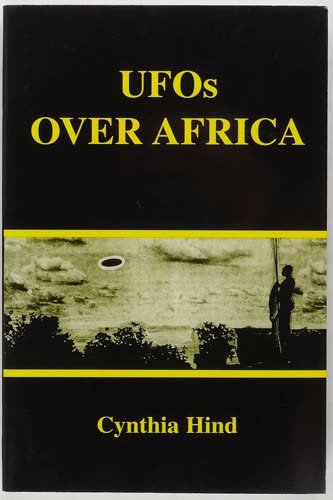
UFOs Over Africa
Find on Amazon →As an Amazon Associate, OverClassified may earn from qualifying purchases made through this link, at no extra cost to you.
Why This Is Essential Reading
UFOs Over Africa earns its place on this list as the primary field record of the continent's most significant UAP case, written by the investigator who was there first — and as a genuinely instructive example of what that primacy costs as well as what it buys. Cynthia Hind, already established as MUFON's Africa coordinator and the editor of UFO Afrinews, arrived at Ariel School four days after the encounter and personally interviewed the child witnesses using a witness-isolation drawing protocol that remains this case's methodological benchmark nearly three decades later, work later documentarians and this site's own case file both rely on directly. That same fieldwork, per a specific and checkable 2025 Skeptical Inquirer critique disclosed in full above, also drew real, named methodological criticism for its group-interview format and at least one documented instance of a suggestive question — a genuine tension this site's own research treats as worth understanding rather than smoothing away. Beyond that single case, the book's citation record across three of this site's own case files — spanning a 1951 airborne sighting over Kilimanjaro, the 1994 Ariel School landing, and a 1996 police encounter in Pretoria compiled within eight months of the event — demonstrates a genuinely continental scope rare in a single-author casebook of its era, and its honest documentation of a failed investigation (the Kilimanjaro witness search) alongside its most celebrated and most contested success (Ariel School) reflects the same investigative candor this site's own research treats as her defining trait. Read alongside Ronald Story's Encyclopedia of UFOs as a regional counterpart to that broader reference work, and alongside this site's own James Oberg entry for the skeptical side of the same Ariel-week evidentiary picture, this book is essential precisely because it preserves, in Hind's own words and from her own fieldwork, the primary record of the case that first brought sustained international attention to African ufology — a primary record this site's research recommends reading critically rather than uncritically.
Related Cases & Theories
Essential Viewing
Sources Cited
- Hind, Cynthia. UFOs Over Africa. Horus House Press, Madison, WI, 1997 (ISBN 1-881852-15-6, cited here).
- "Ufos over Africa." Amazon.com (ISBN 9781881852155, rating 4.2/5 from 21 ratings, cover image, checked August 2026). amazon.com
- "Ufos over Africa." Goodreads (rating 3.67/5, 3 ratings, 2 written reviews quoted). goodreads.com
- Bartlett, Kate. "Remembering Zimbabwe's great alien invasion." Mail & Guardian, September 4, 2014. mg.co.za
- Reid, Gideon. "A Closer Look at Encounters and the Ariel School Sighting." Skeptical Inquirer, October 2025 (methodological critique of Hind's field interviews and Netflix's Encounters). skepticalinquirer.org
- "Cynthia Hind." The UFO Database (biography: MUFON Africa coordinator, UFO Afrinews editor, Ariel School role). theufodatabase.com
- "Ariel Phenomenon UFO Documentary | Talking Strange." Den of Geek via YouTube, 2022 (video verified via YouTube oEmbed, discusses Hind's original investigation as the documentary's foundational source material). youtube.com
- Nickerson, Randall. Ariel Phenomenon, CEIII Media, 2022 (Documentary Feature Film, official site). arielphenomenon.com
- This site's own resources library: Full Reading List, where this exact 1997 edition is cited across 3 separate case-file pages.
- This site's own key-figures entry: Cynthia Hind, for her full biography and site-wide case connections.
- This site's own case file: Ariel School Encounter, which documents Hind's on-site investigation, the witness-isolation protocol, and the case's full supporting and skeptical evidence.
- This site's own case file: Pretoria Police Station UFO Encounter, which this book compiled within eight months of the sighting.
- This site's own case file: Mount Kilimanjaro Cigar-Shaped UFO Sighting, which cites Hind's documented failed witness search.
- This site's own essential-reading entry: The Encyclopedia of UFOs by Ronald D. Story, the broader reference work this regional casebook complements.
- This site's own essential-reading entry: UFOs and Outer Space Mysteries by James Oberg, whose "space dandruff" orbital-debris identification framework bears on the skeptical alternative explanation raised for the same week as the Ariel School sighting.
Have corrections, additional research, or peer-reviewed sources? Help improve this entry.
Suggest an Edit