
The Encyclopedia of UFOs
Core Thesis
The Encyclopedia of UFOs attempts, per its own subtitle, "a comprehensive and objective A to Z of sightings, personalities, theories, and feature articles" — more than 350 entries and 240 photographs organized alphabetically, covering not just the field's best-known cases but the researchers, investigators, skeptics, and organizations that studied them. Editor Ronald D. Story, already established by 1980 as a working UFO researcher and the author of a full-length rebuttal of Erich von Däniken's ancient-astronaut claims, assembled the volume as a genuine reference desk resource rather than a narrative argument for any single interpretation of the phenomenon — a structural choice later reader Kevin Frushour's own review captures precisely: with the majority of its entries devoted to people rather than phenomena, the book functions as much as "a who's who in UFO culture" as a comprehensive catalog of cases.
About the Author
Ronald D. Story, born February 12, 1946, in Joplin, Missouri, founded what he called the UFO Encyclopedia Project specifically to produce this 1980 volume — a deliberate, organized effort to compile the field's scattered case literature, researcher biographies, and competing theories into a single alphabetically searchable reference, rather than an outgrowth of a prior book project.
Before this encyclopedia, Story had already established himself with The Space-Gods Revealed (Harper & Row, 1976), the first full-length, claim-by-claim rebuttal of Erich von Däniken's Chariots of the Gods?, carrying a foreword by Carl Sagan and contributions from Frank Drake, William Hartmann, and Thor Heyerdahl — a project already covered in depth on this site's own Space-Gods Revealed essential-reading entry. That earlier project's own rigor and organizational structure directly informed this encyclopedia's own more comprehensive, multi-contributor approach to UFO case documentation four years later.
Story's own research judgment shaped one of this site's most notable cross-referenced findings: in a 1979 survey of ninety leading ufologists, conducted in preparation for this encyclopedia and asking for the single strongest piece of UFO evidence available, Story found the Father Gill case at Boianai, Papua New Guinea, cited more often than any other — a finding this encyclopedia's own dedicated Father Gill entry incorporated directly, and one that cemented the case's reputation as one of the field's most persuasive multi-witness reports.
Story went on to produce further editions of the same underlying project across two subsequent decades: The Encyclopedia of Extraterrestrial Encounters (2001) and, later, The Mammoth Encyclopedia of Extraterrestrial Encounters, each substantially expanding the original 1980 volume's scope and contributor base as the field itself grew. He has also worked as a consultant on the History Channel's Ancient Aliens series, extending his encyclopedic reference work into television production.
Historical Context & Origins
Doubleday published The Encyclopedia of UFOs in 1980, at a moment when the field had no comparable single-volume reference work: Jerome Clark's own multi-volume UFO Encyclopedia project would not begin appearing until a decade later, in 1990, meaning Story's book was the first attempt at exactly this kind of comprehensive, alphabetically organized reference for the field — a genuinely pioneering structural choice rather than a later entrant into an already-established genre.
The book's 1980 publication places it seven years after Father Gill's case had already become a fixture of serious ufological discussion, and Story's own 1979 survey of ninety leading researchers, conducted specifically for this project, functioned as a kind of contemporary consensus snapshot of the field's own self-assessment at the end of the 1970s — which cases its own practitioners considered strongest, a genuinely useful historical data point distinct from any later retrospective ranking.
Structurally, the book's alphabetical, multi-entry format, with the majority of its content devoted to people and organizations rather than individual case narratives, reflects a specific editorial philosophy distinct from narrative case-survey works like this site's own Sheaffer or Chariton entries: rather than building an argument about what UFOs are or telling a continuous historical story, Story's encyclopedia treats the field itself — its researchers, its institutions, its competing camps — as the primary subject worth documenting comprehensively.
Core Arguments & Key Concepts
The book's central organizing principle, stated directly in its own subtitle, is comprehensiveness across four distinct content types — sightings, personalities, theories, and feature articles — rather than a single argued thesis about the UFO phenomenon's ultimate nature. This deliberately broad scope is what let it function as "the standard reference work on the subject for two decades," per its own later characterization, since a reader could look up a specific case, a specific researcher, or a specific theoretical school with equal ease.
A second, structurally significant theme, per reader Kevin Frushour's own assessment, is that the book functions as much as a biographical directory of the field's practitioners as a case catalog: "the majority of entries focus on people rather than UFO phenomena, making it function more as a 'who's who in UFO culture' than a comprehensive UFO encyclopedia" — an observation that captures a genuine structural choice rather than a shortcoming, since documenting who was doing the field's actual research work was itself a novel contribution in 1980.
A third theme is objectivity as an explicit editorial standard: the book's own subtitle promises a "comprehensive and objective" survey, a stance distinct from either the skeptical debunking tradition or the more credulous proponent literature of the same period — positioning the encyclopedia as a neutral reference tool usable by researchers across the field's own internal disagreements rather than as an argument for any particular camp's conclusions.
A fourth theme, evident in the book's own use as a period consensus-gathering exercise, is treating the field's own internal expert judgment as itself worth documenting: Story's 1979 survey of ninety ufologists, conducted specifically to inform this encyclopedia's case entries, made the field's own collective assessment of its strongest evidence part of the historical record rather than leaving it as informal, undocumented consensus.
Key Cases & Evidence Discussed
Four of this site's own case files cite this exact 1980 edition directly. The Father Gill Sighting (Case File #062, 1959) receives the book's most directly consequential treatment: this site's own case file describes the book as "compiled by the researcher whose 1979 survey of leading ufologists found the Gill case cited more often than any other as the field's strongest evidence," and notes the encyclopedia "includes a dedicated case entry" — making Story's own survey methodology and this book's resulting case treatment directly intertwined for this specific case.
The Island of Trindade Sighting (Case File #105, 1958), at Trindade Island, Brazil, is described by this site's own case file as receiving a "dedicated Trindade entry reflecting how the case was assessed by researchers roughly two decades after the sighting, before the 2010–2011 hoax allegations and archival discoveries" — making this encyclopedia's entry a genuine historical snapshot of the case's reputation before later revelations complicated it.
The Ota Air Base Encounter (Case File #186, 1957), at Ota Air Base, Portugal, is cited by this site's own case file as part of "a broad, cross-referenced survey of pilot-witness UFO cases worldwide, useful for situating Ferreira's account within the wider tradition of credentialed military-aviator sightings" — drawing on the book's comprehensive scope to place a specific Portuguese case within a global pattern.
The Prospect Kentucky Abduction (Case File #024, 1977), at Prospect, Kentucky, is cited for "detailed entries on early abduction cases, listing investigators, witnesses, and primary sources of the era" — reflecting the book's own strength in documenting the specific personnel and process behind period investigations, consistent with its wider "who's who" character.
Critical Reception & Controversies
On Goodreads, the book carries a 4.00-out-of-5 average from 6 ratings and 1 written review. Reader Kevin Frushour, reviewing it in 2022, offered the book's most substantive documented assessment: "This book is a bit of a period piece. Most of the people who have an entry in the book don't even pop up in a Wikipedia search nowadays" — an honest, unflattering observation about how much of the field's own mid-century personnel had faded from public memory by the time of his review, though one that also inadvertently confirms the book's original documentary value: it preserved names and work that would otherwise have gone entirely undocumented.
This site's own sibling-edition Amazon listing (ISBN 0385116810, the same 1980 Doubleday paperback content under a slightly different product listing) carries a 4.4-out-of-5 average from a small sample of 5 ratings (checked August 2026); the specific ISBN this site's own case files cite (0385136773) carries no rating or review data on its current Amazon listing, a used-marketplace-only page with no product image.
No dedicated period review from a major trade or library journal could be located for this specific title — an absence disclosed here honestly rather than papered over with an uncited claim, consistent with how several other pre-internet-era reference works in this site's essential-reading library are documented.
The clearest and most durable measure of the book's reception is its own later characterization as having been "heralded as the standard reference work on the subject for two decades" — a status earned specifically because no comparable single-volume alphabetical reference existed until Jerome Clark's own multi-volume UFO Encyclopedia project began appearing a decade later, in 1990.
The clearest and most independently verifiable measure of the book's lasting reference value on this site specifically is its own citation record: four separate case files, spanning 1957 to 1977 and three continents, cite this exact 1980 edition directly — a citation pattern this site's own research treats as durable evidence of the book's continued usefulness more than four decades after publication.
Influence & Legacy
The most directly measurable evidence of this book's ongoing influence is on this site itself: this exact 1980 edition is cited across four separate case-file pages — Father Gill Sighting, Island of Trindade Sighting, Ota Air Base Encounter, and Prospect Kentucky Abduction — spanning three continents and two decades of case history, and making it one of this site's oldest single-volume reference sources still in active citation use.
The book's institutional legacy runs directly through Story's own continued encyclopedia work: he expanded and updated the same underlying project across two further editions, The Encyclopedia of Extraterrestrial Encounters (2001) and The Mammoth Encyclopedia of Extraterrestrial Encounters, carrying the original 1980 volume's reference-desk approach forward as the field's own case record and researcher roster grew substantially over the following decades.
Its status as the field's first genuinely comprehensive alphabetical reference work directly shaped the format later, more ambitious projects like Jerome Clark's multi-volume UFO Encyclopedia would adopt a decade later — Story's 1980 volume proved the format's usefulness first, at a scale a single editor and a single volume could manage, before Clark's own project expanded it into a multi-volume, multi-decade undertaking.
Within this site's own research specifically, this book functions as an early historical snapshot of how the field's own practitioners assessed their strongest cases at the end of the 1970s: its Father Gill entry, grounded in Story's own 1979 survey of ninety ufologists, remains this site's own primary documented source for understanding why that specific case held (and largely still holds) its reputation as one of the field's most persuasive multi-witness reports.
The Book
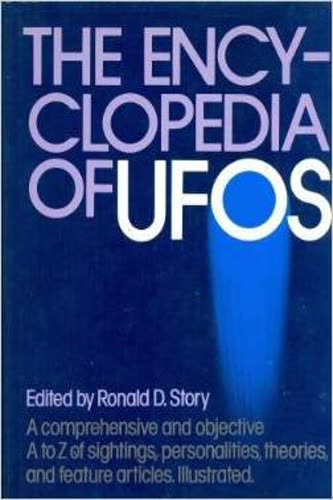
The Encyclopedia of UFOs
Find on Amazon →As an Amazon Associate, OverClassified may earn from qualifying purchases made through this link, at no extra cost to you.
Why This Is Essential Reading
The Encyclopedia of UFOs earns its place on this list as the field's first genuinely comprehensive single-volume reference work: a 1980 project by Ronald D. Story, already an established researcher and the author of a rigorous rebuttal of ancient-astronaut claims, organizing more than 350 entries and 240 photographs into a resource later characterized as "the standard reference work on the subject for two decades" — a claim this site's own research finds well-supported by the book's continued citation a full four and a half decades later. Its real, lasting value on this site's own evidence is not a robust contemporary trade-review record, which this pre-internet-era title does not appear to have generated in a form this site's research could locate, but a citation record spanning four case files across three continents and Story's own documented 1979 survey of ninety leading ufologists — a genuine period consensus snapshot preserved nowhere else. Read as the format-defining precursor to Jerome Clark's later multi-volume UFO Encyclopedia, this book is essential precisely because it proved, first, that the field's scattered case literature and its own working researchers both deserved the same patient, alphabetical documentary treatment — a genuinely novel editorial judgment in 1980 that later, more ambitious reference projects would spend decades building on.
Related Cases & Theories
Sources Cited
- Story, Ronald D., ed. The Encyclopedia of UFOs. Doubleday (Dolphin Books), 1980 (ISBN 0-385-13677-3, cited here).
- "The Encyclopedia of UFOs." Amazon.com (ISBN 0385136773, publisher, publication date, page count, checked August 2026). amazon.com
- "Encyclopedia of Ufo's." Amazon.com (sibling 1980 Doubleday paperback listing, ISBN 0385116810, with product image and 4.4/5 rating from 5 reviews, checked August 2026). amazon.com
- "The Encyclopedia of UFOs: A Comprehensive and Objective A to Z of Sightings, Personalities, Theories, and Feature Articles; Illustrated." Goodreads (rating 4.00/5, 6 ratings, Kevin Frushour review quoted). goodreads.com
- "Ronald D. Story." Unidentified Phenomena (biography: birth details, UFO Encyclopedia Project founding, later editions, Ancient Aliens consulting). unidentifiedphenomena.com
- "The Encyclopedia of UFOs." WorldCat (library catalog record, OCLC 300384419). worldcat.org
- "The Encyclopedia of UFO's." HathiTrust Digital Library (scanned catalog record). babel.hathitrust.org
- "Encyclopedia of Ufo's." Amazon.fr (additional listing corroborating the 1980 Doubleday paperback edition details). amazon.fr
- This site's own resources library: Full Reading List, where this exact 1980 edition (ISBN 0385136773) is cited across 4 separate case-file pages.
- This site's own key-figures entry: Ronald D. Story, for his full biography and site-wide case connections.
- This site's own case file: Father Gill Sighting, which documents Story's 1979 survey and this book's dedicated case entry.
- This site's own case file: Island of Trindade Sighting, which cites this book's pre-hoax-allegation case assessment.
- This site's own case file: Ota Air Base Encounter, which cites this book for its worldwide pilot-witness survey.
- This site's own essential-reading entry: The Space-Gods Revealed, Story's earlier 1976 book that established his research reputation before this encyclopedia project.
- This site's own essential-reading entry: The Emergence of a Phenomenon by Jerome Clark, the later multi-volume reference project this book's format directly preceded.
Have corrections, additional research, or peer-reviewed sources? Help improve this entry.
Suggest an Edit