
The Prospect Kentucky Abduction
Shortly after 1:00 a.m. on January 27, 1977, nineteen-year-old truck driver Lee Parrish reported a brilliant, rectangular, sunset-colored object hovering over the treeline beside Kentucky Route 329 near Prospect, Kentucky. His car radio failed, and a drive his family timed at seven minutes took forty-five. That same evening, under hypnosis with investigators Don Elkins and Carla Rueckert present, Parrish described being inside a circular white room with three blocky, machine-like beings he called the black one, the red one and the white one. Their report in The A.P.R.O. Bulletin remains the only primary account of a case with no physical evidence on record but one of the stranger entity descriptions in the abduction literature.
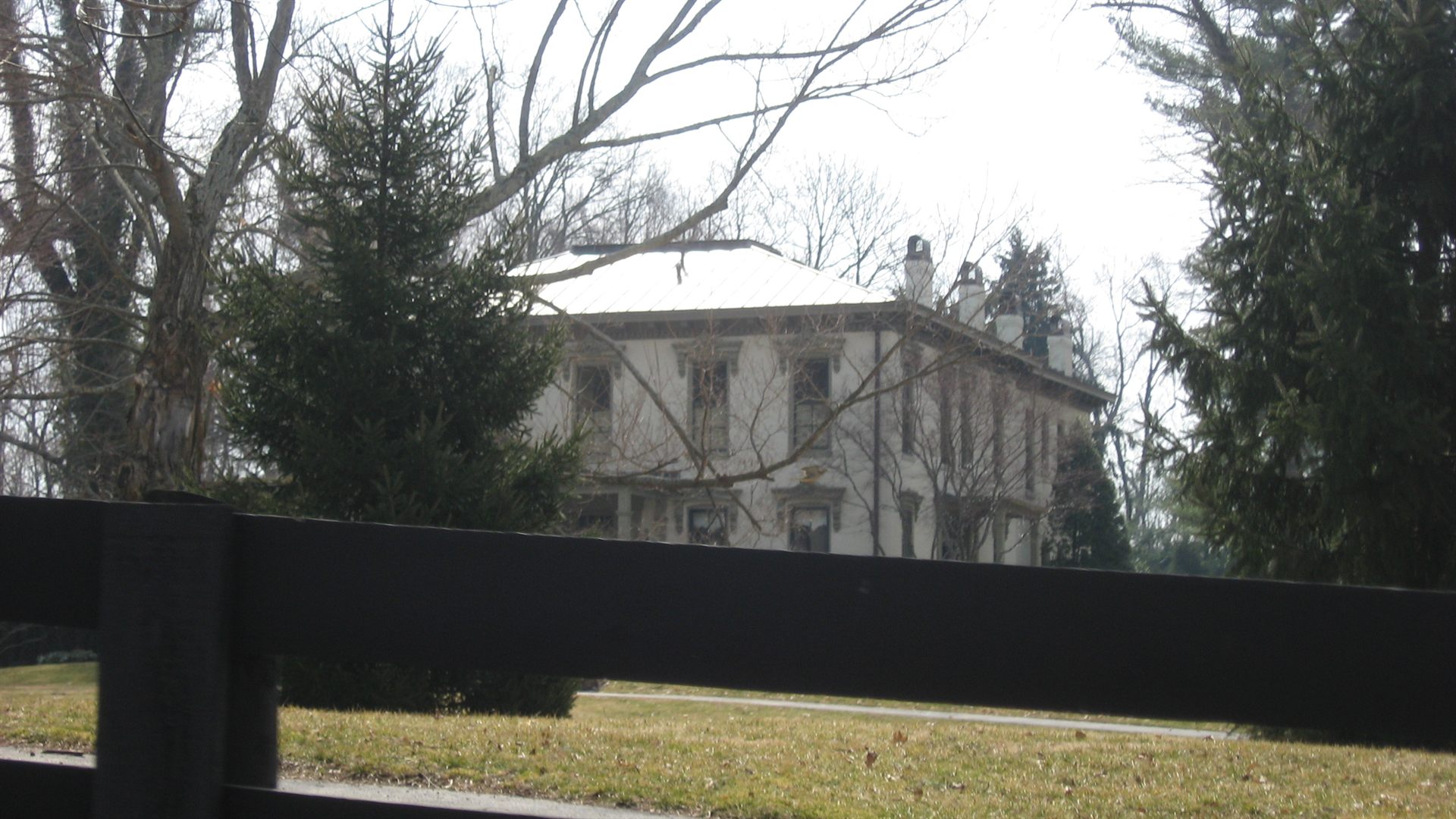
Pictured: the James Trigg House on Boy Scout Road, a historic property in rural Prospect, Kentucky. Boy Scout Road is the Jefferson County stretch of Kentucky Route 329, the road the 1977 report says Lee Parrish was driving, but the report places the sighting only "perhaps four miles" short of U.S. 42 and gives no exact spot, and the house has no connection to the case. No photograph of Parrish's 1970 Jeepster or of the sighting location from the time of the 1977 encounter is known to survive; this image stands in only to establish the rural character of the surrounding community.
Theoretical Alignment
High alignment with the Interdimensional Hypothesis (IDH) and Jacques Vallee's control system model, given the non-biological, symbolic, and machine-like nature of the beings Parrish described. Moderate Extraterrestrial (ETH) alignment based on the structured craft he reported and the radio failure during the sighting. These alignments describe the shape of the account; they are not evidence that any of these hypotheses is correct.
Background
The geographical and cultural backdrop of January 1977 in Prospect, Kentucky, matters to the Lee Parrish account. Prospect was, and remains, a semi-rural residential community northeast of Louisville near the Ohio River, straddling the Jefferson and Oldham county line. U.S. 42 runs through it along the river; Kentucky Route 329 leaves U.S. 42 at Prospect and heads east through woodland and farmland toward Crestwood. The winter of 1976–77 was brutal: in the National Weather Service's Louisville record, January 1977 is the coldest month ever measured, averaging 18.5°F, and the Ohio River froze over that winter. The political climate was also shifting. Jimmy Carter, who had filed a report of his own 1969 UFO sighting in Georgia, had been inaugurated as President just one week earlier, on January 20, 1977.
Within the UAP research community, the late 1970s represented a period of transition. The classic "flying saucer" reports of the 1950s and the military investigations of Project Blue Book (which ended in 1969) had given way to a more intense focus on close encounters of the third kind and physical abductions. The highly publicized abduction of Travis Walton in Arizona in late 1975, and the 1975 television film The UFO Incident (documenting the 1961 Betty and Barney Hill abduction), had brought the concept of alien abduction into the mainstream public consciousness. Hypnotic regression had emerged as the primary tool for researchers seeking to unlock the "missing time" that frequently accompanied these reports.
According to the investigators' report, Lee Parrish was 19, a high school graduate who worked for his family's firm, Parrish Supply, as a truck driver and all-around worker. Carla Rueckert described him as a husky six-footer with a quiet, polite manner, of average intelligence, a common-sense type who was genuinely bothered by what had happened to him. He was not a stranger to the subject. He told the investigators he had always been fairly interested in UFOs, had read at least one book on them in high school, was interested in psychic phenomena, and believed he had seen UFOs several times before, though always in company. His mother had reported several sightings of her own. The report also records an earlier incident, attested by his friend Kathy Johnson, in which an unplugged outdoor light came on when Lee "willed" it to. These details come from the investigators themselves, and they matter for weighing the hypnosis account later on this page.
The case reached investigators through a hypnotist. On January 27, 1977, Lawrence Allison ("Larry"), a hypnotist who had worked with Don Elkins and Carla Rueckert on earlier UFO-related cases, contacted them after Mrs. Parrish called him because she felt something unusual had happened to her son the night before. Elkins, who had been investigating UFO reports since 1955, had taught physics and flown as a commercial airline pilot; with Rueckert he ran the Louisville-based research partnership later known as L/L Research, and the two had published Secrets of the UFO in 1976. Their account of the case, written by Rueckert, appeared as the lead story of The A.P.R.O. Bulletin (Vol. 25, No. 7, dated January 1977) under the headline "Another Kentucky Abduction." That article, together with a companion report by APRO's zoology consultant, is the primary record of the case; everything on this page is checked against it.
Complete Timeline
| Date | Event |
|---|---|
| January 26, 1977 (about 10:30 PM) | In Anchorage, Kentucky, about four miles from the later sighting, Mrs. Louise Belmont and her sons Neil (10) and William (8) watch a large, very bright, yellowish object, flattened below and domed above, hover above the trees near their house for a few minutes. This separate sighting was investigated by APRO consultant Burt L. Monroe Jr. (see Investigative Corroboration below). |
| January 27, 1977 (just before 1:00 AM) | Lee Parrish leaves Kathy Johnson's house as a television program goes off the air, feeds the dog on the way out, and starts home in his 1970 Jeepster, normally a seven-minute trip. |
| January 27, 1977 (1:05 AM) | Driving west on Kentucky Route 329, "perhaps four miles" short of U.S. 42, Parrish sees a brilliant rectangular object hovering just over the treeline. About 15 seconds into the sighting his car radio fails. He cannot remember driving the next stretch. |
| January 27, 1977 (1:45 AM) | Parrish arrives home. His mother asks what is wrong with his eyes; the whites are entirely bloodshot and painful. The seven-minute drive has taken 45 minutes. His mother confirms his arrival time and Kathy Johnson his departure. |
| January 27, 1977 (daytime) | Mrs. Parrish calls hypnotist Lawrence Allison, who contacts investigators Don Elkins and Carla Rueckert. |
| January 27, 1977 (evening) | Lee and Kathy Johnson meet Allison, Elkins and Rueckert at Allison's house. After about 40 minutes of relaxation, Allison regresses Lee to the drive home. Under hypnosis he describes a circular white room and three beings: a black one about as tall as the 20-foot ceiling, a red one about his own size, and a six-foot white one he took to be the leader. |
| January 28, 1977 | The Jeepster's electrical system fails, the day after the sighting. The report says only that it "will need quite a bit of repair work"; no mechanic's findings or repair records were published. |
| February 1–2, 1977 | Prompted by publicity around a meteorite that exploded over Louisville on January 31, the Belmont family reports their January 26 sighting. Monroe, who had already been told of the Parrish case by Elkins, interviews them on February 2. |
| Early 1977 | Rueckert's report, "Another Kentucky Abduction," leads The A.P.R.O. Bulletin Vol. 25, No. 7 (dated January 1977), with Monroe's report on the Belmont sighting printed alongside it. The issue includes a drawing of the three beings captioned "The Parrish Case." |
| January 1981 | Elkins and Rueckert, now joined by Jim McCarty, begin the trance sessions published as the "Ra" material or The Law of One (1984 onward). No source located for this page connects the Parrish case to that work. |
| June 2026 | The case page is published on OverClassified. |
| October 2026 | The page is corrected against the 1977 A.P.R.O. Bulletin report; earlier versions contained invented details (see the note under Sources). |
The Encounter on Route 329
On the night of Wednesday, January 26, 1977, Lee Parrish was at the house of his friend Kathy Johnson. The report does not say where she lived. He left just as a television program they had been watching went off the air, which pinned his departure to just before 1:00 a.m. on January 27. He fed the dog on the way out, got into his Jeepster, a 1970 model with a V6 engine, and headed for home, normally a seven-minute journey. The weather was cold and partly cloudy, with quite a bit of snow on the ground, but the roads were relatively clear and there was no precipitation.
He was driving west on Kentucky Route 329, heading toward U.S. 42 and perhaps four miles short of it, when he saw an object. It was hovering just over the treeline, which he estimated at between 100 and 220 feet off the road, at an altitude of 100 to 150 feet. He judged it to be about 10 feet tall and 40 feet long, and perfectly rectangular. In the report's words, the craft "was the color of the setting sun, but much brighter." The investigators noted that the land on either side of Route 329 there was flat farmland, with two power lines (a utility line and telephone lines) along the road and a small pond nearby; when Parrish first saw the object it was over a treeline, and he later said it seemed to materialize out of thin air.
Parrish felt compelled to look at the object and unable to take his eyes off it, although it was too bright to look at comfortably. He became very frightened and wanted to leave, but could not. He later said he did not remember how the car managed to stay on the road; it seemed to him that he was not driving it. About 15 seconds into the sighting, the car radio failed. At first he thought the light was a fire, then rejected the idea and kept asking himself what it was. His eyes hurt from looking at the bright red object, and he kept repeating that "it's not moving." Somehow he ended up directly underneath it. The report notes that because he could not remember this stretch of driving, it was unknown whether the craft had moved over the road or whether the car had entered the field over which the object hovered.
The object hovered until he was directly underneath it. Then, suddenly, it sped away, first at the speed of a jet and then very quickly, to the northwest. It never made a sound. In his conscious account that was the whole encounter: a brilliant, silent rectangle, a dead radio, and a stretch of road he could not remember driving. He went home without any idea that the trip had taken far longer than it should have.
The Missing Time & Physical Symptoms
When Lee Parrish arrived home, his mother met him at the door and asked, "What's wrong with your eyes?" He looked in the mirror and saw that the whites of his eyes were entirely bloodshot. There was considerable pain, which continued, though to a lesser degree, through that evening. He then noticed that it was 1:45 a.m. He had been on the road from Kathy's house for 45 minutes on what was normally a seven-minute trip. The report states that his mother confirmed his arrival time and that his friend confirmed his departure time.
The eye symptoms are the most concrete physical detail in the report, and their extent should be stated precisely. Rueckert records that his eyes were bloodshot and painful on arrival, that the pain continued at a lesser level, that he slept poorly that night because his eyes hurt, and that they were still hurting him during the hypnosis session the next evening whenever he closed them. The report mentions no doctor, no diagnosis, no eye drops and no medical record, and earlier versions of this page that described a week of medically treated inflammation had no source for it.
The second physical claim concerns the vehicle. The report's last line on the sighting says that "the electrical system of the Jeep went bad the day after the sighting and will need quite a bit of repair work." That is all it says. It names no failed component, no mechanic and no repair shop, and it does not say the investigators examined the vehicle. Earlier versions of this page described melted alternator windings, a burned-out radio coil and a repair invoice reviewed by Don Elkins; none of that appears in the 1977 report or in any other source located for this page, and it has been removed. An electrical failure the day after a sighting is consistent with the radio failure Parrish reported, but in a 1970 vehicle during the coldest month on Louisville's record it is also consistent with ordinary failure, and with no documentation it cannot carry much evidential weight either way.
The Hypnotic Regression Session
The hypnosis did not wait for February. The investigators were contacted on January 27, 1977, the day after the night of the sighting, and Lee Parrish and Kathy Johnson met Lawrence Allison, Don Elkins and Carla Rueckert at Allison's house that same evening. Mrs. Parrish had called Allison because she felt something unusual had happened to her son; the report does not say why she turned to a hypnotist in particular. Earlier versions of this page dated the first session to February 4, 1977, placed it in a clinical office, and described Mrs. Parrish waiting in a reception area and a reel-to-reel recording; the report supports none of that.
Lee was somewhat anxious about being hypnotized, so Elkins and Allison spent some time explaining the technique and what he would experience. He was reassured to learn that he would not be unable to control what happened to him, that he could ask to come out of hypnosis at any time, and that the hypnotists would not be tricking him as he had seen done at a party. He agreed, and said he very much wanted to find out what had happened during the missing time. Allison spent perhaps 40 minutes relaxing him into the hypnotic state and regressing him to several childhood ages, then brought him to the time of the sighting, told him to speak without prompting, and let him tell the story as it was happening to him. Rueckert wrote that it was "quite eerie" to watch.
Under hypnosis, Lee repeated the conscious account of the rectangle over the field and then went further. Suddenly, he said, he could not see anything. A split second before that, the craft had changed color to black, and then to white. Then he could see nothing and felt "something in his eyes." When he could see again, he was no longer in the Jeep but in a circular, all-white room. He had no memory of the transition. He estimated the room at about 20 feet across with a ceiling about 20 feet high, although from outside the ship had not looked nearly that tall. The walls were self-luminous.
Later in the session the investigators asked carefully about how he had been taken aboard and returned. Lee said the red ship had "caught" the Jeep as he went underneath it, "like a mousetrap waiting for a mouse." The Jeep, he said, was neither on the ship nor on the ground but suspended by some force; he was transported in and out of the ship without opening the Jeep's door, and when he was put back in the Jeep it was still suspended until he found himself back on the road watching the UFO leave. The radio stayed dead for the roughly five seconds it took the ship to disappear. At some point the cigarette he had been smoking when he first saw the object vanished completely.
The Three Machine-Like Entities
It was in this white room, under hypnosis, that Lee Parrish described the three beings that make the Prospect account unusual. He instinctively felt that they were sentient, although they were "definitely not human." He called them simply "a black one," "a red one" and "a white one." They had no faces, and nothing in the report describes skin, eyes or limbs in the usual sense. They were blocky, geometric forms, which is why the case is often filed under machine-like or robotic entities. The report does not describe them entering the room; they were simply there before him.
The black one was on his left. It stood as high as the ceiling, about 20 feet; the drawing printed with the report labels it "15 to 20 ft." It was roughly the shape of an army silhouette target, jug-shaped, with a relatively small "head" and a flat bottom, and it had one "arm," a handless appendage with a single joint. The arm was rough-skinned, and the rest of the being was rough in patches and smooth in others. The head was featureless. It moved slowly to Lee and touched him on the left side and back, hurting him quite a bit and terrifying him. Throughout the regression he kept repeating, "No, no, not the black one!" The touch felt somehow cold and burning at the same time, and he felt as if he were vibrating.
The red one was on his right. It was about Lee's size or a little smaller, rectangular, and he compared it to a "Coke machine." It had one arm or probe, unjointed and handless. Lee felt that it was scared and reluctant to touch him, but it too came slowly over and touched him on the shoulder and on the right temple, above the ear and within the hairline. That touch stung briefly, like a needle, but did not terrify him or hurt for long. During this time Lee felt quite cold, and the whole ship seemed to be rocking back and forth "like a boat on the water."
The white one was about six feet tall, Lee's height. It sat in the middle of the room, watching him. Its body was solid and blocky, its head square on the sides and quite flat in front; in profile the head sloped toward the body at about a 45-degree angle, with no features. The body glowed. It had arms but did not use them, remaining stationary. Lee knew, without being told, that it was the "ruler" of the other two.
When the red one had "done its job," it backed up and went together with the white one, either merging with it or going behind it. The white one then started making a sound Lee compared to someone brushing their teeth or using sandpaper, a rhythmic scraping. The black one was backing up slowly, and Lee, who had been quite cold, found he was now warm. The white one moved to the black one and either merged with it or went behind it, leaving only the 20-foot black one in the room with him. Then the black one simply disappeared, and he was alone in the white room. He noticed, perhaps because of the ship's rocking, that he felt heavier.
There was no transition, under hypnosis, between the white room and the Jeep. Lee simply said, "There's the pond," and went on to describe getting home, his burning eyes, his fright and his mother's comments. He never used the word "telepathy," but he said he knew several things about the beings: that they were sentient, that the red one was scared, that the white one was the leader and was thinking about him. Asked what their purpose was, he said he felt they were checking his "chemical makeup" and giving him a physical checkup, that they were curious about "the way that he was Lee," and that they would contact him again.
What the 1977 Report Records of the Session
No transcript of the session has been published. Carla Rueckert's article narrates the session in the third person, with a handful of Lee's own words in quotation marks, and the account above follows it closely. An earlier version of this page presented a long question-and-answer "transcript" between Lawrence Allison and Lee Parrish, dated February 4, 1977. That dialogue has no source: it does not appear in the APRO report, the date is wrong, and several of its details (beings emerging from the walls, a warm platform, a white "scanner" beam, the beings merging into a spinning column of light) contradict what the report says. It has been removed. The words below are among the few that Rueckert recorded Lee saying under hypnosis:
"No, no, not the black one!" … "There's the pond." — Lee Parrish under hypnosis, January 27, 1977, as quoted by Carla Rueckert in The A.P.R.O. Bulletin, Vol. 25, No. 7.
After he was brought out of hypnosis, having been told he would remember everything clearly, the investigators asked him again how the UFO had first come into his line of vision. As best he could tell, it had materialized out of thin air: the fields around him were flat, with no hills for it to hide behind, and when he first saw it, it was over a treeline.
Physical & Psychological Effects
What is known about the aftermath for Lee Parrish is limited to what the investigators recorded in the first days. His eyes were bloodshot and painful on the night of the sighting and still hurt during the hypnosis session the next evening whenever he closed them. His sleep that night was poor, not because of dreams, he said, but because his eyes hurt. He believed the beings would contact him again. The report says nothing about how long the eye symptoms lasted or whether he saw a doctor.
Earlier versions of this page described months of recurring nightmares, avoidance of dark spaces, permanent changes to his vision and a lifelong refusal to discuss the case. No source located for this page records any of that, and it has been removed. Nor has any later interview with Parrish been located. What can be said is that the session itself was frightening for him: Rueckert records him repeating "No, no, not the black one!" throughout the regression and describes the black one's touch as terrifying him.
Earlier versions also described Parrish as a trained artist who produced a series of detailed drawings and paintings of the craft and beings. The 1977 report describes him as a truck driver and does not mention art. The APRO issue does print a single line drawing of the three beings, labeled "black," "red" and "white," with the black one marked "15 to 20 ft" and another height marked "7 ft," captioned "The Parrish Case," but it does not say who drew it. Later retellings that describe Parrish as an artist could not be traced to any primary source.
Historical and Philosophical Significance of Case #024
The Prospect account stands out in the abduction literature mainly because of its beings. Most 1960s and 1970s close-encounter reports involved humanoid figures. The Hills described grey-skinned beings with large heads, Charles Hickson at Pascagoula described wrinkled-skinned figures with pincer-like hands, and the Kelly-Hopkinsville witnesses described small, large-eared, silvery creatures. Whatever those reports were, they described occupants with something like bodies.
The black, red and white forms Lee Parrish described had no faces and no humanoid proportions. They were blocks and slabs with single appendages, closer in his telling to equipment than to creatures, although he also insisted they were sentient, and that one was frightened and another in charge. For writers inclined to the idea that some encounters involve automated probes rather than the makers of the craft, the case is a natural example. That is an interpretation of an account recovered under hypnosis, not something the case establishes.
This site's research could not confirm that Jacques Vallée's book Dimensions discusses the Prospect case specifically; no independent source on this case makes that connection, and an earlier draft of this page's claim to that effect has been removed as unsupported.
The investigators' later careers are part of the case's afterlife. By 1977 Don Elkins and Carla Rueckert had already moved from treating UFOs mainly as a physical problem toward a metaphysical one; Secrets of the UFO, their summary of that shift, had appeared in 1976, before the Parrish sighting. In January 1981, joined by Jim McCarty, they began the trance sessions published as The Ra Material (1984) and later as The Law of One. Earlier versions of this page said that L/L Research used the Parrish case as a "baseline" for the Ra contact. No source located for this page makes that connection, and it has been removed. The accurate statement is narrower: the same two investigators who wrote up the Parrish case went on, four years later and with a third partner, to produce the Ra material.
Investigative Corroboration
The only other sighting tied to the Parrish case in the primary record is a separate report from the same evening, about four miles away, and it is not a match for what Parrish described. Rueckert's article mentions it briefly: Dr. Burton Monroe, APRO's consultant in zoology, who lived in Anchorage, Kentucky, about four miles from the abduction site, reported that at about 10:30 p.m. on January 26 a neighbor heard her children screaming, ran to the window and saw a large, white, disc-shaped object with a dome.
Burt Monroe (Burt L. Monroe Jr., then chairman of the Department of Biology at the University of Louisville) wrote up that sighting in detail in the same issue of the Bulletin. On Tuesday, February 1, 1977, he received a call from Neil Belmont, the 10-year-old son of Mrs. Louise Belmont and a classmate of Monroe's elder son. A spectacular meteorite had exploded over the Louisville area the day before, January 31, and the publicity prompted the Belmonts to report their own sighting to the University of Louisville planetarium, whose director referred them to Monroe. Monroe had already been told of the Parrish case by Don Elkins, and he interviewed the family on Wednesday, February 2.
According to Monroe, at about 10:30 p.m. on Wednesday, January 26, Neil and his brother William, aged 8, were in bed upstairs when their bedroom was suddenly lit up from outside. At the window they saw a large object (Neil said "twice as large as the house") just beyond the nearby trees, yellow and very bright, flattened underneath and humped or domed above. Neil saw reddish light near the top; William described reddish and greenish areas along the edges. Mrs. Belmont saw it too, described it as a "yellowish glow," much like the moon, about the size of a large airliner, roughly 75 to 100 feet up and about 100 yards away. It moved slowly southward to about 300 yards from the house, hovered, and then "suddenly wasn't there any more." She estimated the whole sighting at two to three minutes, possibly longer; the family's dogs barked throughout. There were no noticeable electrical effects: lights and television stayed normal.
Monroe judged the sighting not especially significant on its own, though it had multiple witnesses, and thought the Parrish case two and a half hours later and a few miles away gave it added interest. He also recorded that Mrs. Belmont had reported a close encounter in Virginia some 15 to 20 years earlier, and that on the evening of his interview the family called back to report the house lights dimming and Neil seeing the same or a similar object pass rapidly by. He found no connection between the January 31 meteorite and any of the UFO events. Read carefully, then, the Belmont sighting is a domed, yellowish disc seen by a different family two and a half hours before Parrish's rectangle, with no electrical effects. Earlier versions of this page described it as a group of children seeing an orange-red rectangle that "matched Parrish's description perfectly," and added motorists on Highway 42 whose radios failed and a mechanic's invoice for melted alternator windings. None of those details appears in Monroe's report or anywhere else in the primary record, and they have been removed.
Weather and Setting
The weather on the night of January 26–27, 1977, is described in three sources, and they agree in the main:
- The season: In the National Weather Service's Louisville record, January 1977 is the coldest month ever measured there, averaging 18.5°F, and the Ohio River froze over during the winters of 1976–77 and 1977–78.
- At the time of the Parrish sighting: Rueckert's report describes the night as cold and partly cloudy, with quite a bit of snow on the ground, the roads relatively clear and no precipitation.
- Earlier the same evening: Monroe describes the night of the Belmont sighting, at about 10:30 p.m., as clear, calm and very cold, with a layer of snow on the ground and the moon one day short of first quarter.
- Reanalysis: The computed Open-Meteo/ERA5 values in the forensic profile below (slight snow, roughly −14 to +1°C over the day) are modeled values for the mapped coordinates, not observations.
Earlier versions of this page gave precise station readings attributed to the NOAA record at Standiford Field (a temperature of −11°C at 1:00 a.m., 1024 millibars, 68 percent humidity, 10-mile visibility) and a planetary K-index of 2. None of those figures had a traceable source in the page, and they have been removed rather than left standing as if checked.
The setting is described in the report itself. The land along Route 329 at the sighting location was flat farmland with a rural feel; two lines ran along the road, a utility line and telephone lines, and the only body of water close by was a small pond, the pond Lee named under hypnosis when he found himself back in the Jeep. Earlier versions of this page placed the encounter on U.S. 42 beside limestone cliffs and high-voltage transmission lines from riverside power plants, and cited Louisville Gas & Electric outage records. That description belongs to a different road, and no utility records were cited by any source; it has been removed. The ordinary power and telephone lines the investigators noted are worth keeping in mind for the radio failure, but no one has proposed a specific mechanism linking them to the sighting.
Key Witnesses
Lee Parrish
Lee Parrish was 19 years old at the time of his encounter, a high school graduate working as a truck driver and general hand for his family's firm, Parrish Supply. He reported the sighting through his mother, underwent hypnosis the same evening, and is the sole source for everything that happened during the missing 45 minutes. The investigators found him quiet, polite and genuinely bothered by what had happened. No later interview with him has been located, and nothing is on record about how he regarded the experience in later life.
Mrs. Parrish
Mrs. Parrish met her son at the door at 1:45 a.m., noticed his bloodshot eyes before he did, and confirmed his arrival time to the investigators. The next day she called hypnotist Lawrence Allison because she felt something unusual had happened to Lee, which brought the case to Don Elkins and Carla Rueckert. The report adds that she had seen several UFOs herself, most vividly a nocturnal light behind the house that made a noise "like a sewing machine going full throttle."
Kathy Johnson
Kathy Johnson was the friend Lee had been visiting. She confirmed that he left her house just before 1:00 a.m., as a television program they had been watching went off the air, and she attended the hypnosis session at Allison's house that evening. The report also cites her as attesting to an earlier incident in which an unplugged outdoor light came on when Lee willed it to. The report does not say where she lived.
Lawrence Allison
Lawrence ("Larry") Allison was the hypnotist who conducted the session, at his own house, on the evening of January 27, 1977. The report describes him as a hypnotist who had worked with Elkins and Rueckert before on UFO-related cases, and it was Mrs. Parrish's call to him that started the investigation. The report gives no information about his qualifications or practice, and no recording or transcript of the session has been published.
Don T. Elkins
Don Elkins (1930–1984) taught physics and flew as a commercial airline pilot, and had been investigating UFO reports since 1955. He was present at the hypnosis session and, with Allison, explained the procedure to Lee beforehand; he also passed word of the Parrish case to Burt Monroe, which is how Monroe connected it to the Belmont sighting. With Carla Rueckert and Jim McCarty he later produced the Ra material (1981–1984).
Carla L. Rueckert
Carla Rueckert wrote the case report, "Another Kentucky Abduction," published in The A.P.R.O. Bulletin, Vol. 25, No. 7 (dated January 1977), and attended the hypnosis session on January 27. Her report is the primary source for the sighting, the time gap and everything Lee recalled under hypnosis. It narrates the session rather than transcribing it.
Dr. Burton Monroe
Burt L. Monroe Jr., chairman of the Department of Biology at the University of Louisville and APRO's consultant in zoology, lived in Anchorage, Kentucky, about four miles from the Parrish sighting. He investigated the separate Belmont family sighting of a domed, yellowish disc at about 10:30 p.m. on January 26 and published his report in the same issue of the Bulletin. He did not investigate the Parrish encounter itself, and his report mentions no rectangular object, no motorists and no vehicle repairs.
The Five Observables Assessment
The Five Observables framework is applied to the performance characteristics reported in this case:
Assessment: These ratings describe Parrish's conscious account only, not what he recalled under hypnosis. He described a large object hovering silently just over the treeline, which the framework records as lift without visible propulsion. He said it then sped away to the northwest, "first at the speed of a jet, then very quickly," which is scored as sudden acceleration. After hypnosis he said it seemed to have materialized out of thin air, and that is the basis for the low-observability rating. Hypersonic and trans-medium travel were not reported. All of this rests on one witness's estimates at night, with no instrument data.
Evidence Assessment
The analytical team evaluated the available physical, testimonies, and circumstantial evidence in Case #024:
Supporting Anomalous Origin
- Parrish's 45-minute time gap is confirmed at both ends by other people: his mother for his arrival at 1:45 a.m. and Kathy Johnson for his departure just before 1:00 a.m.
- His eyes were visibly bloodshot when he arrived home, noticed by his mother before he mentioned anything, and still painful the next evening.
- The car radio failed during the sighting and the Jeep's electrical system failed the next day (reported, not documented).
- The case was investigated within hours, the same day, by experienced investigators, and the report was published within weeks.
- A separate, multi-witness sighting of a large bright object was reported about four miles away some two and a half hours earlier (different shape and color).
Supporting Conventional Explanation
- Everything after the sighting itself, including the room and the three beings, comes from a single hypnosis session held the same evening.
- Parrish had a prior interest in UFOs and psychic phenomena, and believed he had seen UFOs several times before; his mother had reported sightings too.
- No repair record, medical record, photograph or physical trace was published, and no second witness saw the object Parrish described.
Why "Disputed"
The Prospect Kentucky Abduction is rated DISPUTED on OverClassified. An earlier version of this page rated it Credible, but that rating rested on corroboration that does not exist in the record: local children who saw a matching orange-red rectangle, motorists whose radios failed on the same road, and a repair invoice for melted alternator windings. Checked against the investigators' own 1977 report, the case is a single-witness account. What is solid is limited but real: the investigation began within hours, two people confirm the 45-minute gap at either end of a seven-minute drive, and his mother saw his bloodshot eyes before he said anything. Against that, everything that makes the case famous comes from one hypnosis session conducted the same evening by a hypnotist who had worked with UFO investigators before, with a subject who already had an interest in UFOs and psychic phenomena. The vehicle failure is reported but undocumented, and the only other sighting nearby was of a differently shaped object hours earlier. The case is not explained, and no specific conventional explanation has been demonstrated, but the evidence does not support more than a sincere, contemporaneously investigated single-witness report.
Sensor & Instrumentation Detection Profile
No radar or instrument data is associated with the case. The only "sensor" effects reported are the Jeepster's radio failing about 15 seconds into the sighting and staying dead until the object left, and the vehicle's electrical system failing the next day. Neither was examined or documented by the investigators.
Environmental & Geospatial Context
A cold, partly cloudy winter night, with snow on the ground and clear roads, during the coldest month on Louisville's record. The sighting was over flat farmland beside Kentucky Route 329, with a utility line and telephone lines along the road and a small pond nearby.
Observer Credibility & Occupational Profile
Lee Parrish was a nineteen-year-old high school graduate working as a truck driver for his family's firm. The investigators found him quiet, polite and of average intelligence, and genuinely bothered by the experience. He had a prior interest in UFOs and psychic phenomena and had reported earlier sightings. Hypnosis does not verify an account; it is the source of most of it here.
Physical & Material Assays
None were carried out. The report records bloodshot, painful eyes (observed by his mother) and an electrical failure in the Jeep the next day, but no medical examination, mechanical inspection or repair record was published.
Historical Precedents & Archive Matches
Matches a rare subset of UAP cases involving non-biological, robotic or slab-like occupants, such as the 1973 Pascagoula abduction, the 1952 Flatwoods Monster, and other late 1970s geometric entity reports.
Material Analysis
The physical claims in the Prospect case come down to two reported effects: the condition of the witness's eyes and the failure of the vehicle's electrical system. Neither was examined by the investigators, and both should be weighed at the level of detail the 1977 report actually gives.
Bloodshot, Painful Eyes
When Parrish got home his mother asked what was wrong with his eyes; the whites were entirely bloodshot, and he was in considerable pain, which continued at a lower level that night and still troubled him the next evening when he closed his eyes. Intense light can cause eye irritation of this kind, and Parrish said he had stared at a very bright object, but the report gives no examination or diagnosis, so it is not possible to say whether this was photokeratitis, simple strain from staring at a bright light, fatigue, or something else. Earlier versions of this page called it medically documented photokeratitis lasting a week; no source supports that.
Vehicle Electrical Failure
The report says only that the Jeep's electrical system "went bad the day after the sighting" and would need substantial repair. It does not say which components failed. Earlier versions of this page described melted alternator windings and reasoned from the melting point of copper to an external electromagnetic pulse; that whole chain rested on an invoice that no source mentions, and it has been removed. A failure the day after the radio cut out is suggestive, but without any record of what failed, it cannot be treated as physical evidence of an external field.
Supporting Anomalous Origin
- The 45-minute gap on a seven-minute drive is confirmed by his mother (arrival) and Kathy Johnson (departure).
- His mother noticed his bloodshot eyes as he came through the door, before he described any sighting.
- The radio failed during the sighting, and the Jeep's electrical system failed the next day (reported, undocumented).
- A separate family reported a large bright object about four miles away earlier that evening (though not the same shape or color).
Supporting Terrestrial Origin
- The vehicle failure occurred during the coldest month on Louisville's record, when electrical faults in a seven-year-old vehicle would not be surprising.
- The abduction narrative comes entirely from a single same-day hypnosis session, a method prone to confabulation.
- The witness had a prior interest in UFOs and psychic phenomena and had reported earlier sightings.
- No physical trace, photograph, repair record, medical record or second witness to the rectangular object exists in the record.
Conventional Explanation Candidates
No skeptic is on record with a published analysis of this particular case, so the candidates below are the standard conventional explanations for an account of this kind, weighed against what the 1977 report actually says:
1. Visual Misidentification
The first candidate is that Parrish misidentified something ordinary: an aircraft, a bright light on a farm or tower, or the moon or a planet seen through cloud. His own first thought was that the light was a fire. The report gives some reason to doubt a simple misidentification: he described a large, sharply rectangular object at close range, 100 to 220 feet from the road and only 100 to 150 feet up, which hovered until he was directly underneath it and then left fast to the northwest without a sound. The report does not mention the moon, which was near first quarter; whether it was still above the horizon at 1:00 a.m. has not been checked. Against that, all of those estimates come from a frightened driver at night who says he cannot remember the stretch of road during which the object was closest, and partly cloudy skies are exactly the conditions in which a bright light can look larger and stranger than it is. Nothing in the record rules a misidentification in or out.
Visual Misidentification
InconclusiveA large, sharp-edged rectangle seen at close range that hovered and then left fast without sound is hard to reduce to a known light source, but every estimate comes from one frightened witness at night, partly in a stretch he could not remember, and no second observer or instrument checks it.
2. Falling Asleep at the Wheel or "Highway Hypnosis"
A second candidate is that Parrish, driving home around 1:00 a.m. after an evening watching television, drifted into a microsleep or a dissociated "highway hypnosis" state, possibly after stopping, and that the gap in his memory reflects lost time of that ordinary kind. His statement that he did not remember driving the car and felt that he "wasn't driving it" is consistent with that, and so is the poor sleep he reported afterwards. What it does not explain well is the bloodshot, painful eyes his mother noticed at the door, the radio failure he reported before the gap began, or why a seven-minute trip took 45 minutes on a cold night without his noticing the time. None of those points is decisive: tired, strained eyes after a late night are not unusual, and nobody checked the radio. The candidate cannot be confirmed or excluded from the record.
Falling Asleep at the Wheel or "Highway Hypnosis"
InconclusiveIt fits his sense of not driving the car and the lost time, and the hour was late, but it explains the bloodshot eyes and the radio failure less well; neither those nor the drive itself were independently checked.
3. Hypnotic Regression Confabulation & False Memory
The third candidate concerns the method of the investigation: that the room and the three beings were produced by hypnotic confabulation, in which a hypnotized subject fills a memory gap with material drawn from expectation, imagination and cues, and experiences it as memory. Several features of this case fit that concern. The session took place the same evening, after about 40 minutes of induction, run by a hypnotist who had worked with UFO investigators before, with two UFO investigators in the room and the subject's friend present. Parrish already had an interest in UFOs and psychic phenomena, had read about UFOs, and believed he had seen them before. The narrative also has a dreamlike structure: no transition into or out of the room, beings that merge and vanish, a ship that "caught" the Jeep like a mousetrap. In the case's favor, the report says Allison told him to speak without prompting, and the bloodshot eyes and the time gap were noticed before any hypnosis. But those facts establish only that something prompted the investigation; they say nothing about whether the hypnotic narrative describes real events. With no published recording or transcript, the questioning itself cannot be checked.
Hypnotic Regression Confabulation & False Memory
PlausiblePlausible as an explanation of the abduction narrative: it came from a single same-evening session with a subject who already had an interest in UFOs, in front of UFO investigators, and no recording or transcript has been published so the questioning cannot be checked. It does not address the conscious sighting, the time gap or the bloodshot eyes, which predate the hypnosis.
Related Cases
Reference Queries & Database Searches
FBI Vault's declassified UFO records collection, including Project Blue Book cross-references and civilian sighting reports, providing archival context for contemporary UAP reports during the winter 1977 period.
UNCLASSIFIED (released via FOIA)National Archives holdings of Project Blue Book investigation files detailing earlier UAP sightings, serving as historical spatiotemporal context for regional waves including Kentucky-area reports.
UNCLASSIFIED (declassified)Search Government Archives Directly
Further Reading — Recommended Literature
Secrets of the UFO
Written by the two investigators of the Parrish case and published by their own L/L Research in 1976, the year before the sighting, this short book explains how Elkins came to treat the UFO phenomenon as a metaphysical rather than a purely physical problem. It does not cover the Parrish case, but it is the best guide to how its investigators were thinking at the time.
The UFO Encyclopedia
The standard encyclopedic reference on the UFO phenomenon, with entries on abduction research, hypnosis and the investigators and organizations of the 1970s, including APRO.
Abduction: Human Encounters with Aliens
Harvard psychiatrist Dr. John Mack's seminal study on alien abductions, providing comparative clinical frameworks for missing-time reports.
DISCLOSURE: Some links above are affiliate links. If you purchase through them, OverClassified receives a small commission at no additional cost to you. This helps support independent research.
Essential Viewing
The 1977 Lee Parrish Alien Abduction
Street of Silence's dedicated overview of the January 27, 1977 Prospect, Kentucky abduction of witness Lee Parrish, covering the missing-time incident and his subsequent hypnotic regression.
Truck Driver's Chilling ALIEN ENCOUNTER CASE From Kentucky In 1977
Weird World revisits the 1977 Kentucky encounter of truck driver Lee Parrish, covering his UFO sighting, the missing time, and the entities he recalled under hypnosis.
Aliens & UFOs: The Prospect Monoliths Encounter
A retrospective on the "Prospect Monoliths" encounter — an alternate name for this case — detailing Lee Parrish's 1977 sighting and abduction near Prospect, Kentucky.
Sources
- Rueckert, Carla. "Another Kentucky Abduction." The A.P.R.O. Bulletin, Vol. 25, No. 7 (dated January 1977), pp. 1, 3–4. Aerial Phenomena Research Organization, Tucson, AZ. Primary source for the sighting, the time gap, the same-evening hypnosis session and the three beings. Scan: openminds.tv (PDF).
- Monroe, Burt L., Jr. [Report on the Belmont sighting, Anchorage, Kentucky, January 26, 1977.] The A.P.R.O. Bulletin, Vol. 25, No. 7 (dated January 1977), pp. 4–5. Aerial Phenomena Research Organization, Tucson, AZ.
- Elkins, Don T. & Rueckert, Carla L. Secrets of the UFO, L/L Research, Louisville, KY, 1976.
- Elkins, Don; Rueckert, Carla; McCarty, James Allen. The Ra Material: An Ancient Astronaut Speaks, The Donning Company, Norfolk, VA, 1984.
- National Weather Service, Louisville. "Louisville, Kentucky: Top Ten Coldest of Each Month." weather.gov (PDF). January 1977 ranks first, at 18.5°F.
- Johnson, Ja'Nel. "When the Ohio River Last Froze Over." Louisville Public Media, January 19, 2016. lpm.org.
- Clark, Jerome. The UFO Encyclopedia: The Phenomenon from the Beginning, Volume 2, Omnigraphics, Detroit, MI, 1998.
- Story, Ronald D. The Encyclopedia of UFOs, Doubleday & Co., Garden City, NY, 1980.
- Mack, John E. Abduction: Human Encounters with Aliens, Ballantine Books, New York, NY, 1994.
- Randles, Jenny. Alien Contacts and Abductions: The Real Story from the Other Side, Sterling Publishing, New York, NY, 1997.
- Vallee, Jacques. Dimensions: A Casebook of Alien Contact, Contemporary Books, Chicago, IL, 1988.
- Hind, Cynthia. UFOs Over Africa, Horus House Press, Madison, WI, 1997.
- Keel, John A. The Cosmic Question, E.P. Dutton, New York, NY, 1975.
- Fowler, Raymond E. The Andreasson Affair, Prentice-Hall, Englewood Cliffs, NJ, 1979.
- Hall, Richard H. The UFO Evidence, Volume II: A Thirty-Year Report, Scarecrow Press, Lanham, MD, 2001.
Correction note (October 2026): This page was corrected against the investigators' own 1977 report. Earlier versions placed the sighting on Highway 42 rather than Kentucky Route 329, dated the hypnosis to February 4 rather than the same evening, described melted alternator windings and repair invoices, local children and motorists who corroborated the sighting, NOAA station readings and a published hypnosis transcript, and said L/L Research used the case as a baseline for the Ra material. None of those details is supported by any source located, and the citations offered for them (a Courier-Journal article, sheriff's dispatch logs, APRO field files, a February 1977 Bulletin follow-up and an L/L tape archive) could not be found. They have been removed, and the case's rating has been revised from Credible (72) to Disputed (40).
See something inaccurate? Have additional information or sources?
Suggest an Edit →Last Updated: October 2026