
Secrets of the UFO
Don Elkins and Carla Rueckert's 1976 Summary — The Book Between Twenty Years of Field Investigation and the Law of One
Core Thesis
Secrets of the UFO is the hinge in one of the more interesting careers in this subject. Don Elkins was a professor of physics and engineering at the University of Louisville from 1953 to 1965 who began investigating UFO reports in 1955, left tenure to fly for a commercial airline so that he could research more freely, and spent two decades piloting his own small aircraft around the United States interviewing contactees and running age-regression sessions. This book, written with Carla L. Rueckert and published by their own L/L Research in 1976, is where he sets out why he stopped treating the phenomenon as a physical problem and began treating it as a metaphysical one. L/L Research's own description is exact: it is a summary of the twenty-five years of philosophical study that preceded the Ra contact, and it traces the progression from physical sightings to metaphysical implications.
About the Author
Don Elkins (1930–1984) was born in Louisville and took a bachelor's and master's in mechanical engineering at the University of Louisville and a further master's in general engineering. He was Professor of Physics and Engineering at Louisville for twelve years, from 1953 to 1965, which places his credentials firmly in the small category of academically trained physical scientists who took the UFO question seriously in the 1950s.
He began the work that became L/L Research alone in 1955, and the shape of his method is worth stating because it is unusual. He used age-regression hypnosis to investigate reincarnation claims, and he travelled to contactees across the United States, frequently flying his own small aircraft to reach them. This was field investigation at personal expense, conducted for a decade before most of the organisations that later dominated the subject existed.
In 1962 he began a channelling experiment using protocols learned from a contactee group in Detroit. This is the decision that determines everything afterwards: a trained engineer, having interviewed contactees for seven years, chose to attempt to reproduce the phenomenon experimentally rather than continue documenting it from the outside.
In 1965 he resigned his tenured professorship and became a commercial pilot, eventually a Boeing 727 captain, specifically so that he could devote himself more fully to the research. He flew until his death in 1984. Leaving tenure for the flight deck in order to have more time for UFO investigation is a career decision that says more about his seriousness than any credential does.
Carla L. Rueckert (1943–2015) co-founded L/L Research with Elkins and was the group's principal channel. This site already records both of them as investigators of the Prospect, Kentucky abduction case, where Rueckert documented the psychological effects and transcribed the regression sessions — a reminder that they were doing conventional field work alongside the channelling.
What they are known for internationally is what came after this book. From 1981 to 1983 the L/L Research group produced the sessions published as The Law of One, or the Ra Material, which became one of the most widely read channelled texts of the late twentieth century. Elkins regarded that material as his life's work. This book is the bridge to it.
Historical Context & Origins
The 1950s and 1960s American contactee movement is the environment Elkins spent twenty years inside. George Adamski, George Van Tassel, Truman Bethurum and their successors had produced a body of claims that was explicitly religious in content and that serious ufology was trying hard to disown, and by the mid-1960s the respectable position was that contactees were a distraction from the sighting evidence.
Elkins took the opposite view, and his reason was investigative rather than devotional. Having interviewed contactees across the country, he concluded that the interesting question was not whether their specific claims were true — he was well aware that most were not checkable — but why the phenomenon consistently produced this class of experience and this class of message.
The channelling tradition he entered in 1962 was already old. Nineteenth-century spiritualist mediumship had established the practice; the mid-century contactee groups had adapted it to space brothers rather than the dead; and by the early 1960s there were channelling circles in most large American cities. The Detroit group whose protocols Elkins adopted was one node in a national network.
The regression hypnosis half of his method is the part that has aged worst, and the chronology explains why he did not know it. Elkins was using age regression from the 1950s onward, decades before the experimental psychology of memory established that the technique reliably generates plausible detail rather than recovering it. His use of it was standard practice for the period and the results should be read accordingly.
By the time this book appeared in 1976, the mainstream UFO field was in retreat. Project Blue Book had closed in 1969, the Condon Report had declared further study unjustified, and the subject had lost most of its institutional standing. That collapse is part of why the metaphysical turn was available: the physical research programme had visibly failed to produce anything, and the question of what else the phenomenon might be was newly open.
The book is also an artefact of self-publishing before self-publishing was a category. L/L Research was Elkins and Rueckert's own operation, running out of Louisville, printing its own material and distributing it by mail. That is why the 1976–77 printing is short, scarce, and typographically homemade, and why the readily obtainable edition is the 2014 reissue at more than twice the length.
Five years after this book, the Ra sessions began. The Law of One volumes appeared between 1981 and 1983 and have had a cultural afterlife far larger than anything else associated with L/L Research, feeding into New Age cosmology, the density-and-harvest vocabulary now common in contactee-adjacent discourse, and a substantial online community that persists today.
Core Arguments & Key Concepts
Twenty years of physical investigation did not produce physical answers, and that is itself a finding. The book's foundational move and the most defensible thing in it. Elkins is not a man who declined to do the empirical work; he did it for two decades, at his own expense, in his own aeroplane. His turn toward the metaphysical is presented as a conclusion drawn from that effort rather than as a preference held in advance, and it should be weighed as such.
The contactee experience is the phenomenon's most informative feature, not its embarrassment. Elkins arrives at this position independently and several years before Vallée and Flammonde reached comparable conclusions from different directions. The claims are unfalsifiable, they recur with striking consistency across unconnected witnesses, and their content is moral and eschatological rather than descriptive.
If the phenomenon communicates, communication can be attempted experimentally. The 1962 decision and the book's boldest claim. The reasoning is coherent on its own terms: a trained engineer, faced with reports of contact, attempts to establish contact under controlled conditions rather than continuing to collect other people's accounts. The problem is that channelling has no controls, no independent output and no way to distinguish reception from production, and the book does not confront this.
The messages converge, and convergence is evidence. The strongest form of the book's argument for the channelled material: that communications received by unconnected groups in different cities exhibit consistent content. The obvious counter — that participants in a national network of channelling circles read each other's transcripts, attend the same gatherings and share a common vocabulary — is not addressed, and it accounts for the convergence without remainder.
The material is a condensation and edited arrangement, and the book says so. A point in its favour that readers usually miss. L/L Research describes the contents as a condensed and edited arrangement of received communications, which is an unusually candid statement about the degree of human shaping involved — more candid than most channelled literature manages.
The regression material cannot bear the weight placed on it. Elkins used age-regression hypnosis extensively, on reincarnation claims as well as on abduction accounts, and treated what emerged as recovered rather than generated. The subsequent experimental literature on memory is decisive against that reading, and every conclusion in the book that rests on regression output should be set aside.
The book cannot distinguish its own two halves, and neither can the reader. The volume mixes abductee testimony collected by conventional interview, channelled material from other groups, and channelling received by Elkins and Rueckert themselves. These are three different classes of claim with three different evidential standings, and they are presented in one register.
Key Cases & Evidence Discussed
The 1955–1975 contactee investigations. Elkins' two decades of visits to contactees across the United States, frequently reached by flying his own aircraft — the empirical foundation on which everything in the book rests and the part of his career least known outside L/L Research.
The 1962 Detroit protocols. The channelling procedures Elkins learned from a contactee group in Michigan and used to begin his own experiment — the specific point at which his method changed from documentation to participation.
The reincarnation regressions. Elkins' use of age-regression hypnosis to investigate past-life claims, running in parallel with his UFO work and reflecting the same instinct: that the interesting material was in what people experienced rather than in what was in the sky.
The abductee testimony. The first-hand accounts collected by conventional interview that make up the book's most conventionally evidential material.
The Prospect, Kentucky case. Not the book's subject but its practical companion: Elkins and Rueckert's joint investigation of the Prospect abduction at Prospect, Kentucky, with Rueckert documenting the psychological effects and transcribing the regression sessions. Evidence that both were doing ordinary field work alongside the channelling.
The channelled communications from other groups. Material received by circles unconnected to L/L Research, presented as independent corroboration — the convergence argument in its strongest form and the point at which the network effect most needs to be considered.
The L/L Research sessions. The channelling received by Elkins and Rueckert themselves, condensed and edited for publication, which forms the book's culminating material.
What follows: the Ra contact, 1981–1983. The sessions published as The Law of One, which Elkins regarded as his life's work and which this book is explicitly the preface to.
Critical Reception & Controversies
The book had no critical reception at all in 1976. It was self-published by a two-person research operation in Louisville, distributed by mail, and never reviewed anywhere. Its readership was the channelling and contactee network and nobody else.
Its standing has been created retroactively by The Law of One. Once the Ra material acquired a substantial following, Secrets of the UFO became the origin document that readers of that material went back to, and L/L Research has kept it in print and reissued it in expanded form for that audience. It is read almost entirely by people who arrived from the other direction.
The sceptical assessment is straightforward and has never needed elaborating. Channelled material has no independent output, no way to distinguish reception from composition, and no test that could fail. The convergence of messages across groups is fully accounted for by the fact that those groups read each other, and the regression material is a product of a technique now known to generate detail rather than recover it.
What complicates that assessment, and is the reason this article treats the book seriously, is the author. Elkins was a trained engineer who held a physics professorship for twelve years, gave up tenure to have more time for the research, funded two decades of field investigation himself, and flew his own aircraft to interview witnesses. Whatever one concludes about his methods, this was not a man looking for a shortcut.
The strongest specific criticism concerns the book's failure to distinguish its own sources. Interviewed abductee testimony, third-party channelled transcripts and the authors' own channelling are three categories with nothing in common evidentially, and presenting them in a single voice invites the reader to extend the credibility of the first to the third.
There is also a fair criticism about the metaphysical turn as an argumentative move. Concluding that a phenomenon which resisted physical investigation must therefore be metaphysical is not an inference; it is a change of subject. That the physical programme failed to produce answers is compatible with many explanations, of which 'the phenomenon is not physical' is only one and the least testable.
The fair placement is as a document in the history of how serious people leave the empirical track. Elkins is the clearest case available of a credentialled investigator who did the physical work properly, found it barren, and moved to a method with no error-correction at all — and who explained his reasoning in print, which almost nobody who makes that move ever does.
Influence & Legacy
The book's own influence is small; the influence of what it leads to is very large. The Law of One became one of the most widely circulated channelled texts of the late twentieth century, and its vocabulary — densities, harvest, service to self and service to others — is now common currency across a broad swathe of contactee-adjacent and New Age discourse. Secrets of the UFO is where that programme is announced.
For the history of ufology its value is as a case study in trajectory. Elkins is the best-documented instance of the movement from physical investigation to metaphysical interpretation, because he did both at length, at his own expense, and left an account of why he switched. Most researchers who make that move do so gradually and without explanation.
It also preserves, incidentally, a record of the 1950s and 1960s contactee network that is otherwise hard to reconstruct: who was operating where, what protocols circulated, how groups in different cities were connected. That material is more useful to a historian than anything in the channelled sections.
Its cautionary legacy is the one this library keeps returning to. A method with no way to fail is not a method, however serious the person applying it, and credentials do not transfer across a change of technique. Elkins' engineering training tells you he could evaluate a physical claim; it tells you nothing about whether a channelling session produces information from outside the room, and the book's implicit invitation to let it do so is the thing to resist.
The Book
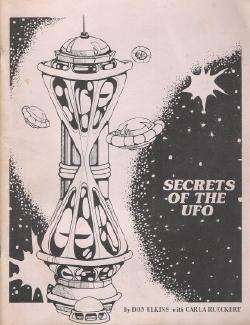
Secrets of the UFO
Don Elkins and Carla Rueckert's 1976 Summary — The Book Between Twenty Years of Field Investigation and the Law of One
Find on Amazon →As an Amazon Associate, OverClassified may earn from qualifying purchases made through this link, at no extra cost to you.
Why This Is Essential Reading
Read it as a document about a researcher, not as a source about the phenomenon. Secrets of the UFO matters because of who wrote it: a University of Louisville physics professor who gave up tenure to fly commercially so he would have more time for UFO research, spent from 1955 onward interviewing contactees across the country in his own aircraft, and then explained in print why twenty years of physical investigation had led him to conclude the problem was metaphysical. That trajectory is the single most interesting thing in the book, and Elkins is more candid about it than almost anyone who has made the same move. The material itself — interviewed testimony, third-party channelled transcripts and the authors' own sessions, all presented in one voice — cannot be assessed, because channelling has no failure condition and the regression work relies on a technique since shown to generate rather than recover. Read it before Passport to Magonia and The Age of Flying Saucers, both of which reached related conclusions about the contactees by routes that can be checked.
Related Cases & Theories
Sources Cited
- Elkins, Don, with Carla L. Rueckert. Secrets of the UFO. L/L Research, Louisville, Kentucky, 1976–77, 104 pp.; reissued by L/L Research June 3, 2014, 214 pp. ISBN-10 0945007000 / ISBN-13 9780945007005. amazon.com
- Open Library edition record, ISBN 0945007000 — bibliographic verification and cover-art source. openlibrary.org
- Google Books record, Secrets of the UFO — the L/L Company 1977 imprint and 104-page original extent. books.google.com
- AbeBooks catalogue record, ISBN 9780945007005 — edition verification, and the publisher's description of the book as a summary of the twenty-five years of philosophical study preceding the Ra contact, tracing the progression from physical sightings to metaphysical implications and serving as an introduction to the Law of One series. abebooks.com
- Barnes & Noble catalogue record — edition and format verification. barnesandnoble.com
- L/L Research — the Louisville organisation Elkins founded in 1955 and through which this book and the Law of One material were published; the primary source for the group's own account of its history, protocols and chronology. llresearch.org
- Encyclopedia.com, "Elkins, Donald T. (1930–1984)" — his birth in Louisville, his engineering degrees, his twelve years as Professor of Physics and Engineering at the University of Louisville from 1953 to 1965, his resignation to fly commercially, and his death in 1984. encyclopedia.com
- Audible author record for Don Elkins — the audiobook editions of this and the Law of One material. audible.com
- Wikipedia, "Contactee" — the movement Elkins spent two decades investigating and whose claims this book reinterprets. en.wikipedia.org
- Wikipedia, "Mediumship" — the nineteenth-century spiritualist practice from which the mid-century channelling protocols Elkins adopted in 1962 descend. en.wikipedia.org
- Wikipedia, "Past life regression" — the reincarnation-research technique Elkins used alongside his UFO work, and the experimental assessment of what it produces. en.wikipedia.org
- Wikipedia, "Hypnotic regression" — the technique underlying the book's recovered-memory material and the evidence on its reliability. en.wikipedia.org
- Wikipedia, "New Age" — the movement into which the Law of One material, announced in this book, was subsequently absorbed. en.wikipedia.org
- Wikipedia, "University of Louisville" — the institution where Elkins took his degrees and held his professorship. en.wikipedia.org
Have corrections, additional research, or peer-reviewed sources? Help improve this entry.
Suggest an Edit