
The Great Texas Airship Mystery
Core Thesis
The Great Texas Airship Mystery retells, largely in the words of the original 1897 newspaper coverage, the statewide wave of "mystery airship" sightings that swept Texas that spring — six years before the Wright brothers' first powered flight — culminating in the notorious claim that one such craft crashed into a windmill outside the small town of Aurora, killing its pilot. Author Wallace O. Chariton, a fifth-generation native Texan and popular Texas-history writer, does not force the material toward either a confident debunking or a credulous endorsement: per the book's own publisher description, he presents his own opinion about a likely solution while laying out the period evidence in enough detail for readers to weigh it and reach their own conclusion, treating the 1897 wave as a genuine, well-documented episode in Texas history whose ultimate cause — hoax, mass misperception, or something else — the surviving contemporary record does not settle definitively.
About the Author
Wallace O. Chariton is a fifth-generation native Texan, born in Fort Worth and raised in San Antonio, who built a long career as a popular chronicler of Texas history, folklore, and humor rather than as a specialist UFO investigator. His bibliography, spanning more than a dozen titles, includes Unsolved Texas Mysteries, Forget the Alamo, Exploring the Alamo Legends, Texas Wit & Wisdom, and Texas Highway Humor — a body of work that positions The Great Texas Airship Mystery as one entry in a wider career devoted to collecting and retelling the state's own regional history and legend, applying the same narrative, primary-source-driven approach to a 19th-century UFO wave that he brought to Texas's other unsolved mysteries and folklore.
Chariton's approach in this book leans heavily on contemporary print sources: newspaper accounts from across Texas published during the actual weeks of the 1897 sighting wave, retold largely in their original words rather than filtered through later decades of ufological reinterpretation. This gives the book a documentary, primary-source character distinct from most UFO literature on the same subject, which more often works from secondary compilations and later retrospective accounts rather than the original period press coverage itself.
He is credited as an avid collector of Texana — the broad category of historical Texas-related printed material and artifacts — a personal interest directly reflected in this book's own newspaper-archive-driven method. At the time of the book's writing he resided in Plano, Texas, and the book was published under Republic of Texas Press, a Plano-based imprint of Wordware Publishing specializing in regional Texas titles, a fitting institutional home for a book built so directly from the state's own historical press record.
Historical Context & Origins
Republic of Texas Press published The Great Texas Airship Mystery in 1991, coming at the tail end of a wave of renewed popular and scholarly interest in the 1896–97 "mystery airship" phenomenon nationally — the same broader wave this site's own Jerome Clark essential-reading entry covers from a national, encyclopedia-format perspective. Chariton's book instead narrows the focus specifically to Texas's own concentrated April 1897 burst of sightings, the most intense regional cluster within the wider national wave, anchored by the state's most famous individual claim: the reported airship crash outside Aurora, Texas.
The book arrived more than nine decades after the events it covers, but well before the most detailed subsequent skeptical fieldwork on the Aurora claim specifically: 1970s-era interviews with elderly Aurora residents who had been alive in 1897, and a 1976 account from the original reporting cotton buyer S.E. Haydon's own granddaughter characterizing her grandfather as a prankster and fiction writer who had fabricated the Aurora story to draw attention to a town suffering economic decline, had already begun circulating by 1991 and inform the skeptical case Chariton's own even-handed treatment weighs alongside the period newspaper record.
Structurally, the book's newspaper-archive method situates it within a specific tradition of regional American UFO history writing that treats the original press coverage as the primary evidentiary record — not because period newspapers are inherently more reliable than later retrospective accounts, but because they preserve exactly what was actually reported in real time, before later decades of ufological reinterpretation, skeptical debunking, and small-town tourism promotion (Aurora itself has, in the decades since, marketed its own UFO-crash legend for visitors) reshaped how the story gets told.
Core Arguments & Key Concepts
The book's central methodological commitment is to let the original 1897 newspaper coverage carry the narrative, retelling the statewide wave largely in period reporters' own words rather than a modern narrator's retrospective summary — a choice that lets readers directly encounter how contemporary Texans actually described and reacted to the sightings, rather than only a later, filtered account of them.
A second, closely related argument is that the Texas wave's scale and consistency across many independent towns and newspapers argues against any single simple explanation covering every reported sighting: the book documents reports from numerous Texas communities during the same concentrated April 1897 window, a pattern this site's own Great Airship Wave of 1896-97 case file independently treats as consistent with a combination of genuine astronomical/atmospheric misidentification, documented copycat and hoax reporting once the story became a proven sensation, and a residual core of harder-to-explain individual accounts.
A third theme, most concentrated in the book's Aurora material specifically, is presenting the crash claim's evidentiary weaknesses candidly rather than either ignoring them or treating them as fully dispositive: the book's own even-handed framing — presenting Chariton's opinion on a likely solution while giving readers the period evidence to judge for themselves — reflects an approach that neither dismisses the Aurora story outright nor asks readers to accept it uncritically, a genuinely rare middle path in popular UFO writing on a single famous claim.
A fourth theme is treating the 1897 Texas wave as a legitimate subject of state and local history in its own right, independent of whatever its ultimate explanation turns out to be — framing the sightings, hoaxes, and public reaction they generated as a genuine, well-documented episode in 19th-century Texas print culture and popular imagination, worth preserving and retelling on that basis alone.
Key Cases & Evidence Discussed
The Aurora UFO Crash (Case File #056, 1897) receives this book's most extensive individual treatment: this site's own case file describes it as "the definitive book-length account of the 1897 Texas airship wave, retelling the sighting reports from across the state — including Aurora — largely in the words of the original 1897 newspaper coverage," grounding the claim in S.E. Haydon's original April 19, 1897 Dallas Morning News article, "A Windmill Demolishes It," describing a crash on Aurora, Texas resident Judge J.S. Proctor's property.
The Denison, Texas 1878 "Saucer" Sighting (Case File #300), at Denison, Texas and predating the main 1897 wave by nearly two decades, is discussed in relation to this book as the closest large-scale Texas precedent to the state's own later, better-documented airship period — this site's own case file citing the book as "a detailed account of the 1897 Texas 'mystery airship' wave, the closest large-scale precedent to the Denison case within the state's own UFO history."
The Sonora Aero Club Secret Society (Case File #027), centered on artist Charles Dellschau's fantastical airship drawings, connects to this book through the wider cultural context of period airship fascination rather than a direct case overlap: this site's own case file describes the book as "a thorough, newspaper-sourced account of the real 1897 Texas mystery-airship sightings — the documented cultural phenomenon most historians believe actually shaped Dellschau's later imagination, including the Hiram Wilson reports researcher Pete Navarro tried to connect to the club."
The Great Airship Wave of 1896-1897 (Case File #228) itself cites this book specifically for its "detailed retelling of the wave's concentrated April 1897 Texas burst, drawn largely from the original period newspaper coverage, including the Aurora incident" — making this book the primary state-level companion reference for a case file that otherwise covers the full national scope of the 1896–97 wave.
Critical Reception & Controversies
As a regional-press 1991 title from a small Texas-focused publisher, The Great Texas Airship Mystery does not appear to have drawn a dedicated period review from a major national trade or library journal that this site's own research could independently locate — an absence disclosed here honestly rather than papered over with an uncited claim.
On Goodreads, the book carries a 4.30-out-of-5 average from 10 ratings and 3 written reviews. Reviewer Roberta called it "such a great UFO book," awarding five stars, while Dan Zarfati described it as "a very interesting little book... very easy to read, and kind of friendly... a fun easy read book with good research," awarding four stars. A third reviewer, Bradley Weber, linked to a podcast discussion of the book rather than writing a text review.
On Amazon, the book carries a more modest 4.0-out-of-5 average from a small sample of five ratings (checked August 2026) — a sample too small to draw a strong conclusion from on its own, and disclosed here as exactly that rather than treated as a robust signal.
Reception of the underlying Aurora crash claim itself, as distinct from Chariton's own book, has grown more skeptical in the decades since 1991: subsequent interviews with elderly Aurora residents in the 1970s revealed inconsistencies in the story, and original reporter S.E. Haydon's own granddaughter stated in 1976 that her grandfather had fabricated the account to draw attention to an economically struggling town — context this book's own even-handed 1991 treatment predates the fullest public airing of, though the underlying 1970s interview material was already circulating by the time of the book's writing.
The clearest and most independently verifiable measure of the book's lasting reference value on this site specifically is its own citation record: four separate case files, spanning 1878 to the full national 1896–97 wave, cite this exact 1991 edition directly — a citation pattern this site's own research treats as durable evidence of the book's usefulness as the standard reference for Texas's own airship-wave history specifically.
Influence & Legacy
The most directly measurable evidence of this book's ongoing influence is on this site itself: this exact 1991 edition is cited across four separate case-file pages — Aurora UFO Crash, Denison, Texas 1878 Sighting, Sonora Aero Club Secret Society, and The Great Airship Wave of 1896-1897 — making it this site's primary reference for the Texas-specific dimension of the 1897 national airship wave.
The book's broader legacy runs through the Aurora legend's own continued cultural life: the crash claim it documents has since generated television documentaries, including 2002's Aurora: The UFO Crash of 1897 featuring researcher Jim Marrs, an annual "Aurora Alien Encounter" community event, and a long-running 1980s B-movie, The Aurora Encounter — a media afterlife this 1991 book, as the most detailed single documentary-style retelling of the underlying newspaper record, has served as reference material for.
Within this site's own research specifically, this book functions as the foundational reference for the entire Texas dimension of the 1896–97 airship wave: its four citing case files span nearly two decades of Texas UFO history (1878–1897), and its newspaper-archive method provides the primary-source grounding this site's own case files draw on when situating individual Texas sightings within the state's own broader documented airship-wave history.
The Book
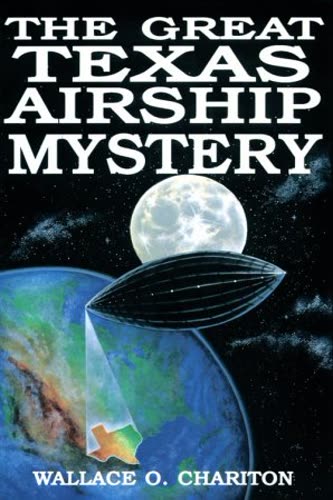
The Great Texas Airship Mystery
Find on Amazon →As an Amazon Associate, OverClassified may earn from qualifying purchases made through this link, at no extra cost to you.
Why This Is Essential Reading
The Great Texas Airship Mystery earns its place on this list as the standard reference for the Texas-specific chapter of the 1896–97 national airship wave: a genuinely even-handed 1991 retelling by Wallace O. Chariton, a fifth-generation Texan and career chronicler of the state's own history and folklore, built largely from the original period newspaper record rather than later ufological reinterpretation. Its real, lasting value on this site's own evidence is not any single contemporary trade review, which this regional small-press title does not appear to have generated, but a citation record spanning four case files across nearly two decades of Texas history and a genuinely balanced treatment of the Aurora crash claim's own real evidentiary weaknesses — presenting the author's opinion on a likely solution while giving readers the period evidence to judge for themselves. Read alongside Jerome Clark's national-scope treatment of the same broader wave, this book is essential precisely because it does what a specialist regional history should: ground a famous, much-mythologized claim back in the actual newspapers that first reported it.
Related Cases & Theories
Sources Cited
- Chariton, Wallace O. The Great Texas Airship Mystery. Republic of Texas Press, 1991 (ISBN 1-55622-140-1, cited here).
- "The Great Texas Airship Mystery." Amazon.com (ISBN 1556221401, publisher, publication date, page count, and current rating, checked August 2026). amazon.com
- "Wallace O. Chariton." Goodreads author page (biography: Fort Worth birth, San Antonio upbringing, Texana collecting, full bibliography). goodreads.com
- "The Great Texas Airship Mystery." Goodreads (rating 4.30/5, 10 ratings, 3 written reviews quoted). goodreads.com
- "The Great Texas Airship Mystery." Biblio.com (1991 Republic of Texas Press first-edition listing, pictorial cover). biblio.com
- Haydon, S.E. "A Windmill Demolishes It." Dallas Morning News, April 19, 1897 (the original Aurora crash news report this book's Aurora chapter is grounded in).
- "Aurora, Texas, UFO incident." Wikipedia (background on the 1897 crash claim, subsequent 1970s witness interviews, and the 1976 Haydon-granddaughter hoax account). en.wikipedia.org
- "The Mysterious Airship Crash in Aurora, Texas." Texas State Historical Association, Texas Day by Day. tshaonline.org
- "The Great Texas Airship Mystery." AbeBooks (1991 first-edition bibliographic record, ISBN 9781556221408). abebooks.com
- This site's own resources library: Full Reading List, where this exact 1991 edition (ISBN 1556221401) is cited across 4 separate case-file pages.
- This site's own key-figures entry: Wallace O. Chariton, for his full biography and site-wide case connections.
- This site's own case file: Aurora UFO Crash, which documents this book's detailed treatment of the case in depth.
- This site's own case file: Denison, Texas 1878 Sighting, which cites this book for the Texas airship-wave precedent.
- This site's own case file: Sonora Aero Club Secret Society, which cites this book for the wider 1897 cultural context behind Dellschau's drawings.
- This site's own case file: The Great Airship Wave of 1896-1897, which cites this book for the wave's concentrated Texas burst.
- This site's own essential-reading entry: The Emergence of a Phenomenon by Jerome Clark, the national-scope companion reference for the same 1896-97 wave.
Have corrections, additional research, or peer-reviewed sources? Help improve this entry.
Suggest an Edit