
The Denison, Texas "Saucer" Sighting
On January 2, 1878, a farmer named John Martin was hunting six miles south of Denison, Texas when he spotted a dark object high in the southern sky. The Denison Daily News reported on January 25 that as the object passed overhead, it appeared "about the size of a large saucer" — one of the earliest documented uses of "saucer" in connection with an unidentified aerial object anywhere in the historical record, nearly 70 years before Kenneth Arnold's famous 1947 sighting popularized the term "flying saucer" nationally. As with Arnold's later account, the word described the object's apparent size at a distance, not its shape, which both Martin and the newspaper compared to a balloon.

Pictured: "A Balloon in Mid-Air," an 1875 oil painting by Jules Tavernier depicting a period American hot-air balloon flight — illustrative of the era and the conventional explanation offered at the time, not a depiction of the actual 1878 sighting. Wikimedia Commons, public domain.
Theoretical Alignment
This file weights Psycho-Social/Mundane highest because the original 1878 newspaper report itself proposed a balloon as the likely explanation, describing the object's shape (not merely its apparent size) as resembling one, and because the case rests entirely on a single, uncorroborated witness account with no surviving physical evidence. The Extraterrestrial and Interdimensional alignments are not scored at zero, since the account cannot definitively rule out an unconventional origin for the object either, but scoring them any higher than a nominal 5% would require inventing detail — a craft, an occupant, a technology — that simply is not present anywhere in the surviving 1878 text. The case's significance to this archive is primarily historical and linguistic — as one of the earliest known uses of "saucer" for an unidentified aerial phenomenon — rather than evidentiary.
Background
Grayson County, in which Denison sits, was solidly agricultural farmland in this period, part of the Blackland Prairie belt that made North Texas one of the state's most productive cotton- and grain-growing regions in the years following the Civil War. Farms like the one Martin worked were typically modest, family-run operations, and hunting on or near one's own land for small game was an entirely ordinary activity for a rural Texan in January, the off-season for the cotton crop that dominated the local economy. It is against this unremarkable backdrop — not a remote wilderness, not a populated town, but ordinary working farmland a short ride from a booming rail junction — that Martin's sighting took place.
On the morning of January 2, 1878, John Martin, described by the local paper as "a farmer who lives some six miles south of" Denison, Texas, was out hunting when he noticed a dark object high up in the southern sky, its "peculiar shape and velocity" catching his attention. He watched it as it grew steadily larger, first appearing "about the size of an orange," and after resting his eyes briefly, found it had grown considerably and was moving rapidly toward him. When it passed almost directly overhead, Martin judged it to be "about the size of a large saucer," at what he took to be a great height, and thought it resembled, as best he could tell, a balloon. It continued on as rapidly as it had approached and was soon lost from sight.
The Denison Daily News printed Martin's account on January 25, 1878, under the headline "A Strange Phenomenon," vouching for the witness directly: "Mr. Martin is a gentleman of undoubted veracity and this strange occurrence, if it was not a balloon, deserves the attention of our scientists." The story was subsequently picked up and reprinted by at least the Dallas Weekly Herald, giving it modest regional circulation at the time, though there is no indication any scientist or official ever formally investigated the report. (One modern secondary source, Texas Co-op Power, states the story was also picked up by an Oklahoma newspaper, but no paper called "the Daily Oklahoman" existed until 1894 — sixteen years after the sighting, when the area was still unorganized Indian Territory — so that specific claim should be treated with skepticism.)
Denison itself was barely five years old when Martin's report appeared, and its youth matters to how the story should be read. The townsite was platted only in the summer of 1872 by the Missouri, Kansas and Texas Railway — universally known as "the Katy" — and the first train rolled in on Christmas Eve of that year. Growth was explosive even by the standards of Gilded Age railroad towns: by the summer of 1873 the settlement had passed 3,000 residents and incorporated, and that same February it opened Texas's first free public school. By January 1878, Denison had become a genuine regional shipping and processing center, with two cotton compresses, a large flour mill, and a stockyard capable of handling roughly seven hundred head of cattle a day, its comparatively orderly Main Street sitting uneasily alongside a rougher tent-city fringe of saloons and gambling halls that had grown up around the rail yards. It sat, too, just a few miles south of the Red River and the boundary of Indian Territory (present-day Oklahoma), a position that made it a natural point where news, freight, and travelers moved back and forth between Texas and the Territory press — a detail that helps explain why a story from a farm outside a mid-sized North Texas town would circulate quickly along that same Texas–Territory corridor.
The paper that carried the story was itself a young and short-lived enterprise. The Denison Daily News launched in 1873 alongside the town it served and ceased publication by 1880, one of several competing dailies and weeklies — including the Denison News and the Denison Herald, both also founded in 1876 — jockeying for readers in a town too small to comfortably support all of them. Like most small-town dailies of the period, it filled four broadsheet pages with a mix of local items, wire dispatches on state and national news, and dense columns of advertising, and it operated without bylines, formal fact-checking, or any separation between news and editorial voice recognizable to a modern reader: the same short item that reported Martin's sighting also personally vouched for his character and editorialized about what "our scientists" ought to make of it, all in the same breath. The original January 25, 1878 issue — Volume 5, Number 280 — survives today as a digitized microfilm scan, preserved through the Grayson County Frontier Village and hosted by the Texas Digital Newspaper Program's Portal to Texas History, giving researchers direct access to the actual page rather than a copied or paraphrased transcription of it.
Complete Timeline
The table below sets out every documented milestone in the case's public life, from the sighting itself through its rediscovery and continued citation in UFO-history literature. The gaps are as informative as the entries: nearly ninety years separate the original 1878 report from its first significant modern rediscovery, a silence that reflects how thoroughly the story dropped out of general circulation once its brief 1878 newspaper run ended, surviving only in bound newspaper volumes and, eventually, microfilm until UFO researchers began actively combing historical archives for pre-1947 precedents.
| Date | Event |
|---|---|
| Jan. 2, 1878 | John Martin reports observing the object while hunting south of Denison, Texas. |
| Jan. 25, 1878 | The Denison Daily News publishes the account under the headline "A Strange Phenomenon," describing the object as "about the size of a large saucer" when overhead. |
| 1878 (following weeks) | The story is reprinted by at least the Dallas Weekly Herald. |
| June 24, 1947 | Pilot Kenneth Arnold's sighting near Mount Rainier, Washington, is widely (and, per Arnold himself, inaccurately) reported using the term "flying saucer," which becomes the standard popular term for unidentified aerial phenomena. |
| 1950 | Donald Keyhoe's book The Flying Saucers Are Real helps cement "flying saucer" in the American popular vocabulary, unrelated to the Denison account, which remained largely forgotten in mainstream UFO literature. |
| 1965 | A Dallas Morning News retrospective helps revive interest in the 1878 account as a historical curiosity. |
| 1970s | The case receives wider circulation in UFO research circles, including coverage in Texas Monthly, as an example of "saucer" terminology predating the 1947 Arnold sighting. |
| Present | The case remains cited primarily for its historical and linguistic significance — an early recorded use of "saucer" for an aerial object — rather than as strong evidence of an anomalous phenomenon. |
The Original Account
The 1878 report is unusually well-preserved by the standards of 19th-century American local journalism, and its exact wording matters to the case's significance. The Denison Daily News wrote that Martin first noticed the object "high up in the southern sky," that it "appeared to be about the size of an orange, which continued to grow in size," and that after he "had to rest his eyes" from staring at it, "the object was almost overhead and had increased considerably in size." At its closest approach, "when directly over him it was about the size of a large saucer and was evidently at great height." Martin judged that it "resembled, as well as he could judge, a balloon," and that it moved "as rapidly as it had come and was soon lost to sight."
Two details are essential to reading this account accurately, and both are frequently lost in later popular retellings. First, "saucer" in the original text describes the object's apparent angular size at its closest approach — a comparison to a familiar tableware object's visual dimensions — not its shape, which Martin separately and explicitly compared to a balloon. Second, the newspaper's own editorial framing treated a balloon as the leading candidate explanation, explicitly inviting scientific attention only in case that explanation proved wrong, rather than presenting the sighting as inherently mysterious.
The structure of the account also rewards a close reading. It is built as a short narrative arc rather than a simple list of facts: an initial small, dark, distant shape; a period of sustained observation demanding enough that the witness's eyes tired and he had to look away; a resumed view in which the object has closed distance dramatically and now moves with "wonderful speed"; a close overhead passage in which its apparent size and altitude are both assessed; and a rapid departure and disappearance. That arc is exactly what a genuine, continuous observation of a real object approaching, passing over, and receding from a fixed ground observer would be expected to produce, which is one reason the account has generally been read by researchers as a sincere description of something Martin actually watched, rather than as an invented tale assembled after the fact. Sincerity of description, however, is a separate question from accuracy of interpretation — a witness can honestly report what he perceived while still being wrong, through no fault of his own, about what the object actually was, how far away it stood, or how fast it truly moved, all quantities that are notoriously difficult for an untrained observer to judge for any airborne object seen without a fixed reference point for scale.
Verifying the Record: Discrepancies Across Retellings
A case built on a single, nearly 150-year-old newspaper column is only as stable as the chain of retellings that carry it forward, and on inspection that chain turns out to be less consistent than the tidy version usually repeated. This file follows the dating and geography most commonly given in modern secondary sources — a January 2, 1878 sighting six miles south of Denison, published January 25 — but it is worth being explicit that not every account agrees. At least one modern retelling places Martin's farm six miles north of the city rather than south; another, drawing on John Keel's 1970 book UFOs: Operation Trojan Horse, dates the sighting itself to January 24 rather than January 2. None of these variants change the substance of the account — every version has Martin watching the same object grow from orange-sized to saucer-sized, and every version has him calling it balloon-shaped — but the disagreement is a useful reminder that a report which has been paraphrased, summarized, and re-summarized across more than a century of UFO literature can accumulate small errors even when no one along the chain intends to mislead. Readers relying on any single modern retelling, including this one, should treat exact dates and compass directions as approximations pending direct comparison against the surviving newspaper page itself.
That caution is not unique to this case. Historians of the "flying saucer" term generally treat 19th-century American local newspapers as sources requiring active skepticism, not because every small-town editor was dishonest, but because the professional norms that would later separate verified reporting from embellishment simply did not exist yet. The 1830s and 1840s "penny press" had already normalized sensational, loosely sourced stories as a business model — the New York Sun's 1835 series claiming the discovery of life on the moon and the New York Herald's 1874 fabricated account of a zoo animal escape rampaging through Manhattan are the two most notorious examples — and by 1878 there was still no widely accepted line between straight reporting, editorializing, and outright invention. Nothing in the surviving Denison Daily News item resembles those infamous hoaxes; its tone is restrained, its claims are modest, and its own editors leaned toward the mundane explanation rather than the sensational one. But the broader climate is exactly why researchers who take the Denison case seriously as a linguistic curiosity are careful not to treat it as strong evidence of anything beyond the fact that a farmer told a newspaper he saw something odd, and the newspaper printed it in more or less good faith.
The witness's own identity is even less secure than the date. The Denison Daily News identifies him only as "a farmer who lives some six miles south of this city" — no age, no address, no family details, nothing beyond the newspaper's blanket assurance that he was a man "of undoubted veracity." A search of 1880 U.S. census records for Grayson County and its neighboring North Texas counties turns up more than one farmer named John Martin, and nothing in the surviving record narrows the field to a single, identifiable individual. That gap is not unusual for 19th-century local journalism, which routinely named ordinary residents without any of the biographical anchoring — a specific address, a prior reputation, a traceable life history — that would let a later researcher independently corroborate the person and weigh their credibility firsthand, rather than simply trusting the newspaper's own say-so.
None of this is a defect unique to the Denison case; it is simply the standard evidentiary ceiling for genealogical research built entirely around a common personal name and a single newspaper mention. Census enumeration in 1878 Texas was itself imperfect — the 1880 count is the nearest surviving federal census to the sighting, since the 1870 census undercounted large parts of post-Reconstruction Texas and no federal census was taken in 1878 itself — and rural Grayson County in this period included a shifting population of recently arrived farm families drawn by the same Katy Railroad that had built Denison, many of whom left no further documentary trace at all. Absent a diary, a land deed, a church record, or a death notice that can be tied definitively to the "John Martin" of the newspaper account, the witness is likely to remain, permanently, exactly what the newspaper made him: a name attached to a story, rather than a fully documented historical person.
The "Saucer" Terminology, Nearly 70 Years Before Kenneth Arnold
This case's primary significance to UFO history is linguistic rather than evidentiary. Popular culture credits pilot Kenneth Arnold's June 24, 1947 sighting near Mount Rainier, Washington, with introducing "flying saucer" into the American vocabulary. In fact, Arnold's own account, given directly, described the objects' motion — "they flew like they take a saucer and throw it across the water" — not their shape; he stated plainly that reporters "misunderstood and misquoted" him, and that an anonymous newspaper headline writer, working from wire coverage by reporter Bill Bequette, coined "flying saucers" as shorthand that stuck. The Denison case shows the identical pattern playing out 69 years earlier at much smaller scale: a witness used "saucer" as a size comparison for an object he separately described as balloon-shaped, and later readers, working from the word alone, have sometimes assumed a shape claim that the original 1878 text does not actually make. The parallel is precise enough that UFO historians treat the Denison account as a genuine, if minor, precedent for the terminology that would define the field seven decades later.
The mechanics behind the 1947 mix-up are worth setting out in more detail, because they show precisely how a size-or-motion comparison can harden into a shape claim within days rather than decades. Arnold, a private pilot and Boise, Idaho businessman, had been searching for a downed Marine transport plane near Mount Rainier when he spotted nine bright objects moving in echelon formation; he landed in Pendleton, Oregon and described the sighting to Bequette, a young reporter at the East Oregonian, just ahead of the paper's deadline. Bequette's colleague Nolan Skiff had already used the phrase "saucer-like aircraft" in an early draft of the story, and Bequette's own brief wire dispatch, sent out over the Associated Press that afternoon, described "saucer-like objects." From there, headline writers at papers around the country who had never spoken to Arnold at all shortened that phrase into the punchier, more literal "flying saucers" — and within days, a pilot's simile about erratic motion had become, in the public mind, a claim about a specific disc shape that Arnold had never actually made.
It is also worth noting that "flying saucer" was not even the only term in circulation immediately after Arnold's sighting; some early wire and headline coverage instead used "flying disk," and for a brief period in mid-1947 the two phrases competed for dominance in American newspapers before "flying saucer" won out as the phrase that stuck in popular use. Arnold himself spent much of the rest of his life periodically re-explaining, with evident and growing frustration, that he had never said the objects were shaped like saucers, and that the press had misquoted and misunderstood a comment about how they moved. That frustration never meaningfully slowed the term's spread; once headline writers nationwide had settled on the punchier, more literal phrase, no amount of correction from the original witness could dislodge it, a dynamic that illustrates just how easily a witness's own careful wording can be overridden by the media apparatus repeating it secondhand — the same basic risk this file flags for the Denison case itself, just compressed from decades into days.
UFO historians who have examined the Denison case at all — its coverage is thin compared with better-documented reports — have generally drawn exactly this parallel between the two episodes. Jerome Clark's UFO Encyclopedia and Curtis Peebles's Watch the Skies!, both standard reference works on the history of the term itself, cite Denison chiefly as an odd linguistic footnote: proof that "saucer" had already attached itself to an unusual aerial sighting once before, entirely independent of the 1947 episode that made the phrase stick nationally, with no evidence of any direct line of influence connecting the two. It also helps to remember that "saucer" was not an exotic or futuristic comparison in either 1878 or 1947 — it was simply one of the most common round objects in an American household, sitting under nearly every teacup, and it carried no built-in association with spacecraft or extraterrestrial visitors in either era, since the popular link between "flying saucer" and alien technology developed only after 1947. The coincidence, in other words, is one of ordinary vocabulary — two witnesses, 69 years apart, reaching for the same familiar tableware to describe an object whose true size, shape, and distance were difficult to judge — rather than evidence of continuity in whatever phenomenon, mundane or otherwise, either man actually observed.
Key Figures
John Martin
A farmer living roughly six miles south of Denison, Texas, whose January 2, 1878 account, published in the Denison Daily News on January 25, is among the earliest known uses of "saucer" to describe an unidentified aerial object. Beyond that one newspaper appearance, no further biographical record of Martin — his age, family, or eventual fate — has been located.
Reading the Sighting Psychologically: The Saucer as Symbol
The Swiss psychiatrist Carl Jung took the flying saucer seriously enough, as a cultural phenomenon if not necessarily as a physical craft, to devote a full book to it: Flying Saucers: A Modern Myth of Things Seen in the Skies, first published in German in 1958 and in English translation in 1959. Jung's argument was not that saucer reports were lies or simple errors, but that the circular, disc-like form recurring across so many independent accounts functioned as a modern instance of the mandala — a symbol of psychic wholeness and order that his analytical psychology traced across centuries of religious and alchemical imagery — surfacing in a technological age anxious about atomic weapons, Cold War tension, and a newly militarized sky. Jung wrote specifically about the post-1947 wave of sightings and never addressed the Denison case, which was essentially unknown outside a small circle of Texas-history enthusiasts during his lifetime; nothing here should be read as claiming he analyzed this specific report.
But the interpretive question Jung raised — why a distant, ambiguous object resolves itself in a witness's mind into one familiar shape rather than another — applies cleanly to Martin's account regardless of Jung's own silence on it. This file already weights the Psycho-Social/Mundane explanation at 85 percent alignment partly for this reason: nothing in the record rules out an ordinary perceptual process at work. Martin himself reports straining his eyes at the object for long enough that he "became blind from long looking" and had to rest them — a detail that, read plainly, describes real visual fatigue affecting a difficult, prolonged observation of a small, high, backlit object. An object's apparent angular size growing steadily as it approaches an observer, exactly as Martin describes moving from "the size of an orange" to "a large saucer," is also the ordinary visual signature of the "looming" effect well documented in perceptual psychology: any approaching object of unknown true size produces this exact subjective impression, independent of whether the object itself is unusual in any way. None of this proves the object was mundane, but it does mean the account's central visual details — growth in apparent size, eye strain from sustained observation, and a final comparison to the roundest familiar object on hand — are all fully consistent with an ordinary human observer doing an unusually good job of describing a genuinely hard perceptual problem, rather than requiring any exotic explanation.
There is also a simpler point worth making about expectation and vocabulary. A witness describing an unfamiliar sight almost always reaches for the nearest familiar category available in his own experience and language, rather than inventing wholly new descriptive terms on the spot; a 19th-century Texas farmer with no cultural concept of "spacecraft," "flying saucer," or any comparable modern category had a strictly narrower set of available comparisons than a witness would have after 1947, and chose, from that narrower set, the two most mundane options imaginable — a balloon for shape, a saucer for size. That choice of the most ordinary available comparison, rather than the most dramatic one, is itself mild evidence against embellishment: a witness inventing or exaggerating a story for effect had every opportunity, in an era already saturated with sensational newspaper writing, to describe something stranger, and did not.
Later Historiography: How the Case Has Circulated
The Denison sighting spent most of its first seventy years as nothing more than a single yellowed newspaper page in a North Texas archive. Its modern life as a UFO-history footnote appears to date to Major Donald Keyhoe's 1950 bestseller The Flying Saucers Are Real, which helped popularize the search for terminological precedents to the newly coined "flying saucer," followed by a 1965 Dallas Morning News retrospective that appears to have reintroduced the case to a Texas readership as a piece of regional trivia, and later still by a Texas Monthly feature revisiting the state's stranger sky stories. Each retelling necessarily compressed and re-summarized the original four-paragraph item, which is very likely how the case picked up its small but real discrepancies in date and direction discussed above.
Jacques Vallée and Chris Aubeck's 2010 book Wonders in the Sky, a catalogue of more than 500 historical aerial reports running from antiquity through 1879, includes the Denison sighting among its late-19th-century entries, placing it within a much longer documented tradition of ordinary people describing hard-to-identify things in the sky using whatever comparisons their own era made available — ships, chariots, shields, lamps, and, by 1878, a saucer. Read across this wider catalogue rather than in isolation, Denison's real contribution to that tradition is narrow but genuine: not proof of an anomalous craft, and not even, on close reading, the first use of "flying saucer" as a phrase (Martin never used that exact two-word combination; the newspaper called the object saucer-sized), but a documented, dated data point in the much longer history of how English speakers have described ambiguous things overhead.
That longer catalogue tradition is itself worth understanding, because it explains why researchers bother tracking down obscure four-paragraph items like the Denison story in the first place. Vallée and Aubeck's broader project, and similar work by other historians of the field, rests on the premise that the modern UFO phenomenon, whatever its ultimate explanation, did not spring into existence in 1947 out of nothing; it has an identifiable prehistory of anomalous and ambiguous sky reports stretching back centuries, of which the post-Arnold era is simply the best-documented and most culturally visible chapter. Cataloguing pre-1947 cases like Denison is, from that standpoint, less about proving any individual old report was a genuine anomaly and more about establishing an accurate baseline: understanding what people were already reporting, and in what language, before "flying saucer" existed as a cultural category available to shape how witnesses described what they saw. A farmer in 1878 describing a balloon-shaped object using "saucer" only as a size comparison, with no hint of anything otherworldly in his own account, is precisely the kind of pre-category data point that lets researchers distinguish later reports genuinely influenced by 1947-onward saucer imagery from reports that predate, and could not have been shaped by, that imagery at all.
The Five Observables Assessment
The Five Observables framework did not exist in any form in 1878; it was developed decades later out of modern military and intelligence analysis of instrumented UAP encounters, most publicly associated with the Pentagon's Advanced Aerospace Threat Identification Program and its successor efforts, and built around characteristics — anti-gravity lift, instantaneous acceleration, hypersonic velocities without sonic booms, low observability to radar and other sensors, and trans-medium travel between air, water, and space — that require exactly the kind of instrumented, multi-sensor data a 19th-century farmer with only his own eyes could never have produced. Applying the framework to the Denison case at all is therefore an act of retroactive translation rather than a natural fit, useful mainly as a consistent yardstick this archive applies across cases of wildly different eras and evidentiary quality, not as a claim that Martin's report was ever evaluated against, or should be expected to satisfy, standards developed for radar-and-camera-equipped military aircrews more than a century later. With that caveat, the framework applies only loosely to a single 19th-century newspaper account with no instrumented data:
Assessment: The account documents no performance characteristic inconsistent with a period hot-air or gas balloon observed at a distance and altitude that made its true size and features difficult to judge. It is worth being specific about what would have moved this assessment: a reported sudden right-angle turn, a stop-and-reverse maneuver, a descent and landing with visible occupants or wreckage, or any sound or visible propulsion mechanism would each individually have pushed the case away from a simple drifting-object explanation. None of these appear anywhere in the surviving text. Martin describes a single, continuous, unidirectional pass from horizon to horizon — approach, overhead transit, departure — which is exactly the flight profile an observer on the ground would expect to see from an object drifting with, rather than maneuvering against, the prevailing wind.
Evidence Assessment
Supporting Historical Documentation
- The account survives in a contemporary, dated, named-witness newspaper report rather than a later retrospective retelling, and was reprinted in at least two other regional papers, giving it a genuine 1878 paper trail.
- The precise original wording — describing apparent size via "saucer" and shape via "balloon" — closely parallels the documented pattern of Kenneth Arnold's later, far more famous 1947 account, a linguistic coincidence with genuine historical interest.
- Unlike many historical UFO reports that survive only as secondhand quotations in later books, the original newspaper page itself is independently verifiable today: it has been digitized and is publicly viewable through the Portal to Texas History, allowing any researcher to check modern retellings directly against the primary source rather than against another retelling.
Supporting a Fully Conventional Explanation
- The report rests on a single, uncorroborated witness with no other named observers, photograph, or physical trace of any kind, despite the sighting reportedly lasting several minutes in clear daylight — long enough that, had anyone else been present in the surrounding farmland or on the roads into Denison, a second account might plausibly have surfaced.
- The original newspaper account itself proposed a balloon as the likely explanation and only invited "the attention of our scientists" as a conditional, not a settled mystery.
- Manned balloon flight was an established, publicly demonstrated technology well before 1878, including flights documented in Texas and across the United States in the preceding decade, making a stray or drifting balloon a genuinely available conventional explanation rather than an anachronistic guess.
- Even the witness's identity cannot be independently confirmed: period census records for the surrounding North Texas counties list more than one farmer named John Martin, and no supplementary record narrows the field to a specific individual.
Why "Disputed"
This case is rated Disputed in the narrow sense that its ultimate significance is genuinely contested — not because credible researchers argue it depicts an anomalous craft, but because sources disagree about how much historical weight the "saucer" terminology deserves. Popular UFO-history writing sometimes treats the Denison account as evidence that "flying saucers" have a documented pedigree stretching back to the 19th century, implicitly suggesting continuity with the modern phenomenon. This file finds that framing overstated: the original 1878 text is explicit that "saucer" referred to apparent size, and the newspaper's own editors favored a mundane balloon explanation, exactly paralleling how Kenneth Arnold's own 1947 account was later popularly distorted from a comment about motion into a claim about shape.
The dispute, in other words, is almost entirely about framing rather than facts. Every serious source agrees on what the newspaper actually printed; they disagree only on how much rhetorical weight to hang on it. Treated as "the first flying saucer" in the sense of the first reported disc-shaped alien spacecraft, the case collapses on contact with its own primary text, which describes a balloon-shaped object and offers a balloon as the likely explanation. Treated more modestly, as an early and independently occurring instance of English speakers reaching for round tableware to describe an ambiguous aerial shape, the case holds up well and earns its place in the historical record on its own, considerably smaller, terms.
What earns the case a place in this archive at all, rather than dismissal as folklore, is that it is a genuine, well-preserved, dated primary source with a named witness and regional press corroboration of publication (if not of the sighting itself) — a real artifact of 19th-century American press coverage of an unusual aerial observation, useful chiefly for what it reveals about how "saucer" language entered the historical record decades before it became culturally inseparable from extraterrestrial visitation.
Observer Credibility & Occupational Profile
The entirety of this case's credibility rests on a single, unverifiable 19th-century newspaper vouching for a witness it identifies only as "a farmer" of "undoubted veracity" — a standard local-color assurance common in period journalism, not an independently checkable credential. No other contemporary record, court document, or personal account from Martin himself has been located to corroborate the newspaper's characterization.
This pattern is common enough in 19th-century press coverage of unusual sightings that historians treat it as close to a stock phrase rather than a genuine character reference: small-town papers routinely assured readers that an unnamed or thinly identified source was a person "of undoubted veracity," "well known," or "a gentleman of high standing" as a way of pre-empting skepticism, without any actual verification process behind the assurance. Denison's own newspaper landscape — three or more competing dailies and weeklies fighting for a still-small readership — gave editors an added incentive to present a colorful local story as credibly as possible rather than to interrogate it further. None of this proves Martin invented or exaggerated his account; plenty of period witnesses genuinely believed, and honestly reported, what they thought they saw. But it does mean the newspaper's character reference cannot be weighed as independent corroboration in the way a modern background check, a second named witness, or an official investigation record could be.
Historical Precedents & Archive Matches
This case is best read alongside the broader wave of 19th-century American "mystery airship" reports, most famously the airship sightings that swept Texas and much of the country in 1896–97, nearly two decades after Martin's account, which similarly combined genuine period fascination with new aeronautical technology and a strong tendency toward embellished or fabricated local newspaper reporting.
That later wave, covered in detail elsewhere in this archive, began with sightings over California in November 1896 and spread east through the winter and spring, reaching a fever pitch across Texas by April 1897, when witnesses in Beaumont, Greenville, Austin, Ladonia, Waxahachie, and more than a dozen other Texas towns reported contact with a cigar-shaped airship and, in many accounts, its inventor-pilot. The single most notorious report of the entire wave came out of Aurora, Texas, where local cotton buyer S.E. Haydon wrote an account, published in the Dallas Morning News in April 1897, claiming an airship had crashed into the windmill of a Judge Proctor and killed its pilot, who was buried in the town cemetery as a being "not of this world." Aurora's own town historian later stated flatly that Judge Proctor never owned a windmill at all, and that the story was cooked up by Haydon and a group of local men as a publicity stunt for a town that had just lost its bid for a new rail line and was otherwise dying — a motive with an ironic symmetry to Denison's own great fortune in becoming a railroad boomtown twenty-five years earlier.
Set against that backdrop, the Denison account looks distinctly different in character. It carries none of the wave-era hallmarks that make so many 1896–97 reports easy to dismiss: no named aeronaut, no elaborate backstory, no crash, no dialogue, no second or third witness corroborating some specific fantastical detail. It is a single, comparatively restrained description of a distant object, offered by one farmer to one newspaper, with the newspaper's own editors leaning toward the least sensational available explanation rather than amplifying the story into anything more dramatic. That restraint is part of why UFO historians have generally treated Denison as a genuine, if minor, curiosity rather than folding it into the same bucket as Aurora and the rest of the wave-era hoaxes — even as they remain equally clear that "genuine" here describes the newspaper account's apparent sincerity, not the presence of an anomalous craft.
The gap of nearly two decades between the two episodes is itself worth dwelling on. By 1896, the American public's relationship with the idea of flight had changed substantially from what it had been in 1878: heavier-than-air, powered flight was now a widely discussed near-future possibility rather than a distant fantasy, inventors across the country were racing to build a viable dirigible, and newspapers had every commercial incentive to feed public appetite for airship stories with invented aeronauts, invented dialogue, and invented crashes. Denison's single, comparatively dry newspaper item predates that specific cultural moment by almost twenty years; whatever readers in 1878 made of "a large saucer... at great height," they were not yet primed by a national airship craze to expect, or to embellish toward, a story about an inventor's flying machine. That earlier, less charged context is part of what makes the case's restraint plausible as sincerity rather than simply a less imaginative hoax.
A second, more distant point of comparison occasionally raised in the literature is the August 12–13, 1883 observation by Mexican astronomer José Bonilla, director of the Zacatecas Observatory, who photographed several hundred dark objects crossing the face of the sun over roughly a day and a half, eventually producing 447 wet-plate images — a genuinely instrumented, photographically documented observation, unlike Denison's single unaided eyewitness account, though one whose objects went unidentified for well over a century before modern researchers proposed fragments of a disintegrating comet passing unusually close to Earth. John Keel's 1970 book UFOs: Operation Trojan Horse cites both the Bonilla and Denison cases within a few pages of each other as evidence that unusual aerial reports did not begin with Kenneth Arnold, though Keel's own interpretive framework — that such reports reflect a semi-independent, trickster-like phenomenon rather than either physical craft or simple misperception — is not one this file adopts. The two cases otherwise share little beyond their pre-1900 dates and their frequent citation, decades apart, in the same secondary UFO-history literature.
Material Analysis
No physical evidence of any kind survives or was ever claimed for this case. The entirety of the surviving record is the January 25, 1878 Denison Daily News article and its subsequent regional newspaper reprints, none of which include an illustration, photograph, or independent corroborating account.
The absence of any photograph is unremarkable given the state of photographic technology in 1878. Commercial photography of the period relied on wet-plate collodion or the newly emerging dry-plate processes, both of which typically required exposure times ranging from a fraction of a second in bright, ideal conditions to several seconds or longer in ordinary daylight, mounted on a fixed tripod with a heavy glass-plate camera entirely unsuited to spontaneous outdoor use. Capturing a small, fast-moving, high-altitude object glimpsed unexpectedly by a farmer in an open field was not a realistic possibility for an amateur, and even professional photographers of the era rarely attempted anything resembling a candid outdoor action shot; George Eastman's first simple box camera would not reach the market until 1888, a full decade later. The case's total lack of imagery is therefore exactly what should be expected of any 1878 sky observation, anomalous or otherwise, and cannot be read as evidence against the sighting's sincerity.
Supporting Genuine Historical Value
- The primary-source newspaper text is well-documented and has been independently located and transcribed by multiple UFO historians, giving the case unusually solid textual provenance for its age.
Supporting a Fully Conventional Explanation
- No physical evidence exists to test any hypothesis against, and the leading conventional explanation (a balloon) was proposed by the primary source itself, not added later by skeptics.
The Conventional Explanation Candidate: A Drifting or Distant Balloon
The leading, and this file's assessed, explanation is the one the original 1878 newspaper itself proposed: a manned or unmanned balloon, observed at a distance and altitude sufficient to make its true size, construction, and purpose difficult for an untrained ground observer to judge, its motion appearing "rapid" chiefly due to the effects of changing distance and perspective rather than true velocity.
Established Balloon Technology by 1878
Manned balloon flight was a mature, publicly demonstrated technology in the United States well before 1878, with exhibition and scientific ascents documented across the country in the preceding decades; a balloon drifting at altitude, or released for scientific, exhibition, or even accidental purposes, is a readily available conventional source for a distant, hard-to-identify aerial object matching Martin's description.
A Culture Already Primed to See Balloons
By 1878, gas and hot-air balloons were not a novelty but an established fixture of American public spectacle, the only form of manned flight that existed anywhere in the world; the Wright brothers' first powered flight was still a full quarter-century away. Showman P.T. Barnum had for years offered daily balloon ascensions as an attraction at his American Museum in New York, and ballooning had already generated its own genre of newspaper human-interest stories, including at least two widely reported "aerial weddings" performed a mile or more above the ground — one over Pittsburgh in 1867, another over Cincinnati in 1874. Exhibition aeronauts routinely toured state and county fairs offering paid ascensions to paying crowds, and scientific balloon ascents to study the upper atmosphere had been conducted by American and European researchers since at least the 1860s. None of this proves a specific balloon was aloft over Grayson County on the day of Martin's sighting — no such flight has been documented, and the newspaper itself offered the balloon explanation as a plausible guess rather than a confirmed identification — but it establishes that a member of the public in 1878 encountering an unexplained dark object at altitude had every cultural reason to reach first for "balloon," precisely as both Martin and his newspaper did, rather than for anything more exotic.
Perspective-Driven Apparent Size and Motion
An object's apparent angular size growing as it approaches, exactly as Martin described moving from "the size of an orange" to "a large saucer," is the expected visual signature of any object approaching an observer at altitude, regardless of its true size or nature, and does not by itself indicate unusual technology. A balloon several hundred to several thousand feet up, carried by upper-level winds that can differ sharply in speed and direction from surface conditions, can easily appear to a ground observer to move with startling and irregular "wonderful speed," particularly when its true altitude and size are unknown quantities the observer has no reliable way to estimate. Nothing in Martin's account — not its apparent speed, not its growth in apparent size, not its silent and eventually receding departure — requires performance beyond what wind alone could produce on a drifting, unpowered balloon.
What the Account Does Not Claim
It is worth stating plainly what Martin's account does not include, since absence of a claim is itself part of the evidence. There is no report of the object stopping, reversing course, descending toward the witness, or otherwise behaving in a way that would rule out simple wind-driven drift. There is no report of any structure, seam, window, light, or surface detail beyond an overall dark silhouette, consistent with a distant object seen only in outline against a bright sky. There is no report of sound, of any effect on plants, animals, or instruments, or of any physical trace once the object passed from view. And there is no claim, anywhere in the newspaper's own wording, that the object was anything other than possibly a balloon; the paper's invitation to "our scientists" was framed explicitly as a conditional, to be acted on only if the balloon explanation turned out to be wrong, not as an assertion that it already had been ruled out. A conventional explanation candidate is strongest when the witness's own account contains nothing that actively contradicts it, and that is the case here.
A Drifting or Distant Balloon — Plausibility Rating: HIGHLY PLAUSIBLE
Related Cases
Record Status
No federal, state, or military record of any kind addresses this case; in 1878 no U.S. agency existed with a mandate to investigate aerial phenomena, and the newspaper's invitation for "our scientists" to examine the report was never acted upon by any known party. The closest thing to a relevant federal scientific body at the time was the Army's Signal Service, established in 1870 and charged with collecting weather observations and issuing storm warnings via telegraph — a genuinely new and expanding federal science program in exactly this period, but one with a meteorological mandate that had nothing to do with investigating an individual farmer's report of an unusual object, and no surviving record suggests the Denison story was ever brought to its attention. The Smithsonian Institution, the era's leading scientific body for matters outside a specific agency's purview, likewise shows no record of having been asked to weigh in, despite the newspaper's own suggestion that the case "deserves the attention of our scientists."
Search Historical Archives Directly
Further Reading — Recommended Literature
Wonders in the Sky: Unexplained Aerial Objects from Antiquity to Modern Times
A catalogue of over 500 historical unexplained aerial reports from antiquity through 1879, directly covering the era of the Denison sighting.
The Great Texas Airship Mystery
A detailed account of the 1897 Texas "mystery airship" wave, the closest large-scale precedent to the Denison case within the state's own UFO history.
The Flying Saucers Are Real
The 1950 book that helped cement "flying saucer" in American popular culture following the 1947 Kenneth Arnold sighting.
The UFO Encyclopedia: The Phenomenon from the Beginning (3rd ed.)
The standard comprehensive reference work on UFO history, including coverage of pre-1947 sightings and terminology.
Watch the Skies! A Chronicle of the Flying Saucer Myth
A rigorously researched skeptical history of the flying saucer phenomenon and how the term itself entered and shaped American culture.
DISCLOSURE: Some links above are affiliate links. If you purchase through them, OverClassified receives a small commission at no additional cost to you. This helps support independent research.
Essential Viewing
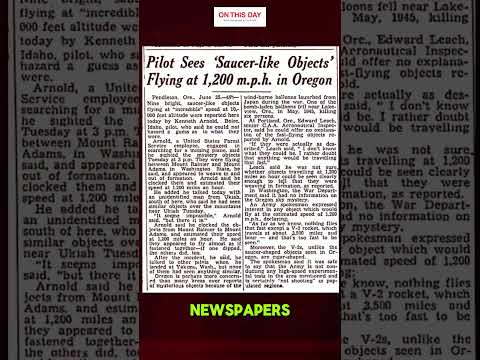
The 1947 Flying Saucer Mystery
On This Day — the Kenneth Arnold sighting that popularized "flying saucer" nationally, 69 years after Denison.

Flying Saucers All Over the Sky
HISTORY, "History's Greatest Mysteries" — context on the postwar flying saucer craze that made the term ubiquitous.
Sources
- "UFOs at close sight: Denison, Texas, 1878, John Martin's report," Patrick Gross UFO archive (transcription of the original Denison Daily News article). Read online →
- "January 1878, Denison, Texas, Daylight UFO," The Black Vault Case Files. Read online →
- "UFO Sighting from the Denison Daily News of Denison, Texas on January 25, 1878," National UFO Center. Read online →
- "The First Flying Saucer," Texas Co-op Power. Read online →
- "Denison Texas UFO," Mike Cox Texas Tales, TexasEscapes.com. Read online →
- "Close Encounters of the Lone Star Kind," Texas Monthly. Read online →
- "Flying saucer," Wikipedia, on the Kenneth Arnold 1947 terminology origin. Read online →
- "The Arrival of Flying Saucers," HowStuffWorks. Read online →
- "January 1878, Denison, Texas Daylight UFO," UFO Casebook. Read online →
- Vallée, Jacques, and Chris Aubeck. Wonders in the Sky: Unexplained Aerial Objects from Antiquity to Modern Times. Tarcher/Penguin, 2010.
- Chariton, Wallace O. The Great Texas Airship Mystery. Republic of Texas Press, 1991.
- Keyhoe, Donald E. The Flying Saucers Are Real. Gold Medal Books, 1950.
- Clark, Jerome. The UFO Encyclopedia: The Phenomenon from the Beginning, 3rd ed. Omnigraphics, 2018.
- Peebles, Curtis. Watch the Skies! A Chronicle of the Flying Saucer Myth. Smithsonian Institution Press, 1994.
- "File: 'A Balloon in Mid-Air' by Jules Tavernier, 1875.jpg," Wikimedia Commons (public domain). View file →
- "Denison Daily News. (Denison, Tex.), Vol. 5, No. 280, Ed. 1, Friday, January 25, 1878," The Portal to Texas History, University of North Texas Libraries (digitized original newspaper issue). Read online →
- "Denison, TX," Handbook of Texas, Texas State Historical Association. Read online →
- "Aurora, Texas, UFO incident," Wikipedia. Read online →
- "Bonilla observation," Wikipedia, on the 1883 Zacatecas Observatory sighting. Read online →
- Jung, C.G. Flying Saucers: A Modern Myth of Things Seen in the Skies. Trans. R.F.C. Hull. Harcourt, Brace & Company, 1959.
- Keel, John A. UFOs: Operation Trojan Horse. G.P. Putnam's Sons, 1970.
See something inaccurate? Have additional information or sources?
Suggest an Edit →Last Updated: August 2026