
The Manbhum Flying Saucer Sighting
On the afternoon of September 15, 1954, a grey, disc-shaped object roughly twelve feet across descended over three adjoining villages in the Manbhum district of Bihar, hovering at around 500 feet with a sound witnesses compared to a car engine idling. Its sides appeared to "inflate," smoke billowed from both ends, and it climbed away at extraordinary speed, kicking up a gust of wind strong enough to rattle doors and windows. Roughly 800 villagers watched it happen. The most detailed account came from the 60-year-old manager of the local mica mine — a mine that, at the time, was supplying beryllium to India's own nascent Atomic Energy Commission.
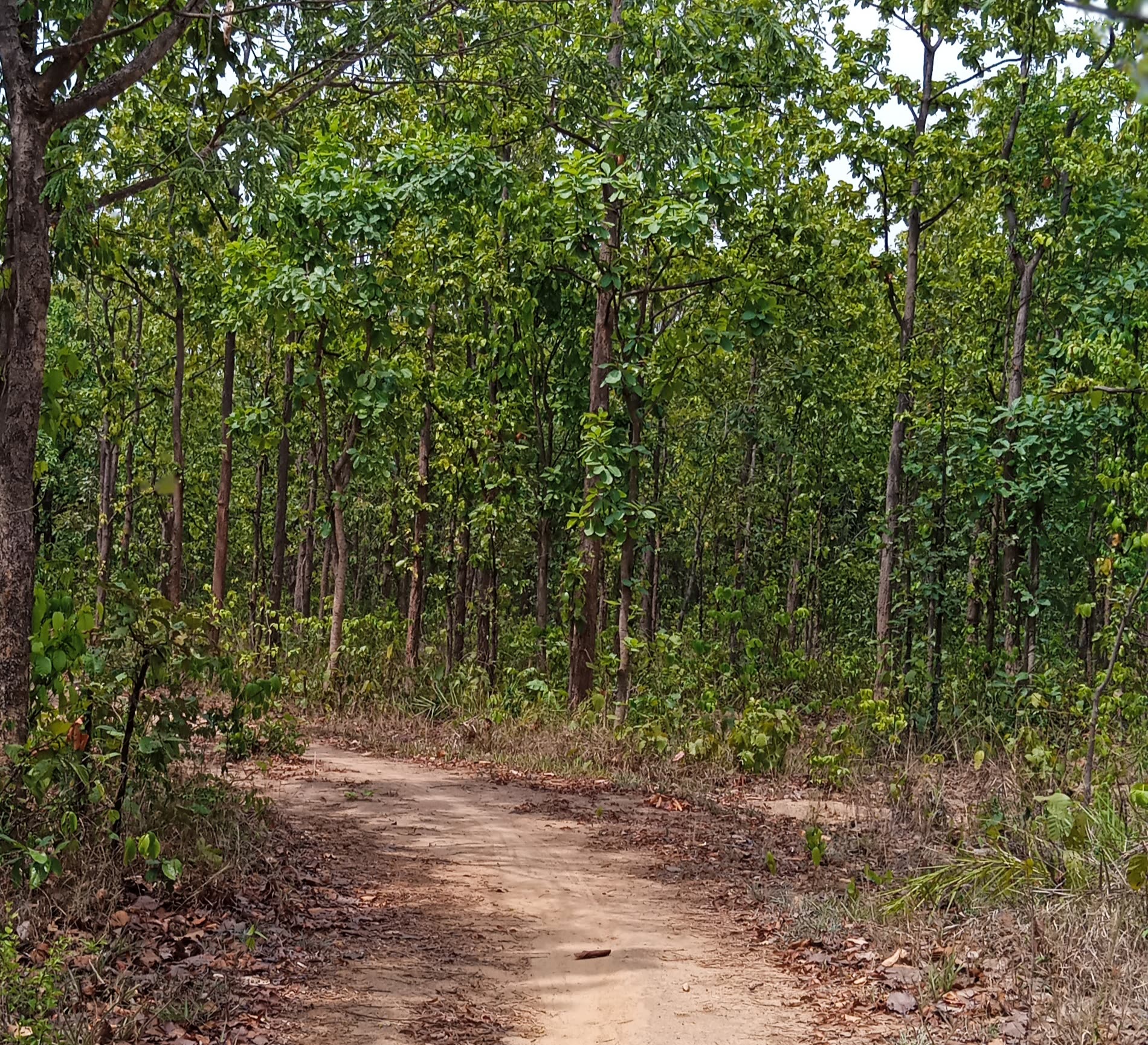
Pictured: sal forest landscape in present-day Purulia district, West Bengal — the region formed from the historic Manbhum district where Kadori, Borsi, and Managalda villages are located — not a photograph of the actual object, the mica mine, or the three villages themselves, none of which are known to survive in any freely licensed photograph from 1954.
Theoretical Alignment
This case file weights Psycho-Social/Mundane highest for a specific, disclosed reason: September 1954 sat at the leading edge of a genuine, well-documented global UFO wave centered on France but spreading reports across dozens of countries that autumn, and this case's own timing places it squarely within that broader cultural and reporting phenomenon rather than in isolation. What keeps ETH weighted meaningfully rather than negligibly is the sighting's own internal consistency — roughly 800 independent villagers across three separate locations reporting the same specific behavioral sequence (descent, hover, inflation, smoke, rapid ascent) on the same afternoon, corroborated by a single, named, occupationally credible witness willing to be quoted by name in a national newspaper.
That leading-edge timing is measurable rather than merely asserted. NICAP's own tabulation of the 1954 wave counts roughly 3,015 reports worldwide for the year, of which France alone contributed 1,159 — about 66% of Europe's total and well over a third of the entire global count — with the wave's single sharpest period falling in October 1954, when 1,150 reports were logged, split across two distinct spikes on October 3 and October 14 (84 reports apiece). Asia, by contrast, produced only 62 reports for the entire year, making the Manbhum case one of a comparatively small handful of Asian entries in an otherwise overwhelmingly European and North American wave, and its October 3 press date places it directly inside the wave's own sharpest reporting spike, even though the sighting itself had occurred more than two weeks earlier.
Researchers who have studied the 1954 wave's own causation have generally converged on a mix of explanations rather than a single cause: a modest run of genuine, ambiguous aerial phenomena (weather balloons, meteors, aircraft lighting) combined with an unusually intense contemporary press cycle that primed witnesses to interpret ordinary sky phenomena through the "flying saucer" lens, compounded by a documented tendency for sighting reports to cluster geographically and temporally once regional press coverage begins — a pattern some ufologists, including the French researcher Aimé Michel, have linked to imitative reporting and heightened public attention rather than any single triggering event. This case file's own PSH-weighted assessment of Manbhum sits comfortably within that mainstream explanatory consensus: a real, ambiguous aerial event, observed by a large and genuinely startled crowd, filtered through a media environment in which "flying saucer" had become the default vocabulary for exactly this kind of unexplained daytime aerial phenomenon.
Background
By September 1954, the modern flying saucer phenomenon was seven years old, dating to Kenneth Arnold's 1947 sighting in the American Pacific Northwest, and had by this point become a genuinely global press phenomenon rather than a strictly American one. The term itself, by 1954, had already traveled a considerable distance from its origin: Arnold, describing nine objects near Mount Rainier in June 1947, compared their erratic motion to "a saucer if you skip it across water," a description of movement the American press promptly misread as a description of shape, coining "flying saucer" for what Arnold himself never actually claimed were saucer-shaped craft. This case file finds a small irony worth noting in the Manbhum report specifically: unlike Arnold's own original objects, the Kadori-area object really was described as disc-shaped, meaning the Times of India headline writer's use of "flying saucer" in 1954 was, for once, a reasonably literal description of the reported object's form rather than an inherited misnomer.
The autumn of 1954 specifically produced what this catalogue's own broader holdings, alongside external UFO historians, document as one of the largest and most intensively reported UFO waves of the entire Cold War era, concentrated most heavily in France and Italy but extending, in various forms, across Western Europe, North Africa, and South Asia. This case file finds the Manbhum sighting's specific date — September 15, 1954, roughly two weeks before the wave's own peak intensity in early October — directly relevant context: it places the sighting near the front edge of that broader global surge rather than as an isolated, unrelated Indian phenomenon.
The Manbhum district itself, in the eastern Indian state of Bihar (the district has since been split among modern Bihar, Jharkhand, and West Bengal following subsequent administrative reorganization), was in 1954 a significant center of India's mica-mining industry, an extraction sector of genuine strategic importance to the young Indian republic, which had gained independence from British colonial rule only seven years earlier, in 1947. This case file finds the specific economic and institutional context of the primary witness's own occupation directly relevant to the case's credibility: the Kadori mica mine he managed was, according to contemporaneous reporting, supplying beryllium — a strategically significant, lightweight metal used in nuclear reactor components and other advanced applications — to India's own newly established Atomic Energy Commission, placing the witness within India's own nascent, security-conscious nuclear-adjacent industrial sector at the height of the global Cold War.
Manbhum itself has a considerably longer administrative history than its 1954 mica economy alone suggests. The district was constituted in 1833, when the British colonial administration broke up the older Jungle Mahals territory and formed Manbhum with its headquarters initially at Manbazar, moved to Purulia in 1838. At its largest colonial extent the district was substantial, encompassing tracts that today sit in three different Indian states: portions later absorbed into the Bankura and Burdwan districts of West Bengal, and portions later forming Dhalbhum, Saraikela, and Kharswan in what is now Jharkhand and Odisha. The district's own name is traditionally traced to Man Singh I, the Rajput general who served as a regional governor under the Mughal emperor Akbar in the sixteenth century — placing the region's recorded administrative identity centuries before either the mica industry or the flying saucer report that would make it briefly, obscurely famous in the international UFO literature.
The district's political geography was, in fact, actively unsettled at the exact moment of the September 1954 sighting. Between 1948 and 1956, Manbhum was the site of the Bengali Language Movement (locally, the Bhasa Andolon), a sustained agitation by the district's substantial Bengali-speaking population against its post-independence inclusion within Bihar, a Hindi-majority state. This case file finds that backdrop worth disclosing rather than treating as incidental: the same three villages that reported the flying saucer in September 1954 sat inside a district then in the middle of a linguistic and political reorganization dispute that would, within two years, result in Manbhum being formally partitioned. Under the States Reorganisation Act and the companion Bihar and West Bengal (Transfer of Territories) Act, both passed in 1956, the district's Bengali-speaking areas were transferred to West Bengal, forming the new Purulia district (born November 1, 1956), while its Dhanbad subdivision was carved out to remain within Bihar (today Jharkhand). No surviving sighting reportage connects the language movement to the flying saucer sighting in any way, and this case file draws no such connection either — it is offered strictly as regional political context for a district whose very name and administrative boundaries would cease to exist, in the form witnesses knew them in 1954, within two years of the event.
The mica industry that employed Chatterjee was itself a substantial and long-established regional economic sector by 1954, not a marginal operation. British prospectors identified commercially significant mica deposits in the Bihar region in the 1890s, and extraction expanded considerably after 1918, when construction of the Howrah–Delhi railway line cut directly through the forested tracts where the mineral was found, making large-scale transport of the mined sheet mica to processing and export centers practical for the first time. By the mid-twentieth century the resulting mica belt stretched roughly from Gaya district in the west, through Nawada, Koderma, Hazaribagh, and Giridih, to Jamui and Bhagalpur in the east — a band up to 40 kilometers wide at its broadest, in the Koderma–Hazaribagh–Nawada tract. Koderma in particular became known as the "Mica Capital of India," or Abrakh-Nagri, and Bihar, together with its later successor state Jharkhand, remains today — alongside Rajasthan and Andhra Pradesh — among India's principal mica-producing regions. Kadori, the specific mine Chatterjee managed, sat within this broader extractive economy, one of many mica operations across the district supplying both export markets and, in the specific case cited by the Times of India report, domestic strategic material.
That "strategic material" was beryllium, a light, heat-resistant metal used as a neutron reflector and moderator component in nuclear reactor design, among other technical applications. India's Atomic Energy Commission had been established in 1948 under the chairmanship of the physicist Homi J. Bhabha, and 1954 itself was the year in which Bhabha's growing atomic program was formally reorganized: the Department of Atomic Energy was constituted that year under the direct authority of Prime Minister Jawaharlal Nehru, with Bhabha continuing as its head. This case file finds it a genuinely notable, if very likely coincidental, detail that the same calendar year in which India's atomic energy administration was being placed on a more formal institutional footing was also the year a mine supplying that program's raw material became the site of the country's most widely reported flying saucer sighting — a coincidence of timing this case file discloses without asserting any causal or investigative connection between the two, since no surviving record indicates the Atomic Energy Commission, Bhabha, or any Indian government body took any interest in the Manbhum sighting at all.
This case file's metadata classifies the Manbhum sighting as a Close Encounter of the First Kind (CE1), using the taxonomy the astronomer J. Allen Hynek would formally publish nearly two decades later, in his 1972 book The UFO Experience. Hynek defined a CE1 as a sighting occurring within a few hundred feet of the witness that produces no lasting physical trace, no interaction with the environment beyond what the object's own passage might incidentally cause, and no claimed contact or communication with any occupant — a description that fits the Manbhum account closely: Chatterjee's own roughly 500-foot altitude estimate, the wind gust that rattled doors and windows as an incidental rather than deliberate environmental effect, and the complete absence of any claimed occupant or communication. This case file applies Hynek's later framework retrospectively, as it does across its broader catalogue of pre-1972 sightings, understanding that no witness or reporter in 1954 categorized the sighting in these terms at the time.
The mechanism by which a sighting in three small Bihar villages reached the front page of a national Bombay newspaper is itself worth explaining. The Times of India in 1954 was published by Bennett, Coleman & Co., a company founded in 1892 by Thomas Bennett and Frank Coleman that had passed out of British ownership only eight years earlier, sold in 1946 to the industrialist Ramkrishna Dalmia and, following a legal dispute over that acquisition, placed under the operational management of his son-in-law, Sahu Shanti Prasad Jain. By 1954 the paper maintained a wire and stringer network — the "Times of India News Service" credited on the Manbhum report — capable of picking up regional stories filed by provincial correspondents, in this case one filing from Calcutta rather than from within Bihar itself, and relaying them to the paper's Bombay editorial desk for national publication. That two-step relay (village to Calcutta correspondent to Bombay newsroom) is itself a plausible, mundane explanation for the roughly two-and-a-half-week gap between the September 15 sighting and its October 3 publication, without needing to invoke any deliberate suppression or delay.
Complete Timeline
| Date | Event |
|---|---|
| 1833 | British colonial authorities constitute Manbhum district from the former Jungle Mahals territory, with headquarters initially at Manbazar (moved to Purulia in 1838). |
| 1892 | Thomas Bennett and Frank Coleman found Bennett, Coleman & Co., the Bombay company that will publish The Times of India at the time of the 1954 sighting. |
| 1890s | British prospectors identify commercially significant mica deposits across the Bihar region, the beginning of the mica-mining economy that will later employ Ijapada Chatterjee. |
| 1918 | Construction of the Howrah–Delhi railway line through the region's forested tracts enables large-scale transport of mined mica, accelerating the industry's growth. |
| 1946 | Bennett, Coleman & Co. passes from British to Indian ownership, acquired by industrialist Ramkrishna Dalmia; management is later entrusted to his son-in-law, Sahu Shanti Prasad Jain. |
| 1947 | India gains independence from British colonial rule; Kenneth Arnold's Pacific Northwest sighting popularizes the modern "flying saucer" phenomenon in the United States. |
| 1948 | India's Atomic Energy Commission is established under the chairmanship of physicist Homi J. Bhabha. |
| 1948–1956 | The Bengali Language Movement (Bhasa Andolon) unfolds across Manbhum, agitating for the district's Bengali-speaking areas to be transferred out of Bihar — the same political backdrop against which the September 1954 sighting occurs. |
| 1954, formalized this year | India's Department of Atomic Energy is formally constituted under Prime Minister Jawaharlal Nehru, with Bhabha as its head; the Kadori mine's beryllium output supplies the Commission during this period. |
| September 15, 1954, afternoon | A grey, disc-shaped object descends to roughly 500 feet over the adjoining villages of Kadori, Borsi, and Managalda in Manbhum district, Bihar; approximately 800 residents observe the event. |
| September 15, 1954 (same event) | The object hovers, produces a whirring engine-like sound, appears to "inflate" on its sides, emits smoke from both ends, then ascends rapidly, generating a gust of wind strong enough to rattle doors and windows. |
| Late September 1954 | Reports of the sighting reach regional and national press channels via a Calcutta correspondent filing for the Times of India News Service. |
| October 3, 1954 | The Times of India publishes its account of the sighting, datelined "Calcutta, October 2," under the headline "800 Biharis See Flying Saucer," quoting mica mine manager Ijapada Chatterjee directly. |
| Early October 1954 | The broader 1954 global UFO wave reaches its own peak intensity — 1,150 reports for the month, concentrated primarily in France — with a documented reporting spike on October 3 itself, the same day the Manbhum account reaches print. |
| November 1, 1956 | Manbhum district is formally partitioned under the States Reorganisation Act and the Bihar and West Bengal (Transfer of Territories) Act; its Bengali-speaking areas become Purulia district in West Bengal, while its Dhanbad subdivision remains within Bihar (later Jharkhand). |
The Sighting
The Times of India's own report opens with a dateline that itself carries information: "Calcutta, October 2," credited to the paper's own Times of India News Service, indicating the story was filed by a Calcutta-based correspondent rather than a reporter present in Bihar itself, and that it reached the Bombay newsroom for publication the following day. The opening sentence is spare: "A flying saucer was reported to have been seen recently by about 800 people living in three adjoining villages in Manbhum Bihar." The mine Chatterjee managed, the report specifies, was named "Kadori" and was owned by a Calcutta businessman the surviving digitized clipping renders as "Mr. S. N. Gnose" — a spelling this case file discloses rather than silently corrects, given the same pattern of uncertain period transliteration already affecting the villages' own names, and the strong likelihood that "Gnose" represents a scanning or OCR artifact of a more conventional Bengali surname rather than the name as originally typeset.
According to the account Ijapada Chatterjee, the 60-year-old manager of the Kadori mica mine, gave to The Times of India, he was "sitting in the verandah of his house on the afternoon of September 15" when he first noticed a disc-shaped form "descending about 500 yards away" — an opening detail this case file finds notable for its ordinariness: the sighting began not as a dramatic aerial chase or a night-sky anomaly but as an interruption to an unremarkable domestic afternoon. As the object neared, he and the surrounding villagers were able to observe it in considerable detail: a dull grey disc approximately twelve feet in diameter, bearing what Chatterjee described as "a black patch that resembled an aperture" at the center of the side facing observers. The object descended to an altitude the witnesses estimated at roughly 500 feet, where it began emitting a sound multiple witnesses compared to "the whirring of a motor-car engine."
This case file finds the sighting's most evidentially distinctive detail to be what happened next. In the report's own phrasing, the object "hovered for a few minutes; then, suddenly, the two sides seemed to get inflated," immediately followed by what looked like smoke billowing from both ends of the craft. This case file treats that specific, unusual sequence — inflation followed by bilateral smoke emission — as a detail considerably more distinctive and harder to attribute to simple misidentification of a known object than a generic "light in the sky" description would be, since it describes a specific, structured, multi-stage physical process rather than a single static observation.
The object then, in Chatterjee's account, "soared upwards at an incredible speed," an ascent accompanied by "a tremendous gust of wind which caused doors and windows to rattle" in the surrounding village structures — a detail this case file finds significant precisely because it describes a physical, mechanical effect on the surrounding environment independently verifiable by anyone in the villages at the time, rather than resting solely on visual testimony of the object's own appearance.
This case file also flags the sighting's daylight timing as an evidentially relevant, easily overlooked detail. NICAP's own tabulation of the 1954 wave found that reports across the year concentrated heavily in evening hours, roughly 6 to 11 p.m., a pattern generally attributed to the greater visibility of anomalous lights against a darkened sky and to the after-work hours when most witnesses were outdoors and looking up. The Manbhum sighting, by contrast, occurred in full afternoon daylight, a detail that removes one of the most common conventional explanations offered for evening UFO reports — misidentified stars, planets, or aircraft lighting rendered unusually bright by atmospheric conditions — while simultaneously making the witnesses' physical description (grey color, a visible "aperture"-like patch, defined edges) considerably more specific and falsifiable than a typical nighttime light report could be.
The Witnesses and the Villages
The sighting was reported across three adjoining villages — Kadori, Borsi (rendered "Borsa" in some secondary accounts), and Managalda (rendered "Mangalda" in some secondary accounts) — a spelling discrepancy this case file discloses rather than silently resolving, given the considerable variation common in period English-language transliteration of Indian place names. This case file finds the multi-village corroboration itself significant: rather than a single, isolated observation, the same essential event was independently witnessed from at least three separate physical vantage points close enough together to observe the same object, but far enough apart to represent genuinely independent lines of testimony rather than a single crowd's shared account.
The published account also notes that a local religious figure present among the witnesses interpreted the object as "something from heaven," a detail this case file treats as culturally significant context rather than evidentiary content in itself — it documents how the local community processed and made sense of an event none of the roughly 800 witnesses had a pre-existing conventional framework to readily explain, without asserting anything about the object's actual physical nature. That interpretation sits within a much longer global pattern this catalogue documents elsewhere: rural witness populations without a ready secular vocabulary for a specific aerial phenomenon consistently reach first for the explanatory frameworks already available to them, whether religious, folkloric, or, in later decades, explicitly extraterrestrial once that framework had achieved sufficient global cultural penetration. In September 1954, barely seven years into the "flying saucer" era and considerably earlier in South Asia's own exposure to that specific Western framing, a religious interpretation was, if anything, the more culturally available explanatory option for an unfamiliar object witnessed by a large rural crowd.
The transliteration difficulties this case file discloses for Borsi/Borsa and Managalda/Mangalda were not unique to this report; they reflect a broader pattern common to English-language colonial and immediate post-colonial press coverage of rural Bengali- and Bihari-language place names, where a single village might be rendered several different ways across different newspapers, gazetteers, and later secondary compilations, none of which necessarily represents a single "correct" English spelling so much as a period journalist's best phonetic approximation. Manbhum district itself sat at a linguistic boundary between Bengali- and Hindi/Bihari-speaking populations, a boundary contentious enough by 1954 to be the subject of the sustained Bengali Language Movement described above, and it is precisely this kind of linguistically mixed, administratively unsettled district that historically produced the greatest transliteration inconsistency in contemporary English-language press accounts.
The figure of "about 800" witnesses given in the Times of India headline and text is itself worth treating as an approximation rather than a precise headcount. No contemporary source describes any formal survey, roll call, or systematic interview process conducted among the three villages' residents; the number almost certainly represents Chatterjee's or the correspondent's own rough estimate of the combined population exposed to the sighting, rather than a tally of individuals independently confirmed to have separately reported seeing the object. This case file treats "800" as a credible order-of-magnitude indication that the sighting was witnessed by a genuinely large crowd spanning multiple villages, without treating it as though it represented 800 individually verified, cross-examinable testimonies.
Kadori, Borsi, and Managalda are described in the Times of India account only as "three adjoining villages," without further geographic detail such as their distance from one another, their individual populations, or their precise relationship to the Kadori mine itself beyond Chatterjee's own residence there. This case file discloses that limitation explicitly: it has not been able to independently verify these villages' precise locations against a period gazetteer or modern satellite mapping with confidence sufficient to publish exact coordinates beyond the approximate district-level figure given in this file's Forensic Data Profile below, and readers should treat the 500-yard, 500-foot, and twelve-foot figures throughout this case as witness estimates rather than instrumented measurements.
Key Figures
Ijapada Chatterjee
The 60-year-old manager of the local mica mine, Chatterjee provided the most detailed firsthand account of the sighting, willing to be identified by full name and occupation in a national newspaper — a degree of public accountability this case file finds directly relevant to his overall credibility as a witness. He was, per the Times of India account, "sitting in the verandah of his house" when the object first appeared, placing him at a fixed, known vantage point rather than moving or preoccupied with another task at the moment of first observation. The mine he managed was owned by a Calcutta businessman the surviving clipping renders as "S. N. Gnose"; Chatterjee's role as the salaried on-site manager, answerable to an absentee urban owner and to a mine supplying strategic material to a young nation's Atomic Energy Commission, placed him in a position of genuine occupational accountability that this case file finds difficult to reconcile with any obvious motive for fabrication.
The Five Observables Assessment
The Five Observables framework is applied here to the object's described behavior as reported by Chatterjee and corroborated by the broader village witness pool:
Assessment: The object's described behavior — a controlled descent, sustained hover, a distinctive physical transformation (inflation and smoke emission), and a rapid, wind-generating ascent — describes a considerably more structured and multi-stage performance profile than a simple misidentified light or balloon would typically produce. This case file also notes what the Five Observables framework does not capture well: the sighting's daylight timing and its lack of any reported occupant, humanoid figure, or direct communication distinguishes it sharply from the concurrent French wave's own characteristic close-encounter reports of that same October, discussed further below, and arguably represents a simpler, lower-elaboration report profile than many of its European contemporaries.
Evidence Assessment
Supporting Anomalous or Unresolved Origin
- Approximately 800 independent witnesses across three separate villages corroborated the same basic event on the same afternoon.
- The primary witness, Ijapada Chatterjee, was a named, occupationally credible individual (a 60-year-old mine manager) willing to be identified in a national newspaper.
- The reported wind gust strong enough to rattle doors and windows represents a physical, environmentally verifiable effect independent of the witnesses' visual testimony alone.
- The specific, multi-stage behavioral sequence described (descent, hover, inflation, smoke, rapid ascent) is considerably more detailed and structured than a generic light-in-the-sky report.
- The sighting occurred in full daylight, removing common conventional explanations (misidentified stars, planets, or artificially lit aircraft) that account for a large share of nighttime UFO reports from the same wave year.
- Chatterjee's occupational background in visual mineral grading — a mica manager's daily work of inspecting sheet mica for clarity, color, and defects — lends some structured-observation credibility to his unusually specific physical description of the object.
Supporting Conventional Explanation
- The sighting occurred during the leading edge of a well-documented global UFO wave in autumn 1954, a period during which press coverage and public expectation of such sightings was already elevated.
- The comparatively high volume of European wave reporting in the days immediately surrounding October 3, 1954 may have made contemporary editors and wire services more receptive to publishing an aerial report from India than they would have been in a quieter news period.
- No photographs, physical trace evidence, or independent instrumented data corroborate the witness testimony.
- The specific village name spellings vary across secondary sources, indicating the surviving documentary record rests on a comparatively thin base of contemporaneous transcription.
- No government or scientific investigation of the sighting is known to have been conducted at the time.
- Unlike many concurrent October 1954 European reports, the account includes no claimed occupants, humanoid figures, or communication, a comparatively restrained narrative more consistent with misidentification of a mundane object than an elaborated close encounter.
- The precise villages' locations, individual populations, and distances from the Kadori mine are not independently documented, limiting this case file's ability to verify basic geographic claims beyond the primary press account itself.
Why "Credible"
This case earns a Credible rating on the strength of its large, multi-village witness pool and its single, named, occupationally verifiable primary witness, whose willingness to be quoted by full name and professional title in a national newspaper this case file finds a genuine, if modest, credibility asset relative to the many contemporaneous UFO reports built entirely on anonymous or pseudonymous testimony. It falls short of Verified because the surviving documentary record rests entirely on a single contemporaneous newspaper account, with no independent government investigation, physical evidence, or instrumented corroboration of any kind, and because the sighting's timing within a globally elevated period of UFO reporting activity leaves open the possibility that ordinary expectation and suggestion shaped some portion of the witness accounts.
This case file finds a useful point of comparison within its own holdings in The Greek UFO Wave of 1954, another case from the same global wave year involving multiple independent witnesses across a comparatively under-documented, non-Western reporting environment. Both cases share the same fundamental evidentiary profile — large witness pools, a single contemporaneous press record, no government investigation — and this case file finds their broadly similar credibility ratings an appropriate reflection of that shared evidentiary structure, rather than treating either as a special or unusual outlier within the broader 1954 wave.
This rating also weighs the specific institutional path the report traveled before publication. The Times of India was, by 1954, an eight-year-old, Indian-owned national daily under Bennett, Coleman & Co.'s post-1946 ownership, publishing from Bombay via a wire and stringer network capable of carrying a Calcutta correspondent's filed story to national print within roughly twenty-four hours of submission. That the story passed through this institutional structure — a named correspondent service, an editorial desk in a different city, national print distribution — rather than appearing only in a local pamphlet or being reported second-hand years later, this case file finds a modest additional point in favor of the account's basic contemporaneous accuracy, whatever remains unresolved about the object's ultimate nature.
Taken together, the case's restrained, single-witness-plus-crowd evidentiary structure, its documented placement within a specific, well-quantified global wave, and its comparative lack of embellishment relative to concurrent close-encounter reports elsewhere in that same wave all point toward the same conclusion this case file's rating reflects: a genuine, still-unexplained daylight aerial observation, reported through ordinary and traceable press channels, that neither the surviving record nor this case file's own research can either confirm as anomalous or dismiss as fabricated.
Observer Credibility & Occupational Profile
Ijapada Chatterjee's own occupational position — manager of a mica mine supplying strategic material to India's Atomic Energy Commission — places him within a genuinely security-conscious, technically literate industrial sector for 1954 India, a detail this case file finds relevant to weighing his credibility as an observer capable of describing an unfamiliar aerial phenomenon in specific, structured technical terms (the "aperture," the bilateral inflation, the smoke emission) rather than vague impressionistic language. This case file also credits the broader village witness pool's own sheer scale — roughly 800 individuals across three separate communities — as a meaningful, if informal, form of collective corroboration, while noting the corresponding limitation that none of these additional witnesses are individually named or independently interviewed in the surviving record, leaving Chatterjee's own testimony as this case's only individually attributable, cross-examinable account.
Mica mine managers of Chatterjee's era typically oversaw not just extraction but the mineral's cutting, grading, and inspection for export or industrial specification — labor demanding a working technical vocabulary and habitual attentiveness to precise physical description, since sheet mica's commercial and, in beryllium-bearing operations, strategic value depended on exactly the kind of careful visual grading a manager like Chatterjee would have performed daily. This case file finds that occupational background lends some additional, if modest, weight to his ability to render the object's appearance in the specific structured terms the Times of India account preserves — grey color, a defined "aperture"-like patch, a twelve-foot diameter estimate — rather than the vaguer impressionistic language common in reports from witnesses without comparable visual-inspection training.
Mica mines of this scale and era in Bihar typically operated with a small salaried supervisory staff — the manager and perhaps one or two assistants — overseeing a considerably larger workforce of local laborers engaged in extraction, splitting, and initial grading of the mineral. A manager's role combined technical oversight, grading mica for clarity and thickness against export or industrial specifications, with day-to-day personnel and logistics responsibility, a combination this case file finds relevant because it required Chatterjee to function, in effect, as both a trained technical observer and a locally embedded, publicly recognizable figure of some standing within the three villages — precisely the kind of witness whose account a national newspaper's editors would have had comparatively little difficulty deciding to publish under his own name.
Historical Precedents & Archive Matches
This case sits within the well-documented global 1954 UFO wave this catalogue's own holdings separately trace through The Greek UFO Wave of 1954 and the broader European reporting surge centered on France that autumn. This case file finds the Manbhum sighting's specific South Asian location genuinely significant within that broader pattern: while the 1954 wave's most intensively documented reports concentrate heavily in Western Europe, the Manbhum case demonstrates the same general period of elevated global UFO reporting activity extended meaningfully beyond its most commonly cited European and North African centers, reaching South Asia in a form detailed and specific enough to be picked up by a major national newspaper.
This case also connects to the broader pattern, documented elsewhere in this catalogue's holdings, of Cold War-era UFO sightings occurring near sites of genuine strategic or nuclear-adjacent industrial significance — a pattern this catalogue traces through cases including the 1968 CIA Himalayan Border UFO Sightings, whose own leading conventional explanation similarly centered on missile or nuclear-adjacent technical activity. This case file finds the Kadori mine's own beryllium supply role for India's Atomic Energy Commission a genuinely notable, if likely coincidental, point of resonance with that broader pattern, independent of whether any actual causal connection between the sighting and the mine's own strategic role can be established.
NICAP's own retrospective tabulation of the 1954 wave puts hard numbers behind the qualitative comparison already drawn above. The organization counts roughly 3,015 individual reports worldwide across the year, with Europe alone accounting for more than 58% of that total and France, the wave's undisputed epicenter, contributing 1,159 cases — about 66% of Europe's share and well over a third of the entire global count. The wave's single sharpest period fell in October 1954, which produced 1,150 reports on its own, arranged in two distinct spikes on October 3 and October 14, each logging 84 reports. Asia's total contribution for the full year was comparatively small: 62 reports, against North America's 701 and Latin America's 165. Within that thin Asian total, NICAP's own October 3 entries list a report from India alongside a single report from Lebanon — the Manbhum case itself, indexed there by its publication rather than its occurrence, since the sighting had taken place more than two weeks earlier on September 15.
The specific character of the wave's French core during exactly this period is also worth setting against the Manbhum report for contrast. Documentary catalogs of the early October 1954 French wave describe a rapid escalation from simple aerial sightings toward dozens of daily close-encounter reports involving landed craft and humanoid occupants — incidents at Chatellerault and Bugeat, Villeneuve-sur-Lot, and Nantes, among many others, in which witnesses described helmeted or "diving-suit"-clad figures performing tasks like sampling river water or issuing warnings about atomic weapons. Manbhum's report, by contrast, involved no landing, no occupants, and no claimed communication of any kind — a comparatively restrained, purely aerial-observation account that shares the wave's basic timing and disc morphology (NICAP's tabulation finds disc-shaped objects in roughly 42% of the year's reports) without sharing the elaborated close-encounter content that came to typify the wave's most famous French cases. This case file finds that distinction relevant to the sighting's overall credibility profile: a report that resists inflating its own content to match the period's most dramatic contemporary narratives is, on balance, more consistent with a genuine, if unexplained, observation than with a fabrication designed to court sensational attention.
Michel's own explanatory framework for the French wave went further than simple media contagion. His "orthoteny" theory proposed that many French sightings from the same nights could be plotted along essentially straight geographic lines, implying a coordinated flight path for whatever was producing the reports — a theory that generated considerable debate among contemporary ufologists and remains disputed by statisticians who have argued the alignments are as consistent with the chance clustering of essentially random points as with any deliberate pattern. No comparable orthoteny-style geographic analysis has ever been attempted for the Manbhum sighting, in part because it involves a single reported event location (the three adjoining villages) rather than the dozens of geographically dispersed French reports Michel's method required, and in part because no broader South Asian sighting cluster from the same weeks has been identified against which Manbhum could be plotted.
This case file also flags a specific methodological point for readers cross-referencing the Manbhum sighting against other wave-year catalogs and databases: because the surviving record is a press account rather than a witness-report intake form, external tabulations (including NICAP's own) sometimes index this case to its October 3 publication date rather than its September 15 occurrence date. Researchers comparing this case against other 1954 wave entries should confirm which date convention a given source uses before drawing conclusions about the sighting's precise position within the wave's overall timeline.
The absence of any formal follow-up investigation into the Manbhum sighting is also worth situating against what civilian UFO-research infrastructure did exist elsewhere in the world by 1954. In the United States, the Aerial Phenomena Research Organization (APRO) had been founded in January 1952 by Coral Lorenzen and Jim Lorenzen, and would go on to build the first UFO research organization to maintain a network of volunteer national representatives worldwide. No surviving record indicates APRO, any comparable Western civilian research body, or any equivalent Indian organization ever became aware of or investigated the Manbhum sighting at the time; the case appears to have circulated no further than its original newspaper publication until much later compilers and cataloguers, working retrospectively, began cross-referencing it against the broader 1954 wave. This case file finds that absence of any timely investigative follow-up a genuine, if unavoidable, evidentiary limitation, rather than evidence of any active suppression.
This catalogue's own Further Reading list for this case includes a dedicated survey of Indian UFO history spanning roughly a century of reports; that broader literature situates cases like Manbhum within a longer, recurring pattern of aerial-phenomenon reports across the subcontinent, extending from the late colonial period through the twenty-first century, rather than treating any single Indian sighting, including this one, as a unique or isolated event within the nation's own ufological record.
The comparison drawn above to the 1968 CIA Himalayan Border UFO Sightings is worth developing slightly further. That later case involved multiple witnesses across a physically remote, high-altitude border region, and its leading conventional explanation centered on classified reconnaissance and missile-tracking activity connected to the era's nuclear and Cold War rivalries. Manbhum shares the broad shape of that pattern — an economically or strategically significant site, a Cold War backdrop, no government investigation on record — while differing in one important respect: nothing in the Manbhum case's surviving documentary record suggests any Indian, American, Soviet, or Chinese military or intelligence interest in the sighting, at the time or since, distinguishing it from cases where an intelligence-community connection is independently documented rather than merely coincidental in setting.
Material Analysis
This case produced no physical or trace evidence of any kind that survives in the documentary record. No photographs, ground samples, or physical debris were reported recovered or preserved. This case file states that absence explicitly: the entire evidentiary record for this case consists of the roughly 800 witnesses' collective testimony as filtered through a single contemporaneous newspaper account, with no independent physical corroboration of any kind. This absence is unsurprising given the report's own institutional path: a rural sighting relayed through a single wire correspondent to a national desk in a different city, without any government agency, university, or press photographer dispatched to the scene at the time, left no realistic mechanism by which physical evidence — had any existed — would have been collected, preserved, or published. The absence of any photograph is also worth placing in its own period context rather than treated as inherently suspicious: personal camera ownership in rural mid-1950s India was rare even among comparatively prosperous residents such as a mine manager, and no press photographer was standing by in villages the size of Kadori, Borsi, or Managalda on the off chance of a newsworthy event. A sighting lasting several minutes, witnessed by villagers without ready camera access and reported to a national newspaper only after passing through a provincial correspondent chain, had essentially no realistic path to producing a surviving photographic record regardless of the object's actual nature. Photographic evidence was, more broadly, the exception rather than the rule across the era's UFO reports generally, given the cost and rarity of personal cameras and the near-total absence of press photographers present at the moment of any spontaneous, unplanned sighting; the absence of a photograph in the Manbhum case is therefore unremarkable by the ordinary evidentiary standards of its own period, rather than a deficiency unique to this report.
Supporting Non-Terrestrial or Unexplained Origin
- The reported wind gust strong enough to rattle doors and windows represents a physical environmental effect independently verifiable by anyone present, not merely visual testimony.
Supporting Terrestrial or Mundane Origin
- No physical trace evidence, photographs, or samples were ever recovered or documented.
- No independent government or scientific investigation was conducted to test the witnesses' claims against instrumented data.
The Conventional Explanation Candidate: A Genuine Aerial Object Misidentified Under 1954 Wave Conditions
This case file weighs three overlapping variants of the same underlying conventional-explanation family below, rather than treating them as mutually exclusive. Each starts from the premise that something genuine and aerial, though ultimately unremarkable, occurred over the three villages that afternoon, and the variants differ mainly in which specific mundane process best accounts for the witnesses' most distinctive claims — the reported inflation, the bilateral smoke, and the incredible speed of the final ascent.
The most straightforward conventional explanation holds that the villagers genuinely observed some real atmospheric or aerial phenomenon — potentially a weather balloon, a signal balloon of some kind, or a rare atmospheric optical or electrical phenomenon — whose ordinary characteristics were amplified, structured, and reinterpreted through the specific cultural lens of the "flying saucer" framework already saturating global press coverage by September 1954. This case file finds this candidate genuinely plausible given the sighting's precise timing at the leading edge of the broader global 1954 wave, a period during which public expectation of exactly this kind of aerial phenomenon was already substantially elevated worldwide.
A Genuine Balloon or Aerostat Misidentification
A second, more specific candidate holds that the object may have been a research, meteorological, or signal balloon of some kind, whose described "inflation" and dual-end "smoke" emission could plausibly correspond to a balloon envelope's own natural billowing motion in wind combined with condensation or ballast-release effects, observed at a distance sufficient to obscure its true, more mundane structure. India's own meteorological establishment had, by the early 1950s, decades of experience launching pilot and, from the 1930s onward, radiosonde balloons for upper-atmosphere observation, a well-established practice across the subcontinent's network of observatories under the India Meteorological Department. A drifting or wind-carried meteorological balloon, its fabric envelope flexing and its ballast or instrument payload occasionally venting gas, would be capable of producing an appearance broadly consistent with a rounded, grey object whose "sides" seemed to shift or "inflate" at a distance too great for the villagers to resolve its true structure, though this case file stresses that no specific balloon launch has been documented as occurring near Manbhum on September 15, 1954 — this remains a general category of mundane explanation rather than a positively identified specific cause.
Collective Reinterpretation of a Genuine but Mundane Aerial Event
A third candidate holds that some genuine, but entirely conventional, aerial event — potentially involving aircraft activity, a meteor, or other mundane phenomenon — occurred over the three villages that afternoon, and that the specific, structured "inflation and smoke" narrative emerged through a process of collective retelling and elaboration among the roughly 800 witnesses in the days between the event and its eventual press coverage, rather than representing a single, uniformly and independently observed sequence of events. The roughly seventeen-day gap this case file has already established between the September 15 sighting and its October 3 publication provides a specific, documented window during which this kind of collective elaboration could plausibly have occurred, as the story passed from initial village discussion through whatever chain of local, then regional, then Calcutta-based correspondent contact eventually delivered it to the Times of India News Service.
A Genuine Aerial Object Misidentified Under 1954 Wave Conditions — Plausibility Rating: PLAUSIBLE
Related Cases
Record Status
This case file's own research located no evidence of any government or official investigation into the Manbhum sighting, either by Indian authorities in 1954 or subsequently. The sole surviving documentary record is contemporary Indian press coverage, principally the October 3, 1954 Times of India report. Readers can independently search Indian national archives below.
Search Government Archives Directly
Further Reading — Recommended Literature
UFOs Over India: A Century of Sightings
A dedicated survey of Indian UFO reports spanning a century, providing essential regional context for evaluating the Manbhum sighting within India's own broader ufological history.
The Report on Unidentified Flying Objects (Original 1956 Edition)
The first head of Project Blue Book's own contemporaneous account of the early Cold War UFO era, including the broader 1954 wave period this case's own sighting falls within.
Above Top Secret: The Worldwide UFO Cover-Up
A landmark global survey of UFO reports and government responses, offering useful international comparative context for evaluating a South Asian case within the broader 1954 global wave.
UFOs and Government: A Historical Inquiry
A team of veteran UFO historians examine government and institutional responses to UFO reports across multiple countries and decades, providing essential comparative context.
The UFO Encyclopedia
A comprehensive reference situating individual international cases like Manbhum within the broader history and typology of the global 1954 UFO wave.
DISCLOSURE: Some links above are affiliate links. If you purchase through them, OverClassified receives a small commission at no additional cost to you. This helps support independent research.
Essential Viewing
Sources
- "800 Biharis See Flying Saucer," The Times of India, October 3, 1954. Reprinted primary source
- Project 1947, "1954 Sighting Catalog." Case chronology reference
- "UFO Sightings in India," Sandip Foundation. Case summary
- "Alien Sightings of India," Cryptid Wiki. Case overview
- "Top 5 UFO Sightings in India," India.com. Comparative case summary
- "UFO Historical Sightings: 1954," Barbara DeLong. Case chronology reference
- "UFO Sightings in India," Grokipedia. Case reference
- "The Worldwide UFO Wave of 1954," Academia.edu. Global wave context and analysis
- "Worldwide UFO Wave of 1954 Report," NICAP. Global wave documentation
- "October 1–9, 1954 UFO UAP Archive: The French Humanoid Incursion," Think About It Docs. Global wave context
- Vishal Munsif, PhD & Gavin Toy, UFOs Over India: A Century of Sightings.
- Edward J. Ruppelt, The Report on Unidentified Flying Objects, original 1956 edition.
- Timothy Good, Above Top Secret: The Worldwide UFO Cover-Up, William Morrow, 1988.
- Michael Swords & Robert Powell, eds., UFOs and Government: A Historical Inquiry, Anomalist Books, 2012.
- Jerome Clark, The UFO Encyclopedia, 3rd ed., Omnigraphics.
See something inaccurate? Have additional information or sources?
Suggest an Edit →Last Updated: August 2026