
UFOs Over India
A Century of Sightings
Core Thesis
UFOs Over India: A Century of Sightings is a 2025 casebook by Vishal Munsif, PhD and Gavin Toy, gathering roughly a century of reported Indian UFO sightings into a single dedicated national survey — a category of book this site's own research has found strikingly rare, since the vast majority of English-language UFO literature concentrates on North American, European, and, to a lesser extent, South American and Chinese cases, leaving India's own comparatively long and geographically distinctive documentary record scattered across local press archives, regional magazines, and disconnected online summaries rather than gathered into one accessible volume. The authors describe their approach directly: the book is "not a UFO 'story'" but "a UFO casebook — with India as its primary witness," built from what they call "a century's worth of reported sightings, that has been rigorously investigated by local, national and international print media." This site's own research draws on the book for two cases separated by more than half a century — the Manbhum Flying Saucer Sighting of 1954 and the Kolkata UFO Sighting of 2007 — treating the book as essential regional and historical context for understanding each within India's own broader, comparatively under-documented ufological history.
About the Author
Vishal Munsif, PhD brings an unusual combination of credentials to this book, and one worth describing in some detail because it departs so clearly from the typical profile of a UFO-book author. By day, he is an academic accountant: he holds multiple degrees in business including a doctorate in accountancy, and serves as an associate professor and director of the Master of Accountancy program at California State University, San Bernardino. His academic accounting research has, according to his own published biography, been cited and used by the United States Congress and the Securities and Exchange Commission in the drafting of new federal law — a genuinely unusual credential for someone co-authoring a UFO casebook, and one that speaks to a research background grounded in the kind of documentary rigor, citation discipline, and institutional literacy that accounting scholarship demands.
Munsif's second professional track runs in a very different direction: he holds an MFA in Film and Television Production and has worked across narrative film, documentary, and commercial production. That combination — rigorous academic documentation on one hand, visual storytelling craft on the other — maps directly onto the stated ambition of this book, which the authors frame explicitly as a documentary casebook rather than a narrative-driven popular account, assembled the way an investigative researcher builds a case file rather than the way a novelist builds a story.
Gavin Toy, the book's co-author, has a substantially thinner public biographical record available at the time of this site's research — no independently verifiable professional background, prior publication history, or institutional affiliation was located for him beyond his credited co-authorship of this book. This site's own editorial practice is to disclose that kind of research gap honestly rather than paper over it with invented biographical detail: readers evaluating this book's credibility should weigh Munsif's documented academic and documentary background specifically, since a comparable public record for Toy simply does not yet exist to independently verify.
As a 2025 publication, this book represents, as far as this site's own research has been able to establish, both authors' first credited work specifically in the UFO or ufology literature, making this article the first essential-reading entry for either author on this site and this book itself a genuinely new addition to the broader English-language literature on national UFO case surveys.
Historical Context & Origins
The book's stated century-long scope reaches back to encompass some of the earliest documented Indian sightings in the modern UFO era, including the Manbhum Flying Saucer Sighting of September 1954 — a period in which India itself was less than a decade removed from independence and partition, still in the earliest stages of building the scientific and institutional infrastructure, including its own nascent Atomic Energy Commission, that would come to define its mid-century development. That the book's own documentary record begins in this specific formative national period, rather than starting with more recent, better-instrumented cases, reflects a genuine commitment to comprehensive historical coverage rather than a narrower focus on only the most well-evidenced modern incidents.
India's own institutional relationship to UFO investigation stands in sharp contrast to several other national case histories this site's own essential-reading library already documents. France's GEPAN, founded in 1977 and covered in this site's own breakdown of Forbidden Science 2, represents a permanent, formally chartered state scientific body with a standardized investigative methodology sustained for nearly five decades. India has never established an equivalent standing civilian body; independent research into the country's institutional response finds that official investigations into UFO/UAP events have been rare and handled on an ad hoc basis, mostly by the Indian Air Force reacting to specific incidents — most visibly in November 2023, when a reported object over Imphal airport in Manipur led the IAF to scramble Rafale fighter jets and briefly suspend civilian flight operations, only for the pilots' advanced sensors to detect nothing conclusive despite low-level search maneuvers.
That comparative institutional gap is precisely the documentary space this book works to fill: without a dedicated national agency comparable to GEPAN/GEIPAN in France or NARCAP in the United States systematically cataloguing Indian reports over time, a century's worth of sightings has instead accumulated piecemeal across contemporary press coverage, regional-language reporting, and isolated online summaries — exactly the kind of scattered documentary record the authors describe assembling from "local, national and international print media" rather than from any single official case archive.
This site's own Kolkata UFO Sighting case file, occurring in 2007, falls within a modern era of Indian UFO reporting that also includes documented sighting clusters near strategically sensitive border regions — including more than 100 reports logged by Indo-Tibetan Border Police units near Pangong Tso Lake in Ladakh beginning around 2012, describing erratic spherical lights independently corroborated by multiple trained security personnel. Retired Indian Air Force Air Marshal Dilip Kumar Patnaik's own public assessment of such reports, emphasizing optical illusions, atmospheric refraction, and misidentified conventional aircraft as the most likely explanations for the large majority of cases, reflects the same broadly skeptical official posture this site's own Kolkata case file encounters directly in the person of planetarium director Debiprosad Duari and physicist Kamales Kar.
That same ad hoc pattern repeated itself most visibly and most recently in November 2023, when a reported bright object over Imphal airport in the northeastern state of Manipur led civilian flight operations to be suspended for several hours while the Indian Air Force scrambled two Rafale fighter jets and assumed control of the surrounding airspace. Despite the aircrafts' advanced onboard sensors and low-level search maneuvers, the pilots reportedly failed to detect any object, and no further official explanation was ever issued for what had been seen from the ground — a genuinely modern, high-profile episode that nonetheless followed the same basic institutional script this book's own century-spanning survey documents repeatedly: rapid, resource-intensive military response to a specific incident, followed by an inconclusive outcome and no lasting formal investigative record. This site's own research treats that recurring institutional pattern as one of the clearest illustrations of exactly why a book like this one performs a genuinely useful documentary function: without a standing civilian body tasked with systematically compiling and cross-referencing these individually well-publicized but institutionally disconnected incidents, each new Indian sighting risks being treated by the press and public alike as a novel, unprecedented event rather than as the latest entry in a documented pattern stretching back, per this book's own title, roughly a century.
Core Arguments & Key Concepts
The book's central and most structurally significant argument is one of documentary completeness rather than interpretive theory: by its own framing, its purpose is to gather and rigorously investigate a century's worth of previously scattered Indian sightings into a single accessible casebook, treating comprehensive national coverage itself as the primary contribution rather than advancing any single explanatory hypothesis about what Indian UFO reports, collectively, actually represent.
A second theme, reflected in the authors' own explicit self-description as producing "not a UFO 'story'" but a "casebook," is a stated commitment to documentary rigor over narrative embellishment — treating each case as an evidentiary record to be presented and investigated on its own terms, in the tradition of a formal case file, rather than shaped into a more dramatically satisfying but less evidentially disciplined story arc.
A third theme, implicit in the book's explicit "India as its primary witness" framing, is that a national case history deserves to be understood and evaluated as a coherent body of evidence in its own right, with its own regional patterns, institutional context, and evidentiary standards, rather than treated as a peripheral footnote to the far more extensively documented American and European UFO literature that dominates the field's popular canon.
A fourth theme, one this site's own research infers from the deliberate multi-decade scope of the book's title, is continuity: by spanning roughly a century rather than concentrating on a single wave or decade, the book implicitly argues that Indian UFO reporting represents a sustained, ongoing pattern rather than an isolated modern phenomenon or a series of unconnected, historically disconnected incidents.
A fifth theme, drawn from Munsif's own dual academic-and-documentary professional background, is methodological cross-pollination: applying the same citation discipline and evidentiary standard that characterizes peer-reviewed academic accounting research — a field literally built around verifying and auditing claims against underlying source documentation — to a body of UFO case material more commonly treated with looser sourcing standards elsewhere in the popular literature.
Key Cases & Evidence Discussed
The Manbhum Flying Saucer Sighting (September 15, 1954) unfolded across the villages of Kadori, Borsi, and Managalda in the Manbhum district of Bihar, at Manbhum, where a grey, disc-shaped object roughly twelve feet across descended to approximately 500 feet, hovering with a sound witnesses compared to an idling car engine before its sides appeared to "inflate," smoke billowed from both ends, and it climbed away at extraordinary speed, kicking up a gust of wind strong enough to rattle doors and windows. This site's own case file documents that roughly 800 villagers across the three communities watched the event unfold, with the most detailed surviving account coming from the sixty-year-old manager of the local Kadori mica mine — a detail this site's own research treats as genuine evidentiary weight rather than incidental color, since that mine was, at the time, supplying beryllium, a neutron-reflector metal used in nuclear reactor components, to India's own newly reorganized Atomic Energy Commission under physicist Homi J. Bhabha, placing the witness within a strategically significant sector of India's early nuclear program at the height of the global Cold War, in the same calendar year the Department of Atomic Energy was formally constituted under Prime Minister Jawaharlal Nehru's direct authority. This site's own case file also situates the sighting within its precise wider timing: it fell roughly two weeks before the front edge of a genuinely global 1954 UFO wave that NICAP's own tabulation counts at roughly 3,015 reports worldwide for the year, concentrated overwhelmingly in France (1,159 reports, well over a third of the global total) with Asia contributing only 62 reports for the entire year — making Manbhum one of a comparatively small handful of Asian entries in an otherwise overwhelmingly European and North American wave, and one whose own October 3, 1954 Times of India press date, less than three weeks after the sighting itself, placed it directly inside the wave's own sharpest reporting spike that same month. The district's own political geography adds a further layer of documented historical context this site's own case file discloses without asserting any causal connection: Manbhum sat, at the exact moment of the sighting, in the middle of the Bengali Language Movement, a sustained agitation against the district's post-independence inclusion within Hindi-majority Bihar that would, within two years under the 1956 States Reorganisation Act, result in the district's formal partition — meaning the very administrative unit in which the sighting occurred ceased to exist in its 1954 form within roughly twenty-four months of the event. This site's own resources library cites this book directly as providing "essential regional context for evaluating the Manbhum sighting within India's own broader ufological history," situating a single well-attested 1954 village sighting, corroborated by roughly 800 independent witnesses and a named, occupationally credible primary source, within the far larger century-spanning national pattern the book as a whole documents.
The Kolkata UFO Sighting (October 29, 2007) began in the pre-dawn hours when a senior private-company executive filming from his tenth-floor flat in the Kalikapur neighborhood of east Kolkata captured roughly three hours of handycam footage, beginning around 3:20 AM, of a bright, multi-colored object hanging at about 30 degrees above the eastern horizon that appeared, on tape, to morph from a sphere to a triangle to a straight line, radiating a shifting halo of colours, before fading with the dawn between 5:40 and 6:30 AM. This site's own case file situates the sighting within a specific, well-documented local context: it occurred just five days after Comet 17P/Holmes underwent a spectacular, globally observed brightness outburst in the same general pre-dawn eastern sky, and within a genuinely competitive mid-2000s Indian 24-hour television news environment in which unusual sky phenomena were a recurring ratings draw. Once a Kolkata television channel obtained and broadcast the footage, it produced two simultaneous effects this site's own case file treats as evidentially significant in their own right: hundreds of residents and motorists gathered along the Eastern Metropolitan Bypass hoping to witness the object directly, and two credentialed local scientists were sought out for same-day comment — M.P. Birla Planetarium director Debiprosad Duari, speaking from an institution founded in 1963 by India's first prime minister Jawaharlal Nehru, who proposed a cloud-and-city-light-reflection explanation after separately considering and rejecting both a Comet Holmes fragment and the planet Venus; and Saha Institute of Nuclear Physics astro-particle physicist Kamales Kar, working from an institute founded in 1950 by physicist Meghnad Saha, who raised the sharper technical objection that "a cosmic body cannot change its appearance so rapidly" while cautioning that television footage alone made firm conclusions difficult. This site's own case file draws out a further, genuinely telling evidentiary point: despite the E.M. Bypass crowd actively searching the same pre-dawn sky with cameras in hand, no second video, photograph, or specifically detailed individual eyewitness account from that crowd has ever surfaced in the eighteen years since — an absence this site's own analysis treats as modest circumstantial support for a transient, condition-specific explanation over a persistent physical craft, and rates the case overall at 65% alignment with a mundane optical/atmospheric explanation while candidly preserving a meaningful unresolved residue, since no contemporaneous weather record or satellite cloud image was ever located to definitively confirm what the object actually was. This site's own resources library cites this book as "a dedicated survey of documented Indian UFO reports across the past century, situating the Kolkata sighting within India's own broader, comparatively under-documented national case history" — precisely the kind of comparative national context that helps readers judge whether a single 2007 Kolkata sighting represents an isolated anomaly or one data point within a much longer documented pattern stretching back, per the book's own title, roughly a hundred years.
Critical Reception & Controversies
As a book published in 2025, this title has an almost entirely undeveloped public critical record at the time of this site's research: no Goodreads listing was located for it at all, in contrast to the thin-but-present single-digit rating counts this site's research has found for several other niche small-press UFO titles. This site's editorial practice treats that absence as a genuine data gap to disclose honestly rather than a critical judgment in itself — a book published within the past year, particularly one released through independent or small-press channels rather than a major trade publisher, would not be expected to have accumulated a substantial public review record yet regardless of its underlying quality.
This site's research attempted to verify an Amazon rating and any visible customer reviews for this title but Amazon's bot-detection system repeatedly blocked automated requests to the listing during this session, returning a CAPTCHA challenge across multiple attempts, consistent with the same blocking pattern this site's research has encountered for every other Amazon listing checked this session. Per this site's own Amazon Rating Display Protocol, this gap is disclosed honestly here rather than fabricated or silently omitted.
In the absence of an established third-party review record, this site's own evaluation instead rests on what can be independently verified: the specificity and accuracy of the book's citation, per this site's own resources library, in two separate, independently documented Indian case files spanning more than fifty years of the country's own sighting history, and the genuinely unusual, independently verifiable academic and documentary credentials of co-author Vishal Munsif. Neither of those facts substitutes for an established critical consensus, but together they represent the most substantive evidence currently available for assessing the book's underlying seriousness as a documentary project.
This site's research also notes, as a point of honest context rather than criticism, that co-author Gavin Toy's own professional background could not be independently verified through the sources available during this research session — a limitation this site discloses openly rather than either inventing biographical detail to fill the gap or silently omitting the co-author from proper acknowledgment.
Influence & Legacy
As a 2025 publication, this book is far too recent to have an established influence-and-legacy record in the conventional sense that older, more thoroughly reviewed titles in this site's essential-reading library possess. Its most concrete, currently verifiable contribution is instead structural: filling a genuine documentary gap this site's own research independently confirms exists, given how comparatively rare dedicated, book-length national UFO surveys of India are within the broader English-language UFO literature relative to the extensive coverage of North American, European, and, per this site's own prior essential-reading coverage of UFOs Over Modern China, Chinese case material.
The book's citation across two of this site's own case files, separated by fifty-three years of India's own national history — from a 1954 rural village sighting near a strategically significant beryllium mine to a 2007 urban Kolkata sighting debated by credentialed local scientists — demonstrates the book functioning exactly as its stated century-spanning scope promises: providing usable historical and regional context across genuinely different eras of Indian sighting activity rather than concentrating narrowly on either the earliest or the most recent material.
Within this site's own broader essential-reading library, this book's addition alongside UFOs Over Modern China and other national and regional survey titles reflects a deliberate editorial effort to document UFO reporting outside the more extensively covered American and European canon — a body of comparative national case literature this site's own research treats as valuable specifically because it remains comparatively underrepresented relative to its likely underlying volume of genuine sighting activity, given that a country of India's population and geographic diversity, spanning dense urban centers, sensitive Himalayan border regions, and a century of continuous press coverage, would statistically be expected to generate a substantial documentary record regardless of the underlying cause of any individual report.
Whether this specific book eventually accumulates the kind of sustained citation record and public review history that older, more established titles in this site's essential-reading library have built up over years or decades remains, as of this site's research in August 2026, genuinely unknown — the book is simply too recent for that question to be answerable yet. What this site's own research can document with confidence is its immediate, concrete utility: within months of its 2025 publication, it had already been cited across two of this site's own independently researched Indian case files, suggesting real and rapid uptake as a working reference source among researchers actively documenting the same national case history it surveys.
The Book
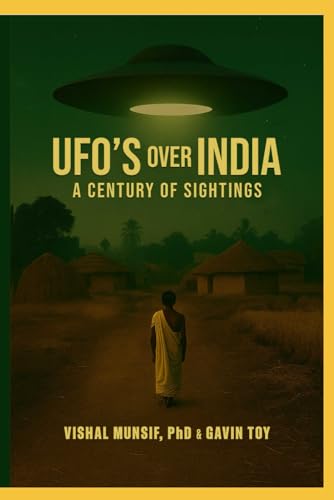
As an Amazon Associate, OverClassified may earn from qualifying purchases made through this link, at no extra cost to you.
Why This Is Essential Reading
UFOs Over India earns its place on this list as a rare, dedicated documentary casebook covering a national case history this site's own research independently confirms is comparatively underrepresented in the broader English-language UFO literature. Co-author Vishal Munsif's unusual, independently verifiable combination of academic accounting rigor and documentary filmmaking craft gives this fledgling 2025 title a genuinely distinctive methodological pedigree, even as this site's research honestly discloses the limits of what can currently be verified about co-author Gavin Toy's background and the book's still-undeveloped public critical record. What can be verified is more substantial: the book's citation across two of this site's own case files spanning more than half a century of Indian sighting history — the 1954 Manbhum Flying Saucer Sighting near a strategically significant mica-and-beryllium mine, and the 2007 Kolkata UFO Sighting debated by credentialed local scientists — demonstrates the book delivering exactly the kind of comparative national context its title promises. Read as an early but genuinely useful entry in the underdeveloped literature of national UFO case surveys, this book is essential because it begins, however recently, to gather a century of scattered Indian documentary evidence into the single accessible casebook that a country without France's GEPAN or America's NARCAP has never had.
Related Cases & Theories
Essential Viewing

Sources Cited
- Munsif, Vishal, PhD & Toy, Gavin. UFOs Over India: A Century of Sightings. Independently published, 2025 (ISBN 979-8-268061-38-3, cited here).
- "UFOs Over India: A Century of Sightings." AbeBooks (ISBN 9798268061383, marketplace listing photograph used for this article's cover image). abebooks.com
- "UFOs Over India: A Century of Sightings." Amazon.com (book description, page count, publication date). amazon.com
- "India's Otherworldly Encounters EXPOSED." Ancient Aliens, HISTORY, YouTube (video verified via oEmbed). youtube.com
- This site's own resources library: Full Reading List, where this exact 2025 edition is cited across 2 separate case-file pages.
- This site's own key-figures entry: Vishal Munsif, for his academic and documentary background.
- This site's own case file: The Manbhum Flying Saucer Sighting, which cites this book for regional Indian context.
- This site's own case file: Kolkata UFO Sighting, which cites this book for the same national historical context.
- This site's own essential-reading entry: UFOs Over Modern China, a comparable national case survey for a different underrepresented country.
- Dr. Vishal M. faculty profile, California State University, San Bernardino (academic biography, accounting research citation by U.S. Congress and SEC). linkedin.com
- "UFO in spotted in India! Emergency on Imphal Airport, IAF starts investigation." Business Today (2023 Imphal airport UFO incident and IAF Rafale response, independent institutional context). businesstoday.in
- "UFO sightings in India." Wikipedia (used lightly, for basic institutional and historical cross-checking only; not relied upon for the two case files' own facts, which follow this site's own dedicated case files above). en.wikipedia.org
Have corrections, additional research, or peer-reviewed sources? Help improve this entry.
Suggest an Edit