
The Emergence of a Phenomenon
UFOs from the Beginning Through 1959
Core Thesis
The Emergence of a Phenomenon: UFOs from the Beginning Through 1959 is Volume 2 of Jerome Clark's original three-volume UFO Encyclopedia project — the first attempt at a genuinely comprehensive, alphabetically organized (A–Z) reference work covering the UFO phenomenon's entire pre-1960 history, from 19th-century mystery-airship waves through the early Cold War sighting flaps that set the terms for everything that followed. Rather than arguing a single thesis, the book enacts an editorial philosophy Clark would carry through every later edition of the project: that after four decades of UFO reports by 1992, the field's own historical record was large, genuinely mixed, and deserved a reference work applying the same evidentiary discipline to every entry regardless of which side of the belief line it fell on — naming confirmed hoaxes as hoaxes (the book's own treatment of the 1897 Alexander Hamilton "cattle lasso" airship story, which Clark had personally investigated and exposed fifteen years earlier, is the clearest example), while treating genuinely unresolved cases as genuinely unresolved rather than forcing either a debunking or a believing conclusion where the evidence does not support one.
About the Author
Jerome Clark was born on November 27, 1946, in Canby, Minnesota, and attended South Dakota State University and Moorhead State College before building a career spent almost entirely inside institutional ufology's own reference and journalism apparatus rather than as an outside commentator on it. By the time this book appeared in 1992, Clark had already spent roughly a decade and a half as a working UFO editor: he had edited Fate magazine, the long-running paranormal digest, through the 1970s and 1980s, and since 1985 had served as editor of International UFO Reporter (IUR), the flagship journal of the J. Allen Hynek Center for UFO Studies (CUFOS) — a position that put him at the operational center of the same organization whose founder, astronomer J. Allen Hynek, had died in 1986, six years before this book's publication, leaving CUFOS and its own most visible in-house historian, Clark, to carry forward Hynek's project of treating UFO reports as a legitimate subject for patient, archival-grade documentation rather than either dismissal or advocacy.
This book was Clark's first major solo reference work, and its scale reflects an unusual personal undertaking: per a detailed account from fellow researcher and personal friend David Halperin, the full three-volume UFO Encyclopedia project Clark wrote across 1990–1996 ran to "nearly 1,200 encyclopedia-sized pages," of which Clark personally authored all but 12 of the project's 273 total entries himself — the small number of outside contributions included folklorist Thomas Bullard's specialist articles on "Abduction Phenomenon," "Anomalous Aerial Phenomena before 1800," and "Waves." Halperin, who knew Clark from adolescence, recalled that even as a teenager Clark's writing was already "clear, astringent, slightly ironic and compellingly readable" — a description later reviewers of the finished encyclopedia would echo almost verbatim.
Clark's approach did not go unchallenged from the skeptical side of the field. Philosopher and CSICOP co-founder Paul Kurtz, whose own Prometheus Books published rival skeptical surveys including Robert Sheaffer's contemporaneous work, criticized Clark as "easily impressed by questionable evidence" even while, in the same breath, faulting Clark for attacking closed-minded skepticism — a two-sided critique from a leading organized-skepticism figure that positions Clark, in the wider field's own self-understanding, as occupying a genuinely middle position: too evidentially cautious for UFO proponents who wanted the encyclopedia to affirm more, and too willing to leave cases open for skeptics who wanted it to close more down.
Clark's career both before and after this volume ranges considerably wider than ufology alone. He researched and wrote about the Heaven's Gate religious movement before its March 1997 mass suicide; he later co-authored Cryptozoology A to Z (1999) with cryptozoologist Loren Coleman, who has separately called Clark "a wonder"; and, entirely apart from paranormal writing, Clark has had a parallel career as a country and folk songwriter, with compositions recorded by artists including Emmylou Harris and Mary Chapin Carpenter — an unusual second creative life running alongside four decades of UFO reference-book authorship. In June 2008, the Society for Scientific Exploration recognized that body of work with its Dinsdale Award, citing his contributions to "the expansion of human understanding through the study of unexplained phenomena," and his 1998 single-volume spinoff The UFO Book: Encyclopedia of the Extraterrestrial separately won a Benjamin Franklin Award in the Science/Environment category — both honors arriving years after this 1992 volume but building directly on the reference-work reputation it established.
Historical Context & Origins
Omnigraphics published The Emergence of a Phenomenon in 1992 as the second installment of a three-volume project that itself shipped out of chronological order: Volume 1, UFOs in the 1980s, had appeared first via Apogee Books in 1990, addressing the most current decade of cases while Clark was still assembling the earlier historical material; this volume followed two years later, reaching back to cover the entire pre-1960 foundation of the phenomenon; and a third volume, covering the 1960s and 1970s, followed via Omnigraphics in 1996, completing the original set before Omnigraphics itself consolidated all three into a two-volume "2nd edition" omnibus in 1998 (later followed by an expanded 3rd edition in 2018, and a 4th edition in 2024 already covered separately on this site as The UFO Encyclopedia).
The book arrived at a specific institutional moment for American ufology: J. Allen Hynek, the astronomer who had founded CUFOS in 1973 after two decades as the Air Force's own scientific consultant on Project Blue Book, had died in 1986. Clark, as CUFOS's own in-house historian and the editor of its flagship journal since 1985, was among those best positioned to carry forward Hynek's specific project — treating UFO reports as a legitimate, patiently documentable historical record rather than either an embarrassment to be dismissed or a cause to be advocated — into reference-work form. This book's pre-1960 scope in particular meant directly engaging with cases from Hynek's own Air Force consulting years, giving Clark's treatment of that era an unusually direct institutional throughline back to the period's own original scientific gatekeeper.
The book also arrived just as the Cold War's end was reopening whole categories of pre-1960 case material to Western researchers for the first time. The Soviet Union's December 1991 collapse, barely months before this book's own 1992 publication, had begun surfacing decades of previously inaccessible Eastern Bloc sighting reports and official records, meaning Clark's own pre-1960 research, largely built from Western press archives and CUFOS's existing case files, was necessarily still working with an incomplete picture of the same decades on the other side of the former Iron Curtain, a limitation any 1992-era reference work covering this period shares.
Structurally, the book's alphabetical (A–Z) format, spanning a reported 113 entries across the pre-1960 period, situates it in a specific ufological-reference tradition distinct from narrative history: rather than telling a single continuous story of the phenomenon's early decades the way a case-by-case survey like Robert Sheaffer's contemporaneous UFO Sightings: The Evidence (also 1998 in its own final published form, though its skeptical case-tracking work long predates that) does, Clark's encyclopedia format lets a reader look up any individual case, investigator, or organization independently — a reference-desk design choice that has made the project, across its four now-published editions, one of the field's standard go-to citation sources rather than a book most readers work through cover to cover.
Core Arguments & Key Concepts
The book's governing method, carried through from this original 1992 volume into every later edition of the project, is even-handed evidentiary discipline applied entry by entry rather than a single overarching argument about what UFOs are or are not. British folklorist David Clarke, reviewing the wider encyclopedia project this volume founded, called it "one of the few attempts to distil the extensive literature of the subject into a definitive, objective history of UFOlogy," praising Clark's "masterly command of the subject in all its many and varied manifestations" built from four decades of work as a UFO historian — a description of the project's overall character that this founding pre-1960 volume, as the earliest-researched and most historically settled portion of the phenomenon Clark covered, exemplifies as clearly as any of the volumes that followed it.
A central, recurring theme specific to this volume's pre-1960 scope is the willingness to name a confirmed hoax as a confirmed hoax without treating that finding as an indictment of the wider phenomenon. The clearest example is Clark's own treatment of the Alexander Hamilton 1897 "cattle lasso" airship story, part of the great airship wave this volume covers: Clark had personally investigated the case in 1977, fifteen years before this book's publication, corroborating an elderly Le Roy, Kansas woman's account that Hamilton had privately admitted inventing the story to win a local "liars' club" tall-tale contest — establishing it, in this site's own case-file research and consistent with Clark's published position, as the wave's single most thoroughly documented confirmed hoax, even as the same wave's Sacramento and Governor Leedy Topeka sightings remain, in Clark's own treatment, genuinely unresolved rather than similarly dismissed.
A second theme is treating international waves as coequal with the better-known American cases rather than as a mere appendix to them. The book's coverage of New Zealand's 1909 airship wave situates it within the same international "phantom airship" chronology as the American 1896–97 wave and Britain's own contemporaneous scares, treating the phenomenon's earliest history as a genuinely global pattern rather than an American story with foreign footnotes — a framing this site's own case-file research on the New Zealand wave describes as placing it "within the same international 'phantom airship' chronology as the American and British waves."
A third, related theme runs through the book's treatment of the early Cold War's international sighting waves: its coverage of the 1952 waves over Morocco and French West Africa and the Oloron and Gaillac "angel hair" sightings the same year extends the same case-by-case documentary method to reports from outside the United States entirely, cataloguing them with the same entry-level rigor rather than treating non-American cases as secondary source material — a genuinely comprehensive approach this site's own research on the Morocco file calls "a standard academic-adjacent reference work for cross-checking how the 1952 wave's individual incidents, including international ones, have been catalogued by researchers."
A fourth theme, evident in the book's coverage of 1954's broader Western European sighting wave specifically — including the Florence Stadium Sighting in Italy and the Marignane Airport Landing in France, both dated to that year — is documenting how quickly and how far a single reporting pattern could spread across national borders once it took hold: 1954's wave, one of the most intensively documented cross-border UFO flaps of the pre-1960 period, receives the same granular, case-by-case treatment in this volume that the book applies to the far better-known 1896–97 American wave decades earlier, letting a reader compare how two mass-sighting events, half a century apart and on different continents, actually unfolded case by case rather than only in aggregate.
Key Cases & Evidence Discussed
This book's own reported scope covers 113 alphabetically organized entries spanning the entire pre-1960 UFO phenomenon, from 19th-century mystery-airship waves through the early Cold War sighting flaps of the 1950s — a scope this site's own case-file citation record independently confirms across six separate pages spanning six decades and three continents.
The Great Airship Wave of 1896–1897 (Case File #228) receives the book's most extensively cross-referenced treatment on this site: Clark's own 1977 field investigation, conducted fifteen years before this book's publication, corroborated an elderly Kansas woman's account that Alexander Hamilton's famous cattle-lasso airship story, backed by a notarized affidavit signed by eleven local officials, had actually been invented to win a local "liars' club" tall-tale contest — a finding this site's own case file calls the wave's "most frequently cited confirmed hoax," while noting in fairness that Clark's debunking itself rests on one witness's decades-later secondhand recollection rather than a document Hamilton personally signed admitting fabrication. The same file treats Clark, alongside historians Robert Bartholomew, Michael Busby, and Daniel Cohen, as one of the four researchers whose published work it draws on most heavily for understanding the wave's newspaper-industry backdrop and its confirmed-hoax component (the Hamilton story and the separate, days-long Collins-Benjamin "secret inventor" fabrication).
The New Zealand Airship Wave (Case File #273, 1909), centered on sightings over Dunedin, extends the same "phantom airship" documentary method to the Southern Hemisphere twelve years after the American wave, and this site's own case file describes this book as "the volume of Clark's standard scholarly UFO Encyclopedia covering the pre-Roswell era in depth, situating the New Zealand wave within the same international 'phantom airship' chronology as the American and British waves."
Two 1952 international cases — the UFO Sightings over Morocco and French West Africa (Case File #180), spanning reports over Casablanca, Meknes, and Had Kourt, and the Oloron/Gaillac Angel Hair Sighting (Case File #244), split between Oloron-Sainte-Marie and Gaillac — are both catalogued in this volume as part of the broader early-1950s international sighting surge, with this site's own Morocco case file describing the book as "a standard academic-adjacent reference work for cross-checking how the 1952 wave's individual incidents, including international ones, have been catalogued by researchers."
Two 1954 cases — the Florence Stadium Sighting (Case File #108), over Florence, Italy, and the Marignane Airport Landing (Case File #214), at the airport in Marignane, France — round out this volume's coverage of that year's intensively documented Western European sighting wave, with this site's own Marignane case file describing the book as covering "the exact 1947–1959 window this case sits within and providing the wider American and international context against which an isolated early-1954 French airport report can be assessed."
Critical Reception & Controversies
As with several standalone volumes from Clark's original three-part encyclopedia project, this specific 1992 edition does not appear to have drawn a dedicated period review from a major library or trade journal distinct from the reviews the project's later, more widely distributed 1998, 2018, and 2024 editions received — an absence disclosed here honestly rather than papered over with a review that was actually written about a different edition.
The clearest documented critical assessment specifically of Clark's encyclopedia-writing approach, rather than of any one edition's packaging, comes from philosopher and CSICOP co-founder Paul Kurtz, who criticized Clark as "easily impressed by questionable evidence" — a real, named critique from organized skepticism's own founding generation, and one this site presents alongside the immediate qualifier that accompanied it in the source record: Kurtz leveled the same criticism at Clark for attacking closed-minded skepticism in the same breath, a two-sided complaint that reads less as a clean debunking of Clark's rigor than as evidence Clark occupied a genuinely contested middle ground between organized skepticism and UFO advocacy.
British folklorist David Clarke's assessment of the wider project this volume founded, published in the academic journal Folklore in 2002, runs in the opposite direction, calling it "one of the few attempts to distil the extensive literature of the subject into a definitive, objective history of UFOlogy" and "indispensable" as a standard reference work — a genuinely peer-adjacent, academic-press assessment of the project this volume founded, though Clarke's review addresses the encyclopedia as a whole rather than singling out this 1992 volume specifically.
On Amazon, this exact 1992 edition (ISBN 1558887415) carries a 4.2-out-of-5 average from a small sample of three ratings (checked August 2026) — too small a sample to draw a strong conclusion from on its own, and disclosed here as exactly that rather than treated as a robust signal.
The clearest and most independently verifiable measure of this volume's lasting reference value is this site's own citation record: six separate case files, spanning the 1896–97 American airship wave through 1954's Italian and French sightings, cite this exact 1992 edition directly — a citation pattern this site's own research treats as stronger, more durable evidence of the book's usefulness as a working reference than any single period review could provide.
Influence & Legacy
The most directly measurable evidence of this volume's ongoing influence is on this site itself: this exact 1992 edition is cited across six separate case-file pages — the Great Airship Wave of 1896–1897, New Zealand Airship Wave, UFO Sightings over Morocco and French West Africa, Oloron/Gaillac Angel Hair Sighting, Florence Stadium Sighting, and Marignane Airport Landing — making it this site's primary reference source for the entire pre-1960 period of UFO history specifically.
The book's more direct institutional legacy runs through the larger project it founded: Omnigraphics consolidated this volume with its two companion volumes into a two-volume "2nd edition" omnibus in 1998, which David Clarke's own review praised as "a treasure for anyone interested in UFOs"; a further-expanded 3rd edition followed in 2018; and a 4th edition appeared in 2024, covered separately on this site as The UFO Encyclopedia. Each successive edition carried this original volume's pre-1960 research forward largely intact, meaning the historical spine of Clark's 2024 reference work still traces back, entry by entry, to research first published here in 1992.
Clark's own career-long recognition followed directly from the reputation this project established: the Society for Scientific Exploration's 2008 Dinsdale Award and the Benjamin Franklin Award won by his 1998 single-volume spinoff The UFO Book: Encyclopedia of the Extraterrestrial both credit, at bottom, the same patient, entry-by-entry documentary method this 1992 volume was the first published installment of.
Within this site's own research specifically, this book functions as the foundational reference for the entire pre-Roswell-era portion of the case-file library: its six citing case files span from 1896 to 1954, and its own treatment of the Alexander Hamilton hoax — grounded in Clark's personal 1977 field investigation, fifteen years before this book's own publication — remains, per this site's own Jerome Clark key-figures entry, "the best-documented confirmed hoax within the wider 1896-97 mystery airship wave."
The Book
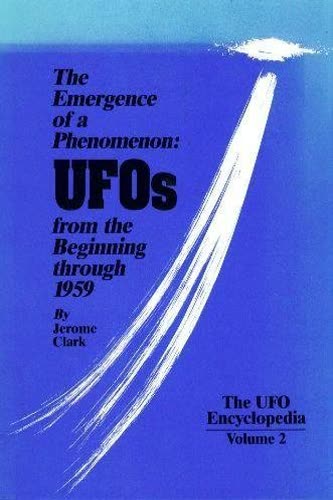
As an Amazon Associate, OverClassified may earn from qualifying purchases made through this link, at no extra cost to you.
Why This Is Essential Reading
The Emergence of a Phenomenon earns its place on this list as the founding volume of the single reference work this site cites most often for the UFO phenomenon's earliest history: a genuinely comprehensive, entry-by-entry survey of the pre-1960 period written by Jerome Clark at a moment — six years after J. Allen Hynek's death, and as CUFOS's own in-house historian — when carrying forward that kind of patient, evidentially disciplined documentation was squarely his job. Its real, lasting value on this site's own evidence is not any single contemporary review, which this specific 1992 edition does not appear to have generated on its own, but a citation record spanning six case files across sixty years of history, from the 1896–97 American airship wave this book's own author personally helped debunk in part, to 1954's Italian and French sightings on the other side of the Atlantic. Read as the historical foundation for the later, more widely reviewed editions of the same project — and alongside Robert Sheaffer's contemporaneous skeptical case surveys for a differently angled take on some of the same decades — this book is essential precisely because so much of what this site and the wider field know about UFO history's first six decades still traces back, entry by entry, to research first published here.
Related Cases & Theories
Essential Viewing

Sources Cited
- Clark, Jerome. The Emergence of a Phenomenon: UFOs from the Beginning Through 1959. Omnigraphics, 1992 (ISBN 1-55888-741-5, cited here).
- Clark, David. Review of The UFO Encyclopedia: The Phenomenon from the Beginning, by Jerome Clark. Folklore, vol. 113, 2002 ("one of the few attempts to distil the extensive literature of the subject into a definitive, objective history of UFOlogy").
- Clark, Jerome. UFOs in the 1980s (The UFO Encyclopedia, Vol. 1). Apogee Books, 1990 — the companion volume immediately preceding this one in Clark's original three-volume project. archive.org
- "The Emergence of a Phenomenon: UFOs from the Beginning Through 1959 (The UFO Encyclopedia)." Amazon.com (ISBN 1558887415, publisher, publication date, page count, and current rating, checked August 2026). amazon.com
- "Jerome Clark." Wikipedia (biography: birth, education, bibliography, Paul Kurtz criticism, Benjamin Franklin Award). en.wikipedia.org
- "Jerome Clark." Center for UFO Studies (official CUFOS board bio: Fate and IUR editorships, 2008 Dinsdale Award). cufos.org
- "International UFO Reporter." Center for UFO Studies (the CUFOS journal Clark has edited since 1985, the same institutional post he held while writing this book). cufos.org
- Halperin, David. "My Friend Jerry — Jerome Clark — and 'The UFO Encyclopedia.'" davidhalperin.net (personal recollection, production details: ~1,200 pages, 273 entries, 12 outside contributions including Thomas Bullard; David Clarke review quotes). davidhalperin.net
- This site's own resources library: Full Reading List, where this exact 1992 edition (ISBN 1558887415) is cited across 6 separate case-file pages.
- This site's own key-figures entry: Jerome Clark, for his full biography and site-wide case connections.
- This site's own case file: The Great Airship Wave of 1896–1897, which documents Clark's 1977 investigation of the Alexander Hamilton hoax in depth.
- This site's own case file: New Zealand Airship Wave, which cites this book for the international "phantom airship" chronology.
- This site's own case file: UFO Sightings over Morocco & French West Africa, which cites this book for cross-checking the 1952 international wave.
- This site's own case file: Oloron/Gaillac Angel Hair Sighting, which cites this book for its 1952 case coverage.
- This site's own case file: Florence Stadium Sighting, which cites this book for its 1954 French wave coverage.
- This site's own case file: Marignane Airport Landing, which cites this book for the 1947–1959 window it covers.
- This site's own essential-reading entry: The UFO Encyclopedia (4th ed., 2024), the direct successor project this 1992 volume's research fed into.
- This site's own essential-reading entry: UFO Sightings: The Evidence by Robert Sheaffer, a contemporaneous skeptical case survey covering overlapping decades from a different methodological angle.
Have corrections, additional research, or peer-reviewed sources? Help improve this entry.
Suggest an Edit