
Project Blue Book Special Report No. 14
Commissioned by Project Blue Book director Edward Ruppelt and produced by the Battelle Memorial Institute, Special Report No. 14 statistically coded 3,201 Air Force UFO cases across roughly 30 variables — the largest such analysis ever conducted. Its central, inconvenient finding, buried inside 312 pages of charts and tables, was that the better-documented and more credible a sighting was, the more likely it was to be classified unknown: 35% of "excellent" quality reports versus 18% of the poorest. The Air Force's own public summary of the study claimed only 3% of cases were unexplained.
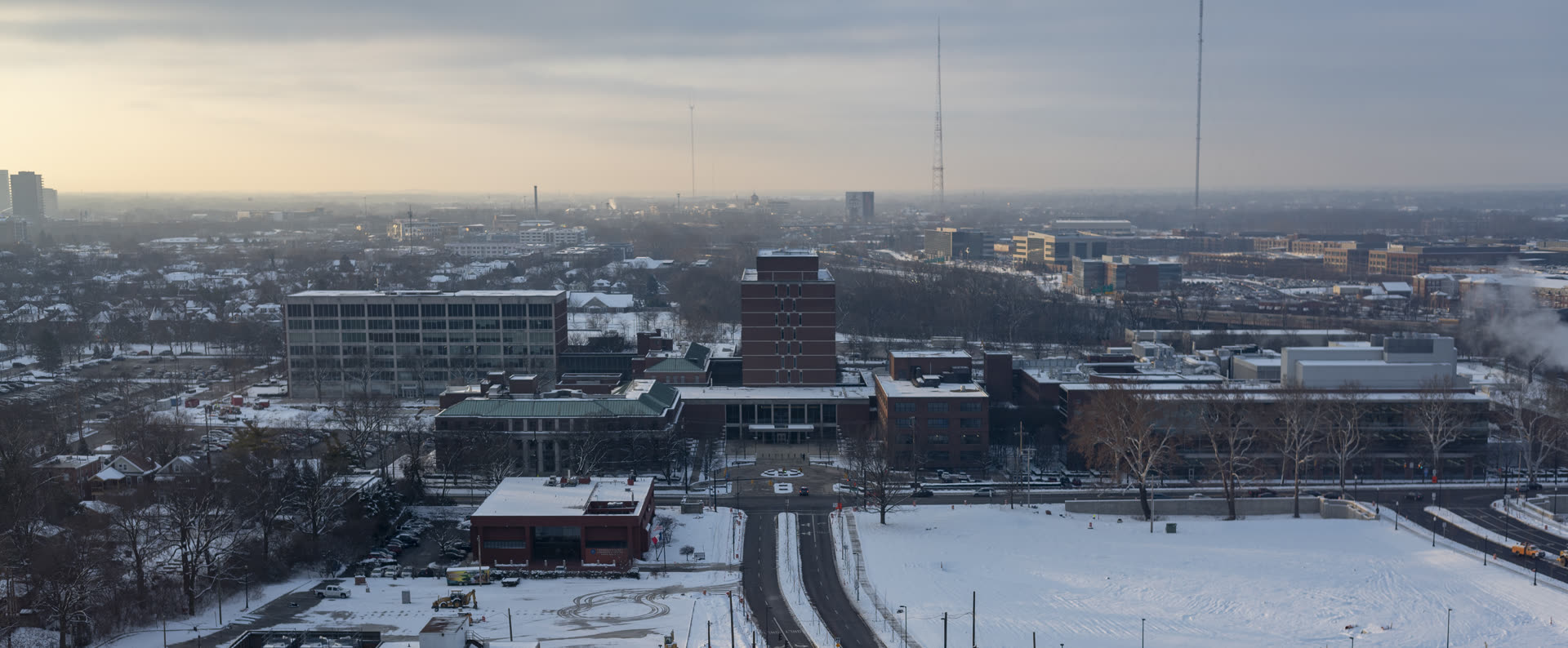
Pictured: the Battelle Memorial Institute headquarters on King Avenue in Columbus, Ohio, where the report's analysts were based — not a photograph of the report document itself or its original 1955 cover, no rights-clear scan of which is known to be freely licensed (only a low-resolution Internet Archive thumbnail exists).
Theoretical Alignment
Special Report No. 14 is not itself a sighting, and this case file treats its theoretical alignment accordingly: not as evidence for what any specific object was, but as evidence about the statistical shape of the entire body of Air Force UFO reporting. Its central finding — that report quality correlates positively, not negatively, with an "unknown" classification — cuts directly against the standard Psycho-Social explanation for the phenomenon as a whole, which predicts the opposite pattern: that poorly documented, low-credibility reports should be the ones most likely to resist mundane explanation, while well-documented, high-credibility reports should be the easiest to resolve. Battelle's own data showed the reverse. This case file assigns that finding real ETH-supportive weight for exactly that reason, while withholding higher alignment because the study itself draws no ETH conclusion — its own analysts explicitly declined to say what the unknowns actually were, only that they were not explainable with the information available.
Background
By late 1951, Air Force Captain Edward J. Ruppelt, newly assigned to head what would shortly be renamed Project Blue Book, had inherited a UFO reporting system he considered methodologically primitive: reports were evaluated case by case, largely by individual investigator judgment, with no standardized coding, no statistical cross-tabulation, and no way to test whether patterns existed across the growing case file as a whole. Ruppelt, who had trained as an aeronautical engineer before his Air Force service, wanted the study put on a genuinely scientific footing, and in December 1951 he approached the Battelle Memorial Institute, a well-regarded private, nonprofit applied-research contractor based in Columbus, Ohio, with a track record of rigorous, statistically literate work for government and industry clients.
The resulting contract, publicly identified decades later under the codename Project Stork, tasked a team of Battelle scientific analysts — statisticians, astronomers, physicists, engineers, and a psychologist among them — with building a standardized questionnaire capturing roughly 30 distinct characteristics of each reported sighting (location, duration, number of witnesses, witness occupation, described shape and color, reported maneuvers, weather conditions, and dozens more), encoding the results onto IBM punch cards, and running the resulting dataset through the kind of cross-tabulated statistical analysis no prior UFO study, inside or outside government, had attempted at this scale. Beginning in late March 1952, the Battelle team worked through the Air Force's accumulated case file, ultimately coding 3,201 individual reports — the great majority of everything Blue Book had collected to that point — before completing its analysis in 1954.
Ruppelt's own motivations for commissioning the study, as he later described them in his own memoir, were genuinely dual-purposed rather than purely skeptical or purely credulous. He wanted a methodology capable of definitively resolving the large majority of reports as conventional misidentifications, which he believed accounted for most of what Blue Book received, while simultaneously wanting whatever residual category of genuinely unexplained reports remained to be identified with enough rigor that it could not be dismissed as mere sloppy investigation or credulous reporting. That dual goal is itself evidentially significant to how this case file weighs the study's later reception: Ruppelt was not seeking a whitewash, and the study's own design — capturing witness occupation, quality ratings, and dozens of other variables specifically so cases could be cross-tabulated by evidentiary strength rather than simply counted — reflects a genuine intent to distinguish strong unknowns from weak ones, not to bury the category entirely.
Ruppelt's own tenure at Blue Book effectively ended in 1953: a previously scheduled February 1953 reassignment took him away temporarily, and though he returned that July to find his staff gutted, his final, permanent departure came around August 1953 — a full year before the Battelle study's analysis was complete, in the aftermath of the Robertson Panel's meeting and the broader institutional shift toward a more dismissive public posture that panel's own recommendations helped produce. This case file finds that timing significant: the study Ruppelt personally commissioned to bring scientific rigor to UFO evaluation was ultimately completed and released under different Blue Book leadership, in a changed institutional climate considerably less receptive to publicizing an inconvenient statistical finding than the climate in which the study had originally been conceived.
The broader institutional backdrop against which Ruppelt made his initial approach to Battelle is itself worth situating. Blue Book in late 1951 was a small, chronically understaffed office within Air Force intelligence, inheriting the accumulated reporting backlog and reputational baggage of its own two immediate predecessor projects, Project Sign and Project Grudge, each of which had struggled with the same basic tension between taking individual reports seriously enough to investigate properly and avoiding public statements that might be read as officially endorsing the extraterrestrial hypothesis. Ruppelt's own decision to seek outside statistical expertise reflected, in part, a recognition that Blue Book's existing internal capacity could not resolve that tension through case-by-case investigation alone, and that a systematic, arm's-length statistical approach might provide firmer institutional ground than another round of individually adjudicated case files ever could.
Complete Timeline
| Date | Event |
|---|---|
| December 1951 | Capt. Edward J. Ruppelt meets with Battelle Memorial Institute representatives to commission a statistically rigorous analysis of the Air Force's UFO case file. |
| Late March 1952 | Battelle analysts begin coding existing Blue Book sighting reports onto standardized IBM punch cards across roughly 30 variables. |
| 1952–1953 | Coding and analysis continue as new cases accumulate; the dataset ultimately reaches 3,201 individual reports. |
| January 14–18, 1953 | The CIA-convened Robertson Panel meets in Washington, reviewing Air Force UFO evidence while Battelle's own statistical study remains in progress and unpublished. |
| 1954 | Battelle completes its full statistical analysis, encompassing 3,201 coded cases and roughly 240 supporting charts, tables, graphs, and maps. |
| May 5, 1955 | The Air Force publicly releases Special Report No. 14, alongside a press summary characterizing the great majority of cases as explained and describing only a small residual percentage as unresolved. |
| 1950s–1970s | Independent researchers, including NICAP analysts, obtain and study the full report, noting the Air Force's public characterization did not match the document's own tabulated statistics. |
| 1970s–1980s | Physicist Bruce Maccabee conducts a detailed independent statistical review of the report's own data, applying chi-square significance testing to the quality-versus-unknown correlation Battelle's own analysts had reported but not emphasized. |
What the Study Actually Measured
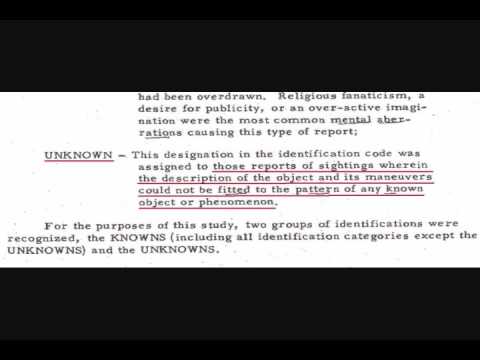
Special Report No. 14's methodology is, on its own technical merits, a genuinely serious piece of mid-century applied statistics, and this case file credits it as such before turning to the controversy surrounding its public reception. Each of the 3,201 cases was independently coded across dimensions including the number and occupational background of witnesses, the reported object's described shape, color, and apparent maneuvers, the duration of the sighting, meteorological conditions, and the proximity of military or industrial installations, then cross-tabulated against a three-way outcome classification: "Known" (a conventional explanation was identified with reasonable confidence), "Unknown" (no conventional explanation could be identified despite adequate information to attempt one), and "Insufficient Information" (the report lacked enough detail to evaluate either way).
Of the 3,201 cases, Battelle's own final tabulation placed approximately 69% in the Known category (split between roughly 38% rated "conclusively" identified and 31% rated only "doubtfully" identified, a distinction this case file finds evidentially important, since it means a substantial share of the "solved" cases were not solved with high confidence), approximately 9% in Insufficient Information, and approximately 22% in Unknown — a category the report's own methodology defined narrowly enough that, per later reviewers including Maccabee, essentially 100% of the Unknown cases carried the study's higher "certain" quality rating, meaning the residual unexplained category was not a dumping ground for weak or ambiguous reports but was disproportionately composed of the study's own best-documented sightings.
This case file finds the "doubtfully identified" subset of the Known category worth dwelling on further, since it is frequently collapsed into the broader "solved" figure in popular summaries of this study in a way this case file considers methodologically misleading. A case rated "doubtfully" explained is, by the study's own internal logic, one where an investigator proposed a plausible conventional cause — a bright planet, a weather balloon, a conventional aircraft — without being able to confirm that explanation with the same confidence as a "conclusively" identified case, where corroborating evidence (a confirmed flight plan, a matching astronomical position, a located and interviewed responsible party) closed the question definitively. Treating "doubtfully identified" cases as equivalent to "conclusively identified" ones inflates the apparent resolution rate; treating them, more conservatively, as genuinely uncertain rather than definitively solved would push a meaningfully larger share of the total dataset into a broader category of unresolved or only tentatively resolved reports than the report's own headline 69%/22%/9% breakdown suggests at first glance.
The coding methodology's roughly 30 variables extended well beyond simple identification outcomes into granular descriptive detail: reported color, number of discrete light sources, presence or absence of sound, reported maneuvers (straight-line flight, erratic movement, hovering, sudden acceleration), and proximity to specific categories of sensitive installation, among many others. This case file notes that granularity as itself methodologically significant — it meant Battelle's own analysts could, and did, test whether specific descriptive features correlated with identification outcome, rather than working only with a single undifferentiated "UFO report" category. That capacity for internal cross-tabulation is precisely what made the later quality-versus-unknown finding possible to extract from the dataset at all, and is part of why this case file weighs the study's underlying methodology considerably more favorably than its public-facing summary.
J. Allen Hynek's own 1977 account of the study, drawing on his direct familiarity with Blue Book's internal operations during the period the report was produced, adds a layer of numerical precision to the case-count figures this case file's other sources cite only approximately. Per Hynek, Battelle actually began with the Air Force's full accumulated file of approximately 4,000 reports; roughly 799 of these were set aside as too sketchy or nebulous to yield usable coded facts, leaving the 3,201 cases this case file's own meta grid reports as the coded dataset. Because a further number of those 3,201 reports proved, on closer inspection, to be duplicate accounts of the same underlying incident, Battelle's own final individual-case tabulation — the number actually run through the identification and cross-tabulation process — came to 2,199 distinct cases, a figure some later secondary sources cite instead of 3,201 without always explaining the discrepancy. This case file treats both figures as accurate rather than contradictory: 3,201 is the size of the coded intake, 2,199 the size of the deduplicated analytical dataset actually tabulated.
The identification procedure itself involved more internal cross-checking than a single analyst's judgment call. Each report was first summarized onto a standardized worksheet and given a preliminary evaluation; a separate "identification panel," working without knowledge of that first evaluation, then reached its own independent judgment. Where the two matched and neither was "Unknown," the case was closed on that basis; where they disagreed, or where either evaluation was "Unknown," Special Report No. 14's own text — as quoted in Hynek's account — states that "a group decision was necessary on all reports finally recorded as unknown, regardless of what the preliminary identification had been" before a case could be closed out in that category, with continuing disagreement, after consultation with additional outside consultants, defaulting the case to "Unknown" rather than forcing a consensus toward a conventional explanation. This case file finds that procedural asymmetry directly relevant to how the residual Unknown figure should be read: the study's own methodology made "Unknown" harder to reach than "Known," not easier, which cuts against any reading of the category as a product of a low evidentiary bar.
The Quality-Versus-Unknown Correlation
The single finding this case file treats as the report's most significant, and the one subsequent critics have returned to most consistently, is Battelle's own quality-stratified breakdown of the Unknown rate: cases the analysts rated "Excellent" in overall report quality were classified Unknown 35% of the time, while cases rated "Poor" were classified Unknown only 18% of the time — almost exactly double the rate. That pattern runs directly counter to the intuitive, and frequently asserted, expectation that unexplained cases are disproportionately the product of poor observation conditions, unreliable witnesses, or incomplete reporting. Battelle's own data instead showed the opposite: the more carefully documented, better-corroborated, and more credible a report was, the harder it was to explain conventionally, not the easier.
This case file's own reading of that correlation, consistent with the independent statistical reanalysis discussed below, is that it represents genuine evidence against the simplest dismissive account of the UFO phenomenon as a whole — that unknowns are merely an artifact of weak reporting that would resolve into knowns given better information. Battelle's own dataset, drawn from the Air Force's own case file and analyzed by an outside contractor with no evident institutional incentive to inflate the unknown rate, found precisely the opposite relationship. This case file also notes, in the interest of full disclosure, what this correlation does not establish: it is evidence that the unknowns are not simply a poor-data artifact, not evidence of what the unknowns actually were.
Hynek's own book reproduces a more granular version of this same finding, breaking the quality gradient into four tiers rather than two: of 213 Excellent-rated reports, 33.3% were classified Unknown; of 757 Good-rated reports, 24.8%; of 794 Doubtful-rated reports, 13.0%; and of 435 Poor-rated reports, 16.6%. Those specific figures differ somewhat from the more commonly cited two-tier 35%-versus-18% comparison this case file's other sources report for the same underlying study, a discrepancy this case file attributes to different secondary sources rounding or re-deriving the comparison from slightly different groupings of the same underlying quality categories, rather than to any dispute over the study's actual raw numbers. Both versions of the finding, however specifically tabulated, agree on the pattern that matters most: the best-documented reports were markedly more likely to end up Unknown than the worst-documented ones. This case file also flags, in the interest of completeness, a wrinkle neither its other sources nor Battelle's own summary conclusions appear to have addressed: in Hynek's four-tier breakdown, the lowest Unknown rate belongs not to the Poor category but to the Doubtful one, a non-monotonic detail that complicates any simple "quality predicts unknown rate" reading of the data even as the Excellent-versus-Poor comparison the report's popular reception has focused on remains intact.
Bruce Maccabee's Statistical Reanalysis
The single most important later contribution to this case's evidentiary record came not from any new investigation, but from a rigorous return to Battelle's own original numbers. Physicist Bruce Maccabee, working decades after the report's initial release, applied chi-square significance testing directly to the quality-versus-unknown correlation Battelle's own analysts had reported but never emphasized in their own summary conclusions. Chi-square testing is a standard statistical method for determining whether an observed relationship between two variables (here, report quality and unknown classification) is likely to reflect a genuine underlying pattern or could plausibly have arisen by chance alone; Maccabee's analysis found the correlation was statistically significant at a high confidence level, meaning the 35%-versus-18% quality gradient was not, in any reasonable statistical sense, a coincidence produced by random variation in a large dataset.
Maccabee's review went further than simply confirming the headline correlation. Working through the report's own 240 supporting charts, tables, graphs, and maps, he documented multiple additional instances where the analysts' own summary prose characterized findings in terms notably more dismissive than the underlying tabulated numbers supported — a pattern this case file finds consistent with, though not proof of, the institutional reassurance bias explanation discussed later in this case file. Maccabee's own broader scientific credentials (he held a doctorate in physics and worked professionally in optical physics research) lend his statistical reanalysis a degree of independent technical authority this case file weighs favorably, since chi-square testing is a well-established, non-controversial statistical method rather than any novel or contested technique specific to UFO research.
A distinct, and chronologically earlier, chi-square analysis appears within Special Report No. 14 itself, conducted by Battelle's own analysts rather than by any later independent reviewer, and this case file treats the two as separate contributions to the same underlying evidentiary picture rather than as a single finding. The report's own authors tested six descriptive characteristics — reported color, shape, number of objects, duration of observation, speed, and light brightness — to determine whether Unknown and Known cases were statistically drawn from the same underlying population or from meaningfully different ones. Per Hynek's own reproduction of the results, five of the six characteristics returned a probability of less than 1% that Unknowns and Knowns belonged to the same statistical population, with only light brightness returning a weaker, still suggestive, result (probability greater than 5%). Hynek, working through his own combined-probability calculation across all six independently tested characteristics, put the odds of all six agreeing this closely by chance alone at much less than one in a billion.
What makes this internal test significant to this case file's own assessment is not just its statistical strength but how the report's own summary conclusion handled it. Special Report No. 14's own text, addressing these same six chi-square results, states only that "the results of these tests are not conclusive since they neither confirm nor deny that the unknowns are primarily unidentified knowns, although they do indicate that relatively few of the unknowns are astronomical phenomena" — a summary sentence Hynek characterized as disregarding the underlying test results "almost brazenly, as if they did not exist." This case file finds that characterization difficult to dispute on the numbers alone: odds against chance of roughly a billion to one are not, in any ordinary statistical sense, inconclusive, and the gap between that internal finding and the report's own summary language is among the most concrete, quotable instances of the broader reassurance-bias pattern this case file documents elsewhere in Special Report No. 14's public presentation.
The Robertson Panel Connection
This case file treats the chronological relationship between Special Report No. 14 and the CIA-convened Robertson Panel as one of the study's most significant, and most under-appreciated, historical dimensions. The panel met January 14–18, 1953, reviewing the Air Force's UFO evidence and ultimately recommending a public "debunking" posture intended to reduce popular interest in and concern about UFO reports — a recommendation that directly shaped Air Force public communications policy for years afterward. At the time the panel met, Battelle's statistical analysis was still roughly a year from completion; the panel's own members reviewed a UFO evidentiary picture that did not yet include Battelle's eventual quality-correlation finding, because that finding did not yet exist in any documented form.
This case file finds that sequencing genuinely consequential rather than a minor historical footnote. Had the Robertson Panel convened after, rather than before, Battelle's full analysis was available, its own members — physicists and other scientists explicitly tasked with assessing whether UFO reports posed a genuine unexplained phenomenon worth further government study — would have had access to a systematic, large-sample finding directly relevant to their own central question: not whether individual reports could be dismissed, but whether the pattern across thousands of reports supported treating the phenomenon as a statistical artifact of poor reporting. Battelle's own data said no. Whether access to that finding would have changed the panel's ultimate recommendation is, this case file acknowledges, an unanswerable counterfactual, but the panel's own published proceedings make no reference to Battelle's ongoing work, suggesting the two efforts proceeded largely in institutional isolation from one another despite addressing closely related questions for the same ultimate government audience.
Hynek's own account adds a specific, well-documented episode to that isolation argument. Per Hynek, when word reached Battelle that the CIA intended to convene the Robertson Panel, Battelle's own leadership sent an urgent, classified letter — routed through the Blue Book office and, per Hynek, therefore never entered into Blue Book's own regular case files — recommending that the panel be postponed until Battelle's statistical study was complete. The CIA convened the panel on schedule regardless. Hynek further records that the Battelle project itself was treated as considerably more sensitive than Blue Book's own nominally unclassified case files: for years afterward, he writes, "the rule around Blue Book was that the name Battelle must never be mentioned," a level of secrecy this case file finds directly relevant to whether the Robertson Panel's own members were even aware a competing statistical analysis was underway at all. If, as that level of compartmentalization suggests, the panel's members had no knowledge Battelle's study existed, the counterfactual above understates the problem: the panel may not have known there was anything to wait for.
Connection to Hynek's Later Classification System
Dr. J. Allen Hynek, the astronomer who served as Blue Book's scientific consultant throughout the period Special Report No. 14 was produced and released, drew directly on the accumulated case-evaluation experience of exactly this era when he later developed his own, more widely known classification system for UFO encounters — the familiar "Close Encounter" taxonomy and its accompanying Nocturnal Light, Daylight Disc, and Radar-Visual categories this catalogue's own case files reference throughout. Hynek's own later, considerably more public turn toward taking the UFO phenomenon seriously as a genuine scientific puzzle, culminating in his founding of the Center for UFO Studies after leaving his Blue Book consulting role, was informed in significant part by his own direct, years-long exposure to exactly the kind of well-documented, high-quality unknown cases Battelle's statistical analysis showed were disproportionately represented in the report's own residual unexplained category.
This case file notes a genuine irony in Hynek's own career trajectory relative to Special Report No. 14's public reception. Hynek spent much of the 1950s and 1960s as the Air Force's own credentialed scientific voice reassuring the public that Blue Book's work, including studies like Battelle's, supported a broadly skeptical reading of the UFO phenomenon; his later, very public reversal, culminating in testimony and writing explicitly critical of the Air Force's own handling of the evidence, drew directly on his insider's knowledge of exactly the kind of gap this case file documents between Special Report No. 14's underlying data and its public characterization. Hynek's own later credibility as a UFO researcher rested significantly on his having been present, as a working scientist, for precisely this era's institutional decision-making — making him one of the few people positioned to compare the internal scientific record against the external public message from direct personal experience.
Key Figures
Capt. Edward J. Ruppelt
Commissioned the Battelle study in December 1951 specifically to bring statistical rigor to Air Force UFO evaluation, and set the coding methodology in motion before his own reassignment in 1953 — a departure that occurred while the study he initiated was still in progress and years before its public release.
Battelle Memorial Institute Analyst Team
Coded and cross-tabulated 3,201 Blue Book cases across roughly 30 variables under the codename Project Stork; this case file was unable to locate individual analyst names in any source consulted, a genuine gap in the historical record for a study of this significance.
Bruce Maccabee
Conducted the most rigorous later independent statistical review of Special Report No. 14's own data, applying chi-square significance testing to demonstrate that the quality-versus-unknown correlation was not a chance artifact, and documenting that the report's own summary conclusions frequently contradicted the 240 charts, tables, graphs, and maps supporting them.
Dr. J. Allen Hynek
Served as the Air Force's own scientific consultant throughout the period Special Report No. 14 was produced and released, later drawing on the same underlying case-evaluation experience the Battelle study formalized when developing his own more widely known classification system for UFO reports.
The "3 Percent" Controversy
Alongside the quality-correlation finding, this case's second major point of documented controversy concerns the Air Force's own public characterization of the overall unknown rate. Multiple later researchers, drawing on the Air Force's own May 1955 press materials accompanying the report's release, describe official statements characterizing only approximately 3% of cases as remaining genuinely unexplained — a figure this case file finds difficult to reconcile with Special Report No. 14's own tabulated 21.5%-to-22% Unknown classification for the same underlying 3,201-case dataset. This case file treats that specific numerical gap as the single most concrete, citable discrepancy in this entire case, considerably more precise and falsifiable than the more interpretive question of how the report's prose summary characterized its own findings.
This case file's own research was unable to locate the Air Force's exact original 1955 press statement in primary form, relying instead on secondary and tertiary sourcing for the specific 3% figure, a limitation this case file discloses rather than treats as settled. What can be established with greater confidence from the primary document itself is the roughly 22% figure Battelle's own tabulation reports; the size of the apparent gap between that number and later-cited official public statements, even allowing for some imprecision in how the 3% figure has been transmitted through decades of secondary retelling, remains large enough that this case file finds a genuine, documented pattern of public understatement more probable than a simple rounding or definitional discrepancy.
One plausible, partially exculpatory explanation this case file considers is that the roughly 3% figure may have originally referred not to the full Unknown category but to a narrower subset — cases the Air Force itself, applying additional internal review beyond Battelle's own classification, considered genuinely inexplicable after further follow-up, as opposed to Battelle's broader "insufficient information to explain with confidence" Unknown category. If that narrower definitional distinction is what actually occurred, the apparent contradiction would be less a matter of the Air Force contradicting its own contractor's data and more a matter of two different, each internally consistent, definitions of "unexplained" being conflated by later commentators without the original distinction being clearly preserved. This case file was unable to confirm or rule out that specific reconciling explanation from any primary source located, and states that uncertainty honestly rather than resolving it in either direction.
The Five Observables Assessment
The Five Observables framework, built to characterize an individual craft's reported performance, does not apply to an aggregate statistical study of 3,201 separate cases with widely varying described behavior, and this case file states that plainly rather than force-fitting the framework onto data it was never designed to evaluate.
Assessment: This section is included for structural consistency with this site's case-file format only. Readers seeking individual craft-performance data should consult the specific cases Special Report No. 14 itself aggregated, many of which appear elsewhere in this catalogue, including this catalogue's own Haneda Air Base Radar-Visual Sighting, a 1952 case that would itself have fallen within the same 1951–1954 collection window Battelle's own 3,201-case dataset drew from.
Evidence Assessment
This case file's evidence assessment concerns the study's own methodological integrity and the accuracy of its public presentation, not the reality of any individual UFO sighting it coded. Those are two genuinely separate questions this catalogue's own broader case files address individually where relevant, and conflating them — treating a well-conducted statistical study as itself proof of extraterrestrial visitation, or treating flaws in its public presentation as proof the underlying data was fabricated — would misrepresent what this specific case actually establishes.
Supporting the Study's Own Methodological Credibility
- Conducted by an independent, reputable outside contractor (Battelle) rather than by Air Force personnel with a direct institutional stake in the outcome.
- The largest, most systematically coded statistical analysis of UFO reports ever conducted, spanning 3,201 cases and roughly 30 variables per case.
- The quality-versus-unknown correlation ran directly counter to what a study designed or massaged to minimize the unknown category would be expected to show.
- Later independent statistical reanalysis (Maccabee) confirmed the correlation was statistically significant, not a chance artifact of the underlying data.
Supporting Concerns About the Study's Public Presentation
- The Air Force's own public release characterized the findings in a way critics and later researchers argue substantially understated the actual 22% unknown rate.
- The report's own summary language ("highly improbable that any of the reports... represent observations of technological developments outside the range of present-day scientific knowledge") is, per Maccabee's review, not clearly supported by the report's own tabulated data.
- A roughly year-long gap between the study's 1954 completion and its May 1955 public release has never been fully explained in any primary document this case file located.
- Individual Battelle analyst names and their own private assessments of the unknown cases were never made public, limiting independent follow-up on the study's internal deliberations.
Why "Credible"
This case file rates Special Report No. 14 Credible as a document — not as evidence for or against extraterrestrial visitation, but as a genuine, methodologically serious government-commissioned statistical study whose own internal data has held up under independent scrutiny (Maccabee's chi-square reanalysis) while its public presentation has not. That distinction matters: this case file is not asserting the Air Force deliberately falsified data, a claim beyond what the available evidence supports, but it is asserting, on the documentary record, that the public summary's framing and the underlying tabulated statistics diverge in a way that favors a more reassuring public message than the data alone would produce. A study whose own numbers say one thing and whose public presentation says another is exactly the kind of primary-source discrepancy this catalogue exists to surface.
This case file also weighs, in the report's favor, its unusual durability as a primary source. Unlike many mid-century government UFO documents that survive only in fragmentary, redacted, or contested form, Special Report No. 14's full 312 pages, including all 240 supporting statistical exhibits, remain publicly accessible today in multiple independently maintained archives. That completeness is precisely what has allowed the study's later reputation to shift over time as independent researchers, unlike the general public relying solely on 1955-era press coverage, have been able to work directly from the underlying numbers rather than from secondhand characterization — a genuinely rare evidentiary luxury for a document this old, and one this case file credits as a real strength even as it finds fault with how the same document was originally presented to the public that funded it.
Sensor & Instrumentation Detection Profile
Special Report No. 14 was itself an analytical instrument rather than a sensor system: its "detection" apparatus was IBM punch-card data processing applied to pre-existing witness testimony and case documentation, not any new observational technology. This case file notes that the study's methodology — standardized coding across roughly 30 variables, cross-tabulated via early-1950s computing methods — was genuinely advanced for its era, predating by years the kind of systematic, computer-assisted statistical analysis that would become standard practice in later UFO research (and in the social and physical sciences more broadly). The absence of any comparably large, methodologically rigorous statistical UFO study for decades afterward is itself informative about how unusual Battelle's approach was for 1952.
The technical constraints of early-1950s data processing are worth situating for readers unfamiliar with the era's computing capability. IBM punch-card systems of this period, predecessors to true stored-program computers, allowed mechanical sorting and cross-tabulation of coded data at a scale and speed no manual analysis could match, but required every variable to be reduced to a fixed, pre-defined coding scheme before analysis could begin — meaning Battelle's own initial questionnaire design, establishing exactly which roughly 30 characteristics would be captured and how each would be categorized, effectively determined the analytical questions the entire study could ever answer. This case file notes that constraint as a genuine methodological limitation inherent to the technology of the period, not a criticism specific to Battelle's own design choices: a study conducted with modern computing and statistical software could in principle re-examine relationships in the same underlying 3,201-case dataset that the original 1950s coding scheme was never designed to capture, though no such full modern reanalysis of the complete original dataset (as opposed to Maccabee's own more targeted chi-square work) appears to have been conducted or published, per this case file's own research.
Environmental & Geospatial Context
Battelle Memorial Institute's Columbus, Ohio headquarters provided an institutional environment well suited to this kind of large-scale applied research: an established, well-resourced private contractor with existing relationships across multiple government agencies and a reputation, at the time, for methodologically serious work across materials science, defense research, and applied statistics. This case file notes that Battelle's own broader institutional reputation is itself part of why Special Report No. 14 carries more evidentiary weight than a comparable study conducted entirely in-house by Air Force personnel would — an outside contractor with its own professional reputation at stake had less institutional incentive to shade its statistical findings toward whatever conclusion the Air Force might have preferred.
Battelle's founding mission and institutional culture, established decades before this contract, centered on applying rigorous scientific method to practical problems across a wide range of client industries — a general-purpose applied-research capability that, by the early 1950s, had already produced significant contributions to fields as varied as metallurgy and nuclear reactor materials. That breadth of institutional experience meant the analysts assigned to Project Stork were drawing on an organizational culture accustomed to defending its own statistical conclusions against outside scientific scrutiny from paying clients across many disciplines, not one built specifically around, or beholden to, the UFO question itself — a structural independence this case file treats as a genuine point in the study's favor relative to research conducted by an organization with a narrower, single-issue institutional identity.
Observer Credibility & Occupational Profile
The Battelle analyst team's own professional credentials — statisticians, astronomers, physicists, and a psychologist, per the fullest account this case file located — represent a genuinely multidisciplinary approach appropriate to a phenomenon spanning optical, meteorological, psychological, and aviation-technical questions simultaneously. This case file discloses, as a real limitation, that it was unable to locate the individual analysts' names in any source consulted for this case file's own research; unlike many of this catalogue's cases, where named individual credibility is central to the evidentiary assessment, Special Report No. 14's credibility rests on its institutional sponsor's reputation and its methodology's later independent statistical validation rather than on any named individual analyst's personal standing.
The inclusion of a psychologist on the analyst team is itself worth noting as a methodological choice ahead of its time. Much of the later, more dismissive popular commentary on UFO reports has rested on largely untested assumptions about witness psychology — that observers under stress or excitement systematically misjudge size, distance, and speed, or that social contagion within a crowd reliably degrades individual testimony. A 1950s-era study that specifically built psychological expertise into its evaluation methodology, rather than leaving psychological judgments to non-specialist military investigators, represents a more rigorous approach to exactly the kind of witness-reliability questions this catalogue itself weighs case by case throughout its own catalogue. This case file was unable to determine, from any source consulted, how heavily the psychologist's specific input shaped the final quality-rating methodology relative to the other three analysts' own disciplinary contributions.
This case file also weighs the underlying witness pool the Battelle study itself drew on — the 3,201 original case reports' own witnesses, not the Battelle analysts themselves. That underlying pool included, per the coded occupational variable Battelle's own methodology captured, a substantial number of military and aviation personnel alongside civilian witnesses, meaning the quality ratings the analysts assigned were not simply a reflection of an untrained public's testimony but incorporated the same category of credentialed observer this catalogue's own military and aviation case files weigh heavily elsewhere. That the "excellent" quality category, disproportionately unresolved, likely included a meaningful share of these more credentialed original witnesses adds a further layer of evidentiary weight this case file finds relevant to how seriously the 35% figure should be taken.
Physical & Material Assays
No physical evidence is associated with Special Report No. 14 itself; it is a secondary statistical analysis of existing case reports, not a field investigation capable of generating or evaluating physical trace evidence in its own right. Individual cases within its 3,201-case dataset may separately carry physical evidence of their own, addressed within each case's own file elsewhere in the historical record and, where those specific cases are independently significant, in this catalogue's own case files.
This case file notes that the absence of any physical-evidence dimension to Special Report No. 14's own methodology is itself a genuine, if unavoidable, limitation on what the study could ever have concluded. A purely statistical recoding of existing witness testimony and investigator notes, however rigorously cross-tabulated, can identify patterns in how reports were classified; it cannot independently verify whether any individual report's underlying description was accurate, exaggerated, or mistaken in ways a field investigation with access to physical evidence might have caught. This case file treats that limitation as inherent to the study's chosen methodology rather than as a flaw specific to Battelle's own execution of it.
One further documented episode bears directly on this case file's assessment of the study's surviving primary-source record, distinct from the physical evidence of any individual sighting. Hynek writes that Special Report No. 14 itself states that "all records and working papers of this study have been carefully preserved in an orderly fashion suitable for ready reference" — and that he personally visited Battelle Memorial Institute some years later to ask to see those records, only to be told they had been destroyed. This case file treats that account, from a scientist with direct institutional standing to make such a request, as the most concrete documented explanation available for why the individual Battelle analysts' own working notes and case-by-case reasoning — as opposed to the published report's own final tabulations — have never surfaced in any archive this case file located, and why the analysts' own names remain unrecoverable from any source consulted for the Key Figures section above.
Historical Precedents & Archive Matches
Special Report No. 14 sits in close chronological and institutional proximity to this catalogue's own Robertson Panel case file: the CIA-convened panel met in January 1953, while Battelle's statistical study was still roughly a year from completion, meaning the panel's own influential recommendation that the Air Force adopt a public "debunking" posture toward UFO reports was made without the benefit of Battelle's own eventual quality-correlation finding — a sequencing this case file finds genuinely significant, since a panel aware of the finding that better-documented cases were more likely to be unexplained might reasonably have reached different conclusions about how confidently to reassure the public. It also connects directly to this catalogue's own Condon Report case file, the next major federally sponsored UFO study, conducted roughly fifteen years later under a very different methodology (field re-investigation rather than statistical coding of existing reports) but addressing many of the same underlying questions about how rigorously government-sponsored UFO research could or should be conducted.
The comparison between Special Report No. 14 and the Condon Report is instructive on its own methodological terms, independent of either study's specific conclusions. Battelle's approach was fundamentally retrospective and statistical: it worked from the Air Force's existing accumulated case file, applying standardized coding to reports that had already been collected, often years earlier, by field investigators of widely varying skill and thoroughness. The Condon Report's methodology, by contrast, was prospective and investigative: University of Colorado staff traveled to sighting locations, interviewed witnesses directly, and conducted original photographic, radar, and physical-trace analysis on a smaller number of cases selected specifically for their evidentiary promise. Neither approach is strictly superior to the other — Battelle's method achieved a sample size (3,201 cases) the Condon Report's more resource-intensive fieldwork could never have matched, while the Condon Report's direct re-investigation caught details and follow-up questions no purely statistical recoding of secondhand reports could ever surface. This case file finds the two studies most valuable read together, as complementary rather than competing approaches to the same underlying evidentiary problem.
This case also connects to the broader pattern this catalogue has documented across multiple mid-century government-commissioned UFO studies: a recurring gap between technically competent underlying research and a public communications strategy that, in case after case, erred toward reassurance over full disclosure of ambiguous or unresolved findings. That pattern recurs across institutions as different as the Air Force's own Blue Book leadership, the CIA-convened Robertson Panel, and, this catalogue's own Condon Report case file argues, aspects of the University of Colorado study's own public rollout — suggesting an institutional tendency that outlasted any single administration, agency, or study, rather than a one-off editorial choice specific to Special Report No. 14 alone.
Material Analysis
This case's material record is the 312-page document itself, publicly available today via multiple archives including the Internet Archive and the CIA's own declassified reading room holdings — a genuinely well-preserved primary source relative to many mid-century government UFO documents, which have often survived only in partial, degraded, or contested form. The report's own internal structure, comprising roughly 240 supporting charts, tables, graphs, and maps, provides an unusually rich body of raw tabulated data for independent reanalysis, which is precisely what allowed Bruce Maccabee's later statistical review to test the report's own summary conclusions against its own supporting numbers directly, rather than relying on secondhand characterization.
The report's survival in this relatively complete, publicly accessible form stands in useful contrast to the fate of the underlying 3,201 individual case files it statistically summarized, many of which have themselves been lost, degraded, or remain only partially declassified in the decades since. This case file finds that contrast informative about the durability of aggregate statistical summaries versus individual case documentation in government recordkeeping more broadly: a single, well-organized 312-page synthesis document proved considerably easier to preserve, catalogue, and eventually declassify intact than thousands of individual case folders, each with its own separate paper trail, witness statements, and investigator notes — a pattern with implications for how future researchers should weigh the completeness of any government agency's own aggregate summary against the more fragmentary record of the individual reports feeding into it.
Supporting the Study's Internal Data Integrity
- The full 312-page document, including all supporting statistical tables, remains publicly accessible today, allowing direct independent verification rather than reliance on summary claims alone.
- Maccabee's chi-square reanalysis, working from the report's own published data, confirmed the quality-versus-unknown correlation as statistically significant.
Supporting Concerns About Presentation
- The gap between the study's own detailed internal findings and its public-facing summary language remains, on this case file's own reading, inadequately explained by any primary document located.
- Individual analyst working notes, if they survive, have not been made publicly available to further clarify how the summary language was drafted relative to the underlying data.
The Conventional Explanation Candidate: Institutional Reassurance Bias
The most plausible explanation for the gap between Special Report No. 14's own tabulated data and its public presentation is not fraud but institutional reassurance bias: an Air Force public affairs apparatus, operating in the aftermath of the Robertson Panel's own explicit recommendation to reduce public UFO anxiety, characterizing a genuinely ambiguous and partly unresolved statistical finding in the most reassuring terms its own summary-writing latitude allowed, without altering or fabricating the underlying data itself. This case file finds this explanation considerably more consistent with the evidence than any theory requiring deliberate data falsification, since the raw statistics Maccabee and others later relied on were never hidden or altered — they were simply available in a 312-page technical document few members of the public or press had the time or statistical background to read past its own summary section.
Simple Bureaucratic Delay
The roughly year-long gap between the study's 1954 completion and its May 1955 release is sometimes cited as evidence of deliberate suppression, but this case file finds ordinary bureaucratic review, declassification processing, and drafting of an appropriately cautious public summary a sufficient and more parsimonious explanation absent any specific documentary evidence of deliberate delay for other reasons.
Genuine Scientific Disagreement Over Interpretation
A third candidate explanation, less discussed in popular treatments of this case but worth this case file's own consideration, is that the gap between Battelle's data and the Air Force's summary reflects a genuine, good-faith scientific disagreement about how to interpret an ambiguous statistical result, rather than either fraud or simple public-relations spin. A quality-versus-unknown correlation, however statistically significant, does not by itself specify a cause: it is consistent with genuine anomalous phenomena being reported more reliably by more credible witnesses, but it is also consistent with a subtler, more mundane possibility this case file has not seen fully addressed elsewhere — that Battelle's own quality-rating criteria may have inadvertently correlated with case complexity or unusualness in ways that made harder-to-explain sightings more likely to also be rated as thoroughly documented, simply because unusual events generate more detailed follow-up investigation and reporting than routine ones. This case file flags that alternative reading as a genuine, underexplored possibility rather than a fully resolved alternative explanation, since it was unable to locate any published analysis directly testing whether Battelle's own quality criteria were independent of, or confounded with, the very unusualness that led a case to be classified unknown in the first place.
Institutional Reassurance Bias — Plausibility Rating: PLAUSIBLE
Related Cases
Confirmed Documents & Official Records
The complete, publicly digitized 312-page report, including its full statistical appendix of supporting charts, tables, graphs, and maps.
A CIA-sourced declassified scan of the report, hosted alongside other Project Blue Book document archives.
Further Reading — Recommended Literature
The Report on Unidentified Flying Objects
Written by the Blue Book director who personally commissioned the Battelle study, offering the closest available insider account of why and how Special Report No. 14 came to be produced.
UFOs and Government: A Historical Inquiry
Includes detailed scholarly treatment of the Battelle/Project Stork study's methodology and its institutional context within the broader Blue Book era.
Clear Intent: The Government Coverup of the UFO Experience
A documents-based examination of the gap between official government UFO statements and underlying case files, directly relevant to Special Report No. 14's own presentation controversy.
Scientific Study of Unidentified Flying Objects
The next major federally sponsored UFO study, useful direct comparison for how differently a field-investigation methodology approached questions Special Report No. 14 tackled statistically.
The UFO Encyclopedia (3rd Edition)
The standard reference work for Blue Book-era programs and documents, including a detailed entry on Special Report No. 14's production and reception.
DISCLOSURE: Some links above are affiliate links. If you purchase through them, OverClassified receives a small commission at no additional cost to you. This helps support independent research.
Essential Viewing
Sources
- "Project Blue Book Special Report #14," Internet Archive (full digitized document). archive.org/details/ProjectBlueBookSpecialReport14
- "Project Blue Book Special Report #14 — May 5, 1955," The Black Vault (declassified scan). theblackvault.com
- "Project Blue Book," Wikipedia. en.wikipedia.org/wiki/Project_Blue_Book
- "Blue Book Special Report 14 and the Robertson Panel," Enigma Labs Library. enigmalabs.io
- "Identification Studies of UFOs," Wikipedia. en.wikipedia.org/wiki/Identification_studies_of_UFOs
- "Comprehensive Catalog of 2,200 Project Blue Book UFO Unknowns," NICAP. nicap.org/bb/BB_Unknowns.pdf
- "Project Blue Book," Military Wiki. military-history.fandom.com
- "Edward J. Ruppelt," Military Wiki. military-history.fandom.com
- "Project Blue Book: USAF's 12,618 UFO Cases Declassified," The Exclusion Zone. theexclusionzone.com
- "Project Blue Book: The Government's UFO Hunt," Hangar1 Publishing. hangar1publishing.com
- "Project Blue Book, A History," UFO Casebook. ufocasebook.com
- Edward J. Ruppelt, The Report on Unidentified Flying Objects, Doubleday, 1956.
- J. Allen Hynek, The Hynek UFO Report, Dell Publishing, 1977 (full text). archive.org/details/hynekuforeport00alle
- Michael Swords & Robert Powell et al., UFOs and Government: A Historical Inquiry, Anomalist Books, 2012.
- Lawrence Fawcett & Barry J. Greenwood, Clear Intent: The Government Coverup of the UFO Experience, Prentice-Hall, 1984.
- Jerome Clark, The UFO Encyclopedia, 3rd ed., Visible Ink Press.
See something inaccurate? Have additional information or sources?
Suggest an Edit →Last Updated: August 2026