
The Soviet UFO Files
Paranormal Encounters Behind the Iron Curtain
Core Thesis
The Soviet UFO Files: Paranormal Encounters Behind the Iron Curtain makes the case, through six chapters and more than 150 photographs and illustrations (many published for the first time in English), that the Soviet military and intelligence apparatus took the UFO phenomenon far more seriously behind closed doors than its public posture of dismissal ever admitted. Drawing on KGB officials, cosmonauts, military pilots, and formerly classified documents, author Paul Stonehill — a Kiev-born emigre who founded the Los Angeles-based Russian Ufology Research Center in 1991 — argues that Soviet authorities treated evidence of UFO activity, and the possibility of a genuine external threat it implied, with real institutional concern rather than the reflexive denial associated with Cold War-era Western skepticism, even as they suppressed public discussion of it just as thoroughly as their American counterparts did.
About the Author
Paul Stonehill was born in Kiev, in the Soviet Union, in 1959, and emigrated to the United States in 1972. His official biography, as published by the International UFO Congress, describes a genuinely unusual adolescence for a future UFO researcher: in his youth, before emigrating, Stonehill assisted in smuggling people out from behind the Iron Curtain, aided Soviet dissidents, and helped smuggle banned literature into the USSR — direct, personal experience with the Soviet state's own machinery of secrecy and censorship that would later inform his approach to a different category of Soviet-era concealment.
After settling in the United States, Stonehill earned a Bachelor's degree in Political Science from California State University, writing his thesis on the Soviet invasion of Afghanistan — grounding his later paranormal research in a formal academic background in Soviet politics and foreign policy rather than in ufology alone. He worked as a journalist covering warfare, and since 1989 has consulted for American television and motion-picture production companies and corporate entities on Russian and Soviet subjects, alongside freelance writing on UFO and anomalous-phenomena topics.
In 1991, three years before this book's publication and the same year the Soviet Union itself formally dissolved, Stonehill founded the Russian Ufology Research Center (RUFORC) in Los Angeles — an organization specifically positioned to translate, collect, and make accessible to English-language readers the Soviet and post-Soviet UFO case record that had been effectively invisible to Western researchers throughout the Cold War. The center's work drew mainstream attention early: OMNI Magazine profiled Stonehill and RUFORC in October 1993, five years before this book appeared, establishing him as a recognized bridge figure between Western ufology and the newly opening archive of Eastern Bloc case material.
This book credits British UFO Research Association member Philip Mantle as its consultant — a credit prominent enough to appear on the book's own front cover above the title — beginning a collaboration between the two researchers that would continue for decades afterward: Stonehill and Mantle co-authored Russia's Roswell Incident: And Other Amazing UFO Cases from the Former Soviet Union (2012), UFO Case Files of Russia (2011), and Russia's USO Secrets: Unidentified Submersible Objects in Russian and International Waters, extending this book's original project across more than a decade of continued joint research. Stonehill's other solo work includes Paranormal Mysteries of Eurasia (2010), and this book itself was translated into Czech and Dutch in addition to its original English edition — a genuinely international reach unusual for a specialist 1990s UFO title. Stonehill is fluent in Russian and reads Ukrainian, language access that let him work directly with primary Russian-language sources rather than relying entirely on prior translations or secondhand accounts.
Historical Context & Origins
CLB published The Soviet UFO Files in 1998, seven years after the Soviet Union's December 1991 collapse had begun surfacing decades of previously inaccessible Eastern Bloc military and intelligence material to Western researchers for the first time. Stonehill's own founding of the Russian Ufology Research Center in 1991 places him among the very first Western-based researchers to organize systematically around this specific historical opening, and this book, arriving mid-decade into that process, represents one of the earliest attempts to synthesize the newly available Soviet case record into a single English-language volume rather than scattered translated fragments.
The book's timing also placed it squarely within the same mid-to-late-1990s surge of mainstream UFO interest that shaped so much of the decade's publishing: The X-Files was in the middle of its highest-rated seasons, the Roswell Incident's July 1997 fiftieth anniversary had just drawn a massive commemorative crowd and a rebutting U.S. Air Force report, and Western publishers were newly receptive to genuinely new categories of case material rather than further recyclings of the same American classics — a receptiveness this book's specifically Soviet, previously unavailable subject matter was well positioned to benefit from.
Structurally, the book's six chapters and more than 150 photographs and illustrations, many published in English for the first time, reflect Stonehill's own direct access to Russian-language primary sources and a domestic Soviet/Russian ufology research community — researchers like Kolchin, Gorshkov, and Vadim Chernobrov, whose work this site's own Robozero Incident case file describes as the "domestic research milieu" that kept older Russian cases in circulation through the 20th century — that few if any Western UFO authors of the period could draw on directly. Philip Mantle's credited role as consultant, and the book's British publisher, situate it within the same British UFO Research Association network that supported several other Eastern Bloc-focused UFO research projects of the era.
Core Arguments & Key Concepts
The book's central argument is that Soviet secrecy around UFO phenomena was not simple dismissal but active institutional concern, treated with genuine seriousness at senior levels precisely because it could not be confidently ruled out as a foreign (specifically American or Chinese) surveillance or weapons program. This argument is best captured in Stonehill's own later characterization of Soviet-era thinking, offered when commenting on the 2019 declassification of a CIA report on the 1973 Sary Shagan sighting: "the Soviets knew they were watched, and those at the top were aware that the 'watchers' were not Americans [or the] Chinese" — a formulation this site's own Sary Shagan case file treats explicitly as Stonehill's own research conclusion rather than as something documented in the CIA report itself.
A second consistent theme is the use of high-credibility, institutionally embedded witnesses — KGB officials, cosmonauts, and military pilots — as the book's primary evidentiary base, rather than civilian eyewitness accounts of the kind that dominate most Western UFO case literature. This witness profile reflects both the book's specific access (Stonehill's Russian-language fluency and direct research contacts inside the former USSR) and its underlying argument: that Soviet UFO concern was a genuinely institutional, top-down phenomenon documented in classified records, not a grassroots civilian belief the state merely tolerated.
A third theme, evident across the book's geographic range, is that Soviet UFO activity was neither confined to remote military installations nor to any single decade: the cases this book and this site's own citing case files span from the 1663 Robozero Incident in Tsarist-era Russia, centuries before the USSR existed, through the Cold War military encounters at Sary Shagan (1973) and Kapustin Yar (1989), to the widely reported public sighting at Voronezh the same year — treating the phenomenon as a continuous thread running through Russian history rather than a purely Cold War-specific development.
A fourth theme is the specific institutional habit, visible across the Warsaw Pact more broadly and not just within Soviet borders proper, of treating unexplained aerial encounters as bureaucratic non-events rather than filed, investigated incidents — a pattern this site's own Vranov nad Dyjí Helicopter Incident case file (Czechoslovakia, 1987) draws on this book specifically to contextualize, describing it as documenting "the specific institutional habit... of Warsaw Pact militaries treating unexplained aerial contacts as bureaucratic non-events rather than filed incidents."
Key Cases & Evidence Discussed
Per the book's own back-cover description, The Soviet UFO Files draws on reports from KGB officials, cosmonauts, and military pilots, and on top-secret Soviet military documents, to argue that Soviet authorities treated evidence of UFO activity with real institutional seriousness despite public denial — a scope this site's own six-case citation record independently confirms spans more than three centuries of Russian and Soviet history.
The Robozero Incident (Case File #271, 1663) is this book's earliest-covered case by a wide margin — a Tsarist-era report from Lake Robozero that predates the Soviet Union itself by more than 250 years. This site's own case file on it credits the book with covering "Tsarist- and Soviet-era Russian ufology in depth, including the domestic research milieu (Kolchin, Gorshkov, Chernobrov) that kept the Robozero case in circulation through the 20th century" — naming the specific chain of Russian-language researchers whose work Stonehill's own access let him draw on directly.
The Sary Shagan CIA Report (Case File #309, 1973), concerning a sighting at the Soviet Union's Sary Shagan anti-ballistic-missile testing range in Kazakhstan, connects directly to Stonehill's own post-publication research: when the CIA declassified its own report on the incident in 2019, Stonehill was quoted commenting on decades of documented UFO activity around Soviet military and research facilities, offering the analytical framework — that senior Soviet officials specifically believed the "watchers" were not a rival human power — that this book's broader thesis rests on.
The Kapustin Yar UAP Sighting (Case File #107, 1989), at the long-running Kapustin Yar rocket and missile test site, and the Voronezh Landing (Case File #046, 1989), one of the most widely publicized Soviet-era sightings of the entire glasnost period, both occurred the same year and are covered in this book as part of the wider late-1980s surge in Soviet UFO reporting that coincided with the political opening of glasnost itself — a period in which state media, for the first time, began covering UFO reports with something closer to Western-style openness. This site's own Kapustin Yar case file names two of the leading Soviet-era figures whose work this book's own institutionally-embedded-witness approach draws on directly: cosmonaut Pavel Popovich, and physicist Vladimir Azhazha, among the Soviet Union's most prominent official-adjacent UFO researchers.
The Emilcin Abduction (Case File #166, 1978), in Communist-era Poland rather than the Soviet Union proper, and the Vranov nad Dyjí Helicopter Incident (Case File #188, 1987), in Czechoslovakia, extend the book's geographic scope across the wider Warsaw Pact rather than confining it to Soviet territory alone — this site's own Emilcin case file citing the book specifically as "regional and political context for understanding why a case like Emilcin received no state institutional investigation of the kind Western cases sometimes did."
Critical Reception & Controversies
As with several specialist 1990s UFO titles from smaller British and American presses, The Soviet UFO Files does not appear to have drawn a dedicated contemporary review from a major library or trade journal (Library Journal, Booklist, Publishers Weekly) that this site's research could independently locate — an absence disclosed here honestly rather than papered over with an uncited claim.
On Amazon, the book carries a strong 4.4-out-of-5 average from 39 ratings (checked August 2026) — a genuinely substantial sample size for a specialist 1990s title still in print more than a quarter-century later, and one of the more robust rating counts among this site's essential-reading library's smaller-press entries.
The book's reception within specialist ufology circles is best measured by its ongoing citation pattern rather than any single review: its consultant, Philip Mantle of the British UFO Research Association, went on to co-author three further books with Stonehill over the following decade and a half — UFO Case Files of Russia (2011), Russia's Roswell Incident (2012), and Russia's USO Secrets — a sustained professional collaboration that reads as a real, practical endorsement of this book's original research and working method by the researcher best positioned to judge it.
The book's translation into Czech and Dutch, alongside its original English edition, and its distribution across at least three separate publisher imprints (CLB in its original UK edition, Quadrillion Publishing, and a Diane Publishing Co. library-binding reprint under a separate ISBN) over the following years, together indicate a specialist title with unusually durable, ongoing demand for a 1990s small-press UFO book rather than one that went quickly out of print after its initial run.
The clearest and most independently verifiable measure of the book's lasting reference value on this site specifically is its own citation record: six separate case files, spanning three centuries of Russian and wider Warsaw Pact history, cite this exact 1998 edition directly — a citation pattern this site's own research treats as stronger, more durable evidence of the book's usefulness as a working reference than any single period review could provide.
Influence & Legacy
The most directly measurable evidence of this book's ongoing influence is on this site itself: this exact 1998 edition is cited across six separate case-file pages — Robozero Incident (1663), Sary Shagan CIA Report (1973), Vranov nad Dyjí Helicopter Incident (1987), Kapustin Yar UAP Sighting (1989), Voronezh Landing (1989), and Emilcin Abduction (1978) — making it this site's primary reference source for Soviet-era and wider Warsaw Pact UFO history specifically.
The book's more direct institutional legacy runs through the research partnership it founded: the collaboration between Stonehill and consultant Philip Mantle, credited on this book's own cover, continued across at least three further co-authored volumes over the following fifteen years, each extending this book's original project of translating and synthesizing the Eastern Bloc UFO case record for English-language readers. Stonehill's own Los Angeles-based Russian Ufology Research Center, founded in 1991 and still active in his later research and media consulting work, remains the institutional base from which this book's original research was conducted.
Within the wider field, this book's real legacy is as an early, foundational English-language gateway to a case record that had simply been unavailable to Western researchers throughout the Cold War: cases like Voronezh and Kapustin Yar had circulated in Soviet and then Russian media, but this book was among the first to place them in front of an English-reading UFO research audience with the specific institutional and political context — KGB secrecy practices, military testing-range geography, the glasnost-era loosening of state media control — needed to actually evaluate them.
Within this site's own research specifically, this book functions as the foundational reference for the entire Soviet and Warsaw Pact portion of the case-file library: its six citing case files span 1663 to 1989, and Stonehill's own post-publication commentary on the 2019 Sary Shagan declassification, quoted directly in this site's own case file on that incident, shows the book's underlying research and thesis still actively informing new case analysis more than two decades after its original publication.
The Book
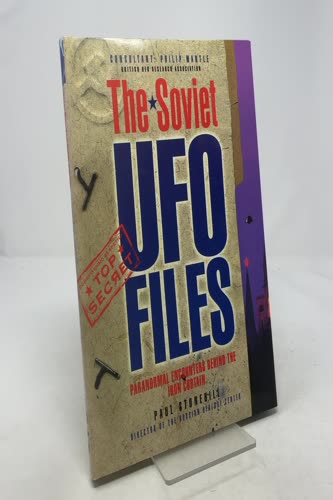
As an Amazon Associate, OverClassified may earn from qualifying purchases made through this link, at no extra cost to you.
Why This Is Essential Reading
The Soviet UFO Files earns its place on this list as the foundational English-language reference for the entire Soviet and wider Warsaw Pact portion of this site's own case-file library: a genuinely pioneering 1998 synthesis, built on Paul Stonehill's own direct access to Russian-language sources and his 1991 founding of the Russian Ufology Research Center, of a case record that had been effectively invisible to Western readers throughout the Cold War. Its real, lasting value on this site's own evidence is not any single contemporary review, which this specialist small-press title does not appear to have generated in a major trade or library outlet, but a citation record spanning six case files and more than three centuries of Russian history, a strong 4.4-star reader rating from a substantial 39-rating sample, and a research partnership with consultant Philip Mantle that produced three further co-authored volumes over the following decade and a half. Read as the entry point into a body of case material this site's own research draws on repeatedly — from the 1663 Robozero Incident to the Cold War military encounters at Sary Shagan and Kapustin Yar — this book is essential precisely because so much of what English-language ufology knows about Soviet-era UFO secrecy still traces back to the research this volume first assembled.
Related Cases & Theories
Essential Viewing

Sources Cited
- Stonehill, Paul. The Soviet UFO Files: Paranormal Encounters Behind the Iron Curtain. CLB, 1998 (ISBN 1-85833-858-1, cited here; consultant Philip Mantle).
- "The Soviet Ufo Files: Paranormal Encounters Behind the Iron Curtain." Amazon.com (ISBN 1858338581, publisher, publication date, page count, and current rating, checked August 2026). amazon.com
- "Paul Stonehill." The International UFO Congress (official biography: birth, emigration, education, career, Russian Ufology Research Center founding). ufocongress.com
- "Paul Stonehill." Coast to Coast AM guest page (bibliography and career summary). coasttocoastam.com
- "Interview with Paul Stonehill, Russia's USO Secrets & UFOs." Podcast UFO Live Shows, August 24, 2016 (YouTube). youtube.com
- "The Soviet UFO files: paranormal encounters behind the Iron Curtain / Paul Stonehill; consultant, Philip Mantle." Smithsonian Institution library catalog record (publisher, consultant credit). si.edu
- "Soviet Ufo Files: Paranormal Encounters Behind The Iron Curtain." Amazon.com (companion ISBN 0756775116, Diane Publishing Co. library-binding reprint edition, listing Philip Mantle's consultant credit). amazon.com
- This site's own resources library: Full Reading List, where this exact 1998 edition (ISBN 1858338581) is cited across 6 separate case-file pages.
- This site's own key-figures entry: Paul Stonehill, for his full biography and site-wide case connections.
- This site's own case file: The Sary Shagan CIA Report, which quotes Stonehill's own analysis of Soviet-era institutional thinking on UFOs directly.
- This site's own case file: The Robozero Incident, which documents the domestic Russian research network (Kolchin, Gorshkov, Chernobrov) this book draws on.
- This site's own case file: Vranov nad Dyjí Helicopter Incident, which cites this book for Warsaw Pact institutional secrecy practices.
- This site's own case file: Kapustin Yar UAP Sighting, which cites this book alongside Stonehill and Mantle's later 2012 collaboration.
- This site's own case file: Voronezh Landing, which cites this book for the wider 1989 Soviet sighting surge.
- This site's own case file: The Emilcin Abduction, which cites this book for regional Warsaw Pact political context.
Have corrections, additional research, or peer-reviewed sources? Help improve this entry.
Suggest an Edit