
The Sary Shagan CIA Report
During late summer 1973, a CIA source described only as a former Soviet citizen stepped outside at Site 7 of the USSR's Sary Shagan Weapons Testing Range in Kazakhstan and watched a sharp, bright green circular object hanging roughly 70 degrees above the western horizon. Within 10 to 15 seconds it widened, and several green concentric circles formed around the mass before the phenomenon silently vanished a few minutes later. The account survives as a CIA Intelligence Information Report, first released to the public in 1978 in heavily redacted form — leaving only a single legible paragraph describing the sighting — and more fully declassified on December 19, 2019, after researcher John Greenewald Jr. of The Black Vault filed a Mandatory Declassification Review request. The document resurfaced publicly again on May 22, 2026, when the Department of War included it in the second release batch of the Presidential Unsealing and Reporting System for UAP Encounters (PURSUE).
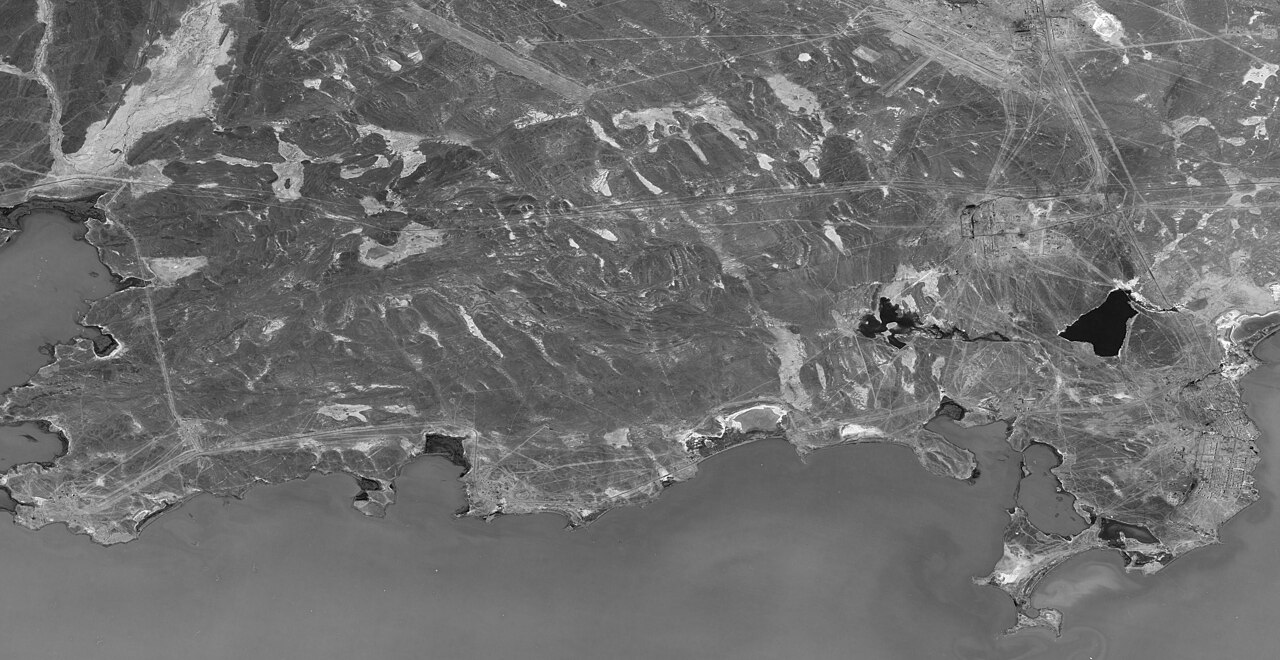
Pictured: A declassified U.S. National Reconnaissance Office satellite reconnaissance photograph of the Sary Shagan testing range on the shore of Lake Balkhash, Kazakhstan, captured April 21, 1966. Public domain, released by the NRO.
Theoretical Alignment
This file substitutes "Man-Made / Foreign Technology" for the Psycho-Social/Mundane category because the leading conventional explanation here is not misperception but a specific, documented Soviet weapons program: the same Sary Shagan range was actively developing directed-energy and missile-defense hardware in the exact years surrounding this sighting, giving this case an unusually concrete potential man-made source unavailable to most sightings in this archive. It retains meaningful weight for Extraterrestrial only because no specific test has been publicly matched to this exact date, and the CIA analyst who filed the original report did not offer or endorse any explanation.
A note on precision, developed at length in the Conventional Explanation Candidates section below: the popular framing of this case, repeated across several outlets covering its 2019 and 2026 re-releases, is that the source witnessed a test of the Terra-3 "laser weapon." This file's research into the documented construction timeline of Terra-3 complicates that framing considerably. As reconstructed below, the specific ruby and carbon-dioxide lasers that eventually occupied the Terra-3 site were not installed until 1979 and 1982, respectively — six to nine years after this sighting. What did exist at Sary Shagan in 1973 was an earlier, more ambitious high-energy laser project then under construction, one that the ABM Treaty halted that same year, and a large and continuously active anti-ballistic-missile interceptor testing program that has received comparatively little attention in coverage of this case. The 80% "Man-Made / Foreign Technology" alignment above should be read as resting more heavily on that broader weapons-testing context than on the specific Terra-3 laser narrative that most secondary coverage has emphasized.
Background
The Sary Shagan Weapons Testing Range was authorized by a decree of the Soviet Council of Ministers on August 17, 1956, and built on the western shore of Lake Balkhash in the Kazakh Soviet Socialist Republic. Formally designated State Research and Testing Site No. 10 of the USSR Ministry of Defense, it became the Soviet Union's principal proving ground for anti-ballistic missile (ABM) technology — the direct Soviet counterpart to the U.S. Army's Kwajalein and White Sands test ranges. Over its operational life the site sprawled across roughly 81,200 square kilometers of semi-desert steppe, stretched some 480 kilometers along Lake Balkhash's shoreline, and was used to test six distinct anti-missile systems, twelve anti-aircraft missile systems, and eighteen separate radar installations, including the Dunay-series early-warning radars, the Don-2NP battle-management radar, and the Balkhash-9 over-the-horizon "Hen House" radar, which remained part of Russia's missile-early-warning network into the 2020s.
The range's first missile test was conducted on October 16, 1958, but its defining achievement came on March 4, 1961, when the prototype System A complex — developed under chief designer Grigory Kisunko's SKB-30 design bureau — became the first anti-missile system in the world to successfully destroy an incoming ballistic missile warhead in flight, using a fragmentation warhead to intercept and disable the target. That intercept, achieved roughly 23 years before the United States would demonstrate an equivalent non-nuclear hit-to-kill capability (the Army's Homing Overlay Experiment, June 1984), made Sary Shagan a Cold War strategic priority for both superpowers: for Moscow, the proving ground for the ABM shield that would evolve into the operational A-35 system defending Moscow; for Washington, one of the hardest intelligence targets in the Soviet Union to observe from the outside, since its most sensitive activity — warhead handling, guidance testing, and (from the mid-1960s onward) directed-energy research — took place inside secured buildings that satellite photography alone could not fully characterize.
Site 7, where this case's sighting occurred, functioned within that larger complex as a checkout and processing area for warheads and interceptor hardware and housed Soviet Air Force personnel assigned to the range. It sat within a few kilometers of a separate, and by 1973 already well-known-to-Western-intelligence, construction project: what U.S. analysts and later journalists would come to call Terra-3. Soviet design work on a high-energy laser capable of damaging or blinding a ballistic missile warhead or reconnaissance satellite began around 1964–1965, and by the early 1970s crews were pouring a large concrete bunker, lined with steel plate, intended to house an explosively pumped, gas-dynamic laser under the direction of TsNPO Vympel and its associated design bureaus. That original, more ambitious laser-weapon project was never completed in its intended form: the Anti-Ballistic Missile Treaty, signed by President Richard Nixon and General Secretary Leonid Brezhnev in Moscow on May 26, 1972, and its associated Strategic Arms Limitation Talks restrictions on missile-defense development, halted full construction of the high-energy laser effort within about a year of the treaty's signing — placing its cancellation almost exactly contemporaneous with this sighting. The complex was not abandoned outright, but it would sit unfinished, in a considerably scaled-down form, for the rest of the decade: a newly formed contractor, Astrofizika, working with NPO Vympel, eventually installed a comparatively modest visible-light ruby laser at the site in 1979 and a carbon-dioxide infrared laser in 1982 — both intended primarily for satellite-tracking and sensor-blinding experiments rather than as a functioning missile-defense weapon, and both, according to a U.S. technical assessment following an on-site inspection in July 1989, roughly a thousand times less powerful than the U.S. military's own MIRACL chemical laser. Cold War-era Pentagon statements during the Strategic Defense Initiative debates of the 1980s nonetheless described Terra-3 publicly as an operational Soviet anti-satellite weapon, a characterization the CIA's own internal reporting reportedly contradicted at the time, and which the 1989 inspection team's finding of "non-operational" equipment with unsuitable, uncooled optics appeared to bear out. A separate and still-disputed claim, that the Terra-3 infrared laser was aimed at the Space Shuttle Challenger during mission STS-41-G on October 10, 1984, causing onboard malfunctions and crew distress, has been denied by both the shuttle astronauts and U.S. intelligence officials who addressed it publicly.
The range's institutional leadership was itself in a period of transition around the time of this sighting. Grigory Kisunko, System A's original chief designer, remained in charge of the upgraded A-35M missile-defense program through the early-to-mid 1970s, but was removed from that role in 1975 amid an internal dispute within the Ministry of Radio Industry over the program's future direction; he was succeeded as general designer of TsNPO Vympel's design bureau by A.G. Basistov, who had been leading a parallel effort since the late 1960s toward what eventually became the next-generation A-135 system. This file finds no evidence connecting that leadership transition directly to the 1973 sighting, but includes it as part of the broader picture of a facility whose flagship missile-defense program, laser-weapons effort, and institutional leadership were all in flux across the early-to-mid 1970s — a period of genuine organizational turbulence at Sary Shagan that the single-paragraph CIA report, filed in the middle of it, does not and could not have reflected.
The practical consequence of this chronology, discussed at greater length in the Conventional Explanation Candidates section below, is that in late summer 1973 — the period of this sighting — Sary Shagan hosted an active, continuously operating ABM interceptor-testing program with a fifteen-year track record, alongside a high-energy laser project that was, at that exact moment, being wound down rather than brought online. Both circumstances matter to how this case should be read, and popular coverage has tended to collapse the two into a single, simpler "Soviet laser weapon" narrative that the underlying documented timeline does not fully support.
The surviving CIA record of the sighting itself takes the form of an Intelligence Information Report, or IIR — a specific category of raw, single-source intelligence product, standardized by the Defense Intelligence Agency for rapid dissemination to intelligence-community consumers. An IIR is explicitly not a finished, analyzed assessment; by design it reports what a source said, largely without editorial evaluation, so that analysts elsewhere in the government can weigh it alongside other reporting. That distinction matters for this case: the document's silence on any explanation for the sighting reflects the limited analytical ambition of an IIR as a document type, not necessarily a considered CIA judgment that the phenomenon was unexplainable.
It was against this backdrop — an active ABM range fifteen years into interceptor testing, a laser-weapon program in transition between an abandoned first design and a modest eventual retrofit, and routine Cold War human intelligence collection on both — that, during "one evening in late summer 1973," a CIA source identified in the surviving document only as a former Soviet citizen stepped outside at Site 7, reportedly during a televised Canada–USSR sports broadcast, and observed an unexplained aerial phenomenon.
Complete Timeline
| Date | Event |
|---|---|
| Aug. 17, 1956 | The Soviet Council of Ministers authorizes construction of the Sary Shagan missile testing range and the System A anti-ballistic-missile program under chief designer Grigory Kisunko. |
| Oct. 16, 1958 | The range conducts its first missile test. |
| Mar. 4, 1961 | System A achieves the world's first successful interception of a ballistic missile warhead in flight, using a fragmentation warhead. |
| c. 1964–1965 | Soviet designers begin work on a high-energy, gas-dynamic laser weapon at the site later known as Terra-3, and construction of a steel-lined concrete laser bunker begins. |
| May 26, 1972 | The U.S. and USSR sign the Anti-Ballistic Missile Treaty in Moscow; its restrictions halt full completion of the original high-energy Terra-3 laser project within about a year. |
| Late Summer 1973 | The CIA source, at Site 7, observes a bright green circular object expand into concentric rings before vanishing. |
| 1973 (following) | The source's account is debriefed and written up as a CIA Intelligence Information Report. |
| 1978 | The CIA first releases the report publicly, with nearly the entire document redacted except one paragraph describing the sighting. |
| 1979 | Astrofizika and NPO Vympel install a modest visible-light ruby laser at the retrofitted, scaled-down Terra-3 complex. |
| 1982 | A carbon-dioxide infrared laser is added to the Terra-3 complex. |
| Oct. 10, 1984 | Terra-3's infrared laser is later alleged to have been aimed at Space Shuttle Challenger during mission STS-41-G; the claim is denied by the shuttle crew and U.S. officials. |
| Jul. 1989 | A U.S. on-site inspection finds the Terra-3 laser complex non-operational, with optics unsuited to high-power use. |
| Dec. 19, 2019 | Following a Mandatory Declassification Review request from John Greenewald Jr. of The Black Vault, the CIA releases a fuller version of the report. |
| May 22, 2026 | The Department of War re-publishes the document as part of PURSUE Release 02, its second batch of UAP file declassifications. |
The CIA's Intelligence Information Report
The surviving document, catalogued in the PURSUE archive as CIA-UAP-D001_Intelligence_Information_Report_USSR_1973 and titled as an Intelligence Information Report on USSR activity, is short even by the standards of single-source HUMINT reporting: a cover sheet, routing and classification markings, and a body that devotes most of its space to the sighting itself rather than to broader facility intelligence. As reproduced by The Black Vault following the December 2019 release, and independently corroborated in the same wording by Newsweek's and the Times of Central Asia's coverage of that release, the operative paragraph reads in full:
"On one evening in late Summer 1973, Source observed an unidentified phenomenon at Site 7. While watching a sport competition between Canada and the USSR on television, he stepped outside for some air and observed an unidentified sharp (bright) green circular object or mass in the sky. Within 10 to 15 seconds of observation, the green circle widened and within a brief period of time several green concentric circles formed around the mass. Within minutes the coloring disappeared. There was no sound, such as an explosion, associated with the phenomenon."
The object was positioned to the west of Site 7 at an elevation the source estimated at approximately 70 degrees above the horizon. Newsweek's account of the fuller declassified text adds a detail not present in the 1978 redacted excerpt: the source described the phenomenon as hovering above cloud level in otherwise clear skies, but was unable to estimate its actual diameter — a witness limitation that recurs constantly across single-observer sightings in this archive, since without a fixed reference point or a second observer at a known distance, an object's apparent angular size cannot be converted into an actual physical size.
Beyond the sighting paragraph, the balance of the document concerns the facility's conventional military activity: Newsweek's summary of the release describes references to experimental missile testing, to warheads employing metal-ball cartridges — a description consistent with the fragmentation-warhead intercept technology that had defined the System A and A-35 ABM programs at the range since the early 1960s — and to laser weapon experiments involving "powerful antennas." That last phrase is notable for how little it actually claims: it reflects the source's own secondhand, non-technical characterization of what was likely the still-under-construction Terra-3 bunker project, filtered through a CIA case officer's debriefing notes, rather than any independent U.S. technical assessment of the facility's laser capability at the time. It should not be read as confirmation that a functioning laser weapon existed at Sary Shagan in 1973; as the Background section above details, the documented construction history indicates otherwise.
The document's framing detail — that the source stepped outside during "a sport competition between Canada and the USSR" on television — is specific enough to check against the historical record, though not specific enough to confirm outright. The best-known Canada–USSR sporting contact of the era, the 1972 Summit Series hockey games, took place a year earlier and would not match a "late summer 1973" broadcast. The most chronologically plausible match this file has identified is the 1973 Summer Universiade, an international university-level games hosted in Moscow from August 15 to 25, 1973, at which Canadian and Soviet athletes competed directly against one another in track and field, volleyball, and basketball, among other sports, with coverage that would plausibly have aired on Soviet television reaching a viewer at a facility as far from Moscow as Sary Shagan. This file has not found a source directly confirming that the Universiade was the specific broadcast referenced in the debriefing, and flags the connection as an inference rather than a documented fact, but notes it as the most consistent match to the report's own stated timing and the specific pairing of the two countries.
The document's declassification history is itself informative. Executive Order 13526 and its predecessors generally require automatic declassification review of national-security records after 25 years, which would have placed this report's presumptive review window around 1998 — more than two decades before the fuller text actually became public. Human-source-identifying information, however, is specifically exempted from automatic declassification precisely because disclosing a source's identity or debriefing details can endanger the source or reveal ongoing collection methods, even many years after the fact. That exemption is the most likely explanation for why a 1973 report remained almost entirely redacted as late as 1978's initial release and stayed that way for another four decades, until John Greenewald Jr.'s Mandatory Declassification Review request — a distinct legal mechanism from a standard Freedom of Information Act request, available specifically for previously classified records and adjudicated first by the originating agency and, on appeal, by the Interagency Security Classification Appeals Panel — produced the fuller 2019 release used as the basis for most reporting on this case today. Even that "fuller" release is not represented by the CIA or The Black Vault as a complete, unredacted document; the source's specific identity, exact debriefing date, and case-handling details remain withheld.
An Anonymous Source in a Denied Area
Unlike most cases in this archive, the witness here is not a named or identifiable individual but a CIA human intelligence source, described in the released document only as a former Soviet citizen with apparent firsthand access to Site 7. This file finds the source's demonstrated familiarity with the facility's internal layout and activities to lend some credibility to the account being a genuine debriefing rather than a fabrication, while the total absence of any name, rank, or verifiable identity leaves the source's reliability, motives, and precise vantage point impossible to independently assess.
The vagueness of the sourcing description is not itself unusual or suspicious; it is standard CIA practice, then and now, to strip identifying detail from any HUMINT product before it circulates beyond a tightly controlled distribution list, precisely so that a compromised copy cannot be traced back to the individual who provided it. Generic phrases like "a former Soviet citizen" are a deliberate tradecraft convention, not an indication that the agency itself lacked a firmer read on who the source was or how they came to have access to Site 7. Sary Shagan's ABM and directed-energy research sat near the top of U.S. collection priorities throughout the Cold War specifically because overhead photography and signals intercepts, however good, could not reliably characterize what was happening inside secured buildings or determine the operational status of a program like the original Terra-3 laser effort; human sources with legitimate access or secondhand knowledge of restricted facilities were, for stretches of the Cold War, one of the only ways to fill that gap, and defector and émigré debriefing programs targeting former Soviet citizens who had worked at or near sensitive installations were a well-documented and long-running feature of CIA collection against exactly this kind of target.
It is also worth situating this report within the CIA's much longer institutional relationship with UFO reporting generally, which by 1973 already ran back two decades. The agency's Office of Scientific Intelligence had convened the Robertson Panel in January 1953 — a group of non-military scientists assembled under physicist Howard P. Robertson to review U.S. Air Force UFO files after a wave of sightings over Washington, D.C. in 1952 — which concluded that most reports reflected misidentification of conventional objects and recommended a public "debunking" posture rather than urgent investigation. That episode shaped the CIA's institutional relationship to the subject for years afterward: the agency was not, by the early 1970s, running any dedicated UFO investigation program, and this report's routine handling as a standard IIR, filed and archived without any special analytical treatment, is consistent with that history rather than a departure from it. Nothing in the document or its release history suggests the CIA treated this sighting as anything other than one more item of raw field reporting to be filed and, per Cold War exemptions for HUMINT sourcing, kept out of public view for as long as any information review deadline allowed.
That same tradecraft convention, however, cuts both ways for this file's assessment. A single anonymous account, relayed secondhand through a case officer's debriefing notes and compressed into a standardized IIR message format, cannot be independently cross-examined for consistency, pressed on ambiguous details, or checked against a named individual's broader reliability record the way named witnesses elsewhere in this archive can be. Cold War human intelligence collection on the Soviet Union was also demonstrably vulnerable to fabrication, exaggeration by sources eager to appear valuable to their debriefers, and in some documented cases deliberate Soviet disinformation fed into Western collection channels; none of those specific failure modes can be ruled in or out here, and the released document offers no indication that the debriefing officer attempted to test the account against other reporting.
Key Figures
The Source (Unidentified)
An anonymous CIA source with apparent firsthand access to Site 7 of the Sary Shagan range, whose debriefed account of the sighting forms the entirety of the surviving evidentiary record; no name or further identifying information was released in the declassified document.
John Greenewald Jr.
Filed the Mandatory Declassification Review request that produced the fuller December 2019 release of the CIA report, after the agency's original 1978 release left almost the entire document redacted.
Paul Stonehill
A researcher specializing in Cold War-era Soviet UFO activity who, commenting on the report's 2019 release, noted decades of documented sightings around Soviet military and research facilities. Stonehill has stated that "the Soviets knew they were watched, and those at the top were aware that the 'watchers' were not Americans [or the] Chinese" — a characterization of internal Soviet thinking on the phenomenon that this file treats as Stonehill's own research conclusion rather than as documented in the CIA report itself, which offers no comparable analysis or attribution.
Garrett M. Graff
A journalist and historian whose 2023 history of U.S. government UAP records provides broader context for how documents like this one move from initial classification through partial 1970s-era release, MDR-driven declassification decades later, and eventual re-publication in a centralized archive such as PURSUE — a pattern this case exemplifies as clearly as any single file in this archive.
The Five Observables Assessment
Applying the Five Observables framework to the reported behavior:
Assessment: This case is a notable outlier among Five Observables cases in this archive: the reported phenomenon exhibited essentially none of the classic maneuverability or performance markers (no reported acceleration, no reported hypersonic motion, no trans-medium activity). What was observed — a static, expanding, silently vanishing green light — is comparatively unremarkable in performance terms and more consistent with an optical, atmospheric, or technological light-emission event than with a maneuvering craft.
The absence of four of the five observables is itself analytically informative rather than a simple gap in the record. The source's account describes behavior consistent with a light source expanding radially from a fixed point — the "several green concentric circles" forming around a static mass — which is the kind of visual signature associated with an explosion, a flare, a high-altitude detonation, or an optical/laser effect refracting through atmospheric moisture or ice crystals, rather than with a discrete solid object changing position in three-dimensional space. That distinction matters because it is precisely the signature one would expect from either of this file's two leading conventional explanation candidates — a fragmentation-warhead intercept test or an early-stage directed-energy calibration event — and considerably less consistent with the kind of high-performance craft behavior that anchors the strongest cases in this archive under the Extraterrestrial Hypothesis. The only observable rated even speculatively present, Low Observability, rests entirely on the phenomenon's rapid and silent disappearance, which is equally explainable by a light source simply extinguishing or burning out as by any deliberate concealment behavior.
Evidence Assessment
Supporting a Genuine Anomalous Observation
- The account survives in a genuine, contemporaneous CIA intelligence document rather than a later reconstruction, and the source's detailed facility knowledge is consistent with genuine firsthand access.
- The CIA analyst who compiled the report did not attach any explanatory note or dismissal, unlike some other declassified sighting reports in the archive that include an internal skeptical assessment.
- The document has survived three separate stages of official government review — the original 1978 release, the 2019 Mandatory Declassification Review, and the 2026 PURSUE re-publication — without any agency at any point issuing a competing explanation or formally attributing the sighting to a specific test or program.
- The specificity of the source's description — a precise compass bearing (west), an estimated elevation angle (approximately 70 degrees), a defined timeframe for the object's expansion (10 to 15 seconds), and the explicit absence of sound — reflects the kind of detail associated with a genuine, attentive eyewitness rather than a vague or embellished account.
Supporting a Conventional Explanation
- The witness is entirely anonymous, with no way to independently assess their reliability, technical background, or exact vantage point.
- The sighting occurred at a facility that was, in the very years surrounding the event, home to both a large, long-running ABM interceptor-testing program and a high-energy laser weapons project then transitioning between an abandoned original design and a later, more modest retrofit — either of which was capable of producing unusual visible light effects in the sky.
- No radar, photographic, or other corroborating evidence exists; the entire case rests on one uncorroborated secondhand debriefing account.
- The described behavior — a static light expanding into concentric rings before vanishing, with no reported motion or maneuvering — lacks any of the high-performance characteristics that typically strengthen a case's evidentiary weight in this archive, and is instead more consistent with a radially expanding light source such as a detonation or optical calibration flash.
- An Intelligence Information Report is, by design, raw and unevaluated intelligence; the absence of a skeptical internal note is a function of the document type rather than evidence that the CIA specifically considered and rejected a mundane explanation.
Why "Disputed"
This case is rated Disputed because it rests on a single, anonymous, secondhand intelligence source with genuine facility access but no verifiable identity, documented in an authentic and only recently fully declassified CIA report that offers no internal explanation of its own. That combination — real primary-source documentation paired with a completely unidentifiable witness — places it above Debunked, since no specific conventional event has been confirmed to match this sighting.
This file does not rate the case higher than Disputed because Sary Shagan was, at the exact time of the sighting, host to an unusually concentrated set of plausible man-made explanation candidates: a fifteen-year-old, continuously active ABM interceptor-testing program employing fragmentation warheads of the same general type referenced elsewhere in the CIA document, and a high-energy laser weapons project that, while not yet operational in the form later associated with Terra-3, was under active construction and had itself entered a period of transition and reduced-scale rebuilding in the exact year of the sighting. That density of specific, documented, technically plausible man-made activity at a single facility in a single year is unusual even within this archive's Cold War Soviet-facility cases, and it is the reason this file does not rate the sighting higher despite the document's clean provenance, even though no particular 1973 test or intercept has been publicly confirmed to match the reported date and location.
It is worth stating plainly what would be required to move this case in either direction. A downgrade to Debunked would require declassified Soviet or U.S. records identifying a specific interceptor test, laser calibration event, or other man-made activity at Site 7 on the approximate date of the sighting; none has surfaced across three rounds of U.S. declassification spanning nearly five decades, though the relevant Soviet-side records, if they still exist, have never been released and may not be searched by any Western declassification process. An upgrade toward a stronger anomaly rating would require either corroborating instrumented data — radar, photographic, or radiometric — from the same event, or independent confirmation of the source's identity and reliability sufficient to weigh their account the way a named, cross-examinable witness can be weighed elsewhere in this archive. Neither exists at present.
Observer Credibility & Occupational Profile
The witness's credibility is genuinely difficult to assess in either direction: their description of Site 7's function and internal geography suggests real, on-the-ground familiarity with a highly restricted Soviet military facility, which this file treats as modestly credibility-supporting. However, the complete absence of any name, rank, technical role, or corroborating debriefing detail beyond the sighting itself means no independent verification of the source's reliability, eyesight, or motivations is possible — a limitation inherent to intelligence-source reporting that distinguishes this case from named-witness sightings elsewhere in this archive.
Standard CIA vetting of a HUMINT source ordinarily involves an internal assessment of access, placement, and reliability — documented in a source's case file but almost never disclosed in the finished or semi-finished reporting derived from it, and certainly not in a single-paragraph IIR excerpt of the kind released here. That means readers of the declassified document today are, in effect, one full layer removed from the vetting judgment the CIA itself would have made in 1973: the agency's case officers presumably had a private assessment of this source's reliability and access that would bear directly on how seriously to weigh the sighting, but nothing in the public record indicates what that assessment was, or whether the source was considered a well-placed, high-confidence reporter or a more marginal one. This file treats that missing layer of information as the single largest unresolved credibility question in the case — larger, in practical terms, than any question about what the source actually saw.
The source's stated activity at the moment of the sighting — stepping outside during a televised Canada–USSR sports broadcast for "some air" — is also mundane and unremarkable in a way that lends the account a measure of ordinary plausibility: it is the kind of incidental, undramatic circumstance under which a genuine unplanned observation is more likely to occur than a deliberately staged or embellished one, though this file does not treat that circumstantial detail as strong evidence on its own.
Historical Precedents & Archive Matches
This case belongs to a small but recurring category in this archive of Cold War-era UFO reports originating from classified Soviet or Warsaw Pact military and research facilities, comparable to other declassified CIA and DIA source reports concerning anomalous phenomena observed near restricted installations during the same period.
Three other cases in this archive document the broader pattern of Soviet-era sightings clustered around military, research, and missile-defense infrastructure, and each offers a different point of comparison for how this case's evidentiary profile should be read.
The Petrozavodsk Phenomenon (Case File #084) of September 20, 1977 remains the single most widely witnessed Soviet-era UAP event, observed by thousands of people across a swath of territory from Helsinki to Vladivostok and officially acknowledged by TASS at the time as an "unusual atmospheric phenomenon" — itself an unusual level of Soviet state transparency about a UFO-adjacent event. Its leading conventional explanation, discussed further in the Conventional Explanation Candidate section above, involves a Soviet rocket launch from the Plesetsk Cosmodrome. The contrast with this case is instructive: Petrozavodsk was a mass-witnessed, state-acknowledged event with a rocket-launch explanation debated openly for decades, while the Sary Shagan sighting is a single, classified, foreign-intelligence-channel report that the Soviet state itself never acknowledged in any form and that only reached the public through a Western agency's own declassification process.
The Kapustin Yar UAP Sighting (Case File #107) of July 28–29, 1989 originates from a separate Soviet ballistic-missile proving ground, where multiple named Soviet signal-corps soldiers filed written depositions describing a hovering craft near a weapons depot — a case that, unlike this one, was never reported by TASS and instead remained a sealed KGB file until a Soviet security official transmitted it to a Western-connected intermediary in October 1991, just before the USSR's dissolution. That case offers this file a useful structural comparison: it is built on multiple named, cross-checkable military witnesses rather than a single anonymous CIA source, illustrating the kind of corroboration this case conspicuously lacks, even though both cases originate from the same category of restricted Soviet missile-testing ground.
The Voronezh Landing (Case File #046) of September 27, 1989 is a further Soviet-era case, involving a reported landing and humanoid occupants witnessed by dozens of schoolchildren and adults, that TASS did publicly report as fact twelve days after the event — only for a multi-disciplinary city commission to find no confirmed physical evidence and for the case's own key scientific witness to later disown his own reporting. That trajectory, from confident state media acknowledgment to public collapse under scrutiny, is a caution against over-reading official acknowledgment as a marker of reliability in either direction; this case has never received any comparable official acknowledgment, positive or negative, from either the Soviet or Russian government, leaving it in an unusual middle position where only the American side of the paper trail exists at all.
Beyond this archive, contemporaneous press coverage of the 2026 PURSUE release also noted a separate, considerably less corroborated 1979 account from Derzhavinsk in northern Kazakhstan, involving alleged humanoid figures, which this file does not treat as comparable in evidentiary weight to this case but notes as an indication that Kazakhstan's Soviet-era military geography produced more than one anomalous report reaching Western archives.
Material Analysis
The case's sole surviving physical evidence is the CIA Intelligence Information Report itself, released in three stages: a heavily redacted 1978 version, a fuller December 2019 version obtained via Mandatory Declassification Review, and its 2026 re-publication in the PURSUE archive. No photographs, physical samples, or independent corroborating records have ever been associated with the case.
The document's chain of custody is unusually well documented for a Cold War-era intelligence product precisely because it passed through three distinct, independently verifiable public releases rather than surfacing once through a single leak or archive discovery. The 1978 release predates the routine, large-scale CIA document releases associated with the agency's later CREST (CIA Records Search Tool) database, which primarily holds material processed for release from the 1990s onward; this document's presence in the public record instead traces to the CIA's own selective release practices of the late 1970s, likely connected to the broader wave of UFO-related FOIA requests the agency fielded following the 1974 Freedom of Information Act amendments and the mid-1970s congressional scrutiny of intelligence agencies. Its second release, in 2019, is attributable specifically to one researcher's use of the Mandatory Declassification Review mechanism rather than to any agency-initiated review, and its third appearance, in 2026, reflects its inclusion in a much larger, centralized government UAP-records consolidation effort rather than a fresh declassification decision. Each stage therefore represents a different institutional actor — the CIA's original release office, a private researcher's individual legal request, and a later interagency records-consolidation initiative — independently affirming the same underlying document, which meaningfully strengthens confidence that the document is what it purports to be, even though it does nothing to resolve what the source actually observed.
The 2026 re-release traces to a specific and recent policy origin worth documenting for context. On September 5, 2025, President Donald Trump signed Executive Order 14347, authorizing the Department of Defense to use the secondary public-facing title "Department of War" — a historical name last used before the post-World War II reorganization that created the Department of Defense, restored here by executive order rather than by the act of Congress that would be required for a full legal renaming. On February 19, 2026, the president directed the newly rebranded department and other federal agencies, with support from the Office of the Director of National Intelligence, to identify and declassify records related to UAPs and related historical inquiries. The resulting PURSUE program — the Presidential Unsealing and Reporting System for UAP Encounters, hosted at war.gov/UFO — began releasing material in periodic batches starting May 8, 2026 (Release 1, roughly 132 files, including the 1994 Tajik Air cable referenced in this file's Related Cases), followed by Release 2 on May 22, 2026 (roughly 222 documents plus video and audio material, including this case's CIA report), with further batches continuing through at least early August 2026. This case's document is therefore not a new discovery but one record among several hundred being surfaced or re-surfaced through a single, centralized, policy-driven consolidation effort rather than through case-by-case investigative work — a distinction that matters when weighing how much independent scrutiny any single document in the batch, including this one, has actually received.
Supporting Continued Legitimate Interest
- The document's authenticity as a genuine 1970s CIA intelligence product, verified through three separate stages of official government declassification, gives the case unusually strong provenance for its evidentiary category.
- The consistency of the sighting paragraph's wording across the 1978, 2019, and 2026 releases, and across independent press outlets that have separately reproduced it, indicates no substantive alteration of the source material between releases.
Supporting a Conventional Explanation
- The complete absence of any evidence beyond a single anonymous source's account, combined with a specific and highly plausible man-made explanation tied directly to the facility's own documented programs, leaves substantial room for a mundane resolution.
- Strong provenance for the document as an authentic CIA record is not the same as strong provenance for the sighting it describes; the paper trail confirms only that the CIA received and filed this account, not that the account itself was accurate.
The Conventional Explanation Candidate: An Early Soviet Laser or Missile-Test Optical Effect
The leading, and this file's assessed, conventional explanation candidate is that the source observed a genuine but man-made optical phenomenon connected to Sary Shagan's own classified weapons programs. Establishing which specific program, however, requires separating the popular framing of this case from what the documented construction and testing history at Sary Shagan actually supports — a distinction this file treats as important enough to address directly, since it is the clearest example in this case of the gap between the CIA document's own limited claims and the UFO-community and press amplification that has grown up around it since 2019.
The Popular "Terra-3 Laser" Framing, and Why It Is Chronologically Strained
Several outlets covering this case's 2019 and 2026 releases — MysteryWire's headline framed it directly as "1973 UFO Sighting Involved Soviet Base Testing 'Laser Weapons'" — have presented the sighting as a probable test of the Terra-3 laser complex. That framing is intuitive: Terra-3 is real, well documented, and located at the same facility. But this file's research into Terra-3's actual construction and equipment-installation timeline, summarized in the Background section above, finds that framing considerably harder to sustain in its literal form. The complex's visible-light ruby laser was not installed until 1979, and its carbon-dioxide infrared laser not until 1982 — six and nine years, respectively, after this sighting. What existed at the site in 1973 was an earlier, more ambitious gas-dynamic laser weapon project, under construction since roughly 1964–1965, that the newly signed ABM Treaty halted in something close to its intended form within about a year of the sighting. There is no declassified evidence, Soviet or Western, that this earlier, unfinished project was ever fired in a way capable of producing a visible atmospheric light effect; a large concrete-and-steel bunker under construction, in the process of having its scope curtailed by treaty, is a materially different thing from an operational weapon undergoing test firings. The most that can honestly be said is that Sary Shagan was a site with an active, if troubled, high-energy laser research program in 1973 — not that "Terra-3" in the specific, later, better-known sense most coverage invokes was testing a laser that evening.
ABM Interceptor and Fragmentation-Warhead Testing
The stronger and better-supported candidate, in this file's assessment, is the range's long-running and, by 1973, fifteen-year-old anti-ballistic-missile interceptor program. Since System A's first successful intercept in March 1961, Sary Shagan had been in continuous, routine use for testing missile-defense interceptors that destroyed incoming targets using fragmentation warheads — described in general terms in period Western analysis as scattering a pattern of metal fragments into an incoming warhead's path at high altitude. Newsweek's characterization of the declassified document's broader content specifically mentions "warheads with metal-ball cartridges" among the material discussed elsewhere in the report, which is consistent with exactly this technology. A high-altitude interceptor detonation of this kind, viewed from tens of kilometers away at dusk, could plausibly present as a bright, sharply defined point of light that rapidly expands into a rounded or ring-like shape as the fragmentation pattern and any associated exhaust or ionization effects disperse outward — a closer visual match, this file assesses, to "several green concentric circles" forming around a static mass than a directed, continuous laser beam would produce. This file has not located a declassified Soviet or U.S. record confirming a specific interceptor test on the exact date of the sighting, which keeps this explanation at the level of a strong structural match rather than a confirmed identification.
Residual Directed-Energy and Optical Testing
A weaker, but not eliminable, secondary candidate is some form of optical or electro-optical testing connected to the still-under-construction Terra-3 bunker itself, or to other instrumentation at the range, such as searchlight-based tracking systems, target-illumination lasers of lower power than the later ruby and CO2 systems, or atmospheric calibration equipment associated with the facility's radar and optical tracking network. The document's own secondhand reference to "powerful antennas" in connection with laser research suggests the source understood something unusual and technical was underway at the site, even without technical precision about what it was. This file treats this as a real, if lower-confidence, possibility that cannot be fully separated from the interceptor-testing explanation given the available evidence.
A Note on the Reported Color
The specifically green coloration described in the source's account is worth brief technical consideration, since it constrains which explanations are physically plausible. A natural auroral origin can largely be set aside: the characteristic green auroral emission line at 557.7 nanometers comes from a specific, well-studied "forbidden" transition in atomic oxygen excited by charged particles at altitudes of roughly 100 to 150 kilometers, and it is overwhelmingly a high-geomagnetic-latitude phenomenon; Sary Shagan sits at approximately 46 degrees north, a latitude at which a visible auroral display would require an unusually severe geomagnetic storm, and this file has found no record of significant geomagnetic activity associated with this date. A man-made source producing green light directly — whether a flare composition, a detonation's flash chemistry, or a metal-vapor laser such as a copper-vapor system, which emits near 510 nanometers, close to the green the human eye perceives most readily at night — is unremarkable by comparison and requires no unusual atmospheric conditions to explain. This file draws no conclusion from color alone about which specific man-made source was responsible, since it has not identified a declassified record confirming copper-vapor or comparable equipment at Sary Shagan in 1973, but treats the coloration as one more data point weighing against a natural atmospheric explanation and consistent with, though not proof of, a deliberately engineered light source of some kind.
Comparative Context: The Petrozavodsk Precedent
The broader pattern of Soviet military and space activity generating ambiguous "UFO" reports later reassessed as routine hardware is well established elsewhere in Soviet UFO history. The 1977 Petrozavodsk Phenomenon, witnessed by thousands, is most commonly attributed by both Soviet-era and later Western analysts to a Soviet rocket launch from the Plesetsk Cosmodrome, its light and ray effects produced by exhaust plume interaction with sunlight at high altitude — itself a contested explanation, but a useful precedent for how a single, dramatic, unexplained light phenomenon over Soviet territory has repeatedly turned out, on later analysis, to trace back to the state's own classified missile and space programs rather than to a genuinely unknown source. This file does not treat that precedent as proof of what happened at Site 7 in 1973, but as a relevant base rate: Cold War Soviet military activity generated more ambiguous, superficially anomalous light phenomena than either contemporary observers or the CIA's own limited debriefing notes could always immediately account for.
An Early Soviet Laser or Missile-Test Optical Effect — Plausibility Rating: PLAUSIBLE BUT UNCONFIRMED, with the balance of evidence favoring routine ABM/interceptor testing over the popularly cited Terra-3 laser narrative.
Related Cases
Confirmed Documents & Official Records
The Black Vault's archive of the fuller December 2019 declassification, obtained via Mandatory Declassification Review.
PUBLIC RECORD (freely accessible)The Department of War's official declassification portal, hosting the document as part of its second UAP file release batch.
PUBLIC RECORD (freely accessible)Search Government Archives Directly
Further Reading — Recommended Literature
UFO: The Inside Story of the US Government's Search for Alien Life Here—and Out There
An extensively researched history of U.S. government UAP records and disclosure, providing context for the PURSUE re-release of this Cold War-era document.
The Soviet UFO Files: Paranormal Encounters Behind the Iron Curtain
A history of Soviet-era UFO sightings and official reactions, written by the researcher quoted on this case, directly relevant to its Cold War Soviet context.
Inside The Black Vault: The Government's UFO Secrets Revealed
The founder of The Black Vault's own account of obtaining declassified UFO documents through FOIA and Mandatory Declassification Review requests like the one behind this case.
The UFO Experience: A Scientific Inquiry
The foundational text on scientifically rigorous UFO classification and witness evaluation.
Watch the Skies! A Chronicle of the Flying Saucer Myth
A skeptical history of the flying saucer phenomenon, useful comparative context for weighing single-source intelligence reporting.
DISCLOSURE: Some links above are affiliate links. If you purchase through them, OverClassified receives a small commission at no additional cost to you. This helps support independent research.
Essential Viewing
Pentagon Releases Second Batch of UFO Footage
FRANCE 24 English — coverage of the May 22, 2026 PURSUE Release 02, which included this case's CIA report.
Pentagon Releases 50 New UFO Videos
CBS News — coverage of the second PURSUE release batch that included this case's declassified document.
Sources
- "CIA UFO Document Declassified Further Solidifies Threat Potential from Unknown Objects," The Black Vault. Read online →
- "Pentagon UFO Files Add CIA Report on Kazakhstan's Sary Shagan Range," The Times of Central Asia. Read online →
- "Declassified UFO Report Documents 'Green Circular Object'," Newsweek. Read online →
- "Declassified CIA Files Reveal Encounter With 'Green Circular' UFO Over Soviet Union During Cold War," Sputnik Globe. Read online →
- "Highlights From 2nd Batch Of Declassified UFO Files Include A UAP Shootdown," ZeroHedge. Read online →
- "1973 UFO Sighting Involved Soviet Base Testing 'Laser Weapons'," MysteryWire. Read online →
- "Declassified UFO Report Documents 'Green Circular Object' Over Soviet Missile Range," Exonews. Read online →
- "Sary Shagan," Wikipedia. Read online →
- "Terra-3," Wikipedia. Read online →
- "United States UFO files," Wikipedia. Read online →
- "Presidential Unsealing and Reporting System for UAP Encounters," U.S. Department of War. Read online →
- Graff, Garrett M. UFO: The Inside Story of the US Government's Search for Alien Life Here—and Out There. Avid Reader Press, 2023.
- Stonehill, Paul. The Soviet UFO Files: Paranormal Encounters Behind the Iron Curtain. CLB, 1998.
- Greenewald, John, Jr. Inside The Black Vault: The Government's UFO Secrets Revealed. Rowman & Littlefield, 2019.
- Hynek, J. Allen. The UFO Experience: A Scientific Inquiry. Da Capo Press, 1998 (orig. 1972).
- Peebles, Curtis. Watch the Skies! A Chronicle of the Flying Saucer Myth. Smithsonian Institution Press, 1994.
- "Declassified Satellite Image of Sary Shagan, Kazakhstan - 1966-04-21," National Reconnaissance Office, public domain. View file →
See something inaccurate? Have additional information or sources?
Suggest an Edit →Last Updated: August 2026