
Tajik Air Pilots' Kazakhstan Sighting
On January 27, 1994, Tajik Air chief pilot Ed Rhodes and two American colleagues, flying a Boeing 747SP at 41,000 feet over Kazakhstan, reported an intensely bright object approaching from the east at high speed before performing circles, corkscrews, and 90-degree turns for roughly 40 minutes. The object's light resembled a "bow wave," and after sunrise the crew reported a visible contrail at an estimated altitude of 100,000 feet. Rhodes, a former Pan Am pilot, concluded the object was "extraterrestrial and under intelligent control" and rejected the U.S. Embassy's suggested meteor explanation based on his own prior experience. The U.S. Embassy in Dushanbe cabled a detailed account to the State Department on January 31, 1994, closing with the note: "We have no opinion and report the above for what it may be worth." The cable remained unpublished for more than three decades until the Department of War released it on May 8, 2026, as part of the Presidential Unsealing and Reporting System for UAP Encounters (PURSUE), the Trump administration's UAP declassification initiative.
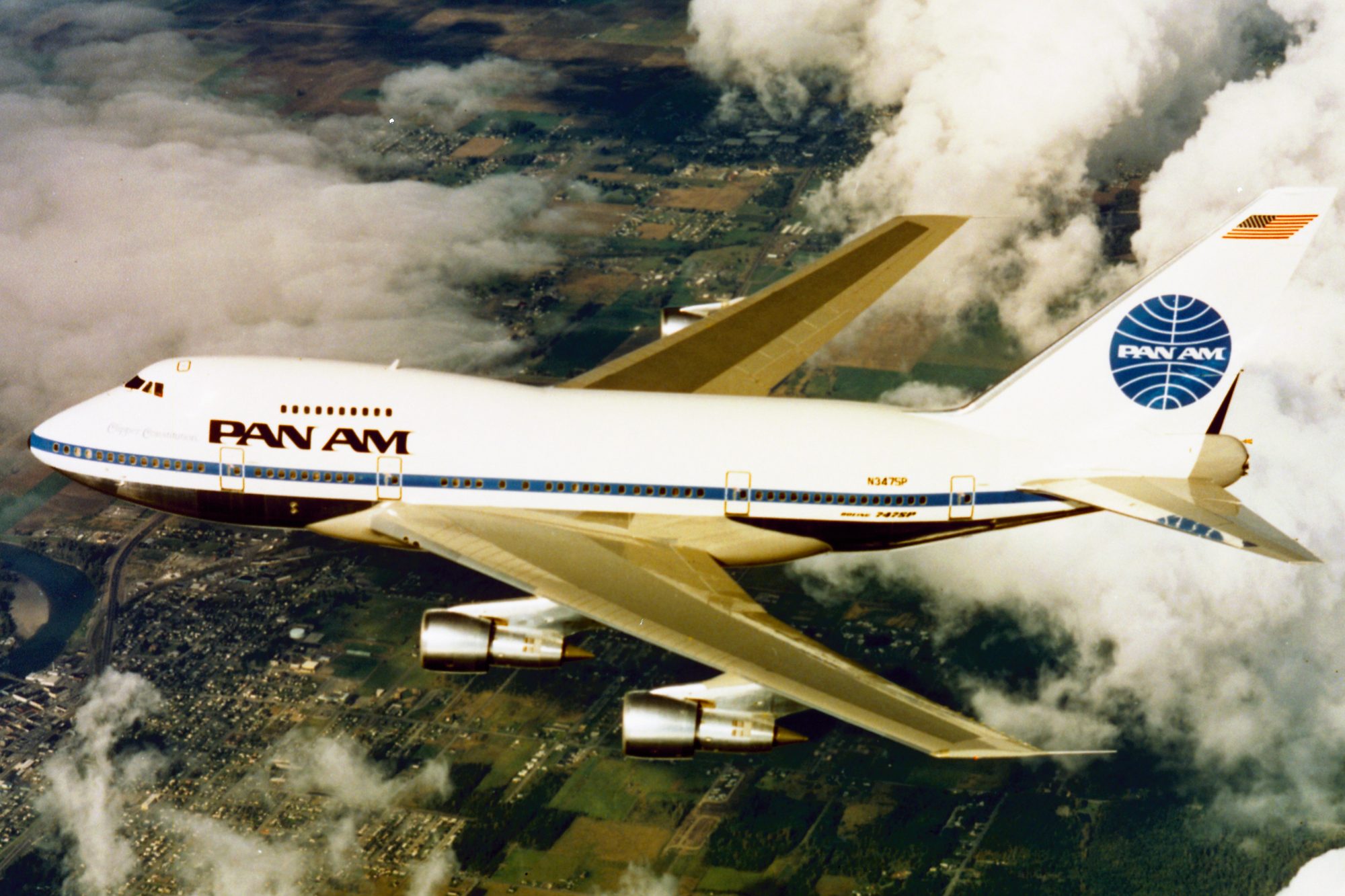
Pictured: A Pan American World Airways Boeing 747SP in flight, 1976. Tajik Air's early fleet included ex-Pan Am 747SPs of the same type flown during the 1994 sighting; not the actual aircraft involved. NASA/National Archives and Records Administration, public domain.
Theoretical Alignment
This file weights Psycho-Social/Mundane highest because the case rests on a single flight crew's account with no radar corroboration, no surfaced photographs despite the pilot's stated intention to take them, and no independent instrumented data of any kind — and because the object's reported behavior, while unusual, was observed only visually from a moving aircraft at extreme distance and altitude, conditions well documented to produce genuine perceptual and motion-parallax illusions even among experienced pilots. It assigns meaningful weight to Extraterrestrial specifically because the primary witness was a credentialed, experienced international airline captain who explicitly rejected the U.S. Embassy's own proposed meteor explanation based on his professional judgment, and because the account survives as an official, contemporaneous U.S. government document rather than a later retrospective claim. Interdimensional receives essentially no weight because nothing in the cable or any secondary reporting on it describes phenomena — sudden materialization or disappearance, apparent passage through solid matter, or similar — that the interdimensional framework was specifically developed to address; the reported behavior, however unusual, is airborne maneuvering and luminosity, squarely within the domain the Extraterrestrial and Psycho-Social/Mundane hypotheses are built to evaluate.
Background
Tajik Air, the national carrier of newly independent Tajikistan following the 1991 Soviet collapse, operated a fleet that included Boeing 747SP aircraft, a shortened long-range variant of the 747 originally developed for Pan American World Airways. On January 27, 1994, a Tajik Air 747SP was flying over Kazakhstan airspace at 41,000 feet when the flight crew, led by chief pilot Ed Rhodes, a U.S. citizen and former Pan Am pilot, along with two additional American crew members, observed an intensely bright light approaching from the east at high speed and at an altitude significantly above their own aircraft.
According to the U.S. Embassy cable that later documented the incident, the crew watched the object for approximately 40 minutes as it performed circles, corkscrews, and abrupt 90-degree turns — maneuvers well outside the performance envelope of any conventional aircraft the crew was aware of, and which the cable describes as occurring at rapid rates and under apparently high g-forces. The object's light was described as resembling a "bow wave." As dawn approached, the crew reported observing a contrail from the object at an estimated altitude of roughly 100,000 feet, well above the operational ceiling of any commercial or most military aircraft of the era. The object's actual physical shape remained obscured throughout the encounter due to darkness. Secondary summaries of the cable indicate the crew had the object in direct, continuous view for at least four minutes at a stretch during the encounter, with the fuller 40-minute window covering the period from initial approach through the final contrail observation near sunrise.
Tajik Air's Post-Soviet Transition
Tajik Air's own institutional history stretches back to September 3, 1924, when a Junkers F.13 flew the carrier's first route between Bukhara and Dushanbe, making it one of the oldest continuously operating airlines in the world by lineage. For nearly seven decades it functioned as the Tajik Territorial Department of the Soviet civil air fleet — formally organized under that name in March 1937 — flying a succession of Soviet types: Lisunov Li-2s and Junkers Ju 52s in the immediate postwar years, Antonov An-2s, and later Tupolev Tu-154s, Yakovlev Yak-40s, and Antonov An-26/An-28 regional aircraft through the 1970s and 1980s. When the Soviet Union dissolved in December 1991, Tajik Air inherited this Soviet-era short-haul fleet essentially intact but suddenly found itself the flag carrier of an independent state with no long-range international aircraft of its own and no independent means of financing them.
The airline's answer was to acquire secondhand Western widebodies, including Boeing 747SP, 757-200, and 767-300 aircraft, layering a jet fleet built for Cold War-era Pan Am and other Western carriers directly on top of its inherited Tupolev and Antonov equipment. This made Tajik Air broadly representative of a pattern common across the former Soviet republics in the early-to-mid 1990s: newly independent flag carriers stitching together international-capable fleets out of used Western aircraft, often crewed in part by Western pilots and engineers hired for exactly the kind of long-haul, ETOPS-relevant experience Soviet training had not produced. The period was not without cost; Tajik Air's operational record through the 1990s includes serious accidents in both 1993 and 1997, a reflection of the broader operational strain on post-Soviet civil aviation during the transition. Ed Rhodes's position as an American chief pilot flying a former Pan Am-lineage 747SP for a Tajik flag carrier is a direct product of this transitional arrangement, not an anomaly within it.
That same transitional period is widely documented, independent of this case, as a genuinely difficult one for post-Soviet civil aviation safety more broadly: newly independent carriers across the former USSR were absorbing unfamiliar Western aircraft types, operating amid currency and fuel shortages, and in many cases losing experienced maintenance and training staff to better-paying opportunities elsewhere, all at a time when the centralized Soviet aviation-safety oversight structure that had previously governed the entire system was itself dissolving into a patchwork of newly independent national regulators. Tajik Air's recorded accidents in 1993 and 1997 sit squarely within that broader, well-documented regional pattern rather than representing an isolated operational failure specific to the airline. This file raises that context not to suggest any connection between aviation safety conditions and the January 1994 sighting — the flight in question landed without incident and no mechanical or operational anomaly of any kind is mentioned anywhere in the cable — but because it is the same operating environment that put an experienced former Pan Am captain in the left seat of a Tajik-flagged 747SP over Kazakhstan in the first place, and is therefore directly relevant to understanding how a three-person American crew came to be flying that specific route on that specific carrier.
The Boeing 747SP and Its Pan Am Lineage
The aircraft type the crew was flying has its own well-documented history that connects back to Pan American World Airways specifically. Boeing developed the 747SP ("Special Performance") in response to a 1973 joint request from Pan Am and Iran Air, both of which needed a high-capacity jet with enough range to fly long, thin routes — Pan Am's New York–Middle East sectors and Iran Air's planned Tehran–New York service — that the standard 747 could not cover economically. Boeing's board approved the program in September 1973, and Pan Am placed the launch order for ten aircraft within weeks, with options on fifteen more. The finished design shortened the 747's fuselage by roughly 47 feet compared to the standard variant, trading cabin capacity for dramatically extended range and speed. The 747SP received FAA certification on February 4, 1976, and entered commercial service with Pan Am on the airline's New York–Tokyo route that April; a Pan Am 747SP named Clipper Liberty Bell set a new around-the-world speed record on May 3, 1976. That the same airframe type later ended up in Tajik Air's fleet, secondhand, flown in part by former Pan Am pilots, is a fairly direct continuity between the aircraft's original design purpose and the 1994 flight over Kazakhstan — and it is the reason this file's hero image above shows a Pan Am-liveried 747SP rather than a Tajik Air aircraft, for which no public photograph from the period of Tajik Air's 747SP operations has been located.
Kazakhstan's Cold War Aerospace and Military Legacy
The airspace the Tajik Air flight was crossing was not an arbitrary stretch of sky; it sat above one of the most militarily and technologically significant regions of the former Soviet Union. Kazakhstan hosted only a small fraction of all Soviet test ranges by count, but among them were several of the USSR's single most important aerospace and nuclear facilities. Baikonur Cosmodrome, built beginning in the 1950s to support flight testing of the R-7 intercontinental ballistic missile and its successors, remained through 1994 Russia's premier launch site for both crewed spaceflight and military/intelligence satellites — and, as detailed below, the origin point of the specific rocket launch this file identifies as the leading conventional explanation candidate for the sighting. Roughly 500 miles to the east, the Sary Shagan test range on Lake Balkhash, authorized in 1956, served for decades as the Soviet Union's primary proving ground for anti-ballistic-missile and directed-energy air-defense systems — a research history this archive documents separately in connection with a declassified 1973 CIA report on laser testing at the site. Further east still, the Semipalatinsk Nuclear Weapons Proving Grounds hosted more than 460 nuclear detonations over four decades and sat adjacent to Chagan Air Base, a major Cold War Long Range Aviation bomber base. None of these facilities is directly implicated in the January 1994 sighting, and this file draws no connection between them and the object the Tajik Air crew described. They are included here because they establish, independent of this specific case, that Kazakhstan's airspace has carried an unusually high density of genuine advanced aerospace, missile, and nuclear activity throughout the second half of the 20th century — the same underlying condition that makes the region a recurring backdrop for both authentic classified military aviation programs and the civilian and pilot anomaly reports that sometimes result from encountering their visible effects at a distance.
A Newly Reopened Embassy in a Country at War
The diplomatic channel through which this sighting reached Washington was itself operating under unusually difficult conditions in January 1994. The United States recognized Tajikistan's independence on December 25, 1991, and the two countries established formal diplomatic relations on February 19, 1992. A temporary U.S. Embassy opened the following month in Dushanbe's Avesto Hotel under Chargé d'Affaires Edmund McWilliams, and Stanley Escudero was named the first U.S. Ambassador to Tajikistan in August 1992. Escudero's tenure on the ground was brief: the embassy suspended operations and evacuated its staff on October 25, 1992, just days after his arrival, as the Tajikistani Civil War escalated sharply following the fall of Dushanbe to government and allied forces. The embassy did not reopen until March 11, 1993 — less than a year before the Tajik Air sighting — and Escudero presented his credentials to Supreme Council chairman Emomali Rahmon that same month. By January 1994, the post-civil-war government and an exiled opposition were still months away from the United Nations-brokered peace talks that would begin in April 1994. This file cites that timeline not to suggest the sighting itself was connected to the conflict in any way, but because it explains why a small, recently reopened embassy in a country still stabilizing from civil war would have handled and transmitted an unusual pilot report from its own national carrier through fairly routine, low-key diplomatic channels rather than treating it as a priority matter — consistent with the cable's own restrained, non-committal closing language.
Complete Timeline
| Date | Event |
|---|---|
| Jan. 27, 1994 | Tajik Air's Boeing 747SP crew, led by chief pilot Ed Rhodes, observes and tracks an unidentified bright object for approximately 40 minutes while flying at 41,000 feet over Kazakhstan. |
| Jan. 27, 1994 (dawn) | The crew reports observing a contrail from the object at an estimated 100,000 feet as sunrise breaks. |
| Jan. 27, 1994 (following days) | Rhodes reports the sighting to the U.S. Embassy in Dushanbe, Tajikistan, describing his attempt to photograph the object with a pocket Olympus camera. |
| Jan. 31, 1994 | The U.S. Embassy in Dushanbe sends a three-page unclassified cable to the State Department, titled "Tajik Air Pilots Report Unidentified Flying Object," documenting the crew's account in detail. |
| 1994–2026 | The cable remains part of the government's classified/unreleased UAP-related records; no photographs from the incident are ever publicly released or confirmed to exist. |
| May 8, 2026 | The Department of War releases the cable as part of the first batch of files under the Presidential Unsealing and Reporting System for UAP Encounters (PURSUE), initiated at the direction of President Donald Trump. |
The Original State Department Cable
The case's primary source is a genuine, contemporaneous U.S. government document: a three-page unclassified cable sent by the U.S. Embassy in Dushanbe to the State Department on January 31, 1994, just four days after the sighting. The cable's own concluding language is notably restrained and non-committal: "We have no opinion and report the above for what it may be worth." This file finds that framing evidentiarily significant — it indicates embassy staff treated Rhodes's professional standing seriously enough to formally document and transmit his account through official channels, while explicitly declining to endorse any interpretation of it, a posture consistent with routine, good-faith diplomatic reporting rather than either credulous amplification or dismissal.
Secondary reporting on the document, drawn from its own release markings, indicates it was addressed not only to the State Department but distributed to intelligence consumers as well, consistent with the routine practice of the era for unusual foreign-reported aviation incidents. The cable itself carries a State Department "Released in Full" declassification review stamp dated February 25, 2026 — the point at which the document cleared internal review for public release — though it was not actually made public until the Department of War's broader May 8, 2026 PURSUE rollout folded it into the first published tranche of records. The roughly ten-week gap between the internal review clearance and the public release date is unremarkable by the standards of large declassification programs, where cleared documents are typically bundled and staged for release in batches rather than published individually as each one clears review.
The cable is formally titled "Tajik Air Pilots Report Unidentified Flying Object" and is catalogued within the PURSUE archive as one of a numbered series of State Department UAP-related cables the Department of War began releasing in 2026; the file this case draws on is designated within that release series as a Kazakhstan-dated document from January 1994, filed alongside similar Cold War and post-Cold War-era diplomatic UAP reporting the program has begun surfacing from State Department archives.
The PURSUE Declassification Program
The program responsible for surfacing this cable is itself a recent and still-unfolding development. President Trump issued a public directive on February 19, 2026, instructing the Department of War and a reported "dozens of agencies" — including the Office of the Director of National Intelligence, the FBI, NASA, the Department of Energy, and the State Department — to locate, review, and release unresolved UAP-related government records under the banner of the Presidential Unsealing and Reporting System for UAP Encounters. The Department of War, itself the renamed Department of Defense following a related executive order earlier in the administration, published the program's first public tranche of declassified records on May 8, 2026, through a centralized online archive at war.gov/UFO. Administration officials described the total pool of potentially relevant records as running into the tens of millions and stated the archive would be updated with new tranches every few weeks going forward, positioning the Rhodes cable as one document within what is intended to be an ongoing, incremental release process rather than a single, final dump of records. The inaugural batch spanned a wide range of material — from Apollo-era imagery and older military incident reports to more recent sightings — of which the 1994 Tajik Air cable, as a unique diplomatic report of a credentialed pilot crew's encounter, represents one of the more evidentially substantive individual documents.
This file treats the PURSUE program's institutional framing as directly relevant context rather than as evidence for or against the sighting itself: a government transparency initiative releasing a document verifies that the document is authentic and that the reported event was taken seriously enough at the time to be formally cabled through diplomatic channels, but it does not and cannot independently verify the underlying interpretation any witness placed on what they saw. The 2026 release changes what is publicly known about this case; it does not change what was actually observed over Kazakhstan on the night of January 27, 1994.
It is also worth situating this specific document within the scale of the broader release. A program spanning a reported dozens of participating agencies and a records pool described as running into the tens of millions is, almost by definition, going to surface material of widely varying evidentiary quality — from mundane misidentifications and administrative paperwork to genuinely unresolved encounters. This file's assessment of the Tajik Air cable is made entirely on the substance of the document itself and the corroborating historical record assembled around it, not on any assumption that inclusion in a high-profile government transparency initiative confers added credibility. A cable can be simultaneously a completely authentic government record of what a flight crew reported, and a record of an event whose most likely underlying cause remains, as this file argues below, a very specific and previously identified conventional phenomenon.
The Pilot's Assessment and the Rejected Meteor Explanation
What distinguishes this case is that the primary witness directly and explicitly engaged with, and rejected, the most obvious conventional explanation. According to the cable, embassy or State Department contacts suggested the object might have been a meteor; Rhodes rejected this explanation based on what the cable describes as his extensive prior experience with anomalous aerial phenomena during his earlier career with Pan American Airways. Rhodes's own stated conclusion, per the cable, was that the object was "extraterrestrial and under intelligent control" — a claim this file treats as going well beyond what the observational evidence, however unusual, can actually support, since ruling out one specific conventional explanation (a meteor) does not by itself establish an extraterrestrial origin, and no instrumented, photographic, or corroborating physical evidence exists to bridge that gap.
The specific basis for the crew's rejection of the meteor hypothesis, as later summarized in reporting on the cable, was that all three pilots said they had personally observed thousands of genuine meteors and pieces of falling space debris burning up in the atmosphere over the course of their careers flying for Pan American, and that the object's behavior bore no resemblance to that familiar pattern — meteors do not circle, corkscrew, or execute sustained turns, and they do not remain visible for anything approaching 40 minutes. This file finds that specific, experience-grounded rejection considerably more credible than a generic dismissal of "it wasn't a meteor" would be, since it identifies precisely which conventional aerial phenomenon the crew had in mind and why their own accumulated observational baseline argued against it. It is also, however, a narrower rejection than it might first appear: ruling out meteors specifically does not rule out other conventional explanations the crew may not have considered, a distinction this file returns to below.
The Missing Photographs
Rhodes reportedly told embassy officials he had taken several photographs of the object with a pocket Olympus camera and stated copies would be forwarded to the embassy and to the Tajikistan desk at the State Department if the images came out. No such photographs appear in the released cable or in any subsequent public record this file has located. This file treats the absence of the promised photographs as a genuine, unresolved evidentiary gap rather than either proof the photographs never existed or proof they were suppressed — a pocket camera attempting to photograph a distant, fast-moving light source at night from a moving aircraft would face substantial technical obstacles to producing a usable image even under the best of circumstances, a mundane explanation this file finds at least as plausible as any alternative.
The technical obstacles here are worth spelling out rather than simply asserting. A compact 1994-era Olympus point-and-shoot would have used a fixed or lightly zoomed lens with a comparatively slow maximum aperture, automatic exposure metering calibrated for daylight or flash-range subjects, and no image stabilization of any kind — all shot through an aircraft cabin window subject to vibration, double-pane distortion, and reflected interior cabin light. A single bright point source against a dark night sky, photographed handheld through that combination of constraints from a cruising jet, would very plausibly render as nothing more than an indistinct blown-out dot or fail to register at all, particularly if the photographer was also flying the aircraft or otherwise occupied with cockpit duties during a 40-minute encounter. None of this proves photographs were taken and simply failed to turn out; it only establishes that a failed attempt is a fully sufficient, unremarkable explanation for their absence, without requiring any assumption of concealment, loss, or fabrication on any side.
Key Figures
Ed Rhodes
Led the flight crew that observed the object, personally rejected the embassy's proposed meteor explanation, and concluded the object was of extraterrestrial origin — a conclusion the surviving evidentiary record does not independently substantiate. Rhodes's career path, from Pan American World Airways to a chief pilot post at Tajik Air, was itself part of a broader early-1990s pattern of Western aviators taking senior flying and training positions with newly independent former-Soviet flag carriers as those airlines rapidly absorbed secondhand Western widebody aircraft their own Soviet-trained pilot corps had little experience operating. That background is precisely what the cable cites as the basis for his rejection of the meteor hypothesis, and it is also, per the cable, shared by the two unnamed American colleagues on the flight deck with him, making this a three-person crew of similarly credentialed observers rather than a single isolated witness.
The Five Observables Assessment
Applying the Five Observables framework to the reported behavior:
Assessment: The reported maneuvers (circles, corkscrews, 90-degree turns, and an ascent to an estimated 100,000 feet) would represent genuinely unusual performance if accurately observed and measured, but this file rates the observables Speculative rather than Present in most categories given the complete absence of radar, photographic, or other instrumented data, and the well-documented difficulty of accurately judging distance, size, altitude, and true motion of a distant light source viewed from a moving high-altitude aircraft at night. It is worth noting explicitly that every one of the observables rated Present or Speculative here is also fully consistent with the Progress M-21 rocket-launch hypothesis discussed later in this file: an ascending booster and its separating stages would exhibit genuine sudden acceleration during powered flight, an expanding exhaust plume reaching very high altitude could plausibly be described after the fact as an "ascent," and a distant, sunlit, wind-sheared smoke trail changing shape over tens of minutes could readily be misread, in the moment, as controlled circling, corkscrewing, and sharp turning. This file flags that overlap because a set of observables being consistent with unusual performance is not the same as their being inconsistent with a mundane cause; here, the two readings are not in tension so much as they are two different interpretations of the same limited set of visual data.
Evidence Assessment
Supporting a Genuine Anomalous Observation
- The witness was a credentialed, experienced international airline chief pilot, not an untrained observer, and the account survives in a genuine, contemporaneous official U.S. government document rather than a later reconstruction.
- The report was taken seriously enough by U.S. Embassy staff to be formally documented and cabled to the State Department within days of the event.
- The witness directly and explicitly engaged with, and rejected, the most obvious conventional explanation (a meteor) based on relevant prior professional experience, rather than the explanation going unaddressed.
- The document's chain of custody — a diplomatic cable drafted within days of the event and preserved in government archives for over three decades before formal declassification review — is unusually well-documented compared to most testimonial UFO evidence.
Supporting a Conventional Explanation
- No radar data, photographs, or any form of instrumented corroboration exists, despite the pilot's own stated attempt and intention to produce photographic evidence.
- The sighting rests entirely on the visual impressions of a single flight crew over a single event, with no independent second aircraft, ground observer, or air traffic control corroboration referenced in the released cable.
- Distant, high-altitude nighttime light sources are well-documented to produce significant perceptual distortion in apparent motion, distance, and altitude, even for experienced pilots.
- The pilot's own conclusion of extraterrestrial origin is explicitly a personal inference, not a finding independently reached or endorsed by the U.S. Embassy, which recorded the account "for what it may be worth" without adopting any interpretation.
- A specific, dated, and geographically consistent rocket launch — Progress M-21, lifting off from Baikonur Cosmodrome in the same general airspace on January 28, 1994 — has been proposed by a specialist analyst as the source of the sighting, with a documented mechanism (an expanding, sunlit, wind-sheared exhaust plume) capable of producing a 40-minute observation of changing apparent brightness and shape.
- Independent research into pilot UFO witness reliability specifically finds pilots, despite their aviation expertise, misidentify conventional astronomical and aerospace phenomena as unexplained at rates around 88 to 89 percent — the highest rate of any studied witness category.
Why "Disputed"
This case is rated Disputed because it combines a genuinely strong witness credibility profile — a credentialed, experienced chief pilot whose account was taken seriously enough by U.S. diplomatic staff to be formally recorded and transmitted through official channels — with the complete absence of any corroborating radar, photographic, or instrumented evidence, despite the witness's own claimed attempt to capture the latter. The case earns its place above Debunked because no credible party has ever proposed and substantiated a specific conventional explanation for the reported 40-minute encounter as a whole; the embassy's own suggested meteor hypothesis was directly and specifically addressed and rejected by a witness with relevant aviation experience, rather than the case simply going unexamined.
This file does not rate the case higher than Disputed because the pilot's own stated conclusion — "extraterrestrial and under intelligent control" — is a personal interpretive leap the surviving evidence does not independently support, and because a single flight crew's uncorroborated visual account of a fast-moving, high-altitude light source at night, however credentialed the witnesses, remains inherently limited by the well-documented perceptual challenges of judging distance and motion under exactly these conditions.
The existence of James Oberg's specific, dated Progress M-21 rocket-launch hypothesis, discussed at length below, does not by itself move this case to Debunked, and this file wants to be explicit about why. A plausible conventional explanation is not the same thing as a confirmed one: Oberg's own account leaves an unresolved timeline question about whether the Tajik Air flight's actual position and timing lined up with the Baikonur launch closely enough to sustain the explanation, and this file has not located a published investigation that definitively closes that gap in either direction. A case moves to Debunked on this archive's rating scale when a specific conventional explanation is not just proposed but substantiated against the available timeline and observational detail; here, the leading candidate explanation is unusually well-specified and geographically and temporally close, which is exactly why this file treats it as the strongest currently available account of the sighting, but "unusually well-specified and close" is still short of "confirmed," and the rating reflects that distinction rather than treating the two as equivalent.
Observer Credibility & Occupational Profile
The case's evidentiary weight rests substantially on Ed Rhodes's professional background: a chief pilot position with an international carrier, and prior service with Pan American World Airways, one of the most prominent commercial aviation carriers of the 20th century, giving him a genuinely relevant baseline of aviation and aerial-phenomena experience against which to judge the sighting as unusual. This file finds his direct rejection of the meteor hypothesis, specifically grounded in that professional background rather than asserted without basis, to be the single strongest credibility-supporting element of the case, even while the ultimate extraterrestrial conclusion he drew from that rejection is not itself independently verified.
What the Research Literature Says About Pilot Witnesses
This archive generally treats credentialed pilot testimony as a meaningfully stronger category of evidence than an untrained ground observer's account, and that general position is well supported: astronomer J. Allen Hynek, the longtime scientific consultant to the U.S. Air Force's Project Blue Book, found in his analysis of the Blue Book case files that pilots as a witness category were reliable identifiers of familiar objects such as aircraft and ground structures, giving real weight to a pilot's judgment that something does not match ordinary air traffic. At the same time, this file does not treat pilot testimony as immune to error. The same Blue Book-derived analysis found that military pilots misidentified conventional stimuli as unexplained in roughly 88 percent of their submitted cases, and commercial pilots in roughly 89 percent — the highest misidentification rate of any witness category Hynek examined, worse than that of untrained civilian observers. The bulk of those pilot misidentifications involved astronomical objects: planets, meteors, and stars whose true nature is difficult to judge from a fast-moving, high-altitude platform with few fixed reference points. This apparent paradox — pilots being simultaneously the witnesses best positioned to recognize when something is not ordinary air traffic, and a witness category with an unusually high rate of misidentifying ordinary sky phenomena as unexplained — is central to how this file weighs Rhodes's account: seriously, as a professional judgment worth documenting, but not as a substitute for the instrumented corroboration the case otherwise lacks.
The broader case for taking credentialed pilot testimony seriously as a category, while still subjecting individual accounts to scrutiny, is most fully developed in the work of Richard F. Haines, a research scientist who spent nearly two decades at NASA's Ames Research Center working on the Gemini, Apollo, Skylab, and Space Station programs before turning his research focus to aviation-related anomalous phenomena reports. Haines later founded the National Aviation Reporting Center on Anomalous Phenomena (NARCAP) specifically to systematize the collection and investigation of pilot and aircrew reports, and authored case-study compilations — including a 1992 study examining pilot reports involving apparent electromagnetic interference with aircraft systems — that this file draws on as a methodological benchmark for evaluating exactly the kind of single-crew, high-altitude account documented here.
Historical Precedents & Archive Matches
This case belongs to a broader category of credentialed airline and military pilot UFO reports this archive documents, and is directly comparable to other Cold War and post-Soviet era high-altitude sightings over Central Asian and former Soviet airspace, a region with a documented history of both genuine military aviation activity and civilian pilot UFO reports.
Compiled research into Soviet and post-Soviet pilot encounters — the same body of work this file draws on for the Rhodes case — documents a small number of other aircrew reports from the region worth noting as comparative context, though this file treats each on its own evidentiary terms rather than as mutually reinforcing. In December 1989, a flight instructor at the Chelyabinsk Aeroclub named Vladimir Kuzmin reported observing a dark, cigar-shaped object for roughly eight minutes, several minutes of which were in direct view, from the cockpit of a two-seat L-29 jet trainer. Kuzmin, a pilot with sixteen years of experience at the time, reportedly developed a skin reaction on the portions of his face left exposed within hours of the encounter — described as a reddened, thickened, crust-like irritation that persisted for more than a week — which Haines later theorized, without confirming, might be consistent with localized microwave-range energy exposure. Separately, a September 1984 Aeroflot flight identified in secondary reporting as Flight 7084, en route from Leningrad to Tbilisi over Belarus, was reported by Soviet researchers Anatoliy Listratov and physicist V. Psalomshchikov to have involved crew exposure to anomalous electromagnetic activity, with Psalomshchikov concluding in his own published analysis that the source was extraterrestrial — a conclusion this file treats with the same skepticism it applies to Rhodes's parallel conclusion in the present case, for the same reason: a witness's or investigator's inference about ultimate cause is not itself evidence for that cause.
This file flags both comparative cases explicitly as reported but not independently verified by this archive, included here only to illustrate that credentialed pilot UFO reports from Soviet and post-Soviet airspace during this general period were not unique to the Rhodes case, and that the broader research community studying them — including Haines, who is credited with having personally documented several thousand pilot UFO reports worldwide over the course of his career — consistently found the same underlying tension found here: professionally credible observers reporting encounters that, absent instrumented corroboration, cannot be moved beyond the status of compelling but ultimately unresolved testimony.
Within this archive specifically, the two related cases linked below illustrate the range that "professionally credible observer, insufficient instrumented corroboration" cases can span. The 1968 CIA Himalayan Border sightings, documented in a confidential CIA information report covering six separate encounters along the Ladakh-to-Bhutan frontier, sit closer to this case on the evidentiary spectrum: strong institutional documentation, no conclusive instrumented data tying the sightings themselves to a specific cause, and a genuine unresolved status decades later. The Lakenheath-Bentwaters radar-visual case from 1956 sits at the opposite end: it involved actual multi-site radar tracking and a scrambled RAF interceptor achieving a radar lock, giving it a category of corroborating instrumented evidence entirely absent from the Tajik Air sighting, even though that case's own credibility was later complicated when the intercepting aircrew, tracked down decades afterward, denied the dramatic details attributed to their pursuit. Read together, the three cases underscore a consistent pattern this archive documents across credentialed-witness sightings generally: strong witness credentials and serious institutional documentation are common to genuinely disputed cases, but they are not a substitute for, and do not reliably predict the presence of, independent instrumented corroboration.
Material Analysis
The case's sole surviving physical evidence is the three-page U.S. State Department cable itself, declassified and publicly released on May 8, 2026. No photographs, radar returns, or other physical or instrumented evidence has ever been publicly produced, despite the pilot's stated intention to forward photographs to the embassy and State Department. Unlike cases built on later recollection, oral history, or retrospective claims recorded years or decades after the fact, the cable was drafted and transmitted within days of the event by career diplomatic staff with no evident stake in the outcome, which meaningfully improves its reliability as a record of what the crew reported at the time, even though it cannot independently verify what the crew actually saw. The document's chain of custody — embassy cable traffic to the State Department in 1994, retained in government archives for over three decades, then processed through a formal 2026 declassification review before public release — is also considerably more traceable than the provenance of most testimonial UFO evidence, where the original record, if one exists at all, is often a personal notebook, a much later interview, or a secondhand retelling.
Supporting Continued Legitimate Interest
- The cable's authenticity as a genuine 1994 diplomatic communication, only recently declassified, gives the case a credible primary-source foundation most testimonial UFO accounts lack.
Supporting a Conventional Explanation
- The complete absence of the promised photographs or any other corroborating evidence, more than three decades after the event, leaves the case entirely dependent on unverified visual testimony.
The Conventional Explanation Candidate: Misperceived Distant Light Source, Possibly Astronomical or Atmospheric
The leading, and this file's assessed, conventional explanation candidate — while not confirmed by any published investigation this file has located — is that the crew observed a genuine but distant and difficult-to-judge light source, potentially a bright planet, meteor, high-altitude aircraft contrail catching early sunlight, or an atmospheric optical phenomenon, whose true distance, altitude, and motion were significantly misjudged due to the well-documented perceptual challenges of observing a point-source light from a moving aircraft at night with no reference points.
The Progress M-21 Rocket Launch Hypothesis
The single most specific and well-documented conventional explanation proposed for this case is not a meteor, planet, or generic atmospheric effect at all, but a real, precisely dated rocket launch. Spaceflight journalist and former NASA Johnson Space Center flight controller James Oberg, a specialist in the Soviet and Russian space program, examined the Tajik Air case in a 1994 analysis of pilot UFO misperceptions and connected it directly to the launch of the Progress M-21 unmanned cargo spacecraft, which lifted off from Baikonur Cosmodrome in Kazakhstan aboard a Soyuz-U booster at 02:12 UTC on January 28, 1994, carrying supplies to the Mir space station (Progress M-21 went on to dock with Mir's Kvant-1 module on January 30, 1994). Oberg's analysis argues that a Soyuz booster's ascent and stage separation, occurring roughly 2.5 minutes after liftoff, produces an expanding, sunlit exhaust and smoke plume at high altitude that can remain visible from a considerable distance for 40 to 60 minutes as it drifts and is sheared into changing shapes by upper-atmospheric winds — a duration Oberg specifically noted was consistent with the length of the Tajik Air crew's observation, in contrast to the few minutes a direct view of the rocket and booster separation themselves would actually last. Baikonur sits within the same general Kazakhstan airspace region the flight was crossing, making a launch from the cosmodrome a geometrically plausible source for a bright light approaching from the crew's reported easterly bearing.
Oberg's specific mechanism for reconciling the rocket-launch explanation with the crew's detailed report of circles, corkscrews, and 90-degree turns is a documented and recurring category of pilot misperception: he argues the crew mistook the plume's changing brightness, as sunlight caught different portions of the expanding, wind-sheared smoke trail at different angles, for the object itself approaching, maneuvering, and turning — describing this specific error, of confusing a stationary or slowly drifting object's brightening with true approach, as one he had documented in other pilot UFO cases. Under this reading, the crew did not fabricate or misreport what they saw; they accurately described the changing visual appearance of a real, complex, and genuinely unfamiliar phenomenon — an expanding rocket exhaust plume lit from below by a sun still beneath the pilots' own horizon — while incorrectly inferring powered flight and directed maneuvering from what was actually a passive, wind-driven visual transformation.
This file finds the Progress M-21 hypothesis considerably more specific and falsifiable than a generic "misperceived light source" candidate, and treats it as the strongest single conventional explanation currently proposed for this case, while stopping short of adopting it as confirmed for one clearly stated reason: Oberg's own analysis notes an unresolved timeline discrepancy, since the explanation only aligns cleanly with the reported January 27 sighting date if the Tajik Air flight in question departed on the night of the 27th and the crew's observation carried into the early morning hours of the 28th, the point at which the actual Baikonur launch occurred. No published account this file has located, including Oberg's own, definitively resolves whether the flight's timing bridges that gap, and the cable's own dating of the encounter to January 27 is the version this file otherwise defers to throughout. This file also notes, separately, that Oberg has documented comparable pilot misperceptions of a Soviet Gorizont/Proton rocket body's atmospheric re-entry witnessed across France and Germany in November 1990, where multiple aircrews independently misjudged debris fragments as structured, maneuvering craft flying in formation and significantly misestimated their distance — a separate, well-documented case that this file cites only as evidence that the specific error pattern Oberg proposes for the Tajik Air sighting is not a one-off explanation invented for this case, but a recurring, previously documented category of pilot misperception of rocket-related phenomena.
It is also worth noting that Oberg's analysis of the Tajik Air case was not a retrospective reassessment written decades after the fact for this or any other declassification effort; it was published within roughly four months of the sighting itself, in May 1994, while the underlying cable was still years from public release. That timing matters for how this file weighs the hypothesis: Oberg was working from contemporaneous press and wire-service reporting on the crew's account rather than from the cable text later released under PURSUE, and reached his rocket-launch conclusion independently of, and well before, the U.S. government's own 2026 disclosure of the diplomatic record. The Kuzmin case discussed above, from December 1989, and the Tajik Air sighting fall within the same roughly five-year window of heightened aviation-community and researcher attention to Soviet and post-Soviet pilot UFO reports that produced Oberg's and Haines's respective analyses, a period this file notes without treating the clustering itself as evidentiarily significant one way or the other — it may simply reflect that researchers were actively looking for and collecting such reports during those specific years, rather than any change in the underlying rate of genuinely anomalous encounters.
The Rejected Meteor Hypothesis
While Rhodes specifically rejected a meteor explanation based on his professional experience, this file notes that the reported 40-minute duration, if accurately observed, would itself argue against a single meteor (which would typically be visible for seconds), while remaining consistent with a sequence of distinct astronomical or atmospheric phenomena, an aircraft contrail illuminated by the rising sun, or a genuine but conventional high-altitude aircraft. Oberg's own assessment of the case makes a related point from a different angle: the crew's rejection of a meteor explanation, however well-grounded in their own experience of watching meteors burn up, is not itself evidence against a rocket-launch explanation, since a launch and ascending booster is a categorically different phenomenon from a meteor and was, on Oberg's account, never presented to the crew as an alternative for them to specifically evaluate and reject.
Perceptual Distortion at High Altitude
Distant light sources viewed from a moving aircraft at night, absent fixed reference points, are well-documented to produce apparent motion, size, and distance illusions even among highly experienced pilots, a mechanism directly relevant to reconciling the crew's detailed reported maneuvers with a genuinely mundane source. This general vulnerability is consistent with the broader statistical pattern discussed above in Observer Credibility & Occupational Profile, where the majority of documented pilot UFO misidentifications specifically involve astronomical or aerospace phenomena rather than conventional aircraft — exactly the category a distant rocket launch and its exhaust plume would fall into.
Taken together, the three candidate explanations this file has assessed — a specific dated rocket launch, a generic misperceived astronomical or atmospheric light source, and simple perceptual distortion inherent to high-altitude night observation — are not mutually exclusive alternatives competing for a single correct answer so much as three levels of the same underlying account. The rocket-launch hypothesis supplies the most specific candidate physical source; the broader astronomical/atmospheric category supplies a fallback if that specific source is ultimately not the correct one; and the perceptual-distortion research supplies the general mechanism, documented independently of this case in the pilot-witness literature discussed above, by which any of those genuine but distant and unfamiliar light sources could plausibly have been reported as controlled, purposeful maneuvering. This file's own confidence in a conventional explanation for the sighting does not depend on any single one of the three being proven; it rests on the combination of a specific, geographically and temporally close candidate source, a well-documented general category of misperception the case fits into, and the complete absence, more than three decades on, of any instrumented evidence that would be needed to establish the alternative.
Misperceived Distant Light Source, Possibly Astronomical or Atmospheric — Plausibility Rating: PLAUSIBLE BUT UNCONFIRMED
Related Cases
Confirmed Documents & Official Records
The original three-page State Department cable, hosted on the Department of War's official PURSUE declassification archive.
PUBLIC RECORD (freely accessible)Search Government Archives Directly
Further Reading — Recommended Literature
UFO: The Inside Story of the US Government's Search for Alien Life Here—and Out There
An extensively researched history of U.S. government UAP records and disclosure, providing context for how cables like this one moved through official channels.
UFOs: Generals, Pilots, and Government Officials Go on the Record
A compilation of credentialed pilot and official UFO testimony, directly relevant to weighing Ed Rhodes's professional account.
Observing UFOs: An Investigative Handbook
A former NASA scientist's methodology for evaluating pilot and aviation-related UFO reports specifically, directly applicable to this case.
The UFO Experience: A Scientific Inquiry
The foundational text on scientifically rigorous UFO classification and witness evaluation.
Watch the Skies! A Chronicle of the Flying Saucer Myth
A skeptical history of the flying saucer phenomenon, useful comparative context for assessing individual pilot testimony.
DISCLOSURE: Some links above are affiliate links. If you purchase through them, OverClassified receives a small commission at no additional cost to you. This helps support independent research.
Essential Viewing
ABC News Exclusive: New UFO Files
ABC News — exclusive coverage ahead of the May 2026 PURSUE first-batch release that included this case's cable.
Pentagon Drops New UFO Files
Fox News — coverage of the broader PURSUE declassification effort this case's cable was released under.
Sources
- "Pentagon UFO Files Include 1994 Tajik Air Report Over Kazakhstan," The Times of Central Asia. Read online →
- "The Kazakhstan UFO," Unsolved Mysteries Wiki. Read online →
- "Airplane pilot UFO encounters in the USSR & CIS," Open Minds. Read online →
- "Pentagon publishes first batch of declassified UFO files under new program," Stars and Stripes. Read online →
- "Presidential Unsealing and Reporting System for UAP Encounters," U.S. Department of War. Read online →
- "Department of War Releases Unidentified Anomalous Phenomena Files in Historic Transparency Effort," U.S. Department of War. Read online →
- "Trump releases the UFO files: 5 key questions," CBC News. Read online →
- "United States UFO files," Wikipedia. Read online →
- "Bright lights and hot orbs: UFO files shed light on sightings but leave interpretation to the public," Arab News PK. Read online →
- Graff, Garrett M. UFO: The Inside Story of the US Government's Search for Alien Life Here—and Out There. Avid Reader Press, 2023.
- Kean, Leslie. UFOs: Generals, Pilots, and Government Officials Go on the Record. Harmony Books, 2010.
- Haines, Richard F. Observing UFOs: An Investigative Handbook. Nelson-Hall, 1980.
- Hynek, J. Allen. The UFO Experience: A Scientific Inquiry. Da Capo Press, 1998 (orig. 1972).
- Peebles, Curtis. Watch the Skies! A Chronicle of the Flying Saucer Myth. Smithsonian Institution Press, 1994.
- "File: N347SP Pan American World Airways Boeing 747SP inflight.jpg," NASA/National Archives and Records Administration, public domain. View file →
- "Tajik Air Pilots Report Unidentified Flying Object" (original cable, DOS-UAP-D2), U.S. Department of State/Department of War PURSUE Archive. Read online →
- Oberg, James. "Case Studies In Pilot Misperceptions Of UFOs," 1994. Read online →
- "Tajik Air," Wikipedia. Read online →
- "Progress M-21," Wikipedia. Read online →
- "Boeing 747SP," Wikipedia. Read online →
- "Embassy of the United States, Dushanbe," Wikipedia. Read online →
- "Richard Haines," Center for UFO Studies (CUFOS). Read online →
See something inaccurate? Have additional information or sources?
Suggest an Edit →Last Updated: August 2026