
Captain Edward J. Ruppelt: Summer of the Saucers — 1952
A Biographical Reconstruction of Blue Book's Pivotal Year, Built From Ruppelt's Own Private Papers
Core Thesis
Where Edward J. Ruppelt's own 1956 memoir, The Report on Unidentified Flying Objects, is a first-person account written by the man who ran Project Blue Book, filtered through his own memory, his own publisher, and his own sense of what he was willing to say while the Air Force he had just left could still read it, Summer of the Saucers — 1952 is something categorically different: a biographical reconstruction assembled forty-four years later by two independent UFO historians, Michael D. Hall and Wendy A. Connors, working from roughly 700 pages of Ruppelt's own private notebooks and an unpublished manuscript held in the care of Professor Michael Swords at the J. Allen Hynek Center for UFO Studies, supplemented by original interviews with Ruppelt's surviving family members and former military and civilian colleagues. Edited by Miranda Jane Emmert and published by the small Albuquerque specialty press Rose Press International, the book narrows its focus to the single most consequential stretch of Ruppelt's tenure — the summer of 1952, anchored by the July Washington, D.C. flap — and asks not what Ruppelt chose to tell the public in 1956, but what his own contemporaneous papers actually show about how Blue Book functioned from the inside while he was living through it.
About the Author
Michael David Hall came to UFO history from a conventional historian's background rather than from ufology itself: he serves as executive director of the Montgomery County Historical Society, and his interest in the subject reportedly began after he encountered obscure wartime reports filed by Allied pilots describing "foo fighters" during World War II. That historian's instinct for primary documentation shaped his approach to UFO research generally — he published his own solo book, UFOs: A Century of Sightings, in the same year as this one, arranging a century of American sightings chronologically and drawing preferentially on reports from military personnel, law enforcement, and other witnesses he considered institutionally reliable rather than on contactee or abduction material.
Hall's UFO research repeatedly intersects with Ruppelt's own case history. He co-authored, with Connors, a separately published documentary history of the Lubbock Lights case built on the same Ruppelt archive material underlying this book, and he discussed the Carson Sink Incident — the July 24, 1952 radar-and-visual case Blue Book carried as an unresolved "Unidentified" through the same summer this book covers — in his own UFOs: A Century of Sightings. That case, along with the rest of the 1952 flap, receives sustained treatment in Summer of the Saucers as well.
Wendy Ann Connors brought a different, and in some ways rarer, set of qualifications. She grew up in Iowa, enlisted in the U.S. Air Force after high school and was honorably discharged, then completed her college degrees at the University of Iowa before relocating to Albuquerque, New Mexico — the same city where Rose Press International published this book. There she spent more than four decades as an independent archivist of UFO history, co-founding the SIGN Historical Group (named for Project Sign, the Air Force's first UFO investigation, which preceded Grudge and Blue Book) and building "Faded Discs," a personal archive that eventually held more than 2,000 hours of vintage UFO-related audio recordings — witness interviews, radio broadcasts, and recorded conversations with early Air Force investigators and researchers, some of the only surviving audio record of that era. She retired from active ufology in 2007 due to ill health, and the Faded Discs collection has since been preserved at the Archives for UFO Research (AFU) on Bainbridge Island, Washington. Her decades of relationship-building with the ufology community's earliest surviving participants, more than any single credential, are what made the family and colleague interviews underlying this book possible.
The book's editor, Miranda Jane Emmert, is credited on the title page and in Library of Congress cataloging data as having shaped the final manuscript, though published biographical detail about her specific editorial role is sparse; she is not credited as a co-author of the book's research or argument, unlike Hall and Connors.
Historical Context & Origins
By 2000, Ruppelt had been dead for forty years, and the specific primary-source material he drew on for his own 1956 book — his working notebooks, internal correspondence with the Blue Book staff he directed from Wright-Patterson Air Force Base, and an unpublished, more candid manuscript he never released in his lifetime — had passed into the custody of UFO historian Michael Swords and the J. Allen Hynek Center for UFO Studies (CUFOS). That transfer of custody is what made a book like this possible in a way it could not have been earlier: Hall and Connors were not reinterpreting Ruppelt's published words but reading material he had never intended the public, or in some cases even his own Air Force superiors, to see.
The book also arrived amid a renewed wave of interest in Blue Book-era primary documentation driven by 1990s-era declassification. The CIA's own files on the January 1953 Robertson Panel — convened directly in response to the Washington flap this book covers — had been substantially released in the years immediately preceding this book's publication, and the broader 1990s FOIA-driven push to reexamine Air Force UFO records (including the GAO's 1995 records search connected to Roswell) had created new appetite for exactly the kind of archival, document-grounded ufology this book represents, as distinct from the advocacy and abduction-focused writing that dominated much of 1990s popular UFO publishing.
As a small-press release from Rose Press International in Albuquerque — Connors's own home city — the book was never positioned for mainstream trade distribution the way Ruppelt's original Doubleday edition had been. Its audience was, from the outset, the specialist community of UFO historians and researchers already working with Blue Book-era primary documents, a narrower readership than Ruppelt's own book found but one uniquely equipped to make direct use of the archival material Hall and Connors were making newly accessible.
Core Arguments & Key Concepts
The book's organizing argument is essentially documentary rather than interpretive: that the fullest, least-mediated understanding of how Blue Book actually operated during 1952 comes not from Ruppelt's own retrospective published account but from his contemporaneous private notebooks, read alongside the recollections of the people who worked alongside him. Hall and Connors present themselves less as advocates for a particular theory of what the Washington flap was than as reconstructors of an institutional and personal history, assembling primary material Ruppelt himself never fully published.
A central piece of that reconstruction is the complete transcript of Maj. Gen. John Samford's July 29, 1952 Pentagon press conference — the largest Air Force press briefing since World War II, held at the height of the flap that centered on repeated radar and visual returns over Washington National Airport and the Capitol. Ruppelt's own 1956 book quotes and characterizes portions of that briefing; this book reproduces it in full, allowing readers to judge Samford's temperature-inversion explanation, and the pointed follow-up questions from the assembled press corps, against the complete record rather than Ruppelt's selective retelling.
The book also traces the institutional aftermath the Washington flap set in motion: the CIA-convened Robertson Panel of January 1953, and the Air Force-commissioned Battelle Memorial Institute statistical study that became Blue Book Special Report No. 14 — a study Hall and Connors note was completed in September 1953 but not publicly released until October 1955, a roughly two-year gap the book documents without asserting a specific hidden motive for the delay.
Individual case studies anchor the broader institutional narrative, including the November 1953 disappearance of a Michigan Air National Guard F-89 over Lake Superior later known as the Kinross Incident, and the September 1951 Lubbock Lights case, where the book engages directly with astronomer Donald Menzel's skeptical explanation that the lights were streetlight reflections off flocks of plovers — a hypothesis this site's own case-file entry on Lubbock treats as one contested explanation among several, not a settled resolution. The book also documents Menzel's own access to internal Blue Book files, a detail relevant to later disputes over how much unofficial influence outside skeptics had on the project's internal deliberations.
The book's closing chapters extend past Ruppelt's own 1953 departure from Blue Book into the mid-1950s, tracing the emergence of Donald Keyhoe's National Investigations Committee on Aerial Phenomena (NICAP) in 1956 and its early efforts to press for a congressional hearing — positioning Ruppelt's own tenure, and this book's account of it, as the institutional prologue to the more adversarial, outsider-versus-Air-Force phase of UFO history that followed.
Key Cases & Evidence Discussed
The Washington, D.C. UFO Flap (Case #015, July 1952) is the book's central event, covered through the complete transcript of Gen. Samford's July 29 press conference and Ruppelt's own private notebook entries from the week of the sightings, offering a more granular institutional account than Ruppelt's own 1956 chapters on the same flap.
The Carson Sink Incident (Case #070, July 24, 1952) — a radar-and-visual case Blue Book carried as formally "Unidentified" — is treated as part of the same summer-long wave the book's title references, a case Michael Hall separately discussed in his own UFOs: A Century of Sightings.
The Lubbock Lights (Case #041, September 1951) receive extended treatment, including direct engagement with Donald Menzel's plover-reflection hypothesis, drawing on the same archival base Hall and Connors used for their separately published documentary history of the case.
The Kinross Incident (Case #061, November 1953) — the disappearance of a Michigan ANG F-89 and its crew over Lake Superior while pursuing a radar target — is covered as one of the more consequential cases from the immediate post-Ruppelt Blue Book period, illustrating how the project's culture and rigor changed after his 1953 departure.
The Robertson Panel (Case #226, January 1953) is documented as the direct institutional consequence of the Washington flap, with the book tracing how the CIA-convened panel's recommendations reshaped Blue Book's public posture during the final months of Ruppelt's tenure.
Critical Reception & Controversies
As a release from a small Albuquerque specialty press with a narrow initial print run, Summer of the Saucers never received the kind of mainstream newspaper or trade-journal coverage Ruppelt's own Doubleday-published 1956 book drew; a thorough search turns up no equivalent to the Cleveland Plain Dealer or Baltimore Sun notices Ruppelt's own book received, and the book carries a Goodreads listing with zero submitted ratings as of this writing — an honest data point about how narrowly this specific title has circulated relative to its subject's own more famous book, rather than a reflection on its research quality.
The most substantive published assessment located is a detailed 2009 review published on the blog REVIEW ARCHIVE, which called the book "superb" reading for students of UFO history, praising its thorough documentation and describing it as offering "fresh insights" drawn from material unavailable to earlier writers. The same review noted a genuine limitation: an "inevitable American bias," with minimal coverage of contemporaneous UK or other international UFO activity, and observed dryly that the book contains "no crashed saucers, no abductions" — a straightforward institutional and biographical history rather than a sensational one.
A structural limitation worth stating plainly: Hall and Connors describe their own project, in language quoted in bookseller listings, as written partly as a tribute to Ruppelt's "devotion to the United States Air Force and his family" — language that signals a more sympathetic, less arm's-length authorial stance than a fully disinterested academic biography would adopt. That the book's authors regard their subject with evident admiration does not by itself undermine the archival material they present, but it is a relevant caveat for readers weighing the book's interpretive framing against its underlying documentary record.
The book's evidentiary strength is also its main limitation for outside verification: because its core claims rest on private notebooks and unpublished manuscript material held at CUFOS rather than on documents independently available elsewhere, readers without direct access to that archive must rely on Hall and Connors's own transcription and characterization of the material, in much the same way readers of Ruppelt's original 1956 book must rely on his account of the now-unlocatable "Estimate of the Situation" document.
Influence & Legacy
The book's most concrete legacy is archival rather than argumentative: by drawing directly on Ruppelt's private notebooks and unpublished manuscript, Hall and Connors made a meaningful portion of that primary-source material accessible, in transcribed and contextualized form, to researchers who would otherwise have needed to travel to CUFOS's own holdings at Western Michigan University to consult it directly.
Connors's own parallel contribution extends beyond this single book: her "Faded Discs" audio archive, built independently of this project over decades, preserved more than 2,000 hours of recordings from UFO history's earliest era and is now maintained at the Archives for UFO Research on Bainbridge Island, Washington — a complementary body of primary-source preservation work that has outlasted her own active involvement in ufology.
On this site specifically, this book's account of the summer 1952 flap and its aftermath connects directly to the existing essential-reading breakdown of Ruppelt's own 1956 memoir, offering researchers a genuine outside-in complement to Ruppelt's own inside-out account of the same events — and Michael D. Hall's own key-figures entry already credited this book, alongside his and Connors's separate Lubbock Lights research, before this article's publication.
The Book
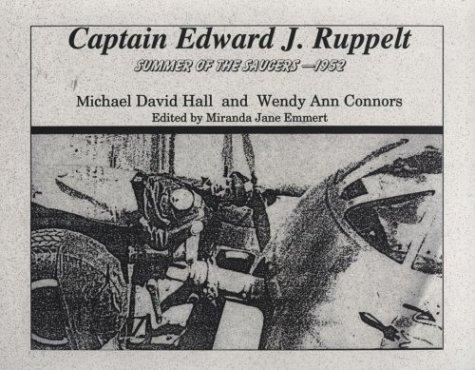
Captain Edward J. Ruppelt: Summer of the Saucers — 1952
A Biographical Reconstruction of Blue Book's Pivotal Year, Built From Ruppelt's Own Private Papers
Find on Amazon →As an Amazon Associate, OverClassified may earn from qualifying purchases made through this link, at no extra cost to you.
Why This Is Essential Reading
Summer of the Saucers — 1952 earns its place on this list precisely because it is not another retelling of Ruppelt's own famous account, but a documented attempt to look past it — using the private notebooks, unpublished manuscript, and personal testimony Ruppelt's own 1956 book necessarily left out or softened. Hall and Connors's decades of combined archival and interview work, particularly Connors's rare direct relationships with ufology's earliest surviving participants, produced a genuinely independent reconstruction of Blue Book's most consequential year rather than a derivative summary of a story already told. Its limitations are real and worth stating honestly: a small specialty-press release with minimal mainstream critical coverage, an admittedly sympathetic authorial stance toward its subject, and evidentiary claims that ultimately rest on archival material most readers cannot independently inspect. Read alongside Ruppelt's own memoir rather than as a substitute for it, this book gives readers something Ruppelt's own account could not give them: a look at the man and the institution from outside his own carefully chosen words.
Related Cases & Theories
Essential Viewing
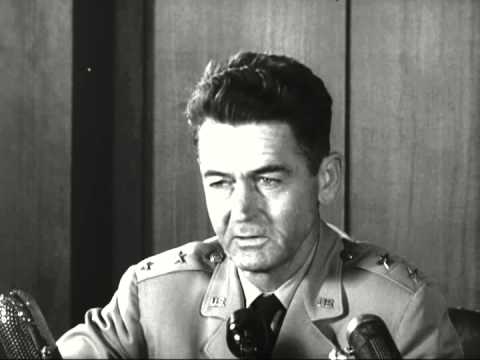
Maj. Gen. John A. Samford's Statement on "Flying Saucers," Pentagon, Washington, DC, 07/31/1952
US National Archives — Original U.S. National Archives footage of the July 1952 Pentagon press briefing this book reproduces in full transcript — the largest Air Force press conference since World War II, held at the height of the Washington flap this book covers in detail.
UFO - The Washington Merry-Go-Round
DisproveThis — A documentary treatment named for the same chapter title Ruppelt himself used in his 1956 memoir, covering the institutional chaos inside the Air Force during the July 1952 Washington flap this book reconstructs from Ruppelt's own private notebooks.
Sources Cited
- "Captain Edward J Ruppelt Summer of the Saucers 1952." Amazon.com (ISBN 0970505507 / 9780970505507, Rose Press International, 2000, softcover). amazon.com
- "Captain Edward J. Ruppelt." Open Library (bibliographic record: 2000 Rose Press International 1st ed., xxiii + 304 pp., edited by Miranda Jane Emmert, LCCN 2001272794, LC class TL789 .H3497 2000). openlibrary.org
- "Captain Edward J Ruppelt Summer of the Saucers 1952." AbeBooks (bookseller listings, edition and condition details). abebooks.com
- Hall, Michael David; Connors, Wendy Ann. "Captain Edward J. Ruppelt: Summer of the Saucers — 1952." The Iliad Bookshop (bookseller listing). iliadbooks.com
- "Captain Edward J Ruppelt Summer of the Saucers 1952." Goodreads (edition record; publication date November 10, 2000, 304 pp. paperback; zero ratings as of this writing). goodreads.com
- "REVIEW ARCHIVE: Edward Ruppelt: Summer of the Saucers." mrobsr blog, August 2009 (detailed content review: sources, chapter topics, critical assessment). mrobsr.blogspot.com
- "SHG — Wendy Connors' Archive Files Introduction." Project 1947 / SIGN Historical Group (Connors's role as founding member, Faded Discs Archive description). project1947.com
- "Wendy Connors." The UFO Database (biographical summary: Iowa upbringing, U.S. Air Force service, University of Iowa education, SIGN Historical Group co-founding, Faded Discs Archive). theufodatabase.com
- "The Early Years of NUFORC — Bob Gribble and Wendy Connors." National UFO Reporting Center (NUFORC). nuforc.org
- "UFOs: A Century of Sightings." Amazon.com (Michael David Hall's separately authored 2000 book; author background). amazon.com
- "Captain Edward J. Ruppelt: Summer of the Saucers -- 1952." Google Books (bibliographic record, Michael David Hall and Wendy Ann Connors). books.google.com
- "Edward J. Ruppelt." Wikipedia (biography: Blue Book tenure 1951–1953, death 1960, custody of personal papers). en.wikipedia.org
- This site's own essential-reading breakdown: The Report on Unidentified Flying Objects, Ruppelt's own 1956 first-person memoir, for direct comparison against this later, outside biographical account.
- This site's own case file: The Washington, D.C. UFO Flap of 1952, for the flap this book treats as its central event.
- This site's own key-figures entry: Edward J. Ruppelt, for his full biography, and Michael D. Hall, for this book's co-author.
Have corrections, additional research, or peer-reviewed sources? Help improve this entry.
Suggest an Edit