
Carson Sink Incident
At 3:40 PM MST on July 24, 1952, U.S. Air Force Lieutenant Colonels John L. McGinn and John R. Barton, Pentagon staff officers flying a B-25 from Hamilton Air Force Base to Colorado Springs, were at 11,000 feet over the Carson Sink east of Reno, Nevada, when three objects they first took for F-86s in a V formation turned out, as they came closer, to be bright silver, tailless delta shapes with a ridge from nose to tail. The objects made a slight left bank and crossed in front of and above the bomber, 400 to 800 yards away, at what the colonels estimated was at least three times an F-86's speed; the whole sighting lasted three to four seconds. Flight Service had no record of aircraft in the area, Blue Book found no deltas or balloons nearby, and the case was filed as "Unknown," Blue Book case #1584. Edward J. Ruppelt, who ran Blue Book at the time, used it in his 1956 book as his example of "a 'good' UFO report with an 'unknown' conclusion" — while also listing the conventional possibilities that could not be ruled out.
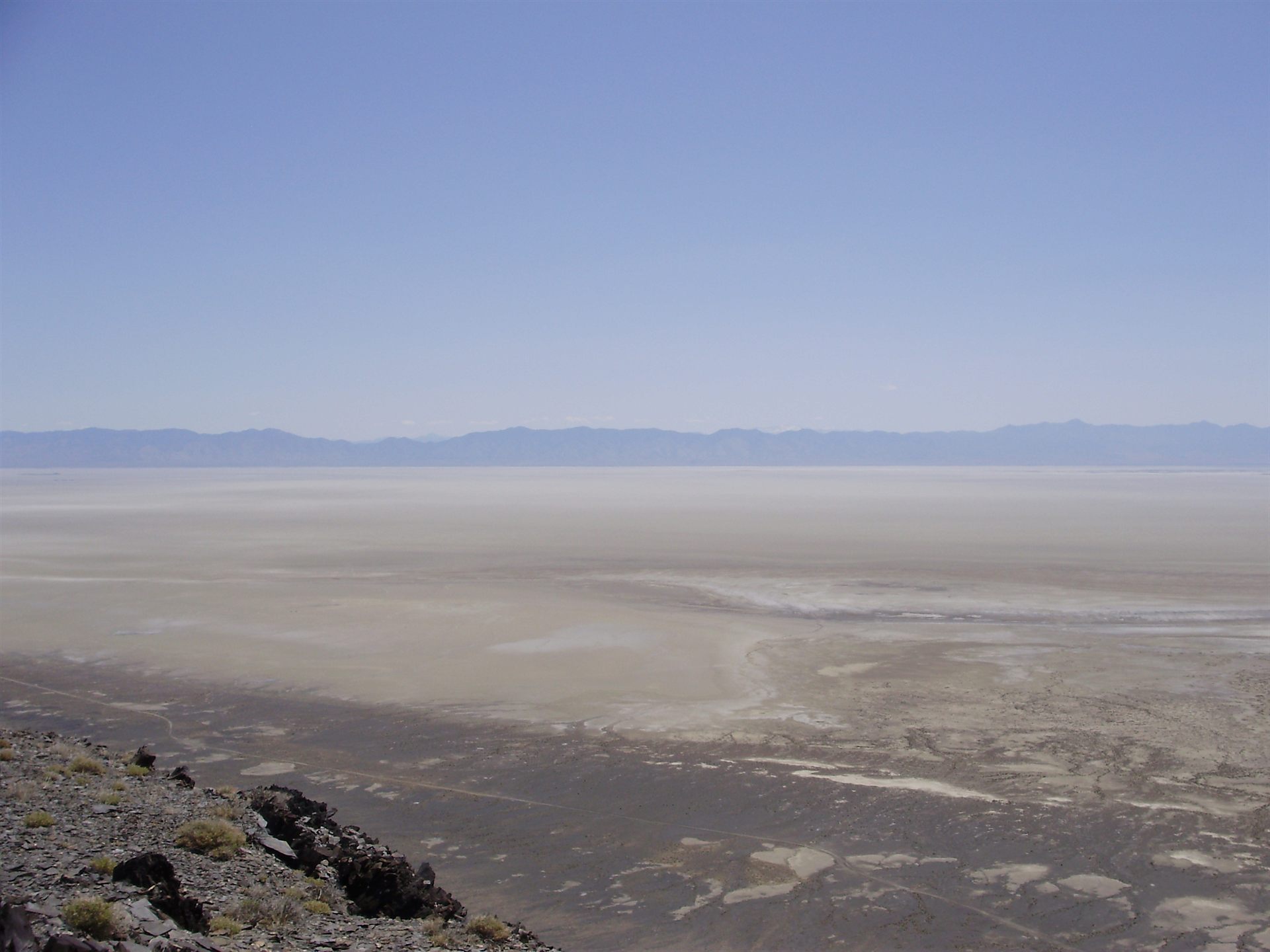
Pictured: the Carson Sink playa in Churchill County, Nevada, viewed from Topog Peak — the same high desert basin the B-25 crossed at 11,000 feet on July 24, 1952, though not the exact flight path or vantage point of the encounter itself. No photograph of the incident exists; the sighting lasted only three to four seconds. (CC BY-SA 3.0, Famartin, Wikimedia Commons.)
Theoretical Alignment
The ETH figure reflects the witnesses' description of three structured craft, unlike any aircraft they knew, crossing their path at very high speed, not any positive evidence of origin. The Interdimensional Hypothesis has nothing to work with: there is no missing time, no hovering, nothing beyond extreme speed. The Psycho-Social Hypothesis is also weak here. Both men, by Ruppelt's account, had openly voiced skepticism about friends' saucer sightings. They were on a routine cross-country flight, and they reported the sighting through official channels to Air Defense Command intelligence on landing. The conventional possibilities that remain, as Ruppelt himself listed them, are a misjudgment of distance, an unlogged formation of F-86s, missing Flight Service records, or perceptual error during a three-to-four-second event.
Background
By July 1952, Project Blue Book was barely four months old. Captain Edward J. Ruppelt had reorganized the Air Force's UFO investigation effort out of the smaller, more dismissive Project Grudge that March, renaming it Blue Book and adopting the term "Unidentified Flying Object" specifically to replace the more sensational and press-friendly "flying saucer." Blue Book operated under the Air Technical Intelligence Center (ATIC) at Wright-Patterson Air Force Base in Dayton, Ohio, with a mandate that was explicitly dual: determine whether the reports represented any threat to national security, and separately, evaluate them on their scientific merits rather than dismiss them reflexively. The timing put Ruppelt's young organization directly in the path of the largest single surge of sighting reports the Air Force would ever process — 1952 alone would generate 1,501 official Blue Book reports, roughly triple the volume of any prior year, cresting through the summer months and forcing ATIC to develop, in cooperation with the Battelle Memorial Institute, a new machine-indexing system simply to keep the incoming case files organized.
Carson Sink itself, the location, had no prior connection to the UFO phenomenon before that afternoon; it was, and remains, simply a vast, empty, sparsely traveled stretch of Nevada high desert along a federal cross-country air corridor — the kind of place two colonels flying a requisitioned bomber from California to Colorado would cross without incident on any other day. Hamilton Field, the B-25's point of origin, was itself a major U.S. Army Air Forces and, by 1952, U.S. Air Force installation north of San Francisco in Marin County, California, used routinely for exactly this kind of cross-country aircraft ferrying and personnel transport between West Coast and interior bases. The bomber's destination, Colorado Springs, was home to Ent Air Force Base, headquarters of the Air Defense Command since the command's establishment in January 1951 — the headquarters whose intelligence staff McGinn and Barton telephoned on landing to report the sighting.
McGinn and Barton's own positions at the Pentagon placed them near, though not directly inside, the growing institutional anxiety about UFO reports that would culminate later that same month in President Truman's own quiet inquiry into the Washington sightings and, the following January, in the CIA-convened Robertson Panel. Neither colonel is documented as having any prior involvement with UFO reporting, investigation, or advocacy before July 24, 1952; their sighting was, by every account in the record, an unplanned, unsought encounter during an otherwise routine ferry flight — precisely the kind of witness profile Blue Book's own analysts considered most credible: professionally qualified, institutionally unmotivated to fabricate or embellish, and reporting through official channels rather than to the press.
Complete Timeline
| Date / Time | Event |
|---|---|
| July 24, 1952, daytime | Lt. Cols. John L. McGinn and John R. Barton depart Hamilton Field, north of San Francisco, in a twin-engine B-25 bomber requisitioned for a cross-country ferry flight to Colorado Springs, Colorado, flying the Green 3 federal airway. |
| 3:40 PM MST | At 11,000 feet and 185 knots airspeed over the Carson Sink area east of Reno, Nevada, the two pilots spot three unidentified objects ahead and to their right, at roughly the 1 o'clock position. |
| Same moment | The objects look at first like three F-86 fighters in a tight V formation, flying higher than civil air regulations would allow (Ruppelt). |
| Within seconds | As the range closes, the colonels see that they are not F-86s but three bright silver, delta-wing craft with no tails and no canopies, each with a ridge running from nose to tail. The objects make a slight left bank and cross in front of and above the B-25 from right to left, at an estimated 400 to 800 yards (1,200–2,400 feet). They look slightly larger than F-86s. |
| ~3–4 seconds after first sighting | The objects pass out of sight. The colonels estimate their speed at a minimum of three times that of an F-86; Brad Sparks's NICAP summary puts it at about 1,800 mph or more, NICAP's 1964 UFO Evidence at 1,000 mph. Blue Book's summary card gives the duration as three to four seconds. |
| Later that day | McGinn and Barton land at Colorado Springs, home of Ent Air Force Base and Air Defense Command headquarters. |
| On landing | The colonels telephone the intelligence staff at Air Defense Command headquarters to make a UFO report. When it is suggested they might have seen F-86s, they reply that they know what F-86s look like (Ruppelt). Michael Hall's account adds that they learned no aircraft had been near them. Air Defense Command relays the report to Project Blue Book. |
| July 24–25, 1952 | The report is filed as an Air Intelligence Information Report. Hall describes it as one of 22 reports that reached ATIC that day and about 100 worldwide for July 24, near the peak of the 1952 wave. |
| Following days | Blue Book checks with Flight Service, which clears military flights and has no record of aircraft near Carson Sink at 3:40 PM. It checks delta-wing aircraft: the Navy's silver deltas are all on the East Coast, a few navy-blue deltas on the West Coast are not near Carson Sink, and the Air Force's one delta is grounded. Standard weather balloons and 100-foot research balloons are also checked. Nothing is found. |
| 1952 | Project Blue Book files the sighting as “Unknown,” case #1584. |
| January 1953 | Former Blue Book Pentagon liaison Maj. Dewey Fournet presents a study of UFO motions to the CIA-convened Robertson Panel. NICAP's Francis Ridge writes that Carson Sink is “apparently case #11” of that study. |
| 1956 | Edward J. Ruppelt publishes The Report on Unidentified Flying Objects. Chapter 1 uses the case, without naming the colonels, as his example of “a ‘good’ UFO report with an ‘unknown’ conclusion.” |
| 2000 | Researcher Michael David Hall discusses the case in UFOs: A Century of Sightings. With Wendy A. Connors, he also covers the 1952 wave, drawing on Ruppelt's papers, in Captain Edward J. Ruppelt: Summer of the Saucers — 1952. |
| September 25, 2005 | NICAP's Francis Ridge posts the digitized Blue Book documents for the case (the case card, Air Intelligence Information Report, object description, Barton's witness statement and a World Aeronautical Chart). |
The Sighting Begins
McGinn and Barton's flight from Hamilton Field to Colorado Springs was, up to 3:40 PM that afternoon, entirely unremarkable — a routine cross-country ferry mission of exactly the kind Pentagon staff officers with active pilot ratings flew regularly to move aircraft and personnel between bases. Cruising eastbound at 11,000 feet and roughly 185 knots along the Green 3 federal airway, with clear skies and unlimited visibility over the open Nevada desert below, the two colonels first noticed three objects ahead of and to the right of their aircraft, at approximately the 1 o'clock position. At that first glimpse, before the objects' subsequent behavior made clear that nothing conventional could explain what they were seeing, there was nothing yet to suggest the encounter would become anything more than a passing curiosity — three aircraft-sized shapes, silver in color, some distance ahead.
According to Ruppelt, one of the colonels noticed three objects ahead and a little to the right that "looked like three F-86's flying a tight V formation." If they were F-86s, Ruppelt adds, they should have been lower, "according to civil air regulations, but on a clear day some pilots don't watch their altitude too closely." Within seconds the objects were close enough to be seen clearly: "They were not F-86's. They were three bright silver, delta wing craft with no tails and no pilot's canopies. The only thing that broke the sharply defined, clean upper surface of the triangular wing was a definite ridge that ran from the nose to the tail." Sparks's summary of the Blue Book file adds that they were silver-white, delta- or arrowhead-shaped, and slightly larger than F-86s. That the colonels first took them for F-86s matters in two ways. It shows the objects were, at first sight, close enough in appearance and behavior to fighters to pass for them. It also means the identification as tailless deltas rests on the closest part of a very brief look.
The Pass and the Departure
The objects' closest approach brought them to an estimated 400 to 800 yards from the B-25 — roughly 1,200 to 2,400 feet, a distance at which the pilots judged the objects' apparent size to be comparable to an F-86 Sabre fighter, itself a roughly 37-to-40-foot aircraft. At that range and apparent size, with clear skies and full daylight, McGinn and Barton had, for a brief window, about as good a visual vantage point on an unidentified aerial object as any Blue Book witness would ever report having — close enough to resolve real structural detail, far enough to avoid any risk of collision, and observed from the relatively stable platform of a large twin-engine aircraft in level flight rather than a fast, maneuvering fighter or a moving ground vehicle.
Then, in Ruppelt's words, "the three deltas made a slight left bank and shot by the B-25 at terrific speed." The Blue Book summary says the objects "crossed in front of and above the B-25 at high speed, in 3-4 seconds," and Sparks's summary of the file gives their path as right to left, south to north. The colonels estimated the speed at "at least three times that of an F-86." With the F-86's top speed of roughly 680–690 mph, that implies about 2,000 mph, and Sparks gives about 1,800 mph or more. Either figure is far beyond any aircraft known in 1952. But it is a visual estimate made during a three-to-four-second crossing, at a range the colonels judged by eye, with no instrument timing or radar. If the objects were in fact smaller or closer than they appeared, the speed would have been much lower, and Ruppelt himself raised this possibility: "Maybe they just thought they were close enough to the three objects to see them plainly." An earlier version of this page described a "sharp, coordinated" bank directly toward the bomber; neither Ruppelt nor the Blue Book summary says the objects turned toward the B-25.
After Landing: The Call to Air Defense Command
McGinn and Barton landed at Colorado Springs, home of Ent Air Force Base and of Air Defense Command headquarters. According to Ruppelt, "the two colonels called the intelligence people at Air Defense Command Headquarters to make a UFO report." When someone suggested they might have seen three F-86s, "the colonels promptly replied that if the objects had been F-86's they would have easily been recognized as such. The colonels knew what F-86's looked like." Air Defense Command relayed the report to Project Blue Book, and "an investigation was started at once." Michael Hall's account adds that the colonels learned on the phone that no civilian or military aircraft had been near them at 3:40 PM.
An earlier version of this page described the call as a self-initiated check by the colonels of Air Defense Command's tracking records and Flight Service's logs. The sources describe something more ordinary. The colonels made a UFO report, and the traffic check was done by Blue Book, which asked Flight Service, the office that clears military flights, and found no record of aircraft near Carson Sink at that time. That negative result is real, but Ruppelt was frank about its limits. F-86s flying "in the local area of their base" and doing some "illegal sight-seeing" would not appear in Flight Service records, and "maybe Flight Service lost the records." The check makes a logged conventional flight unlikely. It does not rule out an unlogged one.
Blue Book's Investigation
The report reached the Air Technical Intelligence Center at the busiest point of the 1952 wave. Michael Hall describes it as one of 22 reports that reached ATIC that day and one of about 100 worldwide for July 24. Ruppelt's account of the investigation is specific. Flight Service had "no record of the presence of aircraft in that area." Because the colonels had described deltas, and "both the Air Force and the Navy had a few of this type," Blue Book checked them: "The Navy's deltas were all on the east coast, at least all of the silver ones were. A few deltas painted the traditional navy blue were on the west coast, but not near Carson Sink. The Air Force's one delta was temporarily grounded." All balloon flights, standard weather balloons and 100-foot research balloons, were checked, and "nothing was found." Blue Book filed the case as “Unknown.” An earlier version of this page said that delta aircraft were flown "essentially exclusively" by the Navy and that every one was located; Ruppelt's own wording is narrower.
The Robertson Panel and Fournet's Motion Study
In January 1953 the CIA convened a panel of scientists chaired by physicist H. P. Robertson to review the UFO evidence. Maj. Dewey Fournet, Blue Book's former Pentagon liaison, presented a study of the reported motions of UFOs in selected cases, arguing that some showed signs of intelligent control. NICAP's Francis Ridge writes that the Carson Sink sighting is "apparently case #11" of Fournet's motion study. Ridge's wording is tentative, and this site has not seen Fournet's case list directly. An earlier version of this page said the case was "Case 11" of a "seventeen-case handout."
The Robertson Panel concluded that UFO reports posed no direct threat to national security and recommended a public-education program to reduce public interest in the subject. It did not publish case-by-case evaluations, and no source has been found for the earlier claim on this page that Carson Sink "survived" the panel's scrutiny or remained "uncategorized among the explained cases" in its files. The case's status rests on Blue Book's own “Unknown” classification.
Ruppelt's Own Assessment
Captain Edward J. Ruppelt headed Project Blue Book from its creation in March 1952 until 1953. In chapter 1 of The Report on Unidentified Flying Objects (1956), he used Carson Sink, without naming the colonels, to show what Blue Book meant by a good report: "But here is a 'good' UFO report with an 'unknown' conclusion." He describes the colonels as command pilots with several thousand hours each, stationed at the Pentagon, whose "highly classified assignments were such that they would be in a position to recognize anything that the United States knows to be flying anywhere in the world." Both, he adds, "had openly voiced their skepticism" about friends' saucer sightings, and their interviews suggested they had changed their minds. Ruppelt then lists the conventional possibilities that could not be excluded: misjudged distance, F-86s whose records were lost or never filed, or hallucination. He adds that while any one such answer may be right for a single case, "if you try this type of speculation on hundreds of sightings with 'unknown' answers, the probability that the speculative answers are correct rapidly approaches zero." An earlier version of this page said Ruppelt "had a hand in originating" the temperature-inversion explanation for the July 1952 Washington sightings and regretted it; no source for that was found, and it has been removed.
What Made It a "Good" Report
Ruppelt introduces Carson Sink in his first chapter to explain how Blue Book sorted its incoming mail. Vague newspaper-style reports, such as a woman shaking a dust mop out of a window who saw "a flying saucer," or a driver who saw "a light," were stamped "Insufficient Data for Evaluation" and filed away as statistics. Reports from people who claimed to have met saucer crews went into a file marked "C.P.," for crackpot. Against these he sets Carson Sink as a "good" report: named, qualified witnesses; a clear sky; a specific time, altitude and position on a charted airway; a detailed description; an immediate official report; and enough information for investigators to run real checks (Flight Service, delta aircraft, balloons). In Ruppelt's usage, "good" describes the quality of the report, not a conclusion about what was seen. The same passage gives the case's unresolved state: "Nobody knows what the two colonels saw over Carson Sink."
His closing argument is about many cases rather than this one. Any single unknown can be explained away with a speculative answer: lost records, misjudged range, an unlogged flight. But, he writes, applying "this type of speculation on hundreds of sightings with 'unknown' answers" makes it ever less likely that all the speculative answers are right. That is an argument about Blue Book's whole body of unknowns. It does not, on its own, raise the probability that this particular sighting was anomalous.
The Range Problem
Almost every striking figure in the case depends on one judgment: how far away the objects were. The colonels put them at 400 to 800 yards and slightly larger than F-86s, which are about 37 feet in span and a little over 37 feet long. At 400 yards, an object that size would subtend about 1.8 degrees; at 800 yards, about 0.9 degrees. Both are easily large enough to show a planform, a ridge and the absence of a tail in good light. The speed estimate follows from the same range. Objects crossing the field of view in three to four seconds at 400–800 yards are moving at very high speed. If they were really twice or three times as far away, they were proportionally larger, and the crossing speed in miles per hour rises with the distance. If they were closer and smaller than they appeared, the speed falls.
There is no independent way to fix the range. The objects were not on radar, nobody else saw them, and the B-25 carried no camera. What the colonels could judge directly was angular size, shape, direction of motion and the time the objects were in view. Distance and speed were inferred from the assumption that the objects were about the size of fighters, the size they had first taken them for. This is why Ruppelt's first speculative answer is "Maybe they just thought they were close enough to the three objects to see them plainly," and why the case, for all its witness quality, cannot settle the question of performance. None of this explains the reported shape: experienced pilots who knew the F-86 well said these were tailless deltas, not F-86s. But it shows that the case's most dramatic number, three times F-86 speed, is its least secure element.
Key Researchers
- Edward J. Ruppelt (1923–1960) — Head of Project Blue Book in 1952–53. His 1956 book (chapter 1, pp. 10–11 in the first edition per Sparks) is the main published account of the case and its investigation.
- Maj. Dewey Fournet — Blue Book's former Pentagon liaison, who presented a study of UFO motions to the Robertson Panel in January 1953. NICAP's Francis Ridge says Carson Sink was apparently case #11 in it.
- Michael David Hall — Researcher who discussed the case in UFOs: A Century of Sightings. With Wendy A. Connors, he wrote Captain Edward J. Ruppelt: Summer of the Saucers — 1952, which draws on Ruppelt's papers. Hall's account names the colonels and adds the ATIC report counts for July 24.
- Francis Ridge — NICAP compiler who posted the digitized Blue Book documents for the case in 2005.
Key Witnesses
Lt. Col. John L. McGinn
John L. McGinn was a lieutenant colonel in the Directorate of Operations at U.S. Air Force Headquarters, listed in Sparks's summary of the Blue Book file as "Deputy of Ops, Fighter Br." Ruppelt describes both colonels as command pilots with several thousand flying hours whose classified Pentagon assignments put them "in a position to recognize anything that the United States knows to be flying anywhere in the world." Which of the two was flying the B-25 is not stated in the sources checked. On landing, the colonels reported the sighting to Air Defense Command intelligence. When F-86s were suggested, they answered that they would have recognized F-86s.
Lt. Col. John R. Barton
John R. Barton was a lieutenant colonel in the Directorate of Operations at U.S. Air Force Headquarters (office symbol AFOOP-OP-D). His witness statement is among the Blue Book documents NICAP posted for the case. His description agrees with McGinn's: three silver deltas with a ridge along the top, slightly larger than F-86s, crossing in front of and above the bomber in a few seconds. The two men, however, shared one vantage point and one very brief look, so their agreement confirms that both saw the same thing rather than providing two independent observations.
The Five Observables Assessment
Assessment: Anti-gravity lift is classified absent: nothing in the account describes hovering, levitation, or any lift behavior inconsistent with conventional winged flight — the objects banked and accelerated like aircraft, not like a craft defying gravity in place. Instant acceleration is speculative rather than confirmed: the objects' rapid departure implies an extraordinary rate of acceleration, but with no instrument timing, this rests entirely on the pilots' visual impression of how quickly the objects covered distance and vanished. Hypersonic performance is likewise speculative: the pilots' own estimate (roughly three times an F-86's speed, or approximately 2,000 mph) would be solidly supersonic and, if accurate, would exceed any documented 1952-era aircraft, but it falls short of the strict hypersonic threshold (Mach 5+) and remains an unconfirmed visual estimate rather than a measured value — it is nonetheless the case's single most emphasized and most scrutinized data point. Low observability is explicitly absent: the objects were bright silver and clearly, continuously visible at close range in full daylight for the entire encounter. No trans-medium transition of any kind was reported.
Evidence Assessment
Supporting Anomalous Origin
- Two lieutenant colonels, both command pilots with several thousand hours and Pentagon assignments that Ruppelt says put them in a position to recognize anything the U.S. knew to be flying, described the same three objects
- Their description (tailless silver deltas with a nose-to-tail ridge and no canopy) is specific, and they rejected the F-86 suggestion outright
- Flight Service, which cleared military flights, had no record of aircraft near Carson Sink at 3:40 PM
- Blue Book located the known Navy and Air Force delta aircraft and found none in the area, and found no weather or research balloons
- Blue Book filed the case as “Unknown” (#1584) at the height of the 1952 wave
- Ruppelt, who ran Blue Book at the time, chose it as his example of a good report with an unknown conclusion
- NICAP's Francis Ridge identifies it as apparently one of the cases in Dewey Fournet's motion study for the Robertson Panel
Supporting Conventional Explanation
- The entire encounter lasted only three to four seconds — an extremely narrow window for even highly trained observers to judge shape, distance, and especially speed with precision
- The case's most striking claim, that the objects traveled at roughly three times an F-86's speed, is a visual estimate with no radar track, gun-camera film, or instrument timing to verify it
- No third-party witness, ground observer or radar station saw the objects. The only corroboration is a negative record (no logged traffic), and Ruppelt noted that F-86s on unlogged local flights would not appear in Flight Service records
- Only two witnesses exist in total, both aboard the same aircraft and sharing the same vantage point, rather than multiple independent observation locations
- The case is now more than seventy years old, and no further evidence — photographic, documentary, or testimonial — has surfaced since the original 1952 file to test the account against
Why "Credible"
Carson Sink is rated CREDIBLE because the sighting is well documented for a brief visual report and well supported by its witnesses. Two senior Air Force pilots reported it at once through official channels, gave a specific description of objects unlike any aircraft they knew, and rejected the obvious F-86 explanation. Blue Book then checked Flight Service, the known delta aircraft and balloon flights, and found nothing, and filed the case as “Unknown.” Ruppelt chose it as his example of a good unexplained report. The rating does not rest on a confirmed anomaly. The whole event lasted three to four seconds. The two witnesses shared one vantage point. There is no radar, photograph or physical trace. The extreme speed depends entirely on a visual estimate of distance. And the negative traffic check cannot exclude fighters flying unlogged local sorties, a possibility Ruppelt himself raised. An earlier version of this page also rested the rating on a same-day traffic check by the colonels themselves, on Air Defense Command tracking records, and on the case's survival of Robertson Panel scrutiny; none of these is supported by the sources and they have been removed.
Sensor & Instrumentation Detection Profile
No radar, camera, gun-camera film, or any other instrumented sensor captured the Carson Sink encounter. In the summer of 1952 the Air Defense Command's permanent radar picket network was still being built out across the western United States, and the airspace over the Carson Sink — a remote, largely unpopulated alkali playa along the Green 3 federal airway — had no dedicated ground radar coverage at that altitude and distance from the nearest stations. The only instrumentation genuinely in play was the B-25's own flight instruments: airspeed indicator (185 knots, per the pilots' report), altimeter (11,000 feet), and compass heading, which together allowed McGinn and Barton to establish the relative geometry of the encounter — the objects' bearing, closing distance, and approximate altitude relative to their own aircraft — with more precision than an untrained civilian observer could have supplied. Beyond the aircraft's own instruments, the case's only other quasi-instrumented data point is negative rather than positive: Blue Book's query to Flight Service found no record of aircraft near Carson Sink at 3:40 PM, and its check of balloon flights found none in the area. That negative record does not detect the objects the way a radar return would, but it does something almost as valuable evidentially: it makes a logged conventional flight unlikely, though, as Ruppelt noted, it cannot exclude fighters on unlogged local flights.
Environmental & Geospatial Context
The Carson Sink is a vast, largely flat alkali playa in the Carson Desert of Churchill County, Nevada — the ancient lakebed remnant of Pleistocene-era Lake Lahontan, roughly 32 miles long and 29 miles wide, bounded by the West Humboldt Range to the north and the Stillwater Range to the east, and lying northwest of the town of Fallon. It is one of the most sparsely populated and visually unobstructed stretches of airspace in the continental United States: no significant terrain, structures, or ground clutter exist to interfere with sightlines at altitude, and on a clear July afternoon with unlimited visibility, an object the size and brightness the colonels described would have been unusually easy to observe cleanly against an otherwise empty sky. The B-25 was flying eastbound along the Green 3 federal airway, a designated cross-country air corridor used for exactly the kind of point-to-point ferry flight McGinn and Barton were making from Hamilton Field to Colorado Springs. The encounter occurred at 11,000 feet — well above any ground-level heat-shimmer or mirage layer that can form over open desert on a hot summer afternoon, a detail directly relevant to evaluating (and, as discussed below, substantially weakening) any optical-illusion explanation for the sighting. No unusual solar, geomagnetic, or meteorological activity is documented for the date or location beyond ordinary clear high-desert summer conditions.
Observer Credibility & Occupational Profile
Carson Sink's evidentiary weight rests largely on its two witnesses. Lieutenant Colonel John L. McGinn is listed in Sparks's summary of the Blue Book file as "Deputy of Ops, Fighter Br" in the Directorate of Operations at USAF Headquarters, and Lieutenant Colonel John R. Barton as AFOOP-OP-D in the same directorate. Ruppelt describes both as command pilots with several thousand flying hours whose "highly classified assignments were such that they would be in a position to recognize anything that the United States knows to be flying anywhere in the world." That is a strong recognition background. An earlier version of this page described them as aircraft-recognition specialists whose daily job was cataloguing silhouettes, which goes beyond the sources.
Their conduct is consistent with credible reporting. Both had been skeptical of friends' saucer stories, by Ruppelt's account. They reported through Air Defense Command intelligence rather than the press, and they rejected the F-86 suggestion on professional grounds. Training does not remove the basic limitation of the observation, however. A distance judged by eye in a few seconds determines both the objects' size and their speed. Neither man had any way to measure range, and the headline speed of three times an F-86 follows directly from that judgment.
Physical & Material Assays
No physical or material evidence of any kind exists in connection with the Carson Sink case. Nothing was recovered from the ground because nothing ever approached the ground: the encounter took place entirely at altitude, over open desert, between an aircraft in level cruise flight and three objects that closed distance, banked, and departed without ever coming close enough to leave any trace, debris, or residue for later recovery. No photograph or film exists, and none was ever claimed to exist — a three-to-four-second encounter left neither officer time to reach for a camera even had one been aboard, and B-25 ferry flights of the era were not typically equipped with gun cameras or other automatic photographic recording systems as a matter of course. The case is, in the strictest sense, a purely testimonial one: two credentialed witnesses, a negative traffic-record cross-check, and nothing more in the way of physical corroboration.
Historical Precedents & Archive Matches
Carson Sink occurred during, and is best understood as part of, the single largest concentrated wave of UFO reports in Project Blue Book's entire twenty-two-year history: the American "flap" of June–August 1952, which peaked in the same window as the Carson Sink sighting and crested spectacularly just days later with the two consecutive weekends of radar-visual sightings over the nation's capital that became known as the Washington, D.C. UFO Flap. Air Technical Intelligence Center (ATIC) records for July 24, 1952 alone — the same day as the Carson Sink sighting — show it as just one of approximately 22 reports that reached ATIC that day and one of roughly 100 logged worldwide, a volume the Air Force's investigators found genuinely alarming at the time. Ten days earlier, on July 14, 1952, Pan American World Airways pilots had reported the equally well-documented Nash-Fortenberry Sighting over Chesapeake Bay, another case built on exceptionally credentialed professional-pilot testimony from the same wave. What distinguishes Carson Sink within that already dense summer of reports is the specific combination of witness rank and occupational relevance: unlike the Washington sightings (radar operators and airline pilots) or Nash-Fortenberry (commercial aviators), Carson Sink's witnesses were Pentagon operations staff officers with, in Ruppelt's words, assignments that would let them recognize anything the U.S. knew to be flying — which is one reason Ruppelt later chose it as his example of a good unexplained report.
Material Analysis
There is no physical or material evidence associated with the Carson Sink case in any form. The encounter took place entirely in flight, at 11,000 feet over open desert, between an aircraft in level cruise and three objects that closed distance and departed without any ground contact, landing, or close-range material interaction of any kind. No debris, residue, soil disturbance, or recovered fragment exists because the entire event occurred in open air far above the ground. No photograph, film, or other imaging record was captured, and none was ever claimed — the encounter's extreme brevity (three to four seconds) left no realistic opportunity for either colonel to retrieve and operate a camera even had one been available aboard the bomber, and B-25 ferry aircraft of the era were not equipped with automatic gun-camera or photographic recording systems as standard equipment. The single closest thing to a physical case artifact is the original Air Intelligence Information Report itself and its accompanying witness statements, preserved in Project Blue Book's archived case files (now digitized and publicly available) — a contemporaneous, dated documentary record created within the Air Force's own official reporting channel, rather than a reconstruction assembled by outside researchers years or decades after the fact.
Supporting Non-Terrestrial or Genuinely Anomalous Origin
- The original Blue Book case file, including both officers' individual witness statements, was generated the same day through official Air Force channels — a preserved, dated, primary documentary record rather than a later reconstruction
- Blue Book's Flight Service traffic check and delta and balloon searches were made at the time, while records were fresh
Supporting Terrestrial or Misidentification Origin
- The complete absence of any photographic, radar, or physical trace record is consistent with (though does not by itself prove) a fast, transient visual event of purely conventional origin
- Without any instrument data, the case's evidentiary weight rests entirely on witness testimony, however credentialed, which is inherently more vulnerable to perceptual error under brief, high-stress viewing conditions than an instrumented record would be
The Conventional Explanation Candidate
Project Blue Book's own investigators, and researchers since, have considered several genuinely plausible-sounding terrestrial explanations for the Carson Sink sighting. Each deserves serious, specific evaluation on its own terms rather than a reflexive dismissal — OverClassified's editorial standard is to weigh the strongest available conventional case exactly as rigorously as the anomalous reading, and Carson Sink's own strength as a case rests precisely on how poorly each of the standard candidates actually fits the specific, detailed facts on record.
Misidentified Formation of Jet Aircraft
The single most common explanation for any fast-moving, multi-object UFO sighting is a formation of conventional jet aircraft, seen briefly and at an unfamiliar angle. This is, in principle, the strongest available candidate for Carson Sink, since formation flying by fighter aircraft was common Air Force and Navy practice in 1952, and a tight three-ship element banking sharply could plausibly present an unfamiliar silhouette to an observer under brief, high-stress viewing conditions. It fails, however, against the specific facts of this case in three separate ways. First, the witnesses were not average pilots but Pentagon staff officers whose actual professional duties centered on fighter-aircraft operations and recognition — men with a strong professional basis for not mistaking a standard swept-wing jet fighter silhouette, viewed at 400 to 800 yards, for a completely different delta or arrowhead planform with no tail and no canopy. Second, Flight Service, queried by Blue Book, had no record of aircraft near Carson Sink at 3:40 PM. Third, Blue Book located the known delta aircraft and found none near the area. The candidate is not excluded, however. The colonels themselves first took the objects for F-86s, and Ruppelt pointed out that F-86s on unlogged local flights, "illegal sight-seeing" in his words, would not show up in Flight Service records. If the range was misjudged, the speed would be overstated too.
Meteor or Bolide
A bright meteor or bolide entering the atmosphere can produce a fast-moving, brief aerial light and is among the most common misidentification sources for daytime UFO reports generally. It does not fit Carson Sink's specific reported behavior. Meteors and bolides travel on essentially straight, ballistic trajectories determined by their entry velocity and the pull of gravity; they do not execute a coordinated sharp bank turn, and three independent meteors could not plausibly maintain a stable V formation both before and after such a turn while remaining visually distinct as separate objects with described structural detail (a delta shape, a dorsal ridge) rather than a single streaking point or trail of light. A meteor event is also typically accompanied by a visible glowing trail or fireball effect distinct from the flat, reflective metallic appearance both witnesses specifically described.
Optical Illusion or Atmospheric Refraction
Mirages and refraction effects are a genuine and well-documented source of aerial misidentification, particularly over hot desert terrain where ground-level heat shimmer can distort the apparent shape and motion of distant objects. This explanation is substantially weakened by the specific geometry of the Carson Sink encounter: the sighting occurred at the B-25's own cruise altitude of 11,000 feet, well above any ground-level heat-mirage layer, rather than at low altitude looking across the desert floor. A stable optical illusion is also difficult to reconcile with a report describing three discrete objects executing a coordinated maneuver relative to a moving aircraft — parallax effects from the B-25's own forward motion would tend to break apart, not reinforce, a static or slowly shifting refraction artifact over a multi-second observation.
Unpublicized Classified or Experimental Aircraft
The early 1950s were an active period of secret U.S. delta-wing aircraft development, including the Convair XF-92A (the Air Force's one delta, which Ruppelt says was grounded) and the Navy's Douglas F4D Skyray prototypes, and it is fair to ask whether the colonels witnessed an unacknowledged classified test flight rather than something genuinely unknown even to the government. Blue Book checked the known deltas: the Navy's silver ones were on the East Coast, its navy-blue ones on the West Coast were not near Carson Sink, and the Air Force delta was grounded; the reported performance — three aircraft in synchronized formation, closing and departing at an estimated multiple of F-86 speed within seconds — also exceeds what is independently documented for any American test aircraft flying in 1952. This candidate cannot be entirely excluded given the genuine secrecy surrounding period test programs, but it remains speculative rather than evidenced.
Misidentified Formation of Jet Aircraft
InconclusiveINCONCLUSIVE. The strongest candidate in principle, but undermined by the witnesses' specific aircraft-recognition expertise, Flight Service's lack of any record and Blue Book's delta-aircraft check, though it cannot be excluded for unlogged F-86s, which the colonels first thought they were seeing.
Meteor or Bolide
ImplausibleIMPLAUSIBLE. A ballistic meteor trajectory cannot produce a coordinated group bank turn or a stable multi-object V formation, and does not match the described flat, silver, structured appearance.
Optical Illusion / Atmospheric Refraction
ImplausibleIMPLAUSIBLE. The encounter occurred at 11,000 feet, well above any ground-level heat-mirage layer, and the described coordinated relative motion is difficult to reconcile with a static refraction artifact.
Unpublicized Classified or Experimental Aircraft
InconclusiveINCONCLUSIVE. Cannot be fully excluded given genuine period secrecy, but no known 1952 U.S. test aircraft matches the reported performance, and Blue Book's own check found no program aircraft in the area.
Related Cases
Confirmed Documents & Official Records
The National Archives' overview and finding aid for the complete Project Blue Book collection (1947–1969), within which the Carson Sink case file (#1584) is catalogued chronologically among the roughly 12,600 reports the Air Force investigated.
UNCLASSIFIED (declassified)NICAP's consolidated directory page for the case, compiled by Francis Ridge, linking the original Air Intelligence Information Report, witness statements, and the Blue Book Master Index page for the July 23–24, 1952 sightings.
Private archive hosting declassified USAF documentsResized scans of the original Blue Book case file pages (Project Blue Book Archive references MAXW-PBB12-1385 through 1390 and MAXW-PBB2-296), including the Air Intelligence Information Report, object description form, and World Aeronautical Chart, hosted via NICAP's case directory.
Declassified USAF documents (digitized)NICAP's compilation of Maj. Dewey Fournet's "motions study" cases presented to the CIA-convened Robertson Panel in January 1953, which Francis Ridge says apparently included the Carson Sink sighting as case #11.
Private archive (non-government)Search Government Archives Directly
Further Reading — Recommended Literature
The Report on Unidentified Flying Objects
The main published account of the case (chapter 1), which Ruppelt used as his example of “a ‘good’ UFO report with an ‘unknown’ conclusion” while listing the conventional answers that could not be excluded.
Captain Edward J. Ruppelt: Summer of the Saucers — 1952
A detailed documentary history of Blue Book's 1952 investigations, drawn directly from Ruppelt's private papers and unedited manuscript, covering the exact summer flap during which the Carson Sink sighting occurred.
UFOs: A Century of Sightings
A chronological survey of major twentieth-century UFO sightings that discusses the Carson Sink case directly (p. 187), focusing on reports from military and professionally credentialed witnesses considered especially reliable.
DISCLOSURE: Some links above are affiliate links. If you purchase through them, OverClassified receives a small commission at no additional cost to you. This helps support independent research.
Essential Viewing
No Videos Available
Sources
- Ruppelt, Edward J. The Report on Unidentified Flying Objects. Doubleday, 1956, chapter 1 (pp. 10–11 per Sparks). gutenberg.org
- NICAP (Francis Ridge, compiler). Carson Sink, Nevada case directory (AVCAT), with Brad Sparks's summary of the Blue Book file (BBU 1584: witnesses' offices, 185 knots, 1,200–2,400 ft, ~1,800+ mph). nicap.org
- NICAP (Fran Ridge & Dan Wilson, compilers). "The Carson Sink, Nevada Case; July 24, 1952," 25 September 2005 (Blue Book documents MAXW-PBB12-1385 to 1390, MAXW-PBB2-296). nicap.org
- NICAP. "The Carson Sink Case" (Michael David Hall's account, with Ruppelt's text). nicap.org
- NICAP. Digitized Blue Book documents for the case (PDF). nicap.org
- NICAP. "The Radar-Visual 'Motions' Study" (Dewey Fournet). nicap.org
- Gross, Patrick. "UFOs at Close Sight: Blue Book Unknown #1584, Carson Sink, July 24, 1952" (Blue Book summary card text, Hall and Ruppelt accounts). ufologie.patrickgross.org
- Hall, Richard H. (ed.). The UFO Evidence. NICAP, 1964, p. 21 (as cited by NICAP).
- Hall, Michael David. UFOs: A Century of Sightings. Galde Press, 2000 (year as given on this site; not independently checked), p. 187.
- Hall, Michael David, and Wendy A. Connors. Captain Edward J. Ruppelt: Summer of the Saucers — 1952. Rose Press International, 2000.
- Jacobs, David Michael. The UFO Controversy in America. Indiana University Press, 1975 (background on the 1952 wave and the Robertson Panel).
- U.S. National Archives and Records Administration. "Project BLUE BOOK: Unidentified Flying Objects" (12,618 sightings, 701 unidentified). archives.gov
- Wikipedia contributors. "Carson Sink" (geography only). en.wikipedia.org
- Wikipedia contributors. "Robertson Panel" (background; pointer only). en.wikipedia.org
- Famartin (photographer). "2012-05-28 View southeast across the Carson Sink from Topog Peak in Nevada.jpg." Wikimedia Commons, CC BY-SA 3.0. commons.wikimedia.org
- Clark, Jerome. The UFO Encyclopedia (general reference; edition details as listed on this site's book page, not checked for this case).
- Wikipedia contributors. "North American F-86 Sabre" (top speed, for the speed comparison; pointer only). en.wikipedia.org
- Wikipedia contributors. "Ent Air Force Base" (Air Defense Command headquarters; pointer only). en.wikipedia.org
- Wikipedia contributors. "Convair XF-92" (the Air Force's delta research aircraft in 1952; pointer only). en.wikipedia.org
Corrections (October 2026)
This page was checked in October 2026 against Ruppelt's 1956 account (chapter 1), the Blue Book summary card and the NICAP and Patrick Gross compilations of the Blue Book file, Brad Sparks's case summary, and Michael Hall's account. The core facts are confirmed: one B-25, two lieutenant colonels (McGinn and Barton), 3:40 PM MST on July 24, 1952, 11,000 feet on Green 3 over Carson Sink, three silver tailless deltas with a ridge, 400–800 yards, at least three times F-86 speed, three to four seconds, Blue Book case #1584 carried as “Unknown.” Corrected: the objects first looked like F-86s, then made a “slight” left bank and crossed in front of and above the bomber, rather than banking “sharply” toward it. The colonels called Air Defense Command intelligence to report the sighting; the traffic check was Blue Book's query to Flight Service, not the colonels' own check of ADC tracking records. The delta check found the Navy's silver deltas on the East Coast, its blue ones away from Nevada, and the Air Force's one delta grounded; the earlier text said deltas were flown “essentially exclusively” by the Navy. Ruppelt's phrase is “a ‘good’ UFO report with an ‘unknown’ conclusion,” and he also listed the conventional answers that could not be excluded, which the earlier text omitted. The Fournet “Case 11” identification is Francis Ridge's tentative “apparently.”
Following this review, the rating was changed from Credible 73 to Credible 65 (October 27, 2026), because the higher rating had rested partly on claims corrected or removed above.
Removed as unsupported: the “seventeen-case handout”; the Robertson Panel quote “raw, unevaluated” and the claim that the case remained “uncategorized among the explained cases” in its files; the description of the witnesses as aircraft-recognition specialists and of McGinn as co-pilot and Barton as pilot; Ruppelt “originating” and regretting the Washington inversion theory; “sworn testimony”; and several fabricated or misattributed source entries (a “Loren E. Gross” credit for Patrick Gross's page, an Air Force Historical Research Agency page on Hamilton Field, a NARA page titled “The 701 Unidentified Cases,” and a “UFO Evidence archive” entry hosted on patrickgross.org).
See something inaccurate? Have additional information or sources?
Suggest an Edit →Last Updated: October 27, 2026