
UFOs: A Century of Sightings
A Professional Historian's Chronology of the Phenomenon, Built From the Nation's Archives Rather Than From Ufology
Core Thesis
UFOs: A Century of Sightings is what this subject looks like when a professional historian assembles it. Michael David Hall was not a ufologist. He was the executive director of the Montgomery County Historical Society in Crawfordsville, Indiana, with an M.A. in American History and doctoral work at Purdue, and he came to the subject by accident: researching Second World War bombing campaigns, he encountered allied pilots' accounts of foo-fighters and realised, as he put it, that 'a huge volume of primary material existed on UFOs in the nation's archives.' The book that resulted is a chronological history rather than an argument — 375 pages tracing the phenomenon from the 1890s airship wave through the 1960s, organised around documented sighting waves, the invention of the term 'UFO' itself, and the successive shifts in official government posture toward the reports. Its governing editorial decision is a filter: Hall works primarily from reports by witnesses whose credibility can be independently assessed — military personnel, law enforcement, and other professionally accountable observers — on the historian's principle that a source's reliability is part of the evidence rather than an afterthought.
About the Author
Michael David Hall's credentials are historical rather than ufological, and that is the whole point of the book. He holds a B.A. from Illinois College and an M.A. in American History from Western Illinois University, and pursued doctoral work in American History at Purdue. His museum career began in 1984 at the Illinois State Museum, and from 1987 he served as Executive Director of the Montgomery County Historical Society and the Henry S. Lane Historic Home in Crawfordsville, Indiana. He also worked part-time as a guide at the United States Air Force Museum in Dayton, Ohio — the institution physically closest to the Wright-Patterson archive where the American UFO record was generated.
His pre-UFO publications were straightforwardly academic local history: a biography of Indiana Senator Henry S. Lane, The Road To Washington: Rise of an Indiana Politician, tracing Lane's path from the first national Republican Convention of 1856 to his role in Lincoln's nomination, plus a body of magazine articles on Indiana history. Nothing in that record predicts a UFO book, which is exactly why the one he wrote reads differently from the rest of the genre.
The origin story is documented in his own account. While researching Second World War bombing campaigns at Purdue, Hall encountered historical accounts of foo-fighters reported by allied aircrew — the phenomenon this site covers in its Foo Fighters case file. Following those references led him into the archival record, and his conclusion — that an enormous volume of unworked primary material was sitting in national collections — is the premise of everything he subsequently wrote.
His other UFO work is archival in the same way. Origin of the UFO Phenomenon documents the early Air Force investigations, and he co-authored a study with the researcher Wendy Connors for the International UFO Reporter examining Alfred Loedding's role in Project Sign — Loedding being the aeronautical engineer at Wright Field whose part in the first Air Force UFO project had been almost entirely lost from the standard histories until Hall and Connors reconstructed it from the files. That recovery is arguably his most important single contribution.
Historical Context & Origins
The book belongs to a small and valuable category: UFO history written by people trained to write history. Almost the entire literature of this subject is produced by physicists, journalists, engineers, enthusiasts and former officers — capable people, but not people trained in provenance, source criticism, archival citation or the historiography of institutional records. Hall's arrival from the museum and academic-history world in the late 1990s coincided with a broader shift toward archival work in the field, and his book, Curtis Peebles' Watch the Skies! (1994, from a Smithsonian aerospace historian) and Swords and Powell's UFOs and Government (2012) together constitute most of what that shift produced.
The chronology it covers has a natural shape that Hall exploits. The 1896–97 American airship wave, the Scandinavian ghost rockets of 1946, the June 1947 Kenneth Arnold sighting that coined 'flying saucer,' the 1948 Project Sign period, the 1952 national flap, and the successive Air Force projects through to Blue Book's decline in the 1960s form a sequence with real institutional continuity — each wave producing bureaucratic responses that shaped how the next was handled.
The 'invention of the term UFO' thread is one the book handles better than most. 'Unidentified Flying Object' was an Air Force coinage, generally credited to Captain Edward J. Ruppelt during his Blue Book tenure, adopted specifically to escape the connotations 'flying saucer' had accumulated. Tracing how official vocabulary changed is a distinctively historian's move and it reveals a great deal about institutional intent.
The witness-credibility filter Hall applies also reflects the period's arguments. By 2000, the field had spent two decades increasingly dominated by abduction narratives and crash-retrieval claims resting on single-source testimony, and a return to military and law-enforcement reports read as a deliberate corrective. Hall's chronology largely stops before the abduction era, which is a choice about what he thought was documentable rather than an accident of scope.
One further contextual note about publication: Galde Press was a small independent Minnesota publisher specialising in metaphysical and paranormal titles, which meant the book reached the UFO readership rather than the history readership. A book written to academic standards and published into the wrong market is a recurring problem in this field, and it substantially explains why this one is not better known.
Core Arguments & Key Concepts
The archive is the underused resource. Hall's founding claim, drawn from his own discovery: the volume of primary UFO material in the National Archives, Air Force records and contemporaneous press was enormous and largely unworked by researchers who preferred interviews and theory. This is the same insight Keith Basterfield acted on in Australia and David Clarke acted on in Britain, arrived at independently.
Witness accountability is evidence. The book's organising filter. Hall privileges reports from military aircrew, police officers and other professionally accountable observers not because such people cannot be mistaken but because their reports carry institutional consequences, generate paperwork, and can be cross-checked against duty logs and unit records. That is a historian's standard, and it produces a very different case selection from the popular literature.
The phenomenon has a documented institutional history independent of what it is. Hall's chronology tracks the government's changing posture — investigation, classification, public dismissal, terminological revision — as its own historical object. Whether the reports describe craft is not required to write that history, and separating the two is the book's central methodological move.
The waves are real and periodic. Presenting a century of reports chronologically makes the wave structure visible in a way case-by-case treatments do not: 1896–97, 1946, 1947, 1952, 1957, 1966 all stand out as genuine concentrations rather than artefacts of attention. What causes them — real events, media contagion, or both — is a question the chronology poses without settling.
Continuity backwards is the strongest single finding. The book's coverage begins in the 1890s, and the continuity between the airship wave, the foo-fighters, the ghost rockets and the post-1947 record is its most consequential argument. A phenomenon reported consistently across a century of transformative technological change is not obviously explained by anything specific to any one decade.
What the book does not do. It does not argue for extraterrestrial origin, does not adjudicate individual cases at length, and does not engage the abduction literature. Readers wanting a thesis will find a chronology instead, and that is deliberate.
Key Cases & Evidence Discussed
The Carson Sink incident (Nevada, July 24, 1952). The case this site cites the book for directly. Two credentialed Air Force pilots over Carson Sink, a confirmed absence of other air traffic, and Project Blue Book's own verdict of 'Unidentified.' This site's Carson Sink Incident file cites Hall at page 187 specifically, and notes that his focus on military and professionally credentialed witnesses is what makes his treatment of this case useful — it is precisely the type of report his filter is designed to surface.
The foo-fighters (European and Pacific theatres, 1944–45). Hall's own entry point into the subject, and the material that convinced him the archives held more than the literature reflected. See this site's Foo Fighters case file.
The 1896–97 airship wave. The book's chronological starting point and the case for continuity backwards. This site's Great Airship Mystery breakdown covers the dedicated literature.
Project Sign and Alfred Loedding (1948). Hall and Wendy Connors' archival recovery of Loedding's role in the first Air Force UFO project is the most original piece of research in Hall's body of work, and it is the kind of finding only an archival approach produces — a central participant essentially absent from every previous history because nobody had read the personnel files.
The 1952 wave. Hall's in-progress A Time To Remember: The UFO Wave of 1952 was to be a dedicated treatment; the material appears in condensed form here. The 1952 sequence — the Washington, D.C. flap, the Samford press conference, Blue Book's peak workload — is the densest section of the chronology.
Project Blue Book Special Report No. 14 (1955). The Battelle Memorial Institute statistical study whose findings the Air Force's own press release substantially misrepresented, and a natural subject for a historian tracking official posture. See this site's Special Report No. 14 file.
Critical Reception & Controversies
The book has never had the critical attention it merits, and the reason is structural rather than qualitative: an academically-trained history published by a small metaphysical press reaches neither the historians who would evaluate its method nor the general readers who might benefit from it. Its Amazon rating sits at four stars, with reader comment praising it as 'an excellent overview of sightings from late 1800's to 1960's' and singling out its logical layout and historical perspective — which is a fair description of what it does well.
The substantive limitation is scope. The chronology effectively ends in the 1960s, leaving out the entire abduction era, the 1970s trace-case literature, the 1980s crash-retrieval revival and everything since. Hall intended an expanded version — UFOs, A Century of Sightings: The Truth Revealed was under development — and readers should know they are getting the first two-thirds of a century rather than the full span the title implies.
A second limitation follows from the book's own virtue. The credentialed-witness filter produces a cleaner and more defensible case selection, and it also systematically excludes categories of report that may be evidentially important — civilian close encounters, physical trace cases with non-professional witnesses, and everything in the experiential register. A historian's standard of source reliability is not the same as an evidentiary standard for an anomalous phenomenon, and the book does not fully reckon with the difference.
The most valuable thing about the book is also the hardest to review: its citations. Hall works from archival primary sources and says where they are, which means a later researcher can follow him back to the documents. In a literature where a great deal of received fact traces to an unsourced assertion in a 1960s paperback, that is worth more than most of what gets praised.
It should also be said that Hall is not a debunker and the book is not a sceptical treatment. He is agnostic about what the reports describe and interested in what the record establishes, which frustrates readers who want a verdict in either direction. The absence of a thesis is a genuine editorial choice, defensible on historian's grounds, and it is why the book has no partisans.
Influence & Legacy
The Loedding recovery is Hall's most durable contribution and it is not in this book — it is in the International UFO Reporter article co-written with Wendy Connors. Restoring a central Project Sign figure to the historical record from personnel files is exactly the kind of result that justifies the archival method this book advocates, and it has been absorbed into every subsequent history of the early Air Force projects.
As a chronology, the book functions as a reference rather than an argument, and that is how this site uses it: the Carson Sink file cites Hall at a specific page for a specific case, which is the appropriate way to use a well-cited survey. Its filter for military and professionally credentialed witnesses makes it particularly useful for exactly the class of case this site's Credible-stamped files tend to draw on.
Its wider significance is as evidence for a claim this site makes repeatedly: that the most productive UFO research is documentary, that the archives are underworked, and that the people best equipped to do the work are trained historians and archivists rather than theorists. Hall, Keith Basterfield in Australia, and David Clarke in Britain arrived at the same conclusion independently on three continents.
Finally, the book is a quiet argument about who gets to write this history. A county historical society director in Indiana, working from the National Archives and the Air Force Museum, produced a better-sourced century-scale chronology than most of the far better-known books surrounding it on the shelf. That is worth noticing, and it is an argument for reading past the famous names.
The Book
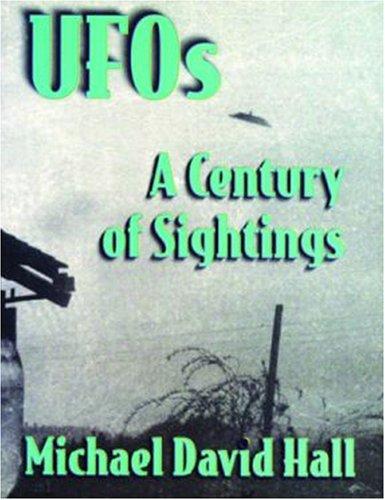
UFOs: A Century of Sightings
A Professional Historian's Chronology of the Phenomenon, Built From the Nation's Archives Rather Than From Ufology
Find on Amazon →As an Amazon Associate, OverClassified may earn from qualifying purchases made through this link, at no extra cost to you.
Why This Is Essential Reading
An underrated reference and a model of method. Michael David Hall was a working museum director and academic historian who found the UFO record by accident while researching wartime bombing campaigns, recognised that the archives held far more than the literature reflected, and wrote a 375-page chronological history built from primary sources and filtered toward witnesses whose credibility can be independently assessed. It is not an argument, it takes no position on what the objects are, and its coverage effectively stops in the 1960s — all deliberate, all worth knowing before you buy it. What you get instead is a cited, checkable, century-scale spine for the subject, from someone trained to build one. Read it alongside Swords and Powell and Peebles, the other two serious historians' treatments, and note that all three reach different conclusions from broadly the same archive.
Related Cases & Theories
Sources Cited
- Hall, Michael David. UFOs: A Century of Sightings. Lakeville, MN: Galde Press, Inc., July 1, 2000, 375 pp. ISBN-10 1880090627 / ISBN-13 9781880090626. amazon.com
- NICAP, "About Michael Hall" — biography: Illinois College B.A., Western Illinois University M.A. in American History, Purdue doctoral work, Illinois State Museum from 1984, Montgomery County Historical Society and Henry S. Lane Historic Home directorship from 1987, part-time guide at the United States Air Force Museum, the foo-fighter discovery at Purdue and the "huge volume of primary material" conclusion, Origin of the UFO Phenomenon, the in-progress A Time To Remember: The UFO Wave of 1952, and the Wendy Connors co-authored International UFO Reporter study of Alfred Loedding and Project Sign. nicap.org
- NICAP book listing for Michael Hall — publication record. nicap.org
- Sign Historical Group, Ohio State University collection index (G to O), Project 1947 — archival finding aid for the early Air Force UFO record Hall worked from. project1947.com
- The Black Vault, "A List of UFO Sightings by Astronomers (Compiled in 2000)" — a contemporaneous document-archive resource of the kind Hall's archival argument concerns. theblackvault.com
- Amazon UK listing, UFOs: A Century of Sightings by Michael David Hall — independent bibliographic confirmation and reader ratings. amazon.co.uk
- Project 1947, "Online Catalogues and Sighting Summaries" — the open archival-catalogue resource ecosystem the archival turn Hall represents produced. project1947.com
- Wikipedia, "Project Sign" — the 1948 Air Force project whose participant Alfred Loedding Hall and Wendy Connors recovered from the personnel files. en.wikipedia.org
- Peebles, Curtis. Watch the Skies! A Chronicle of the Flying Saucer Myth. Smithsonian Institution Press, 1994 — the sceptical historian's parallel treatment. OverClassified breakdown
- Swords, Michael D., and Robert Powell. UFOs and Government: A Historical Inquiry, 2012 — the third serious historians' treatment. OverClassified breakdown
- Basterfield, Keith. UFOs: A Report on Australian Encounters, Reed Books — the Australian archival parallel. OverClassified breakdown
- Clarke, David. The UFO Files: The Inside Story of Real-Life Sightings. The National Archives, 2009 — the British archival parallel. OverClassified breakdown
- Cohen, Daniel. The Great Airship Mystery: A UFO of the 1890s, 1981 — the dedicated treatment of Hall's chronological starting point. OverClassified breakdown
- OverClassified case file, Carson Sink Incident — cites this book at p. 187 for its treatment of the case, and notes Hall's focus on military and professionally credentialed witnesses.
- OverClassified case file, The Foo Fighters (WWII Aerial Phenomena) — the material that brought Hall into the subject.
- OverClassified case file, The Washington, D.C. UFO Flap of 1952 — the densest section of Hall's chronology.
- OverClassified case file, Project Blue Book Special Report No. 14 — the Battelle statistical study and the Air Force's presentation of it.
Have corrections, additional research, or peer-reviewed sources? Help improve this entry.
Suggest an Edit