
The Great Airship Mystery
A UFO of the 1890s
Core Thesis
The Great Airship Mystery: A UFO of the 1890s was, in 1981, the first book to give the 1896-97 American mystery-airship wave a full, dedicated, book-length historical treatment — and its author, Daniel Cohen, brought an unusual combination to the task: a journalism degree, a decade and a half of writing paranormal nonfiction for young readers, and founding membership in the Committee for Skeptical Inquiry's UFO subcommittee alongside Philip J. Klass. Working from surviving period newspaper records, Cohen reconstructs the wave's chronology from its opening sighting over Sacramento, California, on November 17, 1896, through its spread up and down the West Coast and eastward across Nebraska, Kansas, Texas, and finally Illinois and Indiana, where reports died out by mid-1897. His explanation leans heavily on a genuinely earthly cause largely forgotten today: 19th-century newspapers routinely ran fabricated or embellished stories as a circulation-boosting practice, and Cohen argues the bulk of the wave's more elaborate reports — occupants, propellers, wheels, entire crews — are traceable to this specific journalistic habit rather than to any genuine aerial craft. He supplements the hoax explanation with mass suggestion, misidentification of ordinary objects such as the planet Venus, a possible conspiracy among railroad telegraph operators, and the fact that Jules Verne's airship novel Robur the Conqueror was in wide circulation at exactly the moment the sightings began, supplying the public with a ready-made mental image of a cigar-shaped flying machine. Cohen's own reviewers, while praising his research, flagged the book's central weakness as a genuine one: having built a strong case that most sightings were hoaxes or misperception, Cohen goes on to treat the wave as fully solved, a conclusion the surviving documentary record does not quite support.
About the Author
Daniel Edward Cohen was born March 12, 1936, in Chicago, Illinois, and earned a journalism degree from the University of Illinois at Urbana-Champaign in 1958. He worked briefly as a proofreader at Time Inc. before becoming an editor at Science Digest, where positive reader response to his own articles on paranormal subjects encouraged him to write his first book, Myths of the Space Age (1967), a collection of skeptical essays on flying saucers, monsters, and related claims. In 1969 he and his wife, Susan Cohen, relocated to upstate New York so he could write full-time; market demand steered him away from his original plan of straightforward popular-science books and toward the ghosts-monsters-UFOs-and-psychic-phenomena beat that would define his career.
By the time The Great Airship Mystery appeared in 1981, Cohen was already one of the most prolific nonfiction authors working in American children's and young-adult publishing, and he would go on to write close to 200 books before his death — on subjects ranging far beyond the paranormal, including biography, world history, and popular culture, alongside a long shelf of titles on ghosts, cryptids, witchcraft, and UFOs such as The Encyclopedia of Ghosts (1984) and Curses, Hexes and Spells (1974, later listed among the American Library Association's 100 most frequently challenged books of the 1990s). Despite writing almost entirely for a popular and youth audience, Cohen was a self-described skeptic and a founding member of the Committee for Skeptical Inquiry's UFO subcommittee, working alongside Philip J. Klass, James E. Oberg, and Ernest H. Taves — a credential that places The Great Airship Mystery closer to organized skeptical UFO research than its trade-paperback packaging for young readers might suggest, even though, as reviewers noted, his treatment tended toward a lighter, more open-handed tone than dogmatic debunking.
Cohen's life outside his writing desk was marked by tragedy: his daughter, Theodora ("Theo") Cohen, a 20-year-old Syracuse University student, was among the 270 people killed when Pan Am Flight 103 was bombed over Lockerbie, Scotland, on December 21, 1988. Cohen and his wife became public advocates for the victims' families in the years that followed, co-authoring Pan Am 103: The Bombing, the Betrayals, and a Bereaved Family's Search for Justice (2000) and appearing in the documentary Since: The Bombing of Pan Am Flight 103. He continued writing until shortly before his death on May 6, 2018, in Cape May, New Jersey, at age 82.
Historical Context & Origins
Cohen wrote The Great Airship Mystery at a moment when the 1896-97 wave had already drifted to the margins of both mainstream American history and UFO literature. It was well known to specialists — Charles Fort had cataloged some of its stranger reports decades earlier, and UFO writers occasionally referenced it as a curious historical footnote — but no one had yet produced a sustained, book-length investigation drawing directly on the surviving period newspaper record. Cohen's own research pipeline ran through the same paranormal-nonfiction career that had already produced over a decade of books on ghosts, monsters, and flying saucers for Dodd, Mead & Company; The Great Airship Mystery applied that same skeptical, source-based approach to a specific 85-year-old historical puzzle rather than to a contemporary UFO controversy.
The book arrived nine years before Robert E. Bartholomew's 1990 Skeptical Inquirer paper "The Airship Hysteria of 1896-97" applied a more formal sociological collective-delusion framework to the same events, and seventeen years before Bartholomew's own book-length treatment, UFOs & Alien Contact (1998, with George S. Howard), folded the wave into a two-century survey of similar sighting episodes. Cohen's 1981 book is, by a clear margin, the earlier work, and it approaches the material as a discrete historical mystery in its own right rather than as one case study within a larger sociological argument — a narrower, more narrative-driven treatment suited to its publisher and its general-interest readership.
Dodd, Mead & Company, Cohen's publisher, was a long-established New York trade house (founded in 1839, and by 1981 a steady publisher of both adult nonfiction and youth titles) rather than a specialty skeptical press like Prometheus Books, which would later publish Bartholomew's work. That placement meant The Great Airship Mystery reached general bookstore and library shelves — and, per its Library of Congress cataloging under UFOs and the 1896-97 wave specifically, library reference collections — rather than being aimed primarily at either committed ufologists or the organized skeptical movement Cohen himself belonged to.
Core Arguments & Key Concepts
Cohen's central explanatory claim, as Kirkus Reviews summarized it at the book's release, is that "journalistic hoaxing was a widespread and acceptable circulation-booster in 19th-century newspapers," and that this specific, well-documented feature of the period press — not any genuine flying craft — accounts for the bulk of the wave's more elaborate and specific reports, including the accounts of visible occupants, wings, wheels, and propellers that appear throughout the period coverage. This is Cohen's version of the same argument later scholars would formalize under labels like collective behavior or media contagion: that competitive, under-regulated 19th-century newspapers had every commercial incentive to run, and in a number of documented cases to simply invent, airship copy once the story proved to be a reader draw.
Beyond hoaxing, Cohen builds a multi-factor explanation rather than a single-cause one: wishful thinking and mass suggestion once the airship story became a familiar cultural script; misidentification of ordinary bright objects, especially the planet Venus, which was unusually prominent in the evening sky during parts of the wave; a possible coordinated element among railroad employees, whose telegraph lines were the era's main channel for fast long-distance news and rumor; and the contemporaneous newspaper serialization and wide circulation of Jules Verne's 1886 novel Robur the Conqueror, whose plot centers on a secretive inventor's cigar-shaped flying machine — giving the American public a specific, pre-formed mental template for exactly the kind of object witnesses across the country then reported.
Cohen gives particular attention to the wave's own home-grown mythology of a real secret inventor, investigating the several men who came forward, or were named by others, as the airship's actual builder — most notably San Francisco attorney George D. Collins's November 1896 claim to represent an inventor client, later identified in the press as one E.H. "Aluminum" Benjamin, who had supposedly spent seven years secretly building a 150-foot metal airship capable of carrying fifteen passengers. Collins's client never surfaced, no such craft was ever patented or produced, and Collins ultimately recanted the story; Cohen treats episodes like this one as demonstrating exactly the same hoax-and-wishful-thinking mechanism operating at the level of individual claimed inventors, not just newspaper copy.
As Kirkus's contemporary review also noted, Cohen's own argument has a documented internal tension: having built a genuinely strong case that hoaxing, misidentification, and cultural priming explain "most" of the wave's reports, he goes on, in the reviewer's phrase, to "unjustifiably extend 'most' to 'all,'" glossing over a residue of harder-to-explain accounts rather than directly confronting them. That specific gap between the book's evidentiary base and its concluding certainty is, per that same review, the main reason the book's "debatable analysis" left "conclusions [that] will not satisfy either UFO believers or skeptics."
Key Cases & Evidence Discussed
The book's entire subject is this site's own Great Airship Wave of 1896-1897 (Case File #228), which lists Cohen's 1981 book directly in its own timeline as "the first dedicated book-length historical treatment of the full national wave" and cites it in its sources alongside Robert Bartholomew's 1990 paper and Michael Busby's 2004 investigation as one of three works of sustained historical scholarship the case file treats as evidence the underlying record contains genuine unresolved residue.
This site's own Sonora Aero Club Secret Society (Case File #027), covering the earlier, more legendary claims surrounding Charles Dellschau's secret 1850s-70s airship-inventor club, cites this book as essential comparative context for evaluating the argument — associated with historian Brett Holman — that the well-documented, thoroughly pressed-covered 1896-97 wave, not any genuine mid-19th-century precedent, is the real cultural source that later shaped how the Sonora Aero Club's own claims came to be told and remembered.
This site's own Maracaibo UFO Sighting (Case File #055, 1886), a decade-earlier South American case, also cites this book, using Cohen's detailed account of the American wave's press dynamics and hoax mechanics as a comparative historical baseline against which to weigh an earlier, geographically distant reported sighting.
This site's own UFOs & Alien Contact (ER-090, 1998) essential-reading article covers the same 1896-97 wave at length within Robert Bartholomew and George S. Howard's broader two-century historical survey; that article's own sources note explicitly that this site's Great Airship Wave case file draws its Bartholomew material from his standalone 1990 Skeptical Inquirer paper rather than the 1998 book, leaving Cohen's 1981 volume as this site's earliest and most directly wave-specific book-length source on the episode.
Critical Reception & Controversies
The book's most substantial contemporary review came from Kirkus Reviews at its October 1981 publication, and it is worth quoting at length because it captures the book's real strengths and its real limitation in one passage: Kirkus credited Cohen, "prolific writer of juveniles on other-worldly subjects," with tracing "the airship's progress from surviving records" and correctly identifying that "journalistic hoaxing was a widespread and acceptable circulation-booster in 19th-century newspapers," but concluded that "Cohen unjustifiably extends 'most' to 'all,' while ignoring or glossing over a small number of queer and potentially important points," summarizing the book overall as "solid exposition, then, but debatable analysis — so the conclusions will not satisfy either UFO believers or skeptics."
No contemporary review from Publishers Weekly, School Library Journal, or Booklist turned up in this article's research despite a genuine search effort — a real documentation gap worth stating plainly for a 1981 trade release rather than glossing over it, and consistent with the book's relatively modest, specialist-audience profile compared to some of this site's other Essential Reading entries.
Reader reception on Goodreads is modest but positive: the book holds a 3.68-star average across 19 ratings and 4 written reviews. One reader called it "really good," adding they "learned much about what life was like [in] America during these sightings," while another found it "a nice history of the era" that nonetheless "sort of just ends without any conclusion" — an independent echo of the same structural complaint Kirkus raised decades earlier. A third reader review singled out the book's discussion of 19th-century cultural influences on the airship phenomenon, rather than the individual sighting accounts themselves, as its most valuable material, noting many of the reports amounted to either vague lights in the sky or "highly detailed improbable encounters that are almost certainly hoaxes."
Taken together, the book's reception across four decades tells a consistent story: real credit for original archival legwork and a genuinely useful account of the era's newspaper culture, paired with a recurring complaint — from a professional trade reviewer in 1981 and from ordinary readers decades later alike — that Cohen's own conclusions outrun the evidence he assembles, and that the book stops short of fully resolving the mystery its title promises.
Influence & Legacy
On this site specifically, the book's influence is concretely documented rather than asserted: it is cited by exact ISBN across the Great Airship Wave of 1896-1897, Sonora Aero Club Secret Society, and Maracaibo UFO Sighting case files, and this site's own resources library logs it as cited across those same three pages under this exact 1981 Dodd, Mead & Co. edition.
As the first dedicated book-length history of the 1896-97 wave, Cohen's volume effectively set the template that later, more academically credentialed treatments would build on and, in places, correct: Robert Bartholomew's 1990 Skeptical Inquirer paper and his and George S. Howard's 1998 book UFOs & Alien Contact both cover the same core wave with a more formal sociological collective-behavior framework than Cohen's more narrative, journalism-trained approach supplies, and Michael Busby's 2004 book Solving the 1897 Airship Mystery revisited the same events with an explicit brief for a real, terrestrial invention behind at least some sightings — a possibility Cohen's own book had already investigated and, per his reviewers, dismissed somewhat too briskly.
Within this site's own Essential Reading catalog, this book sits as an early, narrower companion to UFOs & Alien Contact (ER-090): where Bartholomew and Howard place the 1896-97 wave inside a two-century sociological argument spanning Thomas Edison's 1878 "electric star" through Sweden's 1946 ghost rockets, Cohen's 1981 book gives the single 1896-97 episode its own full-length, ground-level historical narrative — the more focused, case-specific treatment against which the later, more theoretically ambitious book can be read.
Cohen's parallel career as a founding member of the Committee for Skeptical Inquiry's UFO subcommittee, alongside Philip J. Klass, situates this specific book within the broader organized-skepticism movement of the late 1970s and early 1980s, even though its trade-publisher packaging and general-audience prose kept it somewhat apart from the more polemical skeptical literature Klass himself was producing in the same years.
The Book
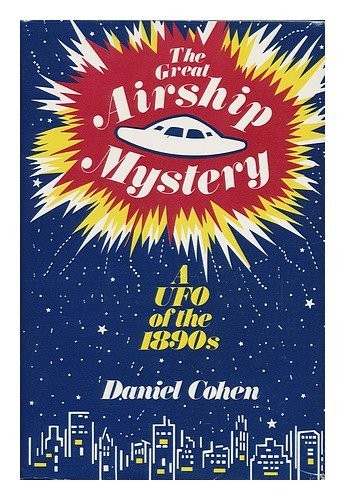
As an Amazon Associate, OverClassified may earn from qualifying purchases made through this link, at no extra cost to you.
Why This Is Essential Reading
The Great Airship Mystery: A UFO of the 1890s earns its place on this list as this site's earliest and most historically foundational source on the 1896-97 American mystery-airship wave — the first writer to give the episode a full, dedicated, archivally grounded book rather than a chapter or a footnote. Daniel Cohen's credentials are real if modest by comparison to some of this site's other Essential Reading authors: a working journalist-turned-paranormal-nonfiction specialist and a founding member of organized skepticism's own UFO subcommittee, rather than a credentialed historian or sociologist. That combination produced a book its own contemporary reviewer at Kirkus rightly called "solid exposition" paired with "debatable analysis" — genuinely useful archival reconstruction of the wave's newspaper-hoax culture, Venus misidentifications, and the Jules Verne connection, undercut by a tendency, flagged independently by both that 1981 review and reader reviews decades later, to claim more certainty than the surviving evidence supports. Read as what it actually is — a pioneering, honestly flawed first draft of this specific history, later supplemented and partly corrected by UFOs & Alien Contact's more rigorous sociological treatment of the same wave — it remains the direct historical starting point this site's own Great Airship Wave case file, and two other case files besides, still cite by name.
Related Cases & Theories
Essential Viewing
1896: Mysterious Airships
The History Guy: History Deserves to Be Remembered — A historian's overview of the 1896-97 mystery airship wave this book chronicles, tracing its spread from California eastward. Verified via YouTube oEmbed before inclusion.
Secret Origin of the Mystery Airships!
Jimmy Akin's Mysterious World — An examination of the cultural and journalistic origins of the 1896-97 airship reports, covering the same hoax and misidentification explanations this book investigates. Verified via YouTube oEmbed before inclusion.
Sources Cited
- Cohen, Daniel. The Great Airship Mystery: A UFO of the 1890s. Dodd, Mead & Co., 1981 (ISBN 9780396079903 / 0396079903, matching this site's own case-file citations under this exact edition). amazon.com
- "The Great Airship Mystery: A UFO of the 1890s." Kirkus Reviews, October 1, 1981 (full contemporary review, quoted at length in this article). kirkusreviews.com
- "The great airship mystery." Open Library bibliographic record (Dodd, Mead & Co., 1981, New York; 212 pp.; ISBN 0396079903; LC Classification TL789 .C6519; OCLC 7554362). openlibrary.org
- "The great airship mystery : a UFO of the 1890s." Internet Archive digitized copy (full scanned text, borrowable). archive.org
- "The Great Airship Mystery: A UFO Of The 1890s." Goodreads (reader ratings: 3.68-star average, 19 ratings, 4 written reviews). goodreads.com
- "Daniel Cohen (children's writer)." Wikipedia (biography: birth/death dates, education, career timeline, bibliography count, CSICOP membership, Pan Am Flight 103 connection). en.wikipedia.org
- "George D. Collins." San Francisco Story (historical account of the November 1896 attorney's claim to represent airship inventor E.H. "Aluminum" Benjamin). sanfranciscostory.com
- "Robur the Conqueror." Wikipedia (bibliographic and publication history of Jules Verne's 1886 novel, cited for its cultural role during the 1896-97 wave). en.wikipedia.org
- "Mystery airship." Wikipedia (overview of the 1896-97 wave, chronology, and historiography including Cohen's, Bartholomew's, and Busby's book-length treatments). en.wikipedia.org
- Bartholomew, Robert E. "The Airship Hysteria of 1896-97." Skeptical Inquirer, vol. 14, no. 2 (Winter 1990), pp. 171–181 (later, more sociologically formal treatment of the same wave, cited for comparison). skepticalinquirer.org
- "The great airship mystery." Biblio.com (bookseller bibliographic listing, first edition details, dust-jacket description). biblio.com
- This site's own case file: The Great Airship Wave of 1896-1897 (Case File #228), which lists this exact book in its own historical timeline and sources.
- This site's own case file: Sonora Aero Club Secret Society (Case File #027), which cites this exact edition and ISBN.
- This site's own case file: Maracaibo UFO Sighting (Case File #055), which cites this exact edition and ISBN.
- This site's own essential-reading article: UFOs & Alien Contact (ER-090), for its own coverage of the same 1896-97 wave within a broader two-century historical survey.
Have corrections, additional research, or peer-reviewed sources? Help improve this entry.
Suggest an Edit