
UFOs & Alien Contact
Two Centuries of Mystery
Core Thesis
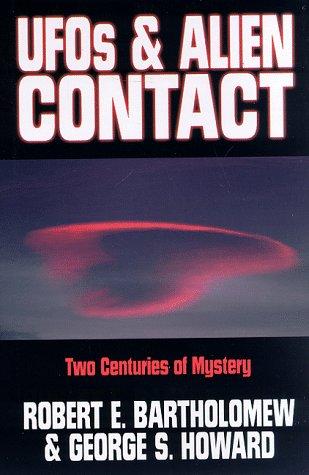
UFOs & Alien Contact: Two Centuries of Mystery pairs Robert E. Bartholomew, a medical sociologist who had spent nearly a decade building an academic research program around UFO sighting waves, with George S. Howard, a University of Notre Dame psychologist whose own research centered on narrative and philosophical psychology, to argue that the UFO phenomenon did not begin with Kenneth Arnold's 1947 sighting but has a documented, patterned history stretching back to Thomas Edison's misreported 1878 “electric star” and the 1896-97 American airship flap. Drawing on several thousand rare period press reports, the authors trace a recurring structure across two centuries of sighting waves — Canada's phantom balloon scare of 1896-97, New Zealand's 1909 “zeppelin” panic, Britain's 1912-13 phantom-airship scare, phantom German air raids and spy-light panics of the First World War, and Sweden's 1946 “ghost rocket” crisis — in which newspaper competition, wartime or technological anxiety, and ordinary misperception of ambiguous stimuli combine to generate waves of sincere, non-fraudulent reports largely independent of any single physical cause. Where the book's historical chapters are Bartholomew's sociological territory, its treatment of the modern abduction phenomenon leans on Howard's psychological training and the two authors' own earlier collaboration: a biographical analysis of 152 abductees and contactees finding them free of diagnosable mental illness but disproportionately likely to exhibit traits of the “fantasy-prone personality” (FPP), a normal psychological variant associated with vivid inner imagery rather than delusion. The result, praised in a rare serious academic review as containing “a wealth of historical detail processed through powerful analytical tools of social psychology,” is one of the more sustained attempts by credentialed social scientists to place the UFO phenomenon inside conventional collective-behavior theory rather than either ufological advocacy or blanket dismissal.
About the Author
Robert Emerson Bartholomew (b. August 17, 1958) built an unusually deliberate academic path into UFO research. After a radio-broadcasting certificate from SUNY Adirondack (1977) and a bachelor's degree in communications from Plattsburgh (1979), he earned a master's in sociology from the State University of New York at Albany (1984), a second master's in sociology from Flinders University in South Australia (1992, built on a 1990 thesis examining UFO reports through the lens of mass hysteria), and a PhD in sociology from James Cook University in Queensland. By the time UFOs & Alien Contact appeared in 1998, Bartholomew had already spent nearly a decade publishing specifically on this material: the monograph UFOlore: A Social Psychological Study of a Modern Myth in the Making (1989), the journal article “The Quest for Transcendence: An Ethnography of UFOs in America” (Anthropology of Consciousness, 1991), and “The Airship Hysteria of 1896-97” (Skeptical Inquirer, 1990), the paper that first applied his collective-delusion framework to the 19th-century wave this book would later revisit at book length. He has since become one of the most prolific researchers of mass psychogenic illness in the world, examining roughly 600 historical and contemporary outbreaks — from the Salem witch trials to the 2011 Le Roy, New York, twitching-illness cluster — in books including Little Green Men, Meowing Nuns and Head-Hunting Panics, The Martians Have Landed! (2011, with Benjamin Radford), Mass Hysteria in Schools (with Bob Rickard), and Havana Syndrome (with Robert W. Baloh). Now an Honorary Senior Lecturer in the Department of Psychological Medicine at the University of Auckland and a self-described “sympathetic skeptic,” he was elected a Fellow of the Committee for Skeptical Inquiry in 2017.
George Stephen Howard (June 8, 1948 – October 2, 2025) brought a very different résumé to the collaboration. Born in Bayonne, New Jersey, and a former high-school teacher in the Bronx with the Marist Brothers, he earned his PhD in psychology from Southern Illinois University before joining the faculty at the University of Houston and then, from 1981 until his retirement, the University of Notre Dame, where he chaired the Department of Psychology, later served as the Joseph Morahan Director of the College Seminar Program, and was ultimately named Professor Emeritus. His own research specialties — philosophical and narrative psychology, research methodology, and later environmental/ecological psychology, the subject of his 1997 book Ecological Psychology: Creating a More Earth-Friendly Human Nature — had nothing to do with ufology on their face. His entry point was a specific piece of collaborative research: in 1991, Bartholomew, Australian UFO investigator Keith Basterfield, and Howard co-authored “UFO Abductees and Contactees: Psychopathology or Fantasy Proneness?” in the American Psychological Association journal Professional Psychology: Research and Practice, a biographical analysis of 152 reported abductees and contactees that found the group “remarkably devoid of a history of mental illness” while identifying fantasy-prone-personality characteristics in 132 of the 152 cases — the specific finding this book's abduction chapters expand into a full historical treatment. Howard authored 11 books and more than 170 peer-reviewed articles and chapters over his career, of which this collaboration with Bartholomew remains, by a wide margin, his most publicly visible work outside mainstream academic psychology.
Historical Context & Origins
By 1998, Bartholomew had spent nearly a decade laying the specific academic groundwork this book would consolidate. His 1989 monograph UFOlore, his 1990 Flinders University thesis on UFO reports and mass hysteria, his 1990 Skeptical Inquirer paper applying collective-delusion theory to the 1896-97 American airship wave, and the 1991 Professional Psychology: Research and Practice paper he wrote with Keith Basterfield and George Howard biographically profiling 152 abductees and contactees were not background reading for the book — they were its direct research pipeline, condensed and expanded into a single 408-page volume nearly a decade later.
The book arrived from Prometheus Books, the Amherst, New York, press that had by the late 1990s become the closest thing organized American skepticism had to a house publisher — the same imprint that, later in 1998, would also publish Terry Matheson's Alien Abductions: Creating a Modern Phenomenon (ER-075), this site's own literary-critical companion piece to this book's more historical-sociological approach. Published in March 1998 as a 408-page hardcover, UFOs & Alien Contact positioned itself explicitly against both tabloid-style UFO literature and simple dismissal, aiming instead for what its own authors and later reviewers would call a genuinely comprehensive, source-documented historical survey.
The book's title promise — two centuries of mystery — is not marketing exaggeration. Its chapters work forward from Thomas Edison's widely but falsely reported 1878 “electric star” through the 1896-97 U.S. airship flap and Canada's parallel phantom-balloon wave of the same years, New Zealand's 1909 “zeppelin scare,” Britain's 1912-13 phantom-airship panic, phantom German air-raid and spy-light scares during the First World War, and Sweden's 1946 “ghost rocket” crisis — a full 70 years of pre-flying-saucer sighting waves before the book even reaches the Kenneth Arnold-era phenomenon most readers associate with the term “UFO.” This deliberately deep historical baseline is the book's organizing argument in miniature: that the specific pattern of media-amplified, socially contagious sighting waves long predates, and does not require, any hypothesis about actual visiting spacecraft.
Core Arguments & Key Concepts
The book's central sociological claim is that UFO sighting waves are best explained as episodes of collective behavior — a technical term, distinct from simple hoaxing, for how ambiguous stimuli (a bright planet, a kite, a genuine meteor, an unfamiliar aircraft) combine with newspaper competition, prior media priming, and ordinary human suggestibility to generate a self-reinforcing cascade of sincere reports. Bartholomew's own earlier line from his 1990 Skeptical Inquirer paper on the 1896-97 wave — that “believing was seeing” — is the book's working thesis writ across 150 additional years of case material: once a specific interpretive frame (secret airship, German spy light, Soviet rocket, extraterrestrial saucer) becomes culturally available, ambiguous sightings reliably get sorted into it.
Structurally, the book proceeds as a chronological case survey rather than a single sustained argument, using each historical wave — the American and Canadian episodes of 1896-97, New Zealand's 1909 scare, Britain's 1912-13 panic, the WWI-era phantom-airship and spy-light scares, and Sweden's 1946 ghost rockets — as a self-contained demonstration of the same underlying mechanism recurring under different technological and geopolitical costumes: airships when dirigible flight was a live public fascination, German aircraft during a genuine European war, Soviet secret weapons at the dawn of the missile age, and finally flying saucers and alien visitors once that specific cultural template became dominant after 1947.
For the modern abduction and contact phenomenon specifically, the book's argument shifts from sociology to clinical psychology, building directly on Bartholomew, Basterfield, and Howard's 1991 journal study of 152 subjects. Rather than treating abductees as either liars or the mentally ill, the authors apply the fantasy-prone personality (FPP) framework developed by psychologists Sheryl Wilson and Theodore Barber: a recognized, non-pathological variant found in a minority of otherwise normal adults, marked by unusually vivid imaginative life, high hypnotic susceptibility, and elevated rates of reported psychic, out-of-body, and apparitional experiences. Their argument is that a disproportionate share of abduction and contact reports come from people who score high on this trait — not evidence of mental illness, but a specific cognitive style that makes certain individuals more likely to have, remember, and vividly narrate an anomalous experience as literal alien contact.
Because the two authors bring genuinely different training to the material — Bartholomew's sociology of collective behavior for the historical wave chapters, Howard's psychological research methodology for the abduction material — the book covers more disciplinary ground than most single-author skeptical UFO treatments of its era, engaging religion, media studies, perception research, and folklore alongside its central sociological and psychological arguments.
Key Cases & Evidence Discussed
Two of this site's own case files cite this exact book for chapter-level content the book actually contains. The New Zealand Airship Wave of 1909 (Case File #273) case file describes the book as one that “situates New Zealand's 1909 ‘zeppelin scare’ directly alongside the American 1896-97 wave, Canada's phantom balloon wave, and Britain's 1912-13 panic within a single comparative collective-delusion framework” — language this site's own Sheerness Phantom Airship Incident (Case File #274) file mirrors from the opposite direction, situating Britain's 1912-13 panic (the very episode formally acknowledged in Parliament on November 18 and 27, 1912, near the Sheerness Royal Navy Dockyard in Kent) alongside the same American, Canadian, New Zealand, and Swedish episodes.
The book's most extensively documented case-level application on this site is the Knowles Family Mundrabilla Encounter (Case File #165, January 1988, near Mundrabilla on Australia's Nullarbor Plain), where Bartholomew classified the family's experience as a “small group panic” — his term, quoted directly on that case file, for episodes in which “normal, healthy people who, as a result of a series of unusual events, grow paranoid and literally scare themselves after growing convinced that their lives are in imminent danger,” typically under conditions that “enhance suggestibility and inhibit… powers of critical thinking.” His own summary concluded the family, “fatigued from a long trip, under the cover of darkness while travelling on an unfamiliar road, mistook an anomalous light for an extraterrestrial space craft that they believed was pursuing them” — a direct, named application of this book's small-group-panic framework to a specific, still-debated Australian case.
The book's chapters on the 1896-97 American airship flap and Sweden's 1946 ghost rockets cover, respectively, the same episodes documented on this site's own Great Airship Wave of 1896-1897 and Swedish Ghost Rockets (Case File #171, Feb.–Dec. 1946) files — but it is worth being precise about which of Bartholomew's own works those specific case files actually cite. The Great Airship Wave file draws its Bartholomew material from his standalone 1990 Skeptical Inquirer paper rather than this 1998 book, and the Swedish Ghost Rockets file does not currently cite this book at all; both remain genuinely on-topic thematic parallels to this book's own coverage of the same waves rather than case files this book directly supplied research to.
This site's own Berkshire UFO Wave / Thom Reed (Case File #072, 1969) and New Jersey / Northeast Drone Wave (Case File #304, 2024) files both cite this book as well, though for its general collective-behavior framework rather than chapter-specific coverage of either event — the 2024 drone wave obviously postdates the book's 1998 publication by 26 years. Bartholomew himself made that continuity explicit: in a December 2024 Psychology Today “It's Catching” column, he directly compared the New Jersey drone panic to the World War I-era “German espionage” light-sighting scares his 1998 book had already catalogued, describing the modern episode as “another classic case of patternicity” — the same historical-parallel method this book established a quarter-century earlier, still doing active analytical work today.
Critical Reception & Controversies
The book's most substantial and most credible review came from an unusually well-qualified source: Michael J. Crowe, a University of Notre Dame historian of science and the author of major scholarly works on the extraterrestrial-life debate, reviewed it jointly with Steven J. Dick's Life on Other Worlds and Barry Parker's Alien Life in Isis, the flagship journal of the History of Science Society, in its June 2000 issue (vol. 91, no. 2, pp. 395-397). Crowe credited Bartholomew and Howard with “a wealth of historical detail processed through powerful analytical tools of social psychology” and “sober, sensible and engaging assessments of developments and events in an area that has been filled with controversy” — a genuinely rare instance of a UFO-shelf book receiving serious attention in a peer-reviewed history-of-science journal rather than a popular-science or genre outlet.
Reader reception has been more mixed. On Goodreads, the book holds a 3.41-star average across 22 ratings (13% five-star, 36% four-star, 27% three-star, 22% two-star, no one-star ratings). Reviewer Erik Graff, writing in 2010, called it “typically derivative” of other sources while noting his own long-standing interest lay less in extraterrestrial explanations than in “the sheer alienness of what many experiencers have reported throughout history.” A more recent 2025 review by Steven H engaged closely with the book's central historical-parallel argument, quoting its own observation that “when we compare the events of the airship episode with contemporary UFO and flying saucer waves, the similarities are striking,” and highlighting the fantasy-prone-personality framework as offering a more therapeutic reading of contactees than either fraud or pathology.
No contemporary trade-press review — Kirkus, Publishers Weekly, or comparable outlets — turned up in this article's research, a genuine gap worth stating plainly rather than glossing over, especially by contrast with this site's own entry on Terry Matheson's Alien Abductions, published by the same Prometheus Books later that same year and reviewed at length by Publishers Weekly. Whatever critical attention this book received came almost entirely from within the history-of-science and skeptical community rather than the mainstream book-review circuit.
The book's dual academic pedigree — a sociologist with a genuine sociology PhD and a Notre Dame psychology professor, rather than a journalist or independent researcher — is itself part of what distinguished it in Crowe's review, which situated it alongside serious scholarly treatments of the extraterrestrial-life question (Dick's NASA-history-adjacent study, Parker's astrophysics-focused survey) rather than reviewing it as a stand-alone UFO title.
Influence & Legacy
On this site specifically, the book's influence is concretely documented rather than asserted: it is cited by exact ISBN across the Berkshire UFO Wave, Knowles Family Mundrabilla Encounter, New Jersey / Northeast Drone Wave, New Zealand Airship Wave of 1909, and Sheerness Phantom Airship Incident case files, and its 1998 publication is logged as a milestone entry in this site's own Psycho-Social Hypothesis theory page timeline, which treats Bartholomew as PSH's “discipline's most sustained modern voice.”
Bartholomew's own career shows the book's specific methodology outliving its 1998 publication date by decades rather than becoming a period piece: his direct application of the same historical-wave comparison to the 2024 New Jersey drone panic, in a Psychology Today column explicitly invoking the World War I-era light scares this book first catalogued at length, demonstrates the framework still doing live analytical work on a genuinely new phenomenon more than a quarter-century after the book's publication.
Within this site's own Essential Reading catalog, this book predates by two decades the academic-adjacent treatments of UFO belief this site already covers: Diana Walsh Pasulka's American Cosmic (ER-018, 2019) and Sarah Scoles's They Are Already Here (ER-068, 2020) both approach UFO belief as a serious object of scholarly study, but from disciplinary homes — religious studies and science journalism, respectively — genuinely distinct from this book's sociology-and-clinical-psychology pairing. Read together, the three represent three separate academic routes into the same underlying question of why UFO belief persists and how it should be studied, rather than one superseding the others.
George Howard's death on October 2, 2025, closes out a career of 11 books and more than 170 peer-reviewed publications in mainstream academic psychology; this collaboration with Bartholomew remains, by any public measure, the widest general-audience reach any single one of his books achieved. Bartholomew, by contrast, has continued building directly on this book's research program in the decades since, extending its collective-behavior framework through later collaborations with Benjamin Radford, Peter Hassall, and Robert W. Baloh, and through his own ongoing commentary on contemporary sighting waves.
The Book
As an Amazon Associate, OverClassified may earn from qualifying purchases made through this link, at no extra cost to you.
Why This Is Essential Reading
UFOs & Alien Contact: Two Centuries of Mystery earns its place on this list as one of the most disciplinarily serious treatments of UFO belief this site's Essential Reading catalog covers — a sociologist and a Notre Dame psychologist, both with genuine, verifiable academic credentials, applying nearly a decade of prior peer-reviewed research to a single, sustained historical argument. Its two-century sweep is not padding: the American and Canadian episodes of 1896-97, New Zealand's 1909 scare, Britain's 1912-13 panic, and Sweden's 1946 ghost rockets are real chapters covering real, independently documented historical waves, several of which this site's own case files already cite this exact book to source. Its treatment of the modern abduction phenomenon through the fantasy-prone-personality lens, grounded in Bartholomew, Basterfield, and Howard's own 1991 biographical study of 152 subjects, offers a genuinely different register than either believer advocacy or blanket debunking — and its rare, substantive review in the history-of-science journal Isis is a level of scholarly engagement few UFO-shelf books from any era can claim. Read alongside this site's own Alien Abductions (Matheson's same-year, same-publisher literary-critical companion) and, two decades later, American Cosmic and They Are Already Here, this book is where a specifically sociological and clinical-psychological academic literature on UFO belief begins on this site's own reading list — and, via Bartholomew's own continued 2024 commentary on the New Jersey drone panic, a framework its surviving author is still actively applying more than a quarter-century later.
Related Cases & Theories
Essential Viewing
Why Mass Hysteria is Thriving in the 21st Century - Robert Bartholomew
Center for Inquiry — This book's co-author discussing the collective-behavior and mass-hysteria framework that underpins its historical UFO-wave chapters, applied to contemporary cases. Verified via YouTube oEmbed before inclusion.
Airship Mystery of 1896 and 1897 (Mystery Airships, UFOs)
Jimmy Akin's Mysterious World — A detailed examination of the 1896-97 American airship flap, the founding case study of this book's two-century historical survey. Verified via YouTube oEmbed before inclusion.
Sources Cited
- Bartholomew, Robert E., and George S. Howard. UFOs & Alien Contact: Two Centuries of Mystery. Prometheus Books, 1998 (ISBN 9781573922005 / 1573922005, matching this site's own case-file citations under this exact edition). amazon.com
- "UFOs & alien contact." Open Library bibliographic record (Prometheus Books, 1998, Amherst, NY; 408 pp.; LCCN 97048845; full digitized copy hosted via the Internet Archive). openlibrary.org
- "UFOs & alien contact." Internet Archive digitized copy (donated by the Boston Public Library; OCR-processed full text). archive.org
- Crowe, Michael J. Review of Life on Other Worlds (Dick), UFOs and Alien Contact: Two Centuries of Mystery (Bartholomew & Howard), and Alien Life (Parker). Isis, vol. 91, no. 2 (June 2000), pp. 395–397, published by the History of Science Society. jstor.org
- Bartholomew, Robert E., Keith Basterfield, and George S. Howard. "UFO Abductees and Contactees: Psychopathology or Fantasy Proneness?" Professional Psychology: Research and Practice, vol. 22, no. 3 (1991), pp. 215–222. psycnet.apa.org
- Bartholomew, Robert E. "The Airship Hysteria of 1896-97." Skeptical Inquirer, vol. 14, no. 2 (Winter 1990), pp. 171–181. skepticalinquirer.org
- "Robert Bartholomew." Wikipedia (biography: birth date, education at SUNY Adirondack, Plattsburgh, SUNY Albany, Flinders University, and James Cook University; career and bibliography). en.wikipedia.org
- "Robert Bartholomew." ResearchGate research profile (PhD, Sociology, James Cook University; Honorary Senior Lecturer, Department of Psychological Medicine, University of Auckland). researchgate.net
- "In Memoriam: George S. Howard, Emeritus Professor of Psychology." University of Notre Dame, Department of Psychology (biography: birth/death dates, education at Southern Illinois University, career at Houston and Notre Dame from 1981, book and article count). psychology.nd.edu
- "George Howard." ResearchGate research profile (Emeritus Professor of Psychology, University of Notre Dame). researchgate.net
- "UFOs and Alien Contact: Two Centuries of Mystery by Robert E. Bartholomew." Goodreads (reader ratings: 3.41-star average, 22 ratings; reviews by Erik Graff and Steven H). goodreads.com
- Bartholomew, Robert. "Social Panic Over Drones Sweeps America." Psychology Today, "It's Catching" column, December 2024 (direct comparison of the 2024 New Jersey/Northeast drone wave to World War I-era "German espionage" light scares this book documents). psychologytoday.com
- This site's own case file: Knowles Family Mundrabilla Encounter (Case File #165), which quotes this book's "small group panic" classification at length.
- This site's own case file: New Zealand Airship Wave of 1909 (Case File #273), which cites this exact edition and ISBN.
- This site's own case file: Sheerness Phantom Airship Incident (Case File #274), which cites this exact edition and ISBN.
- This site's own theory page: Psycho-Social Hypothesis (PSH), which logs this book's 1998 publication as a milestone in Robert Bartholomew's research program.
- This site's own key-figures entry: Robert E. Bartholomew, for his broader site-wide citations beyond this book.
Have corrections, additional research, or peer-reviewed sources? Help improve this entry.
Suggest an Edit