
American Cosmic
UFOs, Religion, Technology
Core Thesis
American Cosmic argues that belief in UFOs and extraterrestrial intelligence is not a fringe curiosity but a genuine, emergent American religion taking shape in real time — complete with its own sacred sites, relics, hidden scriptures, prophets and a priesthood of credentialed scientists who keep their convictions private for fear of professional ruin. Diana Walsh Pasulka, a tenured religious-studies scholar with no prior ufological affiliation, spent roughly six years conducting ethnographic fieldwork among a network of Silicon Valley technologists, aerospace engineers and research scientists who take the UAP phenomenon seriously enough to treat purported crash sites and physical fragments the way pilgrims treat relics of the saints — approaching them with reverence, secrecy and the conviction that direct contact with them can transform a person's beliefs. Pasulka's own position throughout is deliberately, disciplinedly agnostic: she declines to assert whether the underlying phenomenon is physically real, extraterrestrial, or something else entirely, and instead applies the same interpretive tools religious-studies scholars use to analyze the formation of any new belief system — myth, hierophany, relic veneration, pilgrimage, hidden knowledge — to a belief system that happens to be assembling itself inside NASA contractor offices and Silicon Valley venture funds instead of a desert monastery.
About the Author
Diana Walsh Pasulka holds a B.A. from the University of California, Davis, an M.A. from the Graduate Theological Union in Berkeley, and a Ph.D. from Syracuse University. She is a professor of religious studies at the University of North Carolina Wilmington and served as chair of its Department of Philosophy and Religion from 2015 to 2019 — the same years in which she was conducting the fieldwork for this book. She is not a ufologist by training or prior affiliation: her academic specialty, developed across two decades in the field, is the study of how religious belief forms and how it intersects with new and emerging technology, and her scholarly reputation was built well before American Cosmic on work entirely outside the UFO subject.
Her first book, Heaven Can Wait: Purgatory in Catholic Devotional and Popular Culture (Oxford University Press, 2014), examined how a Catholic doctrine without a fixed physical location nonetheless became imagined, mapped and materially represented across centuries of popular devotional culture — a study of belief taking on the texture of a real place that directly anticipates this book's central move: treating a UAP crash site the way a religious-studies scholar treats a shrine. She also co-edited Believing in Bits: Digital Media and the Supernatural (Oxford University Press, 2019, with Simone Natale), examining how digital technology shapes contemporary supernatural belief, and Posthumanism: The Future of Homo Sapiens (2018, with Michael Bess) — both scholarly bodies of work on religion's entanglement with technology that fed directly into American Cosmic's own central argument.
Pasulka's entry into UAP research began not through ufology but through an unrelated academic project: research connecting her with scientists and engineers whose work touched on aerospace and advanced technology, several of whom, she found, privately took UAP phenomena far more seriously than their public professional personas ever let on. Over roughly six years of fieldwork she was granted access to a small, informally networked group of credentialed scientists, engineers and technologists — several kept anonymous or pseudonymous in the finished book, including the aerospace engineer she calls "Tyler D." — who considered themselves part of what she and physicist-turned-UFO-researcher Jacques Vallée called an "Invisible College": a loose, secretive network of insiders investigating the phenomenon outside any official government or academic program, protecting their reputations by keeping the work quiet.
Pasulka's profile rose sharply after American Cosmic's 2019 publication, driven in large part by the U.S. government's own 2017–2021 UAP disclosures, which lent her ethnography of scientist-believers an unexpected currency. She followed it in 2023 with Encounters: Experiences with Non-Human Intelligences (St. Martin's Essentials), extending the same fieldwork-based approach to first-person contact and encounter experiences, and has continued to appear alongside figures from that same research network — including immunologist Garry Nolan, with whom she has spoken publicly about purported crash-site materials and the broader intersection of consciousness research and UAP study. Outside her UFO-related work, she also consults on religious and supernatural history for film and television, including Warner Bros.' The Conjuring (2013).
It is worth stating plainly what Pasulka is and is not. She is a tenured, peer-reviewed religious-studies scholar publishing with a university press, not a ufologist, journalist, or self-identified experiencer, and her academic credentials for the specific interpretive task this book undertakes — analyzing how belief systems form around unexplained phenomena — are genuine and independently verifiable. What her methodology does not supply, and does not claim to supply, is any independent verification of her sources' underlying factual claims: the book is an ethnography of belief, not a forensic investigation of physical evidence, and critics reviewing it, discussed below, have consistently pressed on exactly that distinction.
Historical Context & Origins
Pasulka conducted her fieldwork and wrote American Cosmic during a period, roughly 2013 to 2019, when the American UAP research landscape was quietly being reshaped by money and institutional credibility that had nothing to do with traditional ufology. Robert Bigelow's Las Vegas-based aerospace fortune had already funded the Pentagon's Advanced Aerospace Weapon System Applications Program from 2007 to 2012, and in October 2017 the New York Times broke the story of that program and of the Navy pilot encounters that would become known as the "Gimbal," "GoFast" and "FLIR1" videos — reporting that, alongside the simultaneous public launch of Tom DeLonge's To The Stars Academy of Arts & Science, brought a wave of credentialed scientists, former intelligence officials and aerospace veterans into public UAP conversation for the first time in decades. Pasulka's own fieldwork subjects belonged to a related but distinct current within that same broader realignment: not the public disclosure advocates making headlines, but a quieter, secrecy-preferring layer of working scientists and engineers who had been taking the subject seriously in private for years and had no interest in a television deal.
The book also entered a UFO literature that had, by 2019, largely split into two separate lanes that rarely spoke to each other: investigative and government-disclosure journalism on one side, and the small but real body of academic religious-studies scholarship on UFO belief on the other, tracing back through works like C.G. Jung's 1958 Flying Saucers and continuing through scholars such as historian David J. Halperin, whose Intimate Alien: The Hidden Story of the UFO appeared the same year as Pasulka's book and was reviewed alongside it in the Journal of the American Academy of Religion. Pasulka's specific contribution to that academic lane was ethnographic fieldwork rather than textual or historical analysis: rather than reading UFO literature from the outside, as Jung and Halperin largely did, she spent years inside the actual social network of believing scientists, producing a first-person participant-observer account that was rare within religious studies of any new movement, let alone one involving working aerospace engineers and Silicon Valley money.
Her academic authority to make this move rested on scholarship she had already published years before turning to UAP subjects: Heaven Can Wait (2014) had already established her as a serious scholar of how doctrine and belief acquire physical, spatial reality in popular religious practice, and Believing in Bits (2019) extended that same interest into digital and technological belief formation. American Cosmic arrived as the direct convergence of those two prior research threads — materially embodied belief, and belief mediated by technology — applied for the first time to a live, unresolved, high-profile contemporary phenomenon rather than a settled historical one.
Core Arguments & Key Concepts
The book's organizing concept is that UAP belief in contemporary America exhibits, point for point, the structural features religious-studies scholars use to identify a genuine emerging religion: sacred narratives explaining humanity's place in a larger cosmic order; charismatic figures and hidden "prophets" whose testimony carries special authority; esoteric, restricted knowledge available only to initiates; and, most viscerally, physical sites and objects treated with the reverence normally reserved for relics. Pasulka's key theoretical term, borrowed from the study of comparative religion, is hierophany — a manifestation of the sacred breaking into ordinary space — which she applies directly to a purported 1947-era New Mexico crash site she visits with two fieldwork subjects, blindfolded for the final approach to protect its location. She frames the site's power as deriving partly from its own mythology, reinforced by decades of popular culture including The X-Files, arguing that a landscape need not contain verified physical evidence to function religiously for the people who visit it — the same dynamic, she notes, that operates at long-established pilgrimage sites like Lourdes.
The book's most-discussed figure is the aerospace engineer Pasulka calls "Tyler D.," whom she describes as one of the most intelligent and most private people she has ever met: a NASA-connected engineer who worked on nearly every Space Shuttle launch before his career trajectory shifted following the 1986 Challenger disaster and the death of astronaut Judith Resnik, after which he moved toward exploring consciousness and spirituality alongside his continuing aerospace work. Tyler takes Pasulka and a scientist colleague she calls "James" to the New Mexico site, produces metal detectors specifically configured to flag potential non-terrestrial materials, and functions throughout the book as Pasulka's primary guide into what she and Jacques Vallée — who appears in the book as a real, named interview subject and fellow member of this informal network — call the "Invisible College": a scattered, self-protecting circle of credentialed scientists and engineers, including immunologist Garry Nolan, quietly investigating the phenomenon with one foot in mainstream science and one foot in territory mainstream science has no framework to address.
A second major thread concerns what Pasulka calls belief's dependence on media and technology rather than direct evidence: she argues that most UAP believers, credentialed scientists very much included, are persuaded less by any single piece of physical proof than by a cumulative, technologically mediated stream of imagery, testimony and narrative — film, television, leaked video, secondhand report — that behaves exactly like the religious media environment (icons, relics, scripture, saints' lives) that has manufactured belief for millennia. In this reading, a grainy cockpit video functions less like courtroom evidence and more like a modern icon: an image whose religious power lies in what it lets the viewer feel and believe, independent of its strict evidentiary weight.
Throughout, Pasulka maintains a carefully bracketed methodological stance: she repeatedly declines to assert that UAP are extraterrestrial, or even that they are physically real in any conventional sense, arguing that the sociological fact of scientifically credentialed people organizing their lives, careers and secrecy around this belief is itself significant and worth serious study regardless of the phenomenon's ultimate ontological status. That stance is the book's central argumentative wager: it lets her take her subjects' conviction fully seriously as a cultural and religious fact without personally underwriting their factual claims — a position critics, discussed below, have argued she does not always maintain consistently in practice.
Key Cases & Evidence Discussed
American Cosmic is organized around Pasulka's own fieldwork subjects rather than a catalogue of named historical sightings, so its clearest connections to this site's own case-file library run through the network of people and places her book documents rather than through incidents the text analyzes directly.
The Roswell Incident (Case #001, 1947) supplies the mythological backdrop against which Pasulka frames her own New Mexico crash-site visit — her guide, Tyler, is explicit that the site he takes her to is a separate incident from Roswell, but the book repeatedly acknowledges that Roswell's decades of popular-culture saturation is precisely what gives any New Mexico "crash site" its hierophantic charge for a modern visitor, evidence for her broader argument that belief in a site can precede, and does not require, verified physical proof.
The Chris Bledsoe "UFO of God" Contact Events (Case #191, 2007) connects to this book through its shared network rather than its narrative: Tim Taylor, publicly reported to be the aerospace engineer Pasulka calls "Tyler D." in this book, later contacted Bledsoe following the 2023 publication of Bledsoe's own book, drawing two of the current UAP era's most-discussed contactee and insider narratives into the same small, overlapping circle of credentialed figures this book first documented.
Skinwalker Ranch (Case #296, 1994–1996) is not discussed in the book itself, but sits inside the same broader research ecosystem Pasulka's subjects occupy: aerospace entrepreneur Robert Bigelow, who bought and funded two decades of study at the ranch, and the wider circle of credentialed scientists who moved between his programs and other private UAP research after 2017, overlap substantially with the "Invisible College" milieu — scientifically trained, institutionally cautious, and generally uninterested in public disclosure advocacy — that this book set out to document as a sociological phenomenon in its own right.
The Temple Mount UFO Sighting (Case #149) is directly cited within this site's own case file as an example of Pasulka's framework in action: her analysis of how UAP events at religiously significant locations generate interpretive frameworks distinct from secular scientific analysis is applied there to a 2011 Jerusalem sighting at one of the world's most contested sacred sites, a direct real-world test of this book's central claim that place and belief are inseparable.
The David Grusch Whistleblower Testimony (Case #019, 2023) arrived four years after this book's publication but confirms its central sociological observation from the opposite direction: Grusch's sworn congressional testimony about alleged government crash-retrieval programs describes precisely the kind of compartmented, secrecy-bound insider network of credentialed officials that Pasulka's ethnography had already documented among private scientists and engineers, suggesting the same institutional posture — genuine belief paired with career-protecting silence — extends into government service as well.
Critical Reception & Controversies
The book received unusually wide mainstream press attention for an Oxford University Press academic title, with coverage in Vice, Vox, Fox News and Tank magazine alongside its academic reception. At Vox, Sean Illing framed its real subject as a look at "how myths and religions are created in the first place," a formulation that captures how much of its general-audience coverage treated the book as cultural analysis first and UFO book second.
Academic religious-studies reviewers engaged with the book seriously and largely favorably. Aaron John Gulyas, reviewing it in Nova Religio, the field's dedicated journal for new and alternative religious movements, wrote that the book "deserves to be given attention by those in the religious studies field whose familiarity with UFO Religions is confined to historical cases or more modern personality-driven organizations" — a specific, credentialed endorsement of the book's core methodological contribution. In the Journal of the American Academy of Religion, Benjamin E. Zeller reviewed it alongside David J. Halperin's Intimate Alien and called it "refreshingly engaging," situating both books as examples of religious-studies scholarship bringing serious interpretive tools to a subject the discipline had mostly left to journalists and skeptics.
Critics in the ufology-adjacent press, by contrast, pressed hard on the book's central methodological risk. Reviewing it for the paranormal-research outlet Daily Grail, Greg Taylor praised Pasulka's theoretical framework — her treatment of synchronicity, media and belief formation — but was openly skeptical of the book's reliance on the pseudonymous "Tyler D." and argued that Pasulka's own narrative voice grows steadily more credulous as the book progresses, describing his overall impression as Pasulka coming across "very much as the 'anthropologist gone native.'" That is close to the sharpest recurring line of criticism the book has drawn: that in documenting how technologically mediated belief forms in others, Pasulka's own increasingly immersive first-person narrative risks performing the very process she set out to analyze from the outside.
Writing in the New York Review of Books in April 2024, five years after the book's initial publication, novelist and journalist Nathaniel Rich revisited American Cosmic at length in an essay titled "Ufologists, Unite!", using the book's own framing — UAP belief as an emergent, media-driven religion offering communion with a higher power and explanation for a chaotic world — as an interpretive lens for the surge of government disclosure reporting that followed its publication, a measure of how durable the book's central thesis has proven within mainstream literary and cultural criticism, not just religious-studies scholarship.
The identity of "Tyler D." itself has become a minor case study in the book's own thesis about secrecy and belief: independent researchers subsequently connected the pseudonym to aerospace engineer Timothy E. Taylor, an identification never confirmed directly by Pasulka or Taylor in the book but supported by public-record evidence, including both names appearing together in a 2017 Vatican Observatory annual report. That identification remains publicly reported rather than formally confirmed by either party, and further claims linking Taylor to specific named programs or facilities beyond what public records support should be treated with the same caution Pasulka herself applies to her subjects' more extraordinary claims.
Influence & Legacy
The book's most significant scholarly legacy is its role in establishing serious academic religious-studies engagement with UAP belief as a recognized subfield rather than a novelty. Alongside David J. Halperin's Intimate Alien, published the same year and reviewed jointly with it in the Journal of the American Academy of Religion, American Cosmic helped establish that a credentialed religious-studies scholar could take UFO belief seriously as a genuine object of academic study — not to adjudicate whether UAP are real, but to analyze belief formation itself with the same rigor applied to any other new religious movement.
The book's timing amplified its influence considerably: its 2019 publication landed just as the U.S. government's own UAP disclosures, beginning with the 2017 New York Times reporting on the Pentagon's AATIP program and continuing through the 2021 Office of the Director of National Intelligence preliminary assessment and David Grusch's 2023 congressional testimony, brought unprecedented mainstream and governmental attention to the same community of credentialed insiders Pasulka had already spent years documenting — giving her ethnography an unusual, arguably unintended predictive quality that drove much of its wider press coverage.
On this site specifically, the book already functions as working infrastructure across multiple pages: it is cited in connection with the Chris Bledsoe "UFO of God" Contact Events, the David Grusch Whistleblower Testimony, the Lake Huron UAP Shootdown, the Temple Mount UFO Sighting, and this site's own Interdimensional Hypothesis theory file, and its central "Tyler D." figure is documented at length on this site's own Tim Taylor "The Dragon" key-figures entry.
Pasulka's own subsequent career has extended the book's fieldwork-based approach rather than moving on from it: her 2023 follow-up, Encounters: Experiences with Non-Human Intelligences, applies the same ethnographic method to first-person contact experiencers, and she has continued to appear in public alongside figures from this book's original research network, including Garry Nolan, keeping the "Invisible College" she first documented here a continuing, visible presence in UAP-adjacent scientific discourse rather than a closed historical episode.
The Book
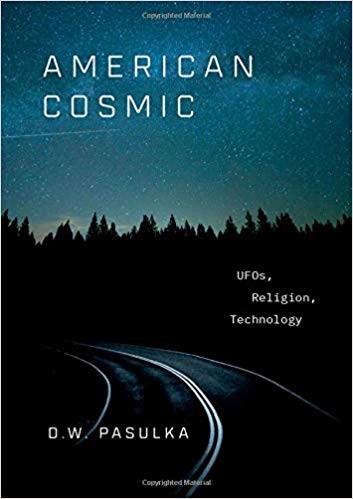
As an Amazon Associate, OverClassified may earn from qualifying purchases made through this link, at no extra cost to you.
Why This Is Essential Reading
American Cosmic earns its place on this list for a reason few other titles here can claim: it is the work of a tenured, peer-reviewed religious-studies scholar with no prior ufological affiliation, applying a genuinely independent academic discipline — the study of how belief and religion form — to a community of credentialed scientists and engineers who were, by her own account, already treating UAP sites and materials as sacred before she ever arrived to study them. Diana Walsh Pasulka's deliberate refusal to adjudicate the phenomenon's physical reality is not evasion; it is the book's methodological backbone, letting her document the sociological fact of scientist-believers and their secrecy without either endorsing or debunking their underlying claims. That discipline occasionally slips — reviewers from Daily Grail's Greg Taylor to academic critics have flagged moments where Pasulka's own narrative voice seems to cross from participant-observer into participant — but the slippage itself is instructive: watching a trained scholar's own objectivity come under pressure from the same media-and-relic dynamics she set out to analyze is, in its own way, the book's most convincing piece of evidence for its central thesis. Read alongside Jung's Flying Saucers, this book brings that older archetypal argument current: not a projection from the collective unconscious onto empty sky, but a fully modern religion assembling itself in real time, with its prophets working day jobs in Silicon Valley and its relics kept in unmarked government-adjacent storage.
Related Cases & Theories
Essential Viewing
American Cosmic: UFOs, Religion, Technology. A conversation with Diana Walsh Pasulka
Harvard Divinity School Center for the Study of World Religions — A recorded conversation hosted by Harvard Divinity School's Center for the Study of World Religions, with Pasulka discussing the book's religious-studies framework directly with an academic audience.
Diana Walsh Pasulka, Ph.D. | American Cosmic: UFOs, Religion, Technology | Special Edition #14
Speaking of Jung — An extended interview with Pasulka discussing the book's archetypal and depth-psychological dimensions, connecting its religious-studies framework back to the Jungian tradition this site's own Essential Reading catalogue also covers.
Sources Cited
- "Diana Walsh Pasulka." Wikipedia (biography: education, UNCW career, chair of Philosophy and Religion 2015–2019, publications, The Conjuring consulting). en.wikipedia.org
- "Diana Pasulka." University of North Carolina Wilmington faculty profile (current academic position and department). uncw.edu
- "American Cosmic: UFOs, Religion, Technology." Oxford University Press (official publisher page: 288 pp., February 2019, ISBN 9780190692889). global.oup.com
- "American Cosmic: UFOs, Religion, Technology." Amazon.com product listing for ISBN 019069288X / 9780190692889 (hardcover edition cited on this site). amazon.com
- "American Cosmic: UFOs, Religion, Technology by D.W. Pasulka." Goodreads (reader ratings and edition record). goodreads.com
- Gulyas, Aaron John. Review of American Cosmic: UFOs, Religion, Technology. Nova Religio: The Journal of Alternative and Emergent Religions (academic review recommending the book to religious-studies readers). researchgate.net
- Zeller, Benjamin E. "American Cosmic: UFOs, Religion, Technology. By D. W. Pasulka; Intimate Alien: The Hidden Story of the UFO. By David J. Halperin." Journal of the American Academy of Religion, Vol. 89, No. 1, March 2021, p. 368. academic.oup.com
- Taylor, Greg. "Review: American Cosmic, by Diana Walsh Pasulka." The Daily Grail, 2019 (ufology-adjacent critical review, "anthropologist gone native" assessment). dailygrail.com
- Rich, Nathaniel. "Ufologists, Unite!" The New York Review of Books, April 18, 2024 (2024 mainstream literary reassessment of the book amid ongoing UAP disclosure reporting). nybooks.com
- "AMERICAN COSMIC." Kirkus Reviews (contemporary trade review). kirkusreviews.com
- "Standing at Ground Zero for UFO Believers." Literary Hub (excerpt from American Cosmic describing the New Mexico crash-site visit with "Tyler" and "James"). lithub.com
- "Tim Taylor: UAP Shadow Network." Stranger Than Fiction (reporting on the public-record basis for identifying "Tyler D." as Timothy E. Taylor, including the 2017 Vatican Observatory annual report). strangerthanfiction.org
- This site's own key-figures entry: Diana Pasulka, for her full biography and UAP-research connections.
- This site's own key-figures entry: Tim Taylor "The Dragon", for the public-record basis of his identification as this book's "Tyler D."
- This site's own case file: Chris Bledsoe and the "UFO of God" Contact Events, for Tim Taylor's post-publication contact with Bledsoe.
- This site's own case file: The Temple Mount UFO Sighting, for this site's own direct application of Pasulka's religious/secular framework.
- This site's own resources library: Full Reading List, where this 2019 hardcover edition (ISBN 019069288X) is cited across multiple case-file pages.
Have corrections, additional research, or peer-reviewed sources? Help improve this entry.
Suggest an Edit