
They Are Already Here
UFO Culture and Why We See Saucers
Core Thesis
They Are Already Here: UFO Culture and Why We See Saucers is science journalist Sarah Scoles's on-the-ground survey of the modern American UFO research and believer community — not an argument for or against the extraterrestrial hypothesis, but a journalist's attempt to explain why so many people, credentialed scientists very much included, spend their lives chasing an answer official channels have never definitively closed. Prompted by the December 2017 New York Times story on the Pentagon's Advanced Aerospace Threat Identification Program, which she initially covered for Wired as a skeptical outsider, Scoles spent roughly eighteen months following UFO blogs and forums, attending paid conferences and MUFON meetings, and traveling to the movement's most mythologized ground — Roswell, the Extraterrestrial Highway outside Area 51, the UFO Watchtower in Colorado's San Luis Valley, and a former paranormal research ranch in Utah — meeting, in her own framing, everyone from the field's "bigwigs" and "scrappy upstarts" to its "field investigators" and its "unhinged kooks." A lapsed Mormon herself, she repeatedly draws on her own departure from organized religion to read the UFO community's structure — leaders, schisms, sacred sites, contested texts — as a genuine, still-forming American belief system, producing a book reviewers have called the work of an "open-minded skeptic" who treats her subjects as full people rather than a punchline, without ever pretending their central extraordinary claim has been proven.
About the Author
Sarah Scoles grew up near Kennedy Space Center in Florida and earned a B.A. in astrophysics from Agnes Scott College before completing an MFA in fiction writing at Cornell University in 2010; Cornell later awarded her its 2018 Freund Prize in Creative Writing for alumni. Before moving into science journalism full time, she worked as an associate editor at Astronomy magazine and as a public education officer at the National Radio Astronomy Observatory in Green Bank, West Virginia — the site of Frank Drake's 1960 Project Ozma, the first modern SETI search, and an early, direct exposure to the scientific search for extraterrestrial intelligence that shaped both this book and her first, 2017's Making Contact.
Scoles has written for Wired, Popular Science, The New York Times, The Washington Post, Scientific American, Vice, The Verge, Slate, Smithsonian, Discover, New Scientist, Aeon, Air & Space, and Outside, among others, and has held contributing-editor or senior-contributor roles at Popular Science, Scientific American, and Undark. Her journalism has won the American Astronomical Society Solar Physics Division's Popular Media Award (2019 and 2020), the American Geophysical Union's David Perlman Award for Excellence in Science Writing (2021), and the National Academies' Eric and Wendy Schmidt Award (2024). She is based in rural Colorado, where she also volunteers with the Custer County Search and Rescue team.
They Are Already Here is Scoles's second book, following Making Contact: Jill Tarter and the Search for Extraterrestrial Intelligence (Pegasus Books, 2017), a biography of the SETI Institute co-founder who was the real-life model for Jodie Foster's character in Contact. She followed it with Countdown: The Blinding Future of Nuclear Weapons (Bold Type Books, 2024), extending the same deeply reported, subject-embedded approach to nuclear-weapons modernization. Unlike Diana Walsh Pasulka, whose American Cosmic brings a tenured religious-studies scholar's academic apparatus to a related subject, Scoles's authority here is journalistic rather than academic: a working science writer with a physics background and no prior ufological affiliation, assigned to cover a beat the U.S. government itself had just made newsworthy again.
Scoles has been candid, including in her own first-person account for the National Association of Science Writers, about how personally unresolved her position remained throughout the reporting: she began the project suspicious of the 2017 Pentagon story's own "holes" and "conflicts of interest," but found many of the UFO researchers she met to be "impressive investigators" whose curiosity she recognized in herself — a tension she has said pushed the book away from a simple believers-versus-skeptics framing and toward the harder sociological question of why the belief persists at all, regardless of any single case's evidentiary strength.
Historical Context & Origins
Scoles began reporting the book in the immediate aftermath of the moment that reopened UFOs as a mainstream news subject: the December 16, 2017 New York Times story, by Leslie Kean, Ralph Blumenthal, and Helene Cooper, revealing the Pentagon's Advanced Aerospace Threat Identification Program and releasing the Navy's "FLIR1" cockpit video — the same program this site's own Advanced Aerospace Threat Identification Program file documents in full. The same news cycle introduced Luis Elizondo and Tom DeLonge's To The Stars Academy of Arts & Science, whose blend of entertainment financing and aerospace-veteran credibility drew an unusual wave of credentialed scientists and former officials into public UFO discourse for the first time since the Condon Report effectively closed the subject down in the late 1960s.
That reopening produced a distinctly two-track UFO literature by the time Scoles's book reached shelves in March 2020: journalistic and disclosure-focused writing chasing the Pentagon program itself, and a smaller, more academic current — including Diana Walsh Pasulka's American Cosmic, published the previous year — treating UFO belief as a cultural and religious phenomenon worth studying on its own terms rather than a mystery to be solved. Scoles's contribution sat closer to the second track than the first: rather than chasing new government disclosures, she set out, as she has said in interviews, to avoid writing "the definitive UFO tome" covering every case, and instead sharpened her focus onto a smaller set of people and places that could say something "useful and true" about the community as a whole.
She spent roughly eighteen months on the reporting, following UFO blogs and watching researchers interact online before setting out on the road: to community groups and paid conferences including the International UFO Congress and regional MUFON meetings, to Roswell and the Extraterrestrial Highway outside Area 51, to the UFO Watchtower in Colorado's San Luis Valley, to a former paranormal-research ranch in Utah, and into the Pentagon's own hallways. Each chapter is organized around one primary subject whose personal story carries a broader theme — politics, memory, checkbooks, celebrity, or trust in scientific method — a structural choice she has described explicitly as a trade-off: comprehensiveness for depth.
The book's title and cover line — "UFO Culture and Why We See Saucers" — signal its governing question directly: not what is actually in the sky, but what explains the durability and internal diversity of the community that has spent eight decades interpreting it, a question with a considerably longer scholarly pedigree running back through C.G. Jung's 1958 Flying Saucers that Scoles's fieldwork-based, present-tense reporting updates rather than repeats.
Core Arguments & Key Concepts
Scoles's organizing move is to treat the UFO research community not as a single monolithic subculture but as a genuine spectrum, ranging from credentialed "bigwigs" running large civilian organizations, through "scrappy upstarts" building smaller investigative outfits, to "field investigators" chasing individual sighting reports, "rational people" who arrived at belief through ordinary personal experience, and, at the far edge, "the unhinged kooks" whose claims strain even other believers' credulity. That taxonomy is the book's central structural argument: lumping the entire field together, as casual media coverage typically does, obscures both the real internal disagreements inside ufology and the genuinely different reasons different people end up there.
A second, more theoretically pointed argument — developed at length in reviewers' own commentary as much as in the text itself — treats UFO belief as functioning like an emergent American religion: a movement with its own leaders and schisms, its own contested and sacred sites, its own disputed texts and insider knowledge, and its own believers willing to organize significant parts of their lives and social identities around an unresolved question. Scoles draws this comparison partly from her own biography as a lapsed Mormon, using her firsthand experience of leaving one American-born faith to read a newer one still assembling itself in real time, in MUFON conference rooms and roadside UFO Watchtowers rather than temples.
Throughout, Scoles pays close attention to the cognitive machinery of belief itself rather than only its content: she discusses confirmation bias, in which both committed believers and committed skeptics tend to find evidence supporting what they already think, and what she and interviewers discussing the book have called authority bias — the uneven credibility people extend to government officials, scientists, or fellow believers depending on how those authorities align with a person's existing convictions. She also traces a recurring, concrete pattern behind many "secret base" and "cover-up" narratives: that a striking number of American aerospace, intelligence, and scientific facilities began as military installations or received military funding, a fact easily discoverable online and just as easily read as evidence of ongoing hidden work, whether or not any actually exists.
Scoles is explicit that the book does not attempt to adjudicate any specific case's underlying reality, and by her own account in Steven Gimbel's Washington Post review, she "does not get into Area 51 or provide insider information" of the kind disclosure-focused books chase; her stated goal instead is "understanding the beliefs and the believers" as a sociological and psychological subject in their own right, whatever the eventual explanation for any individual sighting turns out to be. That deliberately bounded scope — her own description of trading an unattainable "definitive UFO tome" for a narrower book that says something "useful and true" — is the book's clearest methodological throughline.
Key Cases & Evidence Discussed
The book's reporting begins directly from the December 2017 New York Times revelation of the Pentagon's Advanced Aerospace Threat Identification Program (Case File #243) and the Navy "FLIR1" video it released, and Scoles extends that same modern-encounter material to the USS Nimitz “Tic Tac” Encounter (Case File #003, 2004) and the "Gimbal" and "GoFast" videos (2015) — the same cluster of Navy pilot cases that reopened UFOs as mainstream news and drew the credentialed scientists and former officials her book profiles into public view for the first time in decades.
The Roswell Incident (Case File #001, 1947) and the adjoining Extraterrestrial Highway outside Area 51 supply the book's clearest pilgrimage-site material: Scoles visits both as living tourist economies built on a decades-old mythology, using them to demonstrate — much as Diana Walsh Pasulka's American Cosmic argues about its own New Mexico crash site — that a place's power to organize belief does not depend on independently verified physical evidence.
Skinwalker Ranch (Case File #296, 1994–present), the "former paranormal research ranch in Utah" Scoles's own publisher materials describe her visiting, connects this book to the same private, Robert Bigelow-funded research current that American Cosmic's "Invisible College" subjects moved through — further evidence of how small and overlapping the credentialed edge of this field actually is.
David Grusch's 2023 whistleblower testimony (Case File #019) arrived three years after this book's publication but extends its central sociological observation from the opposite direction: Grusch's sworn description of a compartmented, secrecy-bound insider network describing alleged crash-retrieval programs is precisely the kind of institutional posture — genuine conviction paired with career-protecting caution — Scoles had already documented among private researchers, conference organizers, and MUFON investigators three years earlier.
Critical Reception & Controversies
Trade press reaction at publication was strongly favorable. Publishers Weekly, reviewing the book on December 5, 2019 ahead of its March 2020 release, called it a "nonjudgmental, level-headed look at a long-lasting societal phenomenon" and singled out Scoles's own posture directly: "Scoles remains an open-minded skeptic, and it's this objectivity that makes her buoyant survey so delightful to read." Booklist's John Keough called it "a fascinating journey," writing that "the depth of her research is impressive and her curiosity is infectious," while noting, in a milder critical aside picked up by the review aggregator Book Marks, that Scoles at points spends more time clarifying her own position than the material strictly requires.
The most substantial and most favorable mainstream review came from Gettysburg College philosophy professor Steven Gimbel, writing in The Washington Post on May 31, 2020. Gimbel read the book explicitly through the religion lens Scoles herself invites, describing UFO culture as "a new religion" complete with "leaders, schisms and followers" and its own "holy sites, sacred texts, and theological debates," and praised Scoles for marrying "a thoughtful objectivity with a warm subjectivity" that treats the people she meets "as rounded individuals full of hope and pain, not as a collection of rubes and charlatans to be mocked." Gimbel also named the book's clearest limitation directly: Scoles "does not get into Area 51 or provide insider information," a deliberate choice he frames as a strength of focus rather than a missed opportunity, since her stated goal is "understanding the beliefs and the believers," not adjudicating any specific claim.
Coverage beyond the book-review pages reinforced the same reading. Quartz's roundup judged that, unlike "many authors in this realm" who "rely on sensationalism and avoid fact-checking," Scoles "has written the definitive investigation into the origins of UFO culture and its persistence," while Outside's Erin Berger framed its appeal as extending past dedicated UFO enthusiasts to nature lovers and casual sky-watchers drawn to the same basic desire the book identifies: to be known by, and connected to, something larger.
What the book does not claim is worth stating as plainly as what it does: unlike this site's own American Cosmic entry, whose author was granted direct access to a specific pseudonymous aerospace-engineer source and a purported crash site, Scoles's reporting rests on public conferences, on-the-record interviews, and open-source community material rather than privileged insider access — a narrower evidentiary base that is also, as her own reviewers noted, exactly what keeps the book's claims within what she can actually verify.
Influence & Legacy
They Are Already Here arrived as part of a broader wave of serious, non-dismissive mainstream journalistic and academic engagement with ufology that followed the 2017 AATIP disclosures — a wave this site's own American Cosmic and UFO: The Inside Story entries also document from the religious-studies and national-security-history angles respectively, with Scoles's book supplying the on-the-ground, subculture-level reporting the other two approach from further outside.
That overlap became direct and reciprocal in November 2023, when Scoles herself reviewed Garrett M. Graff's UFO: The Inside Story of the US Government's Search for Alien Life Here—and Out There for The Washington Post — a review this site's own essential-reading entry for that book quotes directly, in which Scoles credited Graff's "ample detail of the players and programs and primary source material" while flagging the same structural seam other reviewers noted, that his government-secrecy and search-for-alien-life narratives "simply sit side by side, separate hemispheres that Graff can't quite weld into one orb." The exchange places Scoles on both sides of this site's Essential Reading catalogue: as a profiled author and, three years later, as a working critic of the next major book in the same genre.
On this site specifically, the book already functions as working infrastructure: it is cited on the resources library under this exact paperback ISBN in connection with the AARO Reaper Drone Metallic Sphere Video and Aguadilla CBP FLIR Encounter case files, and appears in source lists on the AARO Historical Record Report and NASA UAP Independent Study Team Report pages.
Scoles's own subsequent career has extended the same embedded-reporting method to other high-stakes, secrecy-adjacent subjects rather than moving fully on from it: Countdown: The Blinding Future of Nuclear Weapons (2024) applies a comparable mix of institutional access and skeptical curiosity to nuclear-modernization policy, keeping the reporting approach she developed following MUFON investigators and conference organizers a continuing feature of her journalism rather than a one-book departure.
The Book
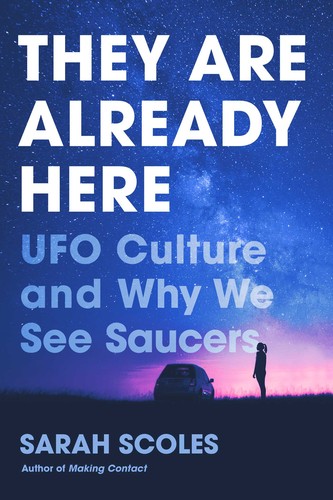
As an Amazon Associate, OverClassified may earn from qualifying purchases made through this link, at no extra cost to you.
Why This Is Essential Reading
They Are Already Here earns its place on this list as the fullest working-journalist's ethnography of the post-2017 American UFO community as it actually is, rather than as either its critics or its most devoted believers describe it. Sarah Scoles's deliberately bounded scope — eighteen months, a handful of representative subjects, no claim to adjudicate any single case — is not a limitation so much as the book's whole method: by refusing to chase insider access or new disclosures, she produces something disclosure-focused books like this site's own UFO: The Inside Story cannot, a genuinely close, respectful, and still clear-eyed portrait of the people who make the field what it is. Read alongside American Cosmic, whose religious-studies scholar approaches a related question from inside a small circle of credentialed insiders, this book completes a useful pairing: one book study a specific, secretive scientific network from within, and this one surveys the far larger, more public, and more varied community around it — and Scoles's own later turn to reviewing this site's UFO: The Inside Story entry is a fitting coda, an author who spent a book listening to believers going on, three years later, to hold the field's most credentialed new history to the same evidentiary standard.
Related Cases & Theories
Essential Viewing
Sarah Scoles, Author of "They Are Already Here: UFO Culture and Why We See Saucers" (043)
Dr Brian Keating (Into the Impossible) — An extended interview in which Scoles discusses confirmation bias, authority bias, and how a science-journalism assignment on the 2017 AATIP story turned into eighteen months embedded in the UFO research community. Verified via YouTube oEmbed before inclusion.
Somewhere in the Skies: They Are Already Here
Somewhere in the Skies w/ Ryan Sprague — A conversation with Scoles on a UFO-community-focused podcast, discussing her reporting process and her experience meeting the field's researchers, investigators, and believers directly. Verified via YouTube oEmbed before inclusion.
Sources Cited
- Scoles, Sarah. They Are Already Here: UFO Culture and Why We See Saucers. Pegasus Books, 2021 pbk. (ISBN 9781643137650 / 1643137654, matching this site's own resources library citation under this exact edition; originally published in hardcover by Pegasus Books, March 2020, ISBN 9781643133058). amazon.com
- "They Are Already Here." Publishers Weekly, December 5, 2019 ("nonjudgmental, level-headed look... Scoles remains an open-minded skeptic"). publishersweekly.com
- Gimbel, Steven. "Identifying meaning in enduring UFO culture." The Washington Post, May 31, 2020, syndicated via Arkansas Democrat-Gazette ("a new religion... leaders, schisms and followers"; "does not get into Area 51 or provide insider information"). arkansasonline.com
- "They Are Already Here: UFO Culture and Why We See Saucers by Sarah Scoles." Book Marks (aggregated review excerpts from The Washington Post, Booklist, and Outside). bookmarks.reviews
- "Space Business: Ufology." Quartz ("Scoles has written the definitive investigation into the origins of UFO culture and its persistence"). qz.com
- "They Are Already Here." SarahScoles.com (author's own book page: description, praise quotes, publication details, best-of-2020 list appearances). sarahscoles.com
- "About Me." SarahScoles.com (author biography: current roles, awards, Custer County Search and Rescue). sarahscoles.com
- Scoles, Sarah. "Sarah Scoles: They Are Already Here." ScienceWriters / National Association of Science Writers, "Advance Copy" column (first-person account of the book's reporting process and origin in the December 2017 AATIP story). nasw.org
- "'They Are Already Here' author explains the spread of UFO belief: Q&A." Space.com (interview on methodology and scope). space.com
- "They Are Already Here." Simon & Schuster / Pegasus Books official publisher page (publication details, hardcover ISBN 9781643133058). simonandschuster.com
- "They Are Already Here: UFO Culture and Why We See Saucers, Sarah Scoles (MFA '10)." Cornell University, Department of Literatures in English (alumni author profile, MFA 2010, paperback June 2021 publication note). english.cornell.edu
- Keating, Brian. "Sarah Scoles, Author of 'They Are Already Here: UFO Culture and Why We See Saucers' (043)." Into the Impossible podcast, YouTube (interview on confirmation bias, authority bias, and the book's approach). youtube.com
- Shermer, Michael. "Michael Shermer with Sarah Scoles — They Are Already Here: UFO Culture and Why We See Saucers." The Michael Shermer Show, Skeptic.com (interview covering AATIP, To The Stars Academy, and the Nimitz videos). skeptic.com
- This site's own essential-reading entry: American Cosmic, for the closest thematic sibling among this site's other Essential Reading titles.
- This site's own essential-reading entry: UFO: The Inside Story, which quotes Scoles's own November 2023 Washington Post review of that book directly.
- This site's own case file: Advanced Aerospace Threat Identification Program (Case File #243), the story that prompted this book's reporting.
- This site's own case file: David Grusch Whistleblower Testimony (Case File #019), a 2023 development extending this book's central sociological argument.
- This site's own key-figures entry: Sarah Scoles, for full biographical detail and further case connections beyond this book.
- This site's own resources library: Full Reading List, where this exact 2021 paperback edition (ISBN 1643137654) is cited in connection with the AARO Reaper Drone and Aguadilla CBP FLIR case files.
Have corrections, additional research, or peer-reviewed sources? Help improve this entry.
Suggest an Edit