
Skinwalker Ranch
Between 1994 and 1996, Terry and Gwen Sherman reported cattle mutilations, UFO sightings, and encounters with an unusually large, apparently bulletproof wolf-like animal on their 512-acre ranch in Utah's Uintah Basin, before selling the property and leaving. What happened next is a matter of public record rather than folklore: aerospace entrepreneur Robert Bigelow bought the ranch in 1996 and founded a private research institute to study it for two decades; from 2008 to 2010, a Bigelow-affiliated contractor ran a $22 million Defense Intelligence Agency contract with the ranch as a field site; and since 2016, new owner Brandon Fugal has continued instrumented investigation, documented in an ongoing History Channel series. This file separates what is independently documented — the ownership history, the government contract, the instrumentation — from what rests solely on the testimony of ranch residents and investigators.
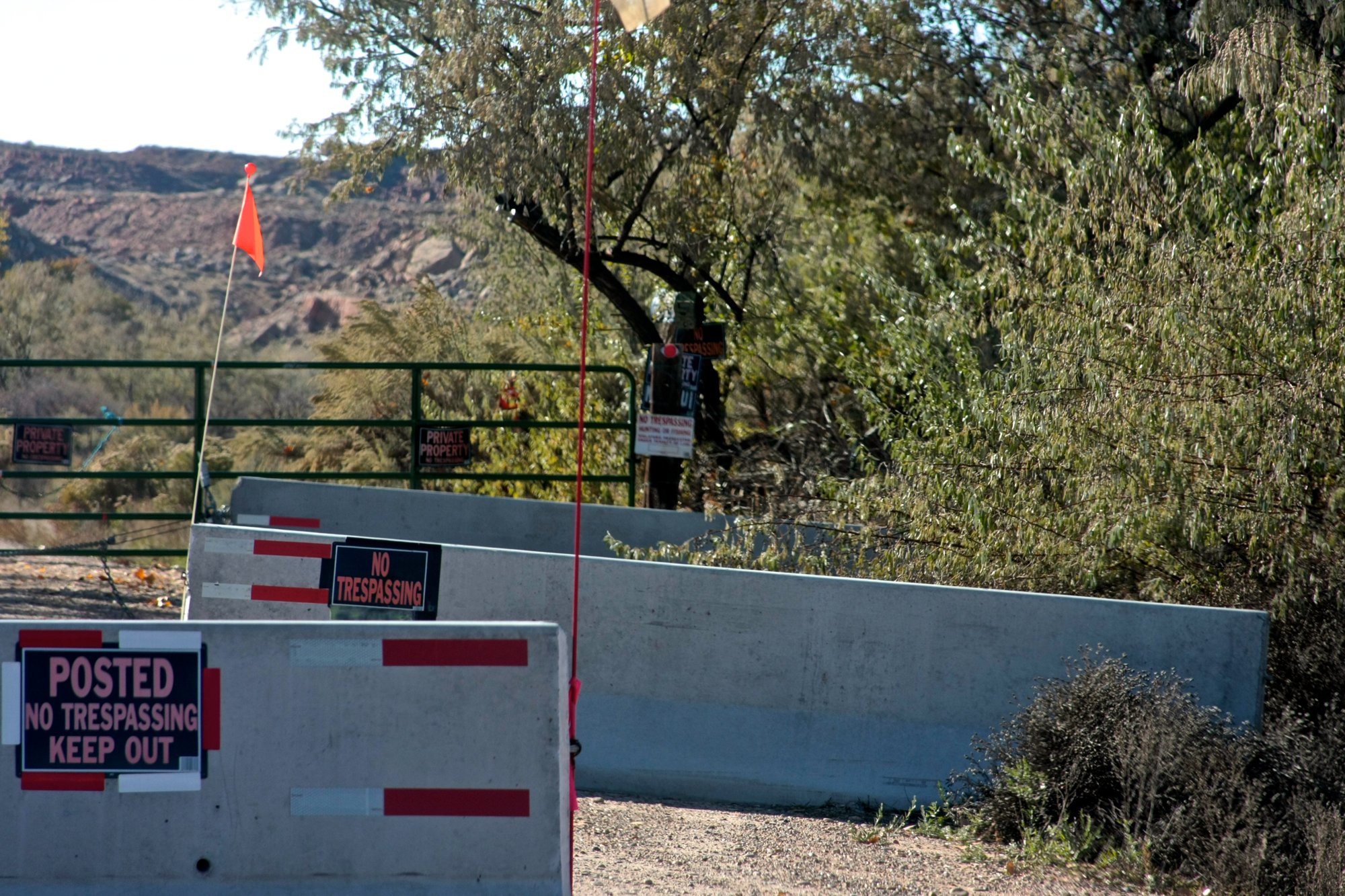
Pictured: the gated entrance to Skinwalker Ranch (also known as Sherman Ranch), Uintah Basin, Utah, photographed in October 2013. Wikimedia Commons, CC BY-SA 2.0.
Theoretical Alignment
Skinwalker Ranch is unusual in this catalogue for how explicitly its own long-term investigators — first NIDS, later BAASS, now Fugal's team — have themselves entertained interdimensional and consciousness-linked explanations alongside conventional extraterrestrial ones, rather than treating ETH as the only serious anomalous hypothesis. Physicists associated with the ranch across multiple eras, including Hal Puthoff and Eric Davis, have backgrounds in exactly the kind of consciousness- and physics-adjacent research (remote viewing, zero-point energy) that inclines toward interdimensional or trickster-style framings rather than a strictly nuts-and-bolts extraterrestrial-craft interpretation, and some commentary on the case explicitly situates it within Jacques Vallee's broader "trickster phenomenon" framework, in which anomalous encounters are treated as behaviorally consistent with historical folklore about fairies, djinn, or other non-human intelligences rather than physical spacecraft. This file weights Psycho-Social/Mundane highest because the great majority of the ranch's specific claims rest on the testimony of a small, financially and reputationally invested group of long-term residents and researchers, operating in a genre (paranormal-investigation television and self-published field reports) with strong incentives toward dramatic interpretation, and because no independent, peer-reviewed scientific publication has yet confirmed any of the anomalous physical claims associated with the property.
Background
The ranch sits in the Uintah Basin of northeastern Utah, southeast of the small community of Ballard, on roughly 512 acres of high desert rangeland bordering the Uintah and Ouray Indian Reservation, home to the Ute Indian Tribe. The name "Skinwalker" refers to yee naaldlooshii, a malevolent shapeshifting witch figure in Navajo tradition — a name applied to the ranch not by any local tribe but by its new owner, Robert Bigelow, after he purchased it in 1996, and one that outside investigators and popular media have used ever since rather than a term the Ute or Navajo communities themselves would apply to this specific parcel. Betsy Chapoose, the Ute Indian Tribe's Cultural Rights and Protection director, told VICE in a 2020 interview that she had never heard any story of a Navajo curse placed on the land specifically, adding: "It's true that the Ute and the Navajo have had a strained relationship over land ownership, but I've never heard any stories about a curse." Chapoose's comment does not resolve whether some form of local folklore about the area predates the Shermans; it does establish that the specific "cursed ranch" narrative now associated with the property is not one Ute tribal leadership recognizes as an inherited tradition of their own.
The 512-acre parcel had a long, and by most published accounts uneventful, ownership history before the Shermans. Kenneth and Edith Myers bought the property in 1934 and worked it as a cattle ranch for roughly sixty years, into the early 1990s, without any public report of anomalous activity surfacing during their tenure; several later accounts, including the Shermans' own, note this contrast explicitly, while allowing that rural ranching families of that era had little occasion or media access to publicize strange occurrences even if something had happened. Independently of the ranch itself, retired Roosevelt, Utah science teacher Joseph "Junior" Hicks had already spent decades, beginning in the early 1950s, investigating more than 400 reported UFO sightings across the wider Uintah Basin, and had specifically noted a correlation between UFO reports and livestock mutilations in the area. Hicks's data became the basis for The Utah UFO Display: A Scientist's Report, a 1974 book by Utah State University plant physiologist Frank B. Salisbury that remains the earliest book-length, credentialed-scientist treatment of the region's sighting reports — establishing that claims of anomalous activity in the wider Uintah Basin predate the ranch's own modern fame by more than four decades, even though Salisbury's book itself makes no mention of the Myers ranch specifically.
Terry and Gwen Sherman purchased the 512-acre ranch in 1994 and moved their family onto the property. Over the following roughly eighteen months, the Shermans reported a wide range of phenomena: unidentified lights and disc-shaped objects in the sky, crop-circle-like formations, and the loss of approximately fourteen head of cattle to what Terry Sherman described as unusually precise, bloodless mutilations — in one case a cow found dead with, in his account, "a peculiar hole in the center of its left eyeball but otherwise untouched with no trace of blood." The family also reported encountering an unusually large wolf-like animal that, according to their account, was unaffected by gunfire. The Shermans first went public with their experiences through Las Vegas investigative reporter George Knapp, whose June 1996 articles in the Las Vegas Mercury were the first outside media coverage of the ranch's modern reputation. When Colm Kelleher and Knapp later wrote the family's story up at book length, they initially referred to Terry and Gwen under the pseudonym "the Gormans" to protect their privacy; the Sherman name had already become publicly attached to the property by the time Hunt for the Skinwalker was published in 2005, but the "Gorman" pseudonym persisted in some early secondary coverage and is occasionally still encountered in older articles about the case.
Complete Timeline
| Date | Event |
|---|---|
| 1934 | Kenneth and Edith Myers purchase the 512-acre property and ranch it for roughly six decades with no publicly documented reports of anomalous activity. |
| Early 1950s– | Retired teacher Joseph "Junior" Hicks begins investigating UFO reports across the wider Uintah Basin, eventually cataloguing more than 400 sightings. |
| 1974 | Utah State University plant physiologist Frank B. Salisbury publishes The Utah UFO Display: A Scientist's Report, based substantially on Hicks's Uintah Basin sighting data. |
| 1994 | Terry and Gwen Sherman purchase the 512-acre ranch and move their family onto the property. |
| 1994–1996 | The Shermans report UFO sightings, crop-circle-like formations, and the loss of roughly 14 cattle to unusual, bloodless mutilations, along with an encounter with a large, apparently bulletproof wolf-like animal. |
| 1995 | Robert Bigelow founds the National Institute for Discovery Science (NIDS) in Las Vegas as a general-purpose anomaly research organization, a year before he acquires the ranch itself. |
| June 1996 | George Knapp publishes the first outside media coverage of the Shermans' experiences in the Las Vegas Mercury. |
| 1996 | Aerospace entrepreneur Robert Bigelow purchases the ranch for approximately $200,000, naming it "Skinwalker Ranch" and assigning NIDS to study it. |
| 1996–2004 | Biochemist Colm Kelleher leads NIDS's on-site investigation, deploying cameras, sensors, and a rotating team of scientists and security personnel. |
| March 1997 | NIDS's field team begins regular on-site monitoring; on March 10, an 84-pound calf is found with its body cavity emptied and no blood at the scene, one of the investigation's most closely documented individual incidents. |
| Dec. 6, 2005 | Kelleher and Knapp publish Hunt for the Skinwalker, the first book-length account of the NIDS investigation. |
| 2004 | NIDS winds down its active operations and formally disbands in October. |
| 2007 | DIA officer James Lacatski visits the ranch and, together with Senator Harry Reid, Ted Stevens, and Daniel Inouye, moves to fund a new Pentagon research effort. |
| 2008 | The Defense Intelligence Agency awards a roughly $22 million contract for the Advanced Aerospace Weapon System Applications Program (AAWSAP) to Bigelow Aerospace Advanced Space Studies (BAASS); Skinwalker Ranch becomes one of the program's field sites. |
| 2010 | AAWSAP funding ends; a smaller successor effort, the Advanced Aerospace Threat Identification Program (AATIP), continues within the Pentagon on a reduced scale. |
| 2016 | Bigelow sells the ranch to Utah real estate investor Brandon Fugal's Adamantium Real Estate LLC for a reported $4.5 million; Fugal keeps his identity as buyer confidential, requiring non-disclosure agreements from those aware of the deal. |
| Dec. 2017 | The New York Times and companion reporting publicly reveal the existence of AATIP and its predecessor AAWSAP for the first time, drawing renewed attention to the ranch's role in both programs. |
| Nov. 2020 | The History Channel premieres The Secret of Skinwalker Ranch, simultaneously revealing Fugal's previously secret 2016 purchase and documenting his ongoing instrumented investigation of the property. |
| June 2023 | Spinoff series Beyond Skinwalker Ranch premieres, investigating other reported high-strangeness sites; it is cancelled after three seasons. |
| 2020–Present | Multiple seasons of The Secret of Skinwalker Ranch air, presenting ongoing camera, radiation, electromagnetic, drone, LIDAR, and ground-penetrating radar surveys of the property; an eighth season has been confirmed by owner Brandon Fugal. |
The Sherman Family's Reports (1994–1996)
The Shermans' own account, as later related to Kelleher, Knapp, and other investigators, describes a rapid escalation of unusual activity after they moved onto the property in 1994: unidentified lights maneuvering over the ranch at night, disc-shaped objects observed at close range, and repeated cattle losses under circumstances Terry Sherman described as inconsistent with predation — animals found with precise, bloodless wounds and no signs of struggle. According to the family's account, the strangeness began almost immediately: on the day they moved onto the property, Terry Sherman and his father reportedly fired multiple rounds from a .357 magnum at a large, wolf-like animal attacking a calf in a holding pen at close range, with no apparent effect on the animal, which left tracks that the family said simply stopped after roughly a mile. Gwen Sherman separately reported encountering, from her car a few weeks later, an animal she described as tall enough for its back to be level with the vehicle's windows, accompanied by a smaller, unidentifiable dog-like creature.
Over the following two years, the family's reported catalogue of incidents grew to include sightings of large, unusually colored birds; tall, dark humanoid figures at the property's edges; and, in one specific account, a stocky, reddish-furred, hyena-like animal that Terry Sherman said he watched attack one of the family's horses before it seemingly vanished, leaving the horse with unexplained claw marks. The family also described poltergeist-like disturbances inside their house — objects moving or disappearing and reappearing elsewhere — and, on occasion, disembodied voices they could not identify. In one frequently repeated account from May 1996, Terry Sherman said he watched a blue orb of light drift across a nearby field at night; the family's three dogs gave chase into nearby brush, after which Sherman reported hearing several sharp yelps before the dogs went silent, and were never found. Regarding the cattle losses, the family's account eventually totaled seven animals across the roughly eighteen-month period: several disappeared outright, in one case with hoofprints that the family said ended abruptly in an open field, and three others were found dead with wounds Terry Sherman and other family members described as surgically precise — including, in one instance, a large, cored opening through the animal's rectum extending several inches into the body cavity, with no blood at the scene and no odor consistent with normal decomposition.
The family also reported the wolf encounter that has since become one of the case's most-repeated details: an animal significantly larger than a typical wolf, which Terry Sherman said he shot at close range without visible effect. After roughly eighteen months, citing the cumulative toll of the experiences on the family, the Shermans sold the ranch and left the area. None of these specific claims — the mutilations, the wolf, the hyena-like creature, the individual light sightings — were independently investigated by any outside agency at the time they were reported; the entire record of this period rests on the Sherman family's own testimony, later collected and published by Kelleher and Knapp, and it is worth being explicit that no veterinarian, wildlife biologist, or law enforcement officer examined any of the reported carcasses, tracks, or animal remains contemporaneously. Skeptic Robert Sheaffer, writing about the broader NIDS and BAASS record years later, described a recurring feature common to this kind of testimony across paranormal research generally: what he termed a "shyness effect," under which reported phenomena — UFOs, cryptids, poltergeist activity — "always make themselves sufficiently scarce to prevent investigators from nailing down any solid evidence of their existence," a dynamic he argued fits the ranch's evidentiary record closely.
NIDS: The Bigelow-Funded Scientific Study (1996–2004)
Robert Bigelow, a Las Vegas hotel and real estate entrepreneur who founded Bigelow Aerospace in 1999, founded the National Institute for Discovery Science (NIDS) in 1995 as a privately funded, Las Vegas-based research organization with a mandate considerably broader than the ranch alone: its stated portfolio, from its early years, covered UFO and UAP reports, livestock mutilations nationally, crop circles, alleged abduction claims, and near-death experiences, staffed at its peak by roughly fifteen scientists and consultants holding doctorates across relevant disciplines. When Bigelow purchased the 512-acre property from the Shermans in 1996 for a reported $200,000, it quickly became NIDS's flagship and most resource-intensive single project. Biochemist Colm Kelleher, a Dublin-trained research immunologist who also held a position at the National Jewish Medical and Research Center in Denver, led the on-site scientific effort as NIDS's deputy administrator, personally spending, by his own account, hundreds of days and nights on the property over the following years, working alongside a rotating team of scientists, former military and law enforcement personnel, and security staff. Physicists Hal Puthoff and Eric Davis, both later associated with EarthTech International and, still later, with AAWSAP and AATIP, were among the outside consultants who reviewed and analyzed material from the investigation during this period, and retired Army Colonel John B. Alexander, a veteran of the military's own earlier forays into paranormal and remote-viewing research, was also involved with NIDS.
NIDS's dedicated field team began sustained on-site monitoring in March 1997, deploying cameras, motion sensors, and other instrumentation across the ranch in an attempt to systematically document whatever was producing the reported phenomena. One of the investigation's most specifically documented individual incidents dates to March 10, 1997, when an 84-pound calf was found dead on the property with its body cavity emptied and no blood present at the scene — a case NIDS researchers examined directly, rather than relying on secondhand testimony, though even this incident was not independently examined by an outside veterinary pathologist. By Kelleher's own later account, given to the Deseret News in 2006, the pace of reported anomalous activity on the ranch had noticeably decreased by around 2000, and gathering evidence "consistent with scientific publication" proved persistently difficult across the investigation's full run; Kelleher told the paper he remained convinced the study of the ranch's anomalies was "basic to the discovery process connected to science, because they ultimately open doors to advance mainstream knowledge," even as he acknowledged the team had not produced a peer-reviewed result. George Knapp was the only journalist NIDS permitted to observe and report on the team's work directly, a relationship that culminated in the December 2005 publication of Hunt for the Skinwalker, co-authored by Kelleher and Knapp, which remains the primary published account of this period. NIDS's active investigation wound down around 2004, and the organization was formally dissolved that October, though Bigelow retained ownership of the ranch itself.
NIDS's public-facing operations extended well beyond the ranch's own gate. By 1998, the organization was spending, according to Bigelow's own account to the Deseret News, "more than a million dollars a year" on its research activities, and it operated a toll-free public hotline through which any rancher elsewhere in the country reporting an unusual livestock death could request a free veterinary necropsy — NIDS's stated position being that "it will cost him nothing to try to find out what happened to his animal." That standing offer of independent veterinary examination for other ranchers' mutilation reports is a detail worth setting alongside the fact that no equivalent outside necropsy was ever performed on the Sherman family's own original cattle losses, which had already occurred and gone unexamined before NIDS existed to make the offer.
AAWSAP and BAASS: The Pentagon Connection (2008–2010)
The path to AAWSAP ran directly through the ranch. In 2007, James Lacatski, a Defense Intelligence Agency officer with a background assessing missile and directed-energy threats, visited Skinwalker Ranch and, according to his own later co-authored account in Skinwalkers at the Pentagon (2021), came away persuaded the subject warranted formal government study; separately reported detail indicates Lacatski also sent active-duty military personnel, including a sailor and two Marines, to the ranch to observe conditions there. Lacatski took the case to Nevada Senator Harry Reid, then Senate Majority Leader, who worked with Senators Ted Stevens (R-AK) and Daniel Inouye (D-HI) — both senior members of the Senate Appropriations Committee — to insert funding as a classified line item rather than through open floor debate. In 2008, the Defense Intelligence Agency awarded a contract worth approximately $22 million to Bigelow Aerospace Advanced Space Studies (BAASS), a subsidiary of Bigelow's aerospace company, to run the Advanced Aerospace Weapon System Applications Program (AAWSAP). AAWSAP's public-facing mandate covered a broad range of advanced-aerospace and anomalous-phenomena research — reporting on the program describes both theoretical papers on hypothetical future propulsion and threat technologies and active field investigation teams responding to specific incidents — and Skinwalker Ranch, still owned by BAASS's own parent company's founder, served as one of the program's field investigation sites, with BAASS personnel deploying scientists, engineers, and security teams there as part of the wider contract.
AAWSAP funding concluded in 2010; a smaller successor effort within the Pentagon, later reported publicly as the Advanced Aerospace Threat Identification Program (AATIP), continued on a reduced scale until 2012. The exact nature of Luis Elizondo's role in AATIP has itself become a separately documented controversy, distinct from the ranch's own evidentiary record: Elizondo has stated publicly that he managed AATIP's counterintelligence and security dimensions before assuming what he describes as its lead role, while the Pentagon's official public position, reiterated in Freedom of Information Act correspondence and press statements reported by outlets including The Black Vault, is that Elizondo "had no assigned responsibilities for AATIP" during his time in the Office of the Under Secretary of Defense for Intelligence. Elizondo has said his own work on the program after 2012, once formal AAWSAP funding lapsed, was conducted informally and that the documentary record supports a more central role than the Pentagon has acknowledged; the Department has not reversed its position. AATIP's existence, along with several associated video releases, became public on December 16, 2017, when the New York Times published "Glowing Auras and 'Black Money': The Pentagon's Mysterious U.F.O. Program," reported by Helene Cooper, Ralph Blumenthal, and Leslie Kean — the same reporting that first brought AAWSAP's Skinwalker Ranch connection to wide public attention and is widely credited with moving UAP research out of its longstanding cultural stigma and into mainstream American journalism and eventual congressional hearings. This file's AATIP entry covers that broader Pentagon program in full detail; this entry focuses specifically on the ranch's role as one of AAWSAP's contracted field sites.
The Fugal Era and Ongoing Investigation (2016–Present)
In 2016, Bigelow sold the ranch to Utah real estate investor Brandon Fugal's Adamantium Real Estate LLC for a reported $4.5 million, a figure that has never been officially confirmed since Fugal declined to disclose the purchase price publicly. Fugal kept his identity as the ranch's new owner secret for nearly four years, tightening on-site security and requiring anyone aware of the transaction to sign non-disclosure agreements, until his ownership was revealed alongside the 2020 premiere of the History Channel series built around his investigation. Fugal has described his own starting position as skeptical, telling Utah Business in 2020: "Even though I acquired the ranch as a healthy skeptic, fully expecting that there was a 95 percent chance that all of the reports of high strangeness and supernatural activity had a natural, prosaic explanation... I always hoped that we were not alone and that there truly is a greater plan for mankind." He has also characterized the purchase in more straightforwardly commercial terms, calling it "the most unusual real estate play that I've ever had involvement in," one that "ended up becoming a very intriguing science project as well."
Fugal has continued and expanded instrumented investigation of the property, work documented publicly since November 2020 through the History Channel series The Secret of Skinwalker Ranch, produced by Prometheus Entertainment and Letter 10 Productions (the studios behind The Curse of Oak Island), and its spinoff Beyond Skinwalker Ranch, which ran for three seasons beginning in June 2023 before cancellation. The on-camera investigation team has included aerospace engineer Dr. Travis Taylor, who separately held a classified role as chief scientist for the Pentagon's UAP Task Force before that position became public in 2021; principal investigator Erik Bard; ranch superintendent Tom Winterton; security chief Bryant "Dragon" Arnold; and scientist Jim Segala, several of whom carried over from the NIDS and BAASS era. The shows depict an ongoing, multi-season program of cameras, radiation detectors, electromagnetic-field measurement, drone surveys, small experimental rocket launches, LIDAR terrain scanning, and ground-penetrating radar deployed across the property. As of this writing, no findings from this ongoing investigation have been published in a peer-reviewed scientific venue independent of the television production itself, and the series has drawn sustained criticism on exactly that point, discussed further below.
Skeptical and Academic Assessment
Writer Jason Colavito, who has reviewed the History Channel series episode by episode on his own site, has argued that the ranch's modern legend is considerably younger than its promoters generally suggest. In his review of the show's premiere, Colavito wrote that "the myth of Skinwalker Ranch was created in the mid-1990s when Las Vegas journalist George Knapp… began crafting it from stories told by the then-owners of the ranch," and that Knapp subsequently "grafted those stories onto local UFO/paranormal folklore from the 1974 book The Utah UFO Display to create a longer history for the ranch's supernatural events." Colavito's broader point is not that Salisbury's book or Hicks's underlying sighting data were fabricated, but that the specific claim of a continuous, named "Skinwalker Ranch" tradition stretching back generations is a retrospective construction assembled after 1996; he has separately written that "nothing recorded in the 1990s… was particularly unusual by the standards of supernatural folklore until Robert Bigelow began to pour money into 'investigating' and Knapp amplified the mystery with a book," concluding flatly that "money and publicity turn stories into legends." Reviewing the History Channel format itself, Colavito wrote that it "immediately degenerated into the 'hurry up and wait' style of The Curse of Oak Island," the format its producers had previously built around a different unsolved mystery.
Skeptical scrutiny of Bigelow's ranch purchase and NIDS's broader anomaly-research program began almost immediately: stage magician and professional skeptic James Randi's foundation gave Bigelow a 1996 "Pigasus Award," an annual, tongue-in-cheek prize the organization used to highlight what it considered the year's most credulous or poorly evidenced paranormal spending, citing Bigelow's ranch purchase alongside his funding of other researchers' abduction and alien-contact investigations. Other critics have focused less on the legend's origins than on the current show's evidentiary standards. Media-literacy reviewer Common Sense Media has criticized the series for presenting what it characterizes as pseudoscientific methods as though they were credible proof, a critique that lines up with this file's own assessment that no finding from the Fugal-era investigation has cleared independent peer review. The cattle-mutilation phenomenon the Shermans reported also has a documented history well beyond this one property: between 1979 and 1980, a federally funded investigation led by former FBI agent Kenneth Rommel, working through the First Judicial District Attorney's office in New Mexico under a Law Enforcement Assistance Administration grant, examined dozens of reported mutilation cases across that state and concluded that the wound patterns he and consulting veterinary pathologists observed were consistent with predator and scavenger activity rather than deliberate, human, or otherwise unexplained mutilation. Rommel's report did not specifically examine the Sherman family's cattle losses, which occurred more than a decade later in a different state, but it remains the most substantial formal government investigation of the broader phenomenon the Shermans' claims resemble, and its predation-and-decomposition explanation is the standard conventional account cited by skeptics of ranch-specific claims as well.
On the folklore question specifically, Ute Indian Tribe Cultural Rights and Protection director Betsy Chapoose's 2020 comment to VICE — that she had never heard of a Navajo curse on the land despite three decades working in tribal administration — is frequently cited by critics as evidence that the "cursed land" framing was assembled by outside investigators and television producers rather than inherited from the Ute community whose reservation actually borders the property. Scholars and community writers covering Navajo tradition separately note that yee naaldlooshii, properly understood, describes a specific kind of witch whose power derives from violating deep cultural taboos, a concept generally considered too sensitive to discuss openly within the culture that originated it — a context largely absent from the ranch's commercial branding and popular coverage, which several critics have described as appropriating a serious cultural and religious concept for entertainment purposes. Taken together, the skeptical literature on Skinwalker Ranch does not generally argue that the Sherman family lied, that NIDS's scientists were incompetent, or that the AAWSAP contract did not exist; it argues instead that a modest, personally frightening, uncorroborated set of family experiences was progressively amplified — by a sympathetic journalist, by a wealthy patron with a standing interest in the paranormal, by a Pentagon program built partly on one official's personal conviction, and finally by a commercial television format built to never fully resolve — into a research subject whose public profile has grown consistently while its independently verifiable physical evidence has not.
Key Figures
Terry & Gwen Sherman
The family whose reports of cattle mutilations, UFO sightings, and an encounter with a large wolf-like animal, first made public via George Knapp's 1996 reporting, established the ranch's modern reputation. Their entire account rests on personal testimony with no independent contemporaneous corroboration.
Robert Bigelow
Founder of Bigelow Aerospace and the National Institute for Discovery Science, Bigelow purchased the ranch specifically to study it, and his company BAASS later held the $22 million DIA contract that funded AAWSAP, with the ranch as one of its field sites.
Colm Kelleher
Led NIDS's on-site scientific investigation of the ranch from 1996 to 2004, personally spending hundreds of days and nights on the property, and co-authored the first published account of the investigation with George Knapp.
George Knapp
The Las Vegas reporter whose June 1996 Las Vegas Mercury articles first brought the Sherman family's experiences to public attention, and the only journalist NIDS permitted to directly observe its research; later co-authored Hunt for the Skinwalker and Skinwalkers at the Pentagon.
Joseph "Junior" Hicks
Independently catalogued more than 400 UFO reports across the wider Uintah Basin beginning in the early 1950s, decades before the ranch's own modern fame, and provided the sighting data behind Frank B. Salisbury's 1974 book The Utah UFO Display.
James T. Lacatski
A Defense Intelligence Agency officer whose 2007 visit to the ranch, and subsequent advocacy inside the DIA, led directly to the creation of AAWSAP; later co-authored Skinwalkers at the Pentagon with Kelleher and Knapp, detailing the program from the inside.
Harry Reid
Working with Senators Ted Stevens and Daniel Inouye, Reid secured the classified appropriation that funded AAWSAP, and later said publicly that the $22 million spent was not enough given the questions the program had raised.
Brandon Fugal
Chairman of Colliers Intermountain, having built Coldwell Banker Commercial Utah into the state's top commercial real estate firm before its 2015 merger with Colliers International; purchased the ranch privately in 2016 and has funded its instrumented investigation since. Fugal has described himself as "not a believer" but "an experiencer," citing a personal sighting he says was unambiguous rather than a distant point of light, and has said he pursued the investigation because even "a 1% chance that what had been reported on the ranch was real" seemed worth the resources required to check.
Erik Bard
A Brigham Young University-trained plasma physicist with a prior career in X-ray instrumentation and optical data-storage research, Bard has led the ranch's day-to-day instrumented investigation under Fugal, overseeing its sensor networks, electromagnetic monitoring, and long-term data acquisition, though the resulting data has so far appeared only through the History Channel production rather than an independently published dataset.
The Five Observables Assessment
The Five Observables framework, developed by former AATIP director Luis Elizondo, applies unevenly across Skinwalker Ranch's decades of reported phenomena, which span light sightings, animal encounters, and physical trace claims rather than a single, consistently described craft:
Assessment: No instrumented, independently verified data supporting any of the Five Observables has been published from Skinwalker Ranch in a peer-reviewed venue. The observables above reflect the character of witness testimony collected across three decades of separate ownership and investigation, not a confirmed physical phenomenon. It is worth noting that the framework itself is a poor structural fit for much of the ranch's reported catalogue: unlike a typical craft sighting, a substantial share of the ranch's most cited claims — the wolf-like animal, the hyena-like creature, the poltergeist-style disturbances, the disembodied voices — are not aerospace observations at all, and the Five Observables framework was designed specifically to assess military and commercial pilot encounters with airborne objects. Applying it here at all is itself a judgment call this file makes for cross-case comparability, not a claim that the ranch's phenomena were ever primarily aerospace in character.
Evidence Assessment
Supporting a Genuine, Unresolved Phenomenon
- Reports of anomalous activity in the wider Uintah Basin predate the Sherman family's tenancy by decades, documented independently by Junior Hicks starting in the early 1950s and given a credentialed-scientist treatment in Frank Salisbury's 1974 book.
- The ranch's Pentagon connection is independently documented: the $22 million AAWSAP contract to BAASS is a matter of public record, not a claim resting on ranch investigators alone, and its congressional origin (Reid, Stevens, Inouye) is corroborated by multiple independent news organizations.
- Multiple, separately motivated owners (Bigelow, then Fugal) have independently chosen to invest significant resources in continued instrumented investigation of the same property over three decades, and a serving DIA officer's own visit to the property in 2007 is what directly triggered formal federal research funding.
- The property's prior owners, the Myers family, held it for roughly sixty years without incident by the same public record used to establish the rest of the ranch's institutional history, which at minimum indicates the site itself does not automatically or continuously produce anomalous reports regardless of who occupies it — a fact both supporting and against a genuine, occupant-linked phenomenon depending on interpretation.
Supporting a Conventional or Unverified Explanation
- No independent, peer-reviewed scientific publication has confirmed any of the specific anomalous physical claims associated with the ranch, across nearly three decades of investigation by three different ownership groups.
- The Sherman family's original reports rest entirely on personal testimony, collected and published years later by authors (Kelleher, Knapp) with a direct commercial and reputational interest in the material, and no contemporaneous outside examination of any carcass, track, or physical trace was ever conducted.
- Since 2020, the ranch's primary public evidentiary output has come through a commercial television production, a format with strong structural incentives toward dramatic, unresolved cliffhangers rather than rigorous null-result reporting; media-literacy reviewers including Common Sense Media have specifically criticized the show's presentation of pseudoscientific methods as though they constituted proof.
- Livestock mutilation reports broadly similar to the Shermans' predate and postdate this specific case across the American West, and have an established, if contested, conventional literature — including a formal 1979–1980 federal investigation led by former FBI agent Kenneth Rommel — attributing many cases to predation and scavenging patterns misread by ranchers unfamiliar with decomposition.
- Writer Jason Colavito has argued, and documented in his own contemporaneous reviews, that the ranch's "ancient" reputation is a retrospective construction assembled after 1996 by grafting the Sherman family's stories onto pre-existing regional UFO folklore, rather than a continuously attested local tradition.
Why "Disputed"
Skinwalker Ranch earns a Disputed rating because it sits at an unusually sharp divide between what is independently, publicly documented and what rests solely on the say-so of a small, continuously self-selecting group of investigators. The ranch's institutional history — its sale prices, its ownership chain, the existence and dollar value of the AAWSAP contract, the congressional maneuvering that created it, the broadcast history of the History Channel series — is genuine public record, verifiable through property filings, declassified contracting documents, contemporaneous news reporting, and network broadcast information. None of that institutional record, however, independently confirms any specific anomalous claim: not the Sherman family's mutilations or wolf encounter, not any individual light sighting from the NIDS or BAASS years, and not any of the readings presented on the current television series. This file rates the case Disputed rather than Debunked because the underlying institutional facts (ownership, funding, government contracting, a serving federal officer's personal advocacy) are real and unusual enough to warrant serious documentation, and rather than Credible or Verified because none of the anomalous physical claims that made the ranch famous have cleared independent scientific scrutiny in three decades of continuous investigation by multiple well-funded parties, and because named skeptics writing under their own bylines — Colavito, Sheaffer — have offered specific, checkable accounts of how the modern legend was assembled rather than merely asserting disbelief.
Observer Credibility & Occupational Profile
The witness and investigator pool spans a wide range of credibility profiles across three distinct eras. The Sherman family were private landowners with no prior involvement in UFO research, whose willingness to be named publicly (through George Knapp's reporting) counts modestly in their favor, though their entire account remains uncorroborated testimony, and no member of the family has a documented professional background in wildlife biology, veterinary medicine, or any relevant forensic discipline that would qualify their own assessment of the mutilations as expert testimony. The NIDS and BAASS era involved credentialed scientists — biochemist and immunologist Colm Kelleher, physicists Hal Puthoff and Eric Davis, retired Army colonel John B. Alexander — alongside former military and law enforcement personnel, operating under a real, formally contracted research institute and later a genuine Defense Intelligence Agency contract awarded on the strength of a serving DIA officer's own advocacy. That is a materially different evidentiary basis than an uninvestigated witness report, though NIDS never published its findings in an outside peer-reviewed journal, and even Kelleher's own public statements acknowledge the persistent difficulty of gathering publication-grade evidence. The current Fugal-era team includes several NIDS and BAASS veterans, including principal investigator Erik Bard, a physicist with a documented prior career in X-ray instrumentation and data-storage research, alongside new researchers such as Travis Taylor (whose separate, formally documented Pentagon UAP Task Force role lends him genuine institutional credibility on UAP matters generally, distinct from and not proof of any specific ranch claim), operating within an explicitly commercial television production, a structural factor this file weighs directly against the reliability of any specific on-camera claim. Owner Brandon Fugal's own credibility profile is mixed in a similar way to his predecessor's: he built a genuinely substantial, independently verifiable commercial real estate career (Coldwell Banker Commercial Utah, later Colliers Intermountain) well before acquiring the ranch, which argues against dismissing him as an uncritical enthusiast with nothing else to lose, but his financial stake in the television production that is now the ranch's primary public output is a direct, acknowledged conflict of interest with any claim of pure scientific disinterest.
Historical Precedents & Archive Matches
Skinwalker Ranch connects most directly to this catalogue's own AATIP entry, since AAWSAP (the ranch's Pentagon-funded research phase) is a documented institutional predecessor to that better-known program, sharing key personnel and the same original DIA contracting relationship with Bigelow's companies. The case also bears comparison to the Piedmont Missouri Wave, another American site subjected to sustained, purpose-built instrumented field investigation by credentialed researchers (Dr. Harley D. Rutledge's Project Identification) rather than a single dramatic event, though Piedmont's findings were published in Rutledge's own book-length scientific account, a more rigorous documentary standard than Skinwalker Ranch has yet produced.
The pattern Jason Colavito describes at Skinwalker Ranch — a modest initial witness account growing substantially in scope and detail through successive retellings, books, and commercial productions over subsequent decades — has a documented precedent in this catalogue's own Roswell entry, where the 1947 debris recovery's now-famous "crashed flying saucer with bodies" narrative did not fully take its modern shape until Charles Berlitz and William Moore's 1980 book, more than three decades after the original event, illustrating that myth-accretion over time is a documented dynamic in American UFO case histories generally rather than a feature unique to this property.
Material Analysis
No physical sample, fragment, or recovered artifact from Skinwalker Ranch has been independently examined and published by an outside forensic or scientific laboratory. The Sherman family's cattle mutilation reports were never subjected to independent veterinary necropsy at the time; the NIDS and BAASS investigations collected extensive camera and sensor data that, per the public record, has never been released for independent peer review, including the specific March 1997 calf mutilation NIDS documented directly; and the current Fugal-era investigation's LIDAR, ground-penetrating radar, and radiation survey results have so far been presented exclusively through a commercial television production rather than an academic or scientific publication. This pattern — extensive private data collection paired with an absence of published, independently reproducible results — holds across all three ownership eras despite very different institutional resources and, in the AAWSAP case, direct federal funding, which this file treats as a significant structural feature of the case rather than a coincidence of any one era's investigators.
Supporting Further Investigation
- A real Defense Intelligence Agency contract (AAWSAP, 2008–2010) is documented public record, establishing that a U.S. government agency judged the property worth including in a formal research program.
- A serving DIA program manager's own account, published under his own name in Skinwalkers at the Pentagon, describes specific instrumentation deployed and personnel dispatched to the site, a level of institutional detail rarely available for most reported anomaly sites in this catalogue.
Supporting Continued Skepticism
- Zero independently peer-reviewed publications have resulted from any of the three separate, well-funded investigations conducted on the property since 1996.
- No outside forensic pathologist, veterinarian, or accredited laboratory has ever examined a physical sample from any reported ranch incident, across thirty years and three ownership eras.
The Conventional Explanation Candidate: Predation, Misidentification, and Narrative Reinforcement
The most straightforward conventional explanation treats the ranch's reported phenomena as a combination of ordinary rural events — predator activity and scavenging misread as mutilation, distant aircraft or astronomical objects misidentified at night, and normal wildlife encounters — filtered and amplified through a self-reinforcing narrative that began with the Sherman family's genuinely frightening experiences and has since been continuously shaped by successive investigators and, most recently, a commercial television production with direct financial incentive to sustain audience interest in an unresolved mystery.
Livestock Predation and Scavenging
Cattle mutilation reports broadly similar to the Shermans' have a decades-long documented history across the American West, and a substantial body of veterinary and law-enforcement literature attributes many such cases to predator and scavenger activity (particularly insects, birds, and canids) producing wound patterns that can appear surgically precise to observers unfamiliar with post-mortem decomposition, without any mutilation ever being independently examined in this specific case. The most formal test of this explanation came from a different state and an earlier decade: Kenneth Rommel's 1979–1980 investigation for the First Judicial District of New Mexico, funded by a Law Enforcement Assistance Administration grant, examined numerous reported mutilation cases and concluded that the carcasses he and consulting pathologists inspected were consistent with predator and scavenger damage rather than deliberate mutilation by any human or otherwise unexplained agency — a conclusion this candidate treats as the closest available formal analogue to what an equivalent contemporaneous investigation of the Sherman family's cattle losses might plausibly have found, had one ever been conducted.
Sustained Narrative and Financial Incentive
Since 2020, the ranch's primary public evidentiary output has come through an ongoing commercial television series, a format that structurally rewards unresolved, escalating claims over definitive null results, and this candidate treats the modern era of the case as, at minimum, shaped significantly by that incentive structure regardless of what any individual investigator personally believes they have observed. Jason Colavito's documented argument that the ranch's origin story was itself assembled after 1996 by combining the Sherman family's testimony with pre-existing regional folklore provides this candidate with a specific, checkable mechanism for how a modest, uncorroborated set of family reports grew into a multi-decade, well-funded research subject, independent of whether anything genuinely anomalous ever occurred on the property.
Predation, Misidentification & Narrative Reinforcement — Plausibility Rating: PLAUSIBLE
Related Cases
Skinwalker Ranch's file connects most naturally to two other categories of case in this archive: the Pentagon programs it directly fed into, and other American sites where sustained, purpose-built field investigation — rather than a single dramatic sighting — is the defining feature of the record. It also connects, more loosely, to this catalogue's theoretical material on how collective belief and sustained investigative attention can themselves shape a case's evidentiary trajectory over time.
Confirmed Documents & Official Records
The DIA's roughly $22 million contract to Bigelow Aerospace Advanced Space Studies (BAASS) for the Advanced Aerospace Weapon System Applications Program is documented public record, confirmed through investigative journalism and subsequent FOIA releases; the DIA withheld the specific AAWSAP contract text itself in a 2011 FOIA response, though the contract's existence and value are independently confirmed.
PARTIALLY CONFIRMED (existence/value public; full contract text withheld)Search Government Archives Directly
Further Reading — Recommended Literature
Hunt for the Skinwalker
The foundational account of the NIDS investigation, co-authored by its lead scientist and the journalist who documented it firsthand.
Skinwalkers at the Pentagon
An insider account of the AAWSAP program, co-written by its DIA program manager, detailing the ranch's role in the government-funded research effort.
Phenomena
A history of U.S. government-funded research into anomalous mental and physical phenomena, providing broader institutional context for programs like AAWSAP.
Navaho Witchcraft
The standard anthropological study of Navajo witchcraft beliefs, including the skinwalker (yee naaldlooshii) tradition the ranch's popular name references.
Digging Into Skinwalker Ranch
An independently researched chronological history of the ranch's ownership and documented events, compiled from public records and prior published accounts.
DISCLOSURE: Some links above are affiliate links. If you purchase through them, OverClassified receives a small commission at no additional cost to you. This helps support independent research.
Essential Viewing
Skinwalker Ranch: The Full Story
Fire of Learning — a documentary overview of the ranch's ownership history and reported phenomena from the Sherman era through the present.
Skinwalker Ranch and UFOs
Vail Symposium — a panel discussion featuring journalist George Knapp on decades of UAP research including the ranch investigation.
Sources
- "Skinwalker Ranch," Wikipedia. Read online →
- "How Skinwalker Ranch Became a Hotbed of Paranormal Activity," HISTORY.com. Read online →
- "Skinwalker Ranch of Uintah County, Utah," Legends of America. Read online →
- "Why Brandon Fugal Bought Skinwalker Ranch," Utah Business. Read online →
- "This Is the Real Estate Magnate Who Bought Skinwalker Ranch," VICE. Read online →
- "AAWSAP — Advanced Aerospace Weapon System Applications Program," Disclosure Archives. Read online →
- "DIA Withheld AAWSAP Contract Awarded to BAASS in 2011 FOIA Response," archival research summary. Read online →
- "The Secret of Skinwalker Ranch," Wikipedia. Read online →
- "What is a skinwalker? Facts about the Native American legend," Sky HISTORY. Read online →
- "How Do Navajo and Ute Traditions Describe Skinwalkers," Factually. Read online →
- "Supernatural Is Normal at Utah's Infamous Haunted Skinwalker Ranch," KSL.com. Read online →
- "Skinwalker Ranch Explained: Sightings and Investigations," Headcount Coffee. Read online →
- Kelleher, Colm A. & Knapp, George. Hunt for the Skinwalker: Science Confronts the Unexplained at a Remote Ranch in Utah. Paraview Pocket Books, 2005.
- Lacatski, James T., Kelleher, Colm A. & Knapp, George. Skinwalkers at the Pentagon: An Insiders' Account of the Secret Government UFO Program. 2021.
- Jacobsen, Annie. Phenomena: The Secret History of the U.S. Government's Investigations into Extrasensory Perception and Psychokinesis. Little, Brown and Company, 2017.
- Kluckhohn, Clyde. Navaho Witchcraft. Beacon Press, 1944.
- Salisbury, Frank B. The Utah UFO Display: A Scientist's Report. Devin-Adair, 1974.
- "Mysteries of 'UFO ranch' in spotlight," Deseret News (2006). Read online →
- "Private UFO study takes a public turn," Deseret News (1998). Read online →
- "Inside Skinwalker Ranch, a Paranormal Hotbed of UFO Research," VICE. Read online →
- "Review of The Secret of Skinwalker Ranch S01E01," Jason Colavito. Read online →
- "Review of The Secret of Skinwalker Ranch S01E02," Jason Colavito. Read online →
- "Bigelow's Researchers Disclose Poltergeists and UFO Crashes," Bad UFOs (Robert Sheaffer). Read online →
- "Pentagon Reinforces Mr. Luis Elizondo Had 'No Responsibilities' on AATIP," The Black Vault. Read online →
- "Glowing Auras and 'Black Money': The Pentagon's Mysterious U.F.O. Program," The New York Times (Dec. 16, 2017), by Helene Cooper, Ralph Blumenthal & Leslie Kean.
- "How Believers in the Paranormal Birthed the Pentagon's New Hunt for UFOs," Military.com. Read online →
- "National Institute for Discovery Science," Wikipedia. Read online →
- Kenneth Rommel cattle-mutilation investigation records, First Judicial District, New Mexico (1979–1980), summarized in contemporary press coverage of "Operation Animal Mutilation."
- "File: Skinwalker Ranch (10393732103).jpg," Wikimedia Commons (CC BY-SA 2.0). View file →
See something inaccurate? Have additional information or sources?
Suggest an Edit →Last Updated: August 2026