
Hunt for the Skinwalker
Science Confronts the Unexplained at a Remote Ranch in Utah
Core Thesis
Hunt for the Skinwalker: Science Confronts the Unexplained at a Remote Ranch in Utah is the original, privately funded account of what happened when Las Vegas businessman Robert Bigelow purchased a 512-acre ranch near Ballard, Utah in 1996 after reading press accounts of the Sherman family's reported cattle mutilations, unexplained lights, and an unusually persistent wolf-like animal, and then installed a team from his own National Institute for Discovery Science (NIDS) to study the property using conventional field-science instrumentation — cameras, motion sensors, magnetometers, and veterinary examination of livestock. Colm A. Kelleher, the biochemist who ran NIDS's day-to-day research as deputy administrator, and George Knapp, the only journalist NIDS allowed to observe its work firsthand, co-wrote the book to lay out roughly eight years (1996–2004) of the team's own case log, and its central, carefully hedged argument is not that the phenomena were proven, but that a credentialed scientific team spent years and a private fortune trying and largely failing to capture the hard physical evidence the anomalous reports would require to be taken as more than testimony — a limitation the authors state plainly rather than paper over. Published years before either author could discuss the classified federal AAWSAP contract that would follow, this book is the property's founding, purely private-sector document, and this site's own Skinwalkers at the Pentagon (2021) entry is its direct, chronologically later sequel.
About the Author
Colm A. Kelleher holds a Ph.D. in biochemistry from Trinity College Dublin and relocated to the United States to work in cancer research before Robert Bigelow recruited him to NIDS, where Kelleher served as deputy administrator and research director from 1996 to 2004, running the day-to-day Skinwalker Ranch field investigation this book documents. This entry keeps its author biography short by design: this site's own Skinwalkers at the Pentagon entry already covers Kelleher's later career in detail, including his 2008–2010 role as deputy administrator of Bigelow Aerospace Advanced Space Studies (BAASS) during its federally funded AAWSAP contract — the chapter of his career that came after, and was enabled by, the private research this earlier book describes.
George Knapp, chief investigative reporter for KLAS-TV in Las Vegas since 1981 and the reporter who broke the Bob Lazar/Area 51 story in 1989, first brought the ranch to public attention in a June 1996 two-part Las Vegas Mercury series, "Path of the Skinwalker," making him the property's longest continuously reporting journalist and, per NIDS's own access policy, the only outside press allowed to directly observe the investigation this book recounts. This book was, as far as the public record shows, Kelleher and Knapp's first full-length collaboration, and it precedes by sixteen years the co-authored sequel that would disclose the same property's later, federally funded chapter.
Historical Context & Origins
The Uintah Basin, where Skinwalker Ranch sits, already had a documented UFO-report history before Bigelow ever bought the property: plant physiologist Frank B. Salisbury's 1974 study The Utah UFO Display, prefaced by J. Allen Hynek, had already catalogued more than 400 sighting reports from the same region, giving Kelleher and Knapp a two-decade-old body of local testimony to situate the Sherman family's specific claims against rather than treating them as an isolated event.
Bigelow purchased the roughly 512-acre ranch from Terry and Gwen Sherman for approximately $200,000 in 1996 after the family's reports of cattle mutilations, unexplained orbs, and a large wolf-like animal reportedly unharmed by close-range gunfire drew local press coverage; skeptic James Randi responded that same year by awarding Bigelow a tongue-in-cheek Pigasus Award for funding what Randi's award citation called one of the year's most useless paranormal studies — an early, dismissive verdict the book was written years later to answer with an actual documented case log rather than rebut with rhetoric.
NIDS itself was a private, Bigelow-funded research entity whose scientific advisory board over the years included figures such as Jacques Vallee and Hal Puthoff, giving the ranch investigation institutional credibility well beyond a single family's testimony even though, as this book's own Core Arguments make clear, that credibility never translated into independently verifiable physical proof.
Structurally, this book is the property's origin document rather than its epilogue: it describes only NIDS's privately funded, pre-2004 investigation, because neither Kelleher nor Knapp could yet discuss the Defense Intelligence Agency's Advanced Aerospace Weapon System Applications Program (AAWSAP), which did not begin until 2008 and remained classified for years afterward. This site's own Skinwalkers at the Pentagon (2021) entry, co-authored sixteen years later by Kelleher and Knapp with AAWSAP program manager James T. Lacatski, is the direct sequel that retroactively reveals a documented Pentagon funding stream running beneath the same property's story — a genuinely different institutional claim this 2005 book never makes because it could not.
Core Arguments & Key Concepts
The book's central methodological claim is that NIDS approached the ranch with conventional scientific instrumentation rather than folklore collection: motion-triggered cameras, night-vision equipment, magnetometers, and, where livestock were involved, veterinary examination protocols, applied by a team the authors describe as including scientists, engineers, and investigators with academic and government backgrounds rather than amateur ghost hunters.
The book's second and most consequential argument is one the authors state against their own interest: after years of sustained field investigation, Kelleher himself is on record summarizing the results as having "managed to obtain very little physical evidence of anomalous phenomena, at least no physical evidence that could be considered as conclusive proof of anything" — a documented admission this article treats as the single most important sentence for evaluating everything else the book describes, since it comes from the investigation's own scientific director rather than from an outside critic.
The book catalogues close to 100 incidents the NIDS team logged over its eight-year presence on the property: reported cattle mutilations, anomalous lights and orbs, poltergeist-type disturbances, a large wolf-like animal witnesses described as resistant to close-range gunfire, and instances investigators and family members described as anomalous magnetic-field effects strong enough to spook livestock. As with this site's own treatment of the later Skinwalkers at the Pentagon, none of these individual claims are treated here as established fact: they are relayed as witness testimony and investigator field notes, not as claims accompanied by photographs, physical samples, or instrument data a reader can independently examine.
A recurring theme investigators on the NIDS team associated with the property — researchers reporting that unsettling experiences seemed to follow them home after time spent on the ranch — appears in this earlier book as field observation before it hardened into the named "hitchhiker effect" terminology this site's own Skinwalkers at the Pentagon entry describes Kelleher using in the later, federally contracted phase of the same research program, illustrating how directly this 2005 book's raw material carried forward into the 2021 sequel's more developed framework.
The authors' overarching argument is a genuinely modest one, easy to lose amid the book's more sensational chapter titles: that phenomena reported at this specific property were worth serious, well-resourced scientific attention, and that a private research team's inability to produce conclusive physical proof after years of trying should be read as an honest negative result about the difficulty of the investigation, not as evidence the underlying reports were necessarily fabricated.
Key Cases & Evidence Discussed
This site's own Skinwalker Ranch case file (Case File #296, 1994–Present) is this book's entire subject and carries this site's own Disputed rating for precisely the reason this article treats the book's anecdotal claims with caution: the property's ownership chain and NIDS's existence as a funded research entity are genuine public record, but none of the specific cattle-mutilation, light-sighting, or wolf-encounter claims this book relays has cleared independent scientific scrutiny in three decades of investigation.
This site's own Skinwalkers at the Pentagon entry (Essential Reading ER-041) is this book's direct chronological sequel: that later entry's own Historical Context section states plainly that Skinwalkers at the Pentagon "functions as a direct sequel to Kelleher and Knapp's own 2005 Hunt for the Skinwalker," retroactively reframing the same property's story with a documented Pentagon funding stream this earlier book could not yet disclose — the single most important cross-link in this article, since the two books are best read as one continuous institutional history split across two publication dates sixteen years apart.
This site's own St. Clair County Triangle Sightings case file (Case File #242) falls within the same NIDS investigative lineage under Kelleher's directorship that this book documents at the ranch, illustrating that Bigelow's private research organization was not a single-site operation even though Skinwalker Ranch became its best-known subject.
Beyond the ranch itself, the book discusses the Uintah Basin's broader UFO-report history that Frank Salisbury's 1974 The Utah UFO Display first catalogued, situating the Sherman family's specific claims within a regional pattern of reports rather than presenting the ranch as a phenomenon with no local precedent.
Critical Reception & Controversies
The most substantive skeptical critique came from Robert Sheaffer, the longtime UFO skeptic and Skeptical Inquirer columnist, who argued that "the parsimonious explanation is that the supernatural claims about the ranch were made up by the Sherman family prior to selling it to the gullible Bigelow," noting that many of the book's most extraordinary claims trace back solely to Terry Sherman's own testimony and that the property's owners for the roughly sixty years before the Shermans reported nothing unusual there at all.
In a pointed and rarely reported detail, Terry Sherman himself later disputed the book's own accuracy, stating that a number of the incidents as written in Hunt for the Skinwalker only resembled what he said had actually happened — a genuinely unusual case of a book's own primary witness pushing back on how his testimony was represented, and one this article treats as material rather than omits.
Reviewer GF Willmetts, writing at SFcrowsnest in December 2021, gave a measured assessment: he credited the authors for noting that the original ranch reports predating NIDS "was done with no vet assessment or even autopsies," praised the book's even-handed weighing of mundane and extraordinary explanations, but lamented the near-total absence of photographic evidence, writing he "would have liked to have seen photographs, even if it was only of the holes in the ground caused by the UFOs," and questioned why obvious follow-up steps, like excavating specific marked locations, were apparently never taken.
Reader response on Goodreads has been consistently split along the same lines as the professional reviews: enthusiastic readers describe the book as a gripping, credible field record, while critical reviewers point to the book's reliance on anecdotal testimony without independent verification and note that the same evidentiary gap Kelleher himself acknowledges — "no physical evidence that could be considered as conclusive proof of anything" — runs through nearly every chapter's most dramatic claims.
James Randi's 1996 Pigasus Award to Bigelow, issued the same year NIDS began its ranch investigation, stands as an early instance of organized skepticism dismissing the underlying research program outright, years before this book existed to give that research program's own case log a public accounting; this article treats the award as evidence of the skeptical community's contemporaneous baseline expectation rather than as a critique of the book's specific contents, which Randi's award predates.
Influence & Legacy
This book's clearest, most concretely documented legacy on this site is already on the record: it is cited on this site's own resources library under ISBN 1416505210, and this site's own Colm Kelleher and George Knapp key-figures cards both already reference it by name as their first collaboration, predating and directly setting up the Skinwalkers at the Pentagon entry this site published covering their 2021 sequel.
The book helped cement Skinwalker Ranch as a fixture of popular paranormal culture well beyond ufology's usual audience: it directly inspired Jeremy Corbell's 2018 documentary film of the same name, and, more recently, a four-issue BOOM! Studios comic-book adaptation written by Zac Thompson with art by Valeria Burzo, published in 2023 — an unusually durable afterlife for a privately published paranormal-investigation memoir.
Within the property's own institutional history, this book is the necessary predicate for everything that followed: Bigelow's 2016 sale of the ranch to current owner Brandon Fugal, the March 2020 premiere of History Channel's The Secret of Skinwalker Ranch documentary series, and this site's own coverage of the federally funded AAWSAP chapter all build on the base case log this book first put into public circulation.
Within skeptical literature specifically, this book has become the standing reference point critics like Robert Sheaffer return to when arguing that Skinwalker Ranch's reputation rests on testimony rather than physical evidence, precisely because the book's own co-author, Kelleher, is the one who put the investigation's central evidentiary limitation on the record in his own words.
The Book
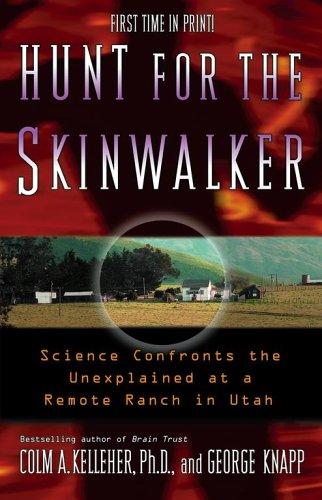
Hunt for the Skinwalker
Science Confronts the Unexplained at a Remote Ranch in Utah
Find on Amazon →As an Amazon Associate, OverClassified may earn from qualifying purchases made through this link, at no extra cost to you.
Why This Is Essential Reading
Hunt for the Skinwalker earns its place on this list as the founding document of Skinwalker Ranch's entire public reputation — the book every later account of the property, including this site's own Skinwalkers at the Pentagon, ultimately traces back to. Read together, the two books tell one continuous institutional story split across sixteen years: this 2005 book covers Robert Bigelow's privately funded NIDS investigation from 1996 to 2004, while the 2021 sequel retroactively reveals the federally funded AAWSAP chapter that came after. What makes this earlier book genuinely essential rather than merely historically first is its own honesty about its central limitation: co-author Colm Kelleher's own on-the-record admission that years of dedicated field investigation produced no conclusive physical evidence is a rare instance of a paranormal-investigation book undercutting its own most sensational chapters in the authors' own words. Read alongside this site's own Skinwalker Ranch case file and the named skepticism of Robert Sheaffer — and Terry Sherman's own later dispute of specific details — this book is essential precisely because it demonstrates, from its authors' own hand, the same evidentiary gap this site applies to every extraordinary claim it covers: institutional facts and testimony are not physical proof, and a reader who conflates them has misread what even Kelleher himself said the investigation actually found.
Related Cases & Theories
Essential Viewing
Skinwalker Ranch: George Knapp and Colm Kelleher Ph.D discuss unpublicized NIDS report
Rebelliously Curious with Chrissy Newton — Both co-authors discuss the NIDS investigation this book documents and an unpublicized report from the ranch, tying the book's original 1996-2004 field research directly to their later public accounts of the property. Verified via YouTube oEmbed before inclusion.
David Paulides Interviews DR. Colm Kelleher, Director of Investigations Skinwalker Ranch, NIDS
Canam Missing Project — A long-form interview with Colm Kelleher covering his role as NIDS's director of investigations at Skinwalker Ranch, including cattle mutilations, cryptid encounters, and the evidentiary challenges this book's Critical Reception section discusses. Verified via YouTube oEmbed before inclusion.
Sources Cited
- Kelleher, Colm A.; Knapp, George. Hunt for the Skinwalker: Science Confronts the Unexplained at a Remote Ranch in Utah. Paraview Pocket Books, 2005 (ISBN 1416505210 / 9781416505211, cited here matching this site's own resources library citation). archive.org
- "Hunt for the Skinwalker: Science Confronts the Unexplained at a Remote Ranch in Utah." Internet Archive bibliographic record (publisher: New York: Paraview Pocket Books, 2005, xiv + 304 pp.). archive.org
- "Hunt for the Skinwalker." Simon & Schuster, official publisher page (ISBN 9781416505211, imprint and edition confirmation). simonandschuster.com
- "Hunt for the Skinwalker: Science Confronts the Unexplained at a Remote Ranch in Utah: Kelleher Ph.D., Colm A., Knapp, George." Amazon.com product listing (edition and ISBN confirmation). amazon.com
- "Hunt for the Skinwalker: Science Confronts the Unexplained at a Remote Ranch in Utah" by Colm A. Kelleher. Goodreads (reader ratings and reviews). goodreads.com
- Willmetts, GF ("UncleGeoff"). "Hunt For The Skinwalker, by Colm A. Kelleher phD and George Knapp (book review)." SFcrowsnest, December 30, 2021 (source of the "holes in the ground" and vet-assessment quotes). sfcrowsnest.info
- "Skinwalker Ranch." Wikipedia (property ownership history, NIDS investigation summary, James Randi's 1996 Pigasus Award, Robert Sheaffer's skeptical critique, and Terry Sherman's later dispute of the book's accuracy). en.wikipedia.org
- Sheaffer, Robert. Skeptical Inquirer / Bad UFOs commentary on Skinwalker Ranch (source of the "parsimonious explanation" quote regarding the Sherman family's claims). badufos.blogspot.com
- Salisbury, Frank B. The Utah UFO Display: A Biologist's Report. Originally published 1974 (400+ Uintah Basin sighting reports predating the Sherman family's claims; prefaced by J. Allen Hynek). openlibrary.org
- "Hunt for the Skinwalker" (2023). BOOM! Studios, written by Zac Thompson, art by Valeria Burzo (four-issue comic adaptation of this book). boom-studios.com
- This site's own essential-reading entry: Skinwalkers at the Pentagon (ER-041), the 2021 direct sequel co-authored by the same two authors with James T. Lacatski.
- This site's own case file: Skinwalker Ranch (Case File #296), for the property's full Disputed-rated institutional and evidentiary history.
- This site's own case file: The St. Clair County Triangle Sightings (Case File #242), for NIDS's broader investigative lineage under Kelleher.
- This site's own key-figures entry: Colm Kelleher, for his full NIDS and BAASS career history.
- This site's own key-figures entry: George Knapp, for his full journalism career and further case connections.
- This site's own resources library: Full Reading List, where this exact edition (ISBN 1416505210) is already cited.
Have corrections, additional research, or peer-reviewed sources? Help improve this entry.
Suggest an Edit