
Phenomena
The Secret History of the U.S. Government's Investigations into Extrasensory Perception and Psychokinesis
Core Thesis
Phenomena: The Secret History of the U.S. Government's Investigations into Extrasensory Perception and Psychokinesis is a different Annie Jacobsen book entirely from her better-known 2011 title this site already covers, Area 51: An Uncensored History: where that earlier book is a Groom Lake aerospace history whose final chapter detours into an uncorroborated Roswell theory, Phenomena (2017) is, cover to cover, a single continuous subject — the real, declassified forty-year history of American intelligence and military research into extrasensory perception (ESP) and psychokinesis (PK), built from more than fifty interviews with participating scientists, psychics, and CIA and Defense Department officials, plus documents obtained via FOIA. It traces that research from captured Nazi occult files at the end of World War II, through Cold War fears that the Soviets held a lead in "psychic warfare," to the Stanford Research Institute's CIA-funded remote-viewing program under physicists Hal Puthoff and Russell Targ, and finally to the Defense Intelligence Agency's Star Gate program and its public, congressionally mandated declassification and termination in September 1995. This is not a UFO book — it does not primarily argue for or against extraterrestrial visitation — but its subject sits squarely inside this site's own "Consciousness & High Strangeness" territory, and it substantially overlaps in cast and institutional history with this site's own Remote Viewing Secrets (ER-078) entry on Stargate viewer Joseph McMoneagle's own training manual — a book McMoneagle wrote from inside the program he served, and whose author, notably, later published a pointed, named rebuttal of specific factual claims in Jacobsen's account of that same history, discussed at length in Critical Reception below.
About the Author
As this site's own Annie Jacobsen key-figures entry and its companion Area 51 article already document, Jacobsen was born June 28, 1967, in Middletown, Connecticut, graduated from Princeton University, and built her early career as a contributing editor at the Los Angeles Times Magazine (2009–2012) before becoming one of the most commercially successful living chroniclers of American classified programs. Phenomena is her fourth book, arriving in March 2017 between two very different projects in her bibliography: The Pentagon's Brain (2015), her history of DARPA that made her a finalist for the 2016 Pulitzer Prize in History, and Surprise, Kill, Vanish (2019), on CIA paramilitary operations — a sequencing worth noting because it places Phenomena at the point in Jacobsen's career when her access to senior, named intelligence-community sources was already well established, rather than at its outset.
Jacobsen's method in Phenomena is consistent with the interview-driven approach this site's Area 51 entry describes at length: rather than working primarily from a single declassified archive, she conducted, by the book's own account, more than fifty original interviews with participating scientists, psychics, and current and former CIA and Defense Department officials, several speaking on the record about a classified program for the first time. That method produces the book's genuine reportorial value — direct testimony from people who ran and staffed Star Gate's constituent programs — and it is also, as with Area 51, the same method her critics inside the program itself have used to challenge specific claims, discussed below rather than smoothed over.
Readers of this site's Area 51 entry will recognize the broader pattern this article does not repeat in full but flags directly: Jacobsen's reporting career includes both widely respected, narrative-driven nonfiction (Operation Paperclip, The Pentagon's Brain) and instances, most notoriously Area 51's single-anonymous-source Roswell-Mengele chapter, where a sensational claim has outrun the evidence a critical reader would want behind it. Phenomena sits closer to the former category than the latter — its central historical narrative of Star Gate's rise and fall is corroborated by declassified government documents and multiple named participants, not a single unverifiable source — but as Critical Reception below documents, it has not escaped its own specific, named factual disputes, including from a participant this site covers directly elsewhere.
Historical Context & Origins
The research history Phenomena reconstructs begins, by Jacobsen's own account, with a real and verifiable postwar discovery: U.S. military intelligence recovering a cache of documents from the SS's Ahnenerbe research bureau, the Nazi organization Heinrich Himmler had tasked with investigating occult and paranormal subjects, including extrasensory perception and psychokinesis, alongside its more notorious pseudoarchaeological and pseudoscientific projects. Jacobsen's account holds that the U.S. and Soviet Union each obtained a share of this material, feeding Cold War-era fears on the American side that Soviet intelligence held a head start in what officials came to think of as a "psychic arms race" — a framing that supplied the original bureaucratic justification for continued American research into phenomena most involved scientists privately doubted.
That funding history is independently documented outside this book: the CIA's own 1972 decision to fund a small feasibility study at SRI International in Menlo Park, California, under physicists Hal Puthoff and Russell Targ, grew out of exactly this concern, beginning with tests of self-described psychic Uri Geller and, soon after, of artist-turned-remote-viewer Ingo Swann. The program that resulted moved through a documented sequence of internal code names over the next two decades — an initial DIA-funded phase at SRI known as Grill Flame, later reorganization as the Army's Center Lane project, transfer to DIA oversight as Sun Streak, and final consolidation in the early 1990s under the name most publicly associated with the whole effort, Star Gate — the same sequence this site's own Remote Viewing Secrets entry traces through Army viewer Joseph McMoneagle's own career inside it.
Phenomena arrived into a specific gap in the popular literature: while Jonathan Kellerman-style thrillers and later Jon Ronson's The Men Who Stare at Goats (2004) had already made Cold War psychic-research programs a subject of pop-cultural fascination bordering on farce, and academic and skeptical treatments existed in specialist journals, no single mainstream trade book had yet attempted a comprehensive, interview-based narrative history spanning from the program's Nazi-document origins through its full, documented 1995 declassification. Jacobsen's book, published twenty-two years after Star Gate's public termination, had the advantage of a fully closed historical record to work from — the CIA-commissioned American Institutes for Research (AIR) review that ended the program, authored principally by Michael Mumford, Andrew Rose, and David Goslin with separate statistical and psychological assessments from statistician Jessica Utts and psychologist Ray Hyman, was by then two decades in the public record — while still being early enough that many of the program's own participants, Puthoff and Targ included, remained available to speak with her directly.
Core Arguments & Key Concepts
The book's organizing argument is that a persistent, well-funded, and bureaucratically resilient current of U.S. government interest in ESP and psychokinesis ran continuously from the late 1940s through 1995 — not as a single coherent research program, but as a series of institutionally rebranded successors, each surviving on a mix of genuine scientific curiosity, Cold War threat-inflation, and individual champions inside the CIA, DIA, and Army willing to keep the funding alive even as mainstream physics and psychology remained overwhelmingly skeptical throughout.
A central narrative thread follows the CIA and SRI's testing of Uri Geller beginning in 1972, including a set of trials at Lawrence Livermore National Laboratory that were not declassified until decades later, and the parallel recruitment and testing of Ingo Swann, whose collaboration with Puthoff and Targ produced the "coordinate remote viewing" protocol that would define the program's operational methodology for the next two decades. Jacobsen treats the scientists' own genuine uncertainty about what they were observing — caught between colleagues' open scorn and superiors demanding operational results — as the book's most consistent human throughline.
A second major thread follows the program's claimed operational successes and their limits: remote viewer Pat Price's Cold War-era targeting of Soviet facilities, astronaut Edgar Mitchell's own privately conducted extrasensory-perception experiment en route to the Moon aboard Apollo 14 in 1971, and Joseph McMoneagle's recruitment as the Army's first designated viewer in 1978 — the same recruitment this site's own Remote Viewing Secrets entry documents from McMoneagle's own side. Jacobsen presents these episodes largely as her interview subjects described them to her, a choice several of her critics, discussed below, argue leaves too little daylight between the participants' own claimed results and independently verified fact.
The book's closing argument follows the program through its final institutional consolidation as Star Gate and its September 1995 termination, following the CIA-commissioned AIR review's genuinely split verdict — Utts arguing the aggregate statistical evidence for anomalous information transfer was stronger than that behind some accepted scientific findings, Hyman concluding the results could not be reliably separated from chance and methodological weakness, both agreeing the program's information had never proven operationally reliable enough to justify its cost. Jacobsen treats that ending not as a scandal or cover-up but as a genuinely documented, official closing chapter — a straightforward-history choice that stands in notable contrast to the single-anonymous-source sensationalism of her own Area 51 Roswell chapter.
Key Cases & Evidence Discussed
This book does not center on any of this site's own catalogued UFO/UAP case files — it is a Cold War intelligence-history book about human cognition research, not a sightings investigation — but its institutional history connects directly to two of this site's own case files through documented, shared personnel rather than genre-adjacency alone. Hal Puthoff, the SRI physicist whose 1972 recruitment by the CIA opens this book's central narrative, later became a scientific advisor to AATIP and AAWSAP, the federally funded Pentagon programs this site's own Advanced Aerospace Threat Identification Program case file (Case File #243, 2007–2017) documents in full — the same continuity skeptic Robert Sheaffer, author of this site's own Bad UFOs entry, has written about directly, arguing the same handful of researchers — Puthoff chief among them — recur across five decades of government-funded fringe-phenomena research from Star Gate through modern UAP programs.
Puthoff's later scientific-advisory role also extended to the National Institute for Discovery Science's investigation of the Utah property this site's own Skinwalker Ranch case file (Case File #296, 1994–Present) covers at length, and which this site's own Hunt for the Skinwalker and Skinwalkers at the Pentagon essential-reading entries already document — a second concrete institutional thread running from the Cold War program this book covers into the modern UAP-research world this site's case-file library tracks in detail.
Thematically, the book's core subject — whether human consciousness can, under any circumstance, obtain information through channels science cannot yet explain — is the direct real-world precedent for this site's own Global Consciousness & Noosphere Hypothesis (Theory File GCN-001) and connects as well to the Ultraterrestrial Hypothesis (Theory File UTH-001), a framework Puthoff himself has explored in his own later writing, per this site's own key-figures entry on him.
Most directly, this book's subject substantially overlaps with, but is not the same book as, this site's own Remote Viewing Secrets (ER-078): where that entry covers Army viewer Joseph McMoneagle's own 2000 training handbook, written from inside the program as a practitioner's methodology guide, this book is an outside journalist's full institutional history of the same program and the decades that preceded it — two genuinely different books connected by shared subject matter and, as Critical Reception below documents, by a direct, published factual dispute between their two authors.
Critical Reception & Controversies
Mainstream trade reviews were, per the book's own publisher, genuinely favorable on balance: the New York Times Book Review, in a review bylined to science writer Dick Teresi, called Jacobsen's narrative technique a kind of "nonfiction picaresque novel," wrote that she "has a keen eye for amusing anecdotes, and writes them up with convincing detail," and credited her with having "accomplished a gargantuan feat" in assembling the full institutional history into one accessible account. Publishers Weekly called the reporting "richly researched" and praised Jacobsen's ability to "objectively tell the story" of the program's murky bureaucratic history, while the book also appeared on the New York Times's Paperback Row and among USA Today's New and Noteworthy picks on release.
Kirkus Reviews struck a more genuinely divided note than the marketing blurbs suggest, opening its assessment with the line "The occultly inclined will be duly enchanted. The materialists—well, not so much," and observing that despite "all the players from various agencies and the large amounts of money spent," the book does not offer readers compelling independent proof that the phenomena under study are real — concluding that, as with Area 51, a reader's response depends substantially on what they were already inclined to believe walking in. Other reader and blog reviews have gone further, with one describing Jacobsen as "a very credulous person who either already believed in ESP and PK before she began the book, or was easily convinced," and another noting that the sheer volume of remote-viewing sketches and claimed hits the book reproduces "feel like the Texas Sharpshooter's fallacy" — selecting apparent successes after the fact rather than establishing accuracy under controlled conditions.
The most pointed and specific criticism of this book, however, came not from a professional critic but from inside the very program it describes, in a direct parallel to how Area 51's own harshest critics were the Area 51 veterans who had trusted Jacobsen with their story. Joseph McMoneagle — the Army's Remote Viewer No. 1 whose own training manual this site's Remote Viewing Secrets entry covers directly — published a named review of Phenomena in the Journal of Scientific Exploration (Vol. 31, No. 2, 2017, pp. 296–311) disputing specific factual claims in the book point by point. McMoneagle directly contradicted Jacobsen's assertion that "just a few years after the end of World War II, the U.S. government determined anomalous mental phenomena to be effective military and intelligence tools," calling it "not true," and characterized her account of the CIA's 1972 SRI feasibility study as "only half true," arguing that while it was accurate that the agency spent roughly $50,000 to assess whether ESP had value and concluded that it did, Jacobsen, in his reading, "chose the sensationalist path" rather than a more complete and balanced account of what the early research actually found. Separately, physicist Edwin C. May, who directed the program's SRI and SAIC-era research phases, addressed a formal letter to Jacobsen's editor and publishing team raising his own objections to specific characterizations in the book — a second named, on-record dispute from a senior program participant rather than an anonymous or purely ideological critique.
Reception from within the parapsychology research community itself, by contrast, has been more favorably disposed: a 2017 review on the Parasociology blog called it "a good book" offering "a rational, balanced, and documented study" of the government's research history, praised its use of "real references and a credible and well-articulated narrative" compared to typical internet treatments of the same material, and noted its inclusion of then-newly declassified detail on the 1975 Livermore Geller trials — while also flagging as a specific omission the book's silence on later, disputed claims that remote viewing contributed to the post-2003 hunt for Saddam Hussein, an addition the reviewer argued would have complicated the book's own implied conclusion that the discipline's results were too inconsistent for real operational use.
Taken together, this book's reception maps a genuinely three-way split rather than a simple pro/con divide: mainstream literary critics largely praised its narrative craft and research depth; participants and specialists inside the parapsychology research tradition it describes offered both the book's most detailed praise (Parasociology) and its most specific, factual rebuttals (McMoneagle, May); and the broader scientific and skeptical consensus, consistent with mainstream physics and psychology's long-standing rejection of ESP and PK as unproven, treated the underlying phenomena as pseudoscience regardless of how well the government's own institutional history of funding them was reported.
Influence & Legacy
Phenomena extended Jacobsen's run of commercially successful nonfiction, landing on New York Times bestseller lists and remaining, alongside Jon Ronson's earlier The Men Who Stare at Goats, one of the most widely read single-volume popular treatments of America's Cold War psychic-research programs — though unlike Ronson's more satirical framing, Jacobsen's book presents itself, and was largely received, as a straight work of investigative history.
Its most concrete documented legacy, independent of critical reception, is procedural: the book helped cement the now-familiar public shorthand for this entire research tradition — "Stargate," "remote viewing," "psychic spies" — in mainstream nonfiction readership terms, feeding directly into the continued public and journalistic interest in the Puthoff-Targ-era research that this site's own reporting on modern UAP programs, via AATIP and Skinwalker Ranch, documents as a live institutional throughline rather than a closed historical chapter.
Within Jacobsen's own bibliography, Phenomena functions as a comparatively low-controversy entry relative to the pattern this site's Area 51 article traces across her career: its central historical claims rest on multiple named sources and a closed, declassified official record rather than a single anonymous informant, and even its most pointed critics — McMoneagle and May chief among them — dispute specific characterizations and emphasis rather than alleging the kind of unsupported, single-source sensationalism that defines Area 51's Roswell chapter.
The book's account of the program's participants also folds directly into this site's own ongoing coverage of the personnel bridge between Cold War psychic research and post-2017 UAP disclosure: Puthoff's documented advisory role at AATIP and AAWSAP, discussed above, means this book's own subjects and the modern UAP-research figures this site profiles extensively are, in several documented cases, the same individuals across five decades — the throughline Robert Sheaffer's own skeptical writing on the subject, cited in this site's Bad UFOs entry, treats as the single most important continuity in the entire government fringe-research story.
The Book
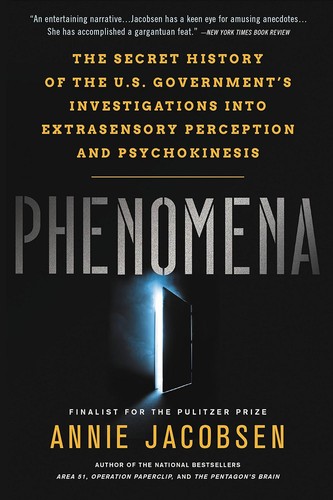
Phenomena
The Secret History of the U.S. Government's Investigations into Extrasensory Perception and Psychokinesis
Find on Amazon →As an Amazon Associate, OverClassified may earn from qualifying purchases made through this link, at no extra cost to you.
Why This Is Essential Reading
Phenomena earns its place on this list as this site's clearest single-volume account of the real, declassified institutional history behind the Cold War psychic-research programs that keep resurfacing in UAP-adjacent research through shared personnel like Hal Puthoff — and as a useful, deliberately drawn contrast to Jacobsen's own Area 51, also on this list, whose worst evidentiary sin this book largely avoids. Read it for what its more than fifty interviews and declassified documents genuinely establish: a forty-year, well-funded, and bureaucratically resilient government research effort that mainstream science never validated and that its own commissioned 1995 review ultimately could not endorse. Read it alongside, not instead of, this site's own Remote Viewing Secrets and the direct, named, on-the-record factual objections its author — Star Gate's own Remote Viewer No. 1, Joseph McMoneagle — and program scientist Edwin C. May raised about specific claims in this book, a genuinely rare instance on this site's shelf of one essential-reading author publicly disputing another's account of the same declassified history.
Related Cases & Theories
Essential Viewing
Journalist Annie Jacobsen: ESP and the U.S. Government
Commonwealth Club World Affairs of California — Jacobsen discusses the book's Cold War origins, the Stanford Research Institute program, and Star Gate's eventual declassification shortly after publication. Verified via YouTube oEmbed before inclusion.
Interview With Annie Jacobsen Part 1
Earthfiles — Linda Moulton Howe's Earthfiles interview with Jacobsen on the CIA, NSA, and DIA's investigations into extrasensory perception covered in the book, recorded around the book's 2017 release. Verified via YouTube oEmbed before inclusion.
Sources Cited
- Jacobsen, Annie. Phenomena: The Secret History of the U.S. Government's Investigations into Extrasensory Perception and Psychokinesis. Little, Brown and Company, 2017 (ISBN 9780316349369 / 0316349364, hardcover first edition cited here). amazon.com
- "Phenomena." Open Library / Internet Archive (edition record: publisher, publication date, page count, ISBN confirmation). openlibrary.org
- "Annie Jacobsen." Wikipedia (biography, education, career chronology, and full bibliography). en.wikipedia.org
- "Stargate Project (U.S. Army unit)." Wikipedia (program history and code-name timeline: Grill Flame, Center Lane, Sun Streak, Star Gate; 1995 termination). en.wikipedia.org
- "STAR GATE [Controlled Remote Viewing]." Federation of American Scientists, Intelligence Resource Program (declassified program documentation and the 1995 American Institutes for Research evaluation). irp.fas.org
- "PHENOMENA." Kirkus Reviews, release date March 28, 2017 (review: "The occultly inclined will be duly enchanted. The materialists—well, not so much."). kirkusreviews.com
- "Phenomena: The Secret History of the U.S. Government's Investigations into Extrasensory Perception and Psychokinesis." Publishers Weekly (trade review). publishersweekly.com
- "Phenomena." AnnieJacobsen.com (official book page collecting the New York Times Book Review's Dick Teresi review excerpt and publisher description, including the “more than fifty interviews” sourcing claim). anniejacobsen.com
- McMoneagle, Joseph. "Phenomena by Annie Jacobsen" (book review). Journal of Scientific Exploration, Vol. 31, No. 2 (2017), pp. 296–311. philpapers.org
- May, Edwin C. "Letter to Jacobsen's Editor of Phenomena and the Management Team." Journal of Scientific Exploration (program scientist Edwin C. May's formal, on-record objections to specific claims in the book). philpapers.org
- "Book Review: Annie Jacobsen's Phenomena." Parasociology (blog), August 2017 (parapsychology-community review praising the book's sourcing while noting its silence on post-2003 remote-viewing claims). parasociology.blogspot.com
- Sheaffer, Robert. "A Not-So-Brief History of Pentagon Woo, With a Familiar Cast of Characters." Bad UFOs (blog), May 2020 (tracing Hal Puthoff, Kit Green, and other Phenomena-era figures' later roles in AAWSAP/AATIP). badufos.blogspot.com
- "'Phenomena' author delves into U.S. government's secret investigations into ESP." CBS News, April 1, 2017 (interview with Jacobsen on the book's Ahnenerbe and Cold War origins material). cbsnews.com
- "Phenomena: The Secret History of the U.S. Government's Investigations into Extrasensory Perception and Psychokinesis." Goodreads (reader ratings and review excerpts, including credulousness and "Texas Sharpshooter's fallacy" criticisms). goodreads.com
- This site's own essential-reading entry: Area 51 (ER-060), Jacobsen's earlier, unrelated-subject 2011 book, for the single-anonymous-source Roswell pattern this article distinguishes Phenomena from.
- This site's own essential-reading entry: Remote Viewing Secrets (ER-078), Joseph McMoneagle's own training handbook, for the practitioner's-side account of the same program this book covers as outside history, and McMoneagle's own published rebuttal of this book's claims.
- This site's own essential-reading entry: Bad UFOs (ER-029), for Robert Sheaffer's own skeptical treatment of the Puthoff-era personnel continuity between Star Gate and modern UAP programs.
- This site's own case file: Advanced Aerospace Threat Identification Program (Case File #243), for Hal Puthoff's documented later advisory role.
- This site's own case file: Skinwalker Ranch (Case File #296), for Puthoff's parallel NIDS advisory role.
- This site's own key-figures entry: Annie Jacobsen, updated to link this new entry alongside her existing Area 51 connection.
- This site's own key-figures entry: Hal Puthoff, for his dual SRI/Stargate and later AATIP/NIDS advisory career.
- This site's own key-figures entry: Russell Targ, Puthoff's SRI remote-viewing program co-director.
- This site's own resources library: Full Reading List.
Have corrections, additional research, or peer-reviewed sources? Help improve this entry.
Suggest an Edit