
Remote Viewing Secrets
A Handbook — Joseph McMoneagle, the U.S. Army Stargate Program's Remote Viewer #001, Teaches His Own Declassified Methodology
Core Thesis
Remote Viewing Secrets: A Handbook is Joseph McMoneagle's attempt to convert two decades of classified military-intelligence experience into a teachable, repeatable skill: unlike his earlier, more autobiographical Mind Trek (1993) or his later The Stargate Chronicles (2002), this 320-page book is explicitly structured as an instructional manual, walking a reader with no prior psychic training through the vocabulary, protocols, ethics, and step-by-step session structure of controlled remote viewing (CRV) as McMoneagle himself came to practice it after being recruited in 1978 as the U.S. Army's first designated remote viewer, "Remote Viewer No. 1," for the program that would eventually be consolidated under the declassified name Stargate. Its relevance to this site is real but narrow and should be stated plainly rather than inflated: the book is not about UFOs, and McMoneagle's own famous claimed successes — describing a Soviet Typhoon-class submarine under construction, locating kidnapped U.S. Army General James Dozier, and predicting Skylab's 1979 reentry — are intelligence-tradecraft stories, not ufological ones. What ties it to this site's own case-file library is a documented network of shared personnel and a specific citation already on this site's resources library: McMoneagle's own 1966 claimed UFO sighting on Eleuthera Island, his participation in the disputed 2015 remote-viewing session connected to this site's own Chris Bledsoe case file, and the fact that his SRI program director, Hal Puthoff, went on to sit on the scientific advisory board that oversaw the Skinwalker Ranch investigation this site's own Hunt for the Skinwalker and Skinwalkers at the Pentagon entries already cover in depth.
About the Author
Joseph McMoneagle was born January 11, 1946, in Miami, Florida, and by his own account had a difficult childhood before enlisting in the U.S. Army in 1964 at age eighteen. He served in signals intelligence, deployed to Southeast Asia during the 1968 Tet Offensive, and, following what he has described as a near-death experience while stationed in Germany, developed the interest in anomalous cognition that would define the rest of his military career. Promoted to warrant officer in 1977, McMoneagle was recruited the following year into the psychic-research trials physicists Russell Targ and Harold "Hal" Puthoff were running at SRI International in Menlo Park, California, where his early test results — five first-place matches in his initial six sessions — led directly to his selection for the U.S. Army's classified remote-viewing unit at Fort Meade, Maryland, where he held the internal designation "Remote Viewer No. 1."
McMoneagle's twenty-year military career, which included roughly five years working directly in the remote-viewing program alongside five years in signals intelligence, ended with his retirement in 1984 and a Legion of Merit award, which multiple independent sources describe as recognizing his intelligence contributions during that final decade of service, including work the Army itself has stated was "unavailable from any other source." This site's own key-figures card credits him specifically as "U.S. Army Stargate Remote Viewer #001 (Ret.); Legion of Merit." After retirement he continued working as a remote-viewing contractor for SRI and later Science Applications International Corporation (SAIC) into the early 1990s, handling by his own account more than 1,500 intelligence-related queries across his full career for agencies including the CIA, DIA, FBI, and NSA.
This specific book sits in a particular place within McMoneagle's own bibliography, a distinction this article treats as material to how it should be read: his first book, Mind Trek: Exploring Consciousness, Time, and Space Through Remote Viewing (1993), and his later The Stargate Chronicles: Memoirs of a Psychic Spy (2002), are both substantially memoir and narrative, recounting his own career and specific sessions. Remote Viewing Secrets, published in between in 2000, is explicitly the outlier — a practical, second-person instructional handbook aimed at training a reader to attempt the discipline themselves, built around definitions, ethics, protocol, and structured practice exercises rather than around McMoneagle's own war stories, though it does draw on his personal experience as its evidentiary basis throughout.
Historical Context & Origins
The real research program this book's methodology comes out of began in 1972, when SRI International physicists Russell Targ and Harold "Hal" Puthoff started studying claimed psychic subject Ingo Swann, work that soon drew CIA and later Defense Intelligence Agency funding. McMoneagle's own recruitment into that program in 1978 came during its early institutional phase, which the declassified program history documents moving through a sequence of internal code names over the following two decades: an initial DIA-funded phase at SRI known as GRILL FLAME (1973–1978), integration and expansion into the late 1970s and 1980s, redesignation as the INSCOM CENTER LANE Project in 1983, transfer to DIA's Scientific and Technical Intelligence Directorate as SUN STREAK when Army funding ended in 1985, and final consolidation under DIA oversight in the early 1990s under the name most publicly associated with the whole effort: Stargate.
In 1995, at Congress's direction, the CIA commissioned an independent review of the entire program from the American Institutes for Research (AIR), authored principally by Michael Mumford, Andrew Rose, and David Goslin, with statistical and psychological assessments contributed separately by statistician Jessica Utts and psychologist Ray Hyman. Their conclusions were genuinely split rather than uniformly damning: Utts argued the aggregate statistical evidence for anomalous information transfer was, by her own assessment, stronger than that behind several accepted scientific findings and recommended continued study, while Hyman concluded the results could not be reliably distinguished from methodological flaws and chance, and did not meet ordinary scientific standards of proof. Both reviewers agreed, however, on the finding that mattered most for the program's survival: even taking the best claimed results at face value, the information produced was too vague and inconsistent to have demonstrated real operational intelligence value. The CIA sided with the negative reading, and Star Gate was formally, publicly terminated in September 1995 after twenty-three years and roughly $20 million in cumulative funding — a genuinely declassified, well-documented ending this article treats as settled historical record rather than as an open controversy.
McMoneagle himself has publicly disputed how thoroughly the AIR review actually engaged with the program's operational record, noting that the reviewers had access to only a limited slice of the program's full case files and did not interview the specific end-users inside requesting agencies who had, in some cases, praised remote-viewing input as useful; he has also argued that Congress's own history of continuing to fund the program across two decades reflected agency-level endorsements that sit uneasily beside AIR's ultimately negative operational verdict. This article presents that rebuttal as McMoneagle's own documented position, not as a rebuttal this site treats as having overturned AIR's official finding, which remains the program's authoritative closing assessment.
This book arrived in 2000, five years after that declassification and public termination, at a point when McMoneagle was free for the first time to write about his methodology without the classification restrictions that had shaped his earlier work, and after roughly seven years already spent training other remote viewers and writing about the subject commercially since his 1984 retirement — context that explains why this book reads as an experienced trainer's condensed teaching manual rather than a first attempt at public disclosure.
Core Arguments & Key Concepts
The book's foundational claim is that remote viewing is a trainable human skill rather than an innate psychic gift possessed by a rare few: McMoneagle defines it, in terms this site treats as his own operational working definition rather than an independently verified scientific fact, as the ability to produce accurate information about a target — a place, person, object, or event — while being completely blind to and shielded from that target in both space and time. The book's core pedagogical argument is that this ability can be developed in most people through disciplined, structured practice using controlled remote viewing (CRV) protocol, though McMoneagle is candid that it demands, in his own words, a huge commitment and an unusually disciplined mind, and that most people who attempt it will not reach operational proficiency.
Structurally, the book is organized as a genuine handbook rather than a chronological memoir: early chapters lay out basic definitions, historical framing, and the qualifications and mindset McMoneagle argues a prospective viewer needs, while the second half moves into detailed training methods, session protocol, target-cueing procedure, sketching and data-recording technique, and the ethical questions McMoneagle believes any serious practitioner has to confront before using the skill on real-world targets rather than practice exercises — a structure this site's own comparison with his more narrative-driven Mind Trek and The Stargate Chronicles treats as the book's clearest organizing choice.
McMoneagle is repeatedly, and unusually for a book making a paranormal-adjacent claim, self-critical about the discipline's own failure modes within its own pages, writing that "the ease with which one is capable of deluding oneself in this field is legendary" and that a viewer's own analytical overlay — conscious or unconscious interpretation and expectation bleeding into the raw perceptual data — is remote viewing's single most persistent source of error. He argues viewers must cultivate what he calls a kind of enforced neutrality, "flowing like water" toward whatever the data actually shows rather than what the viewer expects or wants to find, and separately warns that CRV training manuals that had by 2000 begun circulating informally on the internet were being misused as application guides by untrained readers, "introducing further error into the system" when detached from proper structured training.
The book draws on McMoneagle's own best-known claimed operational successes as illustrative rather than central material — among them his description of a Soviet Typhoon-class ballistic-missile submarine under construction in 1979, two years before its existence became public; his geographic and architectural detail in the 1981 search for kidnapped NATO Brigadier General James Dozier, held by the Red Brigades in Padua, Italy; and his 1978 prediction of the approximate date and impact debris field of the deorbiting Skylab space station, made roughly eleven months ahead of its actual July 1979 reentry. This article treats these, consistent with how this site handles all such claimed intelligence successes, as McMoneagle's own documented account of his work rather than as independently verified, evidentiary proof of anomalous cognition; official government assessments of his individual session accuracy rates have never been made fully public.
The book explicitly does not center on UFOs or extraterrestrial contact as a subject, a distinction this article states directly rather than obscures: its training content is aimed at general-purpose target acquisition, and McMoneagle's own occasional public remote-viewing sessions on UFO- or ET-related targets — including later, separately publicized sessions on Mars and on UFO phenomena — sit outside this specific handbook's own content, appearing instead in his interviews, other books, and later media appearances.
Key Cases & Evidence Discussed
This site's own Chris Bledsoe and the "UFO of God" Contact Events case file (Case File #191, Disputed) is this book's single most direct, already-documented connection to this site: its own resources library entry describes this book as written by "the Army Stargate remote viewer who participated in the disputed 2015 'Pope incident' session with Bledsoe and John B. Alexander," explaining the methodology McMoneagle says he applied to that case. The case file itself documents that John B. Alexander introduced Bledsoe to McMoneagle in 2015, and that a subsequent remote-viewing session the two men conducted is the basis of Bledsoe's claim to have helped identify a threat direction against Pope Francis during his September 2015 U.S. visit — a claim this site's own case file states independent researchers have since found to be chronologically impossible as told. This article treats that specific claim with the same caution the case file itself applies, presenting it as testimony from Bledsoe's own account rather than as a verified episode.
This site's own Hunt for the Skinwalker (ER-076) and Skinwalkers at the Pentagon (ER-041) entries share this book's broader thematic territory — government-adjacent, privately or federally funded research into anomalous human perception and unexplained phenomena — and share a real, specific, and separately documented personnel connection rather than a merely genre-level one: Hal Puthoff, the SRI physicist who co-directed the remote-viewing program that recruited and trained McMoneagle from 1978 onward, later served on the scientific advisory board Robert Bigelow assembled for the National Institute for Discovery Science's Skinwalker Ranch investigation — the same NIDS effort those two essential-reading entries cover in full. This article states plainly that this is a connection between the two research programs' overlapping personnel, not a claim that McMoneagle himself was professionally involved in the Skinwalker Ranch investigation, since no documented evidence of that specific involvement has been found.
Within the book's own pages, McMoneagle's illustrative case material — the Typhoon-class submarine identification, the General Dozier search, and the Skylab reentry prediction — remains entirely within the domain of Cold War-era military and intelligence tasking rather than UFO investigation specifically, reinforcing that this book's core content sits adjacent to, rather than inside, this site's primary UFO/UAP case-file subject matter.
Critical Reception & Controversies
The most consequential critical assessment of the research tradition this book is built on is not a book review at all but the 1995 American Institutes for Research evaluation that ended the Stargate program itself: while statistician Jessica Utts argued the aggregate statistical evidence across two decades of trials was stronger than that behind some accepted scientific results, psychologist Ray Hyman concluded the same data could not be reliably separated from chance and methodological weakness, and both reviewers agreed the program's output had not demonstrated reliable operational intelligence value — the specific, documented finding that led the CIA to terminate the program in September 1995. This article treats that split, publicly available verdict, rather than either reviewer's individual conclusion alone, as the program's authoritative closing scientific assessment, and notes that mainstream psychology and physics have never broadly accepted remote viewing as a demonstrated phenomenon in the years since.
McMoneagle's own book does not hide from this skepticism inside its own pages; his repeated warnings about self-delusion — writing that "the ease with which one is capable of deluding oneself in this field is legendary" — function as a rare instance of a practitioner's handbook building the field's own strongest outside criticism directly into its instructional content, rather than presenting remote viewing as an uncomplicated, risk-free skill.
Reader reception has settled into a moderately positive, non-scholarly consensus: the book holds a 3.81 out of 5 rating from 310 Goodreads ratings, with readers most commonly praising its second half's genuinely practical training content as more useful and less repetitive than the more narrative style of other Stargate-era memoirs, while some reviewers note the book assumes a level of prior familiarity with remote-viewing terminology that a true first-time reader may not have.
Because Remote Viewing Secrets is a training manual rather than an evidentiary case study, it has drawn essentially no independent scientific review of its own; the scientific skepticism that bears on it is almost entirely inherited from the broader Stargate program's own documented record rather than from any dedicated critical assessment of this specific book, a distinction this article states directly rather than implies.
The book's connection to this site's own Chris Bledsoe case file carries its own separate, more recent skepticism: independent researchers cited in that case file have found the 2015 "Pope incident" McMoneagle participated in to be chronologically impossible as told, a specific and documented critique this article treats as directly relevant context for readers who encounter this book primarily through that connection rather than through the Stargate program's own history.
Influence & Legacy
This book's most concrete, already-documented legacy on this site is its existing citation on this site's own resources library under ISBN 1571741593, tied specifically to the Chris Bledsoe case file rather than to a UFO case in the book's own pages — a citation this article's publication converts into a full, independently sourced breakdown for the first time.
Within the broader remote-viewing and CRV training world, this book is one of a small number of publicly available, hands-on training texts written by an original Stargate-era practitioner rather than a later commercial instructor, and it sits alongside the parallel training literature that grew out of the same declassified program, including material from fellow Stargate-program figures and the CRV manuals McMoneagle himself warns, within this book, were already circulating informally online by 2000.
This book's author's later career kept him active in the same government-adjacent research space this site covers extensively: McMoneagle has continued to be interviewed regularly about Stargate's history, appeared in documentary and podcast coverage of declassified psychic-espionage research well into the 2020s, and was, per this site's own case file, drawn into the Chris Bledsoe network specifically because of the Stargate-era credibility this book and his broader body of work established.
More broadly, this book belongs to the same documented category of literature this site treats seriously elsewhere — declassified, government-funded research into fringe or anomalous phenomena, a category that also includes this site's own Hunt for the Skinwalker and Skinwalkers at the Pentagon entries; this book's real institutional link to that literature runs through Hal Puthoff's dual role directing McMoneagle's own SRI training and later advising the Skinwalker Ranch investigation, rather than through any claim that Stargate and Skinwalker Ranch were the same program.
The Book
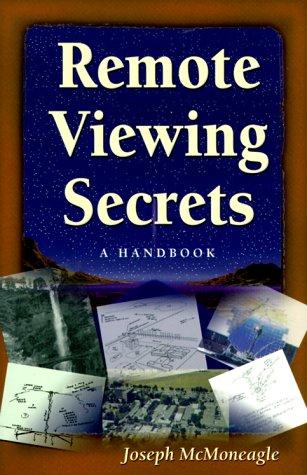
Remote Viewing Secrets
A Handbook — Joseph McMoneagle, the U.S. Army Stargate Program's Remote Viewer #001, Teaches His Own Declassified Methodology
Find on Amazon →As an Amazon Associate, OverClassified may earn from qualifying purchases made through this link, at no extra cost to you.
Why This Is Essential Reading
Remote Viewing Secrets: A Handbook earns a place on this list honestly rather than centrally, and this article states that distinction plainly: this is not a UFO book, and readers looking for ufological content in the way this site's core case-file library provides it will not find much of it here. What the book offers instead is something this site values for a different reason — a first-person, practitioner-written training manual from the U.S. Army Stargate program's own first designated remote viewer, published five years after that real, declassified, and officially terminated government program's public ending, written with an unusual degree of internal candor about the discipline's own capacity for self-delusion. Its connection to this site's own case-file library runs through two real, specific, documented threads rather than genre-adjacency alone: Joseph McMoneagle's own participation in the disputed 2015 session this site's Chris Bledsoe case file already covers, and his SRI program director Hal Puthoff's later advisory role in the Skinwalker Ranch research this site's Hunt for the Skinwalker and Skinwalkers at the Pentagon entries cover at length. Read against the real, published, and genuinely split 1995 American Institutes for Research findings that ended the Stargate program — not as a cover-up, but as an officially documented negative operational verdict — this book is best understood as a primary source on a real government psychic-research program's own internal methodology, useful to readers of this site chiefly for the personnel and institutional threads it shares with cases already documented here, not as evidence bearing directly on the UFO phenomenon itself.
Related Cases & Theories
Essential Viewing
Inside World of Remote Viewing: Joseph McMoneagle, Army's Stargate Project Remote Viewer
Expanding on Consciousness — Joseph McMoneagle discusses his recruitment into the Army's Stargate program, his work as Remote Viewer #001, and the training methodology this book teaches, in his own words. Verified via YouTube oEmbed before inclusion.
Joe McMoneagle: Project Stargate, CIA Remote Viewing & The Mars Session
That UFO Podcast — A long-form interview with McMoneagle covering his CIA-era remote-viewing work, the Stargate program's declassified history, and his later, separately publicized Mars remote-viewing session outside this book's own training-manual content. Verified via YouTube oEmbed before inclusion.
Sources Cited
- McMoneagle, Joseph. Remote Viewing Secrets: A Handbook. Hampton Roads Publishing, 2000 (ISBN 1571741593 / 9781571741592, cited here matching this site's own resources library citation). amazon.com
- "Remote Viewing Secrets: A Handbook." Biblio.com listing (publisher, edition, and ISBN confirmation: Hampton Roads Publishing Company, paperback, May 2000). biblio.com
- "Remote Viewing Secrets: A Handbook." AbeBooks listing (ISBN and edition confirmation). abebooks.com
- "Remote Viewing Secrets: A Handbook" by Joseph McMoneagle. Goodreads (reader ratings: 3.81/5 from 310 ratings). goodreads.com
- "Remote Viewing Secrets Quotes by Joseph McMoneagle." Goodreads (source of the "ease with which one is capable of deluding oneself" and related quotes). goodreads.com
- "Joseph McMoneagle." Wikipedia (biography: birth date and place, Army service dates, SRI recruitment, Remote Viewer No. 1 designation, Legion of Merit, bibliography, 1966 Eleuthera Island UFO sighting claim). en.wikipedia.org
- "Joe McMoneagle." Psi Encyclopedia, Society for Psychical Research (career overview, SRI recruitment under Targ and Puthoff, claimed operational successes including the Typhoon submarine, General Dozier, and Skylab predictions). psi-encyclopedia.spr.ac.uk
- "Stargate Project (U.S. Army unit)." Wikipedia (program history and code-name timeline: Grill Flame, Center Lane, Sun Streak, Star Gate; 1995 termination). en.wikipedia.org
- "STAR GATE [Controlled Remote Viewing]." Federation of American Scientists, Intelligence Resource Program (declassified program documentation and the 1995 American Institutes for Research evaluation). irp.fas.org
- "Jessica Utts." Wikipedia (her role co-authoring the 1995 AIR/CIA Stargate program review and her statistical conclusions). en.wikipedia.org
- "National Institute for Discovery Science." Wikipedia (Robert Bigelow's NIDS, its scientific advisory board including Hal Puthoff, and its 1995–2004 Skinwalker Ranch investigation). en.wikipedia.org
- "Skinwalker Ranch." Wikipedia (Hal Puthoff's documented role on the NIDS scientific advisory board overseeing the ranch investigation). en.wikipedia.org
- "Joseph McMoneagle Commendations and Legion of Merit." Edwin C. May Papers, Woodson Research Center, Rice University (archival finding aid documenting the existence of McMoneagle's Legion of Merit commendation records). archives.library.rice.edu
- This site's own case file: Chris Bledsoe and the "UFO of God" Contact Events (Case File #191), for McMoneagle's documented role in the disputed 2015 "Pope incident" session.
- This site's own essential-reading entry: Hunt for the Skinwalker (ER-076), for the NIDS Skinwalker Ranch investigation Hal Puthoff advised.
- This site's own essential-reading entry: Skinwalkers at the Pentagon (ER-041), for the same research program's later federally funded chapter.
- This site's own key-figures entry: Joseph McMoneagle, for his full Stargate program record and Chris Bledsoe case connections.
- This site's own key-figures entry: Hal Puthoff, for his dual SRI/NIDS advisory career linking the Stargate and Skinwalker Ranch research programs.
- This site's own resources library: Full Reading List, where this exact edition (ISBN 1571741593) is already cited.
Have corrections, additional research, or peer-reviewed sources? Help improve this entry.
Suggest an Edit