
AARO Historical Record Report, Volume I
On March 8, 2024, the Pentagon's All-domain Anomaly Resolution Office released a 63-page unclassified report reviewing every known official U.S. government UAP investigation from 1945 through October 2023 — the most comprehensive such review ever publicly issued. Its central finding: "no empirical evidence" that any UAP sighting represents extraterrestrial technology, and no verified hidden reverse-engineering program. The report was mandated directly by Congress in response to David Grusch's 2023 whistleblower testimony, and its release did not end the underlying dispute: credentialed critics, including former Deputy Assistant Secretary of Defense Christopher Mellon and physicist Robert Powell of the Scientific Coalition for UAP Studies, publicly flagged factual errors, sourcing gaps, and a methodology built largely on interviewees the report itself acknowledged had no firsthand knowledge of the programs they described.
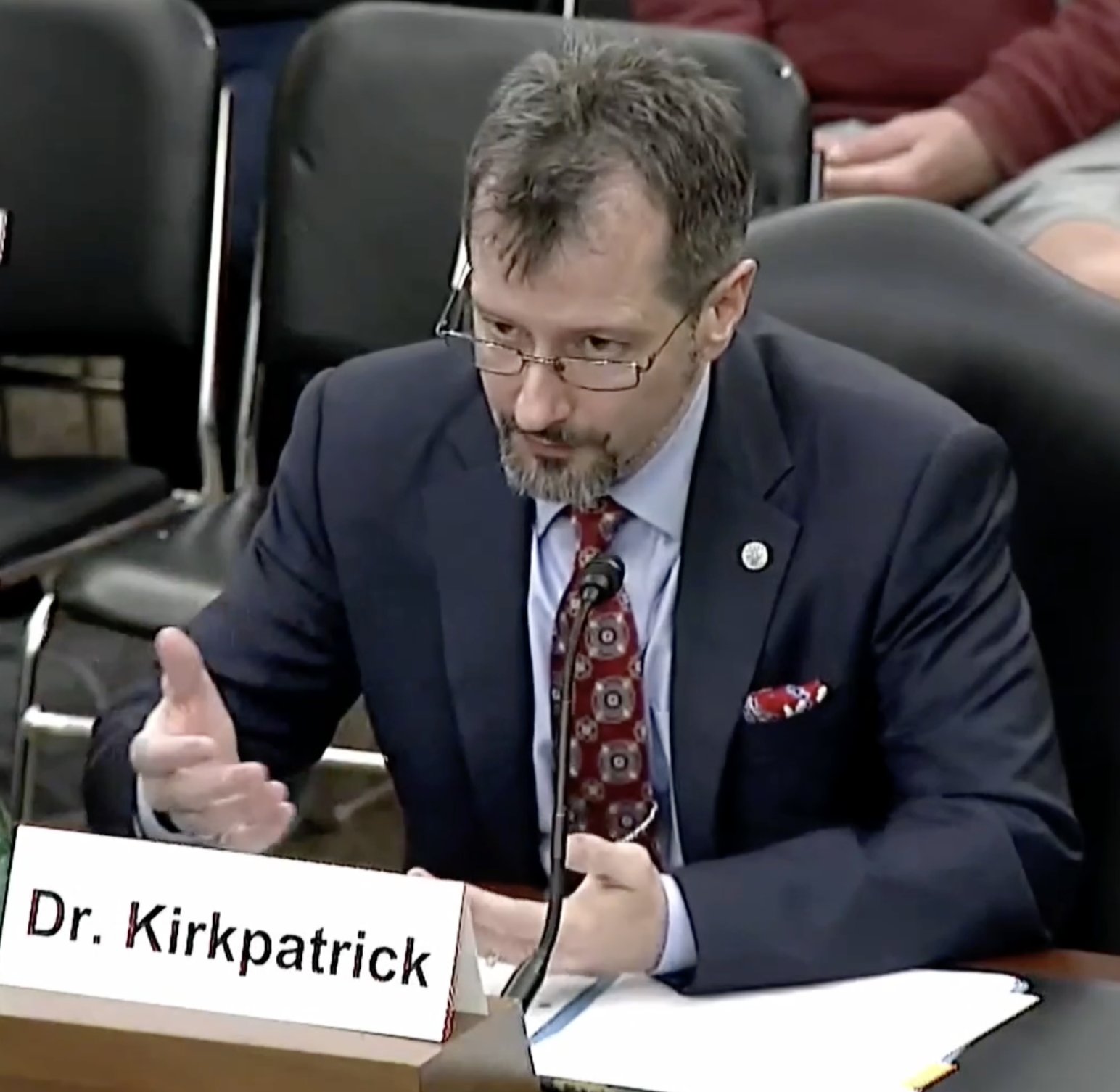
Pictured: Dr. Sean M. Kirkpatrick, AARO's first director, testifies before a subcommittee of the Senate Armed Services Committee, April 19, 2023 — nearly a year before Volume I's release, during the reporting period the document reviews. U.S. government work, public domain.
Theoretical Alignment
As with this archive's other government-program entries, the standard ETH/IDH/PSH framing does not apply: this case documents the existence, content, and reception of an official report, not a UAP encounter. The Historical Record Report's own conclusion aligns almost entirely with the Psycho-Social/Mundane explanation for the broader UAP phenomenon, while explicitly rejecting the extraterrestrial and hidden-technology hypotheses it was specifically created to evaluate. That said, the report's own findings are more layered than a single up-or-down verdict: it separately concludes that most unresolved historical sightings are attributable to poor-quality or incomplete sensor data rather than to any inherently unexplainable phenomenon, and it explicitly declines to fully close out several claims — including elements of the Malmstrom secondary narrative — pending further research it says will appear in Volume II. This file records that layered structure here rather than collapsing it into a simple confirm/deny summary.
Background
The report's origin lies directly in the credibility crisis triggered by David Grusch's July 2023 congressional testimony, in which the former intelligence officer alleged the U.S. government possessed retrieved non-human craft and had run a decades-long reverse-engineering program hidden from congressional oversight. In response, Congress included a provision in Section 6802 of the National Defense Authorization Act for Fiscal Year 2023 directing AARO to compile a comprehensive historical review of U.S. government UAP-related investigations. The statutory text is specific: the AARO director was required to submit "a written report detailing the historical record of the United States Government relating to unidentified anomalous phenomena" no later than 540 days after the Intelligence Authorization Act for Fiscal Year 2023 was enacted, a deadline that fell in mid-2024. Then-Director Sean Kirkpatrick, who was set to retire in December 2023, pushed to complete and submit the report early; it was cleared for public release on March 8, 2024, roughly four months ahead of its statutory deadline.
AARO structured its findings into two volumes rather than one. Volume I covers the historical record from 1945 through October 31, 2023, while a planned Volume II was intended to cover findings from interviews and research conducted between November 1, 2023 and April 15, 2024 — an unusually short six-month coda tacked onto a 78-year review, a split that later became one of the report's more frequently criticized structural choices. In its own introduction, AARO frames its objective narrowly: "The goal of this report is not to prove or disprove any particular belief set, but rather to use a rigorous analytic and scientific approach to investigate past USG-sponsored UAP investigation efforts and the claims made by interviewees." The report also states plainly that it approached the task "without any particular pre-conceived conclusion or hypothesis," a framing AARO leaned on repeatedly in the public messaging that followed release.
Ahead of the report's publication, Kirkpatrick — by then already retired from AARO — used a January 27, 2024 opinion piece in Scientific American to pre-position the report's conclusions with the public and with Congress. He argued that the UAP debate had suffered from a decline in evidence-based scrutiny, invoking Carl Sagan's dictum that extraordinary claims require extraordinary evidence, and criticized members of Congress for engaging with sensational claims in the media rather than through AARO's classified briefings. The op-ed drew its own criticism from transparency advocates, who argued a former government official should not be shaping public opinion about a report before its release, particularly one whose conclusions he had personally overseen.
AARO's stated methodology combined six research approaches: open-source review of public UAP and crash-retrieval claims; classified program research across the intelligence community and Department of Defense; historical interviews with approximately 30 individuals who claimed insider knowledge of alleged programs; partnership with the National Archives to locate historical UAP-related records; direct engagement with commercial entities named by interviewees; and coordination through Special Access Program channels to review sensitive programs for relevance. The report itself candidly noted a significant limitation of this approach: "none of the interviewees had firsthand knowledge" of the specific hidden programs they described to investigators.
Complete Timeline
| Date | Event |
|---|---|
| July 2023 | David Grusch testifies before the House Oversight Committee, alleging a hidden multi-decade UAP crash-retrieval and reverse-engineering program. |
| Dec. 2022 | Congress passes the National Defense Authorization Act for Fiscal Year 2023, including Section 6802's mandate for a comprehensive historical UAP review. |
| 2023 (throughout) | AARO conducts approximately 30 interviews with individuals claiming insider knowledge of alleged hidden programs, alongside archival and classified-program research. |
| Dec. 1, 2023 | Sean Kirkpatrick retires as AARO's first director; Tim Phillips becomes acting director. |
| Jan. 2024 | Kirkpatrick begins a public media campaign, including a Scientific American op-ed characterizing non-human-origin theories as speculative, ahead of the report's release. |
| March 6, 2024 | Acting Director Tim Phillips holds a media pre-briefing for select journalists, two days ahead of the report's public release. |
| March 8, 2024 | The Department of Defense publicly releases the 63-page unclassified Historical Record Report, Volume I, covering 1945 through October 2023. |
| March 2024 (following weeks) | Christopher Mellon and Robert Powell of the Scientific Coalition for UAP Studies publicly criticize the report for factual errors and sourcing problems. |
| 2025 | A subsequent Pentagon disclosure attributes the 1967 Malmstrom Air Force Base missile-disruption incidents, examined in the report, to a classified electromagnetic pulse device test. |
| Present | AARO has released a companion Volume II, and the Historical Record Report remains the U.S. government's most comprehensive official statement on UAP history, cited by both supporters of the "mundane explanation" conclusion and critics who argue its scope and rigor fell short of the congressional mandate. |
The Six Lines of Effort and Interviewee Tiering
AARO's report describes its research architecture as six "lines of effort" (LOEs), conducted in parallel so that a lead discovered in one would drive follow-up research in another. As the report puts it, the goal was "to conduct thorough cross-checks to vet all information to discover and close gaps in its understanding." The six lines were: conducting open-source research on public claims about USG investigation, contact with, and recovery of UAP; conducting classified program research across the intelligence community, the Department of Defense, and the interagency to validate or invalidate claims of hidden programs; conducting historical interviews of individuals claiming knowledge of alleged USG UAP activities; partnering with the National Archives to locate relevant records and refine search requests as new leads emerged; engaging directly with commercial entities named by interviewees as alleged participants in recovery or exploitation efforts; and partnering with the archives of key intelligence and national-security agencies, including the Defense Intelligence Agency, the CIA, the Department of Energy, the National Security Agency, and the National Geospatial-Intelligence Agency.
To manage the roughly 30 individuals who came forward with insider claims, AARO sorted interviewees into three tiers. Tier 1 interviewees were those who had already spoken with congressional staff or members of Congress and were subsequently referred to AARO; Tier 2 interviewees were referred to AARO by Tier 1 sources; and Tier 3 interviewees were identified independently by AARO because they had some corroborating connection to the narrative described by Tier 1 and Tier 2 sources. AARO assigned each interviewee a randomly generated number rather than tracking them by name in its internal case files, a step it describes as intended to protect interviewee privacy, and it applied the same anonymization to organizations named during interviews. The report states that priority was given to interviewees who claimed firsthand knowledge of a program, event, or piece of material, with second- and third-hand accounts triaged as lower priority but not dismissed outright.
The Report's Central Findings
The Historical Record Report's headline conclusion is unambiguous: "AARO has found no evidence that any U.S. government investigation, academic-sponsored research, or official review panel has confirmed that any sighting of a UAP represented extraterrestrial technology." The report states that all resolved cases to date have had ordinary explanations, attributing historical sightings to a combination of misidentified aircraft, balloons, drones, satellites, celestial objects, and, in later decades, an increasing proliferation of never-before-seen experimental and classified U.S. military systems, including early stealth aircraft. AARO adds a second, closely related finding: "AARO found no empirical evidence for claims that the USG and private companies have been reverse-engineering extraterrestrial technology," and specifies that claims naming particular people, locations, technological tests, and documents allegedly tied to such a program are, in its assessment, inaccurate.
On the specific question of hidden reverse-engineering programs, which formed the core of Grusch's testimony, the report states that AARO investigated every named and described alleged program and found each one either did not exist, was a misidentification of an authentic but unrelated program, or resolved to an unwarranted or non-credible claim. AARO assesses that the modern version of this narrative traces back to "a consistent group of individuals" who have been involved in UAP-related advocacy since at least 2009, and that repeated retelling among that group produced what the report calls circular reporting — the same underlying, unverified claims recirculating and gaining apparent credibility each time they were repeated by a new source, rather than through independent corroboration.
The report also disclosed one previously unreported detail: a Department of Homeland Security proposal for a Special Access Program named "Kona Blue," submitted by individuals who believed the government already possessed off-world technology and wanted a dedicated program to study it. DHS never approved the proposal, and its proponents "never provided empirical evidence" to support it — a conclusion AARO's own review echoed rather than contradicted. Separately, AARO examined a physical sample provided to it by a private UAP-research organization and by the U.S. Army, which had been represented to AARO as material from a crashed off-world craft; laboratory analysis found it to be "a manufactured, terrestrial alloy," composed primarily of magnesium and zinc with traces of bismuth and lead, and AARO concluded it possessed no exceptional or non-terrestrial properties.
Looking across every USG, foreign, and academic effort it reviewed, AARO draws a broader conclusion: none reached the finding that any UAP report indicated an extraterrestrial origin, and all concluded that the large majority of reports could be resolved as ordinary objects, natural phenomena, or optical effects, even though a meaningful share of cases in every era have remained formally unresolved. The report also identifies three separate historical efforts that specifically investigated claims of direct or indirect physical evidence — ranging from ground depressions to metallic debris — and states that none found material of foreign or extraterrestrial origin. On the recurring public claim that the Air Force ran a deliberate policy of covering up evidence, made over the years by figures including astronomer J. Allen Hynek, AARO states it found no evidence of a policy intended to hide extraterrestrial knowledge, material, or interactions, and instead attributes the service's historical focus to more mundane national-security priorities, chiefly tracking Soviet aerospace technology and maintaining U.S. defense readiness. The report notes one possible historical exception worth flagging on its own terms: the reorganized Project GRUDGE's first iteration reportedly instructed its staff to resolve every case rather than permit an "unidentified" finding, an internal policy AARO treats as a genuine, if narrow, historical instance of the debunking bias its critics allege was more pervasive.
The report also addressed specific denials from named parties. A former senior CIA official who interviewees claimed had personally managed the movement of and experimentation on off-world technology signed a memo, at AARO's request, rejecting that characterization outright. Separately, executives, scientists, and chief technology officers at the private companies interviewees named as alleged custodians of extraterrestrial material met directly with AARO's director and denied, on the record, ever having recovered, possessed, or reverse-engineered any such technology. AARO further states it found "no evidence of any authentic UAP-related" nondisclosure agreement, addressing a recurring claim in the disclosure community that witnesses had been silenced under NDAs carrying threats of violence or death; AARO notes that ordinary U.S. national-security NDAs do reference Title 18, Section 794 of the U.S. Code, which allows for capital punishment in espionage cases involving classified defense information disclosed to a foreign power — a standard clause AARO suggests may have been misread or mischaracterized by some signatories as UAP-specific.
The Interviewee Narratives: Twelve Craft and a Disclosure Study
Section V of the report lays out, in AARO's own words, "two main narratives" that emerged from its roughly 30 interviews, "with various and potentially unrelated offshoots." The primary narrative holds that the U.S. government and industry partners have possessed and tested off-world technology concealed from congressional oversight since roughly 1964 — or since 1947, if the Roswell incident is counted — and that this hidden program allegedly holds as many as twelve extraterrestrial spacecraft. One interviewee, relaying a thirdhand account, told AARO that an unnamed organization held twelve craft recovered from separate crash events before 1970, some described as "intact," and claimed the CIA had a partnership with the company that ended in 1989 when the agency sought to have the material returned. A separate interviewee described a different organization possessing off-world material as recently as 2009 and 2010, and said they had personally participated in negotiations to return that material to the government. AARO states it found no empirical evidence supporting either account.
Other interviewees offered narrower claims that AARO investigated individually. One described a 1999-era conversation with a senior former military officer who allegedly said he had touched the surface of an intact extraterrestrial craft housed in a building, staffed by roughly 150 people, and kept "outside of government" to protect its secrecy; when AARO located the named officer, he denied the account but recalled a separate, unrelated conversation about physically touching an F-117 Nighthawk stealth fighter, which AARO assessed the interviewee likely misremembered or conflated. Two interviewees separately described participating in a study, conducted in Northern Virginia sometime between 2004 and 2007, that modeled the societal consequences if the United States, Russia, or China were to disclose evidence of extraterrestrial life or craft; AARO confirmed a real study of this kind took place, evaluating roughly five dozen aspects of society such as religion and financial markets, but found no evidence it was requested by the White House, as some interviewees had claimed. Another interviewee, a former service member, said that during a 2009 humanitarian mission overseas he witnessed U.S. special-forces personnel loading containers onto what he believed was a large extraterrestrial spacecraft. AARO also examined an alleged 1961 Special National Intelligence Estimate, circulated online as proof of an early government UFO cover-up, and — consistent with a separate assessment discussed elsewhere in the report — found the document to be inauthentic.
The Malmstrom Nuclear Missile Investigation
Among the specific historical claims AARO examined were long-standing accounts, including testimony from retired Air Force officer Robert Salas, that UAP had disabled nuclear missiles at Malmstrom Air Force Base in March 1967. This claim forms the core of what AARO calls its "secondary narrative": that a cluster of UAP sightings occurred near U.S. nuclear facilities and directly caused malfunctions in intercontinental ballistic missile systems, including one interviewee's account of a UAP allegedly destroying an inert, dummy-warhead-equipped test missile in flight. AARO interviewed five former Air Force personnel who had served near ICBM silos at Malmstrom, Ellsworth, Vandenberg, and Minot Air Force Bases between 1966 and 1977 as part of its review of these accounts.
The report could not fully resolve every specific claim in this category before Volume I's publication and states it would carry unresolved Malmstrom-related allegations forward into Volume II rather than closing them out prematurely. For one related 1964 incident, AARO could not locate original footage but was able to correlate the reported event with a documented antiballistic-missile test. A separate 2025 Pentagon disclosure later attributed the 1967 Malmstrom disruptions specifically to a classified electromagnetic-pulse device test, a resolution that came after Volume I's publication but is broadly consistent with its overall conventional-explanation framework rather than contradicting it.
Historical Programs Reviewed: From Project SAUCER to AARO
A substantial portion of Volume I is devoted to cataloging roughly two dozen distinct U.S. government investigative efforts undertaken since 1945, ranging from formally staffed programs to short-lived outside reviews. The lineage begins with the earliest formal effort, established around the end of 1947 under an unclear original name — sources cited in the report differ on whether it was called Project SAUCER from the outset or acquired that name informally afterward. That effort investigated one of the field's foundational cases: pilot Kenneth Arnold's June 1947 sighting near Mount Rainier, Washington, of nine circular objects flying in formation at an estimated 1,700 miles per hour, which he compared to "the tail of a Chinese kite." Arnold's account, picked up widely by the press, is credited with popularizing the term "flying saucer." The report states this earliest effort found no evidence of extraterrestrial technology.
That program was formalized in January 1948 as Project SIGN, tasked with determining whether the reported objects were secret Soviet weapons or something more exotic. SIGN evaluated 243 reported sightings and concluded in February 1949 that no evidence yet existed either proving or disproving that the objects were real aircraft of an unknown, unconventional design; most were attributed to misinterpretation, hysteria, hallucination, or hoax. According to one historical account the report treats cautiously, given it rests on a single source, SIGN staff drafted an internal document in mid-1948 titled "The Estimate of the Situation," which reportedly concluded some sightings were "interplanetary" in origin. Air Force Chief of Staff General Hoyt S. Vandenberg rejected the document for lacking proof, and it was never published; the episode may have contributed to a loss of confidence in SIGN's staff that led to the program's dissolution and replacement by Project GRUDGE, which some sources describe as carrying an institutional bias toward debunking reports.
A reorganized version of GRUDGE, under Captain Edward Ruppelt, took a more systematic approach: Ruppelt introduced an "unknown" case category to avoid forcing every report into a predetermined explanation, and commissioned outside scientific support from the Battelle Memorial Institute under an arrangement he called Project BEAR. That statistical effort — covered in greater depth in this archive's own Special Report No. 14 file — analyzed sighting frequency, location, and description data and concluded that, wherever sufficient data existed, cases were readily explainable, and that the same was likely true of most unresolved cases if better data had been available. GRUDGE was itself succeeded in 1952 by Project BLUE BOOK, the Air Force's longest-running and best-known UAP investigation, which ran until 1969. Over its lifetime BLUE BOOK evaluated 12,618 reported sightings, of which 701 were categorized as unidentified and never resolved; AARO's review of the surviving Project BLUE BOOK archive, conducted in partnership with the National Archives, catalogued 7,252 files totaling 65,778 digital records. BLUE BOOK found no case indicating a national-security threat, no evidence of technology beyond contemporary scientific understanding, and no case supporting the conclusion that unidentified sightings were extraterrestrial vehicles.
Outside the Air Force's own chain, several independent panels reviewed the same body of cases. In 1952, following a wave of sightings over Washington, D.C., the CIA's Office of Scientific Intelligence formed a Special Study Group that reviewed the accumulated SIGN-through-GRUDGE case files and judged roughly 90 percent of reports explainable, with the remainder simply "incredible" claims rather than evidence of Soviet or extraterrestrial technology; the group also found no corresponding UFO reporting in the Soviet press, leading it to suspect Soviet authorities were themselves suppressing the topic. That study helped set the stage for the CIA-sponsored Robertson Panel in early 1953, discussed at length in this archive's dedicated Robertson Panel file, which similarly found no evidence of a foreign or extraterrestrial threat but proposed a public "training" and "debunking" campaign, reasoning that the volume of reports risked clogging government processes and, in the panel's own words, could foster "mass hysteria" of potential benefit to the Soviet Union. In 1964, the Air Force's own Scientific Advisory Board convened the O'Brien Committee, chaired by physicist Dr. Brian O'Brien and including astronomer Carl Sagan, which likewise found no case indicating a threat or a technology outside terrestrial science, while recommending the subject merited dedicated academic study.
That recommendation led to the University of Colorado's 18-month, USAF-funded study led by physicist Edward Condon, whose 1968 findings — examined in full in this archive's own Condon Report file — concluded that further study of UFOs "probably cannot be justified in the expectation that science will be advanced thereby," after examining 59 individual cases, including alleged physical-evidence claims involving ground markings, residue, and metallic debris that in each instance resolved to ordinary explanations. The Condon Report's methodology was itself later reviewed by a panel of the National Academy of Sciences at the end of 1968, after some scientists — including BLUE BOOK-era researcher Dr. J. Allen Hynek — criticized its rigor; the NAS panel did not reinvestigate individual cases itself.
Formal U.S. government UAP investigation then went dormant for roughly four decades after BLUE BOOK's 1969 closure, according to AARO's account, until Senator Harry Reid secured Defense Appropriations funding in 2008 and 2010 for what became AAWSAP/AATIP, described in the section below. The modern institutional lineage resumed more formally in August 2020, when Deputy Secretary of Defense David Norquist approved a Navy-led Unidentified Aerial Phenomena Task Force (UAPTF), whose work helped standardize UAP reporting and, notably, contributed to the eventual identification of a People's Republic of China high-altitude surveillance balloon that crossed the continental United States. The UAPTF's work fed the June 2021 ODNI Preliminary Assessment on Unidentified Aerial Phenomena, which concluded that limited high-quality reporting hampered firm conclusions, that a limited number of incidents showed unusual flight characteristics warranting further rigorous analysis, that multiple distinct types of UAP likely required different explanations, that UAP could pose airspace-safety and national-security concerns, and that standardized, consolidated reporting was needed for more sophisticated future analysis. The UAPTF was succeeded in November 2021 by the Airborne Object Identification and Management Synchronization Group (AOIMSG), which in turn became this archive's AARO in July 2022 under an expanded statutory mission. Separately, NASA convened its own Independent Study Team between June 2022 and September 2023, chaired by the president of the Simons Foundation, which focused on what data streams NASA could contribute to UAP resolution rather than on the extraterrestrial question, and which led NASA to establish a dedicated UAP research director position.
The report also situates itself against AARO's own first formal count of the government's UAP caseload. On January 12, 2023, the Office of the Director of National Intelligence submitted its 2022 Annual Report on Unidentified Aerial Phenomena to Congress, drafted jointly with AARO and drawing on AARO's own data. That report tallied 510 total UAP reports as of August 30, 2022 — combining the 144 reports covered by the 2021 ODNI Preliminary Assessment with 247 newly filed reports and 119 additional older reports subsequently rediscovered or newly submitted — and noted that UAP events continued to be reported in restricted or sensitive U.S. airspace, which the ODNI and AARO flagged as a potential concern for both flight safety and adversary intelligence-collection activity. AARO's Historical Record Report treats this steadily growing, better-standardized caseload as evidence that its own modern reporting pipeline, whatever its limits, already represents a substantial improvement over the sporadic, inconsistently resourced efforts that preceded it going back to Project SAUCER.
The Roswell Reassessment
The report devotes specific attention to Roswell, the case most closely associated with American UFO culture, largely by pointing back to the Air Force's own two prior investigations rather than reopening the case from scratch. The 1994–1995 Roswell Report concluded that debris recovered near Roswell Army Air Field in July 1947 was consistent with a balloon train from Project Mogul, a then-classified acoustic surveillance program designed to detect Soviet nuclear tests, and found no evidence the government had recovered alien bodies or extraterrestrial material. A 1997 follow-on report, The Roswell Report: Case Closed, added further analysis supporting that conclusion and addressed the enduring "alien bodies" claim directly: it attributed those reports to anthropomorphic test dummies carried aloft by later U.S. Army Air Force high-altitude balloon research, and suggested that separate accounts of military units recovering bodies most likely conflated two unrelated later incidents — a 1956 KC-97 aircraft accident that killed eleven airmen, and a 1959 manned balloon mishap that injured two pilots. A related 1995 Government Accountability Office review, prompted by a congressional request, found that U.S. Army Air Force regulations of the period required air-accident reports to be permanently retained, and that the only four air accidents recorded in New Mexico that July all involved military aircraft and occurred after July 8, 1947 — after the Roswell Army Air Field's own public-information office had already issued, and then retracted, its press release describing the recovery of a "flying disc."
AAWSAP, AATIP, and the Skinwalker Ranch Question
The report's treatment of the Advanced Aerospace Weapons System Application Program — known interchangeably as AAWSAP or by the unofficial name AATIP, and covered in full in this archive's own AATIP file — adds government-source detail to a program whose broad outline was already public. At Senator Reid's direction, the Defense Appropriations Acts for fiscal years 2008 and 2010 provided roughly $22 million for the Defense Intelligence Agency to study long-term, over-the-horizon foreign aerospace threats. DIA awarded the resulting contract in 2009 to a private-sector organization publicly identified in subsequent reporting as Robert Bigelow's Bigelow Aerospace Advanced Space Studies. AARO notes explicitly that while AAWSAP was an authentic, funded DoD program, the "AATIP" name was never itself an official program — after AAWSAP's cancellation, that label was informally adopted by a loose, unofficial community of interest within the Department that continued researching UAP reports as a secondary duty, without its own dedicated staff or budget.
AAWSAP's formal contract covered twelve advanced-aerospace research areas, including exotic propulsion concepts, unconventional materials, and signature-reduction techniques, and although UAP investigation was not part of the statement of work, the contractor conducted UAP-focused research anyway with the support of its DIA program manager, reviewing both new reports and older Project BLUE BOOK cases. The same contractor separately used the arrangement to investigate paranormal activity at a Utah property it owned, publicly known as Skinwalker Ranch, examining reported "shadow figures" and unexplained phenomena, and exploring remote viewing and what the contract materials describe as "human consciousness anomalies" — work DIA says it neither sought nor specifically authorized, though a DIA employee had set up and managed the underlying contract. In June 2009, Senator Reid asked then-Deputy Secretary of Defense William Lynn to designate AAWSAP a formal DoD Special Access Program; Lynn declined, on the recommendation of then-Under Secretary of Defense for Intelligence James Clapper, who found the designation unjustified. Shortly before its 2012 cancellation, the contractor proposed a public-relations effort involving "intellectual debates" at academic institutions, featuring paid reporters and celebrity moderators, whose stated premise was to treat "E.T. visitations" as an assumed fact and steer discussion away from what internal proposal language called "dead-end" debates over evidence. AARO states that AAWSAP/AATIP produced exploratory but never fully peer-reviewed papers on its twelve tasked research areas, and that beyond its Skinwalker Ranch work and a review of existing BLUE BOOK cases, AARO found no additional substantive UAP casework the program had generated before DIA ended it in 2012 over internal concerns about the project.
The Criticism: Scope, Sourcing, and Framing
The report's release did not resolve the underlying congressional and public dispute it was meant to settle. Former Deputy Assistant Secretary of Defense for Intelligence Christopher Mellon and Scientific Coalition for UAP Studies analyst Robert Powell both publicly identified specific factual errors and sourcing problems in the document. Mellon's own response, published on The Debrief under the title "The Pentagon's New UAP Report is Seriously Flawed," ran to roughly 16,000 words incorporating input from a number of UAP researchers and former officials, and characterized the document in unusually blunt terms for a former senior Pentagon intelligence official reviewing a Pentagon-produced report. Independent analysis has also noted a structural concern: roughly 45% of the report's pages are devoted to debunking specific hidden-program allegations rather than comprehensively documenting the government's 78-year investigatory history the statute actually called for, and observers have questioned why AARO chose to split its findings into two volumes, with Volume II covering only an additional six months of the reporting period rather than substantially extending the historical review.
Mellon's critique itemized a series of specific errors and omissions. On dates and figures, he noted the report gives Kenneth Arnold's watershed 1947 sighting as June 23 rather than the widely documented June 24, and that its count of roughly 65,778 digital Project BLUE BOOK records is well below the roughly 130,000 pages of BLUE BOOK material that have been publicly available through commercial archive services since 2007 — a discrepancy Mellon argued undercut AARO's claim to have thoroughly reviewed the archive. He also flagged internal inconsistencies in the report's own chronology: AARO describes a roughly 40-year gap in formal U.S. government UAP investigation between BLUE BOOK's 1969 closure and AAWSAP's 2009 founding, while elsewhere in the same report referencing investigated incidents that fall inside that supposed gap, including a 1980 Rendlesham Forest case. Mellon further argued that specific attributions offered by the report for historical sightings — including a claim that more than half of 1950s- and 1960s-era UFO reports stemmed from misidentified U-2 reconnaissance flights, and a suggestion that Apollo-program activity contributed to UAP misidentification — were not supported by documented, dated, citable examples in the report itself. Most pointedly, Mellon noted the complete absence of any mention of the 2004 USS Nimitz encounter, the case most directly credited with reviving congressional interest in UAP and prompting AARO's own creation, and argued the report likewise omitted or underplayed the roles of NORAD, the NSA, Customs and Border Protection, and the Air Force's Foreign Technology Division in the government's decades-long UAP history.
On methodology, Mellon argued that AARO's public characterization of unresolved cases — describing the roughly 62% of reports that remained unexplained as of an August 2022 tally using softer language rather than stating the percentage plainly — understated how large a share of well-instrumented cases remains genuinely unresolved, and that the report followed what he called Project BLUE BOOK's own discredited practice of folding "insufficient data" cases into the "explained" category rather than treating them as a distinct, unresolved class. He also pointed to the predecessor UAP Task Force's own data, in which a majority of cases involved corroborating readings from multiple independent sensor types simultaneously, arguing this cut against the report's tendency to attribute unresolved sightings broadly to sensor error or misperception.
Robert Powell's public critique, posted shortly after the report's release and later expanded in coverage by The Debrief, focused on a related but distinct concern: that the report selectively marshaled supporting evidence while omitting material that complicated its conclusions. Powell wrote that there was "a tendency in the AARO paper to pull the data that supports th[e] AARO position and leave out the data that might argue against it." Powell's review also caught several smaller factual slips: the report locates Senator Harry Reid's home state incorrectly, and misidentifies Lieutenant Colonel Robert Jones Friend, a Project BLUE BOOK-era director, by an incorrect first name. He also noted the report's own account of the Battelle Memorial Institute contract secured by Captain Ruppelt uses the nickname "Project BEAR" for an effort some historical sources instead identify as "Project STORK," and that AARO's summary of the unexplained-sightings percentage in Battelle's own underlying statistical analysis does not fully match the source document.
The report's own framing has also drawn scrutiny. Rather than directly answering Congress's core question — has the government run hidden UAP programs? — sections of the document instead explore why a substantial portion of the public believes in secrecy and cover-up, attributing that belief to eight interacting factors including Cold War-era security culture, government secrecy norms, popular culture influence, bureaucratic reporting barriers, insufficient data, perceived past deception, declining institutional trust, and internet-amplified misinformation. Critics have characterized this as the report partially reframing a factual mandate into a sociological explanation of belief, rather than a direct historical accounting. Supporters of the report have countered that no single 63-page document could have exhaustively re-litigated 78 years of institutional history within its statutory deadline, and that AARO's willingness to name specific rejected claims, publish a chain-of-custody material analysis, and commit to a follow-on Volume II represented a meaningfully higher level of transparency than any prior official UAP review had offered.
Key Figures
Sean Kirkpatrick
Directed AARO's review process through most of the reporting period and pushed to complete Volume I ahead of schedule before his December 2023 retirement, then led a public messaging campaign supporting its conclusions.
David Grusch
His July 2023 congressional testimony alleging a hidden crash-retrieval and reverse-engineering program directly prompted the congressional mandate that produced this report, whose central findings directly contradict his central claims.
Christopher Mellon
Publicly identified factual errors and sourcing problems in the Historical Record Report, becoming one of its most credentialed critics from within the pro-transparency UAP research community.
Robert Bigelow
His company, publicly identified in later reporting as the private-sector organization that held the 2009–2012 AAWSAP/AATIP contract examined in this report, also used the arrangement to study his own Skinwalker Ranch property in Utah, a dual-purpose use of the contract that AARO's review documents in detail.
Jon Kosloski
A former NSA physicist who succeeded Timothy Phillips as AARO's director roughly five months after Volume I's release, and has since overseen AARO's continuing work on the still-pending Volume II.
The Five Observables Assessment
The Five Observables framework describes claimed craft performance characteristics and does not apply to this case, which documents a government report rather than a sighting:
Assessment: This case documents a report about historical investigations, not an observed craft, and the Five Observables framework is included here only for structural consistency with the rest of the archive.
Evidence Assessment
Fully Documented Institutional Fact
- The report's existence, release date, and full text are confirmed by official Department of Defense publication on AARO's own website and extensive contemporaneous mainstream news coverage, the strongest evidentiary category this archive applies.
- Its statutory origin in Section 6802 of the FY2023 NDAA, and its direct causal link to Grusch's 2023 testimony, are independently confirmed by the legislative text and congressional record.
Limits on the Report's Conclusions
- The report's own acknowledged methodology — interviews with individuals who had no firsthand knowledge of the programs they described — substantially weakens its capacity to definitively disprove, rather than merely fail to corroborate, the specific hidden-program claims it addressed.
- Credentialed critics including Christopher Mellon and Robert Powell identified specific factual and sourcing errors, a criticism this file finds credible enough to weigh directly in this case's overall rating.
- The report's own structure — devoting a large share of its pages to rebutting specific named allegations rather than to comprehensive historical documentation — drew legitimate methodological criticism independent of its ultimate conclusions.
Why "Disputed"
This case is rated Disputed because it sits in a genuinely unusual evidentiary position: the report's existence, content, and official status are fully verified government facts, but its adequacy as an answer to the congressional mandate that produced it is a live, credentialed dispute rather than a settled matter. Unlike this archive's UAP Task Force Formation entry, where the only relevant fact was a confirmed bureaucratic action, this case requires this file to also weigh the substance of what the report concluded — and on that substance, informed, non-fringe critics with real institutional standing (a former Deputy Assistant Secretary of Defense, a physicist with a UAP research nonprofit) have identified specific, named problems rather than simply disagreeing with the conclusion on principle.
This file's own assessment is that the report's central finding — no verified evidence of extraterrestrial technology or a hidden reverse-engineering program — is very likely correct as far as it goes, consistent with every other official U.S. government UAP review this archive has documented. But "very likely correct in its conclusion" and "methodologically adequate to the scope Congress actually mandated" are separable claims, and the specific, sourced criticism the report received on the second point is the reason this case does not carry the same Verified rating as the UAP Task Force's formation.
Two further considerations shape this file's rating. First, several of the errors identified by credentialed critics — a mis-dated sighting, a misnamed director, an archive-size discrepancy — are individually minor but collectively suggest a document produced and cleared for publication on an accelerated timeline, consistent with Kirkpatrick's documented push to finish ahead of his December 2023 retirement and roughly four months before the statutory deadline; a rushed production schedule is a plausible, mundane explanation for sourcing errors, and is a materially different problem from deliberate concealment. Second, AARO's own repeated commitment to carry unresolved claims — including the Malmstrom secondary narrative — forward into Volume II means this file's rating may need revision once that companion volume is fully available and independently reviewed.
Observer Credibility & Occupational Profile
This case's credibility assessment rests on weighing two credentialed institutional sources against each other. AARO itself is a statutorily established Department of Defense office producing a report under direct congressional mandate, with full legal authority and security clearance access to conduct the review it describes; the report's own leadership transitioned mid-project, from founding director Sean Kirkpatrick through acting director Timothy Phillips to current director Jon Kosloski, without any change to Volume I's published findings. Its most substantive critics are similarly credentialed: Christopher Mellon held senior intelligence oversight positions across multiple administrations, and Robert Powell's Scientific Coalition for UAP Studies is a nonprofit staffed by scientists and engineers rather than a fringe advocacy group. Both critics also occupy a specific, non-neutral position worth naming plainly: both have spent years advocating for the position that some UAP evidence deserves more serious scientific scrutiny than the government has historically given it, which does not make their specific, itemized factual claims — misdated sightings, misnamed officials, undercounted archive pages — any less checkable, but it does mean their overall framing of the report as inadequate should be read alongside that pre-existing advocacy stance rather than as a neutral audit. This file treats the resulting disagreement as a genuine dispute between credentialed parties, not as an official report versus an uncredentialed conspiracy theory, and weighs the itemized factual claims on each side largely independent of which side's broader framing they support.
It is also worth noting what this dispute is not: none of AARO's credentialed critics, including Mellon and Powell, argue that the report's central conclusion — no verified evidence of extraterrestrial technology or a hidden reverse-engineering program — is itself wrong. Their criticism targets the report's rigor, completeness, and sourcing in reaching that conclusion, not the conclusion itself, a distinction this file considers important to preserve rather than collapse into a simple "believers versus skeptics" framing.
Historical Precedents & Archive Matches
This case is the direct institutional successor to this archive's UAP Task Force Formation entry, and connects to the earlier Advanced Aerospace Threat Identification Program file, both of which the Historical Record Report directly reviews and discusses as part of its historical scope. The report's own historical review also directly incorporates three other entries in this archive: the Roswell case, whose 1947 origin the report traces through the Air Force's own 1994–1995 and 1997 investigations; the Robertson Panel, the 1953 CIA-sponsored review whose recommendations shaped decades of subsequent U.S. government UAP messaging; and the Condon Report, the 1968 University of Colorado study whose conclusion that the topic did not merit further scientific investment effectively ended formal U.S. academic UAP research for a generation. Read together, these five files trace a single continuous institutional thread running from 1947 to the present day.
Material Analysis
The primary "material" evidence for this case is the report itself: the 63-page unclassified document published on AARO's official website and cleared for release by the Department of Defense on March 6, 2024. The report's own internal evidentiary base includes archival research conducted with the National Archives, classified program reviews conducted through Special Access Program channels, and roughly 30 interviews, a methodology the report itself qualifies by acknowledging its interviewees lacked firsthand knowledge of the specific programs discussed. Within that evidentiary base, one item stands out as genuine physical material analysis rather than documentary or testimonial review: the alleged crashed-craft fragment AARO obtained from a private UAP-research organization and the U.S. Army, which laboratory materials characterization identified as a manufactured alloy of magnesium and zinc with trace bismuth and lead — an ordinary, terrestrial composition rather than anything AARO characterizes as anomalous.
Supporting the Report's Core Conclusion
- The report's finding of no evidence for extraterrestrial technology or hidden reverse-engineering is consistent with every other official U.S. government UAP review conducted before or since, including the 2021 ODNI Preliminary Assessment.
- Where AARO's claims are independently checkable against primary documents — the 1994–1995 and 1997 Roswell reports, the 1995 GAO review, the 1968 Condon Report, and Project BLUE BOOK's own tallies — its summaries of those documents' conclusions match the primary sources.
- Named individuals AARO identifies as central to specific reverse-engineering claims — a former senior CIA official and multiple aerospace-company executives — issued on-the-record denials that are independently attributable and falsifiable, rather than anonymous or unverifiable assurances.
Supporting the Documented Criticism
- Named, credentialed critics identified specific factual errors and sourcing problems, and independent analysis identified a structural imbalance between pages spent rebutting specific claims versus comprehensively documenting the 78-year historical record Congress actually requested.
- Several of the report's own historical figures and statistics — the Kenneth Arnold sighting date, the Project BLUE BOOK archive's digital record count, and the naming of at least one Project BLUE BOOK-era director — do not match figures available in other, independently checkable public archives.
- The report omits or gives minimal treatment to specific, well-documented incidents and institutional players — most notably the 2004 USS Nimitz encounter that helped prompt AARO's own creation — that credentialed critics argue any genuinely comprehensive 78-year historical review should have addressed directly.
The Conventional Explanation Candidate: An Authentic but Contested Government Report
Unlike most cases in this archive, this file does not need to weigh a "conventional explanation" against an anomalous one — the report is what it claims to be, an authentic, congressionally mandated Department of Defense document. The relevant assessment here is instead whether the report's conclusions are adequately supported by its own stated methodology, and on that narrower question this file finds a genuine, credentialed, and still-unresolved dispute rather than either full vindication or full debunking.
A caveat on treating AARO's own conclusions as the final word: this entire case file concerns an official government body assessing its own field, which makes the general caution this site applies elsewhere especially relevant here rather than less so. AARO's headline findings — no evidence of extraterrestrial technology, no evidence of a reverse-engineering program, no evidence of a deliberate cover-up policy — are treated as credible and well-documented, not as automatically true simply because AARO is the government's designated UAP authority; the office has an institutional and career interest in a clean, closed narrative, its own historical lineage (Project GRUDGE's documented instruction to resolve every case rather than permit an "unidentified" finding) is itself a warning the report discloses about exactly this failure mode, and Mellon's detailed, credentialed methodological critique remains genuinely unresolved rather than answered. None of this means the report's conclusions are wrong — the balance of evidence favors them — but they are weighed here as a strong input, not a closing argument.
An Authentic but Contested Government Report — Plausibility Rating: HIGH CONFIDENCE IN CORE CONCLUSION; DOCUMENTED METHODOLOGICAL CRITICISM UNRESOLVED
Related Cases
Confirmed Documents & Official Records
The full, official unclassified report, hosted directly on AARO's own website.
PUBLIC RECORD (freely accessible)Search Government Archives Directly
Further Reading — Recommended Literature
UFO: The Inside Story of the US Government's Search for Alien Life Here—and Out There
An extensively researched history covering AARO's formation and the Historical Record Report in the context of the broader government disclosure timeline.
Imminent: Inside the Pentagon's Hunt for UFOs
A firsthand account from AATIP's former director, offering direct context for the institutional history the Historical Record Report reviews.
In Plain Sight: An Investigation into UFOs and Impossible Science
An investigative journalist's account of the modern disclosure era, including direct coverage of Grusch's claims and AARO's response.
Escaping the Rabbit Hole: How to Debunk Conspiracy Theories Using Facts, Logic, and Respect
A skeptical methodology directly applicable to evaluating both the report's conclusions and the criticism leveled against it.
They Are Already Here: UFO Culture and Why We See Saucers
A science journalist's anthropological look at the UFO research community, useful context for the report's own analysis of why belief in cover-up persists.
DISCLOSURE: Some links above are affiliate links. If you purchase through them, OverClassified receives a small commission at no additional cost to you. This helps support independent research.
Essential Viewing
Kirkpatrick's Senate Testimony
Full congressional hearing on AARO's mission and activities, recorded during the reporting period Volume I covers.

Pentagon Releases New UFO Report
CNN-News18 — contemporaneous coverage of the report's March 2024 release.
Sources
- "Report on the Historical Record of U.S. Government Involvement with Unidentified Anomalous Phenomena (UAP), Volume I," AARO, March 8, 2024. Read full report →
- "Pentagon report finds no evidence of alien visits, hidden spacecraft," The Washington Post. Read online →
- "Read the Pentagon UFO report newly released by the Department of Defense," CBS News. Read online →
- "Pentagon finds 'no evidence' of alien technology in new UFO report," NPR. Read online →
- "No evidence that U.S. covered up existence of UFOs, Pentagon report says," NBC News. Read online →
- "AARO's 2024 Historical Report (Volume I) – an Objective Summary," Justin Snead. Read online →
- "Disinformation and Secrecy in U.S. UAP Policy: AARO and the 2024 UAP Report," New Paradigm Institute. Read online →
- "AARO's Historical UAP Report - Volume 1," Metabunk. Read online →
- "Report on the Historical Record of U.S. Government Involvement with UAP, Volume I" (full transcription, page-by-page), Wikisource. Read online →
- Mellon, Christopher. "The Pentagon's New UAP Report is Seriously Flawed," The Debrief. Read online →
- "AARO's Historical Report: A Tale of Factual Errors and Old Mistakes Repeated," The Debrief. Read online →
- "Top NSA researcher tapped to lead Pentagon's UAP investigation hub," DefenseScoop. Read online →
- "The Malmstrom nuclear UFO incident (1967) returns," Meer. Read online →
- Graff, Garrett M. UFO: The Inside Story of the US Government's Search for Alien Life Here—and Out There. Avid Reader Press, 2023.
- Elizondo, Luis. Imminent: Inside the Pentagon's Hunt for UFOs. William Morrow, 2024.
- Coulthart, Ross. In Plain Sight: An Investigation into UFOs and Impossible Science. HarperCollins, 2021.
- West, Mick. Escaping the Rabbit Hole: How to Debunk Conspiracy Theories Using Facts, Logic, and Respect. Skyhorse Publishing, 2018.
- Scoles, Sarah. They Are Already Here: UFO Culture and Why We See Saucers. Pegasus Books, 2020.
- "File: Sean M Kirkpatrick before a subcommittee of the Senate Armed Services Committee 19 April 2023.png," U.S. government work, public domain. View file →
See something inaccurate? Have additional information or sources?
Suggest an Edit →Last Updated: August 2026