
UAP Task Force Formation
On August 4, 2020, Deputy Secretary of Defense David L. Norquist signed a memo formally establishing the Unidentified Aerial Phenomena Task Force (UAPTF) — the Pentagon's first officially acknowledged, standing body dedicated to detecting, analyzing, and cataloging unexplained aerial incursions into military airspace. The announcement did not create an investigation from nothing; it formalized and elevated an effort that had operated inside the Office of Naval Intelligence since 2018, itself building on the earlier, more secretive Advanced Aerospace Threat Identification Program (AATIP). The UAPTF's creation, and the congressional mandate that followed it, directly set in motion the chain of events leading to the 2021 ODNI Preliminary Assessment and the eventual creation of the All-domain Anomaly Resolution Office (AARO) in 2022.
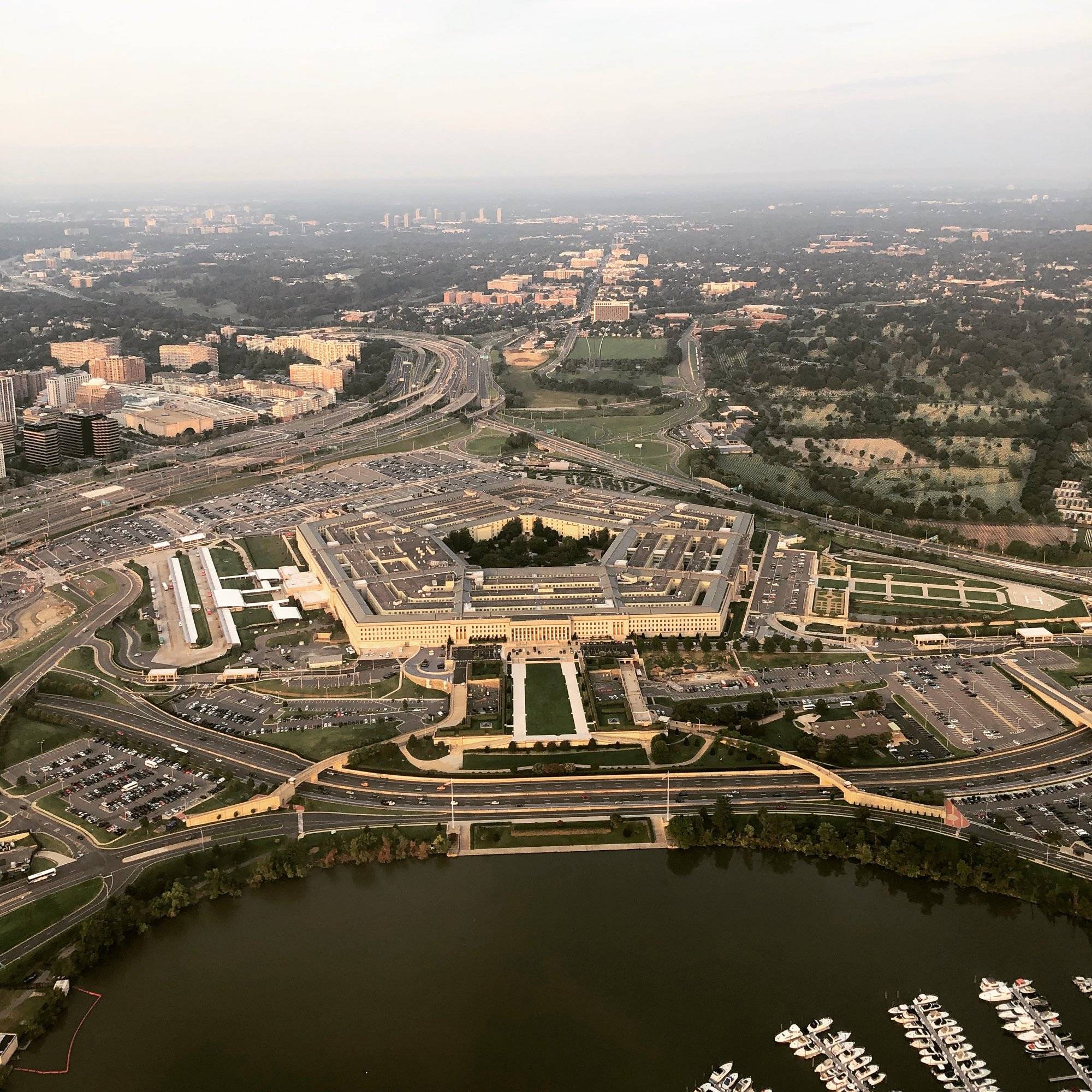
Pictured: The Pentagon, headquarters of the U.S. Department of Defense, where the UAP Task Force was chartered under the Office of the Under Secretary of Defense for Intelligence and Security. Photo by Touch Of Light, Wikimedia Commons (CC BY-SA 4.0).
Theoretical Alignment
This file departs from the standard ETH/IDH/PSH framing used for individual sightings, since the UAPTF's establishment is not a claimed encounter with anomalous technology but a confirmed, publicly announced bureaucratic action. Its significance to this archive is as the institutional turning point that transformed UAP investigation from a series of scattered, often unacknowledged programs (Project Blue Book, AATIP) into a standing, officially named Pentagon body with a direct reporting line that persists, in successor form, to the present day. Readers researching the "modern disclosure era" — the loosely defined period, generally dated from the 2017 AATIP revelation onward, during which U.S. government acknowledgment of UAP as a legitimate subject of official study became routine rather than exceptional — will find the UAPTF sitting at that era's institutional center: it is the first body whose creation, mission, and successors can all be traced entirely through primary government documents rather than leaks, anonymous sourcing, or contested witness testimony.
Background
The UAPTF's creation followed a period of mounting public and congressional attention to military UAP encounters, but the task force itself was the end point of a much longer and more tangled institutional story — one that runs from a Cold War-era Air Force project shut down in 1969, through a little-noticed congressional earmark secured by a Nevada senator in 2007, to a front-page newspaper story that broke a decade of official silence in December 2017. Understanding why the August 2020 memo mattered requires understanding that longer arc.
Project Blue Book and a Long Institutional Silence
From 1952 to 1969, the U.S. Air Force operated Project Blue Book, the most extensive and best-known official American UFO investigation of the twentieth century, cataloguing more than 12,000 reported sightings. Blue Book's closure followed the 1968 report of the University of Colorado UFO Project, commissioned by the Air Force and led by physicist Edward U. Condon, which concluded that further concentrated study of UFO reports was unlikely to advance science and recommended the program be wound down. The Air Force formally ended Blue Book in December 1969, and for nearly four decades afterward the U.S. government maintained no standing, publicly acknowledged office dedicated to investigating UAP or UFO reports — even as individual encounters, including several documented elsewhere in this archive, continued to be reported by military personnel throughout the period.
A Nevada Senator, a Las Vegas Contractor, and a Classified Earmark
The modern institutional lineage that eventually produced the UAPTF began not with a public policy debate but with a private conversation. In 2007, aerospace entrepreneur Robert Bigelow told Senate Majority Leader Harry Reid that a Defense Intelligence Agency official had approached him about visiting his Utah research property, later widely identified as Skinwalker Ranch. Reid, a longtime believer that the subject deserved serious government attention, subsequently met with DIA officials and began organizing classified appropriations for a UFO-related research effort. Between late 2008 and 2011, Congress appropriated just under $22 million, administered through the DIA, for the Advanced Aerospace Weapon System Applications Program (AAWSAP) — with the large majority of that funding flowing to Bigelow Aerospace Advanced Space Studies (BAASS), Bigelow's contracting arm. A related, more narrowly scoped internal DIA effort operating under this umbrella became known as the Advanced Aerospace Threat Identification Program (AATIP), a name that would later become the public shorthand for the entire 2007–2012 initiative.
In 2009, Reid personally petitioned Deputy Secretary of Defense William J. Lynn III to grant the program restricted, special-access status, writing that "much progress has been made with the identification of several highly sensitive, unconventional aerospace-related findings." An internal Pentagon briefing summary from the same period went further, asserting that "what was considered science fiction is now science fact." Lynn declined Reid's request. The DIA's AAWSAP contract funding formally lapsed in 2012, and the Pentagon has stated that this marked the program's end; Luis Elizondo, who has described himself as having directed the effort's later, unfunded phase inside the Office of the Under Secretary of Defense for Intelligence, has maintained that only the money stopped in 2012 — and that a small, informal internal effort continued afterward with no dedicated budget, carried forward largely on institutional goodwill rather than any standing charter.
"Glowing Auras and Black Money": The 2017 Disclosure
The program's existence remained entirely unacknowledged to the public until October 4, 2017, when Elizondo resigned from the Department of Defense, submitting a letter to Secretary of Defense James Mattis that pointed to what he described as institutional resistance and an unwillingness to take the subject seriously at senior levels. Elizondo went public with his departure two months later. On December 16, 2017, The New York Times published "Glowing Auras and 'Black Money': The Pentagon's Mysterious U.F.O. Program," co-written by Helene Cooper, Ralph Blumenthal, and Leslie Kean, revealing AATIP's existence, its roughly $22 million budget, and Elizondo's role for the first time. The story ran alongside two short video clips — later nicknamed "Gimbal" and "FLIR1" — that the Navy would not officially confirm as authentic government footage for another two and a half years. The article is widely regarded within journalism covering the subject as the moment UAP research first received sustained, front-page treatment from a mainstream American outlet, and it is directly responsible for triggering the public and congressional attention that followed.
Elizondo did not remain unaffiliated for long. That same October, entertainer-turned-researcher Tom DeLonge launched To The Stars Academy of Arts & Science (TTSA), co-founded with former CIA officer Jim Semivan and physicist Hal Puthoff; Elizondo joined as Director of Global Security and Special Programs, and former Deputy Assistant Secretary of Defense for Intelligence Christopher Mellon joined the organization's advisory and later operational leadership as well. TTSA itself published the Gimbal clip alongside a third video, "GoFast," in December 2017 and March 2018 respectively, describing them as having "been through the official declassification review process of the United States government and approved for public release" — a characterization a Navy official disputed in 2019, saying the footage had in fact never been properly declassified even though it did depict genuine encounters. That dispute over the videos' provenance, more than any single new sighting, kept the underlying question of official U.S. government UAP policy in the news through 2018 and 2019, setting the stage for the Navy's own reporting reforms and, eventually, for Deputy Secretary Norquist's memo.
Renewed Navy Reporting and Rising Pressure, 2019–2020
A May 26, 2019 New York Times report detailed encounters between Navy F/A-18 pilots and unidentified aircraft off the East Coast between 2014 and 2015, including on-record comments from pilot Ryan Graves, who described the objects' nature as "undetermined." That same month, the Navy confirmed it was updating internal guidance, in place since 2015, on how pilots and aircrew should formally report unidentified aircraft encounters — guidance intended to "facilitate reports of unidentified aircraft/unmanned aerial systems (UAS) that support an objective data driven analysis" rather than to stigmatize sightings as it had previously.
Behind the scenes, an informal Navy effort to track and analyze these reports had already been running inside the Office of Naval Intelligence since 2018, drawing on institutional expertise carried over from the earlier, publicly unacknowledged Advanced Aerospace Threat Identification Program (2007–2012). Former AATIP director Luis Elizondo later stated he believed the new task force was "executing the mission consistent with the fundamental principles of AATIP." By spring 2020, Pentagon spokesperson Susan Gough was publicly confirming that "documented reports of sightings by military personnel form the basis for the investigation process," making clear that formal review work was already underway well before any official task force existed on paper.
The last major public development before the UAPTF's formal charter came on April 27, 2020, when the Department of Defense officially released and authenticated all three previously leaked videos — FLIR1 (recorded November 14, 2004, during a training exercise involving the USS Nimitz carrier strike group off Southern California, showing the object nicknamed the "Tic Tac"), and Gimbal and GoFast (both recorded January 21, 2015). The department stated the release was intended "to clear up any misconceptions by the public on whether or not the footage that has been circulating was real, or whether or not there is more to the videos," while stressing that the objects in all three remained officially "unidentified." That official confirmation, just over three months before Deputy Secretary Norquist signed the UAPTF memo, closed the loop on the years-long dispute over the videos' authenticity and made clear that the Department of Defense's institutional posture toward the subject had shifted decisively from denial and stigma-management toward formal, if still cautious, engagement.
Complete Timeline
| Date | Event |
|---|---|
| 2007–2012 | The Advanced Aerospace Threat Identification Program (AATIP) operates within the Defense Intelligence Agency, later publicly confirmed in December 2017. |
| 2015 | The U.S. Navy issues internal guidance on reporting unidentified aircraft encounters, following sightings around the USS Theodore Roosevelt carrier strike group. |
| April–May 2019 | The Navy confirms it is updating its 2015 reporting guidance to be more specific to unidentified aircraft, aiming to reduce stigma and improve data quality. |
| May 26, 2019 | The New York Times publishes a detailed account of 2014–2015 Navy pilot encounters, elevating public and congressional attention. |
| 2018 (ongoing) | An informal UAP review effort begins operating within the Office of Naval Intelligence, later described as the direct predecessor to the formal task force. |
| Spring 2020 | Pentagon spokesperson Susan Gough publicly confirms an active investigation process is underway ahead of any formal announcement. |
| Aug. 4, 2020 | Deputy Secretary of Defense David L. Norquist signs a memo formally establishing the Unidentified Aerial Phenomena Task Force (UAPTF), under Department of the Navy leadership and Office of the Under Secretary of Defense for Intelligence and Security oversight. |
| Aug. 14, 2020 | The Department of Defense publicly announces the UAPTF's establishment, stating its mission is to "detect, analyze and catalog" UAP events that could pose a threat to U.S. national security. |
| Dec. 2020 | Congress passes the Intelligence Authorization Act for Fiscal Year 2021, including a provision requiring an unclassified report on UAP within 180 days. |
| June 25, 2021 | The Office of the Director of National Intelligence releases the resulting Preliminary Assessment, drawing directly on UAPTF-catalogued incident data. |
| Nov. 23, 2021 | Deputy Secretary of Defense Kathleen Hicks signs a memo establishing the Airborne Object Identification and Management Synchronization Group (AOIMSG) as the UAPTF's successor, widening the effort's scope and interagency coordination. |
| 2022 | The National Defense Authorization Act for Fiscal Year 2023 establishes the All-domain Anomaly Resolution Office (AARO), consolidating and further expanding the mission to include transmedium and submerged objects. |
The Norquist Memo and Official Mandate
Deputy Secretary of Defense Norquist's August 4, 2020 memo gave the Department of Defense, for the first time, a standing, publicly named body with an explicit charter to "detect, analyze and catalog" unidentified aerial phenomena that could pose a threat to the safety of military operations or to national security more broadly. The Department of the Navy was designated as executive agent, operating under the oversight of the Office of the Under Secretary of Defense for Intelligence and Security — a chain of command that placed UAP analysis within the Pentagon's formal intelligence apparatus rather than as an ad hoc side project, as earlier efforts like AATIP had effectively been. The announcement explicitly framed the effort around flight safety and airspace security: "the safety of our personnel and the security of our operations are of paramount concern," the Department stated, and it noted that unauthorized aircraft incursions into training ranges and designated airspace were taken seriously regardless of their ultimate explanation.
The choice of the Navy as executive agent was not arbitrary. It reflected two years of institutional groundwork: the informal review effort already running inside the Office of Naval Intelligence since 2018, the service's 2019 overhaul of its own pilot reporting guidance, and the fact that a disproportionate share of the reports driving public attention — the 2004 Nimitz encounters, the 2014–2015 Theodore Roosevelt carrier strike group incidents, the Gimbal and GoFast footage — involved Navy aviators and Navy airspace. Rather than build a wholly new office from scratch, the Pentagon formalized and resourced an existing capability, giving it a name, a public charter, and an explicit place in the department's intelligence oversight structure. That distinction mattered institutionally: unlike AATIP, which had operated for years without a public mandate and whose exact authorities and even its precise founding date remained disputed even after its 2017 disclosure, the UAPTF existed from its first day as an acknowledged, citable Department of Defense body that reporters, members of Congress, and outside researchers could formally query and hold accountable.
The task force's own day-to-day leadership remained unpublicized for nearly a year after its creation. The Department of Defense's initial announcement named no individual director, describing only the institutional chain of command running through the Navy and the Office of the Under Secretary of Defense for Intelligence and Security. That changed on June 23, 2021 — two days before the Preliminary Assessment's public release — when Brennan McKernan was reported, in briefings to the House Intelligence and House Armed Services Committees, to be serving as the UAPTF's director, with Scott Bray already serving as deputy director in the same period he would later represent the effort publicly at the 2022 congressional hearing. The roughly ten-month gap between the task force's public announcement and its director's first public identification illustrates a pattern that persisted across all three successor organizations: the institutional charter, mission, and reporting chain were made public immediately and in full, while operational leadership below the Senate-confirmed political level was disclosed more slowly and, in the UAPTF's case specifically, was never accompanied by a dedicated public biography or press profile of the kind later given to AARO's Sean Kirkpatrick.
Notably, neither the Norquist memo nor the Department's public announcement made any claim, implicit or explicit, about the origin of the phenomena the task force would study. The stated mission was explicitly framed around safety and security risk — the possibility that some fraction of reported incursions into military airspace could represent foreign adversary surveillance systems, safety hazards to aircrew, or simple sensor error, rather than a claim that any of the underlying objects were extraordinary. This framing let the Pentagon publicly acknowledge that a category of genuinely unexplained incidents existed, worth systematic study, without taking any position on ultimate causation — a posture the department, and later AARO, would maintain consistently through every subsequent public statement on the subject.
The Office of the Under Secretary of Defense for Intelligence and Security, the office given oversight of the new task force, is itself one of the Pentagon's senior intelligence policy bodies, responsible for setting Department-wide intelligence, counterintelligence, and security policy and overseeing agencies such as the Defense Intelligence Agency and the National Geospatial-Intelligence Agency. Placing the UAPTF under that office's cognizance, rather than under a purely scientific or aviation-safety directorate, was itself a substantive institutional choice: it classified UAP analysis as an intelligence discipline akin to counterintelligence or foreign weapons assessment, subject to the same classification rules, oversight mechanisms, and congressional reporting obligations that govern the rest of the Department's intelligence enterprise. That classification is also why so much of the task force's operational detail — its staffing levels, its specific case files, and the technical basis for individual "unidentified" determinations — remained non-public even as its existence, mission, and leadership chain were disclosed in full.
The Path to Congressional Mandate
The UAPTF's creation did not end political pressure for greater transparency — it accelerated it. In May 2020, Senator Marco Rubio became Acting Chairman of the Senate Select Committee on Intelligence after Senator Richard Burr stepped aside from the role. From that position, Rubio pushed to have UAP treated formally as a national security question rather than a fringe curiosity, arguing publicly that the risk of unidentified objects operating over military installations and exercises outweighed any residual stigma attached to the subject. Under his direction, the Committee's report accompanying the Intelligence Authorization Act for Fiscal Year 2021 — Senate Report 116-233 — directed the Director of National Intelligence, in consultation with the Secretary of Defense, to submit an unclassified report on UAP within 180 days of the act's enactment, along with a classified annex covering any sensitive underlying material.
That report, the ODNI Preliminary Assessment, was released June 25, 2021, and drew directly on the incident catalog the UAPTF had been building since 2020 (and informally since 2018). It reviewed 144 reports of UAP encounters by U.S. military personnel, overwhelmingly from Navy aviators, dating back to 2004, and was able to identify only one with high confidence — a large, deflating balloon. The remaining 143 incidents were left formally unresolved.
The 180-day statutory deadline itself is worth noting as a small but telling detail of how Congress structured its oversight. The Intelligence Authorization Act for Fiscal Year 2021 was enacted as part of the broader annual defense and intelligence authorization process at the very end of December 2020, meaning the ODNI's June 25, 2021 delivery date fell almost exactly at the 180-day mark — Congress had not left the executive branch an open-ended timeline, but a specific, trackable one, giving reporters, watchdog researchers, and other members of Congress an explicit date against which to measure whether the administration was complying. That structural choice, more than the report's substantive findings, is part of why this file treats the Preliminary Assessment's release as a direct, foreseeable consequence of the UAPTF's creation rather than a coincidental follow-on event: the reporting deadline was written into law specifically because the UAPTF already existed and had an incident catalog Congress knew it could draw on.
Congressional attention to the office the UAPTF had spawned did not end with the 2021 report. Rubio, joined by Senator Kirsten Gillibrand and others, continued pushing UAP-related legislation in subsequent defense authorization cycles, including provisions aimed at further declassifying historical UAP-related government records; Gillibrand has since publicly described her and Rubio's legislative work together as having been instrumental in creating AARO itself, framing the office's expanded transparency and reporting mandate as a direct, intended legislative outcome rather than an incidental one. That continued congressional involvement, spanning three successive defense authorization cycles between 2020 and 2023, is itself part of why the institutional chain this file documents proved durable rather than a one-time bureaucratic gesture.
The June 2021 Preliminary Assessment in Detail
The Preliminary Assessment's significance for this case file lies in what it reveals about the UAPTF's actual working output during its short institutional life, since the task force itself never published a full public report of its own. Of the 144 reports reviewed, the assessment noted that 18 involved observations of unusual flight characteristics — appearing to remain stationary against strong winds aloft, move against the prevailing wind, maneuver abruptly, or travel at considerable speed without any discernible means of propulsion — and that 11 involved documented near-miss incidents between a UAP and a U.S. military aircraft. The report grouped its explanatory hypotheses into five broad, non-exclusive categories:
- Airborne clutter — birds, balloons, recreational unmanned aircraft, or airborne debris such as plastic bags.
- Natural atmospheric phenomena — ice crystals, moisture, and thermal fluctuations that may register on infrared and radar systems.
- U.S. government or U.S. industry developmental programs — classified or restricted platforms not disclosed to the observing aircrew.
- Foreign adversary systems — platforms developed by a foreign government or non-government entity.
- "Other" — a residual category for cases that resisted explanation under the first four and that the report said would benefit from additional rigorous scientific analysis.
At the press briefing accompanying the report's release, one unnamed senior administration official summarized its central, carefully hedged conclusion:
"Of the 144 reports we are dealing with here, we have no clear indications that there is any non-terrestrial explanation for them — but we will go wherever the data takes us."
The report itself stressed that the sheer variety of described appearances and flight behaviors made it likely that "UAP" functioned as an umbrella term covering several genuinely distinct categories of phenomena rather than a single object type or a single explanation, and it explicitly flagged that limited, inconsistent sensor data across the 144 cases hampered the intelligence community's ability to draw firm conclusions in either direction. Its central recommendation — standardizing UAP incident reporting across the government, expanding collection and analysis resources, and building a streamlined process for screening reports against the broadest possible range of existing government data — became the direct institutional blueprint for both of the UAPTF's successor organizations.
Short Institutional Lifespan and Rapid Succession
The UAPTF itself operated as the Pentagon's officially designated UAP body for barely 15 months. On November 23, 2021, Deputy Secretary of Defense Kathleen Hicks signed a memo establishing the Airborne Object Identification and Management Synchronization Group (AOIMSG) as its direct successor, explicitly tasked with synchronizing detection and identification efforts across the Department and the broader U.S. government, under the authority of Under Secretary of Defense for Intelligence and Security Ronald Moultrie. AOIMSG itself proved short-lived: the following year's National Defense Authorization Act established the All-domain Anomaly Resolution Office (AARO), broadening the mandate again to explicitly include transmedium and submerged objects alongside airborne phenomena, and consolidating the government's UAP analysis function under the structure that remains in place at the time of this writing.
Before that final transition, AOIMSG-era officials gave Congress its first look at the scale of the reporting the UAPTF had helped build. On May 17, 2022, the House Intelligence Subcommittee on Counterterrorism, Counterintelligence, and Counterproliferation held the first open, public congressional hearing on UAP in more than fifty years. Under Secretary of Defense for Intelligence and Security Ronald Moultrie and Deputy Director of Naval Intelligence Scott Bray testified that the department's UAP incident database, built on the foundation the UAPTF had established, had grown to roughly 400 reports, up sharply from the 144 reviewed for the 2021 Preliminary Assessment, and both officials described the increase as reflecting improved reporting culture rather than a genuine surge in incidents.
The National Defense Authorization Act for Fiscal Year 2022, signed in December 2021, went beyond simply authorizing AOIMSG's work: it directed the Secretary of the Navy to formally disestablish the UAPTF no later than the date its successor office was established, and it required an orderly transfer of the UAPTF's data, analysis, and other relevant material to that successor — ensuring institutional continuity even as the organizational chart changed twice in under a year. That successor turned out to be AARO. On July 15, 2022, Deputy Secretary Hicks, acting in coordination with the Director of National Intelligence, renamed and further expanded AOIMSG's mandate into the All-domain Anomaly Resolution Office, formally established that same month under continuing USD(I&S) oversight. Physicist Sean Kirkpatrick, previously chief of the Missile and Space Intelligence Center at the Defense Intelligence Agency, was named AARO's founding director, serving from July 20, 2022, until December 1, 2023. By August 30, 2022, AARO reported a total of 510 cumulative UAP reports on file — the original 144 cases from the 2021 assessment, 247 additional new reports, and 119 further cases newly discovered through historical record review — and testified that UAP activity continued to be observed in restricted military airspace, raising what the office described as "possible concerns for safety of flight or adversary collection activity."
Measurable Outputs and Institutional Legacy
Because the UAPTF never released a full public report under its own name, assessing what it actually accomplished requires relying on later official retrospectives rather than the task force's own contemporaneous public output. The most authoritative such retrospective is AARO's own Historical Record Report, Volume I, submitted to Congress and publicly released in 2024, which reviewed the entire history of U.S. government UAP-related programs from 1945 through 2023 based on classified and unclassified archives and roughly thirty interviews with current and former officials. That report credits the UAPTF specifically with helping to standardize, destigmatize, and substantially increase the volume of UAP reporting across the military services, and with helping calibrate the sensors used to collect UAP-related data, improving its quality for later analysis.
The report's single most concrete, independently verifiable claim about the UAPTF's practical value is also its most striking: it states that the detection and analysis methods the task force helped develop directly contributed to the identification of the People's Republic of China's high-altitude surveillance balloons that later traversed the continental United States — the incident category that culminated in the widely publicized February 2023 balloon shootdown over the Atlantic Ocean, an event that occurred well after the UAPTF itself had been dissolved but that traced its detection lineage back to the reporting infrastructure the task force built. In that respect, the UAPTF's institutional legacy is best understood less as a UFO investigation in the popular sense and more as an early, successful pilot program for exactly the kind of unconventional-threat airspace monitoring the Department of Defense would later rely on against a conventional foreign intelligence-collection platform.
AARO's own subsequent record offers a rough sense of scale for how that reporting pipeline matured after the UAPTF's dissolution. In April 2023, founding director Sean Kirkpatrick testified before the Senate Armed Services Committee that AARO had by then reviewed roughly 650 UAP cases, the large majority of which the office judged explainable through conventional means — balloons, drones, birds, optical artifacts, and foreign or domestic aircraft — while an estimated two to five percent remained genuinely anomalous and resistant to explanation with available data. Kirkpatrick's tenure ended in December 2023; AARO's directorship later passed to physicist Jon Kosloski, formerly of the National Security Agency, who continues to lead the office at the time of this writing, overseeing the same core reporting and analysis mission the UAPTF was chartered to perform in August 2020.
Taken together, this unbroken institutional chain — UAPTF to AOIMSG to AARO, each transition documented by a named official's signed memo and, in AARO's case, subsequent statutory codification — is what makes the UAPTF's 2020 formation more than a single news event. It functions within this archive as the hinge point between two very different eras of U.S. government UAP policy: an earlier era, running from Blue Book's 1969 closure through AATIP's classified 2007–2012 existence, in which any government interest in the subject was either absent or actively concealed, and a later era, beginning in August 2020, in which the government has maintained a continuously staffed, congressionally overseen office studying the subject without interruption. Every subsequent official U.S. government statement on UAP — every AARO quarterly report, every further congressional hearing, every new case added to the incident database — sits downstream of the specific institutional decision this file documents.
Key Figures
David L. Norquist
Signed the August 4, 2020 memo formally establishing the UAP Task Force, giving the Pentagon its first standing, publicly acknowledged body dedicated to UAP analysis.
Luis Elizondo
Led the UAPTF's institutional predecessor, AATIP, from 2010 to 2017, and later publicly stated the new task force was consistent with AATIP's founding mission.
Ryan Graves
His on-record 2019 account of repeated unidentified aircraft encounters helped drive the public and congressional pressure that led to the UAPTF's formal establishment.
Harry Reid
Organized the classified congressional appropriation that created AAWSAP/AATIP in 2007–2008, the UAPTF's direct institutional predecessor, after learning of Robert Bigelow's contact with the Defense Intelligence Agency.
Robert Bigelow
His company received most of AAWSAP's roughly $22 million in congressional funding between 2008 and 2011, and his contact with the Defense Intelligence Agency is the specific event that set the program's creation in motion.
Christopher Mellon
Helped arrange Navy aviators' 2019 congressional briefings on their encounters and, alongside Luis Elizondo, publicly advocated for the formal government investigation that became the UAPTF, later serving with Elizondo at To The Stars Academy.
Scott Bray
Testified alongside Ronald Moultrie at the May 17, 2022 House Intelligence Subcommittee hearing, the first open congressional UAP hearing in over fifty years, on the incident database the UAPTF had built.
Sean Kirkpatrick
Led the office that ultimately absorbed the UAPTF's mission through AOIMSG, and authored AARO's 2024 Historical Record Report, the most comprehensive official retrospective on the UAPTF's own operations and outputs.
International Context: Other National UAP Programs
The UAPTF was not the first standing government body of its kind, nor even the first still operating in 2020 — it was, however, the first the United States had maintained since Project Blue Book's 1969 closure. France's space agency, the Centre National d'Études Spatiales (CNES), has continuously operated the Groupe d'Études et d'Information sur les Phénomènes Aérospatiaux Non-identifiés (GEIPAN) since 1977, making it the world's longest continuously operating government UAP investigation office; unlike the UAPTF, GEIPAN publishes its full case files and statistical classifications openly, a transparency model frequently cited by American critics of the more closed U.S. approach. Chile has operated its Comité de Estudios de Fenómenos Aéreos Anómalos (CEFAA) under its civil aviation authority since 1997, and this archive's own CRIDOVNI case file documents Uruguay's Air Force UFO commission, another long-running Latin American institutional effort predating the UAPTF by decades.
What distinguished the UAPTF from these older foreign programs was not novelty of concept but institutional weight and timing: it arrived backed by an explicit Deputy Secretary of Defense charter, a statutory congressional reporting requirement within a year of its creation, and a national security framing tied directly to active-duty military flight operations, rather than the more open-ended scientific or aviation-safety mandates most of its foreign counterparts operate under. Viewed in this comparative context, the UAPTF's most significant institutional innovation was less that the United States began investigating UAP — several allied and Latin American governments had already been doing so for decades — than that it did so from inside the military intelligence chain of command, with the explicit backing of the Pentagon's civilian leadership, and under a congressionally mandated deadline for public reporting.
Critical and Skeptical Perspectives
Even among researchers who welcomed the Pentagon's more open posture, the UAPTF's competence and methodology drew skeptical scrutiny from the start. Writing shortly after the June 2021 Preliminary Assessment's release, veteran UFO investigator Robert Sheaffer argued in Scientific American that "the Pentagon has already suffered enough embarrassment from the [apparent] incompetence of its UAP Task Force," questioning whether the task force had consulted qualified photographic and optical analysts before characterizing footage like Gimbal and GoFast as showing genuinely anomalous flight behavior. Astronomer Andrew Fraknoi, in the same article, cautioned that media coverage of the report had "lavished" outsized attention on sensational interpretations when "there is a lot less to them than first meets the eye," arguing that the great majority of reported incidents likely reflected conventional terrestrial or atmospheric phenomena rather than anything genuinely novel.
Independent video analyst Mick West, whose work is cited elsewhere in this archive, has argued that several of the specific incidents the UAPTF's reporting pipeline elevated to public attention — including aspects of the Gimbal footage — are consistent with mundane optical and parallax effects created by the recording aircraft's own infrared targeting pod rotating relative to a background object, rather than evidence of exotic propulsion. West's broader critique is not that the task force acted in bad faith, but that its public-facing output during 2020 and 2021 rarely included the kind of rigorous, publicly reviewable technical analysis that would let independent experts check its classifications, leaving room for both over-interpretation by advocates and dismissal by critics. NASA Goddard astrophysicist Ravi Kumar Kopparapu made a related, more measured point in the same period, urging that any underlying sensor data be made available for open scientific review rather than filtered exclusively through classified government channels before conclusions were drawn.
Not every outside reaction was purely skeptical of the underlying phenomenon; several researchers instead focused on process rather than conclusions. Mark Rodeghier of the Center for UFO Studies, a longtime civilian UFO research organization, urged that the task force's work be approached with what he described as an open mind on both sides — neither dismissing the reported incidents out of hand as the pre-2017 institutional consensus effectively had, nor treating the mere existence of a formal government investigation as itself confirmation of anything extraordinary. That middle position, shared in varying forms by figures across the ideological range from committed skeptics to committed researchers, is broadly consistent with how this archive treats the UAPTF's institutional record: as a genuine, well-documented improvement in the government's willingness to collect and systematize UAP reports, whose ultimate scientific payoff remains an open, separately evaluated question for each individual case.
These criticisms are not incompatible with this file's own "Verified" rating, which concerns only the confirmed institutional fact of the UAPTF's creation, not the evidentiary weight of any individual incident in its catalog. If anything, the skeptical commentary summarized here underscores exactly the distinction this file draws elsewhere: that a well-documented government task force existing is a different, and far more easily confirmed, claim than any specific finding that task force later produced.
The Five Observables Assessment
The Five Observables framework describes claimed craft performance characteristics and does not apply to this case, which documents an institutional and bureaucratic milestone rather than a sighting:
Assessment: This case documents the formation of an investigative body, not a UAP encounter, and the Five Observables framework is included here only for structural consistency with the rest of the archive.
Evidence Assessment
Fully Documented Institutional Fact
- The UAPTF's establishment is confirmed by an official Department of Defense press release, a signed memo from a named senior Pentagon official, and extensive contemporaneous mainstream news coverage — the strongest possible evidentiary category available to this archive.
- The task force's chain of command, mission statement, and lead agency are all publicly documented and internally consistent across primary sources.
- Its direct causal role in producing the 2021 ODNI Preliminary Assessment, and its subsequent formal succession by AOIMSG and then AARO, are independently confirmed by separate later government memos and legislation.
- Its institutional and financial predecessor, AAWSAP/AATIP, is independently documented through DIA contracting records, on-record statements from its congressional sponsor, and the 2017 New York Times investigation, none of which have been retracted or seriously disputed.
- The task force's later, concrete practical output — contributing detection methodology used in identifying the 2023 high-altitude surveillance balloon incidents — is independently confirmed by AARO's own 2024 congressional historical report, a document produced by a separate later agency with no institutional incentive to overstate its predecessor's usefulness.
Limits of What This Event Confirms
- The UAPTF's formation confirms only that the U.S. government formally organized to study reported UAP incidents — it is not itself evidence that any incident it later catalogued involved genuinely anomalous technology.
- The task force's own internal findings and methodology were not made fully public during its 15-month existence; its most substantive documented output is the 2021 ODNI report that succeeded it.
- The task force's day-to-day director was not publicly named for roughly ten months after its creation, and no dedicated public accounting of its staffing, budget, or internal review procedures was ever released, limiting independent assessment of exactly how its "unidentified" classifications were reached.
- Outside experts, including several quoted in this file's Critical and Skeptical Perspectives section, have specifically questioned whether the task force consulted sufficiently qualified technical analysts before characterizing specific footage as showing unexplained flight behavior.
Why "Verified"
This case is rated Verified because every element of the claim — the date, the approving official, the chain of command, the stated mission, and the institutional predecessor and successor relationships — is documented in official government sources (a Department of Defense/Navy press release and later DoD memos) and independently corroborated by extensive contemporaneous journalism. Unlike the great majority of cases in this archive, there is no witness credibility question, no disputed physical evidence, and no competing conventional explanation to weigh: the UAPTF's formation is a confirmed bureaucratic fact, not a contested observation.
This file draws a clear distinction, worth stating explicitly, between the verified fact of the task force's creation and the separate, unresolved question of what its underlying UAP incident catalog actually contains or proves — a question addressed by this archive's other entries on the ODNI Preliminary Assessment, AARO's subsequent reports, and individual incident case files, rather than by this one.
It is also worth being precise about what "Verified" does not mean here. It does not mean the task force was effective, well-run, or free of the methodological criticisms summarized above; nor does it mean every case in its incident catalog represents a genuine anomaly rather than a sensor artifact or misidentified conventional object. It means only that the specific, narrow claim this file makes — that a Deputy Secretary of Defense signed a memo on a specific date creating a specific, named Pentagon body with a specific mission and chain of command, and that this body was later succeeded by two further named offices in a documented, traceable sequence — is established beyond reasonable dispute by primary government sources. Readers evaluating any individual UAP incident this task force or its successors later catalogued should apply a separate, case-by-case standard of evidence, exactly as this archive does elsewhere.
Observer Credibility & Occupational Profile
This case's credibility rests entirely on official government documentation rather than personal witness testimony. David Norquist held the statutory position of Deputy Secretary of Defense, the Department's second-highest civilian official, with direct legal authority to charter a Pentagon task force; the Department of the Navy's own press office issued the public confirmation; and the story was independently reported by multiple major news organizations with direct access to Pentagon officials, none of whom disputed the basic facts of the announcement.
The same standard applies to every later development this file describes. Kathleen Hicks and Ronald Moultrie, who signed and executed the memos establishing AOIMSG and later AARO, each held Senate-confirmed positions with direct statutory authority over Department of Defense intelligence organization; Marco Rubio's role is documented through his position as Acting Chairman of a standing Senate committee and the public text of the committee report he directed; and the congressional testimony of Moultrie, Scott Bray, and later Sean Kirkpatrick was delivered under oath before open committee hearings, with video and written transcripts publicly archived by Congress itself. No individual whose account this file relies on has any documented financial or reputational stake in a particular interpretation of the underlying UAP phenomenon — each spoke in an official capacity about an organizational chart and a chain of legal authority, not about the content of any specific sighting.
Historical Precedents & Archive Matches
This case is the direct institutional successor to this archive's Advanced Aerospace Threat Identification Program entry, and a direct precursor to the government's subsequent 2021 UAP report to Congress and the later creation of AARO, forming a continuous chain of official U.S. government UAP institutions running from 2007 to the present.
The archive's Project Blue Book Special Report No. 14 entry documents the earlier, Cold War-era version of this same institutional question — whether the U.S. government should maintain a standing body to study unexplained aerial incidents — and the contrast between the two eras is instructive. Blue Book's statistical analysis was commissioned in part to justify closing the program down, and the 1968 Condon Report that followed it explicitly recommended winding the effort up. The UAPTF's 2020 charter and the 2021 Preliminary Assessment that grew out of it took the opposite institutional direction, recommending expansion, standardization, and continuity rather than closure — a reversal in official posture that this file treats as a distinct, separately verifiable historical fact from any judgment about the underlying phenomena.
Both eras nonetheless share a structural feature worth flagging for researchers using this archive comparatively: in each case, the government's own commissioned or chartered review became the primary lens through which the wider public subsequently understood the underlying incident reports, for better or worse. Special Report No. 14's statistical categories shaped decades of subsequent skeptical and believer argument alike about what fraction of UFO reports were genuinely unexplained; the 2021 Preliminary Assessment's five-category framework and its 143-of-144 "unidentified" figure have played an equivalent role in the current era, cited constantly by both disclosure advocates and skeptics, often in support of opposite conclusions from the same underlying numbers. This file treats that pattern — a single official document becoming the dominant reference point for an entire subsequent public debate — as itself a recurring feature of U.S. government UAP institutional history, visible across both the Blue Book and UAPTF eras despite the roughly half-century gap between them.
Material Analysis
The primary "material" evidence for this case is documentary rather than physical: the Department of Defense's official August 14, 2020 press release, Deputy Secretary Norquist's underlying memo (referenced in subsequent official Pentagon communications, including FOIA-released correspondence), and the later official memos establishing AOIMSG (November 2021) and the legislative text creating AARO (2022), all of which independently confirm the chain of institutional succession this file describes.
The specific FOIA release cited above and in the Sources list is titled by the Pentagon's own reading room as correspondence with the outlet The Debrief dated December 2020 — internal Office of the Secretary of Defense email traffic released under a public records request rather than proactively published. Its existence in the department's own FOIA reading room, filed and indexed alongside other UAPTF-era material, is itself a form of corroboration independent of the Navy's press release: it shows the task force's existence and press-office handling were treated as ordinary, recorded government business subject to the same public-records obligations as any other Pentagon activity, rather than as an informal or off-the-books arrangement.
Supporting Full Confidence in This Case
- Every material fact in this case file is drawn from official government documentation or its direct, undisputed press coverage, the strongest evidentiary standard this archive applies.
Limitations
- Some internal task force records, including specific case files it reviewed, remain unreleased or classified, limiting independent verification of its day-to-day analytical work beyond its public mission statement and eventual output (the 2021 ODNI report).
The Conventional Explanation Candidate: Not Applicable
This case documents a confirmed government institutional action rather than a disputed sighting, so the "conventional explanation" framework used elsewhere in this archive does not apply. There is no competing explanation to weigh: the UAP Task Force's formation on August 4, 2020, under Deputy Secretary of Defense Norquist's authority, is an established historical fact.
Not Applicable — Confirmed Institutional Fact
Related Cases
Confirmed Documents & Official Records
The official Navy.mil announcement confirming the task force's establishment, its mission, and its chain of command.
PUBLIC RECORD (freely accessible)Internal correspondence and briefing materials related to the UAPTF, released through Freedom of Information Act requests and hosted on the Pentagon's own FOIA reading room.
PUBLIC RECORD (FOIA release)The unclassified report mandated by Senate Report 116-233, built directly on the UAPTF's incident catalog and reviewing 144 UAP reports from 2004 to 2021.
PUBLIC RECORD (freely accessible)AARO's own comprehensive official review of the entire U.S. government UAP-program history, 1945–2023, including its most detailed public accounting of the UAPTF's operations and measurable results.
PUBLIC RECORD (freely accessible)Search Government Archives Directly
Further Reading — Recommended Literature
Imminent: Inside the Pentagon's Hunt for UFOs
A firsthand memoir from AATIP's former director on the institutional lineage that led directly to the UAP Task Force's creation.
UFO: The Inside Story of the US Government's Search for Alien Life Here—and Out There
An extensively researched history drawing on declassified documents and interviews, covering the UAPTF, AOIMSG, and AARO in detail.
UFOs: Generals, Pilots, and Government Officials Go on the Record
An earlier, influential compilation of on-record military and government UFO testimony that helped build the case for formal government investigation.
In Plain Sight: An Investigation into UFOs and Impossible Science
An investigative journalist's account of the modern disclosure era, including the UAP Task Force and its successor offices.
Escaping the Rabbit Hole: How to Debunk Conspiracy Theories Using Facts, Logic, and Respect
A skeptical researcher's methodology for evaluating extraordinary claims, useful counterweight for assessing UAPTF-catalogued incidents individually.
DISCLOSURE: Some links above are affiliate links. If you purchase through them, OverClassified receives a small commission at no additional cost to you. This helps support independent research.
Essential Viewing

UFO Task Force Announced by Pentagon
7NEWS Australia — a live interview covering the August 2020 announcement as it broke.
Inside the UAPTF's Later Document Releases
CBS News — coverage of the broader Pentagon UAP disclosure pipeline the task force's creation set in motion.
Sources
- "Establishment of Unidentified Aerial Phenomena Task Force," U.S. Department of the Navy, August 14, 2020. Read online →
- "The DoD Has Officially Announced It Has a UAP Task Force. Here's What That Means," The Debrief. Read online →
- "Pentagon creates UFO task force to see if aerial objects pose threat," Military Times. Read online →
- "Department of Defense makes UAP Task Force official," MysteryWire. Read online →
- "Airborne Object Identification and Management Synchronization Group (AOIMSG) Replaces UAP Task Force," The Black Vault. Read online →
- "New DOD Group to 'Synchronize' Efforts to Track Unidentified Aerial Phenomena," Air & Space Forces Magazine. Read online →
- "US Navy introducing guidelines for pilots to report UFO sightings," CNN Politics, April 24, 2019. Read online →
- "'Remove the stigma': Navy changing its guidelines for reporting UFOs," WTOP News. Read online →
- Unidentified Aerial Phenomena (UAP) Task Force records, DoD FOIA Reading Room. Read online →
- "Preliminary Assessment: Unidentified Aerial Phenomena," Office of the Director of National Intelligence, June 25, 2021. Read online →
- "The Department of Defense All-domain Anomaly Resolution Office: Historical Record Report, Volume I," AARO, 2024. Read online →
- "Glowing Auras and 'Black Money': The Pentagon's Mysterious U.F.O. Program," Helene Cooper, Ralph Blumenthal & Leslie Kean, The New York Times, December 16, 2017 (excerpted/mirrored). Read online →
- "Experts Weigh In on Pentagon UFO Report," Scientific American. Read online →
- "Congress UFO hearing: Military database now includes 400 reported incidents," NPR, May 17, 2022. Read online →
- Unidentified Aerial Phenomena, House Permanent Select Committee on Intelligence hearing transcript, May 17, 2022. Read online →
- "Navy Officially Releases Controversial UFO Videos," The War Zone. Read online →
- Elizondo, Luis. Imminent: Inside the Pentagon's Hunt for UFOs. William Morrow, 2024.
- Graff, Garrett M. UFO: The Inside Story of the US Government's Search for Alien Life Here—and Out There. Avid Reader Press, 2023.
- Kean, Leslie. UFOs: Generals, Pilots, and Government Officials Go on the Record. Harmony Books, 2010.
- Coulthart, Ross. In Plain Sight: An Investigation into UFOs and Impossible Science. HarperCollins, 2021.
- West, Mick. Escaping the Rabbit Hole: How to Debunk Conspiracy Theories Using Facts, Logic, and Respect. Skyhorse Publishing, 2018.
- "File: The Pentagon, Headquarters of the US Department of Defense.jpg," Wikimedia Commons, photo by Touch Of Light (CC BY-SA 4.0). View file →
See something inaccurate? Have additional information or sources?
Suggest an Edit →Last Updated: August 2026