
NASA UAP Independent Study Team Report
On September 14, 2023, NASA publicly released the findings of its 16-member independent science panel, commissioned 15 months earlier and chaired by astrophysicist David Spergel, to recommend how the agency could bring rigorous scientific method to UAP research. The panel found no evidence that any UAP has an extraterrestrial origin, but concluded the field's core problem is a near-total lack of reliable, high-quality sensor data — not a lack of genuine anomalies worth studying. The report recommended NASA appoint a director of UAP research, a position NASA administrator Bill Nelson initially declined to name publicly at the same press conference, disclosing that panel members had received online harassment that, by the agency's own account, had in some cases escalated into direct threats during the course of the study.
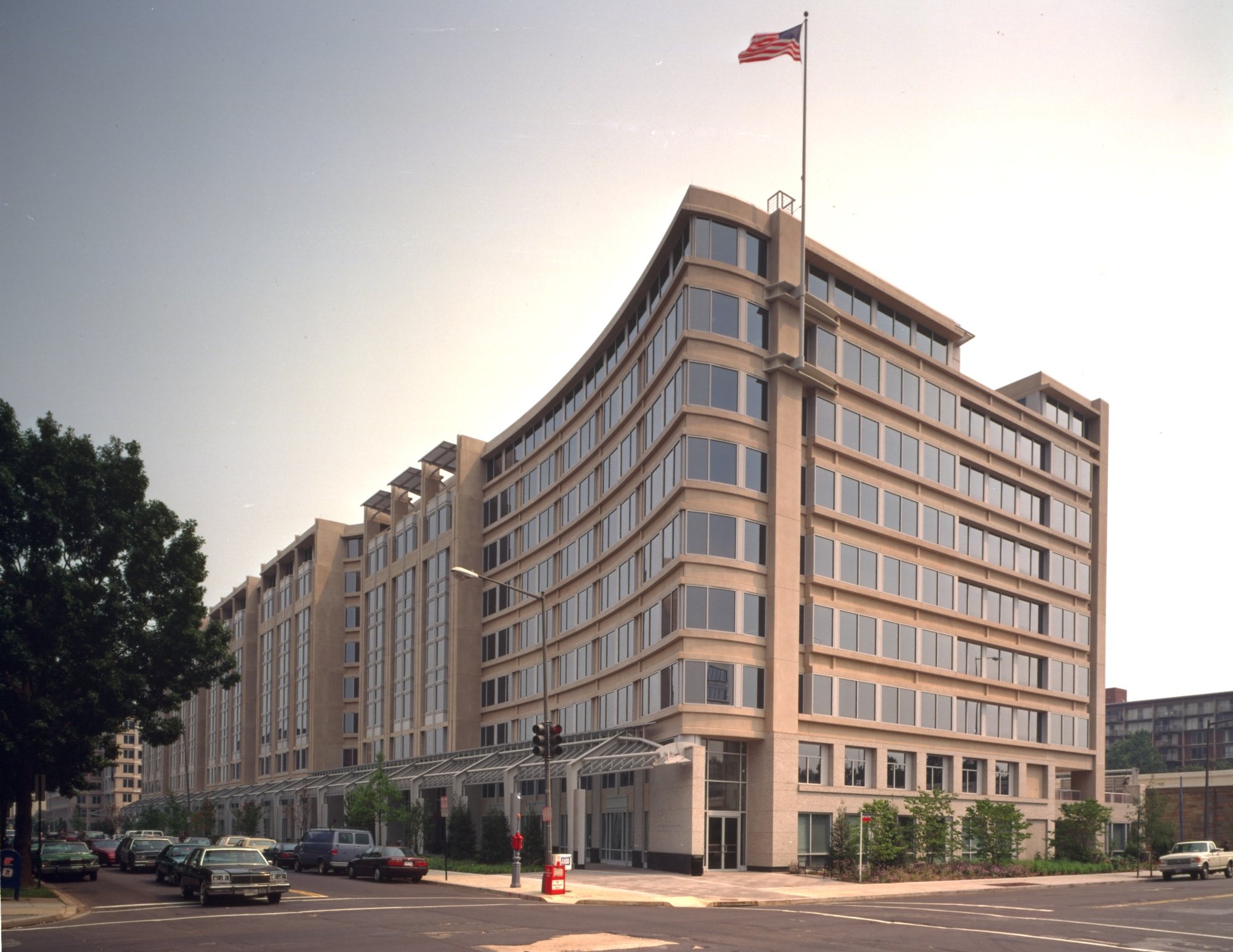
Pictured: The Mary W. Jackson NASA Headquarters building, Washington, D.C., where the report's findings were publicly announced on September 14, 2023. NASA, public domain.
Theoretical Alignment
As with this archive's other government and institutional entries, the standard ETH/IDH/PSH framing does not apply directly: this case documents a scientific advisory report, not a UAP encounter. The report's own conclusion aligns with the Psycho-Social/Mundane explanation for the great majority of the UAP phenomenon it reviewed, while explicitly declining to rule out that a small residual of cases could represent something genuinely new — a position the panel grounded not in speculation but in the observation that existing data quality is simply too poor to draw firm conclusions either way.
Background
NASA announced the formation of its Unidentified Anomalous Phenomena Independent Study Team on June 9, 2022, under the direction of Thomas Zurbuchen, then associate administrator of the agency's Science Mission Directorate. The move came amid a broader surge of federal institutional interest in the subject: the Pentagon's own UAP office would be elevated into the All-domain Anomaly Resolution Office (AARO) just six weeks later, that July, and Congress had begun pressing for greater transparency through hearings and legislative riders. NASA framed its own effort differently from the outset — not as an intelligence or defense investigation into specific incidents, but as a scientific one, asking what the agency's decades of experience in data collection, calibration, and rigorous analysis could contribute to a genuinely evidence-based understanding of the phenomenon. As the report's own foreword states plainly, "This is not a review of previous UAP incidents." A footnote in the report also records that Congress itself redefined the acronym mid-study: UAP stood for "Unidentified Aerial Phenomena" when the team was commissioned, and was formally redefined as "Unidentified Anomalous Phenomena" — broadening the term to explicitly cover undersea and transmedium events — while the study was already underway.
The team's 16 members were publicly named that October, chaired by astrophysicist David Spergel, president of the Simons Foundation and founding director of the Flatiron Institute for Computational Astrophysics. NASA scientist Dr. Daniel Evans served as the study's Designated Federal Official, the role responsible for overseeing the panel's process on NASA's behalf; Evans would later become the report's most visible spokesperson on the subject of the harassment its members faced. The full roster, drawn deliberately from outside NASA's own civil-service ranks to preserve the panel's independence, spanned astrophysics, planetary science, oceanography, national-security policy, aviation safety, data science, and science journalism:
- Dr. David Spergel (Chair) — President, Simons Foundation; founding director of the Flatiron Institute for Computational Astrophysics; professor emeritus of astrophysics, Princeton University.
- Dr. Anamaria Berea — Associate professor of computational and data science, George Mason University; research affiliate, SETI Institute; research investigator, Blue Marble Space Institute of Science.
- Dr. Federica Bianco — Professor of physics and astronomy, University of Delaware; deputy project scientist, Vera C. Rubin Observatory.
- Dr. Paula Bontempi — Biological oceanographer; dean, University of Rhode Island Graduate School of Oceanography.
- Dr. Reggie Brothers — Operating partner, AE Industrial Partners; former U.S. Under Secretary of Homeland Security for Science and Technology; former Deputy Assistant Secretary of Defense for Research.
- Dr. Jennifer "Jen" Buss — CEO, Potomac Institute for Policy Studies.
- Nadia Drake — Science journalist, National Geographic; holds a doctorate in genetics from Cornell University.
- Mike Gold — Executive vice president of civil space business development, Redwire Space; former NASA associate administrator for space policy and partnerships.
- Dr. David Grinspoon — Senior scientist, Planetary Science Institute; inaugural Blumberg NASA/Library of Congress Chair in Astrobiology.
- Capt. Scott Kelly, USN (Ret.) — Former NASA astronaut; commanded three International Space Station expeditions and spent nearly a year aboard the station as part of NASA's Twins Study.
- Dr. Matt Mountain — President, Association of Universities for Research in Astronomy, which operates the Hubble and James Webb Space Telescopes on NASA's behalf.
- Warren Randolph — Deputy executive director, FAA Accident Investigation and Prevention Division.
- Dr. Walter Scott — Executive vice president and chief technology officer, Maxar Technologies.
- Dr. Joshua Semeter — Professor of electrical and computer engineering; director, Center for Space Physics, Boston University.
- Dr. Karlin Toner — Acting executive director, FAA Office of Aviation Policy and Plans; formerly director of NASA's Airspace Systems Program.
- Dr. Shelley Wright — Associate professor of physics, Center for Astrophysics and Space Sciences, University of California, San Diego.
The study relied exclusively on unclassified data, a deliberate methodological choice Spergel and the report both describe as essential to preserving open scientific communication, even though it meant the team could not review classified military incident data directly. Their principal empirical touchstone was the dataset amassed by AARO: at the panel's May 31, 2023 public meeting, AARO Director Sean Kirkpatrick reported that his office had by then collected more than 800 reported UAP events, incorporating data newly folded in from the FAA. Congress's own 2022 decision to formally encourage military aviators to report anomalies without fear of career consequences had already driven a measurable spike in that dataset: the Department of Defense received 247 new UAP reports between March 5, 2021 and August 30, 2022, compared with just 144 total reports covered by the seventeen-year period before that (per the June 2021 ODNI preliminary assessment), according to a 2022 analysis by the Office of the Director of National Intelligence. Of that broader catalogue, the study team found, consistent with AARO's own review, that only a small residual of cases could not be immediately identified as known human-made or natural phenomena — not because those cases displayed anomalous performance, but because the underlying sensor data for them was too sparse, uncalibrated, or poorly documented to support a confident identification either way.
Complete Timeline
The timeline below traces the study from its June 2022 commissioning through the September 2023 report release and the personnel decisions that followed immediately after; the entries are drawn directly from NASA's own contemporaneous news releases and press-briefing transcript, cross-checked against independent wire and network coverage of the same events.
| Date | Event |
|---|---|
| June 9, 2022 | NASA announces it is commissioning an independent study team on UAP, to be led by the Science Mission Directorate. |
| Oct. 2022 | NASA publicly names the 16 study team members, chaired by David Spergel. |
| May 31, 2023 | The team holds its first public meeting; panel members disclose they have faced online harassment since the study was announced, drawing criticism from both UFO believers and skeptics of the study's value. |
| Sept. 14, 2023 | NASA publicly releases the team's final report and holds a press briefing with Administrator Bill Nelson, Associate Administrator Nicola Fox, and chair David Spergel; NASA also announces the creation of a Director of UAP Research position but initially withholds the appointee's name. |
| Sept. 14, 2023 (same day, hours later) | NASA names Mark McInerney, the agency's longtime Department of Defense liaison, as the first Director of UAP Research. |
| Present | NASA's UAP research program, based directly on the team's recommendations, continues under McInerney's direction, including expanded use of NASA's Earth-observing assets and exploration of AI/machine-learning tools and citizen-science data collection. |
Methodology and Scope
NASA structured the team's charge around eight specific questions, formally called the Statement of Task, covering what data NASA and other civilian entities already held that might illuminate UAP, what new data NASA should collect, which analytical techniques could apply, what physical constraints could be placed on the phenomenon from existing information, and how the agency's own Aviation Safety Reporting System and air-traffic-management partnerships with the FAA might be adapted for the purpose. The panel organized its work around a series of sub-panel reports, each addressing a cluster of these questions, which the full team then deliberated and reconciled at a single public meeting on May 31, 2023 — a session NASA held for full public transparency, publishing the underlying sub-panel work products alongside the final report itself rather than treating them as internal deliberations.
The panel's guiding philosophy, laid out at length in the report's own "UAP in a Scientific Context" section, drew explicitly on the history of science. It quoted Thomas Jefferson's 1808 observation that "a thousand phenomena present themselves daily which we cannot explain, but where facts are suggested, bearing no analogy with the laws of nature as yet known to us, their verity needs proofs proportioned to their difficulty" — the same principle later popularized as "extraordinary claims require extraordinary evidence." The report drew analogies to prior scientific mysteries eventually explained through patient, methodical data collection rather than either credulous acceptance or dismissal: the 1967 discovery of pulsars by graduate student Jocelyn Bell Burnell, whose eerily regular radio pulses briefly seemed artificial before being identified as a rapidly rotating neutron star, and Cold War-era gamma-ray bursts, first detected by satellites built to monitor nuclear tests, which decades of follow-up data eventually traced to the collapse and collision of distant stars. The panel also quoted Carl Sagan's The Demon-Haunted World — "science carries us toward an understanding of how the world is, rather than how we would wish it to be" — and invoked Sherlock Holmes's dictum that "once you eliminate the impossible, whatever remains, no matter how improbable, must be the truth," explicitly framing extraterrestrial origin as a hypothesis of last resort, to be considered only after every conventional explanation had been exhausted.
Underlying all of the panel's specific recommendations was a single methodological commitment: reports alone, however credible the witness, cannot constitute scientific data. The working null hypothesis for any UAP case, the report explained, must be that the phenomenon observed is "consistent with known natural or technological causes." Eyewitness accounts, including from trained military and commercial pilots, "may be inherently credible," the panel wrote, but they are not repeatable by others and do not permit investigation of the ordinary sources of error, such as misjudged distance or speed, that affect any human observer; as a result, "reports do not alone constitute data that can support a repeatable, reproducible analysis." That standard, more than any specific finding about any specific sighting, is what the panel meant when it said the absence of good data, not the absence of genuine anomalies, was the core of the problem it had been asked to address.
The report also walked through, in some technical detail, how scientists actually separate a genuine anomaly from ordinary background noise, drawing analogies from outside the UAP field entirely. Neutrino experiments, it noted, are often built deep underground — at Italy's Gran Sasso National Laboratory, or in the ice of Antarctica — specifically because the Earth itself blocks the far more common particles that would otherwise swamp a rare neutrino signal; meteorite hunters, similarly, favor Antarctica's ice sheets because any rock at all found there is automatically an object of interest. The panel argued UAP research faces the opposite problem: the airspace around military installations, where many notable encounters occur, is thick with exactly the kind of background — aircraft, drones, weather balloons — that makes rare signals hardest to isolate, meaning a systematic UAP-detection strategy would need either a genuinely low-clutter search environment or, more realistically, an exhaustively detailed model of what "normal" airspace activity looks like so that true deviations could be reliably flagged. As an example of how independent, rigorously collected datasets can converge on a genuinely surprising result, the report cited the 1990s discovery that the universe's expansion is accelerating — now attributed to "dark energy" — which two separate research teams, working independently with their own data, arrived at almost simultaneously, offering a model for the kind of independently corroborated, hard-to-dismiss finding the panel hoped a mature UAP research program might eventually produce.
Critically, the study team was explicit that its mandate did not include re-investigating individual historical UAP incidents case by case; its job was to assess what data existed and recommend how NASA could help generate better data going forward. Where the report did examine a specific incident in detail, it was to illustrate a methodological point rather than to adjudicate the case. Its treatment of the Navy "GoFast" video — recorded by an F/A-18 aircrew from the USS Theodore Roosevelt and among the most widely circulated UAP videos ever released by the Department of Defense — is the clearest example. The infrared footage appears to show an object skimming rapidly above the ocean, but the report worked through the display's own embedded flight data (camera elevation and azimuth angles, target range, aircraft altitude, and airspeed) to reconstruct the geometry of the encounter: the object was roughly 13,000 feet up and 4.2 miles from the ocean surface behind it, and the aircraft's own groundspeed of about 435 mph, combined with parallax, accounted for much of the visual impression of speed. Using the jet's 15-degree banking turn over a 22-second interval, the panel calculated the object's own true motion at only about 390 meters over that period — an average speed of roughly 40 mph, consistent with ordinary wind drift at that altitude. The object also appeared brighter, meaning colder, than the ocean behind it in the infrared display, providing no evidence of heat from a propulsion system. The panel's conclusion was not that the object was conclusively identified, but that "the analysis reveals that the object need not be moving at an extraordinary velocity" — a demonstration, using only publicly released data and a napkin's worth of trigonometry, of exactly the kind of rigorous reanalysis the report argued was too rarely applied to UAP footage.
The Central Finding: A Data Problem, Not a Phenomenon Problem
The report's most consequential conclusion was not that UAP do not exist or are uninteresting, but that the entire field has historically suffered from a chronic shortage of high-quality, reproducible, multi-sensor data. As the team put it, "the absence of reproducible data makes it challenging to draw firm conclusions about some UAP origins." Rather than treating that data gap as reason to dismiss the topic, the panel explicitly recommended NASA leverage its existing and planned Earth-observing satellite assets to gather independent environmental and sensor data on any future UAP detected by other means, and separately recommended applying artificial intelligence and machine-learning tools, alongside crowdsourced smartphone data from trained citizen observers, to build a systematic, science-grade UAP dataset going forward — the opposite of a dismissive posture, grounded instead in the argument that good science requires good instruments, not merely goodwill.
The panel was specific about which of NASA's own assets it believed could help close that data gap. Earth-observing satellites such as Terra and Aqua, it noted, generally lack the spatial resolution to image an object the size of a typical UAP directly, but their instruments could still be used retroactively to check the atmospheric, oceanic, and environmental conditions coincident with a reported sighting. The forthcoming NASA-ISRO Synthetic Aperture Radar (NISAR) mission, the Vera C. Rubin Observatory's new large-sky surveys, and the 160-radar NEXRAD Doppler network jointly run by the FAA, U.S. Air Force, and National Weather Service were all identified as existing or near-term civilian assets that could help distinguish a genuine anomaly from ordinary airborne clutter, weather, or sensor artifacts. The panel was careful to note that better analysis techniques alone would not solve the problem: "At present, UAP analysis is more limited by the quality of data than by the availability of techniques," it concluded, meaning that even NASA's considerable expertise in artificial intelligence and machine-learning-based anomaly detection would be of limited use until it had well-calibrated, well-documented data to train on.
The panel's crowdsourcing proposal was more specific than a generic call for "an app." It envisioned an open-source, smartphone-based platform, consistent with NASA's institutional commitment to open-source software, capable of collecting near-simultaneous images and sensor metadata from multiple citizen observers of the same event, which could then be triangulated to independently estimate an object's location, velocity, and size without relying on any single witness's account. Built potentially in partnership with AARO and commercial partners, such a system would also need better general data curation: absent a standardized federal reporting channel, the panel noted, civilian UAP reports were then being routed piecemeal to local law enforcement or nonprofit clearinghouses such as the National UFO Reporting Center, producing exactly the fragmented, uncurated record the panel considered scientifically unusable. As a proof of concept for citizen-driven discovery, the report pointed to Galaxy Zoo, a crowdsourced astronomy project whose volunteers helped identify Boyajian's Star, a star with strange, irregular dimming that was briefly considered a serious candidate for an alien megastructure before years of additional, better-calibrated data traced the behavior to a mundane disk of disrupted comet debris — a case study, the panel argued, in how only sustained, transparent, well-instrumented follow-up, not speculation in either direction, actually resolves an anomaly. For genuinely fast-moving events, the report also cited NASA's existing General Coordinates Network, built to rapidly alert astronomers to transient cosmic phenomena like gamma-ray bursts, as a working proof of concept for the kind of automated, real-time follow-up infrastructure a mature UAP-detection system would eventually need.
The report also proposed a concrete, if still theoretical, path to eventually placing hard physical constraints on the phenomenon. Because the performance envelope of known aircraft, drones, and balloons is already well understood, the panel argued that convincingly documented UAP behavior falling within those ordinary bounds would point toward a mundane explanation, while well-corroborated evidence of genuinely anomalous velocity or acceleration — the kind that has featured in some of the more dramatic military encounter narratives — would instead point toward something scientifically novel. The panel regarded reliably distinguishing between the two as "within reach" if the whole-of-government data-collection framework it recommended were actually implemented, underscoring that its conclusions were a roadmap toward future certainty rather than a claim to have already resolved the question.
Even though its own analysis relied on unclassified data, the report's printed pages included a handful of already-declassified Department of Defense images for illustration, credited to AARO. One, describing footage from an MQ-9 drone over South Asia, showed an object trailing what appeared to be an atmospheric wake or cavitation; AARO's own caption stated it was likely a commercial aircraft, with the apparent wake most likely a compression artifact introduced by the video's recording format. Another, from an MQ-9 over the Middle East, showed a silver, orb-like object that AARO's caption said remains unidentified due to limited data — precisely the outcome the panel described as typical of the current dataset: not proof of anything exotic, but a case where the available imagery simply was not good enough to reach a confident conclusion either way.
The report also urged NASA to apply the same FAIR data principles — Findability, Accessibility, Interoperability, and Reusability — that already govern its handling of climate, astrophysics, and planetary science data to any future UAP archive, so that both professional scientists and citizen researchers could mine it directly rather than relying on selectively released case files. It further suggested NASA use its convening power to organize multidisciplinary workshops and structured "data challenges," in which outside researchers would compete to develop anomaly-detection methods against shared mock datasets — an approach already common in fields like particle physics and exoplanet science — as a low-cost way to seed a genuine UAP-analysis research community before NASA's own systematic data collection had even matured.
On the civilian reporting side, the panel singled out NASA's own Aviation Safety Reporting System (ASRS), a confidential, voluntary, non-punitive channel that NASA has administered on the FAA's behalf for 47 years, taking in roughly 100,000 reports annually and more than 1.94 million since its creation, as an underused resource that could be adapted to collect standardized commercial-pilot UAP reports at scale — precisely the kind of professional, non-anonymous testimony the report argued carries the most evidentiary weight. The panel also addressed why so much of the most dramatic UAP data remains locked away in the first place: much of what military sensors and intelligence satellites capture is classified, the report acknowledged, typically not because of what the imagery shows about UAP themselves, but because of what it would reveal about U.S. sensor capabilities to adversaries. That necessary secrecy, the panel wrote, nonetheless "enhance[s] the sense of mystery and conspiracy surrounding UAP" and presents "an obstacle to scientific inquiry" — a tension the report did not attempt to resolve, since it falls outside NASA's own unclassified mandate, but flagged as a structural reason the public conversation and the classified evidence base rarely meet. On future air-traffic systems specifically, the panel recommended NASA use its long partnership with the FAA to explore passive sensing techniques and real-time machine-learning analysis within next-generation air-traffic-management platforms, so that anomalous-object detection could eventually be built into the same infrastructure that already tracks ordinary air traffic, rather than bolted on after the fact.
The Stigma Problem
A second major theme of the report was the corrosive effect of social and professional stigma on data quality itself. Spergel stated plainly that "stigma has limited reporting by pilots, both civilian and military," meaning that even genuinely anomalous events likely go underreported by exactly the trained observers — commercial and military aviators — whose reports would carry the most evidentiary weight. The report called for normalizing UAP reporting as a routine, non-stigmatized part of aviation safety culture, a recommendation directly consistent with the Navy's own 2019 decision to revise its UAP reporting guidance for the same underlying reason.
The report did not treat this as an abstract concern. It documented, in its own words, that "at least one scientist serving on the study team reported receiving negative (hate) mail from colleagues due to their membership. Others were ridiculed and criticized on social media." Team members also said they were personally aware of colleagues elsewhere in academia who had been warned to steer clear of research into topics like extraterrestrial technosignatures altogether, out of concern that even adjacent association with the subject could damage their scientific credibility or promotion prospects — a dynamic the panel called "anathema to the scientific method." The stigma problem, in other words, was not confined to the study team itself; it was, the panel argued, a structural feature of how the broader scientific community had long treated the entire subject.
The panel connected this culture of stigma directly to gaps in the data record on the civilian side as well as the military one. With no dedicated, standardized federal channel for civilian UAP reports, the FAA's own guidance simply directed members of the public to contact local law enforcement or outside nonprofit groups such as the National UFO Reporting Center — producing exactly the kind of sparse, inconsistent, uncurated data the panel identified as the field's core obstacle.
NASA's own remedy, as the report framed it, leaned on the agency's institutional reputation rather than any new legal authority. "The NASA logo is enough to generate interest and credibility," the report observed, arguing that fields once considered fringe had moved into the scientific mainstream specifically once NASA lent its name and rigor to them, and that NASA's decades of public trust — distilled in campaigns like "NASA is with you when you fly" — positioned the agency to model transparent, skepticism-based reporting for a subject long associated with credulity on one side and mockery on the other.
Beyond Earth: Technosignatures and the Extraterrestrial Question
Although the report's headline finding was that no evidence points to an extraterrestrial origin for any UAP event, its treatment of the extraterrestrial hypothesis itself was more careful, and more scientifically grounded, than a flat denial. The panel drew directly on the vocabulary of the search for extraterrestrial intelligence, a field with its own decades-old scientific literature: it cited astronomer Jill Tarter, a pioneer of SETI research, who in 2007 coined the term "technosignature" to describe any detectable trace of an advanced civilization's technology, from atmospheric pollutants on a distant exoplanet to the waste heat a hypothetical Dyson sphere would be expected to radiate. NASA, the report noted, has itself funded technosignature research, including a survey of existing infrared data for exactly that kind of waste-heat signature and studies of potential atmospheric technosignatures on exoplanets, without ever claiming to have found one.
The report placed UAP within what it called an "intellectual continuum" running from established SETI research, to solar-system-scale searches for artificial objects, to the more immediate question of unidentified activity within Earth's own atmosphere. NASA already has the technical capability to launch spacecraft fast enough to escape the Sun's gravity entirely, at roughly 45 kilometers per second; a civilization capable of genuinely interstellar travel would likely need to sustain velocities far beyond that, potentially approaching a meaningful fraction of the 600-kilometer-per-second escape velocity of the Milky Way itself. Rather than treating that possibility as either self-evidently absurd or secretly confirmed, the panel's position was that if the underlying premise of extraterrestrial technology anywhere is scientifically worth taking seriously, intellectual consistency requires taking it seriously everywhere along that continuum, including, in principle, in Earth's own skies — while still insisting that the evidentiary bar for concluding any specific UAP event actually is such technology remains the highest one in science.
The September 14 Public Briefing
NASA presented the completed report at a press briefing on the morning of September 14, 2023, at its Washington headquarters. Administrator Bill Nelson, Associate Administrator Nicola Fox, Dan Evans, and David Spergel all spoke, with Nelson opening by calling it "the first time that NASA has taken concrete action to seriously look into UAP" and stating the agency's aim was to "shift the conversation about UAP from sensationalism to science." Reporters' questions ranged well beyond the report itself. A BBC correspondent asked Spergel about the widely mocked September 12 hearing before the Mexican Congress, held just two days earlier, at which a longtime UFO researcher had presented two small mummified specimens claimed to be non-human "alien" remains; Spergel's response stayed strictly within the study's own evidentiary standard: "We don't know the nature of those samples," he said, adding that if researchers had "something strange," the responsible course was to "make samples available to the world scientific community, and we'll see what's there." Nelson was separately asked about retired Air Force intelligence officer David Grusch's July 2023 congressional testimony alleging a secret government program retrieving non-human craft; Nelson's answer was similarly narrow: "no evidence was presented" to the study team to support that claim. A second BBC question, on how emerging federal regulation of artificial intelligence might affect NASA's own proposed use of AI and machine learning to sift UAP data, drew a more expansive answer from Nelson about balancing innovation with appropriate guardrails. Independent documentary filmmaker James Fox pressed the panel on the practical methodology question of how, exactly, an object would ever be confirmed as genuinely anomalous rather than merely unidentified.
The briefing's most pointed exchange came when NASA declined to name its newly created Director of UAP Research on the spot, citing the harassment campaign described below. A NewsNation correspondent directly challenged the officials on whether withholding a federal employee's name and title was consistent with the transparency NASA had spent the entire briefing promising; Evans's response — that the decision was meant to protect "the sanctity of the scientific process" and the individual's safety — became the moment most widely quoted afterward. NASA resolved the tension itself within hours: later the same day, the agency publicly named Mark McInerney, an award-winning meteorologist who had spent more than a decade at NASA's Goddard Space Flight Center on Earth-observing data systems before moving into the role of NASA's own liaison to the Department of Defense on UAP matters, as the first person to hold the position.
Harassment of Panel Members
The study's public reception included a genuinely troubling development the report's authors did not anticipate: sustained online harassment of the panel's own scientists. At the team's first public meeting on May 31, 2023, NASA Associate Administrator Nicola Fox called it "really disheartening to hear of the harassment that our panelists have faced online," coming from both UFO believers who suspected the study was designed to whitewash evidence and skeptics who considered the entire study a waste of NASA resources. By the September 14 final report release, NASA Science Mission Directorate official Dan Evans stated the situation had escalated: "Not only were some of the things that our panel members received during the course of this study simple trolling, some of them actually rose to actual threats." NASA's decision to withhold the new Director of UAP Research's name at the initial press conference, only naming Mark McInerney hours later the same day, was explicitly attributed to concern that the position's occupant would become a fresh target.
NASA's response to the harassment was not limited to statements. At the May 31 meeting, Fox added that "NASA stands behind our panelists and we do not tolerate abuse," and Evans confirmed that NASA's own security team was actively engaged in addressing the threats directed at panel members — a level of institutional involvement unusual for what was, on paper, an external advisory study rather than a NASA civil-service program.
Scientific and Congressional Reaction
Reaction to the report split along largely predictable lines but was, on the whole, notably more favorable than the reception NASA's panelists had feared during the harassment episode. The Scientific Coalition for UAP Studies, an organization of credentialed researchers formed to advocate for rigorous UAP research, welcomed NASA's involvement directly, stating that "NASA is the right U.S. agency to lead this effort" given its status as "our premier aerospace organization with the necessary capabilities to address the UAP question with scientific openness." Ryan Graves, the former Navy F/A-18 pilot who co-founded the pilot advocacy group Americans for Safe Aerospace and had testified before Congress on UAP as an aviation safety issue two months earlier, called the report "a historic development in UAP transparency" and noted that it showed NASA "values pilot reports to study UAP as an aerospace safety, national security, and scientific issue." Harvard astrophysicist Avi Loeb, whose own Galileo Project pursues a parallel, privately funded search for anomalous aerospace objects, said he was glad to see a major federal science agency take the subject seriously and argued it was "the civic duty of scientists to attend to this phenomena and try to explain it." Historian of science Greg Eghigian, whose research traces the twentieth-century history of UFO belief, described NASA's willingness to publicly attach its name to the subject as a signal that had already measurably loosened the taboo against academic UAP research, giving scientists and scholars who had privately found the subject interesting new cover to say so openly.
Not every reaction was celebratory. Some skeptics of UAP research as a scientific priority argued NASA had spent seven months, and considerable reputational capital, to reach a conclusion — that better data is needed — that was already conventional wisdom among specialists in the field, while some UFO researchers and enthusiasts criticized the report for declining to weigh in on classified military encounter narratives at all. Both criticisms, in different ways, illustrate the position NASA's own officials repeatedly acknowledged occupying: caught between a public eager for either confirmation or debunking of extraterrestrial visitation, and a scientific process that, by design, refuses to offer either until the underlying data supports it.
On Capitol Hill, the report landed in the middle of the most active period of congressional UAP activity in decades. Grusch's late-July testimony before the House Oversight Committee had already pushed the subject into mainstream political conversation; Representative Tim Burchett had formed a bipartisan UAP Caucus that same August, and Senate Majority Leader Chuck Schumer, together with Senator Mike Rounds, was simultaneously pushing the UAP Disclosure Act of 2023 to compel broader declassification of government UAP records. Against that backdrop, NASA's report functioned less as a bombshell than as the more conservative, methodologically cautious counterpart to the classified-disclosure fight playing out in parallel — a distinction its own authors were careful to draw, repeatedly emphasizing that their unclassified-data mandate meant they were simply not positioned to evaluate claims like Grusch's one way or the other.
NASA and AARO: Two Parallel Efforts
The report is explicit that NASA's role was always meant to complement, not duplicate or supersede, the Pentagon's AARO, which Congress designated as the lead federal organization for resolving UAP cases. AARO Director Sean Kirkpatrick worked closely with the study team throughout, presenting AARO's own data and analysis at the panel's May 31, 2023 public meeting and receiving a formal note of thanks in the report's acknowledgements for his "expertise and collaboration." The division of labor the two organizations settled on tracked their institutional mandates: AARO, housed within the Department of Defense, holds and analyzes the classified military and intelligence incident data at the center of the national-security side of the UAP question, while NASA's study team focused on unclassified data and on how the agency's civilian scientific and Earth-observation expertise could be applied to future data collection, deliberately avoiding overlap with AARO's classified caseload.
AARO itself was less than a year old when the study team's report was published. Congress created its statutory basis through the fiscal year 2022 National Defense Authorization Act, and the Pentagon stood up the office on July 20, 2022 by renaming and expanding the short-lived Airborne Object Identification and Management Synchronization Group, itself the successor to the Navy's original Unidentified Aerial Phenomena Task Force established in 2020. Sean Kirkpatrick, a physicist who had previously served as chief scientist at the Defense Intelligence Agency's Missile and Space Intelligence Center, was named AARO's first director. That AARO and NASA's own study team were essentially standing up in parallel, only weeks apart, is part of why the two organizations coordinated as closely as they did: neither wanted the public to receive two competing, uncoordinated federal verdicts on the same underlying question. Kirkpatrick himself described the two efforts as complementary rather than redundant, with NASA evaluating unclassified data and AARO handling classified material with a national-security focus, and both organizations expressing a preference for sharing findings publicly wherever the classification of the underlying data allowed. That coordination was formalized further through the choice of the first Director of UAP Research: Mark McInerney had, prior to his September 2023 appointment, spent years as NASA's own liaison to the Department of Defense specifically on UAP matters, making him one of the very few people already positioned to bridge NASA's newly formalized civilian research effort with AARO's classified, whole-of-government one. This archive's AARO Historical Record Report, Volume I entry and UAP Task Force Formation entry together document AARO's side of that same whole-of-government effort.
The report was also careful to frame every one of its recommendations within a "whole-of-government" structure in which AARO, not NASA, holds the lead role. "Although AARO leads the whole-of-government response to UAP," the report states, "the panel recommends that NASA play an essential role within that framework," leaving it to NASA's own leadership to determine, recommendation by recommendation, "whether it should take a leading or supporting role in implementing" each one — a deliberately modest institutional posture that likely helped the report avoid the kind of bureaucratic turf disputes that have complicated other multi-agency UAP initiatives.
Key Figures
David Spergel
Led the 16-member panel and its unclassified-data-only methodology, and became the report's principal public spokesperson, emphasizing both the field's data-quality problems and the toll of harassment on his team.
Bill Nelson
Presented the report's findings at the September 14, 2023 press conference, stating NASA found no evidence of extraterrestrial origin while stressing the agency's commitment to studying UAP "transparently for the benefit of humanity."
Nicola Fox
Publicly acknowledged the panel's harassment at the May 2023 public meeting and helped oversee the study's transition into NASA's ongoing UAP research program.
Sean Kirkpatrick
Presented AARO's classified-program counterpart data at the study team's May 31, 2023 public meeting and was formally thanked in the report's acknowledgements; described NASA's unclassified-data study and AARO's classified caseload as complementary halves of the same whole-of-government UAP effort.
Ryan Graves
Welcomed the report's focus on pilot reporting as "a historic development in UAP transparency," reflecting the aviation-safety community's reaction to NASA's involvement in destigmatizing UAP reports from commercial and military aircrews.
The Five Observables Assessment
The Five Observables framework describes claimed craft performance characteristics and does not apply to this case, which documents a scientific advisory report rather than a sighting:
Assessment: This case documents a report about how to study UAP scientifically, not an observed craft, and the Five Observables framework is included here only for structural consistency with the rest of the archive.
Evidence Assessment
Fully Documented Institutional Fact
- The report's existence, panel membership, and full text are confirmed by official NASA publication and a recorded, widely covered public press conference, the strongest evidentiary category this archive applies.
- The panel's stated methodology (unclassified data only) and its central data-quality conclusion are independently corroborated by contemporaneous reporting from NPR, CBS News, and other outlets that reviewed the full report text.
- The report's methodological rigor is independently checkable: its reanalysis of the Navy "GoFast" video, for example, uses only publicly released flight-display data and shows its arithmetic in full, allowing any reader to verify the panel's conclusion that the object's true motion was consistent with ordinary wind drift.
Limits on What This Report Establishes
- Because the panel used only unclassified data, it could not directly evaluate the specific classified incidents most central to the concurrent AARO and congressional disclosure debates, limiting how directly its conclusions bear on claims like David Grusch's.
- The report's "no evidence of extraterrestrial origin" finding is, by its own admission, a statement about data insufficiency for a small residual of cases rather than a claim to have positively explained every incident reviewed.
Why "Credible"
This case is rated Credible because it represents an unusually well-executed, methodologically transparent piece of independent science advisory work, distinct in character from this archive's more contested government-report entries. Unlike the AARO Historical Record Report, which drew specific, credentialed criticism over factual errors and sourcing, the NASA study team's report has not attracted comparable substantive pushback on its accuracy; the controversy it generated was almost entirely external (harassment of panelists) rather than internal to the report's own findings or methodology. Its central recommendation — that the field needs better instruments and less stigma, not more speculation — is a scientifically serious, falsifiable, and actionable position that NASA has since begun implementing through the Director of UAP Research role.
This file does not rate the case Verified rather than Credible because the report's conclusions, while well-supported, remain forward-looking recommendations rather than a closed, complete accounting; NASA's own UAP research program was just beginning at the time of the report's release, and its ultimate success in generating the higher-quality data the panel called for cannot yet be fully assessed from this vantage point.
The process itself resembles, more than a typical press-driven UFO disclosure story, the kind of independent expert-panel review NASA and the National Academies regularly commission to evaluate the scientific merit and risk of major missions and research programs: a named, credentialed, publicly vetted panel; a defined statement of task; open deliberation at a public meeting; and a final report published in full rather than summarized through selective leaks. That process-driven credibility is precisely what distinguishes this case from many of the leak- and testimony-driven UAP stories elsewhere in this archive, where the underlying evidence is often available to readers only secondhand, through a witness's account of documents or footage the public itself cannot review. Here, by contrast, virtually every substantive claim in this file can be checked directly against a single, publicly posted document.
Observer Credibility & Occupational Profile
The panel's credibility rests on genuinely strong scientific and institutional credentials: astrophysicist David Spergel (Princeton emeritus, Simons Foundation president), a former NASA astronaut, multiple university physics and data science faculty, and senior FAA and aerospace industry officials, assembled and vetted by NASA's own Science Mission Directorate under a public, transparent nomination process. This file finds the panel's decision to restrict itself to unclassified data, even at the cost of being unable to directly assess classified incidents, a credibility-strengthening choice rather than a weakness, since it kept the panel's own analysis fully open to independent verification by outside scientists and journalists.
The panel's composition was also deliberately broader than a purely astronomical review board: alongside astrophysicists and a former astronaut sat a biological oceanographer, aviation-safety regulators from the FAA, a national-security policy specialist, a science journalist, and senior executives from the commercial satellite-imaging and aerospace industries. That breadth mattered directly to the report's conclusions — the FAA officials' input shaped its recommendations on reporting culture and the Aviation Safety Reporting System, while the commercial remote-sensing executives informed its assessment of what private-sector satellite constellations could realistically contribute to future UAP detection. NASA's public, credentialed nomination process for this panel mirrors the process the agency uses to empanel review boards for major scientific missions and safety reviews, rather than any bespoke or closed-door selection method — a detail that further distinguishes this study from ad hoc UAP commissions and self-appointed research groups elsewhere in the field, whose members and selection criteria are not always disclosed.
Historical Precedents & Archive Matches
This case connects directly to this archive's AARO Historical Record Report, Volume I entry, which the NASA team's own dataset partly draws from, and to the UAP Task Force Formation entry, representing the civilian-scientific counterpart to the Pentagon's parallel institutional UAP effort.
Material Analysis
The primary evidence for this case is the report itself, published on NASA's website and presented at a recorded, publicly available press conference on September 14, 2023, alongside the underlying claim that the panel reviewed AARO's catalogue of more than 800 unclassified UAP incidents as its principal empirical reference point.
Beyond the report's own text, this file's account is corroborated by several independent layers: the official NASA news release naming the panel and, separately, its final findings; the full video record and rush transcript of the September 14 press briefing, in which every quoted official statement in this file can be checked word-for-word; and contemporaneous, independently reported coverage from outlets including NPR, CBS News, the BBC, Bloomberg, and UPI, none of which have disputed the report's central data-quality finding or its account of the harassment panel members faced. Where this file quotes the report's internal reasoning — its use of the GoFast video, its discussion of technosignatures, or its citation of specific reporting statistics — those passages are drawn directly from NASA's own publicly posted PDF rather than from secondhand paraphrase.
Supporting the Report's Credibility
- The panel's unclassified-only methodology, while limiting its scope, maximized independent verifiability, and its central recommendations (better sensors, less stigma) have not been substantively disputed by credentialed critics in the way AARO's Volume I was.
Limitations
- The panel could not directly examine classified incident data, meaning its findings, however credible, cannot fully settle disputes centered on classified claims.
The Conventional Explanation Candidate: An Authentic, Well-Supported Scientific Advisory Report
As with this archive's other verified institutional cases, no competing "conventional explanation" needs to be weighed here: the report is what it presents itself as, a genuine NASA-commissioned independent scientific study. The relevant assessment is whether its conclusions are well-supported by its own transparent methodology, and on that question this file finds strong, if not yet fully proven, grounds for confidence.
A caveat on trusting a government-commissioned "no evidence" finding: NASA is a civilian science agency with a stronger public-transparency track record than the Pentagon on most subjects, and this file's high-confidence rating reflects the panel's genuinely open methodology and independently credentialed membership. Even so, a federal-agency panel convened under government sponsorship to assess a politically sensitive topic is not free of institutional incentive toward a cautious, non-alarming conclusion, and the panel itself stated it was not investigating individual case data directly, only data-collection methodology — a narrower mandate than "no evidence of extraterrestrial origin" can sometimes be read to imply. This file treats the report's conclusions as well-supported for what they actually claim, not as a broader verdict on every unresolved UAP case elsewhere in this archive.
An Authentic, Well-Supported Scientific Advisory Report — Plausibility Rating: HIGH CONFIDENCE
Related Cases
Confirmed Documents & Official Records
NASA's own official UAP research page, hosting the full report and updates on the Director of UAP Research's ongoing work.
PUBLIC RECORD (freely accessible)Search Government Archives Directly
Further Reading — Recommended Literature
UFO: The Inside Story of the US Government's Search for Alien Life Here—and Out There
An extensively researched history covering NASA's study team alongside the parallel Pentagon disclosure timeline.
Extraterrestrial: The First Sign of Intelligent Life Beyond Earth
A Harvard astrophysicist's case for treating anomalous aerial and interstellar phenomena as legitimate objects of rigorous scientific inquiry, closely paralleling the NASA panel's own stated philosophy.
In Plain Sight: An Investigation into UFOs and Impossible Science
An investigative journalist's account of the modern disclosure era, including coverage of NASA's study team and its reception.
UFOs: Generals, Pilots, and Government Officials Go on the Record
An earlier, influential compilation of on-record military and government UFO testimony that helped build the case for exactly this kind of formal scientific study.
They Are Already Here: UFO Culture and Why We See Saucers
A science journalist's anthropological look at the UFO research community, useful context for understanding the stigma the NASA report specifically identified as a barrier to good data.
DISCLOSURE: Some links above are affiliate links. If you purchase through them, OverClassified receives a small commission at no additional cost to you. This helps support independent research.
Essential Viewing
NASA Discusses UFO Report
Associated Press — live coverage of the September 14, 2023 press briefing.
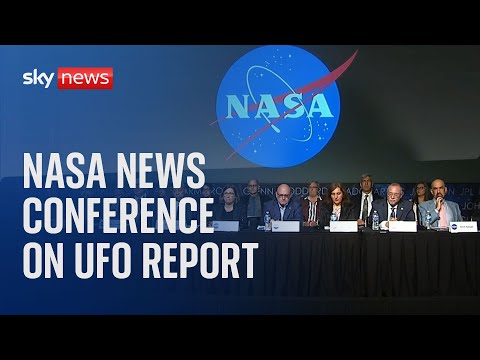
NASA News Conference on UFO Report
Sky News — international coverage of the report's release and its findings.
Sources
- "NASA's UAP Study Team Releases Its Final Report," Sci.News. Read online →
- "UPDATE: NASA Shares UAP Independent Study Report; Names Director," NASA. Read online →
- "New NASA report lays out roadmap for studying UFOs," NPR. Read online →
- "NASA report finds no evidence that UFOs are extraterrestrial," Nevada Current. Read online →
- "NASA Study Team on Unidentified Anomalous Phenomena Calls for Better Data, Ending Harassment and Stigmas," The Debrief. Read online →
- "NASA group studying UFOs stresses need for better data in first public meeting," CBS News. Read online →
- "NASA Appoints UFO Chief Mark McInerney to Investigate Mystery Craft, or UAPS," Bloomberg. Read online →
- "NASA appoints director of UAP research to investigate mysterious flying objects," UPI. Read online →
- NASA Unidentified Anomalous Phenomena Independent Study Team, Wikipedia. Read online →
- "NASA UNIDENTIFIED ANOMALOUS PHENOMENA Independent Study Team Report" (full text PDF), NASA Science Mission Directorate. Read online →
- "Unidentified Anomalous Phenomena Independent Study Report from NASA" (press briefing transcript), Rev.com. Read online →
- "NASA scientists answer questions on UFOs, 'alien corpses,' and other mysteries of the sky," The FADER. Read online →
- "UAP Panel Briefing 9/14/23," Space Defense Newsletter. Read online →
- "Unidentified Anomalous Phenomena (UAP) – NASA Independent Study Draws Reaction," Leonard David. Read online →
- NASA Director of UAP Research, Wikipedia. Read online →
- Mark McInerney, Wikipedia. Read online →
- All-domain Anomaly Resolution Office, Wikipedia. Read online →
- Graff, Garrett M. UFO: The Inside Story of the US Government's Search for Alien Life Here—and Out There. Avid Reader Press, 2023.
- Loeb, Avi. Extraterrestrial: The First Sign of Intelligent Life Beyond Earth. Houghton Mifflin Harcourt, 2021.
- Coulthart, Ross. In Plain Sight: An Investigation into UFOs and Impossible Science. HarperCollins, 2021.
- Kean, Leslie. UFOs: Generals, Pilots, and Government Officials Go on the Record. Harmony Books, 2010.
- Scoles, Sarah. They Are Already Here: UFO Culture and Why We See Saucers. Pegasus Books, 2020.
- "File: NASA HQ Building.jpg," NASA, public domain. View file →
See something inaccurate? Have additional information or sources?
Suggest an Edit →Last Updated: August 2026