
Extraterrestrial
The First Sign of Intelligent Life Beyond Earth
Core Thesis
Extraterrestrial does not claim that 'Oumuamua — the elongated, tumbling object that passed through the inner solar system in October 2017 — definitely was a piece of alien technology. Its actual argument is narrower, and Loeb insists it is more defensible: that 'Oumuamua's specific combination of anomalies, including an extreme and unprecedented shape, an unusually high and variable reflectivity, a measurable non-gravitational acceleration as it departed the solar system, and the complete absence of any cometary tail, gas, or dust despite a close solar pass, made the artificial-object hypothesis scientifically legitimate enough to deserve the same open, rigorous consideration astronomers routinely extend to far less exotic possibilities — and that the reflexive professional taboo against even raising it says more about astronomy's institutional culture than about the object itself. Loeb builds the book's title and central metaphor around Galileo Galilei, arguing that astronomy's founding figure was resisted not for being wrong but for insisting on looking through the instrument himself rather than deferring to inherited authority, and that a softer, modern version of that same resistance — not inquisition, but ridicule, funding starvation, and reputational risk — now polices any working scientist who takes the search for extraterrestrial technology seriously in public.
About the Author
Avi Loeb was born in 1962 and raised on his family's farm in Beit Hanan, Israel, before earning a Ph.D. in physics from the Hebrew University of Jerusalem in 1986 at age twenty-four. He led an international defense-research project during a fellowship at Israel's Institute for Advanced Studies, then spent five years as a long-term member of the Institute for Advanced Study in Princeton before joining Harvard's faculty in 1993. By the time Extraterrestrial was published in January 2021, Loeb held the Frank B. Baird Jr. Professorship of Science at Harvard University and had just completed a nine-year run, 2011 to 2020, as the longest-serving chair in the history of Harvard's Department of Astronomy. He was also the founding director of Harvard's Black Hole Initiative (2016–2021), director of the Institute for Theory and Computation within the Harvard-Smithsonian Center for Astrophysics (2007–present), chair of the National Academies' Board on Physics and Astronomy (2018–2021), and chair of the advisory committee for the Breakthrough Starshot interstellar-probe initiative — an elected fellow of the American Academy of Arts and Sciences and the American Physical Society who had, by that point, published several hundred peer-reviewed papers on black holes, the first stars and galaxies, and the epoch of cosmic reionization. None of that record is in serious dispute, and it matters directly to how the book was read: whatever readers make of its central hypothesis, its author arrived at 'Oumuamua as one of the most credentialed working astrophysicists in the country, not an outsider seeking legitimacy the subject could confer.
'Oumuamua entered that career almost by accident. The University of Hawaii's Pan-STARRS1 survey telescope detected it on October 19, 2017, and follow-up observations quickly established it as the first confirmed object of interstellar origin ever observed passing through the solar system. Its properties were strange from the start: extreme brightness variations implied an object with an axis ratio of roughly 5-to-1 or higher — either a cigar or, on later reanalysis, possibly a flattened pancake — tumbling in a non-principal-axis rotation unlike any comet or asteroid catalogued before it. Despite passing within about 0.25 astronomical units of the Sun, close enough to trigger the outgassing that produces a cometary tail, none was ever detected: no coma, no dust, no measurable gas emission. Yet a 2018 Nature paper by Marco Micheli and colleagues detected a statistically significant non-gravitational acceleration in the object's outbound trajectory — the same kind of subtle course change comets exhibit when venting gas propels them — with no observed venting to explain it. In November 2018, Loeb and Harvard postdoctoral fellow Shmuel Bialy published a paper in The Astrophysical Journal Letters proposing that a thin, large-area object accelerated by solar radiation pressure — a light sail — was physically consistent with that specific combination of measurements, explicitly framed as one candidate explanation among several rather than a proven conclusion.
Loeb founded the Galileo Project at Harvard in July 2021, six months after this book's publication, as a direct institutional answer to its central argument: rather than simply asserting that alien technology deserves serious study, the project built a network of AI-classified telescopes, radio receivers, audio sensors, and magnetometers to search systematically for physical technosignatures — a complement to signal-based SETI focused on artifacts rather than transmissions. He has remained the field's most publicly visible advocate for treating the extraterrestrial-technology hypothesis as ordinary science ever since, extending the project's work in 2023 to a widely covered ocean expedition off Papua New Guinea recovering metallic "spherules" from the seabed near the fall site of IM1, a 2014 meteor NASA has described as of probable interstellar origin, and publishing a 2023 sequel, Interstellar: The Search for Extraterrestrial Life and Our Future in the Stars.
It is worth stating plainly what distinguishes this book's author from most others on this site's list: Loeb's academic credentials were never seriously contested by his critics. What became genuinely, sharply disputed after 2018 was his scientific judgment on this one specific question — whether the 'Oumuamua data actually supported an artificial-origin hypothesis as strongly as he argued, and whether a Harvard astrophysicist's public certainty on a matter his own subfield's specialists considered unresolved was a service to open inquiry or a disservice to it. That dispute, discussed at length below, is the reason this particular Essential Reading entry carries an unusually extensive Critical Reception section: few books on this list generated as immediate, as technical, or as personally pointed a response from other working scientists.
Historical Context & Origins
'Oumuamua's October 2017 discovery landed at a genuinely unusual moment for the scientific respectability of searching for extraterrestrial technology. NASA had convened its first dedicated technosignatures workshop earlier that same year, formally reopening a research category that had been effectively defunded and stigmatized within the agency since Senator Richard Bryan's 1993 amendment killed NASA's original SETI program a year after it began. Only weeks after 'Oumuamua's discovery, the New York Times broke the story of the Pentagon's Advanced Aerospace Weapon System Applications Program and the Navy pilot encounters that became the "Gimbal," "GoFast," and "FLIR1" videos — reporting that, alongside Tom DeLonge's simultaneous launch of To The Stars Academy, began pulling credentialed scientists and former officials into public UAP conversation for the first time in decades. Loeb's book, written and published squarely inside that reopening window, applied the same reconsideration already underway in national-security circles to a purely astronomical object with no military or classified dimension at all.
The book also arrived just as the U.S. government's own UAP disclosures were accelerating past it: the Pentagon confirmed the authenticity of the Navy pilot videos in April 2020, nine months before Extraterrestrial reached shelves, and the Office of the Director of National Intelligence released its unclassified Preliminary Assessment on Unidentified Aerial Phenomena five months after publication, in June 2021 — the same period in which Loeb was founding the Galileo Project. That timing gave a book about a natural-seeming interstellar object an unusually receptive mainstream audience already primed by an entirely separate news cycle about military UAP encounters, even though Loeb was careful throughout to keep 'Oumuamua analytically distinct from Navy sightings, treating it as a testable astronomical data set rather than an eyewitness report.
Loeb frames his own argument explicitly against Carl Sagan's dictum that extraordinary claims require extraordinary evidence, arguing in the book that the claim actually requiring extraordinary justification is the reflexive assumption that any anomalous interstellar object must be natural, given that humanity had never before observed one closely enough to know what "natural" even looks like for this specific class of object. That framing places Extraterrestrial in a long lineage of scientist-authored arguments for taking technosignature searches seriously — tracing back through Frank Drake and Sagan's own founding of modern SETI in the 1960s and Freeman Dyson's 1960 proposal that advanced civilizations might build detectable megastructures around their stars — while positioning Loeb, uniquely among that lineage, as arguing from a single specific object already in hand rather than a general search strategy for future signals.
Core Arguments & Key Concepts
The book's evidentiary core is the specific, compounding set of measurements that made 'Oumuamua unlike any previously catalogued comet or asteroid: its extreme elongation or flattening, inferred from a tenfold brightness variation as it tumbled; its unusually high albedo, brighter than typical cometary nuclei; its complete lack of a coma or measurable outgassing despite a 0.25 AU solar approach close enough to vaporize surface ice on any ordinary comet; and the statistically significant non-gravitational acceleration detected in its outbound trajectory, a course change with no observed venting to explain it. Loeb walks through each anomaly in turn and argues that while any single one might individually admit a natural explanation, their specific combination — extreme shape, no tail, yet cometary-style acceleration — was unprecedented enough to warrant treating an artificial explanation as a live hypothesis rather than dismissing it out of hand.
Its most technical proposal is the light-sail hypothesis Loeb developed with Shmuel Bialy: that if 'Oumuamua's non-gravitational acceleration were driven by solar radiation pressure rather than gas venting, the object's measured brightness would require it to be extremely thin relative to its surface area — consistent with an artificial sail-like structure, whether an active spacecraft, a discarded piece of technology, or debris from a larger vessel, rather than any known natural body. Loeb is explicit in the book that this is a physically consistent hypothesis compatible with the observed data, not a proven identification, and repeatedly proposes specific follow-up observations — radar reflectivity, spectroscopy of a future comparable object — that could have falsified it, a methodological point his critics, discussed below, argue the book's confident public rhetoric did not always match.
A second, closely related argument concerns scientific culture rather than 'Oumuamua itself: Loeb contends that many working astronomers privately consider the artificial-origin hypothesis worth taking seriously but avoid saying so publicly for fear of career damage, media ridicule, or association with UFO culture's reputational baggage — a self-censoring taboo he argues actively degrades the field's ability to investigate genuinely anomalous data on its own terms. The argument runs strikingly parallel to the private-conviction-versus-public-silence dynamic this site's own American Cosmic documents among a different, more secretive network of scientists and engineers, though Loeb's proposed remedy is the opposite of Pasulka's ethnographic distance: rather than studying the silence, he argues scientists should simply stop observing it.
Running underneath the astrophysics is a genuinely personal, memoir-inflected argument about scientific humility, drawing on Loeb's childhood on an Israeli farm and his early academic interest in philosophy: he repeatedly frames Copernican and Darwinian revolutions as historical evidence that humanity has consistently overestimated its own cosmic centrality, and argues that assuming Earth hosts the only technological civilization in a galaxy of hundreds of billions of stars is a comparable failure of imagination rather than a scientifically conservative default. Reviewers, discussed below, split sharply on whether that register strengthened or undercut the book's scientific argument — but it directly foreshadows the practical remedy Loeb proposes in its closing chapters and then built six months later: a systematic, well-funded, instrument-based search for technosignatures, which became the Galileo Project.
Key Cases & Evidence Discussed
Extraterrestrial is organized around a single astronomical object rather than a catalogue of witnessed sightings, so it has no direct counterpart among this site's eyewitness case files; its clearest connection to this site's own library runs through the theory and technosignature-research pages that document the same scientific debate from the outside.
This site's own Extraterrestrial Hypothesis theory file treats Loeb's work as "perhaps the most significant recent development in the scientific debate over the ETH," walking through the same 2017 Pan-STARRS1 detection, the non-gravitational acceleration, the absent cometary tail, and the 2018 Loeb-Bialy light-sail paper this book expands into a full-length argument, and explicitly credits Extraterrestrial with bringing the hypothesis "into mainstream scientific discourse in a way no academic had attempted since" 1960s UFO investigator James McDonald.
The Beatriz Villarroel & the VASCO Project file (Case #193) documents a separate, credentialed astronomer running her own peer-reviewed technosignature search — hunting for stars that vanish or appear across archival sky-survey plates rather than for anomalous interstellar objects — and this site's own resources library already cites this book directly against that case file, describing Loeb as facing "a broadly parallel mix of institutional interest and professional skepticism" to Villarroel's own; both researchers occupy the same narrow, contested space of mainstream-credentialed scientists running observational technosignature programs rather than analyzing witness testimony.
The book's argument also anticipates the Galileo Project's 2023 recovery expedition for IM1, a 2014 meteor NASA's Center for Near Earth Object Studies has described as having interstellar-origin characteristics comparable to 'Oumuamua's own hyperbolic trajectory; that expedition and the disputed "spherules" it recovered from the Pacific seabed off Papua New Guinea are not the subject of this book, published two years earlier, but represent the direct, real-world test of the systematic search this book's closing chapters argue for.
Critical Reception & Controversies
Trade and mainstream review coverage was largely positive on the book's craft even where reviewers hedged on its central claim. Publishers Weekly called it a "thought-provoking work of popular science," and Kirkus Reviews described it as "a tantalizing, probing inquiry into the possibilities of alien life in the universe." Writing in The New York Times, Dennis Overbye called it "well worth reading," characterizing it as "part graceful memoir and part plea for keeping an open mind about the possibilities of what is out there in the universe" while noting plainly that few of Loeb's fellow scientists shared his conclusion. Oliver Moody, reviewing it for The Times of London, found Loeb's "joy in conjecture and omnivorous spirit of inquiry" reminiscent of Freeman Dyson or Carl Sagan — a genuinely double-edged comparison, since both physicists were themselves known for speculative claims that outran their evidence.
The book's more skeptical mainstream reviews pressed directly on its scientific reasoning rather than its prose. Elizabeth Kolbert, reviewing it for The New Yorker in January 2021 under the headline "Have We Already Been Visited by Aliens?," wrote that Loeb "explicitly rejects the Sagan standard" that extraordinary claims require extraordinary evidence — a pointed inversion of Loeb's own framing, since he argues in the book that Sagan's standard is being misapplied against him rather than by him. Jeff Foust, reviewing it for the space-policy publication The Space Review in January 2021, concluded that Loeb "fails to close the case that the object must be artificial," noting that 'Oumuamua is no longer observable and the existing data "is all we will ever have," and invoking the 1967 discovery of pulsars — briefly nicknamed "LGM-1," for "little green men," before their natural origin was confirmed — as a direct historical precedent for anomalous signals that turned out not to require an artificial explanation.
The most substantive scientific rebuttals came from planetary scientists working directly on 'Oumuamua's physical properties. An International Space Science Institute team led by Michele Bannister had already concluded in a July 2019 Nature Astronomy paper, published before this book, that 'Oumuamua's observed properties were "consistent with a purely natural origin" and that there was "no compelling evidence to favor an alien explanation" — a consensus position from the astronomers who study interstellar objects professionally that the book was written squarely against. In March 2021, weeks after publication, Arizona State University's Steven Desch and Alan Jackson published a peer-reviewed alternative in the Journal of Geophysical Research: Planets proposing that 'Oumuamua was a fragment of nitrogen ice shed from a Pluto-like exoplanet, a fully natural mechanism their modeling showed could reproduce the object's albedo, shape constraints, and non-gravitational acceleration without invoking technology at all.
Individual astronomers, including some sympathetic to technosignature research as a legitimate field, were often the sharpest named critics of this specific book. Penn State astronomer Jason Wright, himself a working SETI researcher who has argued elsewhere for taking technosignature searches seriously, wrote at length that Loeb "has no formal training or previous track record" in planetary science specifically, and that his public certainty left "career-long experts in the fields he is opining on" feeling "characterized as obstinate and short-sighted" — a critique from inside the very research community the book claims to be defending, not from outside it. Ohio State astrophysicist Paul Sutter publicly called the artificial-origin claim an insult to "honest scientific inquiry," and astrophysicist Katie Mack suggested Loeb was engaging in a familiar practice of proposing a provocative hypothesis for the sake of forcing wider consideration of otherwise-neglected evidence, whether or not he fully believed it himself.
The book's February 2021 press tour also produced a widely reported personal flashpoint: at a February 12 online panel, Loeb grew visibly frustrated with SETI Institute astronomer Jill Tarter — the researcher who inspired the protagonist of Carl Sagan's Contact — after she pushed back on his framing of the field's history, and he apologized publicly afterward for the exchange. Taken together, the range of reaction — genuine trade-press enthusiasm, a serious and specific scientific rebuttal literature, and pointed criticism from researchers otherwise sympathetic to the broader technosignature-search cause — makes this one of the most substantively contested titles on this site's Essential Reading list, and this entry aims to represent that contest fairly rather than resolve it in either direction.
Influence & Legacy
The book's most concrete, verifiable legacy is institutional rather than literary: the Galileo Project, which Loeb founded at the Center for Astrophysics | Harvard & Smithsonian in July 2021, six months after publication, operationalizing the book's central argument into an actual research program. Structured explicitly as a complement to signal-based SETI, the project deploys a network of AI-classified telescopes, wide-field cameras, radio receivers, and other sensors to search systematically for physical technosignatures — artifacts and equipment rather than transmissions — giving Extraterrestrial a rare distinction among this site's Essential Reading titles: a book whose closing argument became a funded, staffed, ongoing scientific program within the same calendar year.
That same pattern of hypothesis followed by public, technical rebuttal recurred after the book's publication rather than resolving: the Galileo Project's 2023 ocean expedition off Papua New Guinea recovered metallic "spherules" near the seabed fall site of IM1, a probable interstellar meteor, which Loeb argued showed an anomalous elemental composition; University of Chicago researcher Patricio Gallardo and others countered that the spherules' composition was consistent with ordinary coal-ash pollution, a dispute that remained unresolved and mutually contested as of this writing — the same evidentiary pattern the 'Oumuamua debate had already established, playing out a second time on physical samples rather than telescope data.
Loeb's public profile grew substantially on the strength of this book and its aftermath: he followed it with a 2023 sequel, Interstellar: The Search for Extraterrestrial Life and Our Future in the Stars, has published hundreds of essays on Medium reaching a large general-interest readership, and remains one of the most frequently quoted scientific voices in UAP-adjacent media coverage, including ongoing commentary on 3I/ATLAS, a third interstellar object detected in 2025. That sustained visibility has helped keep Harvard's institutional name attached to the broader post-2017 wave of UAP-adjacent scientific legitimization this site documents across multiple pages, for better or worse depending on which of his named critics one asks.
On this site specifically, the book already functions as working infrastructure: it is cited in this site's own Extraterrestrial Hypothesis theory file as the development that brought the ETH into mainstream scientific discourse, and in resources.html against the Beatriz Villarroel & VASCO Project case file as a directly comparable case of credentialed, contested technosignature research, with this new key-figures reciprocal link extending that same cross-referencing to Loeb's own entry.
The Book
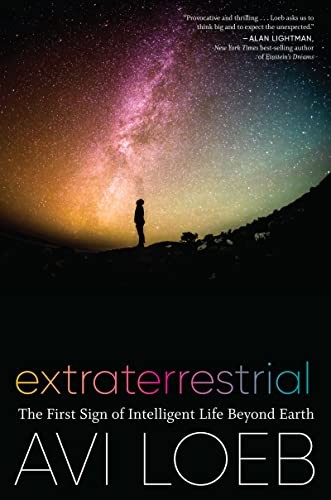
As an Amazon Associate, OverClassified may earn from qualifying purchases made through this link, at no extra cost to you.
Why This Is Essential Reading
Extraterrestrial earns its place on this list not because its central hypothesis has been vindicated — it plainly has not been, and the weight of named, credentialed opinion in planetary astronomy still runs against it — but because it is the clearest test case on this site's shelf of what happens when a scientist with genuinely unimpeachable mainstream credentials stakes real professional capital on the extraterrestrial-technology hypothesis in public. Avi Loeb's argument that 'Oumuamua's specific combination of anomalies deserved rigorous consideration was itself reasonable and, on the book's own more modest terms, largely borne out: astronomers did investigate it rigorously, publishing multiple serious alternative models within months. Where the book's reception splits sharply, and where this entry has tried to represent both sides fairly, is on whether Loeb's own public certainty in the specific light-sail conclusion outran what the data could support — a question researchers as sympathetic to the technosignature-search project as Jason Wright answered with real professional frustration. Read against this site's own American Cosmic, which documents scientists who keep this exact conviction private for fear of exactly this kind of reputational cost, Extraterrestrial is the case of the scientist who said it out loud anyway — and then built a telescope network to keep testing it, whatever the professional cost turned out to be.
Related Cases & Theories
Essential Viewing
Author Avi Loeb on evidence of close extraterrestrial encounters, new book
CBS Mornings — A television interview with Loeb recorded around the book's January 2021 publication, discussing the 'Oumuamua evidence and his case for taking the artificial-origin hypothesis seriously.
The Galileo Project
Palomar Observatory — A recorded lecture on the Galileo Project, the Harvard-based technosignature search program Loeb founded in July 2021 as a direct, funded extension of this book's closing argument.
Sources Cited
- "Avi Loeb." Wikipedia (biography: education, Harvard career, Black Hole Initiative, Galileo Project, bibliography). en.wikipedia.org
- "Extraterrestrial: The First Sign of Intelligent Life Beyond Earth." Wikipedia (publication details, summary, reception). en.wikipedia.org
- "Avi Loeb." Center for Astrophysics | Harvard & Smithsonian faculty profile (positions, honors, current research). cfa.harvard.edu
- "Extraterrestrial: The First Sign of Intelligent Life Beyond Earth." Amazon.com product listing for ISBN 0358278147 / 9780358278146 (hardcover edition cited on this site). amazon.com
- "Extraterrestrial: The First Sign of Intelligent Life Beyond Earth by Avi Loeb." Goodreads (reader ratings and edition record). goodreads.com
- "EXTRATERRESTRIAL." Kirkus Reviews (contemporary trade review). kirkusreviews.com
- Kolbert, Elizabeth. "Have We Already Been Visited by Aliens?" The New Yorker, January 25, 2021 (critical review, "Sagan standard" assessment). newyorker.com
- Foust, Jeff. "Review: Extraterrestrial." The Space Review, January 11, 2021 (critical review, pulsar/LGM-1 precedent). thespacereview.com
- Bannister, M. T., et al. "The Natural History of 'Oumuamua." Nature Astronomy, Vol. 3, July 2019, pp. 594–602 (ISSI team consensus paper: "no compelling evidence to favor an alien explanation"). nature.com
- Desch, S. J., & Jackson, A. P. "1I/'Oumuamua as an N2 Ice Fragment of an Exo-Pluto Surface II: Generation of N2 Ice Fragments and the Origin of 'Oumuamua." Journal of Geophysical Research: Planets, March 16, 2021 (natural nitrogen-ice alternative explanation). agupubs.onlinelibrary.wiley.com
- Wright, Jason. "Avi and 'Oumuamua: Setting the Record Straight." AstroWright (Penn State), July 18, 2023 (named astronomer's detailed critique of Loeb's methodology and conduct). sites.psu.edu
- Loeb, A., & Bialy, S. "Could Solar Radiation Pressure Explain 'Oumuamua's Peculiar Acceleration?" The Astrophysical Journal Letters, 868(1), L1, 2018 (the original light-sail hypothesis paper this book expands on). arxiv.org
- "Harvard Prof. Loeb Launches 'Galileo Project,' Systematic Search for Signs of Extraterrestrial Technology." The Harvard Crimson, August 11, 2021. thecrimson.com
- "The Galileo Project." Official project site, Center for Astrophysics | Harvard & Smithsonian. galileo.hsites.harvard.edu
- This site's own key-figures entry: Avi Loeb, for his full biography and case connections.
- This site's own theory file: The Extraterrestrial Hypothesis, for this site's own treatment of the 'Oumuamua evidence this book argues from.
- This site's own case file: Beatriz Villarroel & the VASCO Project, for a directly comparable credentialed technosignature-search case.
- This site's own resources library: Full Reading List, where this 2021 hardcover edition (ISBN 0358278147) is cited across multiple pages.
Have corrections, additional research, or peer-reviewed sources? Help improve this entry.
Suggest an Edit