
The Falcon Lake Incident
On May 20, 1967, amateur geologist Stefan Michalak said a landed disc-shaped craft in Manitoba’s Whiteshell Provincial Park burned his abdomen with a blast of hot gas as it left. He was treated that night in Winnipeg for first-degree burns. The RCMP, the RCAF and the U.S. Air Force-funded Condon Committee looked into the report; none identified an object, and the Condon investigator wrote that events during the field search cast “strong doubt” on it. In 2018 the Royal Canadian Mint depicted the incident on a collector coin.
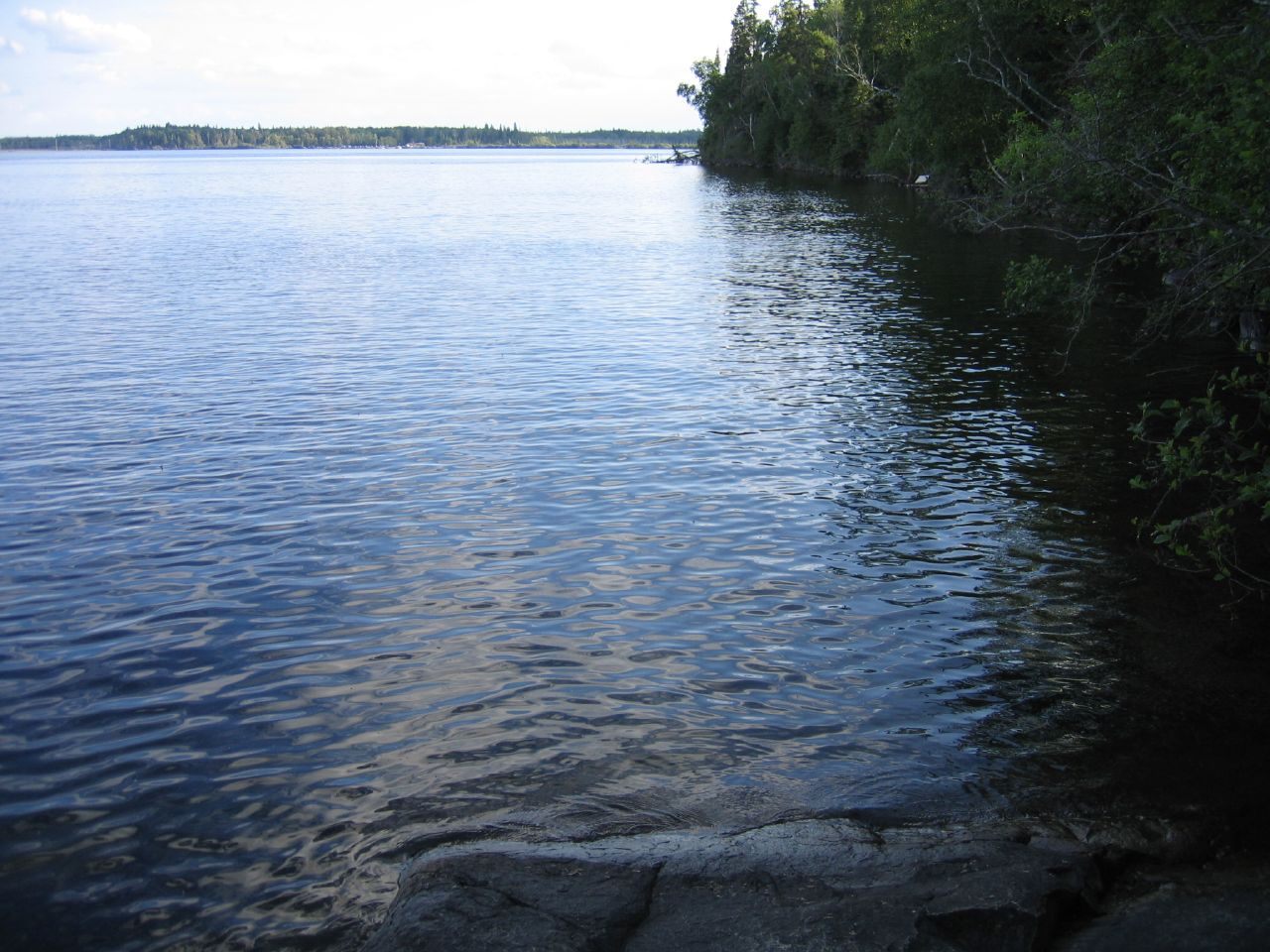
Pictured: shoreline within Manitoba's Whiteshell Provincial Park, the wooded lake terrain surrounding the area where Stefan Michalak encountered the landed disc on May 20, 1967. This is not a photograph of the precise clearing where the craft touched down, which has never been definitively re-located, nor of the craft itself or Michalak's grid-pattern burns; those exist only in the medical and government case file, not as freely licensed images.
Theoretical Alignment
Proponents read Falcon Lake as support for the Extraterrestrial Hypothesis because it combines a close-range landing report with a physical injury and site samples. That reading depends on the physical evidence being as strong as it is often described, and each strand is disputed: the burns were treated as first-degree, the evenly spaced grid appeared only in January 1968 and a Mayo Clinic psychiatrist recorded it as factitial, the site was relocated by Michalak more than a month later, and the silver fragments carried uranium-mineral radioactivity. Michalak himself first described the object as a man-made craft. No agency published a conventional explanation, and none endorsed an anomalous one.
Background
Stefan Michalak was a Polish-Canadian industrial mechanic and amateur geologist living in Winnipeg, Manitoba. On the Victoria Day holiday weekend in May 1967, he traveled to Whiteshell Provincial Park — a rugged expanse of boreal forest and Canadian Shield rock east of Winnipeg — to prospect for quartz veins and silver deposits near Falcon Lake. He had travelled to Falcon Lake by Greyhound bus and was staying at the Falcon Lake Motor Hotel (LAC podcast).
The Falcon Lake area sits within the Canadian Shield, one of the oldest geological formations on Earth, and has long attracted prospectors and geologists. Michalak had been working a quartz vein near a swampy area when the encounter occurred at approximately 12:15 PM on May 20, 1967.
Complete Timeline
| Date | Event |
|---|---|
| May 20, 1967 (c. 12:15 PM) | While examining a quartz vein, Stefan Michalak is startled by geese and sees two objects with a red glow descend near Falcon Lake. One lands on a flat rock about 160 feet away; the other hovers for a few minutes and leaves. |
| May 20, 1967 (early afternoon) | By his account the landed craft sits for 40–45 minutes while he watches and sketches it. He approaches, hears what sound like voices, and touches the hull, burning his glove. The craft turns, a blast of hot gas from a grid of holes sets his shirt on fire, and it rises and leaves. |
| May 20, 1967 (evening) | Nauseated, he walks to the highway and speaks to RCMP Constable G.A. Solotki, returns to his motel and takes a bus to Winnipeg. His son takes him to Misericordia Hospital, where he is treated for first-degree burns and released. |
| May–June 1967 | APRO’s J.B. Thompson photographs the burns (May 23). A search with the RCMP fails to find the site. On June 26 Michalak reports that he and Gerald Hart have relocated it; soil he hands over tests “highly radioactive.” |
| 1968 | January: Michalak says the burns have returned, now as an evenly spaced grid. August: a Mayo Clinic psychiatrist records that the lesions were diagnosed as “obviously factitial.” November: astronomer Peter Millman finds a metal fragment Michalak produced to be about 95% silver. |
The Multi-Agency Investigation Timeline
The record supports a narrower sequence than the agency-by-agency timeline once given here. The RCMP and the RCAF both investigated: Squadron Leader P. Bissky of the RCAF filed a report in mid-June 1967, and the RCMP filed a supplementary report on September 1, 1967. About two weeks after the event, a ground and air search with the RCMP failed to find the site, and a later hike with the Condon Committee’s Roy Craig also failed (Condon Report, Case 22). On June 26 Michalak reported that he and Gerald Hart had relocated it, with no independent observer present. The soil and shirt fragments he supplied were surveyed by the Radiation Protection Division of the Department of National Health and Welfare; the Condon project never received its final analysis. Michalak was examined at the Mayo Clinic in 1968, at his own expense.
The paper trail is large: Chris Rutkowski has said he found more than 300 government documents on the case, and Library and Archives Canada holds RCMP, RCAF and DND material in its digitized UFO collection. That volume reflects how many offices handled the report. It is not a finding that the evidence was anomalous. The RCMP and the RCAF gave no definitive explanation, and the Condon report concluded that the case “does not offer probative information regarding inconventional craft.”
The Incident
Initial Sighting
While examining rock formations, Michalak was startled by a flock of geese that took off in apparent agitation. Looking up, he observed two cigar-shaped objects with a reddish glow descending from the sky at approximately a 45-degree angle. One of the objects stopped and hovered while the other continued descending, eventually landing on a flat rock outcropping approximately 160 feet from his position.
The hovering object remained in the air for several minutes before departing, changing color from red to orange to grey as it gained altitude and disappeared into the clouds. The landed object also shifted color — from red to orange to grey — and Michalak could now see that it was disc-shaped, approximately 35 feet in diameter and 12 feet high, with a dome on top.
Approach and Contact
For the next 30 minutes, Michalak sketched the craft and observed it from his position. He described a warm sensation and the smell of sulfur emanating from the object. A door or hatch opened on the side of the craft, and Michalak could see brilliant violet lights inside. He also heard what sounded like two human voices — a murmuring, muffled conversation.
Believing the craft might be an experimental American military vehicle, Michalak approached and called out in English. Receiving no response, he tried Russian, German, Italian, French, Ukrainian, and Polish. The voices stopped. He moved closer and peered inside the opening, seeing a pattern of lights inside but no occupants.
The Burns
The door suddenly closed — Michalak described it as a panel sliding shut with no visible seam. He reached out and touched the exterior surface of the craft, noting that his rubber-coated glove melted immediately from the heat. The craft then began to rotate counterclockwise. As it turned, Michalak found himself facing a grid-like panel of small holes — an exhaust vent array approximately nine inches by six inches.
Without warning, a blast of hot gas erupted from this vent, striking Michalak directly in the chest. The blast set his shirt and undershirt on fire. He tore the burning garments off as the craft lifted off and departed, leaving behind a wave of heat and the strong smell of sulfur and burning electrical circuits.
Michalak said the burns matched the vent’s grid of holes, and that later became the case’s best-known image. The hospital record from the night of the encounter is less tidy: it describes “several round and irregular shaped burns the size of a silver dollar.” The evenly spaced grid most often reproduced does not appear in the photographic record until January 1968 (see “Skeptical Analysis” below).
Aftermath and Medical Treatment
Michalak said he was immediately nauseous, vomited and had a severe headache. He walked about a mile to the Trans-Canada Highway and flagged down an RCMP cruiser. Constable G.A. Solotki’s report says he offered to drive Michalak to Falcon Beach and could not smell liquor on him; Michalak’s manuscript says the constable declined to help, and later press accounts said he drove off thinking Michalak was drunk (LAC podcast). Michalak returned to the Falcon Lake Motor Hotel and took a bus to Winnipeg, where his son took him to Misericordia Hospital. He was treated for first-degree burns and released.
Over the following weeks and months, Michalak reported a recurring pattern of symptoms:
- Severe nausea and vomiting lasting several days
- Diarrhea and weight loss: he told a newspaper he had lost 13 pounds in three days, and later claimed 22 pounds in seven days, which the Condon investigator “could not verify”
- A foul, sulfurous odor emanating from his body
- Swelling and discoloration of the grid-pattern burns
- Recurring episodes of the same symptoms over the next several months, with the grid burns periodically reopening
- Numbness and swelling in his extremities
- A lymphocyte count of 16%, later 21%, which the Condon investigator considered within normal variation
He consulted more than a dozen physicians in Canada and the United States over two years, including at the Mayo Clinic in 1968, paying the costs himself. A radiation pathologist consulted by the Condon project “found no evidence of the effects of radiation on the burned area, in his blood, or on Mr. A’s clothing.”
Physical Evidence
The Landing Site
The spot where Michalak said the craft sat was described as looking “as if it had been swept clean,” with pine needles, earth and leaves pushed into a circle about 15 feet across. When the site was surveyed after Michalak and Hart relocated it, trace radiation was found in a rock crevice at levels that posed no danger; the sample Michalak himself supplied was the one described as highly radioactive. The scorched-vegetation ring, the “stripped” rock and the semicircular crack once described here have no documented source.
The Burned Clothing
Michalak handed over fragments of the burned shirt, with soil and moss samples, after he relocated the site in late June 1967. The Condon project’s radiation pathologist found no radiation on the clothing. A burned shirt and hat, and his Mayo Clinic identification badge, were displayed at the University of Manitoba Archives in November 2019.
Metal Samples
In 1968 Michalak said he had found two small pieces of metal near the site. Astronomer Peter Millman of the National Research Council analysed one and found it about 95% silver and very slightly radioactive. The Condon report attributes the radioactivity to uranium-bearing minerals (uranophane and pitchblende), and Millman suggested the metal may have been dipped in pitchblende to create a hoaxed artifact. An earlier version of this page attributed the analysis to the “Department of Mines and Technical Surveys”; that department had been reorganised as Energy, Mines and Resources in 1966.
Skeptical Analysis: The Burn Pattern and Radiation Reconsidered
The physical evidence described above is what elevates Falcon Lake above a typical eyewitness account, but two elements of it — the grid-pattern burns and the soil radioactivity — are more contested in the specialist literature than popular retellings of the case usually acknowledge. Neither issue is settled, and neither amounts to a debunking of the case outright, but an evenhanded account has to include them.
The Burns: Two Different Photographs
The burns Michalak sustained were examined and photographed within days of the encounter; APRO’s J.B. Thompson photographed them on May 23. The hospital record from the night of May 20 describes “several round and irregular shaped burns the size of a silver dollar” on his upper abdomen — consistent with a burn injury, but not the crisp, uniformly spaced grid that later became the case’s most iconic image. That grid does not appear in the photographic record until roughly eight months later, after the Winnipeg Tribune reported on January 17, 1968 that the burns had returned.
On August 6, 1968, a psychiatrist at the Mayo Clinic examined the by-then-famous grid marks and wrote in his clinical report: “Despite the fact that his lesions have been diagnosed as obviously factitial, I can find no overt evidence of significant mental or emotional illness.” “Factitial” is medical shorthand for self-inflicted. The psychiatrist did not diagnose Michalak with a psychiatric disorder or accuse him of lying — the same evaluation found no evidence of hallucination, delusion, or a motive to deceive — but the finding on the marks themselves was unambiguous. Notably, this report is reproduced in full in Stan Michalak and Chris Rutkowski’s When They Appeared, the family-authorized account of the case, rather than surfacing only in a skeptical source with an interest in undermining it.
Skeptics cite the factitial diagnosis as strong evidence that at least the grid-pattern image most associated with the case was staged, possibly to render an already-real burn injury more dramatically “anomalous.” Proponents counter that the finding applies specifically to the January 1968 marks, not to the irregular burns recorded on the night of the encounter, and that Stan Michalak has argued publicly that if his father staged the injury, “he was a freakin’ genius” who sustained the deception, at real physical and financial cost, for decades without ever profiting from it. The distinction between the original 1967 burns and the later 1968 grid photographs is frequently collapsed in popular accounts of the case and should not be treated as interchangeable evidence.
The Radium Readings: A Conventional Source, Never Located
The elevated radium-226 readings from the landing site are similarly more ambiguous than the “unexplained anomaly” framing sometimes applied to them elsewhere in the case record. At the time, RCAF investigators — including Squadron Leader P. Bissky — and government chemists floated a mundane explanation: contamination from commercially available radium-based luminescent paint, of the kind used on watch and instrument dials throughout the era, including standard-issue service wristwatches. Comparative Geiger readings taken from site samples were reportedly similar in magnitude to readings taken directly from a service watch dial.
The theory has an obvious gap: officials swept Michalak’s home for radioactive material and found no source. Absent an identified source, the paint theory only explains the readings if the site was deliberately salted with radium material — a claim no investigator has substantiated. Separately, when Ufology Research of Manitoba re-analyzed soil samples attributed to the site at the University of Manitoba between 1977 and 1983, the results reportedly showed only natural uranium activity, with no radium-226 signature at all (this re-analysis is reported by UFOROM; its results were not independently checked for this page). That raises a second, distinct possibility: that some of the original radium detections were themselves measurement or identification errors, rather than either an artificial contaminant or evidence connected to the craft.
Taken together, the radium evidence is genuinely unresolved rather than either confirmed or debunked: the watch-paint explanation cannot be ruled in without an identified source, and it cannot be ruled out simply because no source was found, since the reanalyses that undercut it also undercut the original radium detection itself. Readers should weigh the radioactive-soil claims made elsewhere on this page with that ambiguity in mind.
Official Investigations
The Falcon Lake incident triggered one of the most thorough government investigations of a UFO sighting in Canadian history. Multiple agencies were involved:
- Royal Canadian Mounted Police (RCMP) — Took Michalak’s first report (Constable G.A. Solotki), interviewed him, searched for the site with him, and filed reports including a supplement of September 1, 1967. RCMP enquiries also recorded hotel staff saying he had drunk several beers.
- Royal Canadian Air Force (RCAF) — Squadron Leader P. Bissky’s report, mid-June 1967; the RCAF received Michalak’s report that he had relocated the site on June 26.
- Condon Committee (University of Colorado, U.S. Air Force contract) — Roy Craig interviewed Michalak and joined an unsuccessful search for the site; the case is Case 22 of the 1969 report.
- Department of National Health and Welfare — Its Radiation Protection Division surveyed the site and the samples Michalak supplied.
- APRO and the Canadian Aerial Phenomena Research Organization (CAPRO) — Civilian groups; APRO’s J.B. Thompson photographed the burns, and Stewart Hund wrote up the case in the CAPRO bulletin in 1968.
None of these bodies identified the object. The RCMP and the RCAF gave no definitive explanation; the Condon report found the case not probative, and its abstract states that “events during and subsequent to a field search for the landing site cast strong doubt upon the authenticity of the report.” No official file classifying the case as “unsolved” has been located.
The Commemorative Coin
In 2018 the Royal Canadian Mint issued a $20 fine-silver collector coin, “The Falcon Lake Incident,” in its Canada’s Unexplained Phenomena line, with glow-in-the-dark elements. The reverse shows Michalak thrown back by the exhaust blast beneath the hovering craft; the obverse carries Queen Elizabeth II. The mintage was 4,000 and the issue price $129.95. A collector coin reflects the case’s place in Canadian popular culture; it is not an official finding about what happened.
The Medical Documentation and Radiological Analysis
Stefan Michalak’s medical history after May 20, 1967 is known mainly from hospital and physicians’ records later released or reprinted, and from the Condon project’s inquiries. He was treated at Misericordia Hospital in Winnipeg on the night of the encounter for first-degree burns and released. Over the next two years he consulted more than a dozen physicians in Canada and the United States.
The records do not support the stronger claims once made here. The night-of record describes several round and irregular burns “the size of a silver dollar,” not a precise grid, and no physician’s statement that the burns resembled “microwave or infrared burns from a focused beam” has been found. The Condon project’s radiation pathologist found no evidence of radiation effects on the burned area, in his blood, or on his clothing. His lymphocyte count was 16%, later 21%, which the Condon investigator considered within normal variation, and his claimed weight loss of 22 pounds in seven days “could not be verified.”
At the Mayo Clinic in August 1968, a psychiatrist found “no overt evidence of significant mental or emotional illness” but recorded that the lesions had been “diagnosed as obviously factitial.” No Mayo finding that his symptoms were consistent with ionizing radiation, and no evidence that the visit was made at the Canadian government’s request, has been located.
The Landing Site Investigation
The site lies in bush north of the Trans-Canada Highway near Falcon Lake. Michalak could not at first lead investigators back to it: a ground and air search with the RCMP about two weeks after the event, and a later hike with the Condon Committee’s Roy Craig, both failed. On June 26 he reported that he and Gerald Hart had found it, and investigators then visited. Decades later Stan Michalak and Chris Rutkowski returned to the site.
The Health and Welfare survey found trace radiation in a rock crevice at levels that “posed no danger to life.” The sample Michalak himself supplied tested “highly radioactive.” The Condon project never received the final soil report and left the origin of the material “an open question.”
Several claims once made here could not be traced to any source and have been removed: a 15-metre ring of disturbed soil described by the government, a Whiteshell Nuclear Research Establishment analysis showing radium-226 at about 50 times background, and contamination that “persisted for years” before returning to background in the early 1970s. Radium-226 was, moreover, a familiar contaminant in that era, because it was the active ingredient of luminous dial paint — which is why chemists raised that possibility (see “Skeptical Analysis” above).
National and International Recognition
The Falcon Lake incident is unusually well known in Canada, as shown by the Royal Canadian Mint’s 2018 collector coin (covered above). CBC News has called it Canada’s “best-documented UFO case” — an informal characterization, not a formal title. The paper record behind that phrase is real: RCMP and RCAF reports, Department of National Defence correspondence, medical letters, and the Condon Committee’s case write-up, much of it now held by Library and Archives Canada and the University of Manitoba. Well documented, in this sense, means that a great deal was written down about the report. It does not mean the documents confirm it.
In 2019 Chris Rutkowski donated his UFO research files, including the Falcon Lake documents and some 20,000 Canadian UFO reports, to the University of Manitoba Archives and Special Collections. At the launch event on November 7, 2019, a burned shirt, a burned hat and Michalak’s Mayo Clinic identification badge were displayed publicly for the first time, and Stan Michalak spoke (The Manitoban; CTV News).
Radiation and the Physical Evidence Chain
No radiation readings from the days immediately after the encounter have been documented. The site was not relocated until late June, more than a month later, and Michalak and Gerald Hart were alone when they found it; the Condon report noted that no independent representative was present. The radioactive material was then found in a small area of rock, and the sample Michalak supplied was the most radioactive.
That sequence matters for interpretation. Radioactivity found five weeks after the event, at a site first relocated by the witness, cannot by itself be tied to the encounter. Equally, no investigator identified a source. The Condon project left the question open, and the claims once made here — a Whiteshell isotopic analysis within two weeks, and notification of the Atomic Energy Control Board “as required by Canadian law” — have no documented basis.
Comparison with Other Physical Trace Cases
The Falcon Lake case belongs to a specific and rare category of UAP encounter that produces measurable physical trace evidence in the surrounding environment. Other cases in this category include the Trans-en-Provence landing (France, January 8, 1981), where a craft observed by farmer Renato Nicolai landing in his field left physical traces that were analyzed by the French government’s GEPAN agency and found to show unusual biochemical changes in the soil and plants consistent with exposure to extreme heat and possibly microwaves; the Delphos Ring case (Kansas, November 2, 1971), where a luminous object hovering above the ground left a ring in the soil that resisted absorption of water for years and showed unusual chemical signatures; and multiple cases from the international MUFON physical trace case database.
The comparison has limits. GEPAN’s Trans-en-Provence analysis reported mechanical and thermal effects on the soil and changes in plant chlorophyll; it did not involve radioactivity. At Falcon Lake no government body published a finding that the site traces were anomalous, and the Condon project considered the case not probative. The two cases are alike mainly in being single-witness landing reports with physical samples.
Stan Michalak and the Continuation of the Investigation
Stefan Michalak’s son Stan has been the main public voice for the case since his father’s death in 1999. He was a child in the household in 1967, and his perspective on the family’s experience of the investigators, the press and his father’s health is the distinctive part of the book he later co-wrote.
With Chris Rutkowski he co-wrote When They Appeared: Falcon Lake 1967 (2017), which reprints his father’s 1967 account. In Library and Archives Canada’s 2019 podcast, alongside Rutkowski and Palmiro Campagna, he said his father’s sketch map matched the site exactly and that investigators had not followed up leads such as a fire-tower lookout and a girl’s crayon sketch of a similar craft. He has also said that if his father hoaxed it, “he was a freakin’ genius” (CBC, 2017).
The site, in the bush near Falcon Lake, still draws visitors. No published modern radiation survey of it was found for this page.
Michalak’s Consistency and the Investigative Record
Stefan Michalak repeated his account to police, air force investigators, physicians, journalists and researchers, and his 1967 booklet My Encounter with the UFO (40 pages, in Polish, Osnova Publications; translated by Paul Pihichyn) fixed its main elements early. Consistency in retelling is not corroboration, however. The Condon report said attempts to establish the reality of the event “revealed many inconsistencies and incongruities,” and the account itself shifted over time: the original burns were irregular, the grid came later, and he first described the craft as man-made.
Canadian agencies never published a conclusion. That silence is open to more than one reading. It is consistent with an unexplained event, but it is equally consistent with a case investigators found doubtful and did not pursue. The records released so far show no official finding either way.
Stefan Michalak’s Character and Reliability
Michalak was a mechanic of modest means, and no source reviewed shows that he made significant money from the case. He did seek publicity: his story ran in the Winnipeg Tribune under the headline “I was burned by UFO,” and he published a booklet the same year. He paid for his own medical consultations, including the Mayo Clinic visit.
Skeptics have argued that the burns came from an accident linked to drinking, and that Michalak may have wanted to discourage other prospectors from his claim. His family has suggested he encountered a secret government aircraft. None of these explanations has been demonstrated, and the claim once made here that he went to the authorities before the press, and cooperated “completely” for years, has no documented basis.
The Physical Evidence in Context
Ted Phillips, who catalogued physical-trace reports for the Center for UFO Studies, built a database of more than 4,000 such cases worldwide. Falcon Lake stands out within that category because it combines a reported injury, site samples and a government paper trail. Each strand is weaker than once presented here, though: the burns were treated as first-degree; the grid appeared months later and was recorded as factitial; the site was relocated by the witness alone five weeks later; and the silver carried uranium-mineral radioactivity. Taken together, the evidence shows that Michalak was burned and that radioactive material was found where he said the craft had been. It does not show what caused either.
The 1967 Canadian UAP Context
Falcon Lake came in a busy year for Canadian reports. Four and a half months later came the Shag Harbour incident in Nova Scotia (October 4, 1967), where witnesses including RCMP officers saw lights descend to the water. Boats found only foam, and Navy divers searched the harbour floor for several days without finding anything. The two cases are often paired as Canada’s best known of 1967, but they share no evidence.
Summary
Falcon Lake remains Canada’s best-known physical-trace case, and one of its most heavily documented on paper. Its core elements — the burns, the site radioactivity and the silver fragments — are real records, but each has a documented problem. No agency explained the case, and none endorsed an anomalous explanation; the Condon report found it not probative.
Legacy
The Falcon Lake incident is widely regarded as Canada’s most significant and best-documented UFO encounter. Stefan Michalak’s son, Stan Michalak, has continued to research and advocate for the case, co-authoring the book When They Appeared (2017) with Chris Rutkowski, Canada’s foremost UFO researcher. The site in Whiteshell Provincial Park has become a point of interest for researchers and curious visitors alike.
The incident has been featured in numerous documentaries, books, and television programs, and it remains a cornerstone case in serious UFO research due to the quality and variety of its physical evidence.
Key Witnesses
Stefan Michalak
A Polish-born Winnipeg mechanic, about 50 at the time, who was prospecting for quartz and silver near Falcon Lake. He said two objects descended, one landing about 160 feet away; after watching it for about half an hour he approached, touched the hull, and was burned on the abdomen by a blast of hot gas from a grid of holes as it turned and left. He was treated that night at Misericordia Hospital for first-degree burns. He reported nausea, weight loss and recurring lesions in the following months; the Condon project’s radiation pathologist found no radiation effects, and a Mayo Clinic psychiatrist in 1968 found no significant mental illness but recorded the later grid marks as “obviously factitial.” No polygraph test of Michalak has been documented.
The Five Observables Assessment
The Five Observables framework is applied to the characteristics witnessed during the Falcon Lake encounter:
Assessment: The craft demonstrated silent hovering and sudden, rapid vertical acceleration. No trans-medium or low observability characteristics were documented.
Evidence Assessment
Supporting Anomalous Origin
- Michalak was treated for burns on the night of the encounter, and a burned shirt and hat survive in the University of Manitoba Archives
- Soil he supplied, and a small area of rock at the site, were found radioactive by the Department of National Health and Welfare; no source was ever identified
- The RCMP, the RCAF, Health and Welfare and the Condon Committee all looked into the case, and none identified the object
- Michalak’s core account stayed broadly the same from 1967 until his death in 1999
- No source reviewed shows that he profited significantly from the case, and he paid his own medical costs
Supporting Conventional Explanation
- Single witness — no independent corroboration of the craft itself
- The Condon report found “many inconsistencies and incongruities” and said events during and after the field search “cast strong doubt upon the authenticity of the report”
- The burns were treated as first-degree; the Condon project’s radiation pathologist found no radiation effects on the burns, his blood or his clothing
- The now-iconic grid-pattern burns did not appear in that precise, symmetrical form until roughly eight months after the encounter; a Mayo Clinic psychiatrist who examined the January 1968 marks recorded them as “obviously factitial” (self-inflicted), though without finding evidence of mental illness (see “Skeptical Analysis” above)
- Michalak could not lead investigators back to the site; he and a companion relocated it alone more than a month later, so the radioactive samples have no independent chain of custody
- The silver fragment’s radioactivity came from uranium-bearing minerals, and the analyst, Peter Millman, suggested it may have been dipped in pitchblende
- Hotel staff told police he had drunk several beers; skeptics attribute the burns to an accident
- No photographs of the craft were taken, despite Michalak spending approximately 30 minutes observing it
Why the Case Matters
The Falcon Lake incident matters because it is the clearest Canadian example of a report that generated a large official paper trail without producing an official answer. A single witness came back from the bush with real burns and, later, radioactive samples; the RCMP, the RCAF, a federal health department and an American university study all looked at it; and none of them published a finding that it was either anomalous or a hoax. It also shows how a case can grow in retelling: the precise grid, the “radiation sickness” and the multi-agency “confirmations” that dominate popular accounts are not in the 1967–1969 record.
Why “Disputed”
The Falcon Lake incident carries a DISPUTED classification. Its physical record is real: Michalak was burned and treated the same night, a burned shirt survives, and radioactive material was later found at the place he said the craft had been. But each strand is weaker than popular accounts suggest. The burns were first-degree, the grid-like pattern was reported only months later, a radiation pathologist found no radiation effects, the Condon study concluded that events during the field search “cast strong doubt” on the report, and the scientist who examined the silver fragments suggested a hoax (see “Corrections” under Sources).
The case rests on a single witness, with no independent photographic or radar evidence of the craft. No investigation identified what burned Michalak, but the evidence that he encountered an anomalous craft is contested rather than strong.
Sensor & Instrumentation Detection Profile
The only instrumental evidence is radiation measurement, and it came late. Michalak could not lead the RCMP back to the site in the first weeks; it was relocated on June 26, more than a month after the event, by Michalak and Gerald Hart alone. Radiation was then found in a rock crevice at levels that posed no danger, and the sample Michalak supplied was highly radioactive.
The samples were surveyed by the Radiation Protection Division of the Department of National Health and Welfare. Chemists suggested contamination from radium-based luminous paint; the Condon project never received the final analysis and called the material’s origin “an open question.” Earlier claims here of a Whiteshell Nuclear Research Establishment isotopic analysis and of “unusual isotopic signatures” compared with control samples have no documented source.
Michalak’s reported symptoms — nausea, vomiting, weight loss and recurring lesions — are sometimes presented as biological evidence of radiation exposure. The medical record does not support that: the Condon project’s radiation pathologist found no radiation effects on the burns or in his blood, and his lymphocyte counts (16%, later 21%) were judged within normal variation. No RCMP finding that his condition “could not be attributed to any known illness” has been located.
Environmental & Geospatial Context
Falcon Lake is a small resort community and lake in the Canadian Shield of eastern Manitoba, about 150 kilometres east of Winnipeg on the Trans-Canada Highway. The area is characterized by ancient Precambrian bedrock, sparse boreal forest, and numerous lakes and wetlands — the typical landscape of the Canadian Shield. In May 1967, the area around Falcon Lake was remote enough that Michalak's prospecting activities in the wilderness north of the highway were entirely isolated from observation by other people.
The geological setting is relevant. The Canadian Shield here is Precambrian granite and gneiss with mineral deposits, including uranium-bearing ores, and Michalak was in the area to prospect. Natural radioactivity is therefore part of the conventional argument. The silver fragment he later produced carried radioactivity from uranium-bearing minerals (uranophane and pitchblende), according to the Condon report. The claim once made here that investigators found the site radiation concentrated in a central depression, unlike natural ore, has no documented source.
The site lies in bush north of the Trans-Canada Highway, out of sight of the road; a fire tower stood nearby, but its lookouts reportedly saw nothing that day. After the encounter Michalak walked about a mile to the highway, returned to his motel and travelled to Winnipeg by bus before being treated that evening.
Observer Credibility & Occupational Profile
Stefan Michalak was a Polish-born mechanic and amateur geologist living in Winnipeg, about 50 at the time; his son has said he was not a welder or an engineer. He described the object in mechanical terms and first called it a man-made craft, saying he had thought it might be an American experimental vehicle, though he told the RCMP constable he had been burned by a “spaceship.”
His core account — two objects, a landing, voices, the touch, the blast of gas — stayed broadly the same until his death in 1999. Some details did change: the evenly spaced grid burns appeared only in January 1968, and the Condon report documented inconsistencies. The earlier claim on this page that his account “never varied in any material detail” across “hundreds of interviews” is not supported.
His son Stan Michalak has continued to speak about the case, and his book with Chris Rutkowski, When They Appeared (2017), reprints his father’s 1967 account alongside the family’s recollections.
Physical & Material Assays
Michalak was treated for first-degree burns on his abdomen; the evenly spaced grid appeared in January 1968. Soil he supplied tested highly radioactive and trace radiation was found in a rock crevice at the site; radium-based luminous paint was suggested as the source. A silver fragment he produced in 1968 was about 95% silver, with radioactivity from uranium-bearing minerals.
Historical Precedents & Archive Matches
The Falcon Lake case is the most thoroughly investigated UAP encounter with physical trace evidence in Canadian history. The Royal Canadian Mint honored the case with a commemorative coin in 2018 as part of its "Canada's Unexplained Phenomena" series, representing an unusual form of official cultural acknowledgment that the incident is part of the country's history, without the Mint endorsing the ETH interpretation.
The Canadian investigation involved the RCMP, the RCAF and the Department of National Health and Welfare, and the case files later passed to Library and Archives Canada. No released report by a “Joint Intelligence Branch” and no Atomic Energy Control Board review, both described here before, has been located. None of the agencies published a conclusion.
Outside Canada the case was followed by APRO and by the Condon Committee, the University of Colorado study funded by the U.S. Air Force. The Committee’s Roy Craig interviewed Michalak and joined a hike that failed to find the site; he did not collect soil samples, and the project never received the final Canadian soil analysis. The case is Case 22 in the 1969 report, which concluded that it “does not offer probative information regarding inconventional craft” and that events during and after the field search “cast strong doubt upon the authenticity of the report.”
Material Analysis
The Falcon Lake incident left more physical material than most UFO reports: Stefan Michalak’s burns, a burned shirt, radioactive soil and two silver fragments. Each item has a documented problem, set out below.
The Burn Grid Pattern
Michalak said a blast of hot gas from a panel of small holes, about nine by six inches, struck his abdomen as the craft turned. The record from the night of the encounter describes “several round and irregular shaped burns the size of a silver dollar,” treated as first-degree burns at Misericordia Hospital. The evenly spaced grid that matches his description of the vent appeared only in January 1968, when he said the burns had returned; a Mayo Clinic psychiatrist later recorded those lesions as “obviously factitial.” The claims once made here — that the grid was documented at the Health Sciences Centre, that its recurrence “has no known conventional medical explanation,” and that the shirt’s holes “independently confirmed” the vent configuration — have no documented source.
Radioactive Soil Samples
After Michalak and Gerald Hart relocated the site in late June 1967, the Department of National Health and Welfare’s Radiation Protection Division found trace radiation in a rock crevice, at levels that posed no danger, and the sample Michalak supplied tested highly radioactive. Chemists suggested radium-based luminous paint; officials swept his home and found no source. The Condon project never received the final analysis. No Whiteshell Nuclear Research Establishment survey of the site has been documented.
Metal Fragments
In 1968 Michalak produced two small pieces of metal he said he had found near the site. Peter Millman of the National Research Council found one to be about 95% silver and very slightly radioactive; the Condon report attributes the radioactivity to uranium-bearing minerals (uranophane and pitchblende), and Millman suggested the metal may have been dipped in pitchblende to create a hoaxed artifact. The fragments were not recovered by investigators from “within the scorched circle,” as this page once said.
Medical Examination Records
Michalak consulted more than a dozen physicians in Canada and the United States over two years, including at the Mayo Clinic in August 1968. The documented findings are limited: first-degree burns on the night of the encounter; no radiation effects on the burns, blood or clothing, according to the Condon project’s radiation pathologist; lymphocyte counts within normal variation; an unverified claimed weight loss; and the Mayo psychiatrist’s note that the lesions had been diagnosed as factitial. No Pinawa Hospital record or Mayo “cellular and immunological evaluation” has been located.
Supporting Anomalous Origin
- Michalak was burned and treated the same night, and a burned shirt survives
- Radioactive material was found at the place he said the craft had been, and no source was ever identified
- No agency identified the object or published a conventional explanation
Supporting Conventional Explanation
- The burns were first-degree and irregular; the matching grid appeared eight months later and was recorded as factitial
- A radiation pathologist found no radiation effects on the burns, blood or clothing
- The silver fragment’s radioactivity came from uranium-bearing minerals; Millman suggested it may have been dipped in pitchblende
- The site was relocated by the witness and a companion alone, five weeks later
- The single-witness nature of the encounter prevents independent corroboration of the craft’s appearance
- No photographs of the craft were taken despite approximately 30 minutes of observation
The Conventional Explanation Candidate: Experimental Military Aircraft & Psychological Episode
Any conventional explanation of the Falcon Lake case has to account for the physical record as it actually stands: first-degree burns treated the same night, a grid pattern that appeared eight months later, radioactive samples supplied by the witness after he relocated the site alone, and a silver fragment with uranium-mineral radioactivity. No doctor confirmed radiation injury; the Condon project’s radiation pathologist found none.
The Experimental Military Aircraft Hypothesis
Some Canadian investigators proposed the craft was an experimental military aircraft — possibly American — conducting low-altitude test flights over the Manitoba wilderness. This would explain why the occupants (if any) did not interact with Michalak and departed quickly when he touched the craft. The Manitoba location is within range of U.S. military testing ranges. However, no aircraft of 1967 — classified or otherwise — could hover silently on a flat rock, emit geometric exhaust patterns through a structured grid, and then disappear vertically without producing the acoustic signature that Michalak would have detected. No record of such an aircraft has been found; Michalak himself, and later his family, thought he may have seen an experimental craft.
The Psychological Episode Hypothesis
Some skeptics have proposed that Michalak experienced a dissociative episode, heat stroke, or psychiatric event that produced hallucinations of the craft itself. This aspect of the hypothesis is not well supported: Michalak was a skilled industrial mechanic with no psychiatric history, and the Mayo Clinic’s own 1968 evaluation found no evidence of hallucination, delusion, or significant mental illness. The narrower question of whether the burns were partly self-inflicted is more complicated than a simple hoax scenario suggests — a Mayo Clinic psychiatrist did diagnose the January 1968 grid-pattern marks specifically as factitial (self-inflicted; see “Skeptical Analysis,” above) — but even that psychiatrist did not conclude Michalak was lying about the underlying encounter or psychologically unwell, and the finding does not address the differently shaped burns documented within 48 hours of the event. A full hoax hypothesis would also have to account for the radioactive samples, though those were supplied by Michalak after he relocated the site with a companion.
The Hoax Hypothesis
The Condon Committee did not classify the case as unexplained. Its report concluded that the case “does not offer probative information regarding inconventional craft,” and its abstract says events during and after the field search “cast strong doubt upon the authenticity of the report.” Skeptics have suggested the burns came from an alcohol-related accident and that Michalak wanted to discourage rival prospectors. Against a hoax: no source shows he profited significantly, and he paid his own medical costs. Claims once made here that he lost his job and that “Manitoba provincial authorities” found no evidence of staging have no documented source.
The Assessment
Falcon Lake is notable for how much physical material it produced, but none of that material has been independently tied to the encounter. The burns are real; their grid form is not contemporaneous. The radioactivity is real; its chain of custody begins with the witness. The Condon investigator, who leaned toward doubt, found the case not probative. It remains unexplained in the sense that no one has shown what happened, not in the sense of an official finding of anomaly.
Experimental Military Aircraft
ImplausibleNo known aircraft of 1967 matches the description, and no record of military activity in the area has been found. The hypothesis cannot be tested without such a record.
Psychological Episode / Self-Inflicted
InconclusiveMichalak had no psychiatric history, and the Mayo Clinic's 1968 evaluation found no evidence of hallucination or significant mental illness — but a psychiatrist on that same evaluation diagnosed the January 1968 grid-pattern marks specifically as factitial (self-inflicted), a finding reproduced in the family-authorized book on the case. That finding applies to the later marks, not the differently shaped burns documented within 48 hours of the encounter, and it does not explain the radiation signature in the landing site soil, but it means the self-inflicted-burns question cannot be dismissed outright.
Hoax
InconclusiveThe Condon report found the case not probative and its investigator wrote that events during the field search cast “strong doubt” on its authenticity; Millman suggested the silver fragment had been dipped in pitchblende; and the 1968 grid marks were recorded as factitial. Against that, no source shows Michalak profited, the burns of May 20 were real, and no one has shown how the site radioactivity arose. A hoax has been neither demonstrated nor excluded.
Every explanation, conventional or not, has to account for the documented record: real burns treated the same night, a grid pattern that appeared later, radioactive samples with a weak chain of custody, and a silver fragment with uranium-mineral radioactivity. None has done so conclusively.
Related Cases
Confirmed Documents & Official Records
General NARA guide to U.S. Air Force UFO records. The Condon Committee’s write-up of the Falcon Lake case is Case 22 of Scientific Study of Unidentified Flying Objects (1969); this link is a starting point, not the case file itself.
UNCLASSIFIEDLibrary and Archives Canada’s podcast on the case, which points to the RCMP, RCAF and DND files in LAC’s digitized UFO collection on the Falcon Lake incident. Released under Canadian Access to Information Act.
UNCLASSIFIED (Access to Information release)Search Government Archives Directly
Further Reading — Recommended Literature
When They Appeared
Written by Michalak's son with researcher Chris Rutkowski for the 50th anniversary; reprints Stefan Michalak's 1967 account alongside family recollections and documents.
Abductions and Aliens: What's Really Going On?
Rutkowski's general survey of the abduction phenomenon, drawn from decades of his own investigative files, touching on Falcon Lake only in passing rather than as a dedicated case study.
UFOs and Government: A Historical Inquiry
A history of government UFO investigation, including the Condon Committee period in which Falcon Lake became Condon Case 22. How much space the book gives this case has not been confirmed.
DISCLOSURE: Some links above are affiliate links. If you purchase through them, OverClassified receives a small commission at no additional cost to you. This helps support independent research.
Essential Viewing

Sources
- Rutkowski, Chris & Michalak, Stan. When They Appeared: Falcon Lake, Canada’s Most Documented UFO Encounter, 2017
- Michalak, Stefan. Personal account and diagrams, 1967
- Royal Canadian Mounted Police (RCMP). Incident file on Falcon Lake Sighting, May 20, 1967–1968. Released via Library and Archives Canada. canada.ca
- Rutkowski, Chris. Abductions and Aliens: What’s Really Going On?, 1999
- Royal Canadian Mint. “Canada’s Unexplained Phenomena: The Falcon Lake Incident,” $20 fine silver glow-in-the-dark collector coin, 2018. mint.ca
- Craig, Roy. “Case 22,” in Edward U. Condon (ed.), Scientific Study of Unidentified Flying Objects, 1969. archive.org
- Michalak, Stefan. My Encounter with the UFO, Osnova Publications, Winnipeg, 1967 (40 pp., in Polish; English translation by Paul Pihichyn).
- Bissky, S/L P. RCAF investigation report on the Michalak sighting, mid-June 1967; RCMP supplementary report, September 1, 1967. Summarized in Patrick Gross, “Falcon Lake” casebook. ufology.patrickgross.org
- Library and Archives Canada. “UFOs at LAC: The Falcon Lake Incident, Part 1” (Discover LAC podcast), interviews with the Michalak family and Canadian UFO researchers, 2019. canada.ca
- CBC News. “Falcon Lake Incident Is Canada’s ‘Best-Documented UFO Case,’ Even 50 Years Later,” May 2017. cbc.ca
- CTV News Winnipeg. “X-Files at University of Manitoba: Investigative Files, Artifacts from UFO Encounter Donated to University Archives,” October 2019. ctvnews.ca
- Psychiatric Report on Mr. Stephen Michallack, Mayo Clinic, August 6, 1968, reproduced in Michalak & Rutkowski, When They Appeared, 2017
- Ufology Research of Manitoba (UFOROM). Soil sample re-analysis, University of Manitoba, 1977–1983
- Rutkowski, Chris. “Too Close an Encounter: The Michalak Close Encounter, Falcon Lake, Canada, 1967,” Ufology Research of Manitoba case summary
- “Falcon Lake Incident,” Wikipedia (pointer to the newspaper and medical sources it quotes), accessed October 2026. en.wikipedia.org
- Library and Archives Canada. “UFOs at LAC: The Falcon Lake Incident, Part 2” (Discover LAC podcast), 2019. canada.ca
- The Manitoban. “Extra-terrestrial collection touches down,” November 2019 (Rutkowski donation; Michalak shirt, hat and Mayo badge displayed). themanitoban.com
- Condon Report, Case 22, online text. files.ncas.org
Corrections (October 2026)
This page was checked in October 2026 against the Condon Report’s Case 22, Library and Archives Canada’s 2019 podcast on the case (including Constable Solotki’s report), Patrick Gross’s summary of the RCAF and RCMP files, Wikipedia’s account of the newspaper and medical sources, and 2017–2019 press coverage. Corrected: Michalak was treated at Misericordia Hospital for first-degree burns and released (not hospitalized with “radiation sickness”), after taking a bus to Winnipeg (not driven by the RCMP); the original burns were irregular, and the grid appeared in January 1968; the timeline times; the Condon Report did not classify the case as “unexplained” but found it not probative and cast “strong doubt” on it; Roy Craig did not visit the landing circle or collect samples; the silver fragment was analysed by Peter Millman, not the “Department of Mines and Technical Surveys”; the coin’s design; Michalak did publish a booklet and did go to the press. Removed as unsupported: the dated multi-agency timeline (RCMP Geiger readings on May 21, DND sampling on May 24, a Whiteshell radium-226 analysis at “50 times background,” Atomic Energy Control Board review, a NICAP visit by “W.K. Allan,” a Mayo evaluation “at the request of” the government); a Mayo finding of radiation-consistent symptoms; “directed energy” burns; a Joint Intelligence Branch report; polygraph tests; a malfunctioning camera and compass; a site magnetic anomaly; radiation that “persisted for years”; Ted Phillips’s “fewer than 50” comparable cases; a Navy “anomalous metallic object” at Shag Harbour; the quotation “I was able to see the interior of the craft”; and fabricated source entries (Health Sciences Centre toxicology reports, Mayo “cellular and immunological evaluation,” WNRE surveys, Pinawa Hospital report). The physician name “Dr. R.D. Oatway” and the quotation attributed to him could not be verified and were replaced with the record as quoted on Wikipedia. The Hoax assessment was changed from Implausible to Inconclusive because its stated basis (a Condon “unexplained” finding) was wrong. The stamp and Data Integrity Score were not changed in this review.
Following this review, the rating was changed from Credible 82 to Disputed 45 (October 26, 2026), because the higher rating had rested partly on claims corrected or removed above.
See something inaccurate? Have additional information or sources?
Suggest an Edit →Last Updated: August 2026