
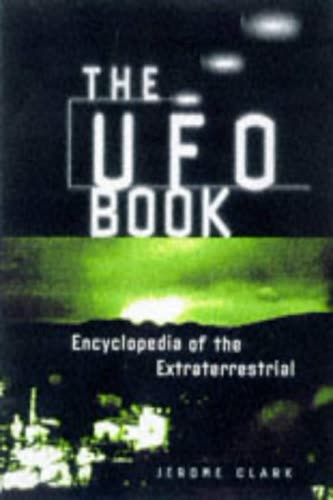
The UFO Book
Encyclopedia of the Extraterrestrial
Core Thesis
The UFO Book: Encyclopedia of the Extraterrestrial distills Jerome Clark's own much larger, two-volume UFO Encyclopedia project into a single, 750-page, alphabetically organized reference covering roughly 200 of the field's most significant cases, phenomena, theories, beliefs, research organizations, personalities, and hoaxes — not a wholesale replacement for the fuller multi-volume work, but a deliberately focused abridgement built for readers who want the crucial entries without the complete project's full scope. Reviewer Steven H's own description of the book's purpose, drawn from its own introduction, frames the selection principle directly: having already "documented in extensive detail hundreds of UFO-related subjects" in the larger encyclopedia, Clark here "focused our attention on the crucial cases, phenomena, theories, beliefs, research projects, personalities, hoaxes, and more" that a general reader most needs, while preserving the same even-handed, evidentially disciplined method — treating hoaxes as hoaxes, unresolved cases as unresolved — that defines Clark's wider body of reference work.
About the Author
Jerome Clark published this single-volume abridgement in 1997, roughly five years after The Emergence of a Phenomenon (1992), the second volume of his original three-part UFO Encyclopedia project, and a year before that same project's own consolidated two-volume "2nd edition" appeared from Omnigraphics in 1998. This book represents a distinct editorial project from either of those: rather than expanding or re-collecting the original multi-volume encyclopedia, Clark and publisher Visible Ink Press condensed it into one accessible volume aimed at a broader general-interest readership than the fuller reference work's roughly 1,200-page scope could reach.
By 1997, Clark had been editing International UFO Reporter, the journal of the J. Allen Hynek Center for UFO Studies, since 1985, and had already established himself, per British folklorist David Clarke's 2002 review of the wider encyclopedia project in the academic journal Folklore, as someone who had "turned a childhood fascination into a masterly command of the subject in all its many and varied manifestations" across four decades of research. This book's condensed, general-audience format let that same research reach a wider readership than the more expensive, more academically pitched multi-volume original.
The book won the Benjamin Franklin Award in the Science/Environment category from the Independent Book Publishers Association in 1998, the year following its publication — a specific, juried publishing-industry honor distinct from any of the citation-based recognition the wider encyclopedia project has received, and one that speaks specifically to this abridged volume's own accessibility and craftsmanship as a single-volume reference work rather than to the larger project it draws from.
This is the third distinct Clark-authored reference work covered on this site, alongside The Emergence of a Phenomenon (1992, Vol. 2 of the original three-volume project) and The UFO Encyclopedia (2024, the 4th-edition two-volume set) — together tracing Clark's own encyclopedia project across more than three decades, from its original multi-volume form through this single-volume abridgement to its most recent full expansion.
Historical Context & Origins
Visible Ink Press published The UFO Book in September 1997, in the same general publishing window as the broader 1990s UFO-culture surge The X-Files and the Roswell 50th-anniversary coverage helped drive — a moment when publishers had clear commercial reason to want an accessible, single-volume UFO reference rather than only the pricier, more specialist multi-volume original.
The book's timing places it squarely between the two other Clark encyclopedia projects this site covers: five years after The Emergence of a Phenomenon (1992) and roughly a year before the original three-volume project's own 1998 consolidated "2nd edition" omnibus. Rather than a stepping-stone toward that later consolidation, this book represents a parallel, separately conceived product: a condensed, general-reader edition released into the market alongside the larger reference work's own continued life.
Structurally, the book's roughly 200 entries and alphabetical organization mirror the format of Clark's fuller encyclopedia work, but the selection itself required a different kind of editorial judgment: choosing which cases, figures, and theories from hundreds of possible entries were essential enough to include in a single accessible volume, rather than documenting the field as exhaustively as the multi-volume original attempted to.
Core Arguments & Key Concepts
The book's central organizing principle, per its own stated purpose as summarized by reviewer Steven H, is selective distillation: rather than repeating the exhaustive case-by-case documentation of Clark's fuller encyclopedia, this volume "focused attention on the crucial cases, phenomena, theories, beliefs, research projects, personalities, hoaxes, and more" — a deliberate editorial argument about which 200 or so entries actually matter most for a general reader trying to understand the field.
A second theme, consistent across Clark's wider body of reference work, is even-handed treatment regardless of a given entry's ultimate status: the book's own description promises to "present evidence in an open-minded manner while maintaining scholarly rigor, allowing readers to form independent conclusions" — the same intellectual-agnosticism standard that defines Clark's larger encyclopedia project, applied here within a tighter page budget.
A third theme is genuine accessibility as its own explicit design goal, distinct from the fuller encyclopedia's more specialist, library-reference orientation: reviewer Laurence Hidalgo's assessment that it is "a well-balanced, authoritative resource" that nonetheless "does sometimes read like an encyclopedia" captures the book's attempt, not always perfectly achieved in every reader's judgment, to balance reference-work comprehensiveness against general-audience readability.
A fourth theme is providing a genuine cross-section of the field's full historical range within a compact format: reviewer Travis's description of the book as "a great summary of famous UFO events, some ancient and some modern" and Jim Huinink's characterization of it as offering "a good bird's-eye-view of the phenom as it was in 1997" both point to the same underlying editorial achievement — compressing decades of case history into a single coherent, chronologically wide-ranging reference.
Key Cases & Evidence Discussed
Five of this site's own case files cite this exact 1997 edition directly, spanning the full history of the modern UFO era from its founding case through the early 2010s. The Kenneth Arnold case (Case File #007, 1947) — the sighting over Mount Rainier that gave the field the term "flying saucer" and effectively founded modern American ufology — is cited via this site's own plain sources list rather than a book-card description, reflecting the entry's role as foundational reference material for the case that opens the modern UFO era.
The Travis Walton case (Case File #009, 1975) receives specific, substantive citation: this site's own case file describes the book as "a comprehensive encyclopedia entry detailing the witness timelines, APRO's role, and the search logistics" — documenting Clark's treatment of one of American ufology's most famous alleged abduction cases in enough procedural detail to serve as this site's own reference for the case's investigative history.
The Falcon Lake incident (Case File #017, 1967), a close-encounter case at Falcon Lake, Manitoba, involving a prospector's reported burns, is cited for the book's "thorough overview of the timeline, the medical tests at the Mayo Clinic, and the radiation trace findings" — one of the field's more medically documented cases, and one this site's own research treats this encyclopedia entry as a reliable procedural reference for.
The Cash-Landrum incident (Case File #011, 1980) is described by this site's own case file as receiving "detailed case analyses and investigations of historical close encounters" treatment in this book, situating it within Clark's wider comparative coverage of physically documented close-encounter cases.
The Ross Barnett Reservoir Sighting (Case File #020, 2012), at Ross Barnett Reservoir, Mississippi — the most recent of this book's five citing cases, and notably more recent than the book's own 1997 publication date, meaning this site's own citation draws on the book's general historical-triangle-wave entries rather than case-specific 2012 material — is cited for "comprehensive entries on historical black triangle waves, evaluating their low-observability and silent flight capabilities."
Critical Reception & Controversies
On Goodreads, the book carries a 4.08-out-of-5 average from 61 ratings and 6 written reviews. Reviewer Jim Huinink called it "very fairly written... fascinating stories and cases... a good bird's-eye-view of the phenom as it was in 1997," while Laurence Hidalgo described it as "a well-balanced, authoritative resource of UFO and extraterrestrial information," adding the honest caveat that "it does sometimes read like an encyclopedia" — a fair description of a reference work whose format inherently trades narrative flow for lookup utility.
The book's most pointed critical review came from Dan Zarfati, who called it "an important book, but not THE BOOK," arguing that "an encyclopedia of UFOs deserves at least 5000 pages and not 400 odd pages" — a critique aimed less at the book's quality than at the inherent limitation of any abridged single-volume format compared to the fuller, more exhaustive multi-volume original this book condenses. (Amazon's own listing gives the book's actual length as 750 pages, somewhat longer than Zarfati's off-hand estimate, though still a fraction of the roughly 1,200-page original three-volume project.)
On Amazon, the book carries a strong 4.4-out-of-5 average from 57 ratings (checked August 2026), a solid sample size consistent with the reception of Clark's other reference works on this site.
The book's clearest institutional endorsement came the year after publication: the Benjamin Franklin Award in the Science/Environment category, awarded by the Independent Book Publishers Association in 1998, a specific juried publishing honor recognizing the book's own editorial and production quality as a standalone volume.
The clearest and most independently verifiable measure of the book's lasting reference value on this site specifically is its own citation record: five separate case files, spanning 1947 to 2012, cite this exact 1997 edition directly — a citation pattern this site's own research treats as durable evidence of the book's continued usefulness as an accessible, single-volume reference distinct from Clark's larger multi-volume works.
Influence & Legacy
The most directly measurable evidence of this book's ongoing influence is on this site itself: this exact 1997 edition is cited across five separate case-file pages — Kenneth Arnold, Travis Walton, Falcon Lake, Cash-Landrum, and Ross Barnett Reservoir Sighting — spanning nearly seven decades of case history and making it this site's go-to accessible single-volume reference for quick-lookup case background, distinct from the fuller detail this site's own Emergence of a Phenomenon and UFO Encyclopedia entries draw on for deeper treatment.
The book's 1998 Benjamin Franklin Award gave Clark's reference-work career a specific publishing-industry credential distinct from the academic and specialist-community recognition his larger encyclopedia project received from reviewers like David Clarke in Folklore — broadening the institutional record of Clark's standing as a reference author across both trade-publishing and academic-adjacent recognition.
Within the wider arc of Clark's own encyclopedia project, this book represents a genuinely distinct editorial approach that the later 2018 3rd edition and 2024 4th edition of the full multi-volume work did not repeat in the same form: rather than further expanding the comprehensive original, this book demonstrated that a condensed, general-audience version of the same underlying research could stand on its own, win independent recognition, and serve readers who wanted Clark's core case coverage without the complete project's full scope.
Within this site's own research specifically, this book functions as the accessible entry point into Clark's wider reference-work career: its five citing case files span the entire history of the modern UFO era, from the field's 1947 founding case through a 2012 sighting analyzed using the book's own historical framework, illustrating how a single condensed 1997 reference continues to serve as usable background material for cases published decades after the book's own writing.
The Book
As an Amazon Associate, OverClassified may earn from qualifying purchases made through this link, at no extra cost to you.
Why This Is Essential Reading
The UFO Book: Encyclopedia of the Extraterrestrial earns its place on this list as the accessible, single-volume entry point into Jerome Clark's wider encyclopedia project: a deliberately condensed, Benjamin Franklin Award-winning 1997 abridgement of roughly 200 essential entries, distinct from both the fuller original multi-volume work this site's own Emergence of a Phenomenon entry covers and the later 2024 4th edition covered in this site's own UFO Encyclopedia entry. Its real, lasting value on this site's own evidence is a citation record spanning five case files across nearly seven decades of UFO history, a strong 4.4-star Amazon average from 57 ratings, a respectable 4.08-star Goodreads average from 61 ratings and 6 candid reviews, and a specific industry publishing award recognizing its own editorial craftsmanship as a standalone volume. Read as the accessible companion to Clark's fuller, more exhaustive reference works, this book is essential precisely because it proves that the same research and even-handed method that built a multi-volume, 1,200-page encyclopedia could also work as a single, genuinely readable 750-page volume — without sacrificing the crucial cases a general reader most needs.
Related Cases & Theories
Essential Viewing
Sources Cited
- Clark, Jerome. The UFO Book: Encyclopedia of the Extraterrestrial. Visible Ink Press, 1997 (ISBN 1-57859-029-9, cited here).
- "The UFO Book: Encyclopedia of the Extraterrestrial." Amazon.com (ISBN 1578590299, publisher, publication date, page count, and current rating, checked August 2026). amazon.com
- "The UFO Book: Encyclopedia of the Extraterrestrial." Goodreads (rating 4.08/5, 61 ratings, 6 written reviews quoted). goodreads.com
- "The UFO Book: Encyclopedia of the Extraterrestrial." Internet Archive (item description and scanned copy). archive.org
- "The UFO book." Open Library (catalog record, publisher, edition details). openlibrary.org
- "The UFO Book: Encyclopedia of the Extraterrestrial." Biblio.com (1997 Visible Ink Press first-edition listing). biblio.com
- Clark, David. Review of The UFO Encyclopedia: The Phenomenon from the Beginning, by Jerome Clark. Folklore, vol. 113, 2002 (assessment of Clark's wider encyclopedia project and research standing).
- "Jerome Clark." Center for UFO Studies (official CUFOS board bio: IUR editorship, career timeline). cufos.org
- This site's own resources library: Full Reading List, where this exact 1997 edition (ISBN 1578590299) is cited across 5 separate case-file pages.
- This site's own key-figures entry: Jerome Clark, for his full biography and site-wide case connections.
- This site's own case file: Travis Walton, which documents this book's detailed treatment of the case's investigative timeline.
- This site's own case file: Falcon Lake, which cites this book for its Mayo Clinic medical-test coverage.
- This site's own case file: Cash-Landrum, which cites this book's close-encounter case analysis.
- This site's own case file: Kenneth Arnold, which cites this book in its sources list for the field's founding case.
- This site's own essential-reading entry: The Emergence of a Phenomenon, the earlier multi-volume original this book abridges.
- This site's own essential-reading entry: The UFO Encyclopedia, the later 4th-edition expansion of the same underlying project.
Have corrections, additional research, or peer-reviewed sources? Help improve this entry.
Suggest an Edit