
Japan Air Lines Cargo Flight 1628
On the evening of November 17, 1986, a Japan Air Lines Boeing 747 cargo freighter carrying French wine from Paris to Tokyo was crossing eastern Alaska at 35,000 feet, about 30 miles southeast of Fort Yukon, Alaska, when Captain Kenju Terauchi, First Officer Takanori Tamefuji, and Flight Engineer Yoshio Tsukuba saw lights that appeared to pace their aircraft. Terauchi described two smaller "ships" and, later, a huge "mothership" he put at two times the size of an aircraft carrier; his crewmates described lights rather than shapes. For roughly half an hour, as the crew descended and turned with the approval of Anchorage Air Route Traffic Control Center, an Anchorage controller and a military radar facility reported intermittent returns near the jet, which the controller put as close as five miles. The case left an unusually large paper trail: a same-night FAA interview in which security manager Jim Derry found the crew "normal, professional, rational," FAA radar reviews that found no confirmed second target and attributed the blip to a split image of the 747's own return, a 1987 skeptical analysis by Philip J. Klass that pointed to moonlit ice-crystal cloud and the planet Jupiter, and a much later account by retired FAA official John Callahan of a briefing at which, he says, the CIA declared the event "never happened." Terauchi was taken off flying duty after speaking to the press and reinstated years later.
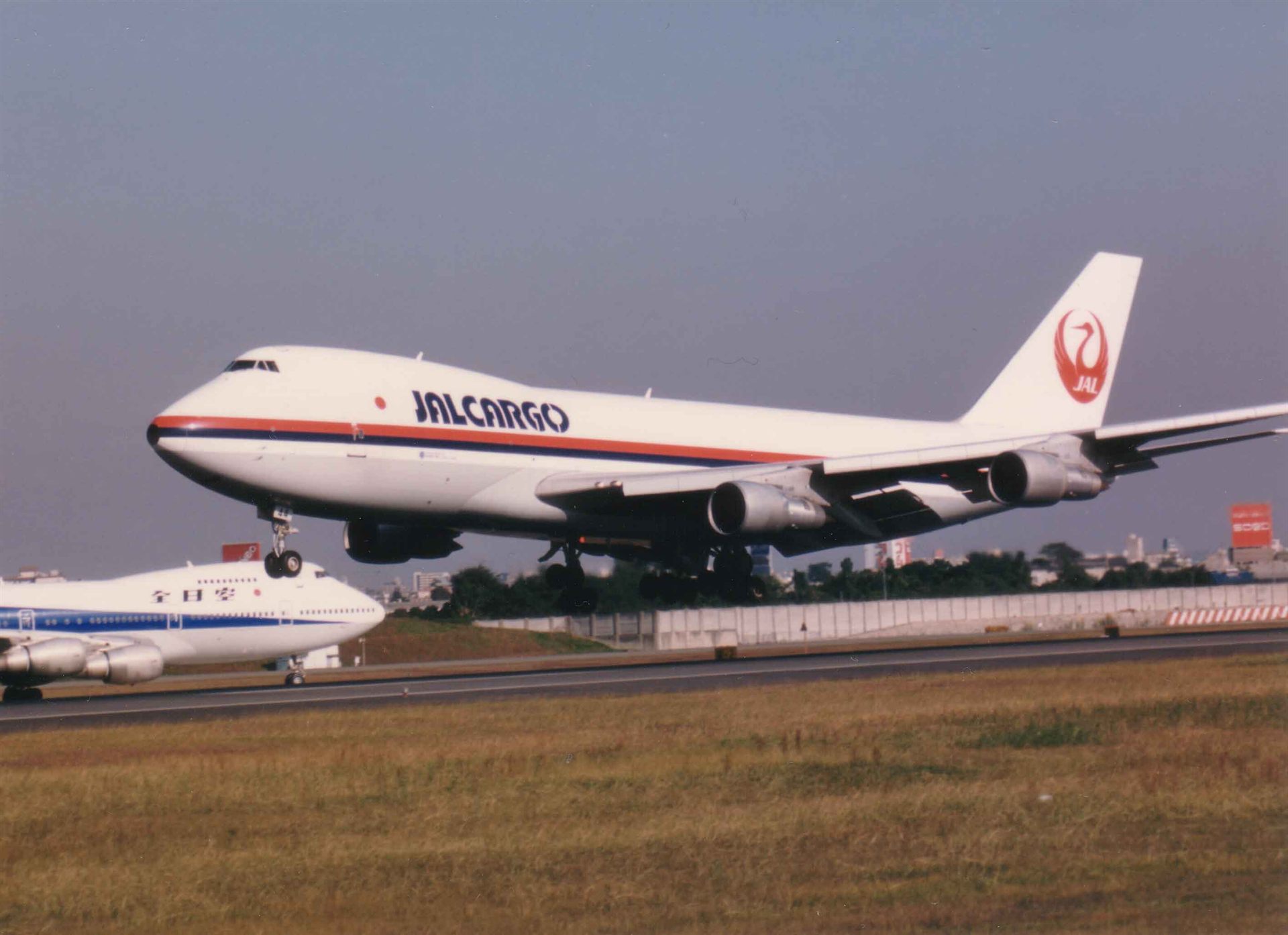
Pictured: a Japan Air Lines Cargo (JAL Cargo) Boeing 747-200F freighter, registration JA8144, photographed at Osaka International Airport circa 1990 — the same operator, aircraft type, and cargo-configured 747-200F variant flown as JL1628, not a photograph of the specific accident aircraft or of the incident itself. No photograph, film, or video of the November 17, 1986 encounter exists; the FAA's own case file consists of radar printouts, ATC voice-tape transcripts, and written witness statements rather than imagery, and no public-domain or rights-clear photograph of the exact aircraft tail number flown that night has been located.
Theoretical Alignment
Flight 1628 is a difficult case for any single theoretical framework to claim cleanly, and this file's alignment scores reflect that difficulty rather than resolve it. The Extraterrestrial Hypothesis scores highest of the three exotic frameworks because the core report — structured, maneuvering objects that appeared to track an aircraft through deliberate course and altitude changes, corroborated by more than one radar system even if only intermittently — is the textbook shape of an ETH-type craft encounter, and the case produced real institutional engagement (FAA security interviews, an internal radar review, a Washington briefing) that most purely anecdotal sightings never receive. It does not score higher than the low-to-mid 30s because the strongest single evidentiary thread in the case — the radar record — was ultimately walked back by the FAA's own public spokesman as an unexplained artifact rather than confirmed as an unknown craft, and because the case's central witness had a documented prior and subsequent history of reporting anomalous lights on the same air corridor. The Interdimensional Hypothesis scores lowest because nothing about the encounter's phenomenology — no landing, no occupants, no high-strangeness folkloric resonance — invites that framework; this is a conventional radar-visual pacing report, not a close encounter. The Psycho-Social Hypothesis scores highest among the three precisely because of what makes this case genuinely contested rather than simply corroborated: a single primary witness whose account (a spacecraft "twice the size of an aircraft carrier") outran what his own crewmates were prepared to describe, a documented pattern of repeat UFO reporting on the same route, and a serious published argument that the opening lights were moonlight reflecting off ice crystals in broken cloud, with a bright planet (Jupiter) misidentified later in the encounter. None of this proves psycho-social misperception occurred, but it is a substantial, evidence-based candidate this file weighs seriously rather than waves away.
Background
On the evening of November 17, 1986, Japan Air Lines Cargo Flight 1628 — a Boeing 747-200F freighter operating the long-haul segment of a Paris–Tokyo cargo run, with an intermediate stop planned at Anchorage, Alaska — was carrying a hold full of French wine westbound across the North Atlantic and Arctic air routes toward Narita International Airport near Tokyo. The flight had already crossed from Paris Charles de Gaulle to Reykjavik, Iceland, and was on the polar-adjacent leg from Reykjavik toward Anchorage when it entered U.S. airspace over eastern Alaska. At the controls was a three-person cockpit crew typical of a 747 freighter of the era: Captain Kenju Terauchi, a 47-year-old JAL veteran and former Japan Air Self-Defense Force fighter pilot with roughly three decades of flying experience; First Officer Takanori Tamefuji, 39; and Flight Engineer Yoshio Tsukuba, 33. Nothing about the flight to that point had been unusual; the crew was cruising at 35,000 feet under the control of Anchorage Air Route Traffic Control Center as they approached the airspace near Fort Yukon, a small community roughly 145 air miles northeast of Fairbanks and just above the Arctic Circle.
Mid-November in interior Alaska brings very short days; by mid-afternoon the sky over Fort Yukon is already fully dark, and the region's extremely low population density means there is essentially no ground lighting for a high-altitude observer to use as a reference or to rule out celestial or astronomical misidentification. It was into this dark, clear, sparsely populated airspace — then, as now, among the most heavily radar-monitored corridors in the state, given its position along a primary Anchorage–Fairbanks–polar air route — that Terauchi first noticed two clusters of lights in the sky ahead and to his left, setting in motion what would become, within weeks, an internationally reported case and a formal three-month Federal Aviation Administration investigation.
Complete Timeline
| Date / Time | Event |
|---|---|
| ~6:13 PM (FAA clock) | By Captain Kenju Terauchi's later account, he had been watching lights ahead and to the left for about six minutes before calling Anchorage; UPI reported that the lights first appeared about a mile from the jet as it crossed the Arctic Circle about 30 miles southeast of Fort Yukon. He first took them for military traffic. |
| During this phase | In his written report, Terauchi said two "spaceships" stopped in front of the aircraft and that "the inside cockpit shined brightly and I felt warm in the face." Neither of the other crew members reported such effects (Klass, from the FAA data package). |
| 6:19–6:27 PM | JL1628 asks Anchorage Center (Sector 15) for traffic information. At 6:26 Anchorage asks the military Regional Operations Control Center (ROCC), which reports a primary return at JL1628's 10 o'clock, 8 miles; at 6:27 the ROCC reports it no longer has any returns near the jet. |
| 6:31–6:32 PM | JL1628 says the "plane" is "quite big"; the controller approves any deviation needed. JL1628 descends from 35,000 to 31,000 feet and says the traffic is descending "in formation." |
| 6:35–6:36 PM | Near Fairbanks, JL1628 turns to heading 210; Fairbanks Approach Control reports no returns near the jet. JL1628 is then issued a 360-degree turn and asked to say whether the traffic stays with it. |
| 6:38–6:42 PM | The ROCC tells Anchorage it has confirmed "a flight of two" in JL1628's position, with "other equipment watching this," one a primary target only. At 6:39 the crew says it no longer has the traffic in sight; at 6:42 the ROCC says the traffic seems to have dropped back and to the right, but it is no longer tracking it. |
| 6:44–6:48 PM | JL1628 reports the traffic at 9 o'clock, then at 7 o'clock, 8 miles. The controller's own report says the object stayed as close as five miles despite the turns and altitude changes. |
| 6:45 PM | Anchorage gives a northbound United Airlines flight (UAL 69), with its pilot's agreement, a 10-degree turn to try to see the traffic. Later accounts also say Terauchi was offered, and declined, a military intercept; this file has not found that offer in the FAA chronology. |
| 6:50 PM | The United crew reports JL1628 in sight "against a light background" but no other traffic. A USAF C-130 passing to the south also sees the 747 but nothing else. |
| 6:53 PM | JL1628 reports it no longer has contact with the traffic, and continues to Anchorage. |
| Night of Nov. 17, 1986 | FAA Alaskan Region security manager Jim Derry and agent Ron Mickle interview the crew after landing; Derry later told UPI they were "normal, professional, rational," with no alcohol or drugs involved. |
| Late December 1986 | Japanese news media ask about the incident (Klass); the story reaches the U.S. press when a reporter queries the FAA. |
| Dec. 29–31, 1986 | UPI wire stories break the case. The FAA says the controller (unnamed; two years' experience) saw a second target but that its recorded radar data showed none; Capt. Robert Morris of Alaskan Air Command suggests "random clutter or weather interference." On Dec. 30 Terauchi gives an interview in Anchorage. |
| Jan. 2 and Jan. 15, 1987 | The FAA tape-records interviews with Terauchi (Jan. 2, when he also submits a written report) and Tsukuba (Jan. 15); Tamefuji is also interviewed in January. |
| Jan. 6, 1987 | The FAA compiles its "Chronological Summary of the Alleged Aircraft Sightings by Japan Airlines Flight 1628." |
| Jan. 11, 1987 | On a repeat Paris–Anchorage flight, Terauchi reports "irregular pulsating lights" in roughly the same area; when radar shows nothing, he and the FAA later agree they were village lights diffused by thin ice-crystal cloud (Klass). |
| Late January 1987 (per Callahan) | FAA Accidents and Investigations Division chief John Callahan says he assembled the radar and voice-tape record and briefed FAA Administrator Donald Engen, then attended a meeting he says included CIA and FBI representatives and members of a Reagan-era scientific study team. |
| March 5, 1987 | FAA Alaskan Region public affairs officer Paul Steucke releases the FAA's data package at a press conference in Anchorage. The FAA Technical Center's analysis attributes the sporadic second blip to an "uncorrected primary and beacon target," a split image of the 747's own return. |
| March 6, 1987 | The Anchorage Daily News reports Steucke's statement that the crew were "people of integrity" who "did report what they saw accurately." |
| March/April 1987 | Optical physicist Bruce Maccabee publishes "The Fantastic Flight of JAL1628" in CUFOS's International UFO Reporter (Vol. 12, No. 2). |
| Summer 1987 | Philip J. Klass publishes "FAA Data Sheds New Light on JAL Pilot's UFO Report" in the Skeptical Inquirer (Vol. 11, No. 4). |
| Later years | JAL, which had moved Terauchi to a desk job after he spoke to the press, reinstates him as a pilot "years later" (The Black Vault; Alaska Commentary says "a few years later"). |
| May 9, 2001 | John Callahan describes the briefing and the alleged CIA instruction at the Disclosure Project press conference at the National Press Club in Washington, D.C. |
| 2010 | Journalist Leslie Kean features the case, including Callahan's account, in her book UFOs: Generals, Pilots, and Government Officials Go on the Record. |
| 2001–2018 | The Black Vault files a FOIA request in May 2001; the FAA says the records were destroyed, but the file, more than 1,500 pages, is later located at the National Archives. |
What the Crew Saw: Two Escorts and a Mothership
Terauchi's account, given to FAA staff after landing, in his written report of January 2, 1987, in his FAA interview that day and to reporters, begins with lights ahead and to the left that he first took for military aircraft. A few minutes later, he wrote, "most unexpectedly two spaceships stopped in front of our face, shooting off lights. The inside cockpit shined brightly and I felt warm in the face." He described each object as two panels of amber-white lights, like the exhaust of jet or rocket engines. Neither of his crewmates reported the light flooding the cockpit or the heat, and UPI reported on December 29, 1986 that the crew had told the FAA they could not see a shape, only lights.
Later in the encounter, near Fairbanks, Terauchi alone reported a far larger object, which he drew as a giant walnut-shaped silhouette and told reporters was "two times bigger than an aircraft carrier." His crewmates, interviewed separately by the FAA in January 1987, were more cautious. First Officer Takanori Tamefuji, who was flying the aircraft during the first sighting, described what at first looked like "two small aircraft" slightly below his altitude. Asked whether he could distinguish the lights from a star, he replied "No"; shown Terauchi's walnut sketch, he said, "I don't see anything like this." Flight Engineer Yoshio Tsukuba described the first source as a "cluster of lights ... undulating," different from town lights, and a second, "absolutely different" source far to the left for 30 or 40 minutes; he could describe no shape for either, and said that when first interviewed he "was not sure whether the object was a UFO or not. My mind has not changed since then." (All quotations from the FAA transcripts as given by Klass, 1987.) This spread between the captain's structured craft and his crewmates' lights is the central tension in the case.
Course Changes and a Vanishing Radar Track
What raised Flight 1628 above a routine report was the series of maneuvers Anchorage Center approved while the crew watched. At 6:32 PM the jet descended from 35,000 to 31,000 feet, and Terauchi said the traffic descended "in formation." At 6:35 it turned to heading 210, and at 6:36 it was issued a 360-degree turn and asked whether the traffic stayed with it; Fairbanks Approach Control, asked at 6:35, had no returns near the jet. The crew reported losing sight of the traffic at 6:39 and seeing it again at 9 o'clock at 6:44 and at 7 o'clock, 8 miles, at 6:48. A light that keeps its bearing through course changes is what a distant celestial object would also do; Klass argued that by this stage Terauchi was watching Jupiter (see below).
The radar record is mixed. All three crew members agreed that the 747's own weather radar showed an echo at roughly the bearing of the first lights, about eight miles away; they also agreed it was green, the colour the set uses for the weakest echoes, and Tsukuba called it "not a dot, but streamlike" (Klass). The Anchorage controller, whom the FAA described as having two years' experience, reported seeing a second target on his scope, at one point as close as five miles; but the FAA's electronically recorded radar data showed no second object, and the FAA said "we can't reconcile the difference" (UPI, December 29, 1986). The military ROCC reported a primary return 8 miles at JL1628's 10 o'clock at 6:26, lost it a minute later, and at 6:38 reported "a flight of two" with one primary-only target. Fairbanks saw nothing. The Anchorage ARTCC air traffic manager, Quentin J. Gates, wrote that a review of the radar "failed to confirm any targets in close proximity to JAL 1628" (The Black Vault).
Reporting It: Jim Derry's Interview and "Very, Very Believable"
JL1628 landed in Anchorage without further incident, and the crew was met and interviewed by Jim Derry, security manager of the FAA's Alaskan Region, and agent Ron Mickle. Derry told UPI that the three men were "normal, professional, rational," with no alcohol or drugs involved, and that they were not hallucinating; The Black Vault summarises the finding as "credible and professional in demeanor." That is a judgment about the crew's sincerity and condition, not about what they saw. Klass later regretted that the FAA had not tape-recorded the crew that night, when recollections were fresh; the recorded interviews came only in January, after Japanese news media began asking questions.
The case reached the American press at the end of December 1986, when a reporter asked the FAA about it. UPI's stories of December 29–31 reported that the controller had seen a target that the FAA's recorded data did not show, and that Alaskan Air Command radar had briefly detected something near the jet; Capt. Robert Morris of that command suggested "random clutter or weather interference," and a sergeant added, "We got out of the UFO business some time ago." In his December 30 interview Terauchi, 47, a pilot with 29 years' experience, called the objects "the two small ships and the mothership" and joked that they might have wanted the Beaujolais in his hold.
The FAA's Retraction: Split Image, Uncorrelated Target
On March 5, 1987, FAA Alaskan Region public affairs officer Paul Steucke released the agency's data package in Anchorage. Radar specialists at the FAA Technical Center near Atlantic City had analysed the recorded data, and specialist Dennis R. Simantel attributed the sporadic second blip to an "uncorrected primary and beacon target," which occurs when the radar echo from an aircraft does not arrive at exactly the same instant as its transponder reply; such returns, he said, "are not uncommon" (quoted by Klass). Steucke added that the FAA "does not have the resources or the Congressional mandate to investigate sightings of unidentified flying objects," and had not tried to determine what the crew saw. He also said that "as far as we know, the whole crew are people of integrity and did report what they saw accurately" (Anchorage Daily News, March 6, 1987, as cited by Gross). Another FAA statement, quoted by Gross, put the agency's position as: "We are accepting the descriptions of the crew, but are unable to support what they saw."
The tension in the official record is therefore between what an individual controller and the military ROCC reported in real time and what the recorded radar data showed afterwards. John Callahan's later account, discussed next, adds a further claim about how the data were handled in Washington.
John Callahan, the CIA, and a Meeting That "Never Happened"
John Callahan was chief of the FAA's Accidents and Investigations Division in Washington, D.C. In his statement for the Disclosure Project press conference at the National Press Club on May 9, 2001, and in later interviews, he said he had the Anchorage radar data and voice tapes sent to the FAA Technical Center, had them played back together, and saw a target near the 747 that came and went over about thirty minutes. This is his recollection, given fourteen years later; it conflicts with the Technical Center's documented conclusion that the second blip was a split image, and no copy of his reconstruction has been published for independent checking.
Callahan said he then briefed FAA Administrator Admiral Donald Engen, and that a later meeting included people he identified as from the CIA, the FBI and a Reagan-era scientific study team, at which a CIA representative said the event "never happened" and the material was taken. He says he kept copies of some material and later gave them to researchers. No document or second witness confirming the meeting has been published, and The Black Vault notes that his account is unconfirmed by other sources. This file therefore treats the CIA episode as Callahan's testimony, not as an established fact. His FAA position is not in doubt; what he says happened at the meeting is unconfirmed.
Grounded for Talking: Terauchi's Discipline and Reinstatement
Terauchi, who was based in Anchorage at the time, was later transferred back to Japan (Klass). After he spoke to the press, JAL temporarily grounded him and gave him a desk job; The Black Vault says JAL reinstated him as a pilot "years later," and Alaska Commentary says he "was fully reinstated a few years later" and that he had "embarrassed" the company. The exact dates of his grounding and reinstatement have not been found in a primary source. Terauchi believed UFOs were extraterrestrial: he told the FAA that the "mothership" had kept to the dark side of the sky because "I think they did not want to be seen," and wrote that he hoped "we humans will meet them in the near future" (Klass).
Independent Analysis: Maccabee's Four Phases
The most detailed analysis by a proponent was published by optical physicist Bruce Maccabee in the Center for UFO Studies' International UFO Reporter (Vol. 12, No. 2, March/April 1987), under the title "The Fantastic Flight of JAL1628." Maccabee divided the encounter into four phases. Phase 1, the distant lights below and to the left, he found unremarkable in itself; Terauchi had been told there was no traffic in the area. Phase 2, when the lights moved in front of the aircraft and the whole crew saw them, he found "inexplicable": "The sighting cannot have been a hallucination by the whole crew. The lights could not have been stars or planets," since those were visible before the "ships" appeared and after they left, and "there is no natural phenomenon that can account for the rectangular arrangement of lights in horizontal rows." Phase 3, when the receding "ships" were seen only as two dim white lights while the weather radar showed an echo, he allowed might be a temporary radar failure but thought it "much more likely that there was some object out there." Phase 4, Terauchi's solitary giant object, was weaker: "It seems at least plausible that he may have misinterpreted oddly lighted clouds," and the ground radar confirmation was "ambiguous at best." His conclusion was that JL1628 "was accompanied during part of its flight by at least two TRUFOS (True UFOs)," a judgment resting on the middle phases rather than on the mothership.
Skeptical Counter-Arguments: Jupiter, Ice Crystals, and a "UFO Repeater"
The fullest skeptical treatment is Philip J. Klass's "FAA Data Sheds New Light on JAL Pilot's UFO Report," Skeptical Inquirer 11(4), Summer 1987, pp. 322–326, based on the FAA's released data package. Klass argued that two different stimuli were involved. For the first, undulating lights, he noted that a nearly full Moon stood about 12° up, almost directly behind the 747, and proposed that moonlight reflecting off turbulent clouds of ice crystals could have produced the flame-coloured lights, explaining why they vanished and reappeared as the cloud changed; the weak, "streamlike" green weather-radar echo, he suggested, was itself an echo from thin ice-crystal cloud. For the later light, he pointed to Jupiter: when Terauchi said the light was "just ahead of United" as UAL 69 approached, Jupiter (magnitude −2.6) lay low in the southeast at about 12° elevation and 143° azimuth, where from Terauchi's position it would appear just ahead of the United jet. "Never once did Terauchi report the 'UFO's' position relative to a 'very bright star,' i.e., Jupiter." Mars, about 19° to Jupiter's right, would have been far fainter. Astronomers Nick Sanduleak and C. B. Stephenson of Case Western Reserve University computed his positions. A JPL Horizons check for 02:30–02:50 UTC on November 18 from 65.8°N, 146.5°W gives Jupiter at magnitude −2.5, elevation 11.5–12.6°, azimuth 142–147°, and the Moon 97.6% lit at 11–12° elevation in the northeast (azimuth about 50–54°), consistent with Klass.
Klass also used the crew's separate January interviews: Tamefuji's "No" when asked whether the lights differed from a star, his "I don't see anything like this" when shown the walnut sketch, and Tsukuba's continued uncertainty. He wrote that the FAA data package "reveals Terauchi to be a 'UFO repeater,' with two other UFO sightings prior to November 17, and two more this past January, which normally raises a 'caution flag' for experienced UFO investigators." Both the "UFO repeater" label and the "caution flag" are Klass's words, not the FAA's. He also pointed out that the two aircraft vectored near JL1628, United 69 and a USAF C-130, saw the 747 but no other object. Robert Sheaffer, revisiting the case on his Bad UFOs blog in July 2014, concluded: "The bottom line is, Terauchi's own flight crew saw only 'lights,' and other aircraft checking out the situation saw nothing unusual."
Proponents answer that the crew described the lights as moving relative to the aircraft and changing arrangement, which a planet would not do. Maccabee's phase analysis argues that the stars and planets were visible before and after the "ships" and that the rectangular arrays could not have been celestial objects. His position is a middle one: neither Terauchi's mothership nor a wholly planetary explanation, but a judgment that the multi-witness middle phase is the strongest part of the record and the single-witness final phase the weakest.
Circumstantial Evidence
- Three professional aircrew reported unusual lights near their aircraft, and the FAA security manager who met them after landing found them "normal, professional, rational," with no alcohol or drugs involved.
- An Anchorage ARTCC controller reported a second target on his scope, at one point as close as five miles, and the military ROCC reported a primary return near the jet at 6:26 PM and "a flight of two" at 6:38 PM. The FAA's recorded radar data did not confirm either.
- The 747's own weather radar showed a weak echo at roughly the bearing of the first lights, about eight miles away, according to all three crew members.
- Former FAA Accidents and Investigations Division chief John Callahan later said a playback of the radar data showed a target near the jet for about thirty minutes; this is his recollection and conflicts with the FAA Technical Center's documented conclusion.
- Optical physicist Bruce Maccabee's phase-by-phase published analysis found the encounter's multi-witness middle phase "inexplicable" as a natural phenomenon, while explicitly declining to extend that same confidence to the case's single-witness "mothership" claim.
Key Witnesses
Kenju Terauchi
A JAL captain of 47 with 29 years' flying experience (UPI), described in later accounts as an ex-fighter pilot with more than 10,000 hours, Terauchi was the primary and most detailed witness, describing two "ships" and a giant "mothership" he alone saw in detail. The FAA's security manager found the crew rational and sober. Klass, reviewing the FAA data package, called him a "UFO repeater," citing two earlier sightings and two in January 1987, one of which Terauchi and the FAA later attributed to village lights seen through ice-crystal cloud. JAL moved him to a desk job after he spoke to the press and reinstated him as a pilot years later.
Takanori Tamefuji
Tamefuji was flying the aircraft during the first sighting. In his January 1987 FAA interview he described what at first looked like "two small aircraft" slightly below his altitude, answered "No" when asked whether he could distinguish the lights from a star, and said of Terauchi's walnut sketch, "I don't see anything like this" (Klass, from the FAA transcripts).
Yoshio Tsukuba
Tsukuba (spelled "Tsukuda" in UPI reports) described the first source as an undulating "cluster of lights," different from town lights, seen for five to ten minutes at about 11 o'clock, and a second, "absolutely different" source at 9 o'clock for 30 or 40 minutes. He could describe no shape for either and called the weather-radar echo "not a dot, but streamlike." He said he "was not sure whether the object was a UFO or not. My mind has not changed since then" (Klass, from his January 15, 1987 FAA interview).
The Five Observables Assessment
The Five Observables framework, developed by former AATIP director Luis Elizondo, is used to classify UAP encounters by performance characteristics exceeding known technology of their era:
Assessment: Anti-Gravity Lift is rated speculative: the crew described objects pacing and matching a large aircraft's altitude and heading changes with no visible conventional propulsion, but with no instrumented flight-dynamics data, this cannot be distinguished from a misperceived aircraft or radar artifact. Instant Acceleration is likewise speculative: the intermittent radar returns came and went abruptly, but that is the pattern the FAA Technical Center attributed to a split image of the 747's own return. Hypersonic Velocity is rated absent, since no reliable distance/time data exists from which any true speed could be calculated, and nothing in the account describes velocities exceeding a conventional aircraft's. Low Observability is rated speculative rather than present or absent: the object(s) were intermittently visible on some radar systems and not others across the same time window, a pattern that could reflect genuine low observability, ordinary radar-system limitations, or simple non-existence, and this file does not consider the evidence sufficient to choose among those explanations. Trans-Medium travel is rated absent, as no air/water/land transition was reported at any point.
Evidence Assessment
Supporting Anomalous Origin
- The crew reported lights that kept station with the aircraft through a descent and turns, and Maccabee argued that the rectangular arrays seen by the whole crew could not have been stars or planets.
- A controller and the military ROCC both reported returns near the jet in real time, and the 747's own weather radar showed an echo at roughly the bearing of the first lights.
- The FAA security manager who met the crew after landing found them "normal, professional, rational," with no alcohol or drugs involved.
- Former FAA division chief John Callahan later said the radar playback showed a target near the jet for about thirty minutes (his recollection, uncorroborated).
- The encounter generated an extensive FAA record — interviews, transcripts, radar analysis and internal reports — now held at the National Archives.
Supporting Conventional Explanation
- The FAA Technical Center's analysis of the recorded radar data attributed the sporadic second blip to an "uncorrected primary and beacon target," a split image of the 747's own return, and the Anchorage ARTCC manager wrote that the radar review "failed to confirm any targets in close proximity to JAL 1628."
- According to Klass, the FAA data package showed Terauchi had reported two UFO sightings before November 1986 and two more in January 1987; one of the latter was attributed, with his agreement, to village lights seen through ice-crystal cloud.
- The two other crew members' accounts, taken separately, were considerably more equivocal than Terauchi's — one explicitly said the lights did not look different from stars, and the other was unsure whether he had seen a "UFO" at all.
- Klass's published explanation (moonlit ice-crystal cloud for the first lights; Jupiter, low in the southeast at about 12°, for the light "just ahead of United") is consistent with JPL Horizons positions for that evening.
- Neither of two aircraft specifically vectored toward the area during the encounter — a United Airlines flight and a U.S. Air Force C-130 — reported observing anything unusual.
Why "Disputed"
Flight 1628 is rated DISPUTED because the record supports both readings in part and settles neither. On one side: three professional aircrew reported lights pacing their aircraft; the FAA security manager found them normal, rational and sober; a controller and the military ROCC reported returns near the jet in real time; the 747's weather radar showed an echo; and Bruce Maccabee argued that the middle, multi-witness phase cannot be explained by stars, planets or hallucination. On the other: the FAA's recorded radar data showed no second target, and the Technical Center attributed the sporadic blip to a split image of the 747's own return; Terauchi's structured "mothership" rests on his testimony alone, while his crewmates, interviewed separately, described only lights, one of them unable to tell them from a star; the weather-radar echo was the weakest kind; Klass identified a specific, checkable conventional explanation (moonlit ice-crystal cloud, then Jupiter) that JPL Horizons positions support; the two aircraft vectored to look saw nothing but the 747; and Callahan's account of a CIA instruction to bury the event is uncorroborated by any document or second witness. Credible witnesses and real but unconfirmed radar reports, set against a plausible astronomical explanation and the FAA's own negative radar finding, place the case in the disputed category.
Sensor & Instrumentation Detection Profile
Four systems are relevant. The 747's own weather radar showed a weak, green, "streamlike" echo about eight miles away at roughly the bearing of the first lights, according to all three crew members (Klass). An Anchorage ARTCC controller reported a second target on his scope, at one point as close as five miles. The military ROCC reported a primary return 8 miles at JL1628's 10 o'clock at 6:26 PM, lost it a minute later, and at 6:38 reported "a flight of two." Fairbanks Approach Control saw nothing. The recorded data from the long-range radar were analysed at the FAA Technical Center, where Dennis R. Simantel attributed the sporadic second blip to an "uncorrected primary and beacon target," a timing artifact of the 747's own transponder reply. Years later, John Callahan said a playback had shown a target near the jet for about thirty minutes; that account is uncorroborated. No photograph, film, video or other instrument record exists.
Environmental & Geospatial Context
The encounter took place over the sparsely populated interior of Alaska, from about 30 miles southeast of Fort Yukon south past Fairbanks toward Anchorage; UPI reported that the objects followed the jet for some 400 miles. It was not full night: Klass gave the Sun as about 11° below the horizon, and JPL Horizons gives about −10° at 02:19 UTC and −13° at 02:45 UTC (65.8°N, 146.5°W); the United crew saw the 747 "against a light background." A nearly full Moon (97.6% lit) stood low in the northeast, behind the southwest-bound jet, and Jupiter and Mars were low in the southeast. The crew described a clear night, but both Maccabee and Klass refer to cloud below the aircraft, and Terauchi himself noted that his flights over Alaska were generally by day and that in darkness "it is confusing to identify the kind of lights." Two other aircraft, United 69 and a USAF C-130, passed near JL1628 during the encounter; both saw the 747 and nothing else.
Observer Credibility & Occupational Profile
All three witnesses were working airline crew. Kenju Terauchi, 47, had 29 years' flying experience (UPI); later accounts describe him as an ex-fighter pilot with more than 10,000 hours. FAA security manager Jim Derry told UPI the crew were "normal, professional, rational," with no alcohol or drugs involved. Against that, Klass reported from the FAA data package that Terauchi had made two earlier UFO reports and two in January 1987, one of which he and the FAA agreed was village lights through ice-crystal cloud, and that he was convinced UFOs were extraterrestrial. Neither point proves what he saw on November 17, but both bear on how much weight his solitary "mothership" can carry.
Physical & Material Assays
Flight 1628 produced no physical or material evidence of any kind. No object, fragment, residue, or trace was recovered from the aircraft, its instruments, or any location on the ground; no injury, burn, or lasting physiological effect was reported by any crew member beyond the transient sensation of facial warmth Terauchi described during the closest approach, a claim that rests solely on his own testimony and was not independently measured. The aircraft itself sustained no detectable damage and completed its flight to Anchorage and, after a stopover, on to Narita without any anomaly in its own systems beyond the ambiguous weather-radar return Tsukuba described. This file's entire physical-evidence assessment for the case is therefore a documentary rather than a material one: FAA interview transcripts, radar printouts, ATC voice-tape recordings, and internal agency correspondence — more than 1,500 pages of which were located at the National Archives after a Black Vault FOIA request first filed in 2001 — constitute the full physical record. That absence of trace evidence is unsurprising for an airborne pacing encounter of this kind and should not by itself be read as diminishing the case's credibility relative to comparable radar-visual reports; it does mean, however, that every claim in this file about the objects' size, structure, or behavior rests on either eyewitness testimony or disputed radar data, with nothing in between.
Historical Precedents & Archive Matches
Flight 1628 belongs to the multi-crew, radar-reported aircrew sighting, most directly comparable in this archive to the July 1957 RB-47 Bomber Chase, in which an Air Force crew's observations were matched by ground and airborne radar, and to the October 1973 Coyne Helicopter Incident, a multi-person Army Reserve crew sighting with a reported instrument anomaly. Like those cases, Flight 1628 combines trained observers with some instrument data; unlike them, its key ground-radar evidence was examined by the agency that recorded it and attributed to an artifact. Terauchi's January 1987 sighting on the same route, attributed to village lights, is part of the same record.
Material Analysis
Flight 1628 left behind no physical or trace material of any kind, and this file states that plainly rather than padding around it: no object, fragment, or residue was recovered from the aircraft or from the ground beneath the encounter's flight path, no instrument or structural damage was detected on post-flight inspection, and no crew member reported any injury beyond Terauchi's own unmeasured, subjective sensation of facial warmth during closest approach. In a case built entirely on aircrew testimony and disputed radar data, that absence is unsurprising rather than suspicious — an object pacing an aircraft at 31,000–35,000 feet would not be expected to leave a ground trace comparable to a landing case — but it does mean the entirety of this file's "material" analysis is documentary rather than physical: the FAA's own case file, the FAA's released data package, and the more than 1,500 pages of FAA records now at the National Archives. Those documents are real, examinable, and independently verifiable as authentic federal records; what remains contested is not whether they exist, but what the radar data within them actually shows, a question this file has already addressed at length above and returns to directly in the Conventional Explanation Candidates section below.
Supporting a Genuine Anomalous Effect
- A civilian controller and the military ROCC each reported returns near the jet in real time, so the crew's testimony does not stand entirely alone.
- Former FAA division chief John Callahan later said the radar playback showed a target for about thirty minutes (uncorroborated recollection).
- The FAA's documentary record — interviews, transcripts, radar analysis and internal reports — is unusually extensive and is now at the National Archives.
Supporting a Mundane Origin
- The FAA Technical Center attributed the sporadic second blip to an "uncorrected primary and beacon target," a split image of the 747's own transponder return.
- No physical evidence of any kind was recovered, and no instrument other than radar — itself disputed — recorded any anomaly.
- Fairbanks Approach Control had no return near the jet during the turns, and the FAA's recorded long-range radar data showed no second object.
Conventional Explanation Candidates
Three distinct conventional explanations have been seriously proposed for Flight 1628, and each deserves evaluation on its own terms.
Planetary Misidentification (Jupiter and Mars) with Ice-Crystal Cloud Reflection
Partially Plausible, IncompletePhilip J. Klass's 1987 Skeptical Inquirer analysis remains the most detailed conventional explanation. For the first, undulating lights, Klass proposed moonlight from the nearly full Moon, about 12° up and almost directly behind the 747, reflecting off turbulent ice-crystal cloud, which would explain why the lights vanished and reappeared as the cloud changed; he took the weak green weather-radar echo to be an echo from the same kind of cloud. For the later light, he showed that Jupiter (magnitude −2.6, about 12° up at azimuth 143°) lay where Terauchi placed the light "just ahead of United," and that Terauchi never reported the light's position relative to a "very bright star." Mars, about 19° to the right of Jupiter, would have been much fainter. JPL Horizons positions for that evening match his figures. The explanation's weakness, as Maccabee argued, is the multi-witness phase: the crew described rectangular arrays of lights that moved in front of the aircraft while the stars and planets remained visible elsewhere, and the explanation does not by itself account for the real-time returns reported by the controller and the ROCC.
Radar Artifact ("Uncorrelated Primary Target" / Split Image)
Partially Plausible, IncompleteThe FAA Technical Center's analysis of the recorded long-range radar data attributed the sporadic second blip near the 747 to an "uncorrected primary and beacon target," which occurs when the radar echo off an aircraft does not arrive at exactly the same instant as its transponder reply; specialist Dennis R. Simantel said such returns "are not uncommon." The Anchorage ARTCC manager wrote that the radar review "failed to confirm any targets in close proximity to JAL 1628." This explanation comes from the people who analysed the recorded data. Its limits are that it addresses the long-range radar only: it does not explain the military ROCC's "flight of two" report, and it sits uneasily with the controller's real-time report and with John Callahan's later, uncorroborated recollection of a thirty-minute target.
Witness Misperception Amplified by a Documented "Repeater" Pattern
Partially Plausible, IncompleteA third candidate holds that Captain Terauchi, by Klass's reading of the FAA data package a "UFO repeater" with two earlier reports and two in January 1987 (one attributed, with his agreement, to village lights through ice-crystal cloud), was predisposed to read ambiguous lights as craft; he was convinced UFOs were extraterrestrial and described the January lights in terms very like the November ones. Its strength is that it uses the documented record; its weakness is that it cannot by itself explain the crew-wide observation of the middle phase, the weather-radar echo, or the real-time ground radar reports.
Each candidate explains part of the record: moonlit ice-crystal cloud and Jupiter for the lights, a transponder split image for the long-range radar blip, and a predisposed principal witness for the "mothership." None accounts for everything: the military ROCC's reports and the controller's real-time sighting remain unexplained in detail, and Maccabee judged the multi-witness middle phase inexplicable. Together they are strong enough that the case cannot be treated as an established unknown.
Related Cases
Confirmed Documents & Official Records
A public-domain archival collection of the FAA's Japan Air Lines Flight 1628 case file, including incident reports, radar data analysis, ATC transcripts, and crew interview statements.
UNCLASSIFIED / PUBLICAn independently maintained index of over 1,500 pages of FAA documents on the case, including radar printouts, ATC audio-transcript material, and internal FAA correspondence, obtained via Freedom of Information Act requests.
DECLASSIFIED / PUBLICSearch Government Archives Directly
Further Reading — Recommended Literature
UFOs: Generals, Pilots, and Government Officials Go on the Record
Features John Callahan's own account of the JAL 1628 radar analysis and the disputed CIA briefing, alongside dozens of other credentialed witness testimonies.
JAL Flight 1628 — UFO Intercept Over Alaska: The Official Reports
A PARANOIA Research File compilation of the FAA's own scanned original documents on the case, including radar reports and interview transcripts.
Project Delta: A Study of Multiple UFOs
Richard Haines's 1994 compendium of about 230 sightings of multiple UFOs (per David M. Jacobs's review). This file has not confirmed whether it discusses JAL 1628.
DISCLOSURE: Some links above are affiliate links. If you purchase through them, OverClassified receives a small commission at no additional cost to you. This helps support independent research.
Essential Viewing
Boeing 747 Followed by a UFO | An Out Of This World Encounter | Japan Air Lines Flight 1628
TheFlightChannel's detailed narrated walkthrough of the flight, the crew's account, and the FAA's investigation.
UFO Sighting at 35,000 Feet | JAL Cargo Flight 1628
Red Web's dedicated case episode covering the crew testimony, the radar dispute, and John Callahan's later account.

INFAMOUS Japan Air Lines UFO Debunked & Explained! (Flight 1628)
A dedicated skeptical case walkthrough covering the Jupiter/Mars and radar-artifact explanations in detail.

JAL Flight 1628 UFO Incident
A concise case-summary overview covering the timeline, the crew's testimony, and the investigation's aftermath.
Sources
- Wikipedia. "Japan Air Lines Cargo Flight 1628" (pointer only). en.wikipedia.org
- United Press International. "The crew of a Japan Air Lines cargo jet…," Dec. 29, 1986. upi.com/Archives
- United Press International. "Controller confirms UFO sighting," Dec. 30, 1986. upi.com/Archives
- United Press International. "JAL pilot describes UFO," Dec. 31, 1986. upi.com/Archives
- United Press International. "A veteran pilot whose UFO sighting was confirmed on…," Dec. 31, 1986. upi.com/Archives
- United Press International. "JAL pilot reports second UFO sighting," Jan. 12, 1987. upi.com/Archives
- Gross, Patrick. "UFOs at Close Sight: Japan Airlines Boeing 747 Meets UFO Over Alaska in 1986" — detailed sourced case archive with ATC timeline reconstruction. ufologie.patrickgross.org
- The Debrief. "What Really Happened to Japan Airlines Flight 1628 in 1986?" thedebrief.org
- American Ghost Walks. "Haunted Alaskan Skies: 1986's Japan Airlines Flight 1628 UFO Encounter." americanghostwalks.com
- Sheaffer, Robert. "JAL 1628: Capt. Terauchi's Marvellous 'Spaceship'" (Bad UFOs), 2014. badufos.blogspot.com
- The Black Vault. "The Vault Files: 1986 Alaska JAL Flight 1628." theblackvault.com
- "FAA Japan Air Lines Flight 1628 Records" (user-uploaded mirror of FAA records, Internet Archive, April 2023). archive.org
- Klass, Philip J. "FAA Data Sheds New Light on JAL Pilot's UFO Report," Skeptical Inquirer 11(4), Summer 1987, pp. 322–326 (quotes the FAA transcripts, Terauchi's report and the Technical Center analysis). centerforinquiry.s3.amazonaws.com (PDF)
- Think About It Docs. "1986: Japan Air Lines Flight 1628." thinkaboutitdocs.com
- TOCANA. "The JAL Flight 1628 UFO Incident: Declassified Files Reveal a 50-Minute Encounter Over Alaska," 2025. en.tocana.jp
- Alaska Commentary. "Unfriendly Skies: The Extraordinary Flight of JAL 1628, Alaska's Best Known UFO Encounter." alaska-commentary.ghost.io
- Maccabee, Bruce. "The Fantastic Flight of JAL1628," International UFO Reporter, Vol. 12, No. 2, Center for UFO Studies, March/April 1987.
- Kean, Leslie. UFOs: Generals, Pilots, and Government Officials Go on the Record. Harmony Books, 2010 (Callahan/JAL 1628 chapter).
- Haines, Richard F. Project Delta: A Study of Multiple UFOs. LDA Press, 1994 (further reading; its coverage of this case has not been confirmed).
- Clark, Jerome. The UFO Encyclopedia, 4th ed. (further reading; entry not checked for this review).
- NASA JPL Horizons ephemeris service, positions of the Sun, Moon, Jupiter and Mars for 18 November 1986, 02:00–03:30 UTC, from 65.8°N, 146.5°W at 10.7 km. ssd.jpl.nasa.gov
- The Black Vault, FAA transcript excerpt, "Selected portions of transcription of the incident involving Japan Airlines Flight 1628 on November 18, 1986, at approximately 0218 UTC" (FAA, February 4, 1987). documents.theblackvault.com
Corrections (October 2026)
A fact-check against Philip Klass's 1987 Skeptical Inquirer article (which quotes the FAA transcripts, Terauchi's written report and the FAA Technical Center analysis), the FAA chronology as reproduced by Patrick Gross, UPI's December 1986 wire stories, The Black Vault's case file, Robert Sheaffer's 2014 post and JPL Horizons led to the following changes. The timeline had been shifted an hour earlier than the FAA's own times (6:19–6:53 PM) and has been rebuilt from the FAA chronology; the claim that the encounter took place in full darkness has been corrected to twilight, and the "100% Full Moon" to 97.6%. An Anchorage controller named "Sam Rich" and his quote "all three of us thought there was a track" could not be found in any source and were removed; the FAA described the controller only as having two years' experience. Jim Derry's quotes "didn't make this up. Something happened that scared them" and "very, very believable," and his description of "sweaty palms, dilated pupils," were not found and were removed, as were the extra interviewers (Jack Wright, the JAL station manager). The "UFO repeater" label and the "caution flag" were Klass's words, not the FAA's or Sheaffer's. Klass's argument had been misdescribed: he attributed the first lights to moonlit ice-crystal cloud and identified Jupiter with the later light "just ahead of United," not with the initial lights, and he mentioned Mars only as a fainter planet nearby. The argument attributed to Richard Haines about the lights' relative motion could not be traced to him and was removed; the comparable published argument is Maccabee's. Also removed or corrected: the claim that First Officer Tamefuji rejected a "weather interference" explanation because the sky was clear; the crew's ages other than Terauchi's; the "Kyodo News" interview and the length of Terauchi's grounding; a "104 miles northeast of Fort Yukon" opening call; a "four systems, two no return, one glitch" radar summary; the FAA's "uncorrelated primary target" wording (the Technical Center's phrase, as quoted by Klass, was "uncorrected primary and beacon target"); and the attribution of "We are accepting the descriptions of the crew..." to the March 5 press conference (Gross cites a separate FAA statement; his March 5 quote is "people of integrity"). Callahan's account is now presented as his uncorroborated recollection, and the claim that his role was "independently verified" through Black Vault correspondence was removed.
Following this review, the rating was changed from Disputed 56 to Disputed 48 (October 27, 2026), because the higher rating had rested partly on claims corrected or removed above.
See something inaccurate? Have additional information or sources?
Suggest an Edit →Last Updated: August 2026