
JAL Flight 1628
UFO Intercept Over Alaska: The Official Reports
Core Thesis
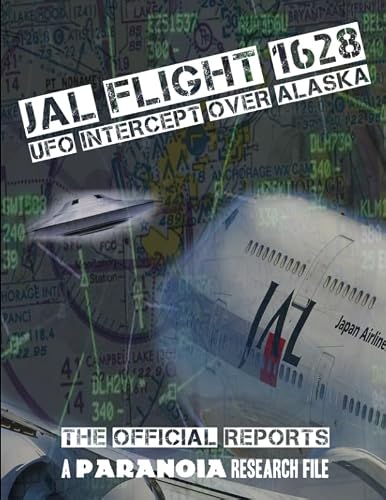
JAL Flight 1628 — UFO Intercept Over Alaska: The Official Reports is not a narrative account but a primary-source compilation: researcher and publisher Olav Phillips gathered and reprinted the Federal Aviation Administration's own original documents on the case this site's own Japan Air Lines Cargo Flight 1628 file documents in full — the November 17, 1986 encounter in which Captain Kenju Terauchi reported two small craft and a much larger "mothership" pacing his Boeing 747 freighter near Fort Yukon, Alaska. The book's contents are scanned radar analyses and interview transcripts rather than argument or interpretation, making it a research tool for readers who want to see the case's own paper trail directly rather than a secondhand retelling of it.
About the Author
Olav Phillips is a real, decades-active UFO and paranormal researcher and publisher: founder of the Anomalies Network, publisher of Paranoia Magazine and Steamshovel Press, author of The Secret Space Age, and a recurring guest on Coast to Coast AM and Gaia's UFO-focused programming. This particular title is the second volume in his "PARANOIA Research File" series, a line of similarly structured document-compilation booklets built around specific, well-documented UFO cases rather than original narrative investigation.
The book's actual authorship is credited, accurately, to the Federal Aviation Administration itself on most retail listings, with Phillips as compiler and editor — a distinction worth stating plainly, since the value of this book rests on the documents' governmental origin, not on Phillips's own analysis or fieldwork.
Historical Context & Origins
The book compiles the FAA's own record of the case, including the accident/incident investigation branch's handling of the report and the interview transcripts with Terauchi and his crew. This site's own case file separately documents the case's central FAA figure, John Callahan, then Division Chief of the FAA's Accidents and Investigations Branch, who compiled the case's radar and interview data and later stated in a televised 2001 National Press Club appearance that a CIA representative told those present the meeting "never happened" and confiscated materials — a striking claim this site's case file treats as independently documented (via Callahan's own on-record statements and Leslie Kean's reporting) but not independently corroborated by the CIA or a second government witness.
This book's own scanned FAA documents predate and are separate from Callahan's later public claims; readers should not assume the book itself contains or substantiates the CIA-confiscation story, since that account rests on Callahan's subsequent personal testimony rather than on the paper record the book reproduces.
The documents this book reprints sit within a specific, well-documented timeline that this site's own case file lays out in detail: Terauchi first noticed two light clusters pacing his aircraft around 5:11 PM Alaska time, radioed Anchorage Center for traffic information roughly eight minutes later, and was told a military Regional Operations Control Center tied to Elmendorf Air Force Base had a primary radar return at his ten o'clock position, about eight miles out. When offered a military jet intercept to investigate further, Terauchi declined, citing concern about provoking a confrontation — a decision-point the FAA's own interview transcripts, reprinted in this book, capture directly from the crew's own words rather than through later summary.
Core Arguments & Key Concepts
As a documents compilation, the book does not advance a thesis of its own; its value is in letting readers examine the FAA's radar analysis and the pilots' interview transcripts directly. This site's own case file summarizes what those documents actually show: a disputed radar record in which some military and ARTCC returns were later characterized by skeptics, including Philip J. Klass, as clutter or a split-image artifact, while researcher Bruce Maccabee's independent four-phase technical analysis concluded the case involved "at least two" what he termed TRUFOs (Temporary Unidentified Flying Objects) and that the overall pattern "seems inexplicable" by conventional means.
The FAA's own contemporaneous assessment, also reflected in the documents this book reprints, characterized the flight crew as professional and rational, with no evidence of drug or alcohol involvement — a finding that narrowed the case's plausible explanations without resolving what, specifically, was observed. Terauchi himself paid a real professional cost for going public: after giving an unauthorized interview to Kyodo News journalists in December 1986, Japan Air Lines grounded him from flight duty and reassigned him to ground work, a period secondary sources describe as lasting from several months to roughly two years before his full reinstatement to flying status in the late 1980s or early 1990s. He largely avoided further public discussion of the case afterward, and separately reported a second, less dramatic sighting on approximately the same air corridor in January 1987, which investigators later attributed to village lights diffused through thin ice-crystal cloud — a mundane explanation for the second event that this article notes precisely because the case file does not extend the same benefit to the original November 1986 encounter, treating the two sightings on their own separate evidentiary merits rather than assuming one discredits the other.
Key Cases & Evidence Discussed
This site's own Japan Air Lines Cargo Flight 1628 case file documents the full record in far greater depth than this book review needs to repeat: Terauchi's complete account, the FAA's investigation and Callahan's role in it, the disputed and partially corroborating radar returns, Klass's skeptical rebuttal, and Maccabee's independent technical analysis. Readers wanting the complete, evenly weighted record should consult that case file directly.
What is specific to this book is unmediated access to the source documents themselves — valuable precisely because so much of this case's public discussion happens at the level of summary and characterization; a reader who wants to check a specific radar report or transcript passage against how it has been described elsewhere has a direct primary source in this compilation.
Critical Reception & Controversies
As of this article's research (August 2026), this book has no meaningful review record: it appears on Goodreads with a listing but no ratings or reviews, and no trade or journalistic review was found, consistent with its nature as a niche, self-published primary-source reprint rather than a title aimed at a general readership. This article treats the absence of reception as an accurate reflection of the book's narrow, reference-oriented purpose rather than a mark against it.
Prospective readers should know before purchasing that this is a short (roughly 80-page) compilation of scanned documents and transcripts, not a prose narrative or analytical treatment of the case — a structural fact about the book itself, not a criticism of its content.
Influence & Legacy
The book's role is archival rather than argumentative: by reprinting the FAA's own documents in an accessible, purchasable format, it has helped keep the case's primary-source record available to researchers and enthusiasts outside of formal FOIA channels, alongside Phillips's parallel PARANOIA Research File volumes on other well-known cases.
Set alongside this site's own case file, which draws on Callahan's later public testimony, Maccabee's technical analysis, and Klass's skeptical rebuttal in addition to the FAA's original documents, this book is best read as a reference companion — useful for verifying specific documentary claims, not as a substitute for the fuller, multi-perspective record the case file assembles.
The Book
As an Amazon Associate, OverClassified may earn from qualifying purchases made through this link, at no extra cost to you.
Why This Is Essential Reading
JAL Flight 1628 — UFO Intercept Over Alaska earns its place on this reading list not as an argument for or against the case's reality, but as direct, unmediated access to the FAA's own documentary record of one of aviation history's most substantially investigated UFO encounters. Readers should approach it with the expectation of a short primary-source compilation rather than a narrative account, and should read it alongside this site's own Japan Air Lines Cargo Flight 1628 case file, which supplies the fuller context, the competing technical analyses, and John Callahan's later, separately documented claims that this book's scanned 1986-era documents do not themselves cover.
Related Cases & Theories
Sources Cited
- Phillips, Olav (ed.); Federal Aviation Administration. JAL Flight 1628 — UFO Intercept over Alaska: The Official Reports. A PARANOIA Research File, independently published, December 2018 (ISBN-13 9781792976261). amazon.com
- "PARANOIA Research File — JAL Flight 1628: UFO Intercept over Alaska." Goodreads (earlier related edition listing, cover art). goodreads.com
- "Olav Phillips." Coast to Coast AM guest bio (independent confirmation of his research/publishing background). coasttocoastam.com
- "Japan Air Lines Cargo Flight 1628." Wikipedia (independent case overview). en.wikipedia.org
- Maccabee, Bruce. "The Fantastic Flight of JAL 1628." Independent technical analysis of the radar and witness record, cited in this site's own case file.
- Kean, Leslie. UFOs: Generals, Pilots, and Government Officials Go on the Record, Harmony Books, 2010 (independent reporting on John Callahan's 2001 National Press Club claims).
- Klass, Philip J. Skeptical analysis of the JAL 1628 radar record (cited in this site's own case file as the primary rebuttal to the case's radar corroboration claims).
- This site's own John Callahan key-figures entry (his FAA role and later public claims about the case's aftermath).
- This site's own Bruce Maccabee key-figures entry (his independent technical analysis of the case).
- This site's own Kenju Terauchi key-figures entry (the flight's captain and primary witness).
- Clark, Jerome. The UFO Encyclopedia, 4th Edition. Visible Ink Press, 2023 (reference-work entry on the case).
- This site's own Japan Air Lines Cargo Flight 1628 case file (full sourcing, the FAA investigation, and the competing technical analyses documented there).
Have corrections, additional research, or peer-reviewed sources? Help improve this entry.
Suggest an Edit