
The Amaury Rivera Abduction
In the early hours after a Mother's Day night in May 1988, Amaury Rivera Toro, a waiter driving home from a nightclub in Hormigueros, Puerto Rico, said he was stopped on a foggy rural road by small beings and taken aboard a craft with fourteen other people. Waking in his car in daylight on an unfamiliar road near Cabo Rojo, he said, he photographed a disc-shaped object being circled by three military jets. His photographs, usually identified as showing a U.S. Navy F-14 Tomcat beside the disc, have circulated widely but have never been independently authenticated, and skeptics regard them as a hoax. Most of what is known about the case comes from Rivera's own account.
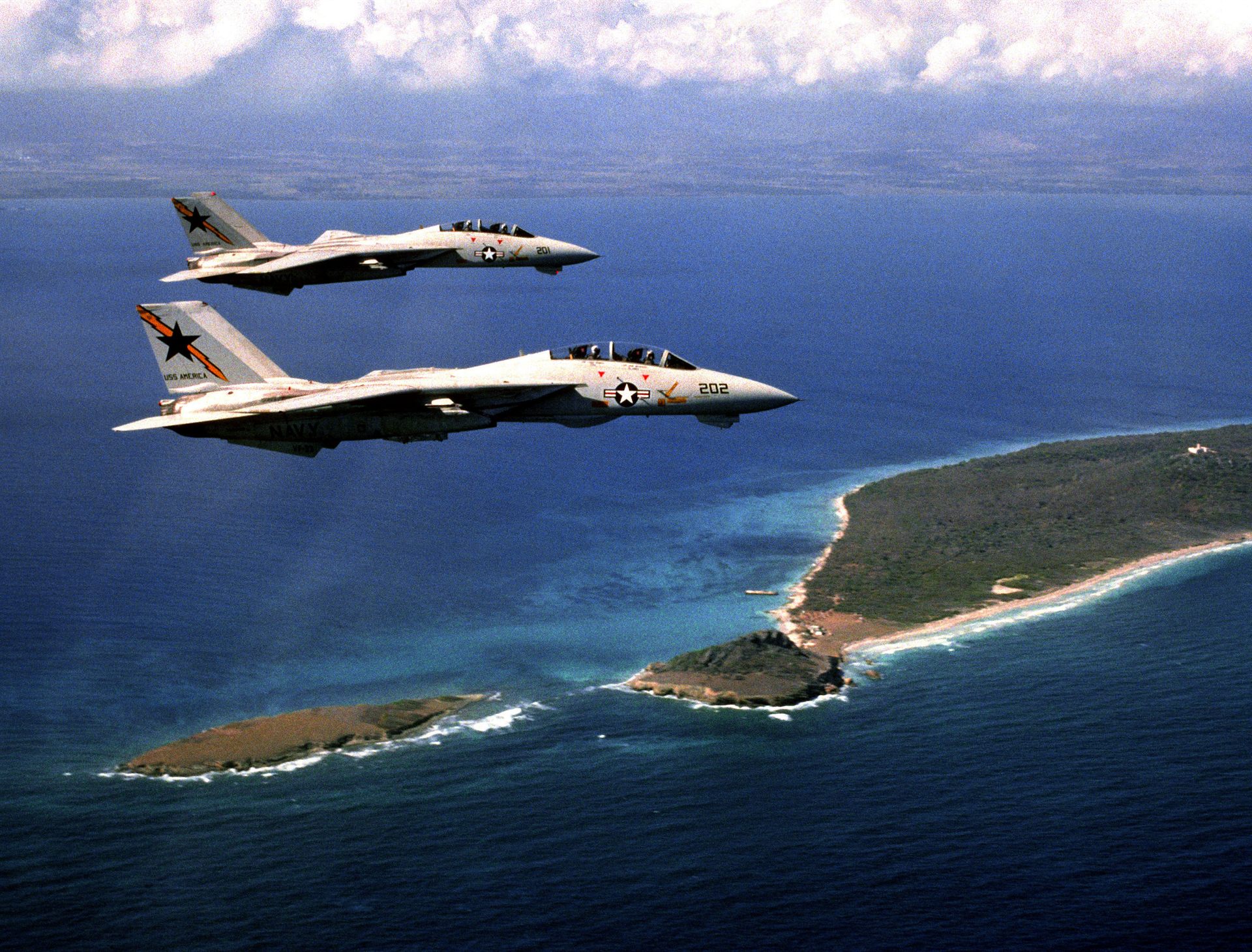
Pictured: U.S. Navy F-14A Tomcats of VF-33 in flight off the Puerto Rico coastline, 1990 — the aircraft type the jets in Amaury Rivera's photographs are usually identified as (Rivera himself describes them only as "military planes"), not the object itself or Rivera's own May 1988 photographs. Rivera's original images have never been published under any verified rights-clear license, so a real photograph of the fighter type stands in for the incident photography here.
Theoretical Alignment
The May 1988 account of Amaury Rivera Toro is usually evaluated against three broad hypotheses. Proponents of the Extraterrestrial Hypothesis (ETH) point to the photographs, to Rivera's description of a structured craft circled by military jets, and to his detailed narrative of non-human beings and a human-looking guide who said he came from a planet called Kaa. The case aligns much more strongly with the Psycho-Social Hypothesis (PSH), which treats such accounts as shaped by cultural expectations and personal psychology. Rivera's narrative was recovered in fragments, its content (a warning of catastrophic earthquakes and tidal waves, a floating island-city for survivors, a guide from another planet) closely follows the conventions of contactee literature, and the photographs, the only physical evidence, have never been independently authenticated. Minor alignment with the Interdimensional Hypothesis (IDH) rests on the dreamlike qualities of the account rather than on any evidence. On balance the case is best described as a single-witness narrative supported only by disputed photographs.
The local context matters. In the late 1980s southwestern Puerto Rico was the scene of a well-publicized UFO wave, much of it centered on the Sierra Bermeja and Laguna Cartagena area near Cabo Rojo, and the island was home to the U.S. Navy's Roosevelt Roads base, so military aircraft were a familiar sight. Accounts of UFOs being chased or "intercepted" by jets became part of the wave's folklore; the best-known, from December 1988 near Cabo Rojo, was reported months after Rivera's encounter. Whatever Rivera saw or staged, his photographs fit that local narrative of military aircraft pursuing unknown craft, which is one reason they spread so widely once they became public.
Background
The late 1980s were a period of intense UFO interest across Puerto Rico. Southwestern towns such as Lajas and Cabo Rojo became centers of reported sightings, and stories of craft over the Laguna Cartagena lagoon and the Sierra Bermeja hills, of underwater bases off the coast, and of government cover-ups circulated widely, promoted in particular by the investigator and magazine publisher Jorge Martín. The island was also a significant U.S. military outpost, home to Naval Station Roosevelt Roads and the scene of large exercises such as Ocean Venture 88, held in the Caribbean that spring. It was against this backdrop that Amaury Rivera Toro's story eventually emerged.
According to his 2011 book, Rivera, who was born in New York, had moved back to Puerto Rico in the spring of 1988 and lived with his grandmother in the Cabo Rojo area. A cousin heard on the radio that the Casa Blanca nightclub in Hormigueros needed a waiter, and he began working there on weekends, driving home in an old Toyota. Part of his route ran through La Bajura, an old, little-used road between Cabo Rojo and Hormigueros where, his cousin warned him, livestock sometimes wandered into the road. On the night of Mother's Day, the club was packed for a performance by the salsa orchestra El Gran Combo, and Rivera had brought his cousin's inexpensive Kodak 110 camera to photograph the band for her. He left work after 4:00 a.m. and turned onto La Bajura, where he found dense fog.
The date is given inconsistently. Rivera's own account places the encounter on the night of the Mother's Day celebration, and a 2005 telling of his story says "the night before Mother's Day"; in Puerto Rico Mother's Day fell on Sunday, May 8, in 1988, and a 2020 book by Pedro P. Canto gives May 8. Many online accounts give May 14, 1988, a date that does not appear in Rivera's own narrative. This page uses May 8 and notes the alternative.
The photographs did not become public quickly. By Rivera's account, his family saw them when his cousin had the film developed, and he then put them away for a long time. Only later, after he had left the nightclub and started a hot-dog stand near the El Combate beach road, did he display an enlargement on his cart, which brought him unwanted attention, a frightening search of his home by men he believed were CIA agents, and eventually contact with a collaborator of Jorge Martín's UFO magazine. He met Martín himself afterwards and, contrary to some later retellings, describes him in the book as a serious and trustworthy person.
Rivera says he eventually gave Martín some of the negatives for computer analysis, which, he writes, showed that the pictures were "definitively real" with "no tricks of any kind." Online summaries say the analysis was arranged through the American ufologist Wendelle Stevens, a collector of UFO photographs whose support for controversial cases, notably Billy Meier's, damaged his reputation; Stevens interviewed Rivera in person. No report of the analysis has been published, so its methods and conclusions cannot be checked.
Rivera's account of pressure from government agents, including the search of his home and demands for the negatives, which he says he had hidden under the roof of his dog's kennel, cannot be independently verified. His book, Amaury Rivera's Alien Abduction: Extraterrestrial Encounter of the HUMAN Kind, translated by Gualberto Del Toro and published in 2011, is the fullest statement of his story and the source of most details on this page.
Complete Timeline
| Date | Event |
|---|---|
| Spring 1988 | Return to Puerto Rico. Amaury Rivera Toro, born in New York, moves to the Cabo Rojo area and takes a weekend job as a waiter at the Casa Blanca nightclub in Hormigueros, driving home by way of La Bajura road. |
| May 7–8, 1988 (night) | Mother's Day at the Club. El Gran Combo plays to a packed house. Rivera has brought his cousin's Kodak 110 camera to photograph the band for her. |
| May 8, 1988 (about 4:30 AM) | Encounter on La Bajura. Driving slowly through dense fog, Rivera hears something running beside the car and sees a small being with a large head and dark, almond-shaped eyes. He brakes; two such beings come to the car and open the door; he faints. |
| May 8, 1988 (missing time) | The Narrative Aboard. In memories that return only later, Rivera finds himself in a gray room like an underground garage with about ten other empty cars, then seated in a large room with fourteen other people. A human-looking man calling himself Amarón, from a planet called Kaa, shows them images of earthquakes, tidal waves and a domed, floating island-city for survivors. |
| May 8, 1988 (morning) | Photographs. Rivera wakes crying in his car, in daylight, on an unfamiliar dirt road. Hearing military planes, he sees a round, blue-gray, domed object being surveyed by three jets and photographs it. The object tilts and shoots upward; the jets leave. A woman tells him he is in the Las Palmas area of Cabo Rojo, and he drives home. |
| Days later | Film Developed. Rivera returns the camera to his cousin with the film still inside. When she has it developed, the pictures of El Gran Combo are followed by the images of the object and jets, alarming the family. |
| Later (date unstated) | Going Public. After leaving the nightclub, Rivera displays an enlargement of one photograph on his hot-dog cart near El Combate beach. He says men he took to be CIA agents later searched his home for the negatives, which he had hidden. |
| Later (date unstated) | Investigators. A collaborator of Jorge Martín's UFO magazine approaches Rivera; he later meets Martín and gives him negatives for computer analysis, which he says found no tricks. American ufologist Wendelle Stevens also interviews him. |
| 1990s–2000s | Circulation and Doubts. The photographs circulate internationally in UFO magazines, books, conferences and, later, websites. No independent analysis is published; skeptics regard the images as a hoax, and a claim that a photographer admitted helping to fake them circulates online without a traceable primary source. |
| 2005 | English-Language Account. Rivera's story is published in English by Aileen Garoutte's UFO Contact Center International after he is met at the International UFO Congress in Las Vegas. |
| 2011 | Book Publication. Rivera publishes Amaury Rivera's Alien Abduction: Extraterrestrial Encounter of the HUMAN Kind, translated by Gualberto Del Toro, defending the reality of his encounter and photographs. |
| 2020 | Spanish-Language Study. Pedro P. Canto publishes El caso Amauri Rivera, a book-length study of the case and of the investigators who promoted it. |
| 2022 | Calvine Comparison. After the 1990 Calvine photograph from Scotland is published, skeptic Robert Sheaffer and others note its similarity to Rivera's 1988 photograph, which Sheaffer labels a hoax. |
| October 2026 | Page Corrected. This case file is corrected against Rivera's own account; earlier versions contained invented details (see the note under Sources). |
According to Amaury Rivera Toro's own account, he left the Casa Blanca nightclub after 4:00 a.m. on the morning after the Mother's Day celebration, exhausted after a hectic night, and drove home by way of La Bajura road, a little-used road between Hormigueros and Cabo Rojo. Dense, white fog covered the road, which he says was nothing unusual at that hour. He was driving slowly, watching for animals, when he heard a sound like something running alongside the car. Out of the corner of his eye he saw movement to his left and turned to see what he first took for a child in a costume, or a dwarf in a mask: a small figure with an enormous head running beside the car and staring at him.
In his panic, he says, he hit the brake instead of the accelerator and the car stopped abruptly. The being, about three and a half feet tall, with pale skin "reminiscent of clown makeup" and tight-fitting olive-green clothing, was now in front of the car in the right headlight, walking toward him out of the fog. Then he heard another noise at his door and realized there were two of them. He felt them opening the door, found he could not move, and fainted. He stresses that at the time it never occurred to him that they might be extraterrestrial; he thought of monsters or demons.
He came to, still in his car, in what looked like an underground parking garage, softly lit and light gray, with about ten other empty cars and no visible doors or signs. One of the small beings, with a "fetus head" and almond-shaped eyes, appeared beside him and raised its hand toward his forehead; when it touched him, everything went blank again. When he next woke he was seated, with his neck and hands hurting and his eyes swollen, in a large gray room that seemed to have no walls, among fourteen other people, men and women, who appeared to be Hispanic. A man who looked entirely human, about five foot seven, slim, with straight black hair worn to shoulder length and copper-toned skin, addressed them in Spanish: "Welcome, my name is Amarón... I come from a planet that goes by the name of Kaa."
What follows in Rivera's book is a long contactee narrative. Amarón showed the group images and, Rivera says, took them to Kaa itself, where they saw its people and its government center. They were shown scenes of catastrophe, including a burning rock falling into the sea, a giant wave and devastating earthquakes and tsunamis, and of a planned refuge: a great, domed, floating island-city, to be called Atlantis, where survivors would be protected. At the end, the small beings placed their hands on each person's forehead and the people lost consciousness one by one. Rivera says he briefly saw one of the beings aim a small black box at him that gave off a light he felt on his forehead.
The narrative elements are typical of a contactee account of the period: small, large-headed beings who abduct, a human-looking messenger from another planet, apocalyptic warnings and a plan for the survival of a chosen few. Rivera himself says he did not remember any of this when he first woke; he remembered only the beings on the road and his fear. The rest came back gradually after he saw the photographs, partly in nightmares and partly in what he describes as a dream in which Amarón spoke to him again. Memories recovered in that way are especially vulnerable to confabulation. Earlier versions of this page described the guide as blonde and pale in a black jumpsuit, "three-dimensional holographic" projections of an asteroid, and the car's engine and lights failing in the fog; those details do not appear in Rivera's own account and have been removed.
The timing of the return is also different from earlier versions of this page, which placed it at 4:55 a.m. on La Bajura. In Rivera's account he woke crying in his car in full daylight, on a wide dirt-and-gravel road he did not recognize, with no people or houses in sight. Only after he photographed the object and drove on did a woman watering her garden tell him he was in the Las Palmas neighborhood of Cabo Rojo and direct him to Road 301. When he reached home his grandmother asked why he was so late; he went to bed and slept through the day. The length of the missing time is not stated precisely, but it ran from about 4:30 a.m. to some point after daybreak. None of the fourteen other people he describes has ever been identified, although Rivera's book says that several people later contacted him describing similar experiences.
The Photographic Evidence
The photographs are the evidence that made the case internationally known. According to Rivera, when he woke in the unfamiliar place he heard military planes and, looking up, saw a round, blue-gray object with a reflective dome, hanging silently in the air while three military planes surveyed it, flying so low he thought they might crash into each other. One came dangerously close to the object. He took his cousin's camera from the car, got out and started taking pictures; each time he pressed the shutter he heard a "beep-beep" like a digital watch, from no source he could identify. The object then tilted, showing an upper side identical to its underside, with the same dome and a star-like design radiating from the center, shot upward and disappeared with a flash. The planes left in opposite directions. The whole sequence, he says, lasted seconds.
The published images, usually four, show a disc with domes above and below and, near it, a swept-wing jet fighter, generally identified as a U.S. Navy F-14 Tomcat. Rivera himself refers only to "military planes," and a 2005 telling of his story identifies them as F-14 Tomcats. Supporters argued that a 110 cartridge camera made trick photography difficult, and Rivera says that a computer analysis of the negatives found no sign of manipulation. Because the jets match the type based at Roosevelt Roads and used in exercises such as Ocean Venture 88 in the Caribbean that spring, they were also cited as a sign of a real military response, though no record of any such flight has ever been produced. Earlier versions of this page said the photographs were taken at 5:00 a.m. on La Bajura from the open driver's window, that the camera was in the glove compartment ready for the purpose, and that Ocean Venture 88 involved the USS Dwight D. Eisenhower and ran April 1–22; none of those details could be confirmed.
Skeptics regard the photographs as a hoax. Robert Sheaffer labels the image a "hoax photo," and writers comparing it with the 1990 Calvine photograph from Scotland, published in 2022, have pointed out how closely the aircraft-and-object composition resembles other faked UFO-and-jet pictures, some of them found among Wendelle Stevens's papers. The main grounds for doubt are that the images have never been independently analyzed in public, that there is no chain of custody for the negatives, that the only analysis reported was arranged by proponents, and that a jet flying that close to a hovering object would be extraordinary. A claim that a photographer admitted helping Rivera fake the pictures is repeated in some online summaries, attributed to the journalist Antonio Huneeus, but no primary source for it could be found.
Earlier versions of this page presented several specific findings as proof of a hoax: a fifth "yard photo" on the same roll showing Rivera at his house with the same trees as the UFO pictures; high-resolution "drum scans" revealing monofilament suspension lines; identical depth of field on the jet and the disc; a confession by a developer named Germán Gutiérrez who processed the film at a Cabo Rojo pharmacy; and an argument that the F-14's swept-back wings proved it was a glued plastic model. No source for any of these could be found. Rivera's own account has his cousin, not a photographer, having the film developed. Those claims have been removed. The photographs remain unauthenticated and widely doubted, but the specific debunking previously described here is not documented.
The Investigations
The record of investigation is thin. Jorge Martín, the Puerto Rican researcher and magazine publisher who did more than anyone to publicize the late-1980s wave in southwestern Puerto Rico, met Rivera through one of his magazine's collaborators some time after the encounter and obtained negatives for analysis. Rivera's book describes Martín arranging a television appearance and a magazine article written by Rivera himself, and introducing him to other people who reported similar experiences. American ufologist Wendelle Stevens interviewed Rivera in person, and online summaries say the computer analysis of the negatives was arranged through him. Rivera says the analysis found the photographs genuine, but no report of it has been published.
Earlier versions of this page gave a detailed chronology for these investigations: Martín publishing the case in issue No. 2 of his magazine Evidencia OVNI in June 1988, Stevens travelling to Puerto Rico in 1989 with copy negatives for "edge-enhancement and densitometry analysis," independent analysts later exposing the photographs, and a bitter falling-out between Rivera and Martín over the negatives and copyright. None of that could be confirmed. Rivera's own account indicates that the case did not become public until well after 1988, and in his 2011 book he speaks warmly of Martín.
The case has been examined more recently by Pedro P. Canto, whose 2020 book El caso Amauri Rivera focuses on the role of investigators in turning the incident into a media phenomenon, and it was revisited in 2022 when the publication of the Calvine photograph prompted comparisons. In skeptical literature it is generally treated as a hoax; in popular UFO media it is still often presented as genuine. Rivera has maintained the reality of his experience throughout.
Rivera's book gives a detailed account of the episode he describes as a search by the CIA, and it is worth setting out because it is often repeated. He writes that one morning, without quite knowing why, he took the envelope holding his photographs and negatives and taped it inside the roof of his dog's wooden kennel on the balcony. That afternoon, he says, four men walked into his grandmother's house uninvited; the one in charge, in a suit, tie and sunglasses, handed him documents headed "CIA" and told him it would be best to hand over the negatives. When Rivera said he did not know what they meant, they searched the house methodically, going first to the drawer where the photographs had been kept, taking away the family's ordinary negatives of birthdays, weddings and baptisms, and even checking behind picture frames and inside the refrigerator, but missing the kennel. No document, witness statement from outside the family, or record of any agency's interest in Rivera has ever been produced, so the episode rests entirely on his account.
The book also complicates the question of what physical evidence survives. Rivera writes that copies had been sent to his brother, a U.S. Marine stationed in Japan, and to his father, and that some negatives later went to Martín for analysis and were returned. But he also writes that, years later, when he moved into a new home and wanted to live there "with no worries," he burned most of the pictures and negatives in front of his family and kept the ashes; only his closest relatives, he says, saw all of the pictures, including some he describes as showing the craft's crew. If that is accurate, the original film that any definitive analysis would need may no longer exist, and the photographs now in circulation are copies of uncertain generation.
The story reached a wider audience in stages. Rivera describes writing a magazine article for Martín, appealing to anyone who might have had a similar experience on the same date, and appearing with Martín on Francisco Ojeda's Puerto Rican television program Ojeda sin Límite. In English, his story was published in 2005 by Aileen Garoutte's UFO Contact Center International after he was met at the International UFO Congress in Las Vegas, and his self-published book followed in 2011. More recently he has been interviewed on online programs such as Area52 Debriefed, and his photographs are widely reproduced on websites and social media, often with the date given as May 14, 1988.
Key Witnesses
Amaury Rivera Toro
Amaury Rivera Toro, born in New York, was working weekends as a waiter at the Casa Blanca nightclub in Hormigueros when, he says, he was abducted on La Bajura road in the early hours after Mother's Day 1988 and later photographed a disc-shaped object circled by military jets near Cabo Rojo. He says the photographs prompted a search of his home by men he believed to be CIA agents. He has maintained the truth of his story for decades and set it out in full in his self-published 2011 book. His photographs have never been independently authenticated and are regarded by skeptics as a hoax.
Jorge Martín
Jorge Martín is a prominent Puerto Rican UFO researcher and magazine publisher, known for his reporting on the late-1980s wave in southwestern Puerto Rico and for his book Vieques: Caribbean UFO Cover-Up. According to Rivera, Martín met him some time after the encounter through one of his magazine's collaborators, obtained negatives for computer analysis, and helped bring the story to television and print. Earlier versions of this page described a 1988 magazine publication of the case and a later falling-out between the two men; neither could be confirmed, and Rivera's 2011 book speaks well of him.
Wendelle C. Stevens
Wendelle Stevens (1923–2010) was a retired U.S. Air Force lieutenant colonel and a well-known collector of UFO photographs, prominent as a promoter of the Billy Meier case. He interviewed Rivera in person, and online summaries say he arranged the computer analysis of Rivera's negatives, which Rivera says found no tricks; no report of that analysis has been published. Several photographs resembling Rivera's, of jets alongside UFOs, were later found among Stevens's files. Earlier versions of this page described a 1989 trip to Puerto Rico and published reports by Stevens supporting the photographs; those could not be confirmed.
Robert Sheaffer
Robert Sheaffer is an American skeptic and long-time columnist for Skeptical Inquirer. Writing in 2022 about photographs resembling the newly published Calvine image, he labeled Rivera's 1988 photograph a "hoax photo" and noted that a similar 1994 jet-and-UFO photograph, photographer unknown, had been found in Wendelle Stevens's files. He represents the prevailing skeptical view of the case. An earlier version of this page gave this slot to a "Germán Gutiérrez," described as the developer of Rivera's film who confessed to helping fake the pictures; no source for that person or confession could be found.
The Five Observables Assessment
The Five Observables framework is applied to the performance characteristics reported in this case:
Assessment: Based solely on Rivera's testimony, the object hovered silently while military jets flew around it, which the framework records as lift without visible propulsion, and then tilted and shot upward out of sight, which is recorded as possible sudden acceleration. None of these characteristics was measured, and they rest on one witness and on unauthenticated photographs.
Evidence Assessment
Supporting Anomalous Origin
- The photographs show a structured, domed disc near a jet fighter in daylight; supporters argued that 110 cartridge film made compositing difficult.
- Rivera says a computer analysis of the negatives, arranged through investigators, found no tricks (no report has been published).
- Amaury Rivera Toro has maintained the core of his account for decades and set it out in detail in his 2011 book.
- Military jets of the type shown were based in Puerto Rico and active in the region in 1988.
- The case occurred during a well-publicized wave of sightings in southwestern Puerto Rico.
Supporting Conventional Explanation
- The photographs have never been independently analyzed in public, and there is no documented chain of custody for the negatives.
- The only analysis reported was arranged by proponents, and its results are known only from Rivera's description.
- Skeptics, including Robert Sheaffer, regard the photograph as a hoax, and similar jet-and-UFO photographs of doubtful origin are known.
- The abduction narrative was recovered in fragments after the event and follows the conventions of contactee literature closely.
- No radar data, military record or second witness confirms an object or an interception that morning.
Why "DISPUTED"
The Amaury Rivera abduction case receives a DISPUTED credibility classification, with a low Data Integrity Score. The case rests on one witness, a narrative largely recovered after the fact, and photographs that have never been independently authenticated. Skeptics regard the photographs as a hoax, and nothing in the public record supports them beyond Rivera's own account of a private analysis. At the same time, the specific proofs of hoaxing that earlier versions of this page relied on, a "yard photo," monofilament lines and a developer's confession, could not be traced to any source, so the case is best described as unsupported and widely doubted rather than conclusively exposed.
Sensor & Instrumentation Detection Profile
No radar data, air traffic record or military log relating to Rivera's sighting has ever been released or cited. Earlier versions of this page said the FAA's San Juan Center recorded no unusual returns that morning and that the USS Dwight D. Eisenhower's radar logs remain classified; no source for either statement was found. The only "instrument" in the case is Rivera's cousin's Kodak 110 camera.
Earlier versions of this page also described forensic analyses of the prints and negatives, including densitometer scans, edge-detection filters and drum scans revealing suspension lines, and identical focus on the jet and the disc. No such analysis has been published, by skeptics or proponents. The analysis Rivera describes, arranged through investigators, is reported only in his own words. A genuine, independent examination of the original negatives would be the single most useful step in resolving the case.
The camera itself sets some limits. The 110 format used a small negative (13 by 17 millimeters), which produces grainy enlargements and makes fine detail, such as thin suspension lines or the edges of a pasted image, hard to judge from prints. That cuts both ways: it limits what a hoaxer would have needed to conceal, and it limits what a supporter can claim the images prove.
Environmental & Geospatial Context
The encounter, as Rivera tells it, began on La Bajura, a little-used road through the low-lying agricultural land between Hormigueros and Cabo Rojo in southwestern Puerto Rico. He describes dense fog there at about 4:30 a.m. and says that was not unusual at that hour. The photographs, by his account, were taken after daybreak somewhere he did not recognize, on a wide dirt-and-gravel road, which a passer-by told him was in the Las Palmas area of Cabo Rojo; he then followed Road 301 and Road 103 home. Earlier versions of this page placed the photographs on La Bajura as the fog lifted.
The conditions Rivera describes, a solitary drive in thick fog at the end of an exhausting night shift, are the kind in which fatigue, microsleep and disorientation are most likely. That does not explain the photographs, which by his account were taken in daylight hours later, but it is relevant to the abduction narrative, which he could not remember on waking and which returned to him only gradually.
Southwestern Puerto Rico in the 1980s lay near U.S. Navy facilities and training areas, and military aircraft were a familiar sight. Local accounts of jets pursuing unknown objects became part of the regional UFO folklore of the late 1980s. Rivera's photographs, whatever their origin, fit squarely within that narrative, which helps explain both their appeal and the suspicion with which skeptics regard them.
Observer Credibility & Occupational Profile
The credibility profile of Amaury Rivera Toro is hard to assess because almost everything known about the case comes from him. In 1988 he was a young man recently arrived from New York, working weekends as a waiter, with no photographic or technical training. His account is detailed, emotionally vivid and, in its core, consistent across the 2005 English-language telling and his 2011 book. But it also contains elements that weigh against it as testimony of physical events: memories that returned only after he saw the photographs, partly through nightmares and dreams; an extended visit to another planet; and a message closely matching earlier contactee literature.
Earlier versions of this page said Rivera collaborated with a developer to fake the photographs and that he took part in paid media appearances. No source for either statement was found. Rivera's book does describe pressure from a magazine collaborator to make money from the story and his own reluctance to go public, and he published his account himself in 2011.
The role of investigators also matters. Jorge Martín was a committed promoter of claims of military-alien activity in Puerto Rico, and the only analysis of the negatives was arranged by proponents of the case. Pedro P. Canto's 2020 study focuses on exactly this: how investigators shaped the incident into a media story. Earlier versions of this page described a breakdown in the relationship between Rivera and Martín over copyright and control of the negatives; Rivera's own book gives no such account.
Physical & Material Assays
The physical and material evidence in the Amaury Rivera case is limited to the photographs and their negatives. No debris, soil samples or site traces were collected, and no medical examination of Rivera is on record. Rivera says the negatives were analyzed by computer and found genuine, but no report of that analysis has been published, and no independent examination has been reported.
Earlier versions of this page argued that the jet in the photographs had its wings fully swept back, a configuration said to be impossible for a slow, low-flying F-14, and concluded that it was a glued plastic model. No source for that argument was found, and it oversimplifies how the F-14's variable-sweep wings were used; it has been removed. Whether the jet is a model or a real aircraft cannot be settled without an independent analysis of the original negatives.
Earlier versions also described specular-highlight and film-grain analysis showing a small, polished object lit at close range, and the absence of motion blur. No published analysis of that kind exists. These are reasonable questions for an analyst to ask, and the doubts they express are shared by skeptics, but they are questions, not findings.
Historical Precedents & Archive Matches
The Amaury Rivera case belongs to a wave of UFO reports in Puerto Rico in the late 1980s, concentrated in the southwest around Laguna Cartagena, the Sierra Bermeja and Cabo Rojo. That wave gave rise to local folklore of underground and underwater bases and of clashes between military aircraft and unknown craft, much of it publicized by Jorge Martín. Rivera's photographs, showing a disc beside a military jet, have since been compared with other pictures of the same type, most notably the 1990 Calvine photograph from Scotland, published in 2022, which also shows a large object near a military jet; skeptics note how many such images have proved doubtful.
Historical government files on UFO reports in the Caribbean, such as Project Blue Book's, mostly describe distant lights and radar tracks, very different from the close-up daylight imagery Rivera's photographs present. The case illustrates the shift in Latin American ufology from simple sighting reports to elaborate multimedia narratives combining abduction, contactee messages and military imagery.
It is also a reminder of the limits of photographic evidence. In the film era, photographs were often treated as decisive proof, and investigators spent years arguing over negatives. Rivera's photographs have been treated as proof by some and as an obvious fake by others, yet neither side has published a rigorous analysis of the originals. Earlier versions of this page described their "eventual debunking by independent analysts" as a turning point in skeptical ufology; no such published debunking was found.
Material Analysis
Unlike crash-retrieval cases such as Roswell, the Amaury Rivera case produced no recovered debris, no soil or metallurgical samples, and no landing-site trace evidence of any kind. The entire material record consists of the photographic prints and their negatives. Neither has been subjected to independent, published forensic testing.
No Landing-Site Trace Evidence
No ground search of La Bajura or of the place where Rivera says he took the photographs is on record. By the time the photographs became public, which by Rivera's account was well after 1988, any traces would long since have disappeared, and Rivera himself did not know exactly where he had been when he took the pictures. The case's evidentiary weight therefore rests entirely on testimony and the photographs.
The Negatives as a Physical Object
The original 110-format negatives are the closest thing the case has to a physical specimen. By Rivera's account he hid them from the men who searched his home, later kept them with family, and gave some to Jorge Martín for analysis, after which they were returned to him; copies had also been sent to his brother. They have never been deposited with a neutral archive for open examination. Earlier versions of this page said Stevens analyzed only copy negatives in 1989 and that an undisclosed "yard photo" frame on the roll showed Rivera's house in the background; no source for either statement was found.
The Forehead Mark
Some retellings say Rivera was left with a circular mark on his forehead. In his own book he describes the beings touching his forehead and one of them aiming a small black box at him that gave off a light he felt on his forehead, and he describes waking aboard with his neck and hands hurting and his eyes swollen, but he does not describe a lasting mark, and no medical examination is on record. Without any contemporaneous record, these reported effects cannot be evaluated.
Supporting Genuine Anomalous Material Evidence
- Rivera says a computer analysis of the negatives found no tricks (no report published)
- The witness has maintained his account consistently in his 2005 telling and his 2011 book
- 110-format cartridge film of the era offered no easy in-camera method for compositing two images
Supporting Mundane/Fabricated Origin
- No soil, debris, or site trace evidence was ever collected or exists to analyze
- No medical examination of the witness is on record
- The negatives have never been independently examined, and there is no chain of custody
- The only reported analysis was arranged by proponents and is known only from the witness's description
- Skeptics regard the photograph as a hoax, and similar jet-and-UFO photographs of doubtful origin are known
Conventional Explanation Candidates (CEC)
Three conventional explanations have been proposed or are commonly applied to cases of this kind. They seek to explain the photographs and the abduction narrative using established photographic, psychological and historical factors.
A Deliberate Photographic Hoax Using Models
PlausibleThe leading conventional explanation is that the photographs were staged with models, a common technique for faking UFO pictures in the film era, and that the story grew up around them. The composition, a disc and a jet fighter flying unusually close together, is the kind of image that small models suspended against the sky can produce, and similar jet-and-UFO photographs of doubtful origin are known, including one found among Wendelle Stevens's files. Skeptics, including Robert Sheaffer, regard Rivera's photograph as a hoax. The case for this explanation rests on the implausibility of the scene, the lack of any independent analysis or chain of custody, and the fact that the only analysis reported was arranged by proponents. It is not, however, established by specific evidence: earlier versions of this page cited a "yard photo," monofilament lines found in drum scans, matching depth of field, an argument from the F-14's wing sweep, and a developer's confession, none of which could be traced to any source. Until the original negatives are independently examined, a hoax remains the most likely explanation of the photographs but not a demonstrated one.
Misidentification of Military Aircraft
InconclusiveA second explanation is that Amaury Rivera saw real military jets, perhaps with flares or lights, during or after a disorienting night, and later built an abduction narrative and, possibly, the photographs around that experience. Military jets were based in Puerto Rico, and Ocean Venture 88, a large U.S. exercise, was held in the Caribbean in the spring of 1988, though no source places any specific flight over Cabo Rojo that morning. This could explain why jets feature in the story, but by itself it does not explain photographs showing a structured disc beside a jet at close range, and earlier versions of this page that tied the exercise to the USS Dwight D. Eisenhower and gave its dates as April 1–22 could not be confirmed. It remains inconclusive.
Psychological Sleep Hallucination and Sleep Paralysis
Plausible (Abduction Narrative Only) Implausible (As a Complete Explanation Without the Hoax)A third explanation is that the abduction narrative arose from fatigue, microsleep, sleep paralysis or a hypnagogic episode, followed by confabulation. Rivera was driving alone through thick fog after an exhausting night shift. His account of being unable to move and then fainting, of a being touching his forehead, and of memories that returned only gradually after he saw the photographs, partly in nightmares and dreams, fits that pattern, and the content of the recovered narrative, a human-looking messenger from another planet with warnings of catastrophe and a refuge for survivors, closely follows earlier contactee literature. This explanation can account for the narrative but not for the photographs, which would still require either a hoax or a genuine object.
Related Cases
Relevant Archives & Official Databases
The National Archives' guide to U.S. Navy ship deck logs, the starting point for anyone trying to check whether a carrier air wing was operating near Puerto Rico in May 1988. No log tying any ship or aircraft to Rivera's sighting has been identified, and earlier versions of this card that said Eisenhower records "confirm" F-14 deployments for the case could not be supported.
UNCLASSIFIED (released via NARA)The FAA's FOIA portal, through which radar or air traffic records for the Puerto Rico sector could be requested. No FAA radar record for the morning of Rivera's sighting has been published; an earlier version of this card that described San Juan Center logs showing no anomalous targets could not be supported.
UNCLASSIFIEDHistorical Project Blue Book investigation records for UAP sightings in Puerto Rico, showing a long history of military interest in the region's airspace anomalies.
UNCLASSIFIED (declassified)Search Government Archives Directly
Further Reading — Recommended Literature
Vieques: Caribbean UFO Cover-Up
Martin's detailed exploration of UFO sightings and alleged military encounters in Puerto Rico, contextually covering regional sightings related to the 1988 wave.
UFO Briefing Document: The Best Available Evidence
A major documentary brief detailing the most credible cases, photographic evidence, and physical trace reports compiled for government briefing purposes.
UFOs and Government: A Historical Inquiry
A comprehensive history of military and intelligence interest in UAP, useful for understanding the background of naval exercises like Ocean Venture 88.
DISCLOSURE: Some links above are affiliate links. If you purchase through them, OverClassified receives a small commission at no additional cost to you. This helps support independent research.
Essential Viewing

DEBRIEFED: Disturbing Photos of His Alien Experience
Area52 Investigations interview covering the 1988 Puerto Rico alien abduction case with footage and analysis.
The Aliens Showed Him HORRIBLE Things - Amaury Rivera pt. 2
Part 2 of the investigation exploring the apocalyptic predictions and warnings given to Amaury.
Hidden Alien Photos! - Amaury Rivera pt. 3
Part 3 examining the photographic evidence of the disc craft and F-14 fighter jets.
Sources
- Rivera Toro, Amaury. Amaury Rivera's Alien Abduction: Extraterrestrial Encounter of the HUMAN Kind. Translated by Gualberto Del Toro. Self-published, 2011. maximizeyourpotential.info (PDF)
- Garoutte, Aileen (UFO Contact Center International). "Amaury Rivera Toro's Abduction." UFO Experiences blog, June 28, 2005. ufoexperiences.blogspot.com
- Canto, Pedro P. El caso Amauri Rivera. 2020. Publisher's description: elojocritico.info
- Sheaffer, Robert. "The Enigma of the 'Calvine-like' UFO Photos." Bad UFOs, September 2022. badufos.blogspot.com
- Ramsay, Chris (host). "Disturbing Photos of His Alien Experience – Amaury Rivera." Area52 Debriefed, episode 84 (interview with Amaury Rivera).
- "UFO picture taken by Amaury Rivera who says that he was abducted also." UFOdB, picture code 68. ufodb.com
- Martín, Jorge. Vieques: Caribbean UFO Cover-Up. 2001.
- Frazier, Kendrick; Karr, Barry; Nickell, Joe (eds.). The UFO Invasion: The Roswell Incident, Alien Abductions, and Government Coverups. Prometheus Books, 1997.
- Berliner, Don. UFO Briefing Document: The Best Available Evidence. Dell Publishing, 2000.
- Swords, Michael, & Powell, Robert. UFOs and Government: A Historical Inquiry. Anomalist Books, 2012.
- Jacobs, David M. (ed.). UFOs and Abductions: Challenging the Borders of Knowledge. University Press of Kansas, 2000.
- Good, Timothy. Unearthly Disclosure. Century, 2000 (context on the Puerto Rico wave of the late 1980s; acknowledges Amaury Rivera among its informants).
- U.S. National Archives. "Navy Deck Logs." archives.gov
- U.S. National Archives. "Project Blue Book – Unidentified Flying Objects." archives.gov
- Spignesi, Stephen J. The UFO Book of Lists. Citadel Press, 2000. archive.org
Correction note (October 2026): This page was corrected against Amaury Rivera's own 2011 account and other traceable sources. Earlier versions described a "yard photo," drum-scan evidence of suspension lines, an aerodynamic argument from the F-14's wing sweep, a confession by a film developer named Germán Gutiérrez, a June 1988 Evidencia OVNI article, a 1989 Stevens trip, FAA and USS Eisenhower records, a blonde guide in a jumpsuit, and a later Rivera–Martín feud. None of these could be traced to any source, and the citations offered for several of them (in Aviation Week, International UFO Reporter, MUFON UFO Journal, El Imparcial, Defense Intelligence Digest and Skeptical Inquirer) could not be found. They have been removed. The date has been corrected to May 8, 1988 (Mother's Day), with May 14 noted as an alternative. The Disputed stamp and score of 25 are unchanged.
See something inaccurate? Have additional information or sources?
Suggest an Edit →Last Updated: October 2026