
The UFO Invasion
The Roswell Incident, Alien Abductions, and Government Coverups
Core Thesis
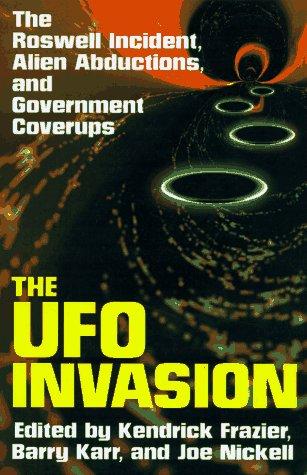
The UFO Invasion: The Roswell Incident, Alien Abductions, and Government Coverups is not a single argued book but a curated case file of its own: 21 contributors' worth of investigative and analytical articles, most originally published in Skeptical Inquirer magazine across roughly two decades, assembled by editors Kendrick Frazier, Barry Karr, and Joe Nickell into a single volume organized around the three claims its subtitle names directly. On Roswell, the book's centerpiece is documentary rather than argumentative: it reprints the main text of the U.S. Air Force's own 1994 report identifying the recovered debris as a Project Mogul balloon train, paired with atmospheric physicist Charles B. Moore's first-person account of the balloon program he helped build. On abductions, it applies the psychology of hypnotic confabulation and the "fantasy-prone personality" construct to hypnotically recovered abduction memories. On government coverups, it takes aim at the Majestic-12 documents specifically, arguing — through Philip J. Klass's established forgery-detection work — that the alleged 1947 presidential UFO-crash-retrieval memo is a modern fabrication rather than a leaked state secret. Where this site's own case files on these same three subjects generally present the anomalous claim first and weigh the skeptical explanation second, this book inverts that order almost entirely — making it, on its own terms, a genuine and substantive counterweight rather than a caricature of one.
About the Author
The UFO Invasion has three editors rather than one, and each brought a different institutional role to the book. Kendrick Frazier (1942–2022) earned a B.A. in journalism from the University of Colorado in 1964 and an M.S. in journalism from Columbia University in 1966, then spent 1969 to 1981 at Science News — rising to editor from 1971 to 1977 — before becoming editor of The Zetetic in August 1977, the magazine renamed Skeptical Inquirer the following year. He held that editorship for 45 years, until his death, while also working a full second career from 1983 to 2006 as a staff writer and, for his final eleven years, editor of Sandia Lab News at Sandia National Laboratories in Albuquerque, New Mexico. He was a Fellow of the American Association for the Advancement of Science and a fellow and executive council member of the Committee for the Scientific Investigation of Claims of the Paranormal (CSICOP, now CSI), and authored or edited ten books in total, including 2009's Science Under Siege.
Barry Karr came to CSICOP from the organization's business and public-relations side rather than its editorial one: born in New York State and holding a B.A. in political science from the University at Buffalo, he was hired part-time by CSICOP founder Paul Kurtz while still a college sophomore, stuffing envelopes before being promoted to assistant public-relations director and, eventually, to Executive Director of the Committee for Skeptical Inquiry and Chief Financial Officer of its parent organization, the Center for Inquiry — a post he held for more than four decades until his June 2025 retirement. His own field investigations over that career ran from faith healers, including a well-documented on-camera exposure of evangelist Peter Popoff's earpiece-fed "psychic" diagnoses, to firewalking seminars, ghost-hunting claims, and a 1988 CSICOP delegation to China that examined qigong masters and children reporting paranormal perception abilities and found no supporting evidence. A year before this book, Karr had already co-edited a similar Skeptical Inquirer anthology, The Outer Edge: Classic Investigations of the Paranormal (CSICOP, 1996), together with Nickell and Tom Genoni — a general-paranormal predecessor volume that The UFO Invasion effectively narrowed and re-focused onto UFO claims specifically, adding Frazier as a third editor for the follow-up.
Joe Nickell (1944–2025) is this book's most UFO-specific editorial voice and, per this site's own existing key-figures entry on him, its own most direct connection to the wider catalogue's Brown Mountain Lights case file. Born in Lexington, Kentucky, he earned a B.A. from the University of Kentucky in 1967, spent nearly a decade in Canada after 1968 rather than accept conscription for Vietnam, and returned following President Carter's 1977 draft amnesty to complete an M.A. (1982) and Ph.D. (1987) in English at the University of Kentucky, with a research emphasis on literary forgery detection and folklore. Between those two chapters of his education he worked, by his own accounting, more than a thousand distinct jobs and personae — stage magician, carnival pitchman, private investigator, blackjack dealer, Mississippi riverboat manager — a working history he treated as direct methodological preparation for what became his defining role: senior research fellow at CSI and, from 1995 until his death, author of the magazine's "Investigative Files" column. He styled himself "the world's only full-time professional paranormal investigator," was nicknamed "the real-life Scully" by admirers after The X-Files' skeptical FBI agent, and applied hands-on forensic methods — document analysis, on-site recreation, precedent research — to subjects from the Shroud of Turin to the forged "Jack the Ripper diary" as much as to UFO claims specifically. He died in Buffalo, New York, on March 4, 2025, at 80; the asteroid 31451 JoeNickell, named for him in 2011 by fellow skeptic and astronomer James McGaha, remains his most literally cosmic honor.
None of the three editors holds a natural-science research doctorate, a fact this site's own treatment of comparable skeptical figures — Robert Sheaffer, a data-communications engineer; Philip J. Klass, an electrical engineer and aviation-trade journalist — treats as worth stating plainly rather than eliding. Nickell's Ph.D. is in English and folklore studies, not a laboratory science; Frazier's formal training was in journalism; Karr's was in political science. Their collective authority on this book's subject matter rests instead on decades of hands-on case investigation and, in Frazier's and Karr's cases, direct editorial stewardship of the field's principal skeptical publication venue — the same credentialing pattern this site's Demon-Haunted World entry notes is unusually rare in organized ufology generally, running mostly in the opposite direction from Carl Sagan's own research-scientist standing.
Historical Context & Origins
Prometheus Books published The UFO Invasion in April 1997, deliberately timed to the fiftieth anniversary of the Roswell Incident itself: the town of Roswell, New Mexico, hosted its largest-ever UFO Encounter '97 festival that July, drawing tens of thousands of visitors at the same moment Frazier, Karr, and Nickell's anthology was arguing the case had already been conventionally solved three years earlier. The book's own Roswell chapter draws on the U.S. Air Force's July 1994 report, The Roswell Report: Fact vs. Fiction in the New Mexico Desert — co-authored by contributor Col. Richard L. Weaver with Capt. James McAndrew — which concluded the recovered debris was wreckage from Flight #4 of Project Mogul, a classified high-altitude balloon-train program designed to detect Soviet nuclear tests via acoustic sensors. The book reprints that report's main text directly alongside physicist Charles B. Moore's own first-person testimony as a Project Mogul balloon engineer, giving readers primary-source material rather than only secondhand summary — notably, the book went to press before the Air Force's follow-up report, The Roswell Report: Case Closed (June 1997), which addressed the 'alien bodies' claims specifically with an anthropomorphic-crash-test-dummy explanation, so this book's own Roswell case rests on the earlier, debris-focused 1994 report alone.
The anthology arrived at a moment when skeptical ufology's own institutional publishing infrastructure, built up gradually across the 1970s and '80s by Philip J. Klass and, later, Robert Sheaffer, had matured enough to support a retrospective anthology format specifically: The UFO Invasion followed directly on the heels of Karr and Nickell's own 1996 The Outer Edge: Classic Investigations of the Paranormal, a general-paranormal CSICOP anthology co-edited with Tom Genoni that established the same reprint-and-recontextualize model this book then applied narrowly to UFO claims, with Frazier added as the volume's third editor.
The book also answered a specific cultural moment beyond Roswell's anniversary: alien-abduction claims had entered mainstream discourse through Whitley Strieber's bestselling Communion (1987) and, more consequentially for the book's own "Therapy"-adjacent framing, Harvard psychiatrist John Mack's 1994 Abduction: Human Encounters with Aliens, which for the first time gave the phenomenon a sympathetic hearing from a tenured faculty member at one of the country's most prestigious universities — the same institutional-credibility problem this site's own Demon-Haunted World entry documents Carl Sagan addressing in his own 1995 book, published two years earlier and covering closely overlapping ground from a broader, non-UFO-specific angle.
The 1995 "Alien Autopsy" film, aired on Fox television that August and claiming to document a 1947 Roswell alien autopsy, gave the book's editors a fresh, still-live controversy to anchor its government-coverup material: Nickell's own investigative postmortem on the footage, published in Skeptical Inquirer's November/December 1995 issue, predates this book by roughly eighteen months and functions as one of its most concrete, single-case skeptical arguments — the film's Manchester special-effects creator, John Humphreys, would not publicly admit the footage was staged until 2006, nearly a decade after this book's publication.
Core Arguments & Key Concepts
The book's organizing method, consistent across its 21 contributors, is documentary reprint paired with skeptical analysis rather than a single original argument advanced by the editors themselves: rather than restate the Roswell debris case in their own words, Frazier, Karr, and Nickell reprint the U.S. Air Force's own 1994 investigative report alongside Charles B. Moore's first-person Project Mogul testimony, letting primary evidence and eyewitness balloon-engineering testimony carry the argument's weight directly rather than through editorial paraphrase.
On alien abductions specifically, the book leans on the psychology of memory rather than the physical plausibility of extraterrestrial visitation: contributor articles apply the "fantasy-prone personality" construct — the clinical finding, developed by psychologists Sheryl Wilson and Theodore X. Barber in 1981 and applied to abduction reports across the 1980s and '90s, that a measurable minority of the population is unusually susceptible to vivid, hypnotically elaborated pseudo-memories — alongside direct critique of hypnotic regression as an abduction-investigation tool, arguing the technique is prone to generating detailed, emotionally convincing false memories rather than recovering suppressed accurate ones, the same critique this site's own Demon-Haunted World entry documents Sagan making independently and roughly contemporaneously.
On the government-coverup claim specifically, the book's most pointed single argument concerns the Majestic-12 documents: the purported 1947 Truman-authorized memoranda establishing a secret alien-crash-retrieval program, first circulated within ufology in 1984. Philip J. Klass, a contributor whose own established Skeptical Inquirer bibliography this site's UFOs Explained entry documents in detail, was among the earliest and most persistent voices in organized skepticism arguing the documents were a modern forgery rather than a leaked state secret — a position this site's own Government Deception Hypothesis theory page independently treats as the more widely accepted read on Majestic-12's provenance, while still cataloguing the documents' continued circulation within disclosure-oriented ufology as a live case study in how crash-retrieval mythology propagates.
A recurring structural argument across the crop-circle and "UFO dogfight" material specifically is that apparently anomalous physical evidence and apparently inexplicable pilot encounters both dissolve under the same kind of patient, checkable investigation Klass and Sheaffer's own solo books apply elsewhere: Nickell and forensic document examiner John F. Fischer's own earlier Skeptical Inquirer field investigation of English crop formations — published in the magazine's Winter 1992 issue, well before Wiltshire hoaxers Doug Bower and Dave Chorley's own 1991 public confession had fully settled the question in the popular press — had already identified a "shyness effect" (formations avoiding being seen mid-creation) and a media-correlated geographic spread pattern as evidence of human manufacture rather than any exotic cause, and this book's crop-circle chapter draws directly on that same investigative through-line.
Key Cases & Evidence Discussed
The Roswell Incident (Case File, 1947) receives the book's most document-heavy single treatment: the reprinted main text of the Air Force's 1994 Fact vs. Fiction report, Col. Richard L. Weaver's own contributor essay, and Charles B. Moore's first-person Project Mogul balloon-engineering testimony together make the book's case that the recovered Roswell Army Air Field debris was mundane, classified balloon-train wreckage rather than extraterrestrial material — the same conventional-explanation candidate this site's own Roswell case file documents in detail as one live hypothesis among several, alongside real, still-disputed counter-evidence including the 509th Bomb Group's contemporaneous lead-sheeting procurement records.
The 1995 "Alien Autopsy" film anchors the book's most concrete single-case forensic argument, drawn from Nickell's own November/December 1995 Skeptical Inquirer investigation: he identified the film's medical examiner as holding surgical scissors "like a tailor rather than a pathologist," the depicted alien anatomy (five fingers, small external ears) as inconsistent with contemporaneous Roswell witness descriptions (four fingers, no external ears), and an on-screen classification stamp as inconsistent with genuine period military markings — a case this site's own Roswell case file separately references as one of several disputed multi-spectrum imagery items in its own evidentiary record.
The Majestic-12 documents receive direct skeptical treatment through Philip J. Klass's established forgery-detection work, read here against this site's own Government Deception Hypothesis theory page, which independently documents the same documents' contested origin and their continued role in disclosure-era claims running from Bob Lazar's 1989 Area 51 account to David Grusch's 2023 congressional testimony.
Crop-circle formations, chiefly in southern England, are addressed through Nickell and John F. Fischer's own field research — a case this site's own catalogue does not carry a dedicated case file for directly, though the adjacent phenomenon of "saucer nest" ground impressions is documented on this site's Tully Saucer Nests and Langenburg UFO Saucer Nests case files, both of which weigh comparable human-versus-anomalous-cause questions about flattened vegetation evidence.
The book's alien-abduction material, applying fantasy-proneness and hypnotic-confabulation psychology to abductee testimony generally, connects most directly to this site's own Betty and Barney Hill Abduction case file — the foundational case in the genre the book's psychological argument is built to address — and to the wider set of hypnotically-recovered-memory abduction cases this site catalogues, including the Pascagoula Abduction and Stanford, Kentucky Abduction files.
One of Nickell's own reprinted pieces concerns a UFO "dogfight" claim; given the book's 1997 publication window and Nickell's own later, more fully documented skeptical revisits of comparable pilot-intercept cases (including his 2013 co-authored reassessment of the Valentich disappearance), this most plausibly addresses a classic pilot-encounter case in the same category as this site's own Gorman Dogfight (1948) case file, though this site's own research could not independently confirm the specific case addressed from secondary bibliographic listings alone.
Critical Reception & Controversies
Trade and specialist reception at publication is thinly documented in surviving secondary sources; unlike The Demon-Haunted World's prominent Kirkus and Los Angeles Times coverage the same year, this site's own research could not independently locate a contemporary trade review of The UFO Invasion from Kirkus Reviews, Publishers Weekly, or Library Journal — itself a data point about the book's more specialist, lower-visibility positioning relative to Sagan's mainstream-published, Pulitzer-backed volume the same year, despite covering substantially overlapping subject matter.
Reception from within organized ufology has followed the same broad pattern this site's other skeptical-works entries document for comparable titles: proponent researchers have generally read the book's Roswell chapter as recycling the Air Force's own contested self-investigation rather than independently testing it, a criticism this site's own Roswell case file gives real weight to by preserving specific counter-evidence — including Freddie Wimbledon-style firsthand disputes documented on other skeptical-works entries and, on Roswell specifically, the 509th Bomb Group's own contemporaneous lead-sheeting procurement records — that the Air Force report and this book's reprinting of it do not resolve.
A structural limitation specific to this book's anthology format, rather than to any single contributor's individual argument, is that a 21-contributor collection compiled from a two-decade run of magazine articles cannot offer the same sustained, book-length argumentative development readers get from Sheaffer's or Klass's single-author volumes; individual chapters vary in depth and in how thoroughly they engage counter-evidence, a tradeoff inherent to the reprint-anthology model this book and its 1996 predecessor, The Outer Edge, both share.
The book's own timing created one specific, checkable limitation: because it went to press roughly two months before the Air Force's June 1997 follow-up report, The Roswell Report: Case Closed, which directly addressed the "alien bodies" and anthropomorphic-test-dummy claims the original 1994 report had left comparatively unaddressed, this book's own Roswell chapter necessarily argues from the earlier, debris-focused report alone — a genuine evidentiary gap in the book's own case that later editions or companion volumes would need a second Air Force document to close.
Influence & Legacy
The book's most durable individual legacy runs through Joe Nickell's own "Alien Autopsy" investigation specifically: his November/December 1995 Skeptical Inquirer analysis, reprinted here, identified forensic inconsistencies in the footage that the film's own creators would not publicly confirm until John Humphreys and promoter Ray Santilli jointly admitted the fabrication in 2006 — an eleven-year gap between Nickell's skeptical analysis and the hoax's confirmed admission that this site's own research treats as a genuine measure of how far ahead of eventual consensus this book's specific claims ran.
Institutionally, the book's editorial team's legacy runs through the organizations and successor works they built rather than through this one anthology specifically: Frazier's 45-year Skeptical Inquirer editorship continued for a quarter-century after this book's publication, ending only with his November 2022 death; Karr's 40-plus-year run as CSI Executive Director continued until his June 2025 retirement; and Nickell's own "Investigative Files" column, begun the same year as this book's April 1997 publication (having started in 1995), continued until his own March 2025 death — making this book, for all three editors, a mid-career project rather than a capstone.
This book's reprint-anthology model, established a year earlier with Karr, Nickell, and Tom Genoni's The Outer Edge, has itself outlived the specific book: newer, retitled paperback and ebook editions of The UFO Invasion have continued to circulate under a "Best of Skeptical Inquirer" series branding through Prometheus's successor imprint, keeping this specific 1997 collection of Roswell, abduction, and coverup material in active print more than a quarter-century after its original publication.
Within this site's own catalogue specifically, this book functions as a direct skeptical counterweight to several case files that this site's editorial framing presents primarily from the anomalous-claim side: the Roswell, Betty and Barney Hill, and Majestic-12-adjacent Government Deception Hypothesis pages all engage with claims this book's own contributors spent the 1980s and '90s specifically investigating and, in the Air Force debris case and the Alien Autopsy film specifically, argue were conventionally resolved well before this site's own more recent case files were compiled.
The Book
As an Amazon Associate, OverClassified may earn from qualifying purchases made through this link, at no extra cost to you.
Why This Is Essential Reading
The UFO Invasion earns its place on this list as the clearest single-volume statement of organized skepticism's case against the three claims — Roswell as extraterrestrial crash, alien abduction as literal extraterrestrial contact, government coverup as active ongoing concealment — that a meaningful share of this site's own case-file library treats as open or genuinely contested questions. None of its three editors, Kendrick Frazier, Barry Karr, or Joe Nickell, holds a natural-science research doctorate, and the book's 21-contributor anthology format trades the sustained argumentative depth of a single-author volume like UFOs Explained for documentary breadth — reprinting the Air Force's own Roswell report and Charles B. Moore's first-person Project Mogul testimony rather than re-arguing the case from scratch. What the book earns through that tradeoff is genuine substance rather than caricature: Nickell's "Alien Autopsy" forensic analysis anticipated the filmmakers' own 2006 confession by eleven years, and its Majestic-12 material rests on the same Klass-led forgery-detection record this site's own Government Deception Hypothesis theory page independently treats as the more widely credited account of those documents' origin. Read against this site's own Roswell and Betty and Barney Hill case files rather than instead of them, it is essential precisely because it argues the opposite conclusion with comparable seriousness — the fair test any single-perspective case file, on either side, ought to be able to survive.
Related Cases & Theories
Essential Viewing
Investigating vs. Debunking
Center for Inquiry — Joe Nickell distinguishes his own investigative method from reflexive "debunking," arguing an investigator must actually eliminate natural explanations first rather than assume a conclusion in advance — the same evidence-first posture running through this book's own contributed chapters. Verified via YouTube oEmbed before inclusion.
Joe Nickell - Why Investigate the Paranormal | For Good Reason
JamesRandiFoundation — Nickell explains why he investigates paranormal and UFO claims firsthand rather than dismissing them outright, the hands-on methodology behind his own Alien Autopsy and crop-circle chapters reprinted in this book. Verified via YouTube oEmbed before inclusion.
Sources Cited
- Frazier, Kendrick; Karr, Barry; Nickell, Joe (eds.). The UFO Invasion: The Roswell Incident, Alien Abductions, and Government Coverups. Prometheus Books, 1997 (ISBN 9781573921312 / 1573921319, cited here). openlibrary.org
- "The UFO Invasion." AbeBooks listing (bibliographic details: title, subtitle, editors, publisher, 1997, hardcover, ISBN 9781573921312 / 1573921319, synopsis). abebooks.com
- "The UFO Invasion: Best of Skeptical Inquirer." Amazon.com product listing for ISBN 1573921319 / 9781573921312, with full contributor list (Robert A. Baker, Robert E. Bartholomew, Joseph A. Bauer, William B. Blake, Robyn M. Dawes, C. Eugene Emery, Zen Faulkes, John F. Fischer, Kingston A. George Jr., Philip J. Klass, Joe Nickell, James E. Oberg, Ian Ridpath, Robert Sheaffer, Armando Simon, Lloyd Stires, Trey Stokes, Dave Thomas, Col. Richard L. Weaver USAF, Jeff Wells, Robert P. Young). amazon.com
- "Kendrick Frazier." Wikipedia (biography: birth/death, education, Science News career, Skeptical Inquirer editorship 1977–2022, Sandia National Laboratories career, CSICOP/CSI fellowship, bibliography). en.wikipedia.org
- "Remembering Kendrick Frazier." Skeptical Inquirer, 2023 (memorial tribute detailing career and death). skepticalinquirer.org
- "Barry Karr." Wikipedia (biography: education, CSICOP/CSI career from college through 2025 retirement, faith-healer and paranormal investigations, 1988 China delegation, bibliography including The Outer Edge). en.wikipedia.org
- "Barry Karr Is Retiring—and That Is Not a Hoax." Skeptical Inquirer, August 2025 (retirement announcement and career retrospective). skepticalinquirer.org
- "Joe Nickell." Wikipedia (biography: birth/death, education, career history, CSI role, "Investigative Files" column, notable investigations including Alien Autopsy and crop circles, honors, death March 4, 2025). en.wikipedia.org
- "Remembering Joe Nickell (1944–2025)." Skeptical Inquirer, 2025 (memorial tribute). skepticalinquirer.org
- Nickell, Joe. "'Alien Autopsy' Hoax." Skeptical Inquirer, Vol. 19, No. 6 (November/December 1995) (forensic investigation of the Santilli/Humphreys film). skepticalinquirer.org
- Nickell, Joe, and Fischer, John F. "The Crop-Circle Phenomenon: An Investigative Report." Skeptical Inquirer, Vol. 16, No. 2 (Winter 1992). skepticalinquirer.org
- Weaver, Richard L., and McAndrew, James. The Roswell Report: Fact vs. Fiction in the New Mexico Desert. U.S. Air Force / Headquarters United States Air Force, July 1994 (reprinted in main text form in this book). nsa.gov
- "Charles B. Moore." Wikipedia (biography: NYU Project Mogul balloon engineering career, role in the Air Force's Roswell investigation). en.wikipedia.org
- "Gorman dogfight." Wikipedia (background on the 1948 Fargo, North Dakota pilot-intercept case). en.wikipedia.org
- "The Outer Edge: Classic Investigations of the Paranormal." Goodreads (bibliographic record: co-editors Nickell, Karr, and Tom Genoni; CSICOP, 1996). goodreads.com
- This site's own case file: The Roswell Incident, which independently documents the Project Mogul explanation this book's own centerpiece chapter reprints, alongside disputed counter-evidence this book's chapter does not address.
- This site's own case file: Betty & Barney Hill Abduction, the foundational abduction case this book's fantasy-proneness and hypnotic-confabulation argument is built to address.
- This site's own theory page: Government Deception Hypothesis, which independently documents the Majestic-12 documents' contested origin this book's Klass-derived material addresses directly.
- This site's own essential-reading entry: UFOs Explained, Philip J. Klass's own 1974 single-author skeptical casebook and this book's closest stylistic and methodological antecedent among this site's own catalogue.
- This site's own essential-reading entry: The Demon-Haunted World, Carl Sagan's 1995 general-skepticism book, published two years before this one and covering closely overlapping abduction-psychology and government-credibility ground from a broader, non-UFO-specific angle.
- This site's own key-figures entry: Joe Nickell, for his broader site-wide case connections beyond this book.
Have corrections, additional research, or peer-reviewed sources? Help improve this entry.
Suggest an Edit