
Brown Mountain Lights
For more than a century, observers along a low ridge in North Carolina's Pisgah National Forest have reported unexplained lights rising above Brown Mountain at night. Unlike most recurring "spook light" phenomena, this one has drawn genuine, repeated scientific field investigation: two separate U.S. Geological Survey studies (1913 and 1922), an Oak Ridge National Laboratory refraction demonstration in 1977, a personal field investigation by longtime CSI researcher Joe Nickell, and an ongoing instrumented study by Appalachian State University astronomer Daniel Caton, underway since 1985. Every serious investigation has reached the same broad conclusion: the lights are real, and most are explainable by combinations of distant automobile and locomotive headlights, refraction, and other mundane sources — though no investigator has claimed to account for every reported sighting.
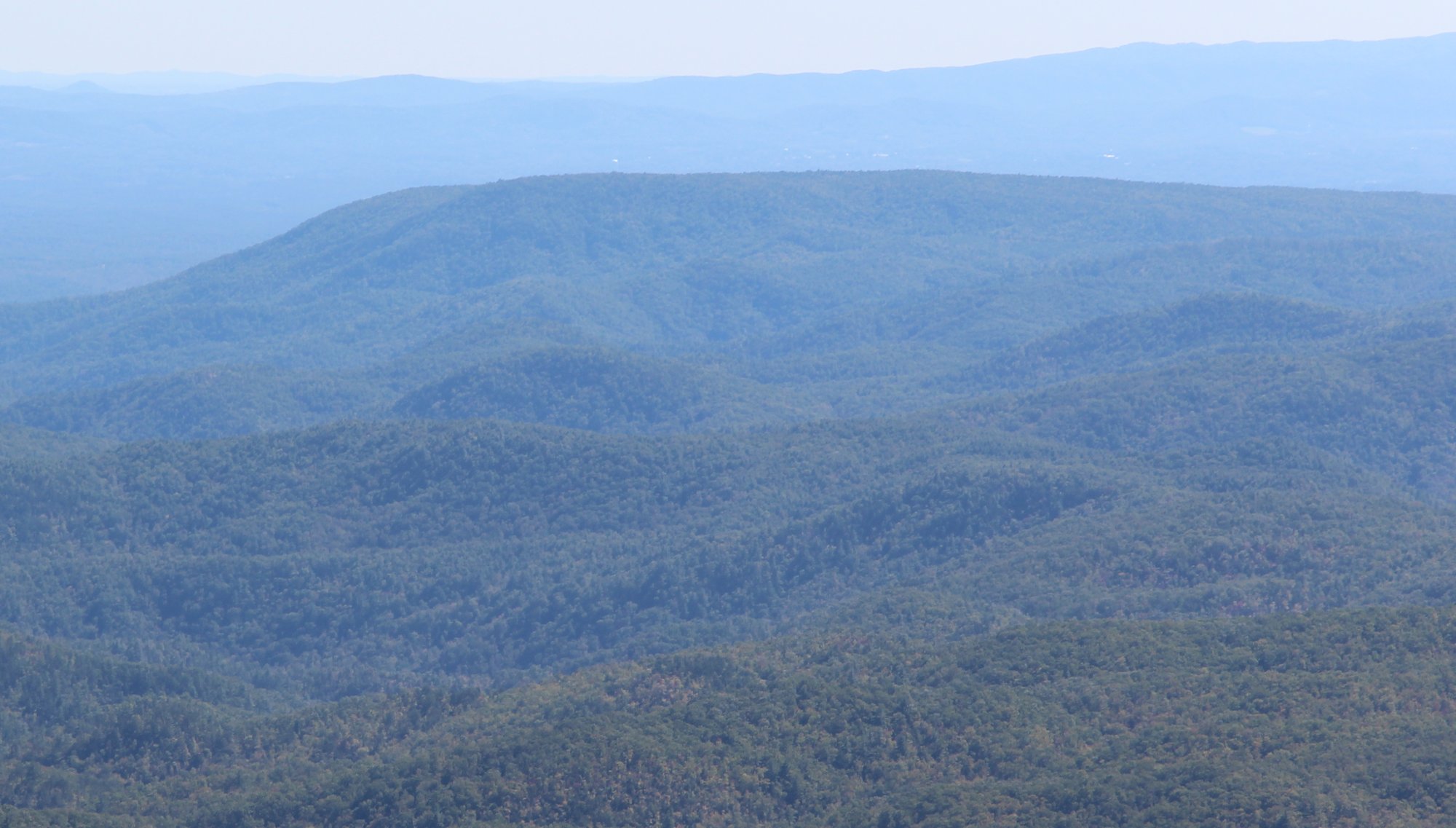
Pictured: Brown Mountain, North Carolina, viewed from Beacon Heights, Pisgah National Forest, October 2016. Wikimedia Commons, public domain (CC0).
Theoretical Alignment
No credentialed scientific investigator who has studied Brown Mountain across more than a century of intermittent research — from the 1913 and 1922 USGS surveys through the ongoing Appalachian State astronomical study — has proposed an extraterrestrial or interdimensional explanation. This file weights Psycho-Social/Mundane highest because every rigorous field investigation has attributed the substantial majority of specific observed lights to identifiable conventional sources (vehicle and train headlights, refraction, brush fires), while candidly acknowledging that not every individual historical report can be retroactively matched to a specific mundane cause. The small residual weightings shown for the Extraterrestrial and Interdimensional hypotheses are not derived from any case-specific evidence pointing in those directions; they should be read as a nominal floor rather than as a substantive finding, since this file has located no serious proposal, by any investigator, of an extraterrestrial or interdimensional origin for the lights.
Background
Brown Mountain is a low, roughly 1.5-mile ridge in Pisgah National Forest, on the border of Burke and Caldwell counties in western North Carolina, overlooking the Catawba Valley and the Wilson Creek watershed, a few miles from the Linville Gorge. It is not a dramatic peak — at under 2,600 feet it barely rises above the surrounding terrain — and its fame rests entirely on what observers report seeing hovering above its dark, even skyline after nightfall: small, seemingly stationary or slowly drifting points of white, yellow, red, or blue-orange light that brighten, dim, and fade over a period of seconds to a few minutes, typically viewed from several miles away across the valley.
Popular accounts frequently trace the lights' folklore back centuries, most often to a Cherokee legend describing the spirits of women searching by torchlight for warriors lost in a great battle with the Catawba, sometimes dated to around 1200 A.D., and to a 1771 journal entry supposedly written by German-American surveyor and engineer John William Gerard de Brahm describing the lights directly. This case file treats both claims with considerable skepticism, because subsequent historical research — including work by researchers affiliated with Daniel Caton's own Appalachian State University Brown Mountain project — has been unable to locate the Cherokee "ghost maidens" story in print anywhere before a 1938 Asheville Citizen article, which asserted the legend as established fact without citing any source. No earlier written or oral record of the specific story has been recovered, and the pattern is consistent with what folklore scholars describe as an "invented tradition": an old-sounding story grafted onto a comparatively recent phenomenon to lend it deeper, more mystical roots. This file does not conclude the story is deliberately fraudulent, but it cannot respectfully be presented as authentic pre-contact Cherokee tradition on the documentary record currently available.
The de Brahm attribution fares no better under scrutiny. De Brahm's actual 1771 report to King George III discusses speculative theories about "nitrous vapors" that could spontaneously ignite around certain mountains — a piece of period pseudo-geology unrelated to any specific sighting — and there is no documentary evidence de Brahm, whose surveying career was based in Florida, Georgia, and South Carolina, ever set foot in the Brown Mountain area of North Carolina at all. Researchers have traced the popular claim linking his name to Brown Mountain specifically to a 1920s newspaper item out of Gastonia, decades after de Brahm's actual writing, and Joe Nickell's own 2016 investigation separately took issue with a modern popular author's repetition of the same unsupported claim. This file's timeline table below flags the 1771 entry as disputed for exactly this reason: it is a widely repeated attribution with no verifiable primary-source connection to Brown Mountain.
What the documentary record does support is considerably more interesting than either legend. Family history recorded (though not published until 1971) describes Josiah Lafayette "Fate" Wiseman observing a recurring nightly flash of light from roughly the same vantage around 1854 — a plausible early sighting, though one that reached print too late to be independently corroborated at the time. Western North Carolina's first regular nightly rail service, between Morganton and Salisbury, began in 1858, which is itself suggestive: a nightly light appearing on a predictable schedule is also exactly what a distant train timetable would produce. The earliest solid, contemporaneously published print record dates to September 1913, when the Charlotte Daily Observer ran an account describing lights appearing punctually around 7:30 p.m. and again near 10 p.m., attributed in the piece to local hotel proprietor Anderson (also recorded as G. A.) Loven. It was this wave of regional publicity — not the older legends — that reached Washington and triggered the case's first federal scientific investigation.
North Carolina Representative E. Y. Webb formally requested a field investigation from the U.S. Geological Survey later that year, making Brown Mountain one of the earliest American "unexplained light" cases to draw a direct congressional request for government scientific study — a genuinely unusual level of official attention for a folklore-adjacent phenomenon, and one that set the pattern for the repeated, serious scientific engagement that has continued intermittently ever since.
Geographically, the setting matters as much as the folklore. The Catawba Valley basin below Brown Mountain is a bowl of lower terrain ringed by higher ridges on several sides, a configuration well suited to trapping cooler night air near the valley floor beneath warmer air aloft — the temperature-inversion layering that later investigators would identify as central to the phenomenon's optical distortion. Brown Mountain itself sits close enough to the much more dramatic terrain of the Linville Gorge Wilderness, including Table Rock and the overlook now known as Wiseman's View, that the same rugged geography drawing hikers to the gorge also produces the elevated, dark, unobstructed sightlines that make the ridge's own lights visible from miles away. In that sense Brown Mountain belongs to a recognizable broader category this archive covers elsewhere: the recurring American "spook light" or "ghost light," a genre that includes Texas's Marfa Lights and Missouri's own Piedmont Missouri Wave site, each independently subjected to some degree of scientific scrutiny and each, to varying degrees, at least partially explained by combinations of distant vehicle lights and atmospheric optics.
Complete Timeline
| Date | Event |
|---|---|
| c. 1854 | Family history, not published until 1971, describes local resident Josiah Lafayette "Fate" Wiseman observing a recurring nightly light from the same general vantage; the earliest plausible sighting, though too late-published to be independently corroborated at the time. |
| 1858 | Western North Carolina's first regular nightly rail service, between Morganton and Salisbury, begins — establishing exactly the kind of predictable, dusk-visible light source later investigations would attribute many sightings to. |
| 1771 (disputed) | German-American engineer John William Gerard de Brahm reportedly records an early sighting in his journal; the claim is widely repeated but not independently verified against a located primary source by this case file, and appears traceable only to a 1920s newspaper item written more than 150 years after the fact. |
| Sept. 13, 1913 | The Charlotte Daily Observer publishes the earliest confirmed print reference to the lights, describing recurring nightly appearances around 7:30 p.m. and 10 p.m. and generating regional publicity. |
| 1913 | North Carolina Rep. E. Y. Webb formally requests a U.S. Geological Survey investigation. |
| Oct. 1913 | USGS geologist D.B. Sterrett conducts the first federal field investigation, attributing the lights to distant locomotive headlights viewed across the valley. |
| 1916 | A major regional flood disrupts rail service; lights are reportedly still seen during this period, a detail critics of the 1913 report use to argue Sterrett's explanation was incomplete. |
| 1922 | USGS geologist George Rogers Mansfield spends two weeks conducting a more rigorous field study, using surveying instruments to plot light azimuths against known roads and rail lines; his report attributes roughly 47% of observed lights to automobile headlights, 33% to locomotive headlights, and the remainder to stationary lights and brush fires. |
| 1938 | The Asheville Citizen publishes the earliest located print appearance of the "Cherokee ghost maidens" legend, asserted without any cited source; no earlier written or oral record of the specific story has been recovered. |
| 1961 | Singer-songwriter Scotty Wiseman publishes the ballad "The Legend of the Brown Mountain Lights," which does much to popularize the phenomenon nationally and cements one branch of the site's ghost-story tradition in popular culture. |
| 1964 | Boone, N.C. columnist Nancy Alexander runs a multi-part series on the lights in the Watauga Democrat, further compiling and popularizing local legends. |
| 1965 | Local resident Ralph Lael self-publishes claims that the lights led him to an underground extraterrestrial base and a personal encounter with beings from Venus, marking the point at which UFO-era mythology attaches itself to the older ghost-light tradition. |
| 1977 | A team from Oak Ridge National Laboratory conducts a field demonstration showing atmospheric refraction can transform a blue-white light source into an apparent orange-red orb hovering above the ridge, reinforcing the refraction component of the conventional explanation. |
| 1985 | Appalachian State University astronomer Daniel Caton begins what becomes a decades-long personal and academic interest in documenting the phenomenon. |
| 2001–2014 | Caton's App State program logs more than 6,300 hours of time-lapse video from fixed camera stations, recording car headlights, aircraft, campfires, porch lights, and fireflies, but no unambiguous, otherwise unexplained light source. |
| 2014 | Committee for Skeptical Inquiry senior research fellow Joe Nickell conducts his own field investigations and historical review, publishing his findings in 2016. |
| July 2016 | Two of Caton's time-lapse cameras simultaneously capture a round, glowing light switching on and off four times over several minutes; after ruling out identified man-made and natural sources, Caton publicly describes it as the first capture the team could not easily explain. |
| 2019 | App State researchers, including Caton and colleague Lee Hawkins, continue using dedicated cameras to capture and analyze light events from Wiseman's View and other vantage points. |
| 2020 | The History Channel airs a segment on the phenomenon as part of its "The Proof Is Out There" series; PBS/UNC-TV airs a separate science documentary on the App State research. |
| 2022 | The Brown Mountain Lights Festival launches in downtown Morganton, drawing bands, artists, and vendors to the courthouse square around the mountain's legend, cementing its status as a regional tourism draw. |
| Present | Brown Mountain remains an active site for both amateur observation (via publicly accessible overlooks including Wiseman's View and the Blue Ridge Parkway's Lost Cove overlook) and ongoing instrumented academic study. |
The 1913 Sterrett Investigation
Responding to Rep. Webb's formal request, the USGS dispatched geologist D.B. Sterrett to Brown Mountain in October 1913. Sterrett's investigation was comparatively brief — a few days in the field — during which he identified that the headlights of westbound Southern Railway locomotives rounding curves in the valley below would have been directly visible from the vantage point at Loven's Hotel, where much of the local reporting originated. This was not a trivial coincidence: Southern Railway had begun upgrading its locomotive headlamps to roughly 600,000-candlepower units in 1909, giving its trains a beam intensity that, at the time, exceeded some operating lighthouses. Comparing known regional train schedules against the timing of observed lights, Sterrett concluded the phenomenon was "nothing but locomotive headlights seen over the mountain from the neighboring heights." The explanation satisfied federal officials but not all local observers, and gained a specific, durable local counter-argument after a major 1916 flood disrupted regional rail service: residents, including hotel proprietor Anderson Loven himself, reported still seeing lights during that period and argued Sterrett's train-headlight theory could not be the whole story, since (in their account) no trains were running to produce them. Modern reviewers, including Nickell in 2016, have generally credited this objection as a legitimate gap in Sterrett's otherwise reasonable but hurried conclusion, rather than as evidence the lights were themselves anomalous — Sterrett's investigation, after all, was a matter of days, not weeks, and did not attempt to rule out the full range of alternative mundane sources a more careful study would later examine.
The 1922 Mansfield Investigation: A More Rigorous Study
In 1922, the USGS returned with geologist George Rogers Mansfield, whose investigation was substantially more methodical than Sterrett's, and remains the case's single most-cited piece of field research a century later. Mansfield spent roughly two weeks in the field, establishing three separate observation stations — including one set up in the former home of a local resident, C.E. Gregory, near Loven's Hotel — and using a telescopic alidade mounted on a plane table, together with compasses, a barometer, field glasses, and a camera, to take repeated precise azimuth readings on each light event as it appeared. He then plotted those readings against a detailed map of known roads, rail lines, and homesteads in the surrounding valleys. Over the course of his field season Mansfield documented 23 distinct light events across seven nights of active observation (four of them past midnight), positively identifying the great majority: by one commonly cited breakdown, 11 events (about 48%) were tied to automobile headlights, 7 (about 30%) to locomotive headlights, 3 (about 13%) to stationary lights such as house lamps, and 2 (about 9%) to brush or other outdoor fires; this file was unable to confirm the specific 23-event count against Circular 646's primary text directly, and treats the report's broader, independently corroborated percentage breakdown — roughly half automobile, a third locomotive, the remainder stationary lights and fires — as the more firmly established figure. Mansfield's report explicitly considered and ruled out St. Elmo's fire and fires from illegal moonshine stills as significant contributors before reaching his conclusion that the lights were "clearly not of unusual nature or origin." His report also specifically noted that atmospheric refraction across the Catawba Valley basin amplified the visibility and apparent strangeness of these otherwise ordinary light sources, a finding later directly demonstrated in the field by the 1977 Oak Ridge team. Locally, the investigation appears to have been persuasive: Joseph Loven, the hotel proprietor who had been among the phenomenon's most vocal early commentators, reportedly stopped speaking publicly about the lights after Mansfield's findings were published.
The Oak Ridge Refraction Demonstration (1977)
In 1977, a team from Oak Ridge National Laboratory conducted a field demonstration specifically testing the refraction component of the conventional explanation, more than fifty years after Mansfield had first proposed it as a contributing factor without directly proving it. By positioning a controlled arc-light source at a known, fixed location and observing it under the valley's characteristic atmospheric conditions, the team documented how a blue-white beam appeared as an orange-red orb apparently hovering several degrees above Brown Mountain's crest — direct experimental confirmation that the valley's temperature-inversion-prone atmosphere really can distort an ordinary light's color, apparent position, and behavior in exactly the way needed to make a mundane source look anomalous to an observer. This is a meaningfully stronger form of evidence than either of the two USGS reports offered on its own: Sterrett and Mansfield inferred that refraction was involved from indirect data (azimuth plots, schedules, and reasoning about what physically ought to happen), while the Oak Ridge team actually reproduced the distorting effect under controlled conditions and observed it happen. Basins like the Catawba Valley, ringed by higher terrain and prone to nighttime temperature inversions in which cooler, denser air pools near the valley floor beneath warmer air aloft, are a textbook setting for exactly this kind of atmospheric bending of light — the same general family of effects responsible for desert mirages and the Fata Morgana phenomenon seen over open water and ice.
The Nickell Investigation (2014–2016)
Joe Nickell, a senior research fellow at the Committee for Skeptical Inquiry, conducted his own field visits to Brown Mountain in 2014 with his wife Diana and reviewed the full historical record dating to 1913, publishing his conclusions in Skeptical Inquirer in April 2016 under the title "The Brown Mountain Lights: Solved! (Again!)." During an evening observation session at the Highway 181 overlook, Nickell's own group watched airplane lights, vehicle headlights, the distant glow of Morganton's town lights, and a red flashing tower beacon, all of which could plausibly be mistaken for "the" Brown Mountain Lights by an untrained observer scanning the ridge — at one point, Nickell himself briefly mistook a nearby firefly for a distant anomalous light, a small but telling illustration of how easily ordinary, nearby stimuli can be misread as distant, mysterious ones in the dark. Nickell's central finding was explicitly pluralistic rather than reductive: "There is no single explanation because there is no single phenomenon." He attributed the reported lights collectively to a combination of atmospheric refraction, vehicle and train lights, distant aircraft, off-road vehicles and campers, campfires, and the lights of towns and homes in the valley below, with rare additional instances plausibly explained by ball lightning — consistent with, and directly building on, Mansfield's 1922 multi-cause conclusion rather than proposing a single new mechanism. Nickell was also openly critical of the site's popular mythology on documentary grounds: he took specific issue with a modern popular author's claim that de Brahm had been "the first white man to view the lights" in 1771, noting de Brahm's actual writing never describes such a sighting, and observed that the interpretive signage at the public overlook itself asserts a multi-century Cherokee sighting history without offering any historical documentation to support it.
The Ongoing Appalachian State University Study
Daniel Caton, a physics and astronomy professor and director of observatories at Appalachian State University, has personally studied Brown Mountain since 1985, making his involvement with the case one of the longest continuous individual scientific engagements with any recurring light phenomenon documented on this site. Caton discussed the case publicly as early as a February 2011 symposium, and working with colleague Lee Hawkins in the Physics and Astronomy Department, he deployed pairs of time-lapse digital video cameras at fixed stations near Jonas Ridge and other vantage points overlooking Brown Mountain and the Linville Gorge, running the project continuously for well over a decade. Between roughly 2001 and 2014, the cameras logged more than 6,300 hours of recorded footage. The overwhelming majority of that footage, by the team's own account, showed exactly the kind of conventional light sources the USGS investigators had identified generations earlier — car headlights, aircraft, campfires, porch lights, and fireflies — with no unambiguous, otherwise unexplained sphere of light captured across those thousands of hours.
That changed, at least once, in July 2016. Two of the team's cameras simultaneously recorded a round, glowing light appearing and disappearing four separate times over the course of several minutes near Brown Mountain. After reviewing the footage and working to eliminate known man-made and natural sources, Caton described it publicly as a genuine outlier: "This is the first time we've captured something that we can't easily explain," he told a regional television reporter, adding that after considering and setting aside possibilities including ball lightning and naturally occurring gases, "we're left with no real explanation other than it's whatever the lights might actually be," as reported by regional outlet WLOS, cited in the sources below. Burke County's tourism director at the time, Ed Phillips, characterized the capture as a validating moment for the many area residents who had reported similar sightings over the decades. Caton's research, profiled in a PBS/UNC-TV Science documentary and covered by regional television and university press, has not published a comprehensive peer-reviewed paper superseding Mansfield's 1922 findings, but it represents the most sustained, best-instrumented individual scientific attention the phenomenon has ever received — and its central result, ironically, is less a debunking than an open question: thousands of hours of conventional light sources, and one genuinely unresolved event.
Myth, Memory, and an Invented Tradition
Much of Brown Mountain's enduring appeal rests on the sense that it carries a centuries-deep, multicultural weight of testimony — Cherokee legend, colonial-era journals, generations of mountain folklore. The documentary record, examined carefully, tells a different and arguably more interesting story: that of a real, recurring, and genuinely puzzling-to-untrained-observers optical phenomenon that only became a public "mystery" around 1913, and that then rapidly accumulated a rich secondary folklore in the decades that followed, much of it demonstrably retrofitted rather than inherited. This file treats the case's cultural history as worth documenting in its own right, distinct from the scientific question of what the lights physically are.
The ghost-story tradition that grew up around the phenomenon in the 20th century did not stay fixed on a single narrative. Variants collected and discussed by regional historians include a heartbroken woman searching nightly with a lantern for a lost love; an enslaved man searching for his master, drawn from Scotty Wiseman's 1961 ballad; a separate account of an enslaved man named "Bird" hiding money during the Civil War; a murdered bride seeking her killer; and a slain mother's spirit attempting to reveal the location of her hidden body, sometimes localized to a reported 1936 killing near the Jonas Ridge community. A Revolutionary War soldier variant appears to date only to the early 1980s, and a Civil War ghost-story variant traceable to around 2012 appears to have originated online rather than in older oral tradition — a useful, datable illustration of exactly how quickly new "old" legends can attach themselves to the mountain even in the internet era. Taken together, folklorists studying the case describe it as a textbook example of a community grafting old-sounding stories onto a real but comparatively recent phenomenon in order to claim deeper historical roots than the documentary record actually supports.
This pattern — a real, physically observable phenomenon that predates any organized mythology, followed decades later by a retroactively deepened folklore claiming much older origins — recurs often enough across recurring-light and spook-light cases generally that this file treats it as worth flagging explicitly rather than silently correcting. It does not mean the phenomenon itself is fake; Sterrett, Mansfield, Oak Ridge, and Caton all treated it as a real thing worth explaining. It does mean that a reader encountering claims of a "centuries-old, cross-cultural mystery" at Brown Mountain should understand that specific framing is itself a comparatively recent addition to the story, not a documented feature of it.
Popular culture did at least as much as folklore to cement Brown Mountain's fame. Scotty Wiseman's 1961 song "The Legend of the Brown Mountain Lights," reportedly drawing on an account from within his own extended family, became a modest hit and is widely credited with turning a regional curiosity into something close to North Carolina's best-known ghost story. Boone columnist Nancy Alexander's multi-part 1964 series in the Watauga Democrat further compiled and popularized the growing body of local legend. By the mid-1960s the case had also absorbed the UFO-era mythology sweeping the country more broadly: in 1965, local resident Ralph Lael self-published an account claiming the lights had led him to an underground base and a personal encounter with extraterrestrial beings from Venus — a claim entirely outside the documentary or scientific record, but a genuinely useful marker of the moment at which flying-saucer-age narratives grafted themselves onto an older ghost-light tradition, a pattern this archive documents at other recurring-light sites as well.
Key Figures
George Rogers Mansfield
Conducted the case's most methodologically rigorous historical field study, using surveying instruments to plot light azimuths against known road and rail infrastructure over a two-week field season. Worked from three separate observation stations, including one set up in a private home near Loven's Hotel, and explicitly tested and ruled out St. Elmo's fire and moonshine-still fires before reaching his conclusions.
Joe Nickell
Conducted personal field investigations in 2014 and published a comprehensive historical review in 2016, concluding the phenomenon results from multiple distinct mundane causes rather than one single source. Also conducted original documentary research disputing the popular Cherokee-legend and de Brahm attributions, tracing both to comparatively recent, unsourced 20th-century claims rather than authentic older testimony.
Daniel Caton
Has personally studied and photographed the phenomenon since 1985, deploying specialized cameras from public overlooks in the case's longest-running individual scientific engagement. Logged more than 6,300 hours of time-lapse footage between 2001 and 2014 with colleague Lee Hawkins, and in July 2016 captured the case's single most notable modern anomaly: a round light switching on and off four times that the team, after ruling out known causes, could not confidently explain.
Modern Status: Tourism and Public Access
Unlike most cases in this archive, Brown Mountain is not a single historical event but an ongoing, publicly accessible attraction that residents and visitors can still go and try to observe for themselves on any clear night. The most commonly recommended vantage points are the Lost Cove overlook on the Blue Ridge Parkway near milepost 310 and the nearby Green Mountain overlook near milepost 301, along with a dedicated pull-off on N.C. Highway 181 south of the parkway, and the more remote Wiseman's View and Table Rock overlooks inside the Linville Gorge Wilderness — the same rugged terrain Caton's App State cameras have monitored for years. Burke County's tourism office actively promotes the phenomenon as a regional draw, directing visitors to these overlooks, and in 2022 a downtown Morganton record shop owner helped launch the annual Brown Mountain Lights Festival, which brings bands, artists, and vendors to the courthouse square each fall in a direct, present-day continuation of the folklore this file has traced back more than a century.
That ongoing public accessibility is itself part of the case's evidentiary profile. Unlike a one-time encounter that can only be assessed after the fact through recollection and secondary reporting, Brown Mountain can be, and regularly is, independently re-observed by any visitor willing to spend an evening at a public overlook — which is precisely how Sterrett, Mansfield, the Oak Ridge team, Nickell, and Caton's students and colleagues have each, independently and decades apart, been able to test the leading conventional explanations against the actual, present-day phenomenon rather than relying solely on historical testimony.
Caton's own institutional position adds a further layer of continuity to that public accessibility: as director of Appalachian State's observatories, his interest in Brown Mountain sits alongside, rather than apart from, the university's broader public astronomy and dark-sky outreach in the region, and his team's published findings and media appearances have themselves become part of what visitors are told to expect when they arrive at the overlooks. Regional tourism materials, television segments, and the annual festival all now draw, directly or indirectly, on more than a century of the same underlying investigative record this file documents — a rare case in which a site's popular mythology and its actual scientific history, however much they diverge on points like the Cherokee legend, at least share the same real, physical, still-visible phenomenon as their common subject.
Nearby Morganton, the Burke County seat, and Lenoir in neighboring Caldwell County both function as the phenomenon's practical gateway towns: overnight lodging, the region's newspapers of record across the case's full history, and, in Morganton's case, the modern festival all sit within a short drive of the overlooks themselves. That proximity has mattered to the case's evidentiary record in a very concrete way: it is precisely because credentialed investigators could reach a working vantage point after a short evening's drive from town, set up equipment, and return the next day, that Brown Mountain has been able to attract the kind of repeated, low-cost, multi-decade field attention that a more remote or logistically difficult site rarely receives.
The Five Observables Assessment
The Five Observables framework applies awkwardly to Brown Mountain, since the case describes recurring, distant point-source lights rather than a structured craft:
Assessment: No investigation of Brown Mountain, across more than a century of study by multiple independent parties, has documented any of the Five Observables. The case's evidentiary interest lies in its unusually sustained scientific attention, not in any claim of anomalous performance. It is worth noting explicitly why the framework fits so poorly here: the Five Observables were developed primarily to characterize discrete, close-range encounters with an apparently solid, maneuvering object, whereas Brown Mountain describes a distant, low-resolution point of light observed across miles of atmosphere. Even the single event Caton's team could not immediately explain in 2016 was, by his own account, an unresolved light source rather than a structured craft exhibiting flight performance — a meaningfully different, and lower, evidentiary bar than what the Five Observables framework is designed to test for.
Evidence Assessment
Supporting Continued Scientific Interest
- Two independent USGS field investigations (1913, 1922), a direct experimental refraction demonstration (Oak Ridge, 1977), and an ongoing university astronomical study (App State, since 1985) represent an unusually sustained, credentialed research effort for a recurring light phenomenon.
- Both major historical investigations (Sterrett, Mansfield) and the most recent skeptical review (Nickell) independently converge on broadly similar multi-cause conventional explanations, a form of methodological consistency across more than a century.
- The phenomenon is genuinely reproducible and publicly observable from established overlooks, unlike most single-event UAP cases in this archive.
- Caton's July 2016 camera capture represents a genuinely unresolved data point recorded by instrumentation rather than lay testimony, the kind of evidence this archive weighs most heavily, even though it remains a single outlier against a much larger base of explained footage.
Supporting Full Conventional Explanation
- Mansfield's 1922 study, the most rigorous investigation on record, positively identified conventional sources (vehicle and train headlights, stationary lights, fires) for the substantial majority of observed events.
- The Oak Ridge team directly demonstrated, rather than merely theorized, that atmospheric refraction alone can transform an ordinary light source into an apparently anomalous hovering orb over this specific ridge.
- No investigation has recovered any physical trace, radar contact, or instrumented anomaly inconsistent with known atmospheric-optical and vehicular-light explanations.
- The case's most-cited folkloric elements — the Cherokee legend and the de Brahm account — do not survive documentary scrutiny, undermining the popular sense that the phenomenon has a centuries-deep, cross-cultural testimonial record; its real record begins in 1913.
- Of more than 6,300 hours of dedicated, purpose-built camera monitoring by App State researchers, only a single event has resisted conventional identification, a base rate strongly favoring an overwhelmingly mundane explanation for the phenomenon as a whole.
Why "Credible"
Brown Mountain earns a Credible rating because it represents a genuine, well-documented, and repeatedly scientifically investigated recurring phenomenon — not because any investigation has found evidence of anything anomalous. The case clears a real bar: two USGS field studies, a national laboratory's direct experimental confirmation of the refraction mechanism, and an ongoing university astronomical research program together represent one of the most sustained scientific engagements with a recurring light phenomenon on record anywhere. That sustained attention, and the consistency of independent investigators' conclusions across more than a century, is itself the evidentiary substance of this file's rating.
It is also worth being explicit about what the rating is not rewarding. This file does not treat the Cherokee legend, the de Brahm attribution, or any of the case's later ghost-story accretions as evidence of anything, because the documentary record does not support treating them as authentic pre-20th-century testimony in the first place. A Credible rating here reflects the quality and consistency of the genuine scientific record — Sterrett, Mansfield, Oak Ridge, Nickell, and Caton — standing entirely apart from, and in some respects directly correcting, the case's much more mixed folkloric record. Readers encountering Brown Mountain primarily through tourism materials, songs, or retellings of the Cherokee legend should understand that this file's rating rests on the former, not the latter.
The case falls well short of Disputed or Verified status specifically because, unlike Norway's Hessdalen Lights, no Brown Mountain investigation has produced instrumented data (radar returns, resolved spectroscopy, or magnetometer readings) suggesting an unexplained energetic process. Every rigorous investigation of Brown Mountain, from Mansfield in 1922 through Nickell in 2016, has converged on the same basic conclusion: the lights are real observed phenomena with multiple, individually mundane causes, amplified and rendered mysterious-seeming by the valley's own atmospheric conditions. The single genuine outlier on record — Caton's July 2016 camera capture, after more than 6,300 hours without one — is treated by this file as exactly that: a rare, unresolved residue inside an otherwise well-explained pattern, not grounds to elevate the case's overall rating.
Observer Credibility & Occupational Profile
Brown Mountain's evidentiary strength rests less on any single witness and more on the credentials and independence of its investigators. D.B. Sterrett and George Rogers Mansfield were both career USGS geologists operating under formal government mandate; the 1977 refraction demonstration came from Oak Ridge National Laboratory, a major federal research institution; Joe Nickell holds a doctorate and decades of professional paranormal-investigation experience with the Committee for Skeptical Inquiry; and Daniel Caton is a tenured physics and astronomy professor with an observatory directorship, joined in his fieldwork by departmental colleague Lee Hawkins. This file finds it directly relevant to the case's credibility that four scientifically credentialed, professionally and institutionally independent investigations spanning over a century have reached substantially convergent conclusions, a consistency this archive rarely documents for recurring light phenomena.
The lay witness base, meanwhile, is broad but methodologically weaker: hundreds of residents and visitors across more than a hundred years, few of whom were making controlled or instrumented observations, and many of whom were reporting sightings already primed by decades of accumulated local folklore about what they were supposed to be seeing. That does not make lay testimony worthless — it is, after all, lay testimony (Anderson Loven's own reports, and later residents' observations during the 1916 flood) that first prompted federal investigation and later complicated Sterrett's initial conclusion. But this file weighs the credentialed field investigators' azimuth data, camera footage, and controlled refraction experiments considerably more heavily than undocumented recollections of what a given light "must have been," consistent with this archive's general evidentiary approach across recurring-phenomenon cases.
Media coverage of the case has itself been unusually sustained and, on the whole, unusually sober by the standards of recurring-light reporting generally. Regional newspapers followed the story from 1913 onward; the Watauga Democrat and Charlotte Daily Observer both covered it in the early 20th century; national interest resurfaced with the History Channel's "The Proof Is Out There" segment in 2020; and PBS/UNC-TV's science documentary and WLOS's regional news coverage of the App State research both treated Caton's camera program as a legitimate ongoing scientific effort rather than as tabloid material. That relatively restrained, decades-spanning media record is itself a modest point in favor of the case's overall credibility rating, distinguishing it from cases in this archive whose public profile has been shaped primarily by sensationalized single-source claims.
Historical Precedents & Archive Matches
Brown Mountain connects most directly to this catalogue's own Hessdalen Lights entry, another long-studied recurring luminous phenomenon subjected to sustained scientific field investigation, though Hessdalen's researchers have documented genuine instrumented anomalies (radar returns with no solid-mass signature) that Brown Mountain's investigators have not. The case also connects to this catalogue's Piedmont Missouri Wave entry, another American recurring-light site subjected to purpose-built field instrumentation by a credentialed physicist (Dr. Harley D. Rutledge). More broadly, Brown Mountain sits within a recognizable family of long-running American "spook light" sites — a category that also includes the Marfa Lights of West Texas and Michigan's Paulding Light — each of which has independently attracted comparable conventional explanations (distant vehicle headlights amplified by atmospheric refraction) alongside comparably persistent local folklore claiming much older, often ethnically or historically specific origins. The consistency of both the proposed physical mechanism and the pattern of retroactively deepened legend across geographically unrelated sites is itself a modest piece of corroborating evidence for the conventional explanation: it is the kind of convergent, independently repeatable pattern this archive treats as more persuasive than any single case examined in isolation.
Material Analysis
No physical trace, fragment, or recovered sample has ever been associated with Brown Mountain across any of its investigations. The closest analogue to physical evidence is Mansfield's 1922 azimuth-survey data set, which directly ties the great majority of observed light positions to specific, mapped roads and rail lines rather than an unlocated source, and the 1977 Oak Ridge refraction demonstration, which produced a reproducible experimental result (not a recovered artifact) showing how the valley's own atmosphere distorts ordinary light. Caton's more than 6,300 hours of time-lapse camera footage constitute the case's largest modern data set by volume, though the great majority of that footage documents ordinary, identified light sources rather than anything requiring further material analysis; the single 2016 anomalous capture exists only as unresolved video, with no accompanying physical trace, spectroscopic reading, or other instrumented data beyond the visual recording itself.
Supporting Continued Legitimate Study
- Mansfield's precise azimuth-mapping methodology remains a genuine, still-citable model for how to rigorously investigate a recurring light phenomenon.
- Caton's decades-long camera program demonstrates that sustained, low-cost instrumented monitoring of a recurring phenomenon is both feasible and capable of producing at least occasional genuinely unresolved data points worth further study.
Supporting a Fully Conventional Explanation
- No investigation across more than a century has recovered any physical evidence inconsistent with the established multi-cause conventional explanation.
- Of more than 6,300 hours of dedicated camera monitoring, only a single event has resisted straightforward conventional identification, an extremely low base rate for anomaly consistent with a phenomenon that is overwhelmingly mundane in origin.
The Conventional Explanation Candidate: Multi-Source Light Misidentification, Amplified by Refraction
The leading, and this file's assessed, explanation is not a single mechanism but the specific multi-cause model independently converged on by Mansfield (1922) and Nickell (2016): the great majority of Brown Mountain sightings result from distant automobile and locomotive headlights, house and town lights, and occasional brush fires, all viewed across the Catawba Valley under atmospheric conditions — directly demonstrated by the 1977 Oak Ridge experiment — that can shift an ordinary light's apparent color and position enough to make it look like it is hovering mysteriously above the ridge. What makes this explanation unusually well-supported, relative to the conventional-explanation candidates offered for most cases in this archive, is that it does not rest on a single investigator's inference: it has been independently reconstructed by a career federal geologist working from schedules alone (Sterrett, 1913), a more methodical federal geologist working from precise instrumented survey data (Mansfield, 1922), a national laboratory team running a controlled physical experiment (Oak Ridge, 1977), and a professional skeptical investigator conducting his own fresh field observations nearly a century after the first federal study (Nickell, 2014–2016) — four independent methodologies, spanning more than a hundred years, arriving at substantially the same answer.
Vehicle and Rail Headlight Misidentification
Mansfield's 1922 azimuth survey directly attributed roughly 80% of observed events to automobile and locomotive headlights, a finding methodologically stronger than Sterrett's 1913 conclusion because it rested on precise instrumented position data rather than schedule comparison alone.
Atmospheric Refraction and Temperature Inversion
The 1977 Oak Ridge field demonstration directly confirmed that the valley's atmospheric conditions can transform an ordinary controlled light source into an apparently anomalous hovering orb, providing experimental (not merely theoretical) support for why an otherwise mundane light source can appear genuinely strange to an untrained observer. Nighttime temperature inversions in the Catawba Valley basin — cooler, denser air settling near the valley floor beneath warmer air aloft — create sharp density gradients that bend light passing through them, the same broad family of optical effects behind desert mirages and the Fata Morgana seen over open water; a distant point source viewed through such a gradient can appear to shift color, position, and even seem to hover, flicker, or slowly drift, all without the light source itself moving at all.
Ruled Out or Marginal: St. Elmo's Fire, Foxfire, and Moonshine Stills
Mansfield's 1922 investigation explicitly considered and ruled out two locally popular period explanations: St. Elmo's fire (a corona-discharge glow that forms around grounded, pointed objects in a strong atmospheric electric field, typically ship masts or church spires) and fires from illegal moonshine stills once common in the surrounding hills. Neither fits the case well on independent physical grounds either: St. Elmo's fire requires a grounded conductor and does not travel or drift the way observers describe the lights doing, and foxfire — the faint bioluminescent glow produced by certain fungi on rotting wood, common in Appalachian forests — is real but far too dim to be visible from the multi-mile distances at which Brown Mountain sightings are typically reported.
Ball Lightning: A Genuine but Marginal Contributor
Both Nickell (2016) and Caton's team, after the unresolved July 2016 camera capture, have raised ball lightning as a possible contributor to a small residue of otherwise-unexplained events. Ball lightning — luminous, roughly spherical atmospheric-electrical phenomena ranging from pea-sized to several meters across, capable of drifting and lingering for longer than an ordinary lightning strike — remains itself incompletely understood by atmospheric physicists even after decades of study, which makes it a genuinely double-edged explanation: invoking it resolves a specific anomalous observation, but only by substituting one poorly understood natural phenomenon for a fully mundane one. This file treats ball lightning as a plausible explanation for a small number of outlier events (including, tentatively, the 2016 App State capture) rather than as a load-bearing explanation for the case as a whole, which remains overwhelmingly accounted for by vehicle and rail headlights amplified by refraction. It is also worth being precise about what ball lightning would and would not explain if it does turn out to be the correct account of the 2016 capture: it could plausibly explain a light appearing to switch on and off repeatedly without an obvious external source, but it would not, on its own, explain the multi-decade pattern of nightly, schedule-correlated lights that both the 1913 and 1922 investigations tied so specifically to train and road traffic. A responsible reading of the full evidentiary record treats the case as genuinely multi-causal in the strict sense: several different, independently identifiable physical phenomena, each accounting for a distinct subset of historical reports, rather than any single mechanism, mundane or otherwise, accounting for all of them at once.
Multi-Source Light Misidentification, Amplified by Refraction — Plausibility Rating: HIGHLY PLAUSIBLE
Related Cases
Confirmed Documents & Official Records
The USGS's own consolidated public report on both the 1913 and 1922 federal field investigations, authored by George Rogers Mansfield and first issued in 1922, then reprinted by the agency in 1971 as Circular 646. It remains the single most-cited primary document in the case's entire evidentiary record and is freely available through the agency's publications archive.
PUBLIC RECORD (freely accessible)Search Government Archives Directly
Further Reading — Recommended Literature
Real-Life X-Files: Investigating the Paranormal
Includes Nickell's own field investigation and historical review of Brown Mountain, alongside dozens of other paranormal cases he examined firsthand.
Piedmont Phantoms
A regional North Carolina folklore collection including spook-light and unexplained-phenomena stories from across the Piedmont, useful comparative cultural context.
Light and Color in the Outdoors
The standard reference on atmospheric optics, including refraction and mirage effects directly relevant to the leading explanation for the phenomenon.
Lights in the Sky: Identifying and Understanding Astronomical and Meteorological Phenomena
A field identification guide covering ball lightning and related atmospheric light phenomena directly, useful for weighing this file's own treatment of ball lightning as a genuine but marginal contributor to a small residue of otherwise-unexplained sightings.
Spooklights: True Tales of Anomalous Lights
A comparative survey of American "ghost light" phenomena, including Brown Mountain alongside Marfa and other recurring light sites.
DISCLOSURE: Some links above are affiliate links. If you purchase through them, OverClassified receives a small commission at no additional cost to you. This helps support independent research.
Essential Viewing
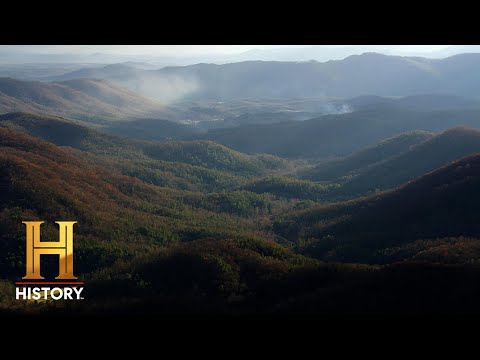
Brown Mountain Lights Confound Astronomers
HISTORY, "The Proof Is Out There" — a segment covering the ongoing investigation of the phenomenon.
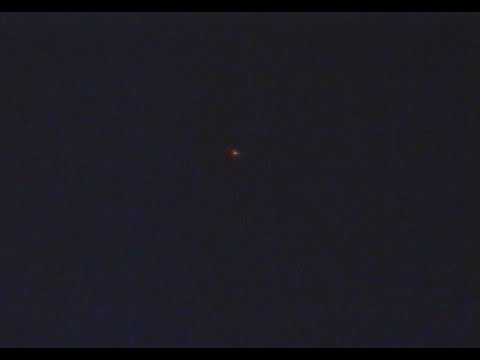
Lights Captured in 1999
WXII 12 News, from TV archives — a regional news segment documenting a period sighting.
Sources
- "Origin of the Brown Mountain Light in North Carolina," USGS Circular 646, 1971 reprint of the 1913/1922 investigations. Read online →
- "Brown Mountain lights," Wikipedia. Read online →
- Nickell, Joe. "The Brown Mountain Lights: Solved! (Again!)," Skeptical Inquirer, April 2016. Read online →
- "The Brown Mountain Lights: Ghost Stories, Headlights, and a Century of Watching the Ridge," Appalachianhistorian.org. Read online →
- "ASU Scientists Think They've Captured Images of WNC's Unexplained Brown Mountain Lights," WLOS. Read online →
- "Professors Research the Mysterious Brown Mountain Lights," The Appalachian. Read online →
- "UNC-TV Science | Searching for The Brown Mountain Lights," PBS North Carolina. Watch online →
- "The Mysterious Brown Mountain Lights," Carolina Country. Read online →
- "Brown Mountain Lights," NCpedia. Read online →
- "For Over 200 Years, Strange Colored Lights Have Danced Above Brown Mountain," My Family Travels. Read online →
- Nickell, Joe. Real-Life X-Files: Investigating the Paranormal. University Press of Kentucky.
- Barefoot, Daniel W. Piedmont Phantoms. John F. Blair, Publisher, 2019.
- Minnaert, Marcel. Light and Color in the Outdoors. Springer, 1993.
- Busch, Elisabeth. The True Ghost Stories Archive: Spooklights.
- Floyd, E. Randall. Ghost Lights and Other Encounters with the Unknown. August House, 1993.
- "File: Brown Mountain, North Carolina viewed from Beacon Heights, October 2016.jpg," Wikimedia Commons (CC0). View file →
See something inaccurate? Have additional information or sources?
Suggest an Edit →Last Updated: August 2026