
Spooklights
True Tales of Anomalous Lights
Core Thesis
The True Ghost Stories Archive: Spooklights: True Tales of Anomalous Lights is Elisabeth Busch's 2020 self-published comparative survey of twenty of North America's most famous "ghost light" or "spooklight" phenomena, drawing on firsthand witness accounts Busch gathered over roughly two decades through ghosts.org, the ghost-information website she founded in 1994. On this site, it serves the same comparative role as Piedmont Phantoms: this site's own Brown Mountain Lights case file cites it as "a comparative survey of American 'ghost light' phenomena, including Brown Mountain alongside Marfa and other recurring light sites."
About the Author
Elisabeth Busch began her involvement with ghost-story collection in the early 1990s, first maintaining the FAQ for a Usenet ghost-stories discussion group before archiving true ghost stories on an FTP server in 1993. In 1994 she launched ghosts.org, which she describes as the internet's first, and now longest continuously operating, website dedicated to ghosts and hauntings — a claim this site's research was unable to independently verify beyond Busch's own account, though her site's continuous operation since the mid-1990s is independently confirmable.
Busch is a prolific self-published author whose primary body of work, The True Ghost Stories Archive series, spans at least fifteen numbered volumes of fifty ghost stories each, drawn from decades of reader-submitted accounts to her website, alongside standalone thematic volumes including this one focused specifically on anomalous ghost lights.
Little independent biographical detail beyond her own author platform and publisher listings was located during research for this article — consistent with the honest, plainly stated limitation this site applies to other self-published or niche authors whose public record consists primarily of their own writing rather than third-party profiles or media coverage. Busch has more recently begun publishing an original serial science-fiction drama, Children of Copernicus, and lives in Las Vegas.
Busch's transition from early-1990s Usenet FAQ maintenance to running one of the internet's longest-continuously-operating specialist websites places her within a distinct generation of online paranormal-community builders, predating the social-media-driven ghost-hunting and paranormal-investigation content that would come to dominate the space from the 2000s onward. Her archive's multi-decade span means the witness accounts underlying this book were gathered across genuinely different eras of internet communication, from early FTP-based text archives through the modern web.
Historical Context & Origins
The book was self-published in 2020, part of a broader wave of independently published paranormal and true-crime-adjacent nonfiction that Amazon's Kindle Direct Publishing platform enabled through the 2010s and 2020s — a publishing model this site has encountered with several other niche titles on its Essential Reading list, distinct from both university-press and mainstream trade publication.
Its underlying source material, however, predates its 2020 publication by decades: Busch's own account describes the book's twenty featured spooklight cases as drawn from firsthand accounts "gathered over two decades" through her ghosts.org archive, meaning the book functions as a curated retrospective distillation of a much longer-running collection effort rather than a project researched from scratch for this specific publication.
The book's publication also follows, by roughly two decades, the peak of Brown Mountain and Marfa's own most concentrated periods of formal scientific attention (the 1922 USGS Brown Mountain survey and subsequent 20th-century Marfa investigations), positioning it as a later popular-audience synthesis of already well-documented individual cases rather than a work of original field investigation into any single site.
The broader will-o'-the-wisp and ghost-light folklore tradition this book draws its twenty case studies from has documented parallels stretching back centuries across multiple cultures, from British and European "will-o'-the-wisp" and "jack-o'-lantern" legends to comparable phenomena described in folklore worldwide — a long historical throughline this specific book narrows to a modern North American focus, but which situates its twenty featured 19th- and 20th-century American cases within a much older, cross-cultural pattern of reported anomalous lights.
Core Arguments & Key Concepts
The book's central organizing claim, as described in its own marketing copy, is that spooklights represent a category of paranormal phenomena distinguished by their relative documentability: unlike ghosts or hauntings generally, spooklights "can be filmed and photographed, and thousands of people have seen them," a framing that treats the phenomenon's physical visibility and reproducibility as its most scientifically interesting feature, regardless of what ultimately explains any individual case.
Busch's stated method combines firsthand witness accounts drawn from her decades-long archive with what her publisher description calls "objectively researched history," positioning the book between pure folklore collection and more rigorous investigative literature — closer in spirit to Daniel Barefoot's Piedmont Phantoms than to Joe Nickell's more explicitly scientific Real-Life X-Files, though covering a narrower, more specifically defined phenomenon category than either.
The book's comparative structure, surveying twenty distinct North American spooklight sites within a single volume, allows readers to weigh well-known cases like Brown Mountain and Marfa directly against less nationally famous regional lights, a useful corrective to the tendency of single-case investigative literature to treat any one famous mystery as uniquely inexplicable rather than as one example within a broader, recurring category of reported phenomena.
That comparative framing carries a genuine analytical benefit distinct from single-case depth: when the same basic phenomenon — a persistent, recurring, unexplained light reported by multiple independent witnesses over long periods at a fixed location — turns up independently at twenty different sites across two countries, the pattern itself becomes a data point worth examining, regardless of what mundane or non-mundane explanation ultimately accounts for any individual case.
As with any self-published compilation drawing on reader-submitted accounts collected over decades through a personal website rather than peer-reviewed or editorially fact-checked channels, the book's individual case reports carry the evidentiary weight of collected testimony rather than independently verified investigation — a limitation this site states plainly rather than allowing the book's comparative usefulness to obscure.
The book's twenty-case scope necessarily means each individual site receives considerably less depth than a dedicated single-case investigation could provide; readers seeking exhaustive treatment of Brown Mountain specifically should weigh this book's brief comparative entry against Joe Nickell's own firsthand 2014 field investigation, documented at greater length in Real-Life X-Files and his subsequent 2016 Skeptical Inquirer article, rather than treating this book's shorter treatment as a substitute for that more rigorous single-case work.
Key Cases & Evidence Discussed
This site's own Brown Mountain Lights (Case File #297, credible status, with recorded reports dating to at least September 13, 1913) receives direct comparative treatment in this book, positioned as one of the twenty featured North American spooklight sites alongside Marfa — the specific pairing this site's own case file cites the book for, in the same broader North Carolina spooklight tradition centered on Brown Mountain that Daniel Barefoot's own comparative folklore work also documents.
This site's own Marfa Lights (Case File #298, reports dating to January 1883) is the book's other most prominent featured case, and the two sites' shared inclusion within a single twenty-case comparative survey underscores how both this site and Busch's book independently arrive at the same pairing as the two best-known, most enduringly documented American ghost-light traditions.
Critical Reception & Controversies
As a self-published title from a niche independent author, the book has not attracted mainstream critical review coverage; the most concrete independent reception indicator located during research for this article is a single five-star Goodreads rating with no accompanying written review, reflecting the book's limited but not entirely absent independent readership.
Busch's broader author platform, built on ghosts.org's multi-decade operation and her substantial self-published True Ghost Stories Archive series, gives this specific title an established audience base drawn from her existing website readership rather than from traditional publishing-industry promotion or review coverage.
This site's own research treats the book's evidentiary status honestly: as a compilation of witness testimony gathered through an independent website over decades, without the kind of institutional fact-checking, peer review, or on-site field investigation that distinguishes titles like Joe Nickell's Real-Life X-Files, this book's value lies primarily in its comparative breadth across twenty cases rather than in rigorous verification of any single one.
This distinction between comparative-survey value and single-case investigative rigor is not unique to this book; it applies broadly across the growing self-published paranormal-nonfiction category this site has encountered with several other niche Essential Reading titles, where an author's genuine, decades-long personal archive of collected testimony coexists with the inherent limitations of material never subjected to independent editorial fact-checking before publication.
No source located during this article's research directly disputes the book's specific factual claims about the individual spooklight sites it covers; the appropriate critical stance, consistent with this site's treatment of other self-published, testimony-based compilations, is to weigh its comparative value against its inherent limitations as unaudited, non-peer-reviewed source material.
Influence & Legacy
This exact title is cited in this site's own Brown Mountain Lights case file's Further Reading section as a comparative survey specifically pairing Brown Mountain with Marfa and other recurring American light sites, occupying a similar comparative-context role there to Daniel Barefoot's Piedmont Phantoms.
As one entry within Busch's much larger self-published bibliography, the book represents a specialized, single-phenomenon spin-off from her broader decades-long True Ghost Stories Archive project, demonstrating how a single long-running personal archive of reader-submitted testimony can be repackaged into multiple distinct, more narrowly focused published volumes.
The book's continued availability across Kindle and paperback formats several years after its 2020 publication indicates a modest but sustained niche readership within the broader community of readers interested in comparative ghost-light and paranormal-phenomena literature, consistent with the readership pattern this site has observed for other independently published regional and thematic anomaly compilations.
Busch's broader ghosts.org archive, having operated continuously since 1994, represents one of the internet's longer-running crowdsourced paranormal-testimony collections, predating by years the more institutionally organized case-reporting databases (like MUFON's own online submission system) that would later formalize similar witness-testimony collection for UFO reports specifically. This book's twenty spooklight cases represent only a narrow, specifically curated slice of that much larger, multi-decade underlying archive.
The Book
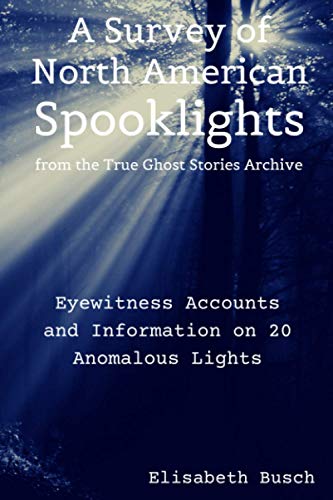
As an Amazon Associate, OverClassified may earn from qualifying purchases made through this link, at no extra cost to you.
Why This Is Essential Reading
Spooklights earns its place on this list as useful comparative context rather than rigorous investigative source material: its twenty-case survey usefully situates this site's own Brown Mountain Lights case file within the broader American ghost-light tradition, while its self-published, testimony-based nature means readers should weigh it alongside, rather than in place of, more rigorously fact-checked sources like Joe Nickell's own firsthand field investigation of the same case.
Related Cases & Theories
Sources Cited
- Busch, Elisabeth. The True Ghost Stories Archive: Spooklights: True Tales of Anomalous Lights. Independently published, 2020 (ISBN-13 9798649688758). amazon.com
- "The True Ghost Stories Archive: Spooklights." Goodreads (publication date, page count, description, reader rating). goodreads.com
- "The True Ghost Stories Archive: Spooklights: True Tales of Anomalous Lights." Amazon (paperback edition, bibliographic listing). amazon.com
- "Elisabeth Busch." Amazon Author Page (author bibliography, ghosts.org background). amazon.com
- "Spooklights." AbeBooks (bibliographic listing, cover art source). abebooks.com
- This site's own case file: Brown Mountain Lights, for the full mystery this book provides comparative context for.
- This site's own case file: Marfa Lights, for the book's other most prominent featured case.
- This site's own essential-reading entry: Piedmont Phantoms, a similarly comparative regional folklore title cited for the same case file.
- This site's own essential-reading entry: Real-Life X-Files, Joe Nickell's more rigorously investigative treatment of Brown Mountain specifically.
- This site's own key-figures entry: Elisabeth Busch, for her full biography and further case connections.
- ghosts.org, Elisabeth Busch's ghost-information website, founded 1994, the underlying archive this book's case material was drawn from. ghosts.org
- "Will-o'-the-wisp." Wikipedia (background on the broader ghost-light/spooklight folklore tradition this book surveys). en.wikipedia.org
Have corrections, additional research, or peer-reviewed sources? Help improve this entry.
Suggest an Edit